Wednesday, January 21, 2026

Venezuela's Rodríguez to visit Washington in first presidential trip since Maduro capture

Venezuela's Rodríguez to visit Washington in first presidential trip since Maduro capture
Rodríguez, who served as Maduro's vice president and oil minister, assumed interim leadership as part of what Secretary of State Marco Rubio has outlined as a three-phase American strategy.
By bnl editorial staff January 21, 2026

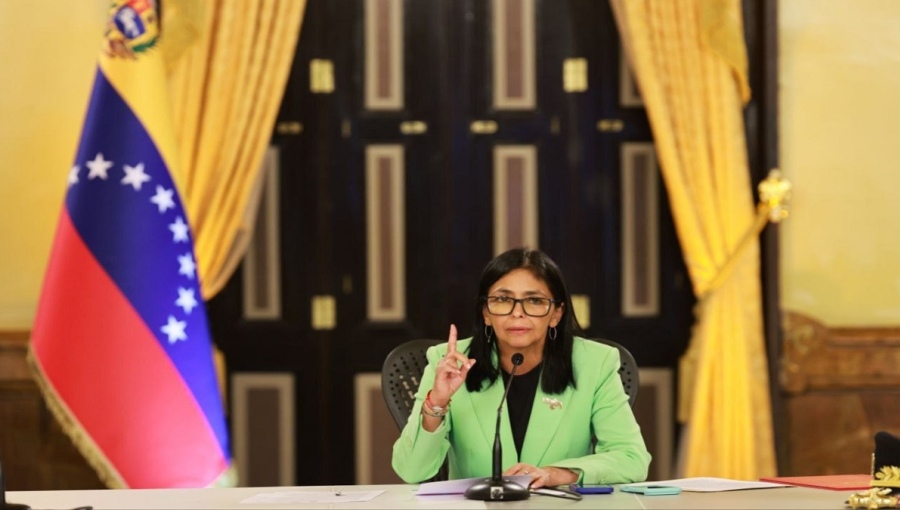
Venezuela's acting president Delcy Rodríguez will travel to Washington in the coming days, a senior US official told multiple news agencies, cementing her status as President Donald Trump's preferred partner for governing post-Maduro Venezuela despite her two decades defending authoritarian rule

The planned visit would mark the highest-level engagement between the two governments since Nicolas Maduro and his wife were captured and transferred to New York to face narcoterrorism charges after the January 3 operation. It would also make Rodríguez the first Venezuelan president to travel to the United States for bilateral talks in more than a quarter century – aside from protocol appearances at United Nations meetings in New York.

The dramatic US military raid that extracted Maduro from a heavily guarded compound in Caracas has fundamentally reshaped Venezuela's political landscape. Rodríguez, who served as Maduro's vice president and oil minister, assumed interim leadership as part of what Secretary of State Marco Rubio has outlined as a three-phase American strategy beginning with "stabilisation" through economic leverage, followed by "recovery" ensuring US companies gain oil sector access, and concluding with political "transition."

Washington has seized multiple Venezuelan oil tankers and recently completed its first sale of confiscated petroleum worth approximately $500mn whilst controlling revenues that would otherwise flow to Caracas. The Trump administration maintains explicit threats of further military intervention if the interim government fails to cooperate, a leverage that has so far produced tangible results including the release of over 400 political prisoners, though opposition groups report lower figures.

The announcement comes just a week after President Donald Trump met Venezuelan opposition leader and Nobel Peace Prize laureate María Corina Machado. Despite praising Machado personally, Trump has so far sidelined her from the country's transition process, arguing she lacks sufficient political backing.

After Machado presented him with the Nobel Prize, Trump seemed to partially backtrack on January 20, saying, "We're talking to her and maybe we can get her involved some way. I'd love to be able to do that; Maria, maybe we can do that.”

Still, he has firmly endorsed Rodríguez's post-Chavista administration, saying it is operating under his government's tutelage and meeting US demands, including granting access to Venezuela's oil sector and shipping millions of barrels of crude to the US for sale.

In a veiled swipe at Machado, which some also saw as an ironic reference to Maduro, Rodriguez told the National Assembly last week “If one day, as acting president, I have to go to Washington, I will do so standing up, walking, not being dragged." “I’ll go standing tall ... never crawling.”

During his speech at the World Economic Forum in Davos on January 21, Trump heaped praise on Rodriguez stating, "Her leadership is good and smart. We are working together to ensure that both countries prosper in this new era of trade."

Yet the arrangement remains precarious. Rodríguez, a pragmatic technocrat, governs alongside Interior Minister Diosdado Cabello, the brutal enforcer who commands intelligence services accused by the United Nations of crimes against humanity, and Defence Minister Vladimir Padrino López, who controls the armed forces. Armed pro-regime motorcycle gangs known as colectivos have established roadblocks in Caracas, prompting the State Department to issue urgent warnings ordering US citizens to flee immediately. The violence suggests that removing Maduro did not eliminate the coercive apparatus sustaining authoritarian control.

On the same day as Trump's meeting with Machado, Rodríguez held talks in Caracas with CIA Director John Ratcliffe on security matters and potential economic cooperation. Ratcliffe became the most senior US official, and the first cabinet member under Trump, to visit Venezuela since the military operation that ousted Maduro.

The Real Reason Washington Wants Venezuela’s Oil

  • Venezuelan heavy crude could replace up to 5% of WTI intake at U.S. Gulf Coast refineries, boosting diesel yields and utilization of heavy conversion units.

  • China faces higher feedstock costs and financial risk as discounted Venezuelan barrels are redirected toward the U.S., Europe, and India.

  • Over the medium term, rising Venezuelan production and easing sanctions could revive domestic refining and reshape global heavy crude flows.

The timeline of the US–Venezuela conflict highlights a long-term strategy centered on securing heavy crude supplies for US Gulf Coast refineries, which are configured to process heavy sour barrels and benefit from Venezuela’s ability to deliver crude over short lead times. This will reduce reliance on Middle Eastern high-sulfur fuel oil (HSFO) for the US. Exports of Venezuela crude are expected to recover slowly toward the US, Europe and India, leaving China disadvantaged, while OPEC+ remains defensive.

US Gulf Coast refineries process nearly 1.45 million bpd of imported crude out of an average 9 million bpd in total refinery runs. With between 400,000 and 500,000 bpd of Venezuelan crude (primarily Merey) expected to be added, nearly 5% of West Texas Intermediate (WTI) crude intake could be replaced by Venezuelan Merey. We used linear programing (LP) modeling (AVEVA) for some Gulf Coast refineries (having coker, catalytic cracker and hydrocracker) to estimate changes in product yields and utilization rates of heavier oil-processing units. The results indicate an average 2% increase in diesel yield, primarily higher utilization of bottom of barrel units, driven by increased utilization of heavy conversion units by almost 2% to 3%.
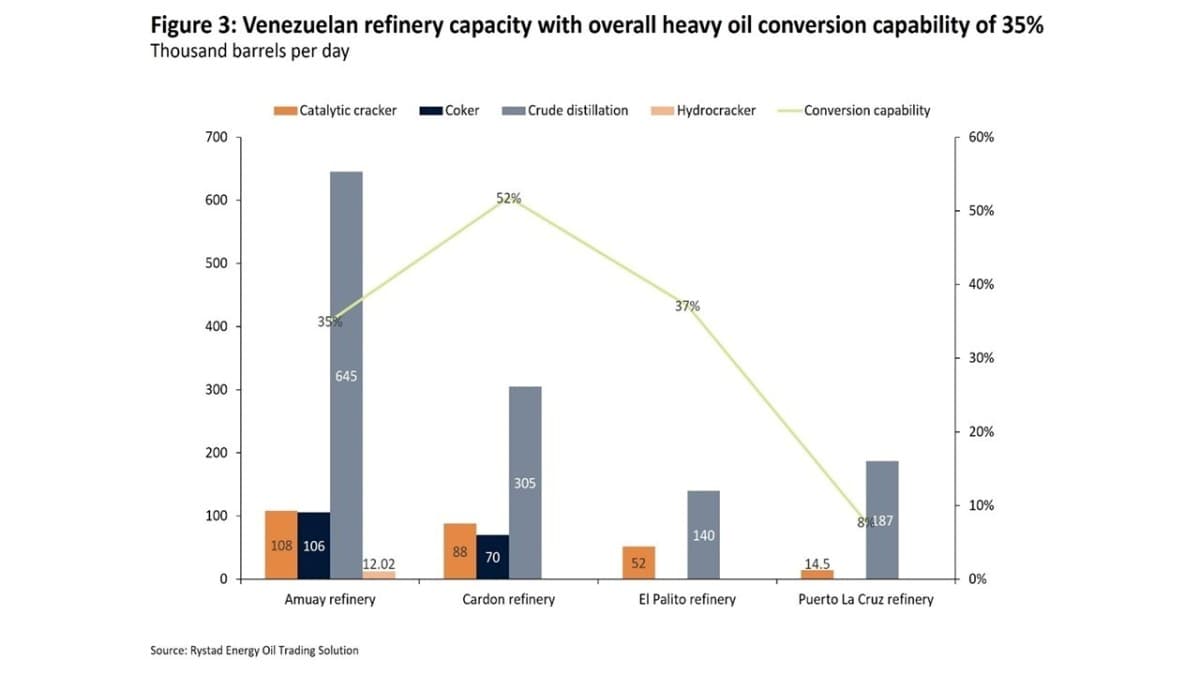
Fig


Over the longer term, as Venezuelan crude production just exceeded 900,000 bpd in 2025, with anticipated US capital inflow and a subsequent demand increase, Rystad Energy expects the Venezuelan refining sector – which has 1.2 million bpd of capacity – to start increasing runs within 18 to 24 months. Current run rates are hampered by frequent power disruptions, unplanned outages and improper maintenance of the refineries. We assess that the typical turn-down rate of 60% should be feasible by the middle of next year.

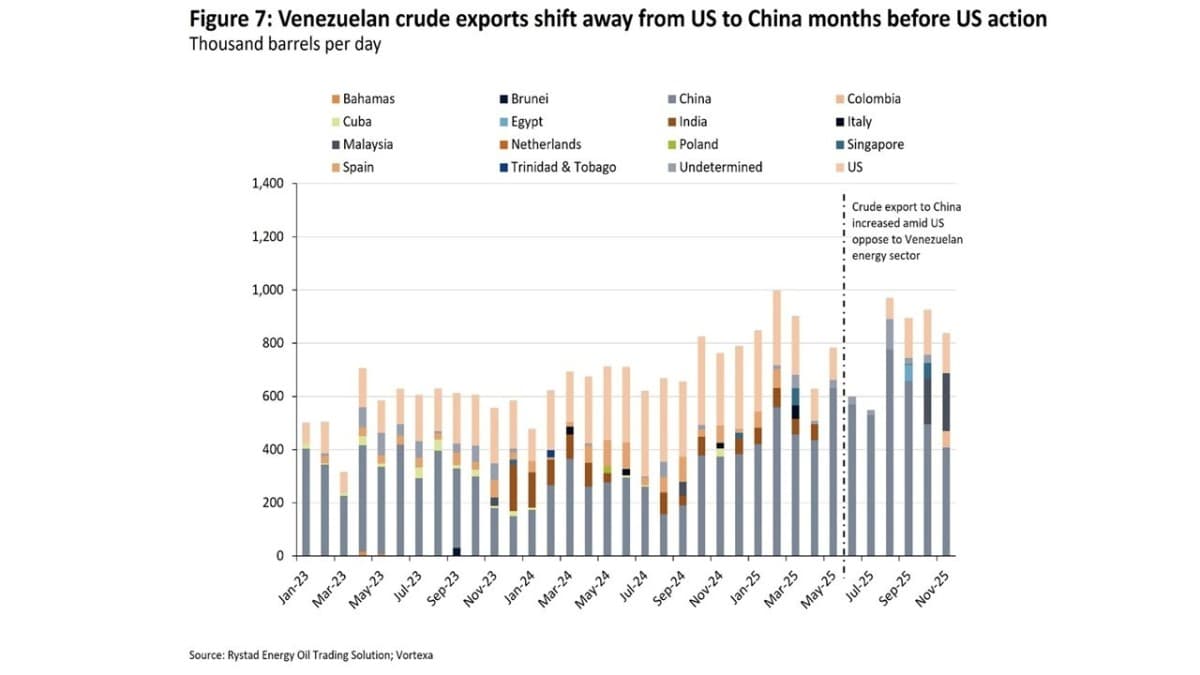
China remains the primary loser in this evolving structure. The loss of heavily discounted Venezuelan crude undermines the economics of independent so-called ‘teapot’ refiners and places approximately $12 billion in oil-backed loans at risk. Although some Middle Eastern HSFO and heavy barrels may now be redirected toward Asia, Chinese refiners still face higher feedstock costs, longer shipping distances and elevated geopolitical risk compared with the Venezuelan barrels they previously imported. India, by contrast, stands out as a structural winner, with complex refineries well suited to heavy sour grades and a renewed opportunity to absorb Venezuelan crude as sanctions ease.

Venezuelan crude accounts for approximately 500,000 bpd of the 15 million bpd in China refinery runs since around 2019, which marked the start of increased US opposition to the Venezuelan energy sector. Chinese refineries processing heavy crudes are typically integrated facilities equipped with heavy bottom-of-the-barrel upgrading units. As a result, the loss of heavy Venezuelan barrels is unlikely to have any noticeable impact on China’s overall product yields, given total refinery runs of around 15 million bpd. While individual refiners processing this crude will need to adjust their crude slate, these changes are not expected to affect aggregate Chinese yields materially.
Fig

Disclaimer: The opinions expressed in this article are solely those of the author, and do not necessarily represent the views or beliefs of Rystad Energy. 

By Pankaj Srivastava for Rystad Energy


Inside the Economics of Venezuela’s Elusive Oil Reserves

  • Venezuela’s reported oil reserves are largely unaudited government claims that ignore economic viability.

  • Most of the country’s oil is extra-heavy crude that requires costly upgrading, diluents, and sustained high prices to produce profitably.

  • Political instability and long-term investment risks make a major near-term increase in Venezuelan oil production improbable.

In the wake of the Trump administration's prosecution of a war and blockade against Venezuela and the administration's promise to vastly increase oil production in the country, it's worth knowing why claims about Venezuela's oil "reserves" being the largest in the world are problematic. It's also important to understand what this implies for the future of oil production in Venezuela.

Consider the following:

1. Official oil reserves are just that. They are numbers reported by official government sources. Where these numbers come from large state-owned oil companies—as is the case with Venezuela—they are rarely verified through independent audits. And, those numbers tell you nothing about the economic viability of the claimed reserves.

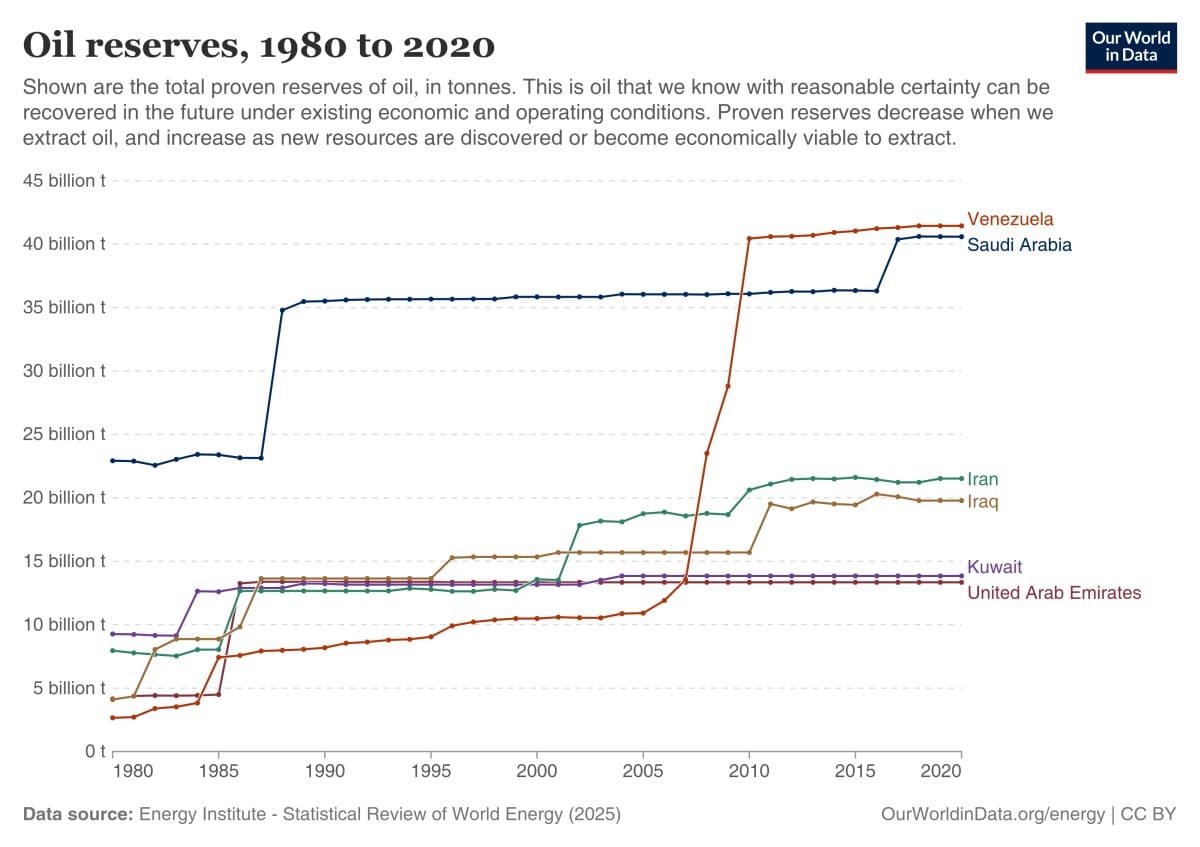
2. There is a pattern among several OPEC countries, including Venezuela, of suddenly claiming vast increases in oil reserves without evidence of additional economically viable discoveries. Just to be clear, reserves are known deposits of minerals demonstrated to be extractable using current technology and profitable at current prices. The term "reserves" does not appear to apply to most of Venezuela's extra-heavy crude at current prices, which is believed to be 90 percent of its supposed reserves. This is true especially if upgrading facilities have to be built from scratch—Venezuela has only one extra-heavy crude facility that began production in 1947. Such an expensive long-term investment requires a belief that prices will reach and maintain much higher levels than today and that political and social conditions will remain calm and favorable over long periods. (For a comparison of Venezuelan crude oil with others in the world, see this infographic.)

In several Middle Eastern countries, the sudden reserve increases mentioned above happened in the mid-1980s. In Venezuela, it happened over a three-year period from 2007 to 2010. The following chart is based on the Statistical Review of World Energy (formerly sponsored by oil giant BP and now published by an independent organization):Oil
3. The vast majority of Venezuela's so-called reserves are in the form of extra-heavy crude in an area called the Orinoco Belt, which lies in eastern Venezuela along the Orinoco River. The U.S. Energy Information Administration reported that Venezuela's state oil company claimed that there are 270 billion barrels of extra-heavy crude oil reserves in this area in 1998. Venezuela today reports 303 billion barrels of reserves of all types, including heavy crude, which it currently processes and sells. But nobody knows the real numbers because there is no outside independent audit.

4. Extra heavy crude oil is a very viscous liquid—about the consistency of "cold peanut butter"—that is suitable for use in asphalt, but little else. To be useful as oil, it must be upgraded using complex and costly processing that requires vast amounts of natural gas and also diluents such as naphtha, which are mixed with the oil to make it feasible to transport through a pipeline. Just to get the heavy oil out of the ground requires steam or water injection. And during refining, the high sulfur content—sulfur is an air pollutant that has to be removed—makes it more expensive to refine. In other words, it takes a lot of energy to extract and process extra-heavy crude oil to make it into something we call oil. And, all of that is quite expensive.

5. Which brings us to the price of oil and the economics of producing Venezuela's extra-heavy crude. The world benchmark for crude is Brent Crude, currently trading at around $64 per barrel. But because Venezuela's extra-heavy crude is so difficult to refine, it sells for a substantial discount to the world benchmark price, somewhere between $12 and $20. The cost of diluents adds another $15 to the costs of getting this extra-heavy crude through a pipeline.

So the seller is already taking a financial haircut of between $27 to $35 compared to the world benchmark crude. For massive investment to take place in Venezuela, world oil prices would probably have to be and remain around $100 per barrel for years in order to convince oil companies to risk making the kind of investments that only provide a return over 20 to 30 years—the kind that extraction and upgrading of extra heavy oil requires.

6. All this suggests that oil production in Venezuela is probably not going to rise much in the coming years. And, the idea that increased Venezuelan oil production could bring down current oil prices is nothing short of ridiculous since producing the vast majority of the country's oil resources will require much higher prices.

Of course, I haven't even factored in the political and social instability that is plaguing Venezuela in the wake of the U.S. attacks and blockade. Nor have I considered the fact that, despite the removal of Venezuelan President Nicolas Maduro, his vice president (now elevated to acting president) and administration are still in charge. These are the same people who expropriated U.S. oil company assets in the country previously and who levy high taxes on the remaining oil operations. Given this backdrop, it's hard to imagine much investment going into the Venezuelan oil industry from foreign countries anytime soon.

The smash-and-grab diplomacy in which the United States is now engaged in Venezuela may seem like it will somehow liberate Venezuela's supposed oil riches. But all it is likely to do is demonstrate that those riches are as elusive as ever.

By Kurt Cobb via Resource Insights


Maduro Redux


The Profanity of Life

Trump’s behavior has triggered a recall of Mario Vargas Llosa’s novel, based partly on his life, Aunt Julia and the Scriptwriter. In the novel, the protagonist’s employer hires an eccentric Bolivian scriptwriter to write soap opera serials. The novel chronicles the scriptwriter’s success and increasing popularity. The soap operas become more bizarre and reflect the scriptwriter’s descent into madness.

From start of his second ascendancy to king of the kingdom, Trump has exhibited a growing intensity of aggrandizement, internalized success that begs greater accomplishment, and escalations in daring episodes, violations of constitutional norms, and profanity of life. Each day, his disregarding the sanctity of life, permitting arbitrary killing, and indicating he will pardon anyone who commits a crime that has his approval, reflects his scriptwriting descent into madness.

Armed groups — National Guards, Homeland Security and its Immigration and Customs Enforcement (ICE), Federal Bureau of Investigation (FBI), and Secret Service — no longer defend the populace, operate in the benefit of the U.S. president, patrol our streets, commit aggressions, defy laws, and operate without constitutional control. There is no defense to the transgressions, except to take up arms against the armed, and no peace loving and country-loving citizen is prepared to do that. The trend is to increased trampling of national and international law, followed by national and international resistance, followed by national and international strife, and escalation of alarming national and international aggressions by a maddening president who holds the code to releasing nuclear-armed missiles.

Complementing a president descending into madness is a large portion of the population exhibiting symptoms of derangement. The lack of concern for the genocide of the Palestinian people, the inertia in protesting the unnecessary killings of unproven drug smugglers, and the slaughter of up to 100 Venezuelans and Cubans to apprehend a country’s leader and satisfy a U.S. court indictment in a case that will not be resolved for years, highlights the deranged thought. Reactions to the recent shooting of Renée Good by an ICE agent emphasize the derangement.

No normal person can consider the shooting of Renee Good as anything but homicide. From the start of the video of the crime scene to its ultimate tragic conclusion, the behavior of the ICE officers was provocation and use of force. Ms. Good was not entirely blocking traffic, drove the car away as the ICE agents wanted, did not steer the car to the agent who deliberately appeared in front of the car, did not hit the agent, and received bullets through the front and side windshields from ICE officer Jonathan Ross, who was never in danger.

The utterances from administration officials — President Trump initially claiming Ross was run over and was in the hospital; Homeland Security Secretary Kristi Noem saying, that the shooting occurred “because Ms. Good was allegedly using her Honda Pilot as ‘a deadly weapon;’” and Vice President JD Vance haranguing in a briefing that, “The reason this woman is dead is because she tried to ram somebody with her car, and that guy acted in self-defense. That is why she lost her life, and that is a tragedy,” are deliberate falsehoods that do not coincide with the facts.

Reading comments to the reports on the incident in Yahoo news, where a large assortment of the comments agree with the administration, is disturbing. Discussion of the shooting on PBS News Hour by political commentator, David Brooks, increased the disturbance. Brooks recited that, in his X account, followers responded to the shooting in accord with their agendas, splitting exactly as their feelings toward the present administration. He declined to voice his own opinion, willing to leave it to history.

Learning that the electorate is guided by agenda and not by reality and facts is disheartening. How can equality, justice, and freedom be achieved in that environment. Not a day of peace for Americans

Here is an interesting deliberation. Compare the murder of Ms. Good to the response by the Chinese military to the famous “Tank man,” who stopped Chinese tanks on the day after the Tiananmen incident and received no known rebuke, physical or otherwise. We also know that if Officer Ross is indicted and convicted, Trump will grant him a pardon, which is chilling. Dispose of anyone who gains the Trump wrath and don’t be concerned; similar to pardons granted other convicted criminals who were on good terms with Trump, you will not serve a day.

Each day brings another conflict between the U.S. populace and U.S. authorities. Trump has already said “he might use the Insurrection Act to deploy troops to Minneapolis.” With 33 Senate seats and all 435 congressional seats up for re-election, his popularity decreasing, and a possibility that a more heavily constituted Democratic congress might be successful in an impeachment vote and in a conviction, an out-of-control Trump might consider the anarchy he is creating as an excuse to control the mid-term congressional elections.

Will Minneapolis, Minnesota be the 21st century Fort Sumter?


Dan Lieberman publishes commentaries on foreign policy, economics, and politics at substack.com.  He is author of the non-fiction books A Third Party Can Succeed in AmericaNot until They Were GoneThink Tanks of DCThe Artistry of a Dog, and a novel: The Victory (under a pen name, David L. McWellan). Read other articles by Dan.

U.S. Seizes Seventh Crude Oil Tanker Linked to Venezuelan Trade
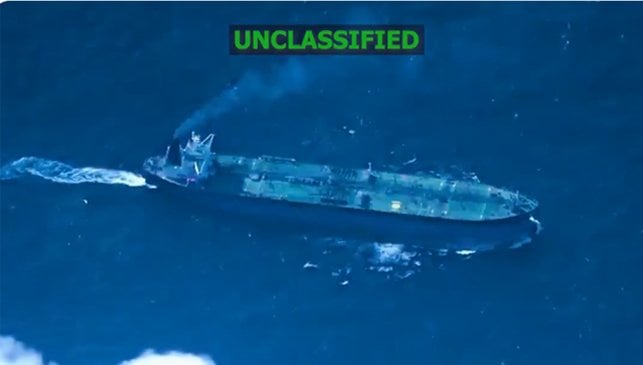
oil tanker seized
The U.S. seized the seventh crude oil tanker linked to the Venezuelan oil trade (Southern Command)

Published Jan 20, 2026 5:43 PM by The Maritime Executive


Southern Command announced this afternoon, January 20, that U.S. military forces have seized a seventh crude oil tanker. Few details were provided with the statement, only saying the apprehension took place without incident.

In announcing the seizure, the U.S. again declared that “the only oil leaving Venezuela will be oil that is coordinated properly and lawfully.” Southern Command asserted that the tanker was “operating in defiance of President Trump’s established quarantine of sanctioned vessels in the Caribbean.”

The ship, which had been sanctioned by the United States at the beginning of 2025, as well as sanctions by the European Union and the UK, is different in its modus operandi. Built in 2005, the tanker is 106,433 dwt and has been operating since 2022 under the name Sagitta. Unlike most of the shadow fleet, it has not bothered to change its name, but is reported to have used “zombie” identities.

The analytics service TankerTrackers.com reports the ship had operated for three years exporting Russian oil, but appeared to stop after the January 2025 sanctions. It, however, reports the tanker was tracked exporting fuel oil out of Venezuela in August 2025, using a zombie alias.

The Equasis database lists the vessel’s owners and managers as being in China. The ship was previously flagged in Panama and Liberia, but since 2024 has been operating without a flag registry. Lloyd’s Register lists its class certification as withdrawn in December 2024. The last port state inspection appears to have been in 2023.


The seizure comes as other reports have said some of the previously seized tankers were spotted off Puerto Rico, while the Bella 1 (Marinera) was last seen arriving in Scotland last week to re-provision. Russia’s Foreign Minister today asserted that the United States has not followed through on its commitment to release the two Russian crewmembers aboard the tanker.

Russia’s Minister of Foreign Affairs, Sergey Lavrov, told reporters in Moscow that “We were assured that a decision had been made at the highest level to secure their release.” He called on the U.S. to release the crew of the Bella 1 (Minerva) after Russia declared that the U.S. statement that the crew of the tanker might face prosecution is “categorically unacceptable.”

Trump has vowed the U.S. will seize shadow fleet tankers operating in the Caribbean and sell the oil. Like the Bella 1, it appears today’s seizure is of a vessel traveling only with ballast.

COMPRADOR

Belarusian opposition leader Kolesnikova adds to calls for Europe to engage with Putin, Lukashenko

Belarusian opposition leader Kolesnikova adds to calls for Europe to engage with Putin, Lukashenko
Belarusian opposition leader Maria Kolesnikova added her voice to the growing number ofcalls for Europe to engage in direct talks with Lukashenko and Putin. / bne IntelliNews
By Ben Aris in Berlin January 21, 2026

Belarusian opposition leader Maria Kolesnikova said that it's time for Europe to engage in talks with pariahed Belarus President Alexander Lukashenko, in a remarkable contrast with her colleagues who have spent more than five years asking for the sanctions screws on Minks to be tightened.

Recently released from jail where she was serving an 11-year sentence on politically motivated charges, Kolesnikova argues that “Lukashenko is a pragmatic person. He understands the language of business. If he is ready for humanitarian steps in response to a relaxation of sanctions, including the release of prisoners and allowing independent media and NGOs into Belarus, this needs to be discussed.”

While her opposition leader colleagues largely fled the country after the mass demonstrations sparked by the massively falsified presidential election in August 2020 began to fade, Kolesnikova stayed on until she was snatched from the street by security forces and thrown in jail.

As bne IntelliNews reported, there has been arguments amongst the Belarusian government in exile, headed by Belarusian opposition leader Svetlana Tikhanovskaya (Sviatlana Tsikhanouskaya) who ran in the 2020 elections against Lukashenko and is believed to have won by a landslide.

Tikhanovskaya leads a faction within the opposition that believe they should lobby Europe to tighten sanctions and release all of the some 1,300 remaining political prisoners still in jail at once.

However, after a string of political prisoner releases brokered by the White House, there are others that believe a step by step approach would be more effective – an argument boosted by the release of high profile prisoners in a series of deals in the last year, including the release of Kolesnikov herself and Tikhanovskaya’s husband, Sergei last June.

The US success has clearly had an impact on the debate. “But as someone with a European mindset, I do not understand why Europe did not start talking to Lukashenko before the US,” Kolesnikova said. “It is obvious that Germany, for example, has far more ties with Belarus than the States.”

Her argument runs counter to Europe’s approach of keeping links with Belarusian democratic forces in exile, minimising contacts with the regime, and maintaining economic sanctions on exports, a ban on flights and tighter visa rules.

Promoting this kind of dialogue — particularly aimed at securing the release of other political prisoners and preventing further repressions — is now her focus. “I think it’s clear that I’m not leaving politics.”

“One day the regime will change,” Kolesnikova told the FT. “And by that point, there must not be scorched earth there. We must prepare the ground.”

Europe’s hardline is softening

For all his myriad faults, Trump’s two biggest successes has been to hold the first direct talks with Putin since the failed 2022 Istanbul peace deal talks and make real progress towards bringing the war in Ukraine to an end. The second is he has brokered the release of some 200 political prisoners from Belarusian jails as relations with the US begin to thaw.

Europe’s hardline policy of sending authoritarian leaders to Coventry is starting to melt as the war in Ukraine goes nowhere, Europe finds itself in increasingly difficult financial straits and US President Donald Trump puts the cat amongst the pigeons with his efforts to dismantle the international rules-based order.

The pressure on Kyiv to capitulate is mounting fast and Europe is increasingly powerless to prevent that from happening. Since the start of January Russia has launched a missile and drone barrage against Ukraine’s biggest cities that has plunged them into a hell of freezing cold and darkness. As of the time of writing, residents of Kyiv are starting to flee the increasingly uninhabitable capital where temperatures inside some of the blacked out apartment blocks have fallen to below -5°C according to local reports.

Around one in six residents heeded Mayor Vitali Klitschko's call for temporary evacuation: 600,000 of the 3.6mn inhabitants have left the city since January 9, Klitschko told the AFP news agency. "Not everyone has the opportunity to leave the city, but the population is currently shrinking," Klitschko said.

And since the Trump administration cut off all funding to Ukraine and won’t sell it weapons unless Europe pays for them, the already economically distressed leading European governments are wondering how they can foot a €100bn a year bill that continuing the war in Ukraine will cost. In December the EU raised a €90bn loan to keep the government in Kyiv afloat, two thirds of which will be spent on weapons, but even that was around €50bn short of what the war is expected to cost over the next two years. Moreover, Europe’s defence industry will struggle to produce the number and quality of weapons Ukraine is so desperate for – more air defence ammo topping the list.

Zelenskiy appeared to be facing harsh realities when he said earlier this month that the war may be over by this summer – an unusual statement as the Ukraine’s president is usually reluctant to ascribe timelines to comments like this.

French President Emmanuel Macron was the first to say it outloud, calling for Europe to open direct talks with the Kremlin. He was followed soon after by Italy’s Prime Minister Giorgia Meloni who agreed that the time had come for direct negotiations. German Chancellor Friedrich Merz did an abrupt about face a week later, calling Russia a "European" country and saying Berlin was also open to direct negotiations.

Maybe most surprising of all was former Nato Secretary General Jens Stoltenberg, who added his voice to the growing cacophony on January 17, saying Western countries should "talk to Russia as a neighbour."

"We need to discuss ending the fighting in Ukraine with Russia just as we, the United States, and other countries are doing... We need to talk to Russia as a neighbor," he said in an interview with Der Spiegel magazine.

Unity within the EU in its support of Ukraine and opposition to Russia is crumbling. Ukraine fatigue has built up steadily as it becomes increasingly obvious that Ukraine will not be able to win a military victory against Russia.

Add to that there is a certain ennui amongst EU leaders to the fact that as the US-sponsored peace talks got underway in earnest in December with the peace plan thrashed out between US envoys and Putin in a Moscow meeting on December 3 where the EU suggestions were entirely ignored. Part of the motivation for calling for direct talks is to reinject European interests into the dialogue, although the Kremlin is unlikely to welcome engaging in the negotiations. Russian President Vladimir Putin has said in the last month that he sees Europe as the biggest obstacle to doing a peace deal.


COMMENT: 1984 is now – living under the spectre of Orwell’s most famous political novel

COMMENT: 1984 is now – living under the spectre of Orwell’s most famous political novel
/ bno IntelliNews
By Mark Buckton - Taipei January 21, 2026

In his dystopian novel 1984, George Orwell depicted a world where truth was malleable, information was weaponised and citizens lived under the shadow of relentless ideological struggle. In the contemporary geopolitical landscape, echoes of Orwellian concerns - fragmentation, mistrust and narrative control - are increasingly visible. Recent tensions between the United States and its European partners, shifts in global alliances, and fractures in economic and strategic consensus reflect long-standing pressures on the post-World War II international order. While these developments do not constitute a literal fulfilment of Orwell’s fiction, they do reveal patterns that resonate with his warnings about centralised power and factional division.

Orwell’s world and the new geopolitics

Orwell’s novel was less a prediction of precise future events than a warning about the dangers of unchecked power and ideological conformity. The hallmarks of his imagined society, including surveillance, opaque governance and the breakdown of common ground, now find metaphorical parallels in the geopolitical sphere. Modern states, including once great champions of democracy, compete fiercely over narrative control and economic leverage. At the same time, global consensus on shared rules has weakened, giving rise to a far more fragmented world order.

A central pillar of post-war stability has been the transatlantic alliance between the United States and Europe. For decades, this partnership anchored global security, economic integration and regional diplomatic cooperation. Recently, however, strands of disagreement have emerged over trade, defence and the prioritisation of one nation’s interests above all others.

This has strained the US-Europe relationship to a degree not seen in many years.

Trade and tariffs

One of the clearest flashpoints in recent transatlantic relations has been the intensification of trade disputes and tariffs. US leadership under President Donald Trump has threatened or implemented tariffs against several European countries following disagreements over his stated desire to take control of Greenland, as well as broader trade policy.

These policies, typically framed by US leaders as necessary for national security and competitiveness, have generated unprecedented European backlash. A number of nations have moved troops to Greenland in support of Denmark’s claim over the North Atlantic landmass, while critics and political leaders within Europe have described these moves as coercive and damaging to the long-standing “rules-based” trading system. As a joint statement from Denmark, Norway, Sweden, France, Germany, the United Kingdom, the Netherlands and Finland warned, such measures risk pushing the alliance into a “dangerous downward spiral”.

From an Orwellian perspective, this situation recalls the manipulation of “truth” through economic levers: tariffs become diplomatic weapons, and trade agreements are reframed not as mutual bargains but as instruments of domination.

Another dimension of this geopolitical shift is the redefinition of strategic narratives. Recent US strategic documents reportedly characterise Europe not merely as an ally but as a partner whose long-term reliability and cultural identity are subject to debate. According to analysis of the latest US National Security Strategy, parts of Europe have been described in terms that extend beyond policy disagreement to touch on questions of cultural and civilisational vitality.

Such rhetoric, which frames allies in ways that may fuel internal doubt or external critique, mirrors Orwell’s notion of “doublethink”, where language is used both to persuade and to destabilise. When diplomacy is inflected with civilisational judgement, the shared foundations of cooperation risk erosion. In turn, this leaves room for strategic fragmentation rather than integration.

Global economic splits

These tensions between the United States and Europe are unfolding against a broader backdrop of global economic fragmentation. Institutions and frameworks that have governed international finance and trade for decades are under pressure from rising geopolitical strains, driven in large part by the actions of a single political figure.

This fragmentation manifests itself most clearly in the emergence of new economic blocs, including those that prioritise strategic self-interest over open cooperation. Prominent examples include BRICS+, China’s Belt and Road Initiative and the Shanghai Cooperation Organisation.

Lesser-known groupings on the global stage include the Regional Comprehensive Economic Partnership and the Comprehensive and Progressive Agreement for Trans-Pacific Partnership, a post-US TPP bloc. All are Asia-centric.

As states seek to safeguard their own economic security, long-established norms of trade and investment are being reconfigured, in some cases giving rise to competing spheres of influence rather than integrated markets. These trends resonate with Orwell’s portrayal of a world in which ideological blocs exist in perpetual tension, each constructing its own narrative of legitimacy.

Europe’s response to these external pressures is also shaped by internal political dynamics, though to a far lesser extent than those seen in Asia. Fragmented governments, resurgent nationalist sentiment and differing visions of strategic autonomy have complicated the European Union’s ability to present a unified front against global fragmentation efforts led by President Donald Trump.

These internal differences weaken collective action and amplify external pressures. Europe is increasingly at risk of becoming an also-ran on the global stage.

In 1984, the manipulation of internal divisions was a key tool for maintaining control. In today’s geopolitical environment, a comparable dynamic is emerging - sometimes facilitated by European leaders acting in alignment with US priorities, perhaps without a full appreciation of the long-term consequences.

Yet unlike Orwell’s fictional world, where division was orchestrated by a single authority, modern geopolitical fractures arise from economic disparity, political flux and competing national priorities. When such divisions emerge, they can be exploited by external actors, undermining confidence in cooperative institutions and accelerating fragmentation.

As a result, some observers now characterise current dynamics as a new kind of Cold War - not between two superpowers alone, but among multiple, evolving blocs with shifting allegiances. In this environment, alliances are less stable and increasingly transactional, with traditional partners finding themselves in tension over overlapping interests.

What Orwell warned against was not specific political alignments, but the erosion of shared objective reality and the ascendancy of competing narratives. In that sense, contemporary geopolitics underscores his caution. As nations prioritise strategic self-interest and redefine allies as competitors, the shared structures that once underpinned international cooperation risk becoming casualties of the very forces they were designed to restrain.

To suggest that 1984 has come true would be an oversimplification. Today’s geopolitical landscape is one of shifting alliances and economic contestation, reflecting elements of Orwell’s enduring themes rather than his precise vision. Nonetheless, recent tensions between the United States and Europe, disputes over tariffs, evolving strategic narratives and the fragmentation of global economic structures serve as a reminder that the challenges of shared truth and collective action remain as relevant in the 21st century as they were in Orwell’s imagination.

Trump actively dismantling the international rules-base order

Trump actively dismantling the international rules-base order
US president Trump is systematically dismantling the international order and may provoke a major trade war with Europe that will hurt everyone. / bne IntelliNews
By Ben Aris in Berlin January 21, 2026

Trump is actively dismantling the international rules-based order, dismantling or sidelining the multinational institutions that have been built up since the end of WWII, and put himself personally in charge of running the world.

This process has been unfolding for a year already. It started in Ukraine when he conflated the principled support for Ukraine’s stand against Russian aggression with business deals.

As part of his 28-point peace plan (28PPP) was a proposal to seize the Central Bank of Russia (CBR)’s frozen $300bn in reserves and create a $100bn Ukraine restoration funds and another $200bn US-Russia investment fund for commercial joint venture projects – a major sop for Russian President Vladimir Putin and a de facto rehabilitation of Russia into the international community. In addition, Trump tied any support for Ukraine to the minerals deal that was signed on April 30 and gave significant concessions to US companies, but offered no critical security guarantees in return whatsoever.

That episode could still be sold as a “pragmatic” solution to winning over US support for Ukraine’s fight to regain control over its sovereign territory, but with the decapitation of Venezuelan President Nicolás Maduro’s regime on January 3 all pretence at following the rules was dropped.

America’s early morning bombing and helicopter assault on Caracas. The kidnapping of a sitting president. The cold-blooded execution of 100 Venezuelan presidential guards and their Cuban colleagues. And Trump’s open admission that the entire operation was all about grabbing control of Venezuela’s oil. This was all totally illegal under international law and flies in the face of the UN Charter that is supposed to be the bedrock of the international order.

To add insult to injury, Trump’s decision to hand over the concession to dispose of 50mn barrels of oil seized as part of the raid to his mega-donor Vitol, the world’s largest independent oil trader, to dispose of was a corrupt insider deal worthy of the Kremlin and Putin’s sweetheart deals for his inner circle of stoligarchs.

Trump is becoming bolder and bolder as he asserts his transactional approach to geopolitics. The emerging new economic paradigm is a return to nineteenth century imperialism where might-makes-right is the new rule book. This was codified in the recently released National Security Strategy (NSS) where the trans-Atlantic shared values “special relationship” that has driven US-EU relations since the end of WWII is over. Europe has been downgraded to simply being a US market and the White House has openly said it will interfere with European domestic politics, favouring the parties of the far-right. The upgraded Monroe Doctrine that is spelled out in the NSS is a reassertion of “America First, and everyone else last”.

The latest escalation is even more extreme. All coming one on top of the other, Trump is now proposing to send in 100,000 troops to Greenland, which has a population of 57,000 people, to take control of the country for the sake of US “national security” needs. It will be the easiest invasion ever, as US soldiers will outnumber the unarmed Greenlanders five-to-one and can simply walk into the parliament building without firing a shot.

Trump has justified this plan by claiming that Russia and China “may” annex the island, which is complete nonsense. China’s foreign ministry issued a statement this week, calling on Trump to drop the “fake China-threat” argument, used to justify his own “selfish” ambitions.

Russia has never expressed any interest in Greenland either, but has bitterly objected to Trump’s proposed annexation of Greenland. The idea of US troops establishing bases on the island, which lies on Russia’s northern border creates a security issue for the Kremlin where there was none before – very similar to the Kremlin’s objection of Nato moving into Ukraine on Russia’s western borders, just across from European Russia where 80% of the population lives.

Just the possibility of the US moving missiles into a new “51st state” that could strike Russian missile and military bases deep inside the country, that were previously out of range of European-based Nato munitions, would create a new security crisis where none existed before. Russia would inevitably respond. It invaded Ukraine simply because the US refused to contemplate any exclusion from Nato for Ukraine despite the fact the White House and Brussels have adamantly repeated there was never any plans to allow Ukraine into Nato. Turning Greenland into a US militarised proxy, even if no more bases are built and no troops are stationed there, is a giant step on from any possible Nato-proxy threat Ukraine poses to Russia.

The implications of a US annexation of Greenland are too grim to contemplate. One Nato country attacking and annexing another Nato country spells the end of Nato. It flies in the face of the UN charter. It makes the US the enemy of Europe, more aggressive and threatening than Russia or China. Putin has invaded Ukraine which is neither a member of the EU nor Nato. Trump would have invaded Greenland, which is a member of both.

A US annexation of Greenland means there are no rules at all anymore. But that was already clear after Trump ordered the kidnap of Maduro purely so he could seize Venezuela’s oil.

Peace Council

Trump’s efforts to dismantle the international order are no longer haphazard or piecemeal. As the process goes on, it is becoming systematic and it is escalating.

2025 was characterised by a series of ad hoc measures, but as his confidence grows he is now attempting to institutionalise the process. The latest initiative is to set up a “Board of Peace” that is an attempt to sideline the UN and silence the voices of all the other countries in the world in the process.

This could trigger a new and extreme crisis. Europe, in particular, has been put in a desperate position where it now has to choose to either stand up to Trump and stick to its principles or trigger a debilitating trade war.

Europe’s collective economy is already flat on its back due to the boomerang effect of the Russian sanctions. France is facing a major budget deficit crisis it has lost control of. Germany’s economic model has been wrecked by the end of cheap Russian gas and has been in recession for three years now. And the UK is being strangled by its mounting and increasingly unsustainable debt burden.

The game is in play in Davos where European leaders are due to meet Trump in the next few days and have an almost impossible choice to make.

Trump is proposing to set up a conflict resolution body, the Board of Peace, with himself as chairman and retaining veto powers over any decision the council reaches.

We don’t need a Peace Council. We already have one. It’s called the UN. And everyone is already a member of that. Trump is actively trying to usurp the UN and put himself personally in charge of running the world. If Russian President Vladimir Putin had done this, he would be called a fascist and compared to Hitler.

So far invitations to join the Peace Council have been extended to 60 countries. (The UN has 193 members.) Countries that have already said yes include UAE, Kosovo and Israel. Belarus President Alexander Lukashenko gleefully signed off on accepting his invitation yesterday. Russia has also been invited but the Kremlin is still thinking about it. (The Kremlin has always said the UN is the appropriate body to run a multipolar world.)

Other countries that have reacted positively to the idea include Hungary, Vietnam, Kazakhstan, Argentina, Morocco and Canada. Those that have already definitely rejected the invite include France, Norway and Sweden. Notably, Brussels has yet to comment. Trump says he only needs three countries to say yes to set the Council up.

The foundation of the rules based international order was established by the UN Charter signed in 1945 that was designed to prevent another world war. It commits members to sovereign equality, non-use of force, territorial integrity, and peaceful settlement of disputes. The economic and financial governance was covered by the Bretton Woods deal in 1944 and trade by General Agreement on Tariffs and Trade (GATT) in 1947.

Trump has already withdrawn from multiple UN institutions, most notably the Paris Climate Agreement. But that process is now accelerating, after he recently cancelled the US membership in 66 international institutions, 31 of them UN bodies including the UN Human Rights council and WHO. On economics he has threatened to punish any country that tries to drop the dollar and on trade he is using the US status as a major trade partner to weaponize tariffs with his poignantly named Liberation Day tariff regime.

The construction of an international order has been going on since the end of WWII. A major plank in this effort were Helsinki Accords signed in 1975 by 35 states, specifically including the US and the Soviet Union that codified the rules and stabilised tensions during the Cold War.

The Accords emerged from the Conference on Security and Co-operation in Europe (CSCE) that set post-war borders in Europe, and created rules for coexistence between East and West. Crucially, they linked security, economic cooperation, and human rights into a single framework in three “baskets”: the inviolability of existing borders in Europe; trade and economic cooperation; and guarantees for human rights and fundamental freedoms

Trump is proposing to throw all this work out of the window and Europe, as the leader of the values-based system, is now facing an existential choice.

French President Emmanuel Macron summed up the issues in his speech delivered in Davos on January 20. Wearing sunglasses to conceal his eye condition, the president warned that the world is entering a phase of “increasing instability”.

“International law is trampled underfoot and the only law that seems to matter is that of the strongest,” he told the assembled captains of the global economy.

“We are approaching a world without rules,” he cautioned, in a speech marked by explicit references to the return of “imperial ambitions” and the “normalization of conflict as a political tool.”

Former Nato Secretary General Anders Fogh Rasmussen put it even more bluntly: "The time for flattery of Trump is over."

Should I stay or should I go?

Following the raid on Caracas, the threats of bombing Iran (which still might happen next week) and now the potential invasion of Greenland, the EU’s policy of appeasing Trump is facing a litmus test. Trump has largely ignored all European demands and entreats so far. Europe is coming up to a red line where it may be forced to take retaliatory trade action itself. Putin and Chinese President Xi Jinping must be looking on in amazement.

But European leaders are split on Trump's offer to join the Peace Council and the issue will only deepen the already increasingly divided EU. It is clear that France will fight back, but for countries like Britain, which is not an EU member, London may choose to fold and attempt to revive its own “special relation” with the US, forged in the days of the Margret Thatcher, Ronald Reagen double act. Hungarian Prime Minister Viktor Orban and Slovak Prime Minister Robert Fico will go with Trump. The Nordic states will oppose him.

The Peace Council has already undermined Western unity in the Ukraine conflict. Lukashenko was delighted by the offer and leapt on the possibility to reagitate Belarus’ return to the, albeit Trumpian, international order. (Although he also made it clear he was not going to pay the $1bn membership fees Trump is demanding.)

Trump is clearly narked by Macron’s criticism and leaked private messages from Macron in which the French president proposed organizing a G7 summit in Paris, even with the possibility of inviting Russia on the sidelines of the meeting, which would have marked the first high-level rapprochement since the start of the war in Ukraine. In Davos, Macron denied any such meeting was planned and avoided elaborating on the episode.

Polish Prime Minister Donald Tusk is another one that is calling for a showdown. He urged European countries to resolutely defend their interests amid “blackmail” by Trump. Tusk, without directly mentioning either the US or Trump, called on European partners to stop "appeasement" and to defend their interests more firmly.

"Appeasement is always a manifestation of weakness. Europe cannot afford weakness - neither towards enemies nor towards an ally. Appeasement ends with a lack of results - except humiliation. At this time, European perseverance and confidence are very much needed," the Polish Prime Minister noted.

The choice is between economic wellbeing and points of principles. The US-Europe trade pair is the biggest in the world with over $1 trillion of annual turnover. At the same time, they have also the heaviest mutual foreign direct investment (FDI) of some $5 trillion investment stock in each other’s country – the fruits of 80 years of that special relationship.

A major trade war would wreck this relationship permanently with major economic consequences.

Now we are waiting to see what will happen next. Trump is firing his first salvos, threatening to put 10% on European countries that do not join the Peace Council, and singled out France for a 200% tariff on champagne.

The EU has already prepared its own retaliatory package of tariffs that target things like US-made motorbikes and bourbon whiskey in case Trump rolls out his threatened 10% additional tariffs on top of the 15% already conceded by European Commission President Ursula von der Leyen last year. However, if things escalate, Brussels has its "trade bazooka" in reserve: a set of regulations that could freeze US companies out of the European market entirely.