Thursday, May 07, 2026

Obliteration Ecocide from Gaza to Lebanon and Beyond

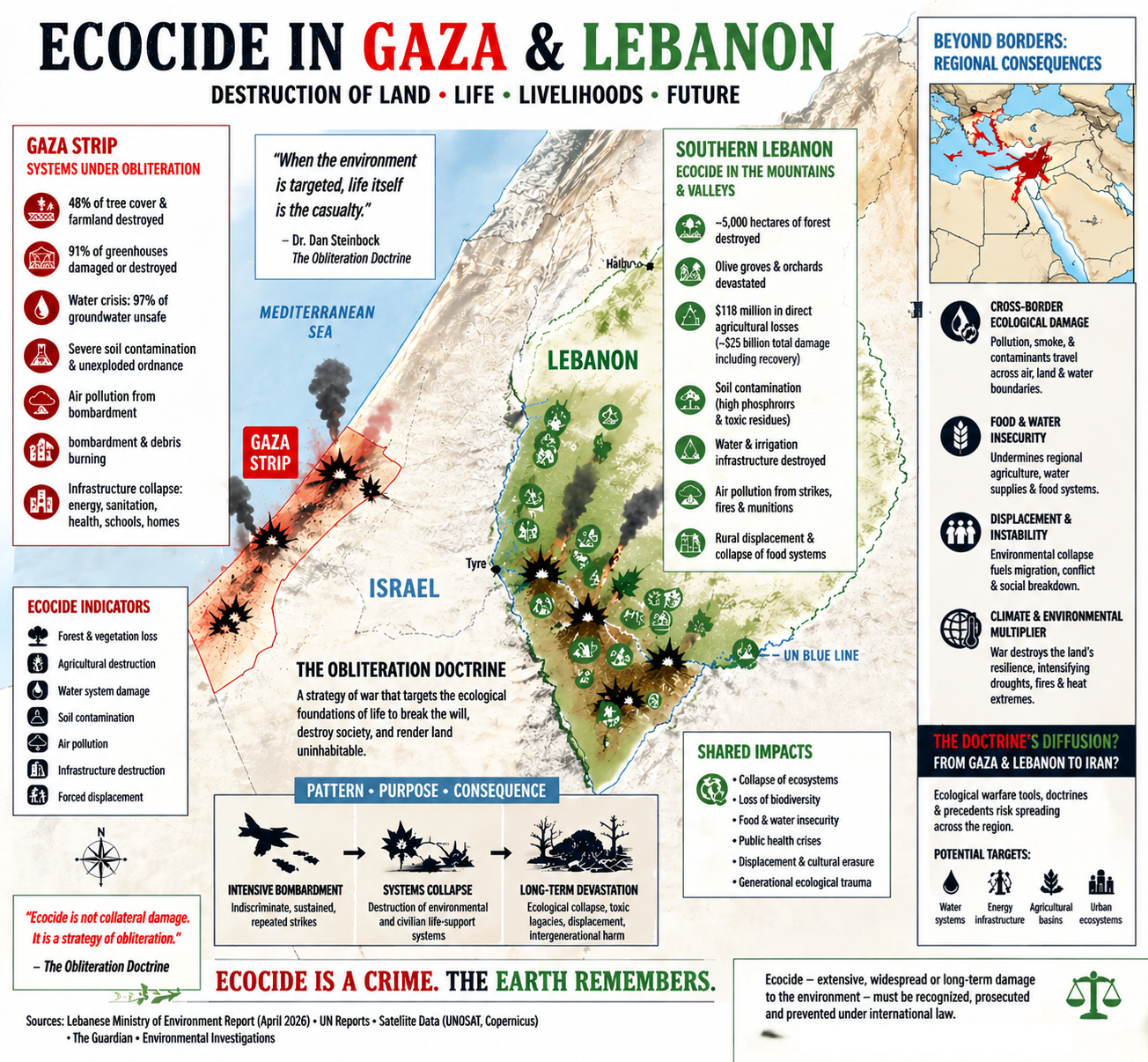
Lebanon accuses Israel of committing ecocide in country since 2023. It is an extension of Israel’s destruction of Gaza – and its obliteration doctrine.


by  | May 7, 2026 | 

Israeli military aggression has “reshaped both the physical and ecological landscape” of southern Lebanon, according to the Lebanese report (which does not consider the impacts of Israel’s latest barrage of attacks this spring).

In her foreword, Lebanon’s minister for the environment Tamara el Zein notes: “The scale and intentionality of the damage to forests, agricultural lands, marine ecosystems, water resources, and atmospheric quality constitute what must be recognized as an act of ecocide, with consequences that extend far beyond immediate destruction.” 

Obliteration ecocide in Lebanon

Released by the country’s National Council for Scientific Research and presented by the environment ministry, the report accuses Israel of “ecocide” during the 2023–2024 war and subsequent escalations. It frames environmental destruction not as incidental “collateral damage” but as systematic transformation of ecosystems.

Key findings are damning. They include:

  • 5,000 hectares of forest destroyed
  • Massive agricultural losses ($118m direct infrastructure damage; much larger indirect losses)
  • Soil contamination (including high phosphorus levels)
  • Air pollution from repeated strike cycles
  • Destruction of orchards and irrigation systems

Minister el Zein characterizes this as “intentional ecological destruction” affecting food systems, public health, and long-term viability of southern Lebanon’s rural economy.

International reporting on the same dossier highlights an estimated total damage burden of over $25 billion when recovery costs and economic losses are included. The figure is a combined total from the assessments by the Lebanese report and the World Bank Rapid Damage and Needs Assessment (RDNA) 2025.

This framing aligns with a growing legal discourse around “ecocide” as a potential international crime, particularly where environmental damage is widespread, long-term, and strategically embedded in military operations.

It is also aligned with UN reporting on the broader Israel–Lebanon escalation confirming extensive infrastructure destruction, civilian displacement, and strikes affecting residential areas.

As the ecocide of Gaza has gone effectively unpunished by the international community, the Netanyahu government is extending the environmental devastation into Lebanon and the proximate region. 

Obliteration doctrine in Gaza

In The Obliteration Doctrine (2025)related commentaries and excerpts, I define this doctrine as the lethal mix of scorched earth policy, collective punishment and civilian victimization, coupled with massive indiscriminate bombardment and systematic use of artificial intelligence (AI).

The concept is vital because it connects the dots between military strategies, aerial bombardment, lethal deployment of artificial intelligence (AI) and international law, particularly the Geneva Conventions and the Genocide Convention. As Professor William Schabas, a leading scholar of genocide, notes, “the Obliteration Doctrine” “adds a new term to the lexicon on genocide, notably in the application of international law and its judicial mechanisms.”

Modern warfare in Gaza is no longer just counterinsurgency but systems-level destruction of the environmental and infrastructural substrate of life – water, soil, agriculture, energy, and urban continuity.

This interpretation overlaps with empirical reporting on Gaza’s environmental collapse:

  • Satellite analysis shows 38–48% of tree cover and farmland destroyed
  • Severe contamination of soil and groundwater
  • Large-scale destruction of greenhouses and irrigation systems
  • Air pollution from sustained bombardment and debris burning

These patterns are described in independent investigations as producing conditions of near-uninhabitability in many parts of Gaza.

Warfare is no longer bounded by battlefield geography. It becomes the restructuring – or “obliteration” – of ecological systems that sustain civilian life.

Ecocide here is not merely destruction of nature, but destruction of life-support systems as purposeful strategy. It is another word for cultural genocide. 

Lebanon and the Gaza template

The Lebanese report and international commentary suggest strong structural parallels between Gaza and southern Lebanon operations:

  • Destruction of orchards, especially olive groves (long-lived economic ecosystems)
  • Targeting of water infrastructure and rural supply systems
  • Repeated airstrikes generating soil and atmospheric contamination
  • Displacement of civilian populations from ecological productive zones, which can be seen as a form of ethnic cleansing

International media reports that Israel is applying a “Gaza playbook” in Lebanon: expulsion orders, infrastructure targeting, and village-level destruction patterns.

Lebanon is now an adjacent theatre where similar operational logics are extended across a different ecological terrain:

  • Gaza: dense urban-agricultural mosaic under blockade conditions
  • Southern Lebanon: dispersed agro-ecological rural system with forested and orchard economies

In both cases, ecological assets are not collateral but structurally embedded in livelihood and resistance capacity – and that makes them strategic targets under the high-intensity obliteration doctrine. 
Consequences beyond Lebanon (and for Israel)

The environmental consequences of such conflict patterns are not geographically contained. Three spillover trajectories are particularly important.

First of all, regional ecological degradation. Soil contamination, wildfire damage, and agricultural collapse are not confined to strike zones. Windborne particulates, water contamination, and long-term soil chemistry changes affect broader cross-border ecosystems.

Second, economic fragility and food-system insecurity. Both Lebanon and Israel depend on regional agricultural stability and water systems. Repeated infrastructure destruction increases food import dependence, rural depopulation and long-term land degradation in border zones.

Third, internal Israeli environmental vulnerability. A less discussed but critical dimension is the simple reality that prolonged warfare conditions can feed back into Israel’s own ecological systems vis-à-vis air quality deterioration from sustained military operations, water system strain under security infrastructure expansion, fire ecology disruption in northern regions. long-term land-use militarization effects.

In this sense, “obliteration” generates mutual ecological degradation across interconnected landscapes. It is an ecological version of MAD – mutually assured destruction. 

Diffusion of doctrine

The key concern is not just localized destruction but doctrinal diffusion. Methods of high-intensity ecological disruption normalize across theaters. And let’s keep in mind that the first test of the obliteration doctrine occurred in Dahiya, the predominantly Shia enclave of Beirut.

US military legacy in Iraq and Syria already includes extensive infrastructure and ecosystem disruption under counterinsurgency and airpower doctrines. These feature water system destruction in Iraq, oil field fires and atmospheric contamination, and urban siege warfare effects in Raqqa and Mosul via coalition partners.

Such precedents create a shared operational vocabulary where environmental damage is treated as secondary to strategic objectives.

In a potential Israel–Iran escalation scenario, ecological infrastructure becomes strategically central through water scarcity systems in Iran’s arid regions, oil and petrochemical infrastructure vulnerability, and agricultural basins dependent on irrigation networks.

Under the obliteration logic, these become dual-use environments – civilian life-support systems that also acquire military significance.

Finally, there is the regional systemic risk. This implies a shift from territorial warfare to ecosystem-targeted coercion, where water, soil, energy, and agriculture become primary pressure points. Meanwhile, environmental degradation is exploited as a form of strategic leverage and recovery cycles extend beyond political timelines into generational horizons. 

From battlefield to biosphere as target

The Lebanese charges, Gaza environmental destruction data, and the doctrine of obliteration converge on a structural transformation in modern conflict.

The object of war is increasingly not just territory or armed forces, but the ecological infrastructure that makes civilian life possible. In this way, destruction of that infrastructure is a prelude to ethnic cleansing and displacement.

For military doctrines, this may be framed as incidental or operational necessity. But for Lebanon and environmental analysts, this constitutes potential ecocide under international law. In view of the obliteration doctrine, it represents a systemic shift in the practice of warfare itself – from the battlefield to biosphere as target.

What happens in Gaza won’t stay in Gaza. What happens in Lebanon won’t stay in Lebanon. The stage is being set for obliteration ecocides wherever they are seen as effective necessities.

Ecological systems are now central to both the conduct and consequences of war.

The original commentary was published by Informed Comment (US) on April 30, 2026


Dr. Dan Steinbock is an internationally recognized visionary of the multipolar world and the founder of Difference Group. He has served at the India, China and America Institute (US), Shanghai Institutes for International Studies (China) and the EU Center (Singapore). For more, see https://www.differencegroup.net 

Wednesday, May 06, 2026

Corking the Front Door: Japan’s New Role in the Global Siege of China


The verbal barbs between Japan and China have been a distraction; the real story is Japan’s deepening military integration with the Philippines. As the U.S. and its allies move to seal the Luzon Strait, Japan is shedding its pacifist skin to serve as the regional arsenal, providing the hardware and the boots on the ground necessary to turn the Front Door of the South China Sea into a strategic bottleneck. It is the tactical manifestation of a new cold war focused on maritime choke points and the kinetic kneecapping of China’s Belt and Road Initiative.


by  | May 4, 2026 | 

On April 21, 2026, Japan’s Cabinet officially scrapped decades-old restrictions on the export of lethal defense equipment. This decision by Prime Minister Sanae Takaichi marks the definitive end of the 1967-era “Three Principles on Transfer of Defense Equipment,” effectively dismantling the final legal barriers of postwar pacifism. This is more than a policy tweak; it is a structural re-alignment of the Japanese state to function as a regional “arsenal of democracy.”

A prime example of this friction is the Philippine Navy’s interest in Abukuma-class destroyer escorts – vessels specifically designed for anti-submarine warfare. While the Navy emphasized in February 2026 that Japan had yet to make a formal offer – limiting the interaction to a “joint visual inspection” – the Takaichi Cabinet’s recent legal pivot specifically removes the requirement to strip these vessels of their weapons systems. By clearing the legal path for the export of lethal hardware, Tokyo has effectively moved the Abukuma from a sidelined “visual inspection” to a viable, armed option for reinforcing the Front Door.

The Takaichi administration is framing these exports under the concept of “Fighting Resilience,” a strategic doctrine aimed at building a persistent industrial base among allies. By providing the Philippines with these 2,000-ton vessels, Japan is essentially outsourcing a portion of the Front Door defense to Manila. This ensures that the Philippine Navy can maintain a constant, lethal presence in the Luzon Strait without requiring a perpetual U.S. or Japanese hull on-site – effectively turning a local navy into a proxy gatekeeper for the Allied blockade.

For the first time in history, the Japan Self-Defense Forces (JSDF) are not merely observing the Balikatan military exercises; they are full participants. Under the newly implemented Reciprocal Access Agreement, approximately 1,400 Japanese troops have joined their U.S. and Philippine counterparts as part of a 17,000-strong force in a high-stakes rehearsal for maritime conflict. The centerpiece of this year’s drills is a coordinated “joint maritime strike” off the coast of Northern Luzon. Allied forces are practicing the sinking of the BRP Quezon (PS-70).

Sinking the BRP Quezon with Allied missiles – including Japanese Type 88 surface-to-ship systems – is a visceral demonstration of the hardware and tactics required to turn the northern Philippines into a lethal barrier. Though this exercise takes place within the West Philippine Sea, its strategic importance lies in its geography. Northern Luzon’s proximity to the Luzon Strait makes it a massive flashpoint; it is the Front Door of the disputed South China Sea and the primary gateway to Taiwan.

The logistical hinges of this gateway were greased in January 2026, when Manila and Tokyo finalized the Acquisition and Cross-Servicing Agreement (ACSA). This pact allows for the tax-free entry of military supplies and services, effectively turning the Philippine archipelago into a frictionless launchpad for Japanese power. Combined with the 2024 Reciprocal Access Agreement, the ACSA ensures that the Allied arsenal is no longer just visiting the Front Door – it is moving in.

This Front Door strategy is the kinetic counterpart to China’s greatest strategic anxiety: the “Malacca Dilemma.” If the Luzon Strait is the entrance, the Strait of Malacca is the Back Door in the southwest. The Belt and Road Initiative was conceived as a multi-billion dollar workaround to the fact that 80% of China’s oil trade must pass through this narrow artery. By corking the Front Door in the northeast while maintaining the potential for a “distant blockade” at the Back Door, the United States and its allies are signaling their ability to sever China’s energy veins at will. In 2026, the sinking of a ship off Northern Luzon isn’t just a drill; it’s a demonstration of how to create a permanent blockage in the world’s most vital maritime artery.

The pincer movement in the Pacific is mirrored on the other side of the globe, where the U.S. is playing a high-stakes game of chess in the Strait of Hormuz. By tightening the naval grip on this oil valve, the administration is directly targeting the lifeblood of China’s industrial engine. As I detailed in my previous work, “Board Games and Bottlenecks,” Iran serves as a critical junction on this chessboard. The strategic importance of this node was underscored earlier this month when a U.S.-Israeli strike targeted a section of the China–Iran rail corridor. While Iran managed to repair the link in under three days, the message was clear: no land bridge is beyond the reach of kinetic interference.

The strategy extends deep into the Western Hemisphere under what is being called the “Donroe Doctrine.” This policy is designed to systematically purge Chinese influence from Greenland to Latin America, turning the entire hemisphere into a series of geopolitical choke points. The recent kidnapping of Nicolás Maduro in Venezuela and the intensifying pressure on Cuba are tactical hits against BRI hubs. Even Brazil is now a target; as they approach their upcoming elections, the policy mirroring and interference tactics suggest a desperate effort to block China’s trade access to the Atlantic.

As Captain’s John Konrad noted, “Chokepoints Are The Focus Of A New Cold War.” Analysts like Brian Berletic have long warned that the goal is a total blockade of China, but these choke points are no longer strictly maritime. This is all-out hybrid warfare, utilizing everything from ethnic armed groups and proxy terrorists to economic sanctions and the arsenal of export controls we are now seeing. In this context, a choke point isn’t just a narrow strait; it is any node – financial, digital, or geographic – where the Allies can exert a stranglehold on China’s industrial lifeblood.

The rationale for this aggression is economic reality: the United States cannot compete with the integrated industrial capacity of China’s State-Owned Enterprises (SOEs). As Clementine G. Starling-Daniels noted at the Atlantic Council, the U.S. simply does not have a comparable offering that allows private firms to match the state-subsidized prices of Chinese SOEs. Because U.S. multinational corporations cannot win on a level playing field, the strategy has shifted from competition to kneecapping. If you cannot outbuild the Belt and Road, you must destroy the transit points that make it viable.

Tina Antonis is an independent researcher and blogger. A long-time reader of Antiwar.com, she has been writing about U.S. foreign policy on her WordPress since 2017 and publishes essays – ranging from geopolitical critique to personal and philosophical reflections – on Substack. You can find her on X (formerly Twitter) or contact her at ms_cat71@aol.com.

Imperial Lies and the War in Iran

Under the guise of principled conservatism, the United States has been led down a path of global empire and endless wars.

by  | May 5, 2026 | 

Mass deception is a cornerstone of the state’s ability to maintain total control. One of the main methods used by government to convince the population of their legitimacy is the tool of propaganda. This is nothing new, and states throughout the world have engaged in this practice for all of human history. What is new, however, is the mass awakening that is occurring in this moment of imperial decay.

I believe this decay is the direct result of an expansionist foreign policy, which is focused on expanding the global empire rather than furthering the values of liberty at home. The systems established by our founders are no longer the guidelines by which our government operates, and they haven’t been for a very long time. Consider the fact that the President of the United States, Donald Trump, is yet to receive Congressional approval for his reckless war of choice against Iran, launched on February 28th, 2026.

Under Article 1, Section 8 of the U.S. Constitution, it is stated that the Congress is the body with the authority “To declare War.” However, the United States hasn’t officially declared war since World War 2. The U.S. President swears an oath to “preserve, protect and defend the Constitution of the United States.” This oath, which these Presidents take with their hand on the Bible, is routinely broken.

As a result of this lack of respect for the founding documents, we have seen the United States engage in countless wars over the past century. Arguably the most disastrous of these wars was the second Iraq War, launched in March of 2003 by the George W. Bush administration.

This war was sold through a series of lies, which states that Iraq’s head of state, Saddam Hussein, had acquired weapons of mass destruction, and was collaborating with the jihadist terrorist group Al-Qaeda to use these weapons against America. This was a particularly engaging narrative because just a little over a year and a half prior, on September 11th, 2001, Al-Qaeda had hit the United States with a series of terrorist attacks in New York City and Washington, D.C.

This narrative would go on to be proven false over the subsequent years. Saddam did not have WMDs and he was not aligned with Al-Qaeda. This war was the result of a group of people known as the neoconservatives hijacking the foreign policy wing of the Bush administration and using it to accomplish goals which they had already been pushing for before 9/11. The terrorist attacks simply served as their pretext for war.

Through a mixture of fake intelligence, foreign influence, and outright lies, the U.S. was led into a war that was against our interests.

This conflict started a chain of events that has resulted in catastrophe for our nation. The U.S. has never left Iraq, and between 2003 and 2023 the war resulted in anywhere from 200,000-600,000 Iraqi civilian deaths, roughly 4,598 American troops killed, and countless more American veterans having taken their own lives in the aftermath due to mental struggles. We spent, borrowed, and printed trillions of dollars over the course of this conflict, which has resulted in inflation here at home.

Every war is sold through a narrative, usually one which paints a picture of good vs. evil, light vs. dark, or hero vs. villain. The U.S. government is usually described as a “liberator,” whose goal is to free the people of foreign nations from their oppressive regimes. This line was used not only in Iraq, but is even being used today to justify the war in Iran. Donald Trump repeatedly expressed a goal to “help” the Iranian people free themselves from their regime, as if the bombing of Iranian major cities was rooted in humanitarian impulses. How kind.

In reality, this is merely fiction. The truth has much more to do with global power, foreign influence, and the ideological drive towards big government, masked as principled conservatism.

This fraudulent lie about the motives of the U.S. government has been the basis for the expansion of the American empire. This story, organized in the style of a superhero movie, is one of the core pillars serving as a justification for so much of what the state is able to get away with. By casting themselves as the “good guy,” whose only goal is the expansion of global liberalism, they are able to get the American people on board with endless war, also known as state-sanctioned mass murder.

Take this current war in Iran as an example. This war was not a war of necessity, and that is patently obvious. Nobody is buying the narrative that Iran was plotting to develop a deliverable nuclear weapon for the purpose of bombing the United States. This not only wouldn’t be possible for close to a decade, according to the Defense Department’s own 2025 report, titled, “Golden Dome for America: Current and Future Missile Threats to the U.S. Homeland,” but it is also a statement devoid of any context that could help us come to a negotiated solution.

When you assess these types of situations in a vacuum, you are more likely to conclude that military action is all that can be done. However, when you look at the history of these tensions, you can better judge the grievances of both sides, and it becomes more possible for diplomacy to work.

John Mearsheimer and his “Realist” school of foreign policy thought tells us that understanding the motives of the enemy, and the grievances they hold, is essential to having a holistic grasp on the conflict. This doesn’t mean we agree with them or justify actions they take as a result. As a libertarian, I am against essentially all states, especially oppressive theocracies. But this doesn’t mean there isn’t a history to these feuds that is worth assessing and understanding.

As it pertains to this current war, there is a history that I urge everyone reading this to look into. The CIA and MI6 orchestrated a coup in 1953, known as Operation Ajax, against Iran’s then-president Mohammed Mosaddegh. This led to the installation of the U.S.-backed Shah Mohammed Reza Pahlavi, a brutal monarch. The tension against his rule culminated in the 1979 Iranian Revolution, which led to the establishment of the Islamic Republic of Iran.

Since then, the U.S. has overthrown all of Iran’s neighbors. Iraq, Syria and Libya have all been casualties of the United States’ “War on Terror,” which sought to overthrow regimes across the Middle East that were hostile to Israel. This was the direct result of neoconservatives, who explicitly prioritize the goals of the State of Israel over those of America, taking control over our foreign policy.

Now, after decades of advocating for this war, both the U.S. and Israel have launched a regime change operation against the IRGC. This is now a war of survival for Iran.

It does not take a foreign policy genius to understand how these dynamics could create the situation we see today. Clearly, there is much more to this story. This is not as simple as a childish “good vs. evil” narrative.

It is the failure to even consider the broader history that results in our leaders either being ignorant or intentionally dishonest in their assessment. However, more people than ever before are awake to the fact that they aren’t telling us the whole story. According to a new Washington Post-ABC News-Ipsos poll, 61% say that it was a “mistake” for the U.S. to take military action against Iran.

While they may not know the whole history, and they may not necessarily be against this conflict based on a principled anti-war stance, the majority of this country senses deep down that something is off. It becomes apparent that the entire story is not being told, especially when the holes in said story are so gaping.

What is to be done about this? Tell the truth. As the heroic Congressman Ron Paul said so wisely, “Truth is treason in the empire of lies.” That is the necessary first step to breaking down this facade. This has already begun, and if we are to guide our republic back to sanity, we must continue fearlessly.

Nolan Denaro is a paleolibertarian political commentator and host of “The Quest For Clarity” podcast, which can be found on YouTube and Spotify. He writes on Substack, and his work can be found at nolandenaro.substack.com. He can be reached for correspondence by email at nolansdenaro@icloud.com.

Europe’s Moral Crisis: The Crumbling Shield Around Israel

by  | May 4, 2026 | 

The European Union is the “chief of all cowards,” Amnesty International declared in a searing statement issued on April 21. The condemnation was a direct response to the European bloc’s systemic failure to sever ties with Israel during the Foreign Affairs Council meeting in Luxembourg.

Despite months of legal warnings, the EU once again prioritized procedural safety over the urgency of human life.

The efforts to press the EU to finally take a moral position were led by a coalition of Spain, Ireland, and Slovenia, later joined by Belgium. They argued that the EU-Israel Association Agreement – the legal framework governing their trade relationship – is predicated on the “respect for human rights.”

To maintain this agreement while the extreme violations in occupied Palestine continue is to render the EU’s own founding treaties meaningless.

Such a decision, even if belated, would have done immeasurable good. It would have restored a measure of the EU’s shattered credibility and re-enlivened the discussion on international law. More importantly, it would have initiated a series of concrete measures to hold Israel accountable and provided Palestinians with a tangible sense of hope.

None of that occurred, however, thanks to the lobbying of Germany and Italy. These nations acted as a diplomatic firewall, shielding Israel from consequences.

The German position remains consistent with Berlin’s hardline defense of Israel, a stance that has persisted even throughout the genocide in Gaza. As a country that should have been the world’s greatest advocate against mass extermination, Germany has repeatedly shielded Israel at the International Court of Justice (ICJ) and other global institutions.

During this genocide, Berlin has doubled down, insisting that the accusation has “no basis whatsoever.” This rigid stance remained unchanged even as Spain joined the South Africa case at the ICJ, signaling a profound rupture in European legal and moral consensus.

Therefore, it was no surprise that Germany’s leadership dismissed the Luxembourg proposal to suspend trade as “inappropriate.” Along with Italy, it insisted that the EU must remain in a “constructive dialogue” with Tel Aviv – a phrase that has become a euphemism for complicity.

Italy presents a more bizarre example. While Giorgia Meloni’s right-wing government remains aligned with the pro-Israel guard, the Italian people’s mobilization has been among the strongest in Europe.

The streets of Rome and Milan have seen mass protests and general strikes that rival the fervor seen in Spain. Yet, Meloni still refuses to heed her people’s call, with her ministers stating in Luxembourg that the proposal to suspend the treaty has been “shelved.”

Israeli Prime Minister Benjamin Netanyahu likely felt a great deal of relief following the vote. The Israeli economy is currently struggling under the staggering burden of continued wars, with the budget deficit ballooning as defense spending skyrockets. The EU remains Israel’s largest trading partner, with total trade in goods reaching over €42 billion.

This agreement provides a vital economic lifeline through preferential market access and high-tech integration; its suspension would trigger a devastating financial shock.

But the fact that Germany and Italy managed to sustain the treaty for now does not negate the imminent rupture already underway.

This rupture is not being led by governments, but by European societies. It would not be an exaggeration to suggest that Europe’s relationship with Israel is destined for pivotal change. The historical divide between Israel’s unconditional supporters, like Germany, and more sympathetic nations, like Ireland, is collapsing as the political pendulum swings toward Palestine.

The hardliner camp received its most significant blow recently with the political shift in Hungary. With the rise of Péter Magyar, who recently vowed that Hungary would respect ICC warrants for Netanyahu’s arrest, Israel has lost its most reliable “veto-man” in Brussels.

This leaves Germany increasingly isolated as the sole heavyweight protector of the status quo.

We are no longer talking about symbolic gestures. We are witnessing a critical mass of support for Palestine accompanied by direct action: encampments, legal challenges, and labor strikes. On April 14, it was reported that more than one million Europeans signed a formal “Justice for Palestine” petition calling on Brussels to impose sanctions.

This reflects a sustained pressure capable of shaping political agendas. Polling from this month indicates that only 17 percent of respondents in Germany now view Israel as a reliable partner. This exposes a widening gap between European publics and their governments. While Spain appears to be responding to public sentiment, Germany continues to act in defiance of it.

These same moral positions are reflected in attitudes toward other regional wars. Polling from March 2026 shows that 56 percent of Spaniards and Italians oppose US-Israeli military action in Iran. Public opinion increasingly sees these not as separate crises, but as interconnected fronts of a single, failed policy.

The rejection of war is part of a broader rejection of Israeli military policy and the alignment of European governments with it. These shifts have not only isolated Israel; they have begun to isolate its allies. Aside from Donald Trump and his full alignment with Netanyahu’s agenda, the era of a unified Western bloc catering unquestioningly to Israel’s demands is fading.

The traditional explanation for Europe’s backing – historical guilt over the Holocaust – no longer explains the conduct of political elites. A more accurate explanation lies in Europe’s own legacy of colonial violence and racial hierarchy.

However, the real shift belongs to civil society and the resilience of Palestinians who have bypassed traditional media filters to speak directly to the world.

Europe now knows that a genocide has been committed. This paradigm shift is unlikely to be reversed, regardless of whether Luxembourg’s bureaucrats manage to delay the inevitable

Dr. Ramzy Baroud is a journalist, author and the Editor of The Palestine Chronicle. He is the author of six books. His forthcoming book, ‘Before the Flood,’ will be published by Seven Stories Press. His other books include ‘Our Vision for Liberation’, ‘My Father was a Freedom Fighter’ and ‘The Last Earth’. Baroud is a Non-resident Senior Research Fellow at the Center for Islam and Global Affairs (CIGA). His website is www.ramzybaroud.net