The tortuous paths of resistance
Wednesday 6 May 2026, by Antoine Larrache
Iran, Lebanon, Ukraine, Palestine, Mali, Congo, Sudan... The warlike hotbeds seem to be ever more numerous, embodying the extent of the capitalist crisis and also giving the measure of the stakes in facing it.
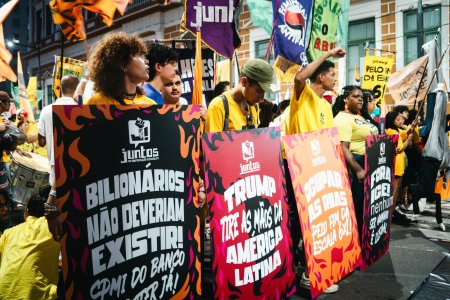
Originally scheduled for 2024, the Anti-Fascist Conference for the Sovereignty of the Peoples in Porto Alegre was postponed following the terrible floods that hit the city – a direct consequence of the acceleration of the climate crisis. The Conference brought together several thousand participants from all over the world against the rise of fascism, authoritarian regimes and wars. This is an undeniable achievement – it has been more than 20 years since we have seen such an international and pluralistic event bring together social movements, trade unions and parties from all over the world to reflect and try to act.
A little humanity in a world at war
For the activists who went there, it was a breath of fresh air. African activists, Ukrainians with their Russian allies opposed to Putin, delegations from the United States, Canada, Europe, Latin America and Asia were present. This created an extremely positive emulation, networks of exchange and a common understanding that must contribute to rebuilding a concrete in-ternationalism.
But the conference also has its limits, whether it is the insufficient participation of the major reformist social movements (trade unions, associations as well as parties, and so on) or po-litical confusion linked to the situation we are experiencing.
Thus, it was not possible for the conference to adopt a position of support for the Ukrainian resistance against the invasion, due to the presence of currents which were pro-Russian – or at least relaying some of its anti-Ukrainian propaganda under the pretext of an intransigent fight against NATO. Worse, an (indirect) representative of the Iranian regime intervened in the forums, masking behind a muted anti-imperialist discourse the bloodthirsty nature of the regime in power in Tehran, responsible for a repression that has caused the death of tens of thousands of people. It is a strong contradiction, at an anti-fascist conference, that the rep-resentative of the country that undoubtedly most corresponds to the characteristics of fascism was able to speak.
Urgency and frustrations
The temptation is great, including in the internationalist left, to turn our backs on the con-ference for these reasons, and to erase all the positive things it produces, the contribution it makes to the construction of concrete international actions.
Struggles against wars, flotillas (for Gaza or Cuba...), for the climate, for wages, feminist mobilizations, there is no shortage of battles. But, paradoxically, the multiplicity of issues seems to make convergences more difficult. From an analytical point of view, the capitalist polycrisis highlighted by the congress of the Fourth International connects all the dynamics: economic crisis, accelerated ecological crisis, imperialist wars and inter-imperialist tensions, the rise of the far right and the strengthening of reactionary violence against women, LGBTI people or racialized people. All this is very coherent and reinforces the conviction of the need for a world social revolution. But, as Martín Lallana and Júlia Martí point out in their article in this issue of International Viewpoint, “Power and urgency in the ecological crisis”, the seriousness of the situation, in each of the fields, convinces very broad activist sectors of the need for a partial response, believing that they can identify the possibility of resolving one struggle, if not all.
Thus, some hope to find objective allies for Palestine in the “axis of resistance” of Iran, Hezbollah and Hamas, secreting illusions both about their military capabilities and about the nature of their political project. This impasse is all the greater because national projects – from Algeria to Venezuela via Brazil – seem more and more futile in a situation of exacerbated global crisis.
Others hope to weaken NATO through Putin’s Russia. Some believe that a solution to the crisis is in Chinese planning. Still others sing the praises of Western democratic achievements, forgetting what they cost oppressed peoples and how quickly the ruling classes abandon even the idea of them. Finally, some, seeing fascism everywhere, are ready to compromise, losing sight of the need, in the face of real fascism – that which responds to the crisis by the physical destruction of the workers’ movement and the freedoms acquired by the oppressed – to strengthen a left ready to confront the dominant classes.
Analyse to act
This is where the question and the difficulties lie: what alliances are inevitable, and which independent political project must be defended. Alliances make it possible to act in a unitary way at a given moment on a specific point. But not only that: in a period of retreat of the organizations of the working class, they also represent the crystallization at a given moment of social forces, whether they are inter-class (for democratic or anti-imperialist struggles for example) or the concretization of the class for itself.
They must also be considered not only as one-off actions, but also in terms of what they produce dynamically: paths in the right direction or dead ends, gains in confidence or loss of energy. It is the analysis of a concrete situation and its inclusion in the more general context that should give us indications as to the necessary and relevant choices.
Thus, there may be a tendency to isolate the wars waged by the United States and its allies from those waged by Russia or the defence of European or Chinese interests in the world. Or even to include all this in the supposed common aims of a “fascist international”. Such a vision quickly reaches its limits, in the context of the reorganization of the world, both in terms of the balance of power and the economic upheavals. On the one hand, because the conflicts between the “Iranian fascists” and the “fascist Trump” are not explained thus. On the other hand, be-cause the current moment, which has the appearance of a division of spheres of influence between Trump and Putin, is probably a short-lived phase. Finally, because an oppressed nation, even one led by a very reactionary regime, is not on the same level in global contra-dictions as an imperialist power.
The biggest confrontations are ahead of us
“Crises, riots and mass demonstrations are three phenomena that will occur in the years to come,” Martín Lallana and Júlia Martí tell us. There is nothing to say that these actions will produce convergences in the short term. On the contrary, each battle, noting its partial ur-gency, could fear that it would be weakened by the others. The comrades continue: “These are events that will fracture political time. [...] Preparing to intervene in crises and uprisings requires broadening our base, strengthening our alliances.” Indeed, each of these struggles possesses, for us who re-inscribe it in a global understanding of the system, a subversive potential within the framework of an already extremely unstable capitalism: who could predict the potential of a revolution in Iran on the region and the whole world? Or even the retreat of the United States in the face of the anti-imperialist resistance of several forces in the region? What hope would this create in neighbouring countries?
Moreover, what form would a new global climate movement take today? What would the fall of Putin following a defeat in Ukraine lead to? These questions tend to reinforce the idea that waiting for the objectives of anti-imperialist struggles or other sectoral struggles could upset the balance of forces and certainties. Especially in a world where, more than ever in history, everything is connected. And even if for this to happen, we have to accept allies of circum-stance, reactionary or reformist, to whom “we do not attribute [...] all sorts of revolutionary virtues”. [1]
Faced with the discordance of the times
The situation is reminiscent in many ways of the “discordance of the times” noted by Daniel Bensaïd in the 2000s and to which he tried to respond: “How can a multiplicity of actors who can be brought together by a common negative interest (of resistance to the commodification and privatization of the world) make a strategic force of transformation without resorting to this dubious metaphysics of the subject? However, I would like to point out that, for me, the class struggle is not a form of conflict among others, but the vector that can cross other antagonisms and overcome the closure of clans, chapels, races, etc.” [2]
To be at the forefront of partial struggles, to build alliances and to assume their contradictions, while maintaining political independence – class independence as well as the independence of an eco-socialist revolutionary project – is undoubtedly the key, concerning the major inter-national gatherings that seem to be resurfacing, in Porto Alegre yesterday, tomorrow on the flotillas to Gaza, in front of the G7 in Evian in June, at the anti-NATO summit in July in Turkey, at the World Social Forum in Cotonou in Benin in August. And concerning the great social struggles that will inevitably take place in the next period.
28 April 2026
Translated by International Viewpoint.
P.S.
If you like this article or have found it useful, please consider donating towards the work of International Viewpoint. Simply follow this link: Donate then enter an amount of your choice. One-off donations are very welcome. But regular donations by standing order are also vital to our continuing functioning. See the last paragraph of this article for our bank account details and take out a standing order. Thanks.
Footnotes
[1] “Iran: The Contradictions of a Bourgeois Nationalist Leadership”, Michel Rovère, Intercontinental Press, 25 August 1980.
[2] Interview in the Argentine journal Praxis in 2006, republished in Contretemps, January 2018.
Antoine Larrache
Antoine Larrache is editor of Inprecor and a member of the leadership of the Fourth International
.png)
.png)

.png)