Thursday, May 07, 2026

New Gangsters for Capitalism


 May 6, 2026

Photograph by Nathaniel St. Clair

Some lawmakers have grown so alarmed by the Trump administration’s actions in Latin America that they are beginning to accuse the administration of gangsterism.

Representative Stephen Lynch (D-MA) saw the possibility of gangsterism at the start of the second Trump administration when he warned that the United States could “join the ranks of gangster nations,” but there is a growing sense in Congress that the day has arrived.

At a congressional hearing last month, Representative Joaquin Castro (D-TX) asserted that the Trump administration is exploiting the U.S. military to take Latin American resources for U.S. corporations. Castro seemingly channeled the anti-war critiques of Smedley Butler, the U.S. military hero of the early twentieth century, who condemned war as a racket and lamented his exploitation as a racketeer for capitalism.

“For decades, our men and women in uniform who volunteered to protect our country became mercenaries ordered to risk their lives to protect the profits of U.S. corporations,” Castro said. “Today, President Trump is ordering them to do so again.”

The Case of Venezuela

The Trump administration’s critics in Congress have been warning about the administration’s gangsterism due to its actions in Venezuela.

Since the Trump administration directed a military operation earlier this year to seize Venezuelan President Nicolás Maduro and take control of the country’s oil and minerals, several lawmakers have suggested that the administration has begun to employ force and intimidation as its basic tools of statecraft.

Lawmakers have condemned the administration for conducting a military operation without congressional approval, meddling in Venezuela’s internal politics, displaying contempt for Venezuela’s political process, facilitating corruption in Venezuela and the United States, and using the U.S. military to take control of Venezuela’s resources.

“You are taking their oil at gunpoint,” Senator Chris Murphy (D-CT) told Secretary of State Marco Rubio earlier this year.

Although Congress has not held the president accountable, as the Republican majority in each chamber supports the president, critics have kept pressure on the White House, prompting officials to defend the administration’s actions.

At the congressional hearing last month, State Department official Michael Kozak claimed that the intervention in Venezuela advanced U.S. interests. He cited the Monroe Doctrine, which marks Latin America as a sphere of influence. Like the president, he boasted that the United States now controls the country’s resources.

“We’ve got very significant control over the oil revenues at this point,” Kozak said.

Several Democratic lawmakers responded with strong criticisms. They condemned the Trump administration for acting so aggressively in the hemisphere, and they warned that its actions would create a backlash against the United States.

Representative Sydney Kamlager-Dove (D-CA) described the administration’s approach as “shameful.” She insisted that the United States should not be “reviving a policy of domination and subjugation in the Western Hemisphere through the Monroe Doctrine.”

Castro repeated his warning that the Trump administration is focused on commerce and profits. He suggested that the president is using the U.S. military to enrich people close to him.

“What has happened now is that there’s a group of folks that the president favors in his circle that is able to commence commerce and make money off of, whether it’s valuable minerals, oil, anything else in Venezuela,” Castro said.

Kozak expressed disagreement with Castro’s analysis, but he acknowledged that the Trump administration has established significant controls over Venezuela. Once again, he boasted that the Trump administration controls the country’s resources.

“People can lift oil and sell it on the open market, but all that money goes into an account that we have control over,” Kozak said. “All the revenues that are coming from the mining sector and everything, instead of going into their bank accounts, are coming into the Treasury accounts, and then we can dole it out as we see fit.”

The Case of Cuba

Now that the Trump administration has moved against Venezuela, establishing new leadership and doling out profits from its resources, lawmakers anticipate that it will move against Cuba next.

For months, Trump has been openly threatening Cuba. He has moved to block oil shipments to the country, causingan economic crisis. Knowing that he has put tremendous pressure on the Cuban government, he has demanded that the country’s president leave office.

“I do believe I’ll be having the honor of taking Cuba,” Trump said in March. “I think I could do anything I want with it, if you want to know the truth.”

Although the Trump administration’s military intervention in Iran has shifted its focus away from Cuba, the administration is maintaining an economic stranglehold over the island nation, making its recovery impossible. The U.S. military continues blocking the free flow of oil to Cuba, even while Trump demands the free flow of oil through the Strait of Hormuz. The few oil shipments that have reached Cuba, for instance a recent tanker from Russia, have provided little relief.

At the congressional hearing last month, several lawmakers argued that the Trump administration is a major reason why Cuba is facing such tremendous hardship, including island-wide blackouts and preventable deaths at hospitals and health clinics.

“We cannot ignore our own country’s role in the ongoing humanitarian catastrophe in Cuba,” Castro said.

Representative Jonathan Jackson (D-IL), who recently visited the country, made the strongest criticisms. Warning that the administration’s policies are causing tremendous harm to the Cuban people, he indicated that the Trump administration is violating international humanitarian law.

“We have engaged in collective punishment,” Jackson said.

The congressman also accused the Trump administration of trying to make life so miserable for the Cuban people that they would rise up and overthrow the Cuban government. He described it as a failed “policy of starving” Cuba.

“It was one of the most cruel things I had ever seen in my life,” he said.

Just as the Trump administration has been able to get away with its actions in Venezuela, however, it has been able to continue its policies toward Cuba. The administration maintains support among Republicans and some Democrats, few of whom oppose the administration’s goal of regime change.

The president, who knows that he faces little opposition in Congress, continues threatening to direct a military intervention in Cuba, even citing the operation in Venezuela as a precedent.

“In January, our warriors flew straight into the heart of the Venezuelan capital, captured the outlawed dictator Nicolás Maduro, and brought him to face American justice,” Trump said last month. “And very soon this great strength will also bring about a day 70 years in waiting. It’s called, ‘A New Dawn for Cuba.’”

War Is a Racket

When Smedley Butler spoke against his exploitation as a racketeer for capitalism nearly a century ago, he made a criticism of the American way of war that was considered to be so radical by U.S. leaders that it has been largely excluded from mainstream political discourse.

Only a few politicians, such as former Representatives Cynthia McKinney (D-GA) and Ron Paul (R-TX), have cited Butler and his warnings. Rarely, if ever, does the mass media report on war as a racket in which the country’s leaders are exploiting U.S. military forces as gangsters for capitalism.

Today, however, some elected leaders are beginning to issue the same kinds of warnings about the Trump administration. Alarmed by the president’s insatiable lust for wealth and power, they are starting to suggest that the president is engaging in a kind of gangsterism across Latin America. The president, they say, is using the power of the U.S. military to steal the wealth of Latin American countries to enrich himself, his family, his closest business associates, and U.S. corporations.

“By any measure, this is the most corrupt administration in American history,” Senator Chris Van Hollen (D-MD) saidearlier this year.

Now that the Trump administration is openly pillaging Venezuela and getting away with it, several lawmakers are warning that it may apply the same approach to other Latin American countries.

“It’s making me think that the goal in Cuba is going to be the same,” Castro said at the hearing in April. “It’s who’s going to go over there that’s friends with the president to make money and who’s going to profit off of Cuba and the Cuban people.”

Indeed, there is a growing sense in Congress that the Trump administration is turning to gangsterism. Moving beyond standard establishment critiques of the president’s contempt for norms and traditions, critics are giving serious consideration to the idea that Trump’s wars are a racket and that Cuba may be next.

This first appeared on FPIF.

Edward Hunt writes about war and empire. He has a PhD in American Studies from the College of William & Mary.

Brussels, Russia and the Venice Biennale: Art as Politics and Hypocrisy


May 6, 2026

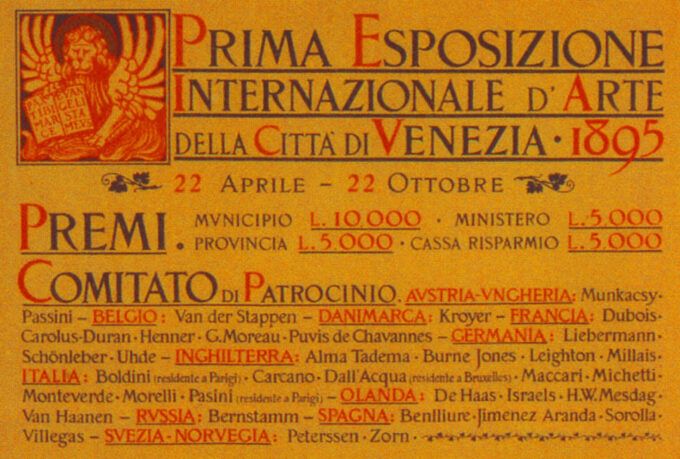
First edition official poster. Photograph Source: Cyril S – Public Domain

The jury at the Venice Biennale Art Exhibition have outdone themselves.  Few juries at any art or literary festival can be trusted at the best of times, their judgment likely to be swayed by factions, self-interest and the ethically sapping succour of the gravy train (the global art scene is an enormous racket after all), but to see such figures take a moral stand is a peculiar thing indeed.

The stand in question, which took the form of a mass resignation, was initiated in response to the decision to permit Russian participation for the first time since the February 2022 invasion of Ukraine, even if the country had self-absented itself.  (Russia, indeed, has its own permanent exhibition space in the Giardini.)  In a terse statement, the jury set out “our intention – to express our commitment to the defence of human rights.”  In doing so, it would “refrain from considering those countries whose leaders are currently charged with crimes against humanity by the International Criminal Court.”  This meant excluding artists from both Israel and Russia, as their sitting leaders Prime Minister Benjamin Netanyanu and President Vladimir Putin both face ICC warrants for their arrest.

The organisers had taken a different view in considering Russia’s participation, deeming the re-admission of its artists as “consistent with the founding spirit of La Biennale, based on openness, dialogue, and the rejection of any form of closure or censorship.”  Given what the organisers of such events can quail before the loss of funding or a perceived dent in reputation, this was unusually principled.

The political philistines have been quick to weigh in, further showing that the art scene – or at least art as shown in public – is governed by the sentiments and prejudices of sponsors who give no fig to the quality of what is on show.  Ukrainian Foreign Minister Andriy Sybiha offered a simple, and simplistic assessment about the pavilion exhibition entitled The Tree is Rooted in the Sky, centred on performances with a focus on sound and experimental music: “The aggressor’s culture is not neutral in the times of war and must never be utilized to serve the interests of the aggressor, to whitewash its crimes, and to spread propaganda.”  Forget the actual content of the exhibition: all Russians shared a form of cultural pox, incapable of expressing moral and intellectual sentience.

Brussels, taking a similar line, hectored and bullied the organisers last month, ignoring the self-evident point that their powers over the Russian-owned space were limited.  On April 21, the European Union High Representative for Foreign Affairs and Security Policy, Kaja Kallas, proved firm and dogmatic: “While Russia bombs museums, destroys churches and seeks to erase Ukrainian culture, it should not be allowed to exhibit its own.  Russia’s return to the Venice Biennale is morally wrong, and also the EU intends to cut its funding.” The European Commission, very much in the mood for splitting hairs, excoriated participating Russian artists as members of a “‘governmental delegation’ (whose participation is entirely funded and promoted by the Russian government via a national pavilion”.  This implied “that the Biennale appears to have accepted indirect support from the Russian government in exchange for granting a cultural platform”.

The Italian government preferred the neutrality of impotence, claiming that the Biennale was acting “entirely independently” of Rome’s direction.  Prime Minister Giorgia Meloni did, however, state that permitting Russian participation was “a decision not shared by the government”, though the Biennale was an autonomous entity with a “very capable” president.

The reasoning fashioned against the Russian participants is a most troubling reading of the artistic temperament.  If artists are to be reduced to the same culpability as their political leaders, what does it say about their art?  It is true to say that the fickle, dominant patron is certainly indispensable in the history of art, from emperors and Popes to any number of modern, tarted-up demagogues.  The same also goes for artists happy to exchange independence of mind for the stability of thoughtless servility.  But to use the narrow field of reason adopted by the judges would be to prevent any showing of Pablo Picasso’s Guernica because the leader of his country was the bloodthirsty monomaniac Generalissimo Francisco Franco.  Guernica was a shattering admonishment of modern war, yet such a sensibility would be utterly occluded by petty juries worried about the moral character of political leaders.

The saddening and maddening nature of the jury resignation, accompanied by the crude response from Brussels, further ignores the point that artists can, on their own volition, take a stance.  In 2022, the curator and artists selected for the Russian pavilion withdrew in protest against the invasion of Ukraine.  In 2024, Russia lent the space to Bolivia.

The Biennale Foundation, following the jury’s resignation, has decided to revise the awards system.  Instead of having the usual jury-selected Golden and Silver Lions, two “Visitors’ Lions” will be introduced.  A public vote will be taken for best national participant and best individual artist.

By all means, ban the political hacks, flunkeys and toadies who turn up to exhibitions on a free ride.  Damn the pen pushers and grovellers who yearn for the approval of power.  But spare any artist with an inch of backbone and an ounce of courage.  Any exhibition will be the better for it, even if it might not necessarily guarantee fine works.

Binoy Kampmark was a Commonwealth Scholar at Selwyn College, Cambridge. He lectures at RMIT University, Melbourne. Email: bkampmark@gmail.com

Canada Is Quietly Putting War Into Your Portfolio


 May 6, 2026

Image by Hal Gatewood.

Canada is set to host the headquarters of the proposed Defence, Security and Resilience Bank (DSRB), a new multinational institution designed to mobilize tens of billions in financing for military and security projects among allied nations. In short, what we are seeing is the quiet normalization of something far more consequential: the permanent financialization of war. The structure being envisioned for DSRB closely resembles other multilateral financial institutions. It would raise capital on global markets, issue bonds, and extend loans to governments and defense companies. That means funding for military supply chains, weapons systems, and defense infrastructure would increasingly flow through financial markets rather than direct public expenditure. In doing so, war itself risks being transformed from a political decision subject to public scrutiny into a financial product embedded in portfolios.

And so, with remarkable efficiency, we may be arriving at a point where, whether you like it or not, you are investing in war. Not because you consciously chose to, but because modern finance rarely asks for permission. It integrates. It diffuses. It embeds. Just as complex mortgage-backed securities seeped into pension funds and retirement portfolios before the 2008 Financial Crisis, instruments tied to defense financing could quietly become part of the same financial plumbing that underpins everyday savings. Deposits in major banks, such as Royal Bank of Canada or Toronto-Dominion Bank, feed into broader lending and investment pools. If those banks help underwrite DSRB bonds or finance defense projects, then ordinary savings are, at least indirectly, part of the system. You won’t need to opt in. The system will do it for you.

Once you are in that system, try opting out. Go ahead — divest. In theory, it sounds simple. In practice, it is anything but. Large pension funds, such as the Canada Pension Plan Investment Board or the Ontario Teachers’ Pension Plan, operate within a web of financial relationships that makes complete divestment extraordinarily complex. If DSRB bonds are rated as safe, investment-grade assets, they could easily find their way into fixed-income portfolios. Even if funds choose to avoid them directly, indirect exposure remains: through banks that underwrite the bonds, through ETFs that bundle defense assets, and through lending syndicates that finance defense contractors. “All the king’s horses and all the king’s men” of global finance, institutions like JPMorgan Chase and Deutsche Bank, are already lining up behind this model. When the entire financial stack aligns like this, divestment becomes less a matter of choice and more a question of how far you are willing, or even able, to disentangle yourself from the system.

What emerges is not just a new bank, but a new layer of abstraction between citizens and the consequences of war. Traditionally, military spending is debated, however imperfectly, through parliaments and public scrutiny. A financialized model shifts that process into capital markets, where decisions are driven less by voters and more by risk assessments, yield expectations, and institutional incentives. Over time, this risks normalizing war as an investable asset class, something to be priced, traded, and held in portfolios rather than questioned in public forums.

That transformation carries consequences. One of the most immediate concerns is that such a bank could normalize or even facilitate controversial military interventions. If borrowing costs for defense spending are lowered, the financial barriers to launching military operations also fall. History offers a sobering precedent. The Iraq War was widely condemned after the central justification, claims of weapons of mass destruction, collapsed under scrutiny. Yet the war had already been financed, executed, and justified through institutional momentum. A system like DSRB could make such momentum easier to sustain, not harder. When capital is readily available, restraint becomes less likely.

Over time, this could make war financing a permanent feature of the global system. What used to be occasional becomes routine, and what was once debated becomes taken for granted. In that sense, the DSRB starts to look like a ‘World Bank for Warfare.’

Equally concerning is the question of democratic oversight. Traditional military spending must pass through national parliaments, where budgets are debated by elected representatives. A multilateral financial institution operates differently. By raising funds on global capital markets and deploying them through loans and financial instruments, DSRB could create a layer of decision-making that sits at arm’s length from voters. The result is a subtle but significant shift from public accountability to financial abstraction. Decisions about long-term military financing could become less visible, less contested, and ultimately less democratic.

What makes this shift particularly jarring is where it is happening. Canada has long cultivated an image of a country that prioritizes diplomacy, multilateralism, and peacekeeping. Yet by stepping forward to host the DSRB, it is positioning itself not just as a participant in global security, but as a financial hub for its expansion. The very country that has emphasized de-escalation is now spearheading an ecosystem designed to sustain long-term militarization.

The implications extend beyond symbolism. By helping institutionalize a system capable of mobilizing upwards of $100–135 billion in defense financing, Canada is effectively tying part of its economic future to the expansion of military spending. That alignment carries risks. When financial systems are built around a particular sector, they begin to depend on its growth. We have seen this dynamic before, most notably in the housing market prior to the 2008 Financial Crisis, when an entire economic ecosystem became reliant on ever-expanding real estate values.

Apply that same logic to the realm of defense, and the parallels become difficult to ignore. A system that depends on continuous military spending creates subtle but powerful incentives: to maintain high levels of defense budgets, to expand procurement programs, and to sustain the geopolitical tensions that justify both. Over time, what begins as risk management can evolve into dependence. A system built to finance war risks becoming a system that depends on it.

Then comes the uncomfortable question: what happens if the wars actually stop?

In a world where defense financing is deeply embedded in financial markets, peace does not simply reduce risk; it disrupts revenue. If the assumptions underpinning defense-linked investments are built on sustained spending and ongoing tension, then de-escalation could trigger a recalibration across portfolios, institutions, and markets. The consequences would not remain confined to defense companies or financiers. They would ripple outward to pension funds, public investment vehicles, and the everyday savings of millions who never consciously chose to participate in this system.

This is where the analogy to the 2008 Financial Crisis becomes more than rhetorical. Before that collapse, housing was treated as a permanently expanding asset class. Financial innovation spread exposure across the system, embedding risk in places few fully understood. When the underlying assumptions failed, the fallout was systemic. Homes were lost. Savings evaporated. Institutions faltered.

Now imagine a similar architecture built around militarization. A world in which conflict is not just a geopolitical reality, but a financial dependency. Where instability is quietly priced into the system as a driver of returns. And where, if that instability recedes, the economic consequences are felt far beyond the battlefield.

At that point, the challenge will not just be moral or political, it will be structural. Governments may find themselves trying to stabilize a system that has grown dependent on the very thing it claims to minimize: war. And there may come a moment when the system simply breaks, and it becomes impossible to put Humpty Dumpty back together again.

Umer Azad is a software engineer by profession and a volunteer with CODEPINK and the Palestinian Youth Movement (PYM). He previously served as the Regional Social Media Expert for Pakistan Tehreek-e-Insaf (PTI), where he worked on digital outreach, exposing voter fraud, and documenting human rights violations.