History Moved But the Liberal Left Didn’t: Ireland’s Fuel Protests
Photograph Source: Dnjka4444 – CC0
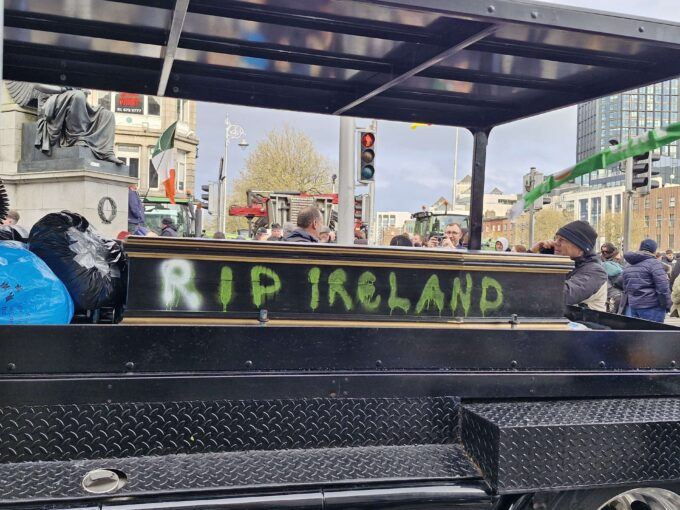
The liberal left again adopted a self‑defeating posture during the recent fuel and cost‑of‑living protests in Ireland. Instead of supporting the protesters or attempting to engage with them, they stood on the sidelines criticising. The republican left broadly supported the movement.
But that section of the left whose support base is largely urban middle‑class – the Greens, the Social Democrats and the Labour Party – refused to support this largely spontaneous movement.
Why this refusal? For the parties that withheld support, it is clear from their middle‑class base that they do not wish to challenge the status quo. They prefer to manage the capitalist system and scrape small crumbs from the table of the wealthy for ordinary people.
As for ordinary liberals, the racism visible among the extremist fringe who attempted to take over the protests – some of whom acted as spokespeople – put them off entirely. That is understandable to a point, but every time “progressives” and liberals refuse to be present when a bottom‑up movement is emerging, the power of the far right increases.
This refusal may stem from liberal puritanism, identity politics, a class disconnect, the rural/urban divide, and habits of cancel culture. But it also demonstrates a lack of understanding of social movements and bottom‑up mobilisation in Irish history.
Mixed Nature of the Protests
Certainly, the strong influence of the far right was evident in the protest. Many of the national spokespeople were on the right and even on the far right. Their demands were limited (a reduction in tax and excise, but no price cap on fuel) and sometimes bizarre (for example, calling for offshore oil drilling near Galway).
Moreover, full‑time unemployed far‑right grifters and wasters – “McGregorites” – promoted themselves, especially in Dublin. From there, they spread through social media and gave the protest more of a right‑wing appearance than was perhaps the reality. In other places – Laois, Wexford, Cork, Mayo – ordinary people, including some non‑Irish born, were involved. In some counties, such as Mayo, far‑right agitators were expelled from WhatsApp groups.
In Galway, a notorious fascist was expelled from the protest at the Docks, which had set up a barricade – something unseen in the West in decades, if not centuries. The protests clearly had different makeups and dynamics in different places.
The Land War, 1879-82
Historically, no bottom‑up mobilisation on a material issue in Ireland has ever emerged without ideological or organisational conflict. During the Land War, activists from the Land League and radical republicans had to grapple with priests and conservative middle‑class elements: shopkeepers and wealthy farmers.
When the Land League was being founded in Mayo in 1879, Fenians had to stand their ground against groups they disagreed with. Although Michael Davitt, a radical Fenian, drove the founding of the League in the county, Charles Stewart Parnell of the Irish Parliamentary Party was reluctant to participate because the organisation was emerging from below.
But Davitt eventually persuaded him, which added to the power of the League by combining grassroots Fenianism at the local level and parliamentary agitation in Westminster.
In Claremorris in July 1879, priests attempted to pass resolutions at a Mayo Land League meeting. Their aim was to centre Catholic education and the Pope’s temporal power. Fenians rejected the attempt on the basis that it would destroy the non‑sectarian character of the movement.
The following year, when the Land League was founded in Cork in September 1880, “Long” John O’Connor, a member of the Irish Republican Brotherhood (IRB), was elected secretary. He gave his first speech in October in Bantry. O’Connor claimed that all the land of Ireland was owned by 742 landlords who had never done a day’s work in their lives. That statement was too radical for the priests on the platform.
With the support of a conservative nationalist MP, O’Connor was driven from the stage. The priests told the crowd that they should act for the rights of both tenants and landlords, and they condemned the Cork republican for his seditious and socialist arguments.
Nevertheless, Fenian activists within the Land League continued to struggle with the right wing of the movement. By 1881, even the IRB’s Supreme Council – which included a landlord like John O’Leary – was focused solely on the national question rather than the social upsurge.
But local Fenian leaders persisted in their campaigning. It is true that Parnell betrayed the movement with the Kilmainham Treaty and that Davitt’s vision of national land redistribution was not achieved, thus acting as a warning against cross-class alliances. But the first cracks in structures of the landlords’ authority began to appear, and in that sense the most powerful and pro‑imperial class in the country was weakened.
Vacuum Left by Unions and the Left
This is not to claim that this movement over fuel and high prices is as powerful or important as that of 1879–1882. But as the cost‑of‑living crisis worsens due to inflation and the chaos of capitalism, it is clear that this issue will not disappear soon. The Dublin government has announced a package for farmers and hauliers in response, but it will do little for vast swathes of the population crushed by rising energy costs.
Liberals, social‑democrats and others, yet again, will have no interest in influencing events as they unfold. Their hands‑off approach has already contributed greatly to the growth of fascism.
The absence of trade unions and leadership on the left in building a movement around the cost‑of‑living and housing has also created a vacuum. The so‑called Raise the Roof coalition on housing (consisting of Sinn Féin, People Before Profit and others) was never a serious project. It merely staged symbolic protests instead of getting into the nitty‑gritty of building a movement around housing beginning with a focus on the local.
During the water tax protests of 2014–2016, the trade unions demonstrated leadership and, with the help of republican parties and campaign groups, were able to steer the burgeoning movement leftward. Without such an influence, it was obvious cranks would step into the breach during the fuel protests. To be fair, the spontaneity of the fuel protests may have caught some off guard.
Captain Rock and Pastorini, 1821-24
But the point around leadership is important and deserves another historical parallel. During an earlier period of agrarian agitation, known as Captain Rock’s Rebellion of 1821–24, this absence had a profound effect. Irish Republicanism had been in retreat since 1798 and Daniel O’Connell’s elite Catholic movement for Emancipation balked at the notion of a mobilised peasantry.
As J.S. Donnelly Jr. notes, this allowed what were known as Pastorini’s Prophesies (not dissimilar to modern conspiracy theories) to flourish. Those who promoted them in the 1820s, whom he termed “activist millenarians”, tended “to flourish in colonial countries, especially … after the indigenous peoples have incurred repeated defeats in their efforts to resist foreign domination through secular military or political means”.
Others like E.P. Thompson have argued more generally that when the working class is politically disorganised, people become vulnerable to authoritarian, moralistic, or anti‑structural narratives. Today migrants and others are blamed instead of the socio-economic structures of capitalism.
The Need for a Movement that Engages
The comparison here with the rise of far‑right narratives (if not hardened ideology) among ordinary people in Ireland in 2026 should not be overlooked. It is not too outlandish to claim that the Irish working class has suffered a series of defeats, is politically disorganised, and is fatigued by the current parliamentary strategies of the broad left.
The answer, certainly, is not to turn away in disgust at ordinary people because their politics are not fully developed or coherent. Despite the disreputable character of a section of the protesters, these mobilisations around fuel and the cost‑of‑living more generally demonstrated the power of coordinated action and disruption. They show that things can change when people act together, even loosely, and that collective pressure remains a tool capable of influencing entrenched systems.
Those waiting for an uprising or a “pure” movement from below will be waiting forever. It is clear that such people do not truly want a movement capable of achieving meaningful change – such a movement would be messy and difficult. The alternative, however, is remaining on the margins indefinitely.
Irish republicans and the left must lead on the cost‑of‑living by building movements and be ready, through preparation, to show leadership when future spontaneous upsurges on these material questions erupt.