Friday, May 15, 2026

Sci-fi or battlefield reality? Ukraine’s bet on swarm drones


By AFP
May 14, 2026


Ukraine claims to be the world-leader in drone warfare
 - Copyright AFP/File Genya SAVILOV


Barbara WOJAZER

Hundreds of AI-controlled robots operating in unison, talking to each other to autonomously attack targets — a dystopian vision of the future of war that Ukraine’s defence industry wants to make a reality.

Four years into the Russian invasion, the idea — known as swarm drones — is one of the hottest topics in military tech in a country that describes itself as the world-leader in drone warfare.

“There is a huge interest,” military expert Yury Fedorenko told the audience at the recent Drone Autonomy conference, held in an undisclosed location in the western Ukrainian city of Lviv.

“No matter who you speak to, they always say: show them to us. where are they, we want to see!” he added.

The conference was organised by Iron Cluster, a group of defence groups operating out of Lviv.

The prospect of drone swarms, groups of drones that can act together and fulfil set tasks without human intervention, has triggered both anxiety and excitement.

“We’ve been talking about swarm technology for a very long time, and we in the military have been waiting for it even longer,” said Volodymyr “Colt”, the head of civil-military cooperation at Ukraine’s 412th brigade.

“The only question is when it will happen,” he added.


– ‘A few years’ away –


Ukrainian military and defence industry figures told AFP Kyiv had made progress in getting the much-hyped technology off the ground.

Others cautioned it remains some way off and that swarm drones were just one part — albeit an eye-catching one — of the much broader race toward autonomous warfare.

The appeal is clear.

The swarms would allow a few operators to deploy dozens or hundreds of attack craft simultaneously — overwhelming enemy defences and helping Ukraine’s army offset Russia’s manpower advantage.

“The main purpose is to save the lives of our servicemen,” Andrii Lebedenko, deputy commander-in-chief, told AFP.

“Today we have such projects. They’re not large-scale, but they’re growing… mass deployment is possible in the coming years,” Lebedenko said.


– ‘Valid target’ –


Defence Minister Mykhailo Fedorov has championed the use of advanced technology to fend off Russian attacks, including launching the Defense AI Center A1.

Its head, Danylo Tsvok, told AFP “drone swarms are currently in the testing phase … there are a lot of things that we can’t say”.

Swarmer, a Ukrainian-US company, has emerged as a leader in the field, listing on the US Nasdaq exchange earlier this year.

US CEO Alex Fink told AFP the company had been deploying early swarm technology in combat since April 2024.

Its systems can autonomously deploy multiple drones to an area, after which human pilots step in to manually engage a target, or operators select targets and the drones carry out the strikes autonomously.

“It’s definitely not at the point where we can trust technology to make strategic decisions or even make tactical decisions about what’s a valid target,” Fink said in a telephone interview.

“We don’t want our systems to make that decision. We want the humans to be in charge.”


– ‘Manhattan Project’ –


At the AI defence conference in Lviv, there was some level of scepticism.

“Drone swarms are totally overhyped… because they make for a good sci-fi story and a visual image,” said Yaroslav Azhnyuk, head of the Fourth Law, which specialises in drone autonomy.

Autonomy, he argued, was about more than just drone swarms. It covered everything from navigation, target selection and attack execution — and could apply to all kinds of drones.

He compared autonomy to the development of Microsoft Word — concentrating on swarms was like obsessing over the button that makes text italic, instead of the whole programme.

“We’re focusing on massively scalable full autonomy,” he said.

“This is the Manhattan Project of our era,” he added — a reference to the US WWII initiative that produced the first nuclear weapon.

“Imagine if either the Nazis or the Russians got the nuclear bomb first. That would have been a very, very different world,” he said.

“Now imagine if they get the full autonomy first,” he said

Russia has set AI and drones as its top military priorities.

It has “likely fielded a fully autonomous unmanned system in combat”, according to an April 2026 report by Kateryna Bondar, an expert with the Center for Strategic and International Studies.

Anton Melnyk, co-founder of MITS Capital, set up to fund Ukraine’s defence industry, was blunt about the stakes involved.

“Either we will achieve this –- the Armed Forces of Ukraine, together with various NATO partners –- or the enemy will.”


Ukraine Strikes Black Sea Oil Terminals as Russia Unleashes Drone Barrage

explosion at Russian oil terminal
Ukraine hit the Black Sea oil terminal and port during its latest strikes (Special Operations Forces)

Published May 14, 2026 2:18 PM by The Maritime Executive


Widespread attacks by both Russia and Ukraine followed the end of the temporary ceasefire for Russia’s Victory Day Parade. Ukraine reports it was able to inflict serious damage on Russia’s energy infrastructure, while reports said Russia launched the largest sustained drone barrage of the war.

Russia launched a total of 1,428 drones and decoys over a sustained 24-hour period from Wednesday into Thursday, reports The New York Times. It termed it the “largest sustained daylong drone attack” since the start of the war, by its calculations. Ukrainian President Volodymyr Zelensky later asserted that Russia had launched more than 1,560 drones since Wednesday, as well as at least 56 missiles.

The capital city of Kyiv was one of the primary targets, but the attacks struck multiple parts of the country. Odesa Administrator Oleh Kiper reported a large-scale drone attack on port infrastructure. He said there were two waves with the Russians damaging equipment, property, and vehicles.

Ukraine, in return, intensified its ongoing campaign against Russia’s energy infrastructure. Ukraine’s Special Operations Forces reported they had targeted a key export and transshipment facility near the Kerch Strait. They highlighted that it was more than 200 miles from the front line.

Bloomberg is reporting that Ukraine’s strikes on the Russian oil infrastructure reached a four-month high in April. It writes that there were at least 21 attacks on refineries, pipelines, and tankers.



Pictures posted online showed large explosions at the Tamanneftegaz terminal, with reports of ongoing fires in the facility located near the Port of Taman, located on the Kerch Strait. Ukraine said the terminal is used for storage, transshipments, and exports of oil, fuel, diesel, and liquefied gases. There were two waves of attacks on Wednesday and again on Thursday at the terminal.

Ukraine also reported strikes on the Port of Taman and its energy terminal. They said the terminal could accommodate up to four ships at one time. They asserted that it was being used to provide fuel for Russian troops and as a major export hub.

Ukraine’s General Staff reported other energy-related strikes, including on the Yaroslavl oil refinery. They said it was used to produce gasoline, diesel, and jet fuel. They reported striking the primary oil refining units.

Russia’s oil production is projected to fall to a nearly 20-year low in 2026, according to reports in the Moscow Times. It writes that production levels in 2026 will be similar to 2009, citing the impact of the Western sanctions as well as Ukraine’s ongoing attacks.


Forest fire burns through Chernobyl

exclusion zone after drone crash


ByAFP
May 8, 2026


The site surrounding Chernobyl nuclear plant has been largely deserted since 1986, when the plant suffered a catastrophic meltdown 

- Copyright Ukrainian Chernobyl Radiation and Ecological Biosphere Reserve/AFP Handout

A large forest fire was burning through the Chernobyl exclusion zone on Friday following a drone crash near the defunct nuclear plant the previous day, Ukrainian authorities said.

Radiation levels at the site were within “normal limits”, authorities reported, adding that firefighters were working to contain the blaze.

An image published by Ukraine’s state emergency service showed a large column of white smoke billowing into the sky from the area, parts of which are closed off to the public due to high levels of radioactivity.

The site surrounding Chernobyl nuclear plant has been largely deserted since 1986, when the plant suffered a catastrophic meltdown.

“As of 10 a.m. (0700 GMT) on May 8, the approximate area of the fire was about 1,100 hectares (11 square kilometres, four square miles),” the Chernobyl nature reserve, which manages the site of the 1986 disaster, said.

The fire broke out on Thursday “as a result of a drone crash”, it said.

It did not say the origin of the drone.

Kyiv has repeatedly accused Moscow of recklessly attacking its nuclear sites, including the Chernobyl complex.

A Russian drone last year punctured a hole in one of the radiation shells covering the reactor unit that exploded in the 1986 disaster.

Ukraine’s state emergency service said rescuers were working to prevent the further spread of the fire.

“Due to strong gusts of wind, the fire is rapidly spreading across the territory, covering new sections of the forest,” it said.

“The situation is complicated by dry weather, strong winds and mine danger in certain areas of the territory, which significantly limits the possibility of extinguishing work.”

The exclusion zone suffered wildfires in 2020, which lasted several weeks and caused a spike in background radiation.

Ukraine only last month marked 40 years since the disaster.


Drones to fight school shooters? One US company says yes


ByAFP
May 15, 2026


The drones are designed to disable the attacker by flying right into him or her or spraying them with pepper gel - Copyright POOL/AFP Evan Vucci


Moisés ÁVILA

A new idea for combatting America’s horrific problem of school shootings is to unleash an unarmed drone to confront the attacker, like a giant buzzing insect.

It is the brainchild of a company called Campus Guardian Angel, which has pilot programs using the technology in Georgia and Florida, with growing interest in Texas. These drones have not yet been battle-tested, however.

The approach seems to reflect that part of America which says the way to address recurrent school shootings — part of the country’s broader gun violence epidemic — is not with stricter gun control laws but rather with weaponry, such as giving teachers guns.

The company says the new approach would work like this: when a potential shooter enters a school, a teacher hits an alarm on their cell phone to alert the police and as officers rush to the scene, a drone is activated from a pre-established position inside the school as a first line of defense.

These small, black, roughly square drones weighing about two pounds (one kilo) are piloted by humans in the Texas state capital Austin and can actually buzz around inside the school by navigating 3D maps that Campus Guardian Angel will have made beforehand.

The drones do not shoot bullets or any other kind of projectile.

Rather, they are designed to disable the attacker by flying right into him or her or spraying them with pepper gel.

Khristof Oborski, Campus Guardian Angel’s director of tactical operations, said the firm’s CEO Bill King observed that small drones were highly effective in attacks on the battlefield in the war in Ukraine.

“So he started thinking about how can you introduce this type of system to be able to combat a growing problem in the United States, with school shootings,” Oborski said.

Oborski explained that what the drone actually does depends on what the shooter or potential shooter does.

If a child with a gun is walking in a school corridor, the drone has two-way radio so human operators can talk to the attacker and try to persuade him or her to put down the weapon, Oborski said.

The operators are in constant contact with police so officers can, say, be guided to where the attacker is.

If the assailant is actually shooting people, “we go straight to either kinetic impacts or we use our less lethal JPX pepper gel on the suspect,” Oborski said.

In 2025, US schools endured 233 incidents involving firearms, according to a data base called IntelliSee.

One of the worst recent school shootings was in Uvalde, Texas in 2022, with 19 children and two teachers shot and killed. It took police 77 minutes to move in close enough to kill the attacker.


– ‘To be the nerd’ –


Campus Guardian Angel offers its services with yearly contracts, the fee depending on the size of the school and how many buildings it has.

Besides the pilot programs in Florida and Georgia, the company says some parents in Houston are interested in getting the drones set up in their kids’ schools.

“The best-case scenario is we put this in every single school in America and then never have to use it, right? Because it’s got a deterrent quality to it,” said King, a former Navy SEAL.

He said he is often asked if the drones are operated by artificial intelligence and the answer is no, which King said people find reassuring.

Alex Campbell, a 30-year-old operator in this system and professional drone-racing competitor, describes himself as more of a nerd than a soldier.

“To be the nerd behind the scenes, to help the heroes on this Earth saving us from the bad things happening, it’s really fulfilling to be able to have a hand in that,” Campbell said.


Energy-hungry German industries in decline since Ukraine war: data


ByAFP
May 15, 2026


Germany's chemical industry has been hit hard by higher energy costs 
- Copyright AFP Kirill KUDRYAVTSEV

Germany’s energy-hungry industries have suffered sharp falls in output since the start of the Ukraine war, data showed Friday, with little hope of an imminent rebound.

After Russia launched its invasion of Ukraine in 2022, Moscow slashed gas supplies to Europe amid soaring tensions with the West, sending up power costs for German industry.

Production in Germany’s most energy-intensive sectors fell by 15.2 percent between February 2022, the month when the conflict began, and March this year, according to statistics agency Destatis.

The decline in these sectors, ranging from chemicals and metal processing to glass and paper production, was sharper than for industry as a whole over the period, it said.

Over 53,000 fewer people were employed in the country’s energy-intensive industries by March this year, a 6.3 percent decline.

It is the latest bleak news for Europe’s biggest economy, which has been stagnating for years due to a manufacturing slump, weak demand for exports and the US tariff blitz.

There had been hopes the economy would recover this year, helped by hefty public spending on defence and infrastructure, but the energy shock unleashed by the Iran war is weighing heavily.

After an encouraging start to the year, recent indicators “point to a significant setback in the second quarter”, the economy ministry warned Friday.

“Rising prices, supply chain problems, and uncertainty are weighing on sentiment in both businesses and private households,” it said in a monthly report.

“The further economic outlook depends on how long the conflict in the Middle East persists and continues to disrupt trade routes and production capacities,” it added
GEMOLOGY

Myanmar says massive 11,000-carat ruby discovered in Mandalay


ByAFP
May 8, 2026


Myanmar announced the discovery of an 11,000-carat ruby, but did not give a precise value - Copyright Myanmar Radio and Television/AFP Handout

Myanmar said Friday it had discovered a massive 11,000-carat ruby, one of the largest ever found in the country renowned for its precious gemstones.

Unearthed in the Mogok area, the ruby was “exceptionally large, rare, and difficult to find,” the new military-backed government said in a statement.

“The giant ruby has a purplish-red colour with yellowish undertones and is considered to have a high-quality colour grade,” it added.

While smaller than a similar 21,450-carat ruby found in the same area in 1996, the recently discovered stone is more valuable “due to its superior colour, clarity, and overall quality,” the government said without giving a precise value.

Emperors, kings and warlords have long fought over the valley of Mogok in Mandalay region, where the unique “pigeon-blood” stones lie hidden.

The Mogok rubies are the most expensive in the world, with the highest-quality jewels fetching multi-million-dollar prices in an industry notoriously bereft of regulation.

Myanmar has been ruled by a junta since a 2021 coup that triggered a civil war, but its former military chief was sworn in last month as civilian president after a tightly restricted election.

Cuba faces ‘devastating’ ripple effects from US hit to mining


Havana, Cuba. Stock image.

Canadian miner Sherritt International Corp.’s decision to shut down its nickel operations in Cuba under US duress will weigh heavily on an economy that’s already starved for hard currency and fuel.

In addition to halting production of the battery metal, it means Cuba loses revenue from its share of refining operations in Alberta and a metals-commercialization operation that it ran in partnership with Sherritt out of the Bahamas, according to Omar Everleny Perez, the former director of the Center for Cuban Economic Studies at the University of Havana.

Sherritt also produces electricity, oil and gas on the island through a one-third stake in Energas SA, another joint venture with Cuba’s state electric and petroleum companies. Energas, which accounts for about 10% of national capacity, is crucial because it produces the reserve energy needed to power up the country’s aging thermoelectric plants after chronic blackouts, Everleny said.

“The biggest problems are going to show up in electricity production,” he said by phone from the Cuban capital. “This is a devastating blow to our economy.”

Sherritt didn’t respond to requests for comment on the status of those operations. Its shares were down as much as 10% on Friday in Toronto after dropping 42% a day earlier on the Cuba pullout news.

Cuba has been suffering days-long blackouts that have only gotten worse since the US imposed a near-total energy blockade on the island in January. Since taking office for a second time in 2024, President Donald Trump’s administration has been strangling the island’s economy as it tries to end 67 years of one-party rule in the Caribbean nation.

Washington has hit Cuba’s remittances, tourism and its international medical brigades — some of Havana’s top sources of foreign income, said Paolo Spadoni, a professor at Augusta University in Georgia who studies the island’s economy.

The US “has done an incredibly good job of going after their sources of revenue,” he said. “Now they’ve hit nickel exports; there’s very little left to go after.”

As late as 2021, nickel matte — a less refined nickel mixture — was Cuba’s top export, at $788 million, beating out tobacco, and raw sugar, according to data compiled by the Observatory of Economic Complexity. In 2024, the last data available, nickel had slipped to third spot at $88.6 million.

Sherritt has been running mining operations in Cuba since the 1990s and had defied the US embargo for years. That the company is finally pulling out now “is a significant concession to the strength of these sanctions,” Spadoni said.

Attention now turns to other international companies that do business in Cuba, including Spanish hotel operators, after the US signaled they would have about a month to wind down any operations with the country’s military conglomerate before facing potential sanctions.

US Secretary of State Marco Rubio said Sherritt was targeted because it “has exploited Cuba’s natural resources to benefit the regime at the expense of the Cuban people,” noting that it was using assets expropriated from US citizens shortly after the 1959 revolution.

Cuban Foreign Minister Bruno Rodriguez called the latest sanctions, which target foreign citizens and foreign entities operating in Cuba, an act of economic “blackmail and intimidation” that will “further hinder the functioning of the national economy.”

(By Jim Wyss)


US targets Cuban military, mine in new sanctions


ByAFP
May 7, 2026


The United States announced new sanctions on Cuban military conglomerate 'Grupo de Administracion Empresarial SA' (GAESA) whose Havana office is pictured here - Copyright AFP YAMIL LAGE
Jordane BERTRAND

The United States on Thursday imposed sanctions on a Cuban military conglomerate that controls nearly 40 percent of the island’s economy, as well as a Canadian mining company, as part of a mounting pressure campaign.

The sanctions announced by Secretary of State Marco Rubio target the Gaesa conglomerate as well as a joint venture involving Canadian mining company Sherritt, which in a near simultaneous announcement said it was leaving Cuba.


Gaesa was already under US sanctions.

The new measures were imposed under an executive order signed last week by President Donald Trump that outlines parts of the Cuban economy for which foreign banks would incur sanctions if they have transactions.

“Just 90 miles from the American homeland, the Cuban regime has brought the island to ruin and auctioned off the island as a platform for foreign intelligence, military and terror operations,” said Rubio, a Cuban-American and vociferous critic of Havana.

“Additional designations can be expected in the following days and weeks,” he warned.

Rubio said that Gaesa was “designed to generate income not for the Cuban people, but only for the benefit of its corrupt elite.”

The sanctions also targeted the conglomerate’s president, Brigadier General Ania Guillermina Lastres Morera.

A Miami Herald investigation based on purported leaked documents estimated that Gaesa had $18 billion in assets in early 2024, in line with the level of expenditure by the state itself.

Writing on X, Cuban Foreign Minister Bruno Rodriguez said that “with the additional measures of collective punishment announced today against Cuba, the US government confirms its genocidal intention against the Cuban nation and clears all doubts on the false nature of its pretexts to attack our country.”


– ‘Exploited Cuban resources’ –


Besides Gaesa, Rubio was also harshly critical of the Cuban investments of Sherritt, which mines for nickel and cobalt in the northeast of the island.

He said that Sherritt’s joint venture with the state had “exploited Cuba’s natural resources to benefit the regime at the expense of the Cuban people” and that it “profits from assets that were originally expropriated by the Cuban regime from US persons and corporations.”

In a statement Sherritt announced the immediate suspension of its participation in all joint ventures in Cuba and the repatriation of its expatriate staff.

It said the sanctions “materially alter” Sherritt’s ability to continue business in Cuba and “may also result in financial or other providers being unable or unwilling to continue to support Sherritt’s operations or other business activities.”

In mid-February, the company had already announced the suspension of its operations in Cuba due to the oil embargo imposed by the United States on the island.

Trump has mused about taking over arch-foe Cuba, which has been under a US embargo almost continuously since the 1959 communist revolution of Fidel Castro.

In January, he halted oil shipments from Cuba’s main supplier Venezuela and threatened other countries with tariffs if they sought to make up the shortfall.

Since then he has allowed only one Russian oil tanker through.

Three UN special experts said jointly Thursday that the fuel blockade amounted to “energy starvation,” and had “grave consequences” for human rights and development.


US gold firm taps mining veteran Warke for Venezuela project


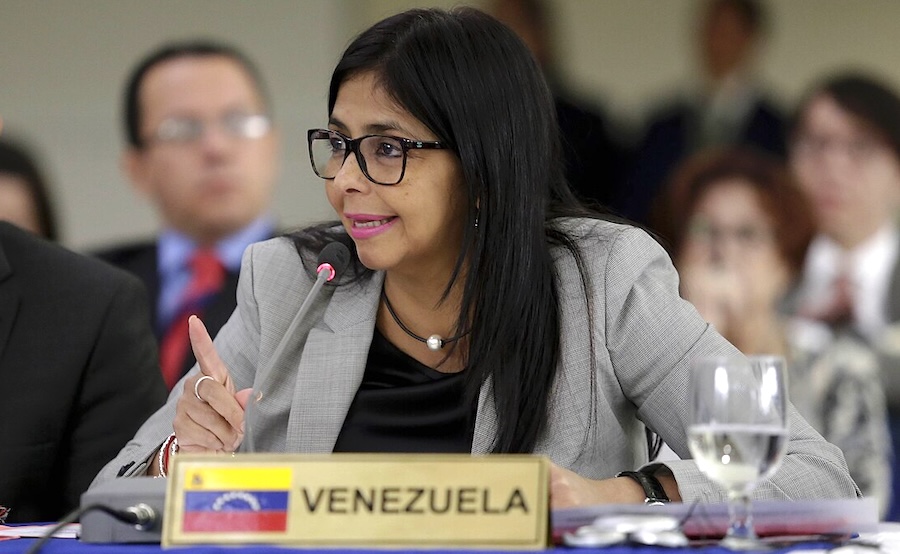
Venezuela’s interim President Delcy Rodríguez. (Image courtesy of El Salvador government |WikiCommons.)

A US-owned exploration firm has signed a deal with mining veteran Richard Warke’s company to advance a long-stalled gold project in Venezuela, the latest signal of renewed foreign interest in the country’s mineral riches.

Warke’s Augusta Capital Corp. will have the option to build a 50% ownership in Gold Reserve Ltd.’s stake in Siembra Minera by spending as much as $200 million to develop the asset, according to a memo obtained by Bloomberg News. The earn-in agreement says Vancouver-based Augusta Capital must spend the funds over four years, with at least $25 million within the next year.

Gold Reserve and Augusta Capital did not immediately respond to requests for comment.

The deal is the latest example of mining companies plotting a return to Venezuela after years of political turmoil and sanctions drove much of the industry away. Gold Reserve, a tiny junior mining company based in Washington, has sought for years to revive the giant Siembra Minera Project in southeast Bolivar State. The company estimates it holds 52.2 million bullion ounces.

Venezuela seized the mining project from Gold Reserve in 2008 under former President Hugo Chávez, with the company retaining a 45% interest in the asset. But the country’s new mining law, enacted by acting President Delcy Rodríguez’s administration in April, removes mandatory state ownership requirements for mining projects, potentially allowing Gold Reserve to reclaim its majority stake.

Under the new agreement, Gold Reserve and Augusta Capital will jointly negotiate with Venezuelan officials as they seek to restart development at the property, according to the memo.

Warke, a Vancouver-based mining entrepreneur, has built a reputation in the industry for developing and selling mining companies at multibillion-dollar valuations. He is the co-founder of Equinox Gold Corp., which agreed to buy Orla Mining Ltd. in a $5.1 billion deal on Wednesday. Warke is also a part owner of a number of sports assets, including the PGA Tour, basketball’s Boston Celtics and Fenway Sports Group, which owns Major League Baseball’s Boston Red Sox and English Premier League soccer team Liverpool FC.

Venezuela boasts vast mineral wealth, including conventional materials such as coal, gold and diamonds as well as critical minerals including bauxite, copper and coltan, a metallic ore that can be refined to extract tantalum and niobium.

Those reserves could support the Trump administration’s bid to reduce US dependence on China for minerals used in mobile phones, batteries, jet engines and other products.

The government has already taken steps — including buying stakes in mineral companies and exploring price floors to support production — to wean the US off supplies from Beijing after a trade spat last year halted the flow of some materials.

(By Jacob Lorinc)


Congo eyes deals with cobalt producers to tackle illegal mining


(Image courtesy of Enough Project | Flickr)

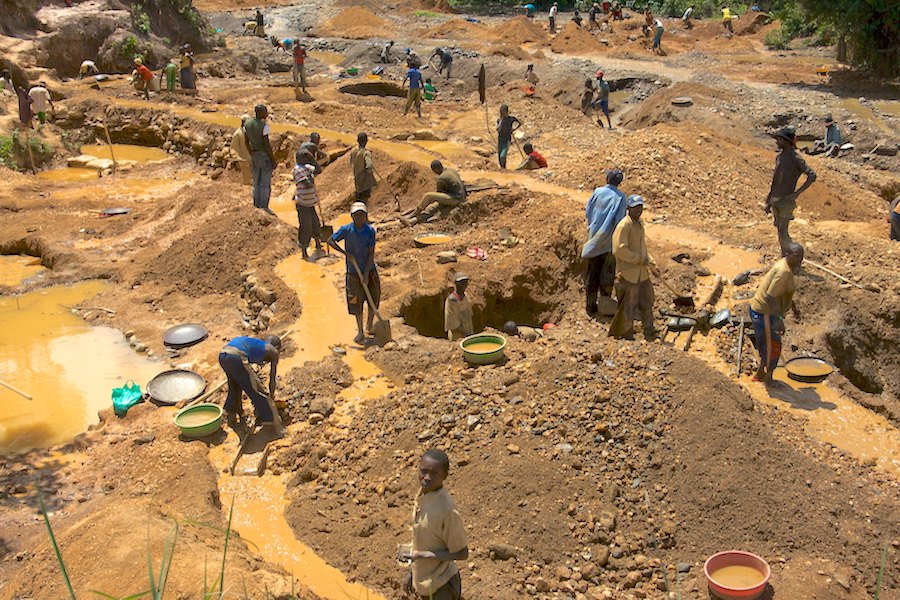
A state-owned company that holds a monopoly on the purchase of hand-dug cobalt in Democratic Republic of Congo is seeking to form additional partnerships with industrial producers to control illegal mining on their sites, the head of the group said in an interview.

So-called artisanal diggers who illegally enter mining sites have been a persistent risk for the country’s big copper and cobalt miners, including CMOC Group Ltd. and Glencore Plc. Hundreds of thousands of Congolese work in the industry, often under dangerous conditions, and the sheer number of diggers has made it difficult for the government and mining companies to protect their sites.

To tackle the problem, Congo’s Entreprise Generale du Cobalt is seeking to designate small areas of land on miners’ concessions for development by cooperatives of independent diggers, in partnership with the companies holding the permits, chief executive officer Eric Kalala said Wednesday.

“It’s one of the social solutions that we’ve offered to the industrials: To work with us to reduce the pressure,” Kalala told Bloomberg in an interview at the Cobalt Institute’s annual congress in Madrid. EGC would designate “squares” of land for artisanal use without changing the permit’s legal status, he said.

Formalizing the interplay between artisanal and industrial mining has been a struggle up to now, partly because miners have been reluctant to give up any of their valuable concessions, or open themselves up to legal liability. EGC is hoping to mitigate those concerns through new regulations released last year allowing it to enter into partnerships with mining companies to address the artisanal issue.

EGC signed its first deal in February with Eurasian Resources Group, which owns multiple copper and cobalt projects in the country, where the two minerals are often found together. EGC and ERG are still identifying sites for the project, Kalala said.

EGC is also talking with US company Virtus Minerals Inc. to implement a similar plan on their sites, he said. Virtus took over multiple copper and cobalt permits earlier this year amid a US-Congo economic pact signed in December aimed at helping American companies gain access to minerals critical for defense, energy and technology.

Virtus confirmed the talks in a message to Bloomberg.

The partnerships could be positive for mining companies anxious to deal with incursions on to their concessions, while also offering a viable living for Congo’s impoverished population, Bandi Mbubi, executive director of the Fair Cobalt Alliance, told Bloomberg Wednesday in Madrid.

“The reality is people are desperate so they just go to the mining concessions and everybody loses out, so it’s better to structure how you do it,” Mbubi said.

EGC, which launched operations in the fourth quarter of last year, is also looking for more partners to supply and process hand-dug ore, according to Kalala.

It’s currently working with Chengtun Congo Ressources Sarl, a subsidiary of China’s Chengtun Mining Group Co., to process its copper and cobalt, he said. Chengtun didn’t immediately respond to requests for comment.

EGC is exporting minerals sourced from the Kamilombe and Menuiserie sites around Kolwezi belonging to state-owned miner Gecamines, which is EGC’s main shareholder, Kalala said.

From the last quarter of 2025 through April, EGC shipped 4,125 tons of cobalt and 1,585 tons of copper, according to the company.

(By Michael J. Kavanagh and Annie Lee)

Lobito Corridor: Africa’s mega-project facing delivery test


ByAFP
May 6, 2026


The Lobito Corridor is meant to move minerals vital to the energy transition - Copyright AFP Phill Magakoe

François AUSSEILL

The Lobito Corridor mega-project linking three African countries is shifting from blueprint to proving ground in the global race for critical minerals.

Linking Angola, the Democratic Republic of Congo and Zambia, it was pitched as the West’s answer to China’s dominance in African mining.

Backed by more than $2.7 billion in pledged investment, the corridor is meant to move copper and cobalt, vital to the energy transition. For now, it remains a work in progress.


– Rail at the core –


The project aims to develop rail infrastructure to transport large quantities of minerals extracted in southern DRC and northern Zambia to Angola’s Atlantic Ocean port of Lobito for shipment to global markets.

The governments involved and the European Union — the project’s largest foreign backer — also want the corridor to drive regional development through farmland projects, logistics hubs and workforce training.

The corridor’s backbone is the historic Benguela railway, which runs west to east from Lobito to the Congolese border.

Much of the line was destroyed during Angola’s 1975-2002 civil war and rebuilt by a Chinese company until 2019.

Three years later, a European consortium — Lobito Atlantic Railway, or LAR — won a 30‑year concession to operate the line, transport minerals and manage Lobito’s mineral terminal.

The Angolan rail system already links up with a line serving DRC’s mineral-rich Lualaba province and is meant eventually to extend to Haut‑Katanga and into northern Zambia.


– US, Europe and China –


For years, the Lobito Corridor was billed as the biggest US infrastructure investment in Africa.

A US government agency, the Development Finance Corporation, provided a roughly $550-million loan to LAR to upgrade the railway and scale up mineral transport.

Washington’s enthusiasm culminated in a late‑2024 visit to Lobito by President Joe Biden, a first for Angola after Barack Obama in 2015.

Donald Trump’s return to the White House has clouded the picture. While he has openly coveted critical minerals, he has also favoured bilateral deals over large, multilateral ventures.

Europe has stepped firmly into the lead. Through the EU, its member states, the European Investment Bank and private companies, it has committed about 2 billion euros ($2.3 billion) to the project.

Just over a third is direct development aid, the EU’s ambassador to Angola, Rosario Bento Pais, told AFP in Luanda.

“We don’t want it to be just a transport corridor. We want it to be an economic development corridor that exactly will embrace all the development of the local economy and of the populations,” she said.

Although China lost its concession, Chinese mining firms are already using the corridor to move copper, LAR chief executive Nicholas Fournier said.

In late 2025, China signed a $1.4-billion agreement with Zambia and Tanzania to rehabilitate another line, the 1,800‑kilometre (1,120-mile) Tazara railway, securing long-term access to an Indian Ocean port for mineral imports.


– Why Lobito? –


Lobito, a port city of about 200,000 people some 500 kilometres (310 miles) south of Angola’s capital Luanda, sits at the western end of the Benguela line.

Its bay hosts a commercial port, oil and gas terminals and the mineral port. Naturally sheltered, it allows year‑round shipping.

Port capacity far exceeds current traffic, sharply reducing vessel waiting times and cutting costs for exporters.


– Missing link –


Zambia, Africa’s second‑largest copper producer, remains the corridor’s missing piece.

An old rail line links the country’s northern mining belt to Lubumbashi and Kolwezi in the DRC, but it requires a full overhaul — a project estimated at $4 billion and 10 to 15 years of work.

Zambia “remains very interested”, Pais said, but “the United States is no longer in the picture, at least for now.”

Working with partners such as the African Development Bank and Italy, the EU is exploring another option: upgrading a road from northern Zambia to the Angolan town of Luacano, where minerals could be loaded onto trains bound for Lobito.


– Risks –


A newly created intergovernmental agency must still prove it can smooth customs bottlenecks and regulatory hurdles.

Political uncertainty looms, with elections scheduled in Zambia in August and in Angola in 2027, raising the risk of policy shifts.

In April, torrential rains damaged sections of the Angolan railway, forcing LAR to rely temporarily on trucking while repairs were carried out.

Critics warn the project will be seen as just another chapter in the global scramble for Africa’s critical minerals unless it delivers tangible economic gains for communities in all three countries.


Africa’s Lobito Corridor chief tells AFP business, not geopolitics, drives strategy


ByAFP
May 6, 2026


Lobito Atlantic Railway CEO Nicholas Fournier says business takes precedence over geopolitics - Copyright AFP Phill Magakoe

François AUSSEILL

The chief executive of the Lobito Atlantic Railway (LAR) project to link southern African mines to an Angolan export port says his priority is the business of the operation, not the geopolitical tussle over Africa’s minerals.

LAR holds a 30-year concession to operate the Benguela railway, a key artery of the planned Lobito Corridor linking Angola to the mining belt of the Democratic Republic of Congo, with a longer-term ambition to connect to Zambia.

Western governments have promoted the corridor as an alternative export route for critical minerals at a time when China dominates much of the region’s mining and processing capacity.

But chief executive Nicholas Fournier told AFP in an interview in the port city of Lobito that his priorities are operational.

Around 70 percent of mines in the DRC are Chinese-owned and some are already using the line to ship copper and receive sulphur, which is used in copper processing, Fournier said.

End buyers, he said, are spread across regions.

“They are in the Americas, in Europe or in Asia,” Fournier said. “So we are totally apolitical.”

The company is owned by a consortium led by commodities trader Trafigura and Portuguese construction firm Mota-Engil, each holding 49.5 percent.

Belgian private rail operator Vecturis owns the remaining one percent.

Financing includes a loan of more than $500 million from the US International Development Finance Corporation (DFC), fuelling perceptions of Western backing.

“It is indeed a loan and we pay interest on it,” Fournier said.


– High demand –


LAR began operations in 2023 and is responsible for freight traffic on the Angolan section of the line, moving mining-related cargo as well as supplying fuel and gas to the country’s interior.

Passenger services are operated by Angola’s state-owned railway company Caminho de Ferro de Benguela (CFB).

Much of the route is single track and it only doubles at stations, where trains can pass each other, a constraint that limits traffic and makes timetable discipline critical.

“In 2025, we ran 5,000 trains in Angola,” Fournier said, adding that 90 percent were passenger trains and the rest freight for the domestic market and the DRC.

On the Congolese route, he said LAR can now run up to one “copper train” a day to Lobito and one “sulphur train” a day back toward the mines.

Copper accounts for the bulk of LAR’s Congolese freight. The metal is shipped as cathode plates in sealed containers, representing about 95 percent of the volume from the DRC.

LAR has also transported cobalt, packaged in one-tonne bags, and could carry other minerals either in bulk or packaged form.

“We receive a lot of proposals for manganese. For lithium, too. But for the moment, we are focusing on what is in highest demand: copper,” Fournier said.


– ‘Plan B’ –


Scaling up will require more work on the Congolese side of the border, he said.

The corridor’s economics would improve if trains could be lengthened from around 15 wagons to 25 and potentially to 50, but that depends on track condition and infrastructure.

LAR is supporting DRC’s state railway operator, SNCC, with expertise and a pre-financing mechanism to fund works on the track from the Angolan border to Kolwezi and on to Lubumbashi, the main city in the country’s copper belt.

“It will take time, but we are confident that within two years, we will have a continuous line from Lobito to Kolwezi,” Fournier said.

The Zambian segment of the Lobito Corridor — often described as the missing link — is not on LAR’s near-term agenda, he added, citing the scale and cost of rehabilitating the rail infrastructure.

“We have been approached for numerous discussions regarding a possible extension to Ndola in Zambia, but at present, it is not really on my radar.”

The interview came as Fournier was managing disruption from severe flooding in Angola’s Benguela province 10 days earlier that he said would require weeks of repair work.

“So we put a Plan B in place,” describing a 350-kilometre (220-mile) road haul before the cargo can be transferred back onto rail.

“Unfortunately, there’s no other way than using trucks in this type of situation.”

Negative views of US jump among Europeans: polls


ByAFP
May 8, 2026


Just 24 percent of Europeans view America positively, according to the survey
 - Copyright AFP Wojtek RADWANSKI

Three-quarters of Europeans hold a negative view of the United States, a sharp jump compared to late last year, according to a wide-ranging survey published on Friday.

Based on polling across the EU’s 27 member states, the share of people with an unfavourable opinion of the United States has risen 14 points since October-November 2025, to hit 74 percent.

Just 24 percent of Europeans now view the country positively, the Eurobarometer survey found.

By comparison, 83 percent of EU citizens polled held a negative view of Russia, 61 percent of China and 41 percent of India.

The shift coincides with a period of acute transatlantic tensions as US President Donald Trump has targeted the EU with waves of tariffs, threatened Greenland’s sovereignty and launched a new war in the Middle East.

The European Commission declined to comment on the survey findings.

“The US is an important partner for us, and we work with them constructively on all the topics of common interest we have with them,” said commission spokeswoman Arianna Podesta.

At the same time, 73 percent of respondents described the European Union as a “place of stability in a troubled world”.

And the survey found overwhelming support for deeper EU cooperation on defence and security, with 81 percent backing a common policy in the area — the highest level in 20 years.

The poll was conducted from mid-March to early April across all 27 EU member states, with more than 26,000 people interviewed.

Thursday, May 14, 2026

Op-Ed: USA Mega Drought — Food prices at serious risk, long-term water strategy questionable at best


By Paul Wallis
May 8, 2026


The scientists warned that 'long-lasting severe droughts like these are no longer rare events' — © AFP

Water resources worldwide are under severe pressure from demand, obsolescence, inefficiencies, and virtually comatose governance. In the US, it is, of course, worse. Politics inevitably gets in the way of actual management.

This drought is a historical monster. It’s been going on for many years. The drought map tells an unambiguous story of serious shortages. Now, just at the time grocery prices are developing a real sting, the drought will make it significantly worse.

Everyone’s on the same page to the extent that farmers can see the bullet coming. Early heat hasn’t helped.

For consumers, it’s likely to get pretty irritating as well as expensive. Water use rules are about to tighten up nationwide.

Even mainstream US media has condescended to mention the problems. Things must be pretty bad if they’re talking about something other than the Washington puppet show.

The story looks familiar. The Colorado River, which feeds the Hoover Dam, has been on life support for years with occasional mentions. The crisis is now just more bad news to go with the other bad news. The 26-year-long mega drought has effectively compromised the whole system, which is now simply trying to survive. Water overuse by seven US states and Mexico is cited as a major contributing factor. The national situation isn’t much better.

There’s much more to this horrendous, avoidable mess than just the current reality.

The future is already looking badly mismanaged before a word is said.

The Water Apocalypse is simultaneously dovetailing into the emerging plague of data centres and their huge water demands and related issues. It’s unclear how much water automation will drain from water supplies, but it’s not looking good.

What the world needs now is a rhetorical question.

Who’s going to win, the food deserts or Big Tech?

An already badly unbalanced and overloaded water supply is about to get robbed, it seems. Is anyone going to argue with the Technobratocracy? Unlikely.

The US has done itself no favors with its astonishingly blasé response to water issues over the last nearly three decades. US farmers and consumers have been on the wrong end of the gun for that long, and nothing has changed. The farmers are now in a very bad way, and consumers are likely to take the full force of inevitable price rises.

One overall general option for food suppliers is obvious but likely to be expensive. At least it’s something they can do to help themselves. Upgrading to “sky farms” and improved horticultural methods, with hands-on measures like water micro misters for watering commercial and domestic plants, and improved water systems efficiencies will help.

Recycling stormwater requires a lot of infrastructure, but will underpin macro water resources overall. Grey water recycling is also highly effective.

Getting rid of ancient leaky water mains wouldn’t hurt, either. A lot of water loss is typically in the water supply systems themselves.

Washington’s ability to manage a game of marbles isn’t even under serious discussion anymore.

This is a critical current and long-term big capital problem that could trash the wider economy progressively over the next few decades. Fixing the failing system and managing extreme demand on future water resources can’t wait till the next diaper change.

Droughts don’t take prisoners.

__________________________________________________

Disclaimer
The opinions expressed in this Op-Ed are those of the author. They do not purport to reflect the opinions or views of the Digital Journal or its members.
Conflict inflames tensions at Venice Biennale of Art


ByAFP
May 9, 2026


World conflict looms large over the Venice Biennale this year. 
- Copyright AFP MARCO BERTORELLO


Juliette RABAT

World conflict is looming large over the Venice Biennale this year with the simultaneous presence of Russia, Ukraine, Israel and the Palestinians, with one participant described the mix as akin to “inviting a serial killer to a dinner” among friends.

In the gardens where the world’s largest contemporary art event opens to the public Saturday, the Russian pavilion stands just a few paces from a deer sculpture that was rescued from the Ukrainian front lines.

Russia’s return to the Biennale — from which it had been absent since its February 2022 invasion of Ukraine — has sparked an international outcry since being announced in early March.

“Having them here in the Biennale is like inviting a serial killer to a dinner with your friends,” Ukrainian Culture Minister Tetiana Berejna said Thursday at Venice.

Those who argue that war should not make a difference when it comes to art and that all should be welcome at the prestigious festival are “absolutely wrong,” Berejna told AFP, adding that 346 Ukrainian artists have been killed by Russia since the war began.

“When Russia comes to our country, they destroy our libraries, they burn our books, they destroy our museums,” she said.

“Culture is targeted during this war.”

Besides Russia and Ukraine, other countries involved in conflicts are represented in Venice, including the United States and Israel, which attacked Iran in late February. Tehran, originally scheduled to participate, ultimately decided not to attend.

This year, Israel has a pavilion at the Arsenale, a former shipyard that serves as additional exhibition space at the Biennale, not far from Ukraine’s.

The Palestinians, whose state is not recognised by Italy, do not have their own pavilion but are represented by an exhibition dedicated to Gaza at the Palazzo Mora, titled “Gaza – No Words – See the Exhibit”.

“There’s really no way to describe the horror that was inflicted upon the Palestinians in Gaza, and I don’t think we would want to be in the same place as the people who did that,” said the exhibition’s curator, Faisal Saleh, founder of the Palestine Museum in the US state of Connecticut.

Police officers stationed near the Russian, Israeli and US pavilions serve as a reminder that the global geopolitical situation makes coexistence between countries at war — including within the realm of art — potentially explosive.

On Friday, a fresh pro-Palestinian demonstration brought together about 2,000 people in Venice, according to the Italian news agency Ansa, to protest against Israel’s presence at the Biennale.

– Artists as spokespeople? –

Russia’s pavilion became the epicentre of protests against Moscow’s presence on Wednesday, as members of the Russian activist group Pussy Riot and the Ukrainian feminist collective Femen staged their first joint action, appearing with hooded faces and breasts bared.

“If the Biennale were to start selecting not works but affiliations, not visions but passports, it would cease to be what it has always been: the place where the world comes together, and all the more so when the world is torn apart,” argued Biennale President Pietrangelo Buttafuoco Wednesday.

Israeli artist Belu-Simion Fainaru told AFP that the divisions at the Biennale were “destroying the meaning of art… to unite people”.

“I don’t think we should reduce the art world to a political arena,” added the sculptor, whose installation, “The Rose of Nothingness”, is a water basin fed by a drip irrigation system.

That position was also voiced by Italy’s Deputy Prime Minister Matteo Salvini who visited the Biennale Friday: “I don’t think American, Chinese, Israeli, or Russian artists are spokespeople for ongoing conflicts.”

At Palazzo Mora, about a hundred pieces of embroidery, hand-woven by Palestinian women in refugee camps, reproduce images “more vivid than photographs” of what has gone on in Gaza over the past two years, explained Saleh.

As if to calm the controversy, three evenings dedicated to reflection and “the theme of peace” were scheduled during the pre-opening week, featuring Russian director Alexander Sokurov and Palestinian writer and architect Suad Amiry.