Wednesday, May 20, 2026

US/Iran Energy Shock Damage Is Spreading in Asia

The US/Iran-linked energy crisis has shifted from a commodity shock to structural geopolitics, with Asia at the epicenter due to its dependence on imported oil and LNG. Global reverberations can no longer be avoided.


by | May 19, 2026

In the Asian shock, four transmission channels play a role. In the case of oil, elevated risk premium is coupled with physical tightening via Strait of Hormuz disruptions.

Lliquefied natural gas (LNG) poses a more severe constraint than oil and thus structural tightening of Asian gas balances. Meanwhile, coal substitution is experiencing a short-term demand surge in Asia, especially in India, China and Southeast Asia.

On the economic side, countries are struggling with imported inflation, foreign exchange pressure, and painful policy trade-offs between subsidy support and fiscal stability.

The shock is no longer a temporary price spike but a sustained supply reordering. The International Energy Agency (IEA) projects large-scale oil drawdowns. LNG disruptions are removing 20% of global LNG flows at peak disruption, which will tighten Asian supply chains significantly.

What happens in Asia won’t stay in Asia. In the coming months, the adverse reverberations will be felt across the world.

Asian Century and global growth at stake    

Asia remains the engine of global economic growth, with China and India alone contributing roughly 40–45% of incremental global GDP growth, while other major Asian economies – Indonesia, South Korea, Vietnam, and ASEAN collectively – add another 10–12%.

In the medium term, Asia’s share of global growth is expected to rise further as Western economies slow, driven by demographic momentum, urbanization, and productivity gains in services and manufacturing.

However, a severe energy crisis, particularly if it triggers sustained LNG and oil shortages, would sharply compress industrial output, inflation-adjusted consumption, and investment in these economies, potentially reducing global growth by 1–2 percentage points in 2026–27.

An Asian slowdown would have significant spillovers to the US, Europe, and Japan through trade, investment, and financial channels. Reduced Asian demand would depress exports of machinery, electronics, and consumer goods from these regions. Higher energy prices would further weigh on consumption and industrial costs. Financial markets could face increased volatility, amplifying capital flow disruptions.

In Japan, the combination of energy dependence and weaker regional demand could sharply constrain growth, while Europe and the US would experience slower industrial output and dampened inflation-adjusted consumption, reinforcing the global drag from the Asian energy shock.

Oil tightness, LNG constraint, brief coal rebound

Oil remains volatile but more flexible than gas. Prices surged above $100/bbl during peak disruption and remain elevated ($90–100 volatility band in stress conditions)

Strait of Hormuz instability has removed millions of barrels/day of export capacity. OPEC+ spare capacity is partially offsetting but insufficient to normalize inventories. Inventories are falling at record pace, reducing the buffer against further shocks.

Unlike earlier cyclical oil shocks, this episode is characterized by structural inventory depletion, making price spikes more persistent even if supply partially recovers.

Nonetheless, natural gas is the primary stress point for Asia. Up to 20% of global LNG supply was disrupted at peak due to Hormuz-linked flows. Asian LNG prices surged above $20/MMBtu in multiple spot windows.

Northeast Asian importers (Japan, Korea, China, Taiwan) entered emergency procurement and rationing. Long-term contracts are under stress due to force majeure risks and shipping rerouting constraints.

Asian LNG imports have dropped sharply. Qatar/UAE-linked exports remain vulnerable due to chokepoint exposure. LNG is increasingly perceived in Asia as less reliable as a transition fuel, accelerating diversification away from gas-heavy strategies in parts of the region.

Then there is the curious rebound of coal, temporarily distorting markets. Asia’s immediate adjustment has been substitution, not demand destruction. China, India, Indonesia and other countries have increased coal burn in power generation. In several ASEAN economies, this is increasingly seen as short-cycle substitution, not structural reversal.

Renewables deployment acceleration continues in parallel (especially China, India). 
How are countries coping

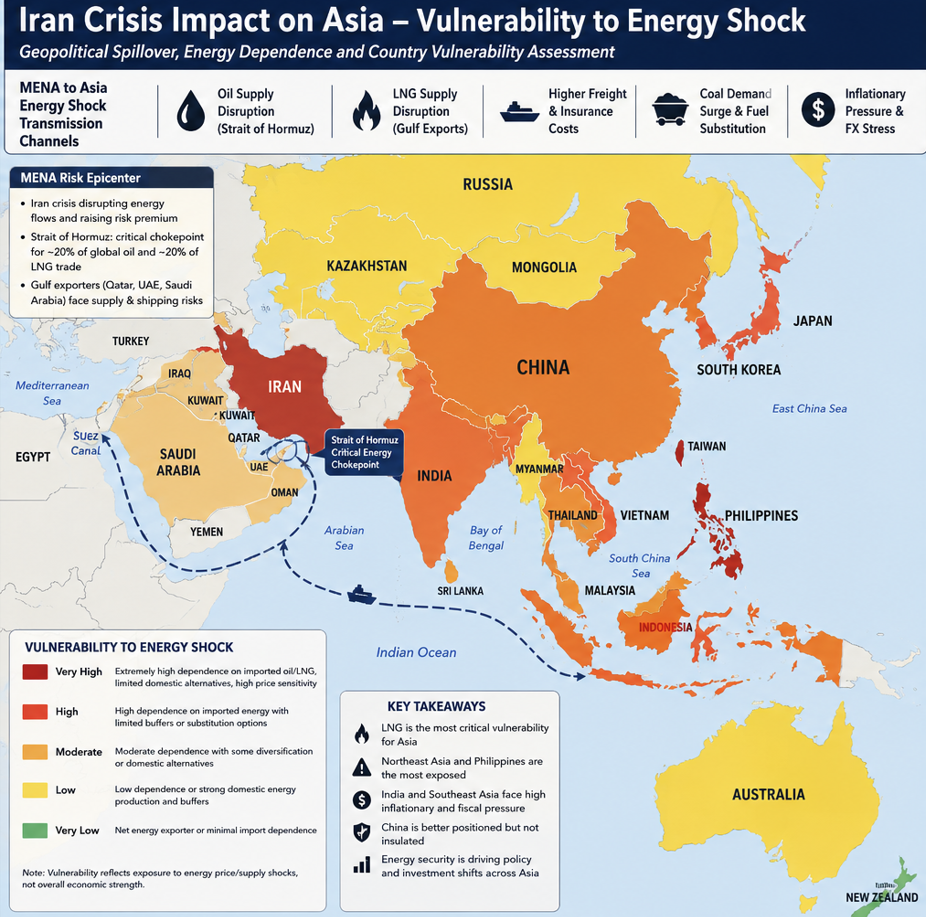
China is managing a dual challenge: LNG exposure plus industrial cost pressure. Hence, the simultaneous deployment of coal and renewables. Strategic LNG diversification has increased from the Middle East to Russia, US and Australia. Energy security is now embedded into industrial policy response.

India is highly exposed to imported LNG and oil inflation. Strong coal buffer limits crisis severity but increases environmental cost, which is already soaring with the nation’s broad takeoff. Unsurprisingly, fiscal pressure is rising from fuel subsidies. The net effect is manageable but inflationary growth drag.

Japan and South Korea are structurally most exposed to LNG disruption. So, emergency procurement and demand management measures have been activated, with the acceleration of nuclear restarts and efficiency gains. Now energy security dominates macro policy debate.

Southeast Asia (Indonesia, Vietnam, Thailand, Philippines) is highly price-sensitive to LNG demand. Consequently, LNG project cancellations and delays have a painful impact, which is rapidly translating to political volatility. Hence, the efforts to re-optimize coal in Indonesia and Vietnam.

Longer-term shift prevails toward renewables and regional grid integration. But as energy reserves are diminishing, the focus is on the short-term. To paraphrase Keynes: in the long-run, we’re all dead. 

From economic transmission to energy shift

The energy shock is feeding directly into consumer price index (CPI) via fuel, logistics, and fertilizers. Hence, the secondary pass-through into food prices, notably in South Asia.

Foreign exchange is under severe pressure as import-dependent Asian economies are facing severe currency depreciation pressure. Before the crisis, US dollar was less than 58 Philippine peso; now, close to 62. Meanwhile, central banks are forced into tighter-than-expected monetary policy stance.

Industrial slowdown risk is increasing. Energy-intensive manufacturing margins are compressed. Fertilizer, petrochemicals, and steel sectors are most exposed.

The crisis is accelerating three structural shifts. The first entails the move from LNG expansion to LNG risk hedging.

Second, the past objective to move away from fossil transition has been superseded by energy security primacy.

Third, electrification has accelerated. Renewables and storage investment are front-loaded. Future is not next year. It’s now.

Trump–Xi summit: hope for stability 

Prior to the summit, analysts hoped that the US-China talks could serve as a stabilizing variable for global energy markets, in three ways.

Strategic signaling fosters oil price stabilization, just as US–China coordination reduces demand-side geopolitical uncertainty. The potential easing of tariff and geoeconomic tensions could support global demand expectations.

Second, LNG trade realignment suggests that China may diversify LNG imports further from politically sensitive corridors. US LNG exports could benefit from strategic trade normalization, while Europe–Asia LNG competition could moderate if US-China trade improves.

Third, there is the political minefield of sanctions and Iran-related diplomacy: Even limited coordination could reduce escalation probability in the Middle East, which is vital to avoid extreme oil price spikes.

From the standpoint of the energy markets, the summit was less about immediate supply restoration and more about reducing geopolitical volatility embedded in energy pricing. But the success of the summit will be determined by the markets only in its aftermath.

Unsettling scenarios for 2026–27 

Base scenario: Partial stabilization of the Middle East conflict proceeds without full resolution. Hormuz remains intermittently disrupted but not fully closed. LNG supply is partially restored but tight. Oil inventories rebuild slowly but remain below norm. Brent crude varies around $85–105/bbl and LNG Asia spot at $12–20/MMBtu. Inflation stays elevated but manageable. Asia faces growth drag but no recession.

Optimistic scenario: Diplomatic stabilization is supported by US–China coordination following the summit. Shipping lines are gradually reopened. LNG infrastructure is partially restored. OPEC+ increases output into recovering demand. Brent crude falls to $65–85/bbl and LNG to $8–14/MMBtu. Inflation falls sharply in Asia. Policy easing resumes globally and energy transition investments accelerate again.

Pessimistic scenario: Renewed military escalation takes off in the Iran–Gulf theater. Hormuz’s closure is sustained or repeated. LNG infrastructure damage spills over in Qatar/Gulf. Severe inventory depletion triggers panic buying. Brent crude soars to $110–140+/bbl and LNG climbs to $20–35/MMBtu. Severe imported inflation shock spreads, with industrial slowdown and rationing risk in parts of Northeast Asia. Renewables and coal substitution surge simultaneously. With financial volatility, emerging market currencies fall and capital flight resumes.

The 2026–27 outlook is at best clouded in uncertainty. The concern is that it will morph into high plateau volatility.

The original version was published by China-US Focus (US/Hong Kong) on May 15, 2026.

Dr. Dan Steinbock is an internationally recognized visionary of the multipolar world and the founder of Difference Group. He has served at the India, China and America Institute (US), Shanghai Institutes for International Studies (China) and the EU Center (Singapore). For more, see https://www.differencegroup.net 


Senators Propose To Head Off ‘Automatic’ Draft Registration by Repealing Selective Service


by | May 20, 2026

On May 14th, Senators Ron Wyden (D-OR), Rand Paul (R-KY), and Cynthia Lummis (R-WY)  reintroduced the Selective Service Repeal Act, S. 4537).

This bill already has the endorsement of dozens of peace and antiwar groups, draft resisters, religious organizations, antiwar feminists, and civil libertarians.

This bipartisan bill to abolish the Selective Service System (SSS) and end preparations for a military draft has been proposed in each session of Congress since 2019, but has yet to get a hearing or a floor vote in either the House or Senate.

The timing of this bill is more critical than ever: Unless Congress takes action before December 18, 2026, the SSS will start collecting data from other Federal agencies to try to register potential draftees “automatically”. The White House is currently reviewing regulations to implement that change in the draft law, which was buried in the annual defense (sic) bill enacted in December 2025.

The garbage-in, garbage-out process of automated and involuntary registration won’t produce a list that’s complete, accurate, or fit for the purpose of reliably and provably delivering induction orders. But it will allow war planners to continue to pretend that a draft is available as a fallback, so they don’t have to consider whether enough Americans will fight the wars they are planning, even if they prove bloodier than expected. And it will produce a list that’s vulnerable to misuse and weaponization.

“If a war is worth fighting, Congress will vote to declare it and people will volunteer”, Sen. Paul said in in reintroducing the Selective Service Repeal Act. According to Sen. Wyden, “The Selective Service is an outdated program that costs millions of taxpayer dollars to prepare for a military draft that Americans don’t want or need. There is no need to replicate the same draft that sent two million unwilling young men to war 50 years ago.”

The attempt at “automatic” draft registration will inevitably be a fiasco. The only way to head it off is to end draft registration entirely. That won’t happen unless Congress feels public pressure — soon.

In the past, the  Selective Service Repeal Act has received significant bipartisan support in the House, but as of now it’s been reintroduced only in the Senate in the current Congress. Opponents of the draft should push their Representatives to sponsor a House version as soon as possible.

The Selective Service Repeal Act is unlikely to be enacted as a standalone bill, especially in the current Congress. It probably stands a chance of approval only if it is included in the National Defense Authorization Act (NDAA) for Fiscal Year 2027. So it’s critical to find members of the House and Senate Armed Services Committees who will introduce the Selective Service Repeal Act as an amendment to the NDAA, while the NDAA is still in committee.

Draft registration failed, but the hapless Selective Service System and its network of undertrained and unready draft boards have lingered, zombie-like, for decades. “Automatic” registration won’t work and will cause new problems. Tell Congress it’s time to end draft registration entirely and stop pretending that Americans would accept or comply with any sort of military draft.

Edward Hasbrouck maintains the Resisters.info website and publishes the “Resistance News” newsletter. He was imprisoned in 1983-1984 for organizing resistance to draft registration.

Bolivia shuns emergency rule as Morales-backed protests tighten grip on La Paz


Authorities reported more than 95 arrests following clashes in which protesters used dynamite charges, fireworks and stones against riot police, who responded with tear gas and chemical agents.

By Mateo Palacios May 20, 2026

Bolivia’s government rejected calls for a state of emergency on May 19 even as escalating protests led by supporters of former president Evo Morales paralysed key transport routes, triggered violent clashes in La Paz and deepened fears of economic collapse.

President Rodrigo Paz instead ordered a reinforced police and military deployment around the capital while insisting security forces would continue operating in a “deterrent” role without lethal weaponry.

"Those seeking to destroy democracy will go to jail," Paz warned last week.

The unrest entered its third week after thousands of demonstrators descended from El Alto into central La Paz demanding Paz’s resignation and fresh elections within 90 days. Protesters linked to Morales’ hard-left political movement Evo Pueblo, alongside miners, coca growers and labour activists from the Central Obrera Boliviana (COB), attempted to breach police cordons protecting Plaza Murillo, home to the presidential palace and congress.

Authorities reported more than 95 arrests following clashes in which protesters used dynamite charges, fireworks and stones against riot police, who responded with tear gas and chemical agents. Public buildings and private businesses suffered extensive damage, while several commercial premises were looted and burned.

Speaking during a rally in El Alto, Cochabamba peasant leader Nelson Virreira warned Paz he would face “social convulsion” if he refused to resign voluntarily.

“We are offering Rodrigo Paz a peaceful exit,” Virreira said in remarks broadcast by coca growers’ radio station Kawsachun Coca. “Otherwise, he will leave through the roof with the rebellion of the people.”

The government accused Morales' loyalists of attempting to force a change of power through anti-democratic means. Presidential spokesman José Luis Gálvez said officials had identified armed groups infiltrating demonstrations and circulated footage allegedly showing members of the indigenous activist group Ponchos Rojos carrying weapons and calling for civil war.

Interior vice-minister Hernán Paredes said anyone carrying firearms or dynamite would be arrested. He confirmed police detained a former electoral candidate carrying explosives and fuses in a backpack near protest zones in La Paz.

Authorities are also investigating the movement of large sums of money allegedly arriving from Chapare, Morales’ coca-growing stronghold, to finance road blockades around the capital.

The protests have exposed the fragility of Paz's centrist administration only months after he ended nearly two decades of MAS rule, which collapsed at last year's election amid an internal feud between Morales and former president Luis Arce. Paz took office in November without a congressional majority and inherited a severe economic downturn marked by fuel shortages, inflationary pressure and declining foreign reserves.

His government axed fuel subsidies shortly after taking office, pushing up transport and consumer costs across the country. Analysts say the administration has struggled to implement broader reforms needed to stabilise Bolivia’s worst economic crisis in four decades.

Road blockades have intensified shortages. Bolivia’s highway authority said more than 40 blockade points were active across six departments, including La Paz, Oruro, Cochabamba, Chuquisaca, Potosí and Santa Cruz.

More than 130 fuel tanker lorries remained stranded on highways as diesel and petrol shortages worsened nationwide. Hospitals in La Paz declared emergency conditions after reporting shortages of oxygen and medical supplies.

Business groups warned the country was approaching institutional and economic paralysis. The National Chamber of Commerce estimated losses above $50mn per day, while the Bolivian Institute of Foreign Trade (IBCE) said cumulative damage from the blockades had already surpassed $500mn.

Rather than imposing emergency powers, the government opted to establish humanitarian corridors coordinated with neighbouring countries including Argentina, Chile and Ecuador to secure food and fuel deliveries into major urban centres.

“There is no possibility of a state of emergency,” Government Minister Marco Antonio Oviedo said in a radio interview. “We will instead take tough and strict measures with greater police and military presence.”

Vice-President Edmand Lara called for unconditional national dialogue to prevent shortages from evolving into a humanitarian crisis.

The violence has already left at least four people dead since the blockades began. Among them was Alberto Cruz Chinche, an indigenous community leader associated with the Ponchos Rojos movement. According to Gálvez, Cruz Chinche died after falling into a trench dug by protesters themselves near a blockade point.

Other victims included two women unable to access timely medical treatment because of road closures and a 20-year-old woman whose death was reported in El Alto on May 14.

Morales, who governed Bolivia between 2006 and 2019, has continued encouraging demonstrations from Chapare, where he has avoided arrest since 2024 over allegations involving the abuse of a minor in 2016. A second detention request related to the same case was issued earlier this month.

Supporters of the controversial former president have reportedly secured an unused airstrip in Chapare amid fears authorities could attempt to detain him.

The crisis has also generated diplomatic tensions. While receiving support from the United States and several Latin American governments, Paz's administration pushed back against comments by Colombian President Gustavo Petro, who described events in Bolivia as a "popular insurrection." On May 20, the government ordered Colombia's ambassador to leave the country, citing sovereignty concerns and non-interference in internal affairs.

Meanwhile, Morales' allies continue mobilising supporters in rural and indigenous communities, framing the protests as a response to economic hardship and alleged government repression.

Despite mounting pressure, Paz has refused to negotiate directly with Morales’ faction, insisting his administration will preserve constitutional order while avoiding measures that could deepen political polarisation.


 Bolivia: Paz Government Using Lawfare Against Protesters, “Terrorists” and “Drug Traffickers”

 May 20, 2026

Image by Wikipedia.

In Bolivia, after weeks of protests against the proposed privatization of indigenous lands, the Rodrigo Paz government is setting the stage for mass repression against political opponents. The president, who calls himself a democratic centrist, has unleashed a systematic campaign of criminalization and stigmatization against Bolivia’s indigenous and popular movements.

What we are witnessing is the deliberate rhetorical construction of an enemy within, designed to legally and politically justify the dismantling of democracy, the Plurinational State, and the rights of indigenous peoples along with them.

From the highest levels of government, there has been a highly coordinated narrative that the protesters are not legitimate, organic, peaceful citizens exercising their constitutional rights, but rather, in rather Orwellian terms, threats to the democratic order and progress.

In an interview at the Casa del Pueblo, Vice Minister of Indigenous Justice and Coordination with Social Movements, Jorge García, laid out the administration’s line with striking candor. He accused the blockade leaders of being “completely radicalized, identified with the movement of Evo Morales,” and claimed they are subsidized by the former president’s political machinery.

García suggested using the State’s legal apparatus to pursue these social movements, which he linked directly to “narcotrafficking.” He accused the MAS of having “kidnapped Bolivia, isolated us from the world so we couldn’t know the truth of what was happening here; they have destroyed Bolivia.”

President Paz himself has dismissed the protesters with contempt. “Under ideological arguments, they want to generate tribune arguments because they have neither sociological nor philosophical density.”

Minister of Public Works Mauricio Zamora has accused the movements of being financed by Evo Morales, who is tied to drug trafficking, saying “the blockades have always brought death and been used for social convulsion.” The Minister of the Presidency, Jose Luis Lupo, has said the protests are used to destabilize Bolivia, faced with a “Black May.”

The Ministry of Productive Development issued statements blaming blockades for price hikes, referring to “so-called protesters,” while painting them as illegitimate. Representatives of the state security apparatus have said they will use “progressive and proportional force,” with rumors they will use live ammunition against blockaders.

Former president Carlos Mesa and right-wing leader Tuto Quiroga have joined the chorus, calling protesters “violent minorities,” with their supporters referring to protesters as “dirty” and “uncivilized” “Indians” — a racial slur that has been lobbed at the indigenous resistance since the colonial era. On social media, thousands of comments label demonstrators “terrorists,” “authoritarians,” “drug traffickers,” “fraudsters,” and a wide range of racist and classist slurs.

The protests, despite the government and right-wing opposition’s best efforts, are not marginal. The tens of thousands of Red Ponchos (an Aymara territorial defense force), the Bolivian Workers’ Union (COB), the Rural Teachers’ Union, mining unions, and indigenous communities from the Amazon (who walked all the way from there to La Paz) are blockading roads across La Paz, El Alto, Cochabamba, and Lake Titicaca. These are the largest protests since the Paz government took power.

The Bolivian Highway Administration (ABC) has reported at least 41 blockade points, paralyzing key routes and cutting access to the Peruvian border, Sucre, Oruro, Potosí, and Santa Cruz. Access to critical supplies have been affected by the blockades.

The government’s response has been swift and brutal. On the morning of May 16, a contingent of 3,500 military police intervened at Río Seco in El Alto with tear gas, riot gear, and rubber bullets, apprehending dozens, including journalists. Some protesters were brutalized by police. On May 18th, the police put up barricades across downtown La Paz, and evacuated key government buildings. I witnessed a standstill attack between the Red Ponchos and security forces at the Judiciary building, one block from the Casa del Pueblo.

Similar operations followed in other areas, a continuation of the repression from days prior, that is almost certain to escalate. One protester nearly lost an eye, while another has reportedly died. Journalists have also been harrassed by police, tear gassed, and pushed out. Over 100 protesters and journalists have been arrested.

The Wiphala, the indigenous flag that symbolizes the Plurnational State and pro-indigenous democracy, has been quietly removed from public spaces, including the Plurinational Assembly and the Casa del Pueblo, the seat of the executive. The government no longer defends the rights of indigenous peoples. Counter-protesters are openly calling the Wiphala a “terrorist symbol,” with some stepping on it in public squares. One group of counter-protesters on May 18th burned the Wiphala in front of indigenous protesters.

Vice President Edmand Lara, a populist anti-corruption crusader and former police officer whom social movements have embraced as an ally (which, according to all accounts, immensely helped Paz win the presidential election last year), issued two powerful statements breaking with Paz. The statements are part of a series of direct rebukes and insults from “Captain Lara” against Paz.

Lara condemned “the indiscriminate use of chemical agents and any action that violates the integrity and fundamental rights of citizens, particularly elderly persons, pregnant women, children and girls.” He exhorted police and armed forces to act with “responsibility, professionalism, and strict adherence to protocols on the rational and proportional use of force.”

He condemned the intimidation of press workers. And he made a direct call to Paz: “Prioritize dialogue and conciliation as fundamental mechanisms for the peaceful resolution of social conflicts.”

Most significantly, Lara invited the Inter-American Commission on Human Rights to monitor the situation.

The COB has already stated that protests will not stop, despite the COR El Alto signing a deal with the government and being accused by protesters of selling out. The government has been signing deals with certain social movement factions to get them to defect, in a “divide and conquer” strategy, buying them off while jailing opposition leaders and repressing remaining blocks.

The Paz administration has systematically dismantled the legal and institutional framework that once protected Bolivia’s plurinational democratic character. They have dismantled the Ministry of Justice, and practically annulled the results of the judicial elections from last year. They have jailed former president Luis Arce, taking away his rights to a lawyer and due process.

They have laid the groundwork to go after the COB, student unions, and other socialist organizations. Perhaps most chillingly, they have released the 2019 coup plotters — former interim president Jeanine Áñez and Santa Cruz governor Luis Fernando Camacho — figures convicted for sedition, terrorism, and crimes against humanity for their role in the illegal overthrow of Evo Morales, backed by the United States and the Organization of American States. The coup government employed death squads and the state to target and even kill opposition, while preventing the democratic will from being upheld.

Former indigenous-socialist president Evo Morales himself has issued warnings. In a statement, Morales alleged that the United States ordered the Paz government to execute a military operation, with the support of the DEA and SOUTHCOM, to detain or kill him. Among the architects, he named former right-wing minister Carlos “Zorro” Sánchez Berzaín, who fled to Miami after the 2003 Black October massacre, and Paz’s Vice Minister of Social Defense Ernesto Justiniano, currently in Washington. Justiniano has said “there will be a DEA office in Bolivia” this week.

Meanwhile, Argentina has sent a Hercules aircraft reportedly carrying tear gas and police equipment, disguised as “humanitarian aid” with food and medicine shipments. Milei, who is fighting his own war on democracy at home, has expressed solidarity with Paz, arguing the protesters destabilize Bolivia and block “liberty and progress.”

Bolivia, as does Latin America in its autocratic shift, faces a dark moment in its short democratic history, where indigenous protesters are labeled by the state as illegitimate terrorists, drug-traffickers, and obstacles to progress to be crushed. Soon, with promised U.S. involvement against “narcoterrorism” and support from other Latin American autocracies, that moment may get even darker.


Bolivian Government Charges Labor Leader

With Terrorism as Police Crack Down on

Protests

The leader of the country’s main labor federation said officials were responding to protesters who have marched hundreds of miles in recent days with “militarization and repression instead of listening to the people.”


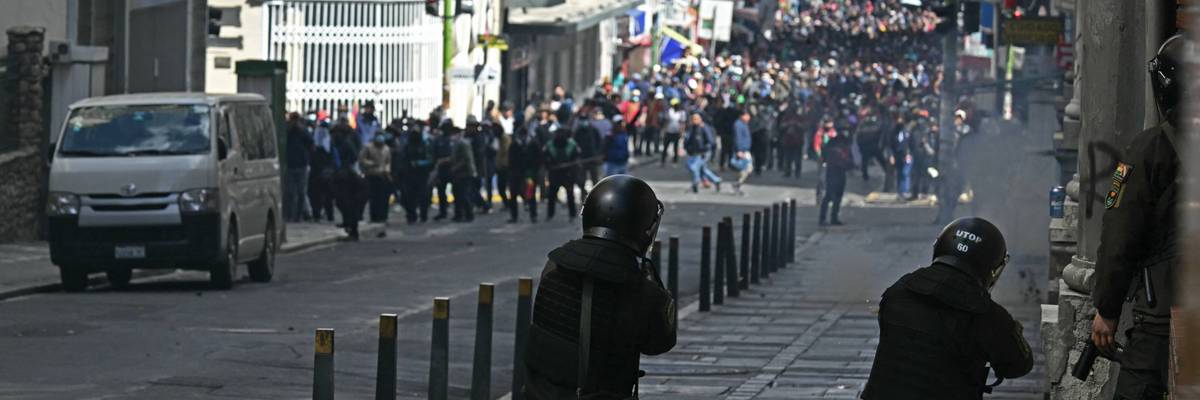
Riot police fire tear gas at demonstrators during a protest demanding the resignation of Bolivian President Rodrigo Paz, in La Paz, on May 18, 2026.

(Photo by Aizar Raldes/AFP via Getty Images)

Julia Conley
May 19, 2026

A leader of Bolivia’s main labor federation, the Bolivian Workers’ Union, said late Monday that the country’s public prosecutor is “trying to silence” mass protests that have included Indigenous communities, miners, peasants, and teachers in recent days, as the government issued arrest warrants for labor and grassroots organizers.

TeleSUR reported that State Attorney General Roger Mariaca confirmed his office was charging Mario Argollo, executive secretary of the union, known in Spanish as Central Obrera Boliviana (COB), with public instigation to commit crimes and terrorism.

“They will not subdue us in the struggle we have undertaken,” Argollo said in a statement. “They are trying to silence us as leaders with popular actions and criminal charges.”

Drop Site News also reported that the public prosecutor issued an arrest order targeting Justino Apaza Callisaya, a leader of the Federation of Neighborhood Councils of La Paz (FEJUVE), “an influential grassroots organization tied to urban protest movements and labor mobilizations.”


The office is also reportedly investigating “several individuals” following COB’s declaration of a general strike on May 1.

“The accused are being investigated for extremely serious offenses including: public incitement to commit crimes, criminal association, terrorism, financing terrorism, attacks on transportation security, [and] attacks on public services,” reported Drop Site.

The mass mobilization has included dozens of road blockades across the country as the union and other groups have demanded the resignation of President Rodrigo Paz, whose administration ended a fuel subsidy amid an economic crisis; higher wages; and an end to privatization, including through Law 1720, which opponents say would allow the transfer of Indigenous and peasant land to corporations.

Protesters have spent days marching from their communities to La Paz, where thousands were met by riot police armed with tear gas canisters on Monday.


Al Jazeera reported that some protesters brandished “dynamite sticks and slingshots” as they arrived in the capital city.

An unspecified number of protesters were injured Monday as the government deployed the police and the military to try to break the road blockades, Al Jazeera reported. TeleSUR said that at least four demonstrators were reportedly killed. About 90 arrests were made.

The US State Department said Sunday that it supported Paz’s efforts to “restore order for the peace, security, and stability of the Bolivian people.”

COB said the government was responding with “militarization and repression instead of listening to the people.”

“History will remember who defended the citizenry and who turned their backs. No force should be above the people or their rights,” said COB.

The arrest documents and government investigations, said Drop Site, showed that “the Bolivian government is escalating its response to the protests by describing parts of the strike movement not simply as civil unrest, but as potential terrorism and organized criminal activity.”

A student leader at the Public University of El Alto told Drop Site, “No matter what the Paz government attempts to do, repress the protesters or sanction us as terrorists... we will continue to uphold the sovereignty and rights of our peoples.”


An Indigenous leader told the outlet that Paz’s government “was clearly elected with a mandate from the social movements and from indigenous peoples—who have been stabbed in the back the minute they entered office. They have attempted to use the state to go after the very forces that got them to power.”