Wednesday, May 20, 2026

Why It’s Essential to Fix the USMC

May 20, 2026
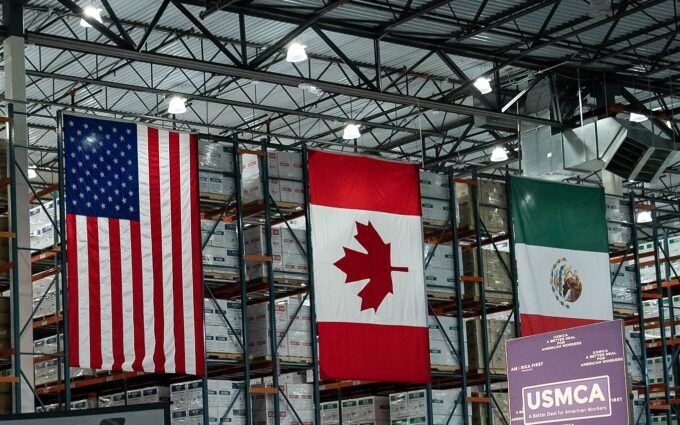
Photograph Source: The White House – Public Domain

Nancy Duran Rodriguez took several pairs of work gloves to Mexico in 2025, intending to hand them out as a goodwill gesture to fellow union workers she met there.

But Duran Rodriguez, a member of United Steelworkers (USW) Local 6787 in Burns Harbor, Indiana, discovered that some of her Mexican counterparts lacked even the most basic personal protective equipment to guard against heat, toxins, jagged objects, and other risks on the job.

Grateful workers there saw the gloves as a godsend, not souvenirs.

It’s a sobering reminder of how corporations continue to exploit Mexico’s low wages, poor working conditions, and lax enforcement of labor laws to oppress working families on both sides of the border.

Fortunately, we have an opportunity to change this. The USW, other unions, and our allies are pushing for meaningful improvements to the United States-Mexico-Canada Agreement (USMCA), the trade pact subject to “joint review” and modification by all three countries this summer.

The six-year-old USMCA replaced the disastrous North American Free Trade Agreement (NAFTA), which emboldened greedy companies to abandon U.S. factories, shift hundreds of thousands of jobs to Mexico, and hollow out our manufacturing communities.

Although it represented a step forward, the USMCA has so far failed to end this race to the bottom. Employers keep ditching America and moving jobs to Mexico. Employers go right on victimizing Mexican workers, who still make a fraction of Americans’ wages and who still fight to form real, independent unions and stay safe on the job, even though the USMCA officially extended protections they never had before.

“They deserve the things we do,” said Duran Rodriguez, noting mill workers there make hundreds less per day doing the same jobs that Local 6787 members perform at the Cleveland-Cliffs complex in Burns Harbor.

“It’s not enough. They’re living day by day, just to be able to make it. It is definitely a struggle. It is something that needs to change,” she said, pointing out that lifting up Mexican workers, a key objective in the USMCA, remains the only way to end offshoring and bring prosperity to workers in all three countries.

Every April, the USW sends a delegation to Lázaro Cárdenas on Mexico’s Pacific coast to build on our decades-long alliance with Los Mineros, the Mexican mine and metal workers union.

After learning about shortages of personal protective equipment in 2025, Duran Rodriguez took only four outfits and filled the rest of her suitcase with gloves to distribute during her return trip with other USW members in April 2026.

These visits build cross-border solidarity, as Duran Rodriguez’s experience showed, and they include many inspiring moments, such as our annual march to remember two striking members of Los Mineros gunned down by police in 2006. Workers began the strike following a coal mine explosion that killed 65 coworkers and exposed the reprehensible disregard for safety in Mexican mines.

“It pumps you up,” Steven Minchuk, an assistant griever and safety trainer for Local 6787, said of the energy unleashed by the marches.

“They never forget,” Minchuk observed of the Mexican workers. “They keep fighting for their rights.”

The impact of worker exploitation touches many aspects of life in Mexico, depriving families not only of the means to support themselves but also to build healthier, more livable communities.

“It’s a whole different world,” observed Minchuk, a former firefighter and fire commissioner who once toured a Mexican fire station and walked away dismayed by what he saw. “The equipment that they had was comparable to ours in the 1960s and 1970s.”

The USMCA portended a hard break with all of this. That’s because the USW and our allies, such as then-U.S. Senator Sherrod Brown of Ohio, successfully fought to include pro-worker provisions in the final version of the agreement.

It required Mexico to pass a law affording workers the right to form the democratic, independent unions needed to negotiate better wages, win safer working conditions, and curb U.S. employers’ appetite for offshoring.

The USMCA also established a Rapid Response Labor Mechanism to investigate retaliation against union activists and punish violators. It set rules to keep other countries, such as China, from sneaking unfairly traded products into the U.S. via sham operations in Mexico.

But Mexico failed to hold up its end of the deal for political, financial, and logistical reasons. Just as disappointing, America and Canada failed to step into the breach and keep progress on track.

Now, as part of the USMCA review process, it’s essential to ramp up enforcement of labor laws in Mexico, to commit more resources to stamping out anti-union harassment and to deter would-be violators with swift, severe penalties.

But the review also needs to go beyond steps to safeguard rights and boost wages. It’s just as important to address Mexico’s lax environmental standards, which draw employers happy to do an end run around the more stringent regulations in America and Canada.

The USW and our allies will spend the next few months pushing officials in all three countries to adopt a more robust, effective USMCA.

Given the high stakes, there’s no breaking our will to see this through. It’s a battle that’s pumping all of us up.

“I believe every worker deserves the same protections, benefits, and dignity,” said Minchuk, noting he has a friend in Mexico who works three jobs to make ends meet. “No one should have to risk their well-being simply to provide for the people they love.”

This article was produced by the Independent Media Institute

Roxanne D. Brown is the international president of the United Steelworkers Union (USW).

A Culture of Violence Finds Its Nearly


Perfect Number of Victims


May 20, 2026

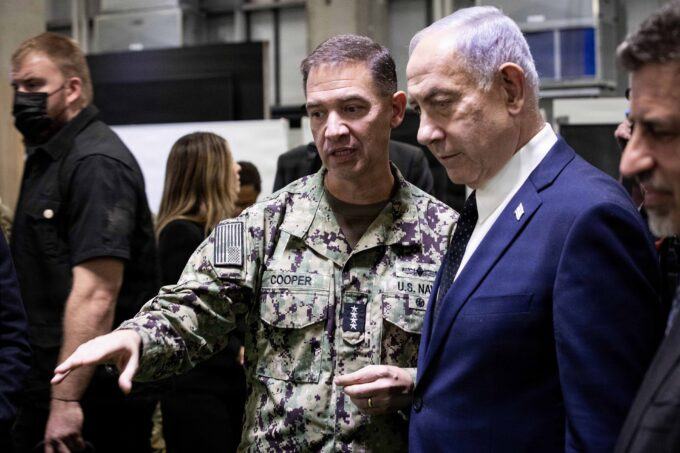
Cooper with Prime Minister Benjamin Netanyahu. Photograph Source: U.S. Army photo by Staff Sgt. Michael Ito – Public Domain

Admiral Brad Cooper, the head of US Central Command whose responsibilities include coordinating attacks on Iran, recently testified at a Senate hearing. Cooper said that when it comes to Iranian civilian deaths caused by US missiles, the United States has done a practically flawless job. The New York Times reported that Cooper suggested: “the US military’s record … had been near perfect.”

According to Admiral Cooper, near perfection apparently translates to an estimated 1,700 civilian deaths in Iran since February 28, when the United States and Israel began an unprovoked war of aggression. Unprovoked military attacks are major crimes under international law. In fact, they are a violation of Article 2(4) of the United Nations Charter.

That nearly perfect record includes the deaths of about 254 children, 120 of whom (and likely more) were killed on the very first day of the illegal war when a Tomahawk missile slammed into an elementary school. About thirty teachers and parents were also killed.

Closer to home, we are approaching the fourth anniversary this month of a mass shooting at Robb Elementary School in Uvalde, Texas, where 19 children and two teachers were murdered. One does not need a law degree to know that shooting up a school is against the law, too.

Would it be remotely acceptable—or sane—to opine that Salvador Ramos, the shooter at Uvalde, would have had a nearly perfect, practically spotless body count to his name if just one or two children were killed? Many legislators certainly don’t fuss over these fine distinctions since they could not have cared less about any number of murdered school children in Texas or Iran, a sentiment that in itself is criminal, but not in any formal legal sense. No, they proceeded in a perfectly legal manner when they resisted calls for substantial gun safety legislation. It also seems to be perfectly acceptable to the US Congress to not restrain a president from unprovoked war making.

After Uvalde, lawmakers instead offered their perfectly usual platitudes and prayers. They also professed their boundless love for the Second Amendment and their seething hatred of the tyranny that would surely arise if even a little of the deadliest ordnance Americans can lay their hands on were ever fenced off from public access. To their credit, however, they didn’t get in front of the TV cameras in the US Senate to say that Ramos, unlike the Trump administration and the Pentagon, exhibited nearly perfect conduct.

Near perfection only applies to those wielding high-tech weapons worth billions of dollars that eviscerate a comparatively small number of innocent people; it of course does not refer to a psychopath with a gun that was purchased at Outback Sports to slaughter a score of children.

Near perfection only applies to polished functionaries dressed in uniforms and business suits, not to some maladjusted, enraged teenager fatally cosplaying Tom Cruise in Mission Impossible.

Admiral Cooper said that the school bombing in Iran is under investigation. Just that one, though, not the estimated 22 other schools that were reportedly turned into rubble and ash. He found that number impossible to verify even though it could be. The military also seems uninterested in the bombings of hospitals, clinics, and residential areas. Ignoring those other deaths would preserve a self-described excellent record of avoiding civilian deaths.

Why might the killing of ordinary adults and children in Iran be a nearly perfect illustration of blameless violence?

One reason is that the victims in Iran were not people at all because, as we are told over and over again, they want to hurt us. Those in the media who claim expert knowledge but know nothing about the Middle East and Islam constantly treat us to lectures about how angry Arabs and Persians harbor a blind hatred for us that compels them to seek the West’s destruction. They are beasts who prefer Oriental depots to lord over them, and that sort of evil should be consigned to oblivion. Importantly, we can apparently achieve near perfection in our struggle against them if fatalities hover around some arbitrary number.

By contrast, the children in Uvalde were people. They lived in our country and were Christians, so they were allowed a small measure of pity. Also, there were a lot of victims in that case. More than normal. Those murders fueled tepid outcries and fleeting national grief. That they were tepid and fleeting was shown in what didn’t happen after those 19 funerals: What didn’t happen was a fulsome and broad shouldering of national trauma over the dismembering of small bodies by swarms of bullets. Such home-grown atrocities should have resulted in voters showing many lawmakers the door at the very first electoral opportunity.

But that didn’t happen. In other countries, legislators enact more effective firearm laws after mass shootings, but meaningful change doesn’t happen here; our leadership is able to cultivate perfectly undamaged careers in the aftermath of deaths that they largely ignore. Sometimes, they claim that extinguishing the lives of children is the price of freedom.

We are so accustomed to our culture’s hideous violence that it goes unchecked and, depending on the body count, often passes unnoticed. One would think we haven’t a blemish of violence here at home given lawmakers’ stubborn refusal to address it. However, when lots of child-sized body bags are required, our atomized population starts to pay attention, but it still feels largely powerless to stop what happens on the next block or in the next state. When the public does pay attention, that can be dangerous for planners; frightening people and engendering a sense of helplessness impedes focused attention on officially sanctioned criminality. Barring deflection, attention and anger could otherwise become threatening to those in power.

And forget halfway around the world where, according to some notable government officials like Ron DeSantis, non-people are intent on killing infidels and establishing Sharia law. Unaccountable exported violence stamped with “Made in the USA” comes with a guarantee that the deaths of brown Muslims will be described as perfectly fine, especially when, like here at home, the numbers are relatively small.

Similar to the Uvalde mass shooting, things become uncomfortable when the fatality count sharply rises. For example, the United States has been helping Israel turn Gaza into a wasteland for more than two years. Recent estimates show that nearly 73,000 Palestinians have been killed, including more than 21,000 children. Americans have expressed increasing opposition to Israel’s actions in Gaza and the West Bank to the point that almost 60 percent have considerably negative views of Israeli Prime Minister Benjamin Netanyahu. Interestingly, about the same proportion of Americans believe that gun control laws should be much stricter.

The divide between political elites and the population is vast. The former has no problem with generating a perfect number of victims, just enough so that we do nothing about it. When fatalities increase, they can simply be ignored, or pundits and planners can reach into a deep reservoir of Islamophobia to justify murder. However, that can change because we have power in numbers.

Michael Slager is an English teacher at Loyola University Chicago.