Sunday, May 24, 2026

D.E.I.

Panama Canal Names First Female Administrator as Challenges Grow
Panama Canal
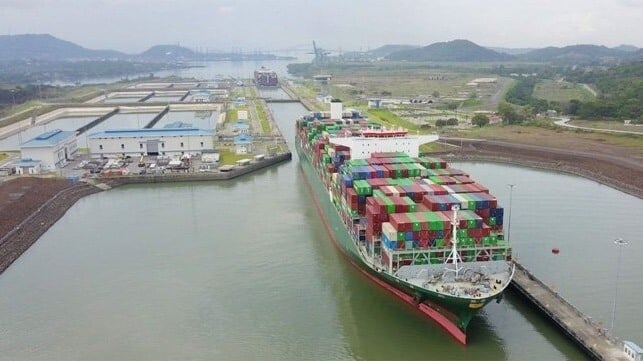
Panama Canal is seeing a surge in volumes as tankers rush to the wateway after leaving the Middle East (ACP)

Published May 21, 2026 7:36 PM by The Maritime Executive


The President of Panama, Jose Mulino, announced on Thursday the decision of the Board of Directors of the Panama Canal Authority to appoint its first-ever female administrator for the vital waterway. An engineer and the current deputy administrator, Ilya Espino de Marotta, will officially assume the leadership position on October 1, taking the reins at a critical time as the operation is seeing increased traffic and potential impacts from a brewing El Niño weather pattern and the lingering pressure from the United States after Donald Trump asserted that China was controlling the operations.

A marine engineer, a graduate of Texas A&M University, with a master's degree in Economic Engineering from Santa María La Antigua University and executive training from INCAE and the Kellogg School of Management, Espino de Marotta, the authority highlights, was selected after a national international search, consultation, and evaluation process. It notes she has over 40 years of experience and is a 35-year veteran at the Panama Canal, having overseen major projects, including the expansion programs.

Espino de Marotta takes over as volume at the Panama Canal is increasing. The industry trade group BIMCO highlights that the disruptions in the Middle East and the closure of the Strait of Hormuz are contributing to the Panama Canal’s volumes. With oil and gas prices increasing, U.S. exports are growing, and Asia is seeking to make up the shortfall through U.S. imports.

BIMCO highlights an eight percent year over year increase in daily transits at the Panama Canal, with a current daily average of 38 vessels driven by the tanker sector. In the past five weeks, BIMCO reports there has been a 16 percent year-over-year increase in traffic at the Panama Canal.
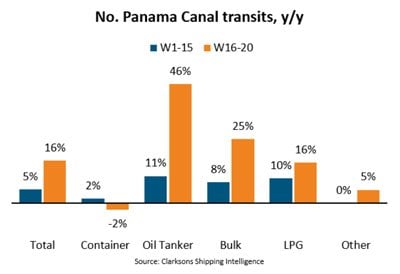
 

(BIMCO - Clarksons data)


“The daily maximum capacity of the Panama Canal is around 36 to 40 transits, meaning it is currently operating close to maximum capacity,” says Filipe Gouveia, Shipping Analysis Manager at BIMCO. “The recent spike in demand has inflated auction prices and caused a 50 percent year-over-year increase in waiting times, now sitting at a 47-hour average.”

The Panama Canal Authority’s online dashboard shows a total of 83 booked vessels and 10 non-booked vessels waiting as of May 21. It says the average wait for non-booked vessels is 3.9 days northbound and 8 days southbound.

The surge in volume has also sent prices skyrocketing for the slots the AMP auctions off to vessels without bookings. Earlier in the month, brokers reported a record $4 million price paid at auction for a slot, while the average is running around $400,000, up nearly three times from the average before the war started in the Middle East.
 
BIMCO highlights that container vessels, LPG, oil tankers, and bulkers make up approximately three-quarters of the transits. The rise in energy shipments, it notes, adds to the strain as many of these vessels operate in the spot market without schedules that permit advance reservations. 

“Looking ahead, demand for Panama Canal transits could stay high for as long as disruptions in the Strait of Hormuz persist and U.S. energy exports stay strong. In the short term, congestion and waiting times could remain high and increase further in the medium term,” reports BIMCO. 

The first challenge will come in June. Beginning at midnight on June 9, the canal will begin a dry maintenance process for the east lane at Gatun Lock, and it is scheduled to run through June 17. During that time, booking slots will be cut to just 16 vessels, with the authority warning that lockage will take additional time as the vessels share the westbound lane. It will be offering 10 fewer slots than normal during the maintenance period.

Also looming and expected to start this month or next is the weather phenomenon known as El Niño, which is likely to reduce rainfall on the isthmus. The authority highlights that it is better prepared than in the 2023-2024 season, when the lack of water forced it to cut transits to 22 vessels and reduce the maximum draught.

It reports monitoring began in late 2025 and that it has kept water levels at historically high levels in Gatun Lake, which serves as the main reservoir of the operations. They also point to an unusually wet season, which helped strengthen water reserves in the lakes, while they have also maintained water-saving measures at the locks. Currently, they do not anticipate being forced to renew restrictions in 2026, but the situation requires careful monitoring and management.

Longer-term, Espino de Marotta is likely to face renewed pressures from the Trump administration, which has also demanded free passage for U.S. government ships. The authority is also planning the development of two new port terminals, one at each end of the canal, with the tender expected in the coming months. It was announced to address U.S. concerns before Panama’s courts canceled the concession of CK Hutchison. The country remains locked in a brewing legal battle or arbitration with the Hong Kong company, while it also plans to tender for new concessions to operate the two existing terminals.

The Panama Canal Authority has announced other expansion plans, including a natural gas pipeline and improvements to the logistics corridor. It also has a long-term program to improve its reservoir system and water management.

 

Maersk Center Downsizes Amidst Uncertainty on Path to Decarbonization

MMCZCS
An ammonia bunkering simulation at Port of Rotterdam, conducted in partnership with the Maersk Mc-Kinney Møller Center for Zero Carbon Shipping (MAGPIE / MMMCZCS)

Published May 21, 2026 9:54 PM by The Maritime Executive


Amidst uncertainty about the form and timing of shipping's green transition, the A.P. Moller Foundation's Maersk Mc-Kinney Møller Center for Zero Carbon Shipping has quietly reduced its headcount by about 30 percent. Chief technology officer Torben Nørgaard has also confirmed that he is departing to join a commercial venture. 

"Far from retreating, the Center is adapting so that we can continue to deliver on our mission, together with our partners and the wider maritime ecosystem," said CEO Bo Cerup-Simonsen in a statement earlier this week. "Drawing on the insights and experience we have gained, we are deepening our focus and directing our energy to where our impact can be greatest."

Going forward, the center plans to focus on its technical work - researching energy efficiency measures and low-carbon propulsion - and supporting the development of regulations and policies. 

Simonsen said that he is optimistic about the long-term future of the IMO's carbon emissions regulatory process. Many of the member states that are skeptical of aspects of the Net Zero Framework have reservations about implementation, but are still committed to the broader idea of the 2023 IMO Greenhouse Gas Strategy, he said - encouraging for the prospects of working out a deal down the road. 

"These [MEPC] meetings have left us in a constructive, if fragile, position. Member states are now preparing to find a way forward that can secure broad support while living up to the ambition of the 2023 IMO GHG Strategy," Simonsen said. 

The downsizing may also reflect a financial reality. With new geopolitical headwinds facing decarbonization in general, the center has shed several commercial sponsors since the start of 2025. Notable departures from the public partnership list include big names in energy, classification, shipping and marine technology, but 18 core sponsors remain. 

MONOPOLY CAPITALI$M

Baleària Completes Canary Islands Acquisition from Armas Trasmediterránea

Baleària Canary Island ferry acquisition
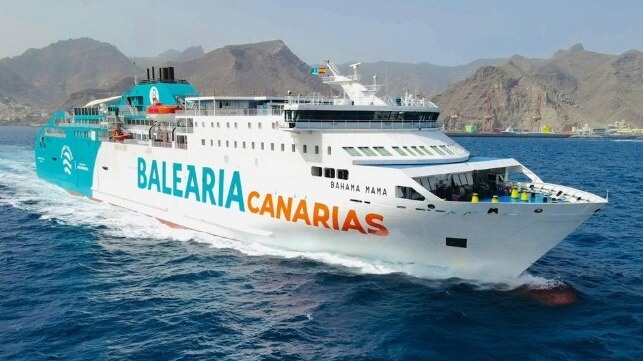
Baleària completed the Canary Islands portion of the combination reporting it will launch a new brand (Baleària)

Published May 21, 2026 8:45 PM by The Maritime Executive


Baleària, Spain’s leading maritime passenger and freight transport company, has completed the first phase of the planned acquisition of Armas Trasmediterránea, taking control of the assets in the Canary Islands. It includes both inter-island routes and connections between the mainland and the island and, according to the company, consolidates Baleària’s position as Spain’s leading operator of scheduled maritime transport while also establishing it as one of Europe’s leading ferry operators, in terms of both scale and quality.

The agreement for this acquisition was announced last August, with the company now taking control of the Canary Island assets. The procedures relating to the operations for the Strait of Gibraltar and Alboran Sea are yet to be finalized. The company said the deal would include the management of 15 ships, while other portions of the operations were being sold to DFDS.

This acquisition marks the integration of three historic Spanish shipping companies: Trasmediterránea (founded in 1916), Armas (in 1941), and Baleària (in 1998). The resulting group will have around 4,500 employees and a fleet of over 50 vessels. The combined annual traffic volume will exceed 8 million passengers and 11 million linear meters of cargo, generating a consolidated turnover of over €1 billion (nearly $1.2 billion at current exchange rates). 

"The new Baleària is ready to ensure the efficiency of the entire national maritime transport network across all its regions," said Adolfo Utorm, president of Baleària. “We are talking about a key infrastructure for territorial cohesion with the Canary and Balearic archipelagos, and with the autonomous cities of Ceuta and Melilla, as well as a vital link for political and commercial relations with Morocco and Algeria."

As part of this integration, the company has launched the Baleària Canarias brand, through which it will operate in the Canary Islands. During the transitional period, this new brand will coexist with that of Armas Trasmediterránea. 

Baleària has also committed to investing €45 million ($52 million) over the next three years in the Canary Islands to enhance the quality, digitalization, and comfort of the fleet it has acquired. The company has also guaranteed that the entire existing workforce will be retained.

It is a significant consolidation of ferry operations in Spain and its territories. Baleària called it a strategic deal that would increase its competitiveness against the multinational ferry companies.


Seven Crewmembers from MSC Elsa 3 Casualty Seek Release from India

containership sinking
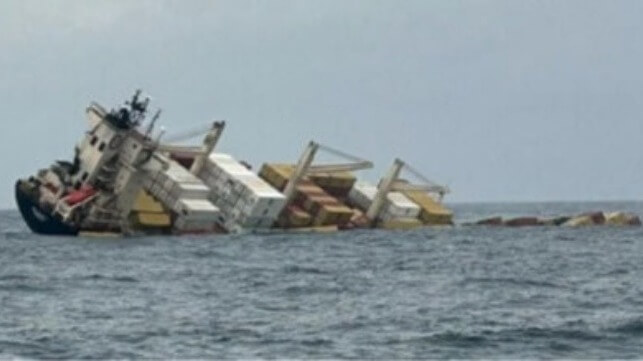
Seven crewmembers remain detained in India a year after their ship sank (DGS)

Published May 22, 2026 2:29 PM by The Maritime Executive


A year after the MSC Elsa 3 containership rolled onto its side and sank off the Indian coast, seven officers and crewmembers from the vessel remain detained in India. They are asking the High Court in Kerala for the return of their passports and permission on humanitarian grounds to return to their home countries.

The MSC Elsa 3 had listed onto its side on May 24, 2025, and later sank around 14.6 nautical miles off the Kerala coast. The Indian Coast Guard organized a rescue mission and brought all 24 crewmembers safely into the port. However, the crew says that the Mercantile Marine Department in Kochi issued a notice directing that no crewmember should leave Kochi without written permission.

The police later filed papers for charges against the vessel and its owner/operator, while the local government and the Indian authorities have filed court claims for more than $1 billion in compensation. In addition, the cargo owners filed admiralty claims, while the local fishing community and others have also filed claims in the court against MSC.

The crew told the court that the police had seized their passports. Yet they highlight that only the master of the ship was named in the police indictment. They assert that they have cooperated with the investigation and should now be released to return to their homes. They note that the Director General of Shipping allowed 15 crewmembers to depart India in August 2025.

The remaining crewmembers, including the master, chief officer, chief engineer, and second engineer, filed papers with the High Court asking for the return of their passports and contending they are being illegally detained. The crewmembers are from Russia, Ukraine, Georgia, and the Philippines.

The court held an initial hearing on the petition, and it asked for responses from the Indian government and the local government in Kerala. A follow-up hearing has been scheduled for next Friday, May 29.

Media reports are also highlighting that a year after the casualty, the shoreline continues to be polluted by the cargo. The vessel was carrying 643 containers, some transporting calcium carbide and plastic nurdles. Days after the ship sank, some of the containers began to wash ashore or break open. Around 630 metric tons of debris were recovered during a shore cleanup while a diving program sought to drain the oil from the hulk.

An environmental group is now saying that despite the government ending the cleanup, it is still finding nurdles on the beaches. It reports finding a “persistent presence of the pellets on beaches” while warning that the pellets will be a persistent threat. They theorize that strong waves and weather conditions could also be stirring up debris that remained at sea and driving it to shore.


Tanker Near Somalia Fires Warning Shots to Chase Off Suspicious Approach

pirate group in small boat
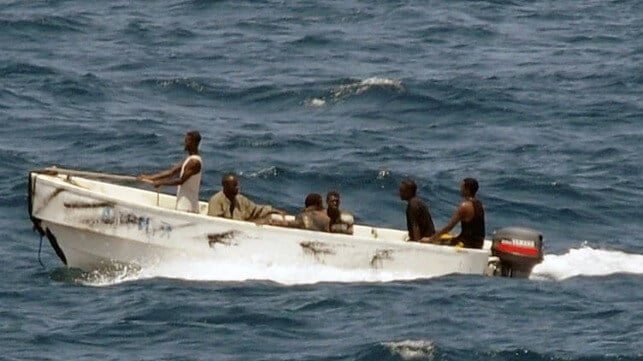
Small boat approached a tanker marking the third incident in a week (USN)

Published May 22, 2026 12:30 PM by The Maritime Executive


A tanker sailing in the Gulf of Aden reported on May 22 that its security team was forced to fire warning shots during a suspicious approach. It was the latest in the ongoing incidents in the region being linked to several active groups of Somali pirates.

The company security officer for the unidentified tanker reported the incident to the UK Maritime Trade Operations. The tanker was underway when it was approached approximately 98 nautical miles from Socotra, an island controlled by Yemen.

A small craft with five people aboard was detected approaching the tanker. The armed security team fired warning shots, which caused the small boat to change course.

It was the third approach in the last week, according to data from the EU’s Maritime Security Center for the Indian Ocean (MSCIO). On May 18, a skiff operating near Bosaso, Somalia, was reported to the EU’s Operation Atalanta. It was believed to be a pirate group seeking a merchant ship target. Three days earlier, on May 15, a suspicious high-speed boat was reported to have stopped a fishing vessel. The people aboard the boat were carrying weapons resembling AK-47 rifles.

Three vessels also remain under the control of pirate groups and are being held off the coast of Somalia. The tanker MT Honour 25 was seized on April 21, the general cargo ship Sward was seized on April 26, and the tanker Eureka was seized on May 2. The pirates are reported to be demanding $3 million for the release of the Eureka.

UKMTO warns that the piracy threat level remains severe along the Somalia coast and in the Somalia Basin. MSCIO specifically cited the highest risk to the north near the Puntland region and in the Gulf of Aden. It also rates the risk as moderate along the Somali coast. Vessels have been warned to remain at least 150 nautical miles off the coast, or to avoid the region if possible.


Dali Civil Trial to Begin June 1 After Judge Denies Motion to Delay

Dali and wreckage of Key bridge
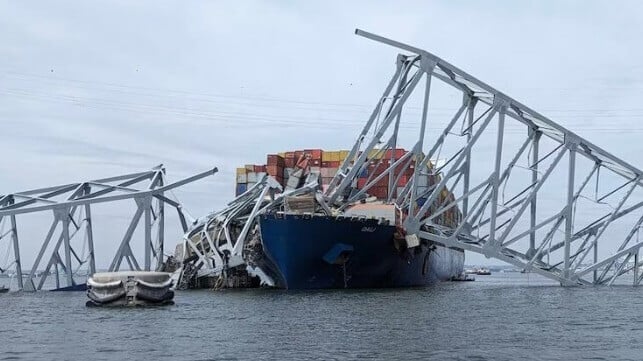
A judge refused an effort to delay the civil trial related to the Dali destroying the bridge in Baltimore in 2024 (US Army Corps of Engineers)

Published May 21, 2026 3:14 PM by The Maritime Executive


The civil liabilities case against the owners and operators of the containership Dali will commence on June 1, as scheduled, a U.S. District Court Judge ruled on Wednesday. The companies had filed a motion calling for staying the trial based on the recent criminal indictments or at least delaying it for 90 days while they resolved issues related to potential witnesses.

Judge James Bredar, who is presiding over the civil litigation and will hear the case as a bench trial (i.e., without a jury), held a hearing on May 20 to review the petition to delay filed by Grace Ocean and Synergy Marine. The companies argued the U.S. Department of Justice had delayed unsealing the criminal indictment against Synergy Marine and one of its employees to less than a month before the start of the civil trial. They also asserted that a dozen employees and crewmembers of the Dali were refusing to come to the United States to appear as witnesses due to a fear that they would be detained and that they might also not testify via video.

The crewmembers and shoreside supervisors invoked their right against self-incrimination during the pre-trial discovery phase. One person had refused to come to the United States and had their deposition taken in London. The companies said they were working with lawyers in an attempt to resolve the issue, possibly having some of the individuals appear through video testimonies, but this required additional time. They also asserted proceeding with the civil trial could harm its defense in the criminal trial

Supporting the call for a delay, the federal government was present and argued that the criminal trial should be held first. They acknowledged that it could be a year or more until the criminal trial proceeded, but asserted the federal government could compel the individuals to testify and has additional tools at its disposal not available during a civil trial.

“The right course, the best course, the most fair course, is to stay the course,” Judge Bredar told the court. He ruled the civil case was ready and that the petitioners had failed to show they would suffer significant harm if the case proceeded as scheduled on June 1.

The City and County of Baltimore, joined by lead counsel for private economic loss claimants, had filed their opposition to the move to delay the trial by Grace Ocean and Synergy. They noted that the companies had initiated this action shortly after the containership hit the bridge in 2024, seeking the limitation of liabilities even before the claims were filed. They argued that “it has been apparent that a federal indictment was a near certainty,” since the Dali destroyed the Key Bridge.

In their opposition motion, the lawyers also argued the companies “seek to use the unsealing of the indictments as an opportunity to convert the Limitation shield into a sword.”

The judge agreed that extensive time has been invested to this point and that the discovery phase has been completed to prepare for trial. In the interest of judicial efficency he said the trial should proceed as scheduled. He said the companies had failed to prove that the issues around the witnesses, or new witnesses, would be available if the trial was delayed. He also denied claims that there would be harm to the criminal case if the civil case proceeded and found that the continuing delay is a hardship to the families and others who have filed claims.

In the first phase of the civil case, Judge Bredar is set to decide on the issue of limiting liabilities. The second phase would directly address the claims from five family members of the road workers killed when the bridge collapsed, as well as the City and County of Baltimore’s claims and those filed by businesses and others claiming economic loss from the port having been closed and the loss of the vital roadway.

During the hearing, it was revealed that a sixth family has reached a settlement over its wrongful death claim against the companies. Previously, the State of Maryland also announced that it had settled its claims for a record $2.25 billion with Grace Ocean and Synergy Marine.

The U.S. Federal Government indicted two Synergy Marine companies and one individual employed by the companies as a port supervisor on criminal charges related to the destruction of the bridge and charges of lying during the investigation. 

WinGD Reports First Marine Ethanol-Fueled Engine Orders for Vale Bulkers

ethanol-fueled bulker with wind rotors
WinGD will supply the first ethanol-fueled motors for the massive new ore carriers (WinGD)

Published May 19, 2026 7:24 PM by The Maritime Executive


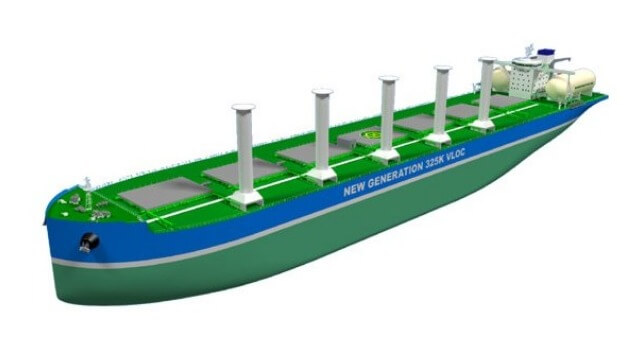
Ethanol, although a common and widely available fuel, was mostly overlooked in the discussions on maritime alternative fuels. Last month mining giant Vale announced it was planning two large bulkers that would use ethanol-fueled engines along with wind rotors, and now engine manufacturer WinGD confirmed it will be supplying these first purposely adapted engines for ethanol.

WinGD notes that ethanol is now gaining attention as a ship fuel due to its widespread and cost-competitive availability in several markets. These markets include Brazil, from where Vale will operate vessels. Vale highlighted in its investigations that it believes the use of ethanol can reduce greenhouse gas emissions by around 90 percent compared to heavy fuel, making it a good consideration for alternative fuels.

While there are concerns over supply competition with the food chain, ethanol is easier to handle than ammonia, which is toxic and highly corrosive. It has similar properties to methanol but is more available and requires less infrastructure development. Maersk reported last December that it was exploring ethanol aboard its pioneering methanol-fueled feeder ship, Laura Maersk. Everllence also reported in September 2025 that it had successfully tested ethanol on its large two-stroke engines in the factory.

WinGD received the order to supply its first ethanol-fueled X-DF-M/E engines to Beihai Shipbuilding in China for two 325,000 dwt ore carriers. Each will be powered by a six-cylinder, 820mm-bore 6X82DF-M/E engine intended to run primarily on ethanol fuel. The contract also includes options for further engine deliveries should the vessel series be extended.

“These first ethanol-fueled X-DF-M/E engines build on more than a decade of intensive investigation into alcohol fuels, including ethanol and methanol,” said WinGD Executive Director of Sales Volkmar Galke. “This is a clear signal that the shipboard technology and fuel infrastructure around ethanol as a marine fuel are ready, giving confidence to others considering ethanol as an option for maritime decarbonization.”

WinGD reports the engines will be the first of the X-DF-M/E platform optimized for primarily ethanol use. The fuel supply and injection pressure will be modified from WinGD’s methanol-fueled engine concept already in service to account for the difference in energy density between the two fuels, which otherwise share very similar properties and combustion characteristics. 

The engine deliveries are scheduled to take place in early 2029, depending on shipyard requirements. The ships will be owned by Shandong Shipping Corporation and operate on long-term charters to Vale.


ASRY & Priya Blue Launch World-Class Ship & Offshore Recycling Venture

Priya Blue Group

Published May 21, 2026 4:43 PM by The Maritime Executive


[By: Priya Blue Group]

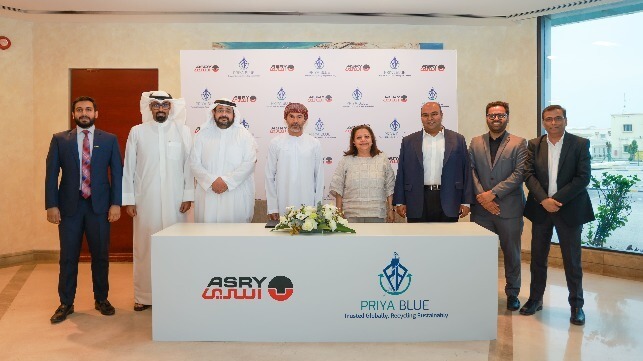
The arrival of the first vessel under the ASRY - Priya Blue joint venture marks the transition from strategic partnership to active operations, establishing a world-class facility for compliant and environmentally responsible ship- and offshore asset recycling in the Middle East.

Arab Shipbuilding & Repair Yard Company (ASRY), the leading industrial maritime hub, and Priya Blue Group, South Asia’s largest green ship recycling company, have formally launched their joint venture following the arrival of the first vessel for recycling in Bahrain. As part of this structure, Best Oasis, one of the world's leading cash buyers of ships & energy assets (offshore) for recycling, is supporting the joint venture in sourcing tonnage and managing the commercial acquisition of vessels brought to the Bahrain facility

The partnership combines ASRY’s 49 years of marine and heavy industrial infrastructure with Priya Blue’s three decades of ship recycling experience. The JV provides an integrated recycling solution covering vessel sourcing, recycling operations, safety and environmental management, compliance documentation, hazardous waste management, dry dock and slipway access, heavy lifting infrastructure, and regulatory support within Bahrain.

In addition to conventional vessels, the joint venture is particularly well positioned to support the recycling of complex offshore assets including FPSOs, FSOs, rigs and offshore structures.

The yard holds the licenses required to recycle vessels containing hazardous materials originating from production fluids. This includes the handling, storage, treatment, export and disposal of NORM (Naturally Occurring Radioactive Material) waste, which represents a key challenge in the recycling of offshore assets and production facilities.

Recycling operations can be performed using dry dock, slipway and alongside methodologies, with capability to recycle vessels up to ULCC (Ultra Large Crude Carrier) size as well as receive rigs and offshore structures directly onto berth. The facility incorporates ship recycling, environmental protection and hazardous waste management systems.

The joint venture operates in alignment with the principles of the Hong Kong Convention (HKC) and EU SRR which supports the development of Bahrain as a regional hub for compliant ship and offshore recycling.

Commenting on the launch, ASRY CEO Dr. Ahmed Al Abri stated: “ASRY has been and continues to be the most experienced maritime hub in the region for five decades. We have successfully delivered complex repair and maintenance operations for some of the world’s most demanding vessels, serving operators from across the globe.”

He added: “Partnering with Priya Blue to bring best practices in ship recycling to the Kingdom of Bahrain represents a strategic extension of ASRY’s journey and evolution, while this vessel marks the beginning of this new phase.”

Sanjay Mehta, Chairman of Priya Blue Group commented: “We have recycled over a hundred complex vessels at Alang. We know what compliant, responsible ship recycling looks like - and what it takes to deliver it consistently. Bahrain is not an experiment. It is a deliberate expansion of a proven operation, and this vessel is its opening statement.”

The products and services herein described in this press release are not endorsed by The Maritime Executive.


Expedition Cruise Ship Hondius Arrives in Rotterdam to Begin Disinfection

Hondius expedition cruise ship
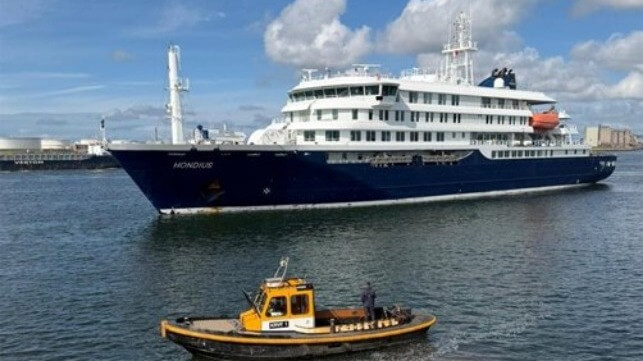
Hondius arriving in Rotterrdam (WHO)

Published May 18, 2026 3:16 PM by The Maritime Executive


The expedition cruise ship Hondius docked in Rotterdam on Monday, May 18, operating with a skeleton crew, and will begin an extensive disinfection process. The ship’s operator, Oceanwide Expeditions, and Dutch health authorities are reporting that none of the crew and medical staff remaining aboard were experiencing symptoms of the hantavirus, but as a precaution, they are all being placed in quarantine.

The ship had a crew of 25, mostly from the Philippines, still aboard after disembarking all its passengers and about half the crew in Tenerife 10 days ago. The passengers were all repatriated to their home countries, where most of them remain in quarantine. The hantavirus has up to a six-week incubation period, and the World Health Organization is recommending a 42-day quarantine period.

The World Health Organization reports that as of today, there are a total of 11 cases reported, with nine confirmed and two probable cases. This includes a Dutch couple and a German passenger who died. Officials in Canada were the latest to report that one of the evacuated passengers tested positive over the weekend, but was only displaying mild symptoms. A French passenger remains in a hospital in Paris in critical condition.

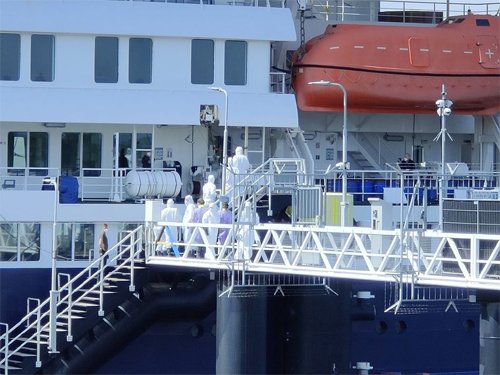
The Hondius was met by a crew in hazmat suits, and according to the Dutch health organization RIVM and the Port of Rotterdam, 22 people were disembarked, including two medical personnel from RIVM who joined the ship when it reached Cape Verde. Two Dutch crewmembers are going into home quarantine, while 17 crewmembers from the Philippines, as well as three from Ukraine, are initially going into quarantine at a special facility in the port. RIVM said they might later be repatriated. All the crewmembers were given a medical examination to leave the ship.


The cruise ship was placed in quarantine and will undergo a sanitation process (WHO)


Five crewmembers currently remain aboard the cruise ship to continue its operations and coordinate with EWS Group, which has been hired to disinfect the ship. RVIM reported that an inspection would begin today, along with taking samples.

Officials at the Port of Rotterdam said the port is a safe haven, designated as a quarantine port. They said they were prepared for the situation and expect some of the crewmembers to remain in quarantine until June 18.

Oceanwide Expeditions said the cleaning operation is estimated to require three to four days, subject to the findings of the inspection. The ship will also undergo additional testing and inspections after the disinfection process.

The Hondius, which is a 6,600 gross ton expedition cruise ship, entered service in June 2019 and is registered in the Netherlands. The ship has a maximum passenger capacity of 170 people and 57 crew.

Cruises aboard the ship scheduled to depart on May 29 and June 5 have been canceled. Oceanwide reports the cruise ship will resume full operations on June 13, departing from Longyearbyen, Svalbard.


China’s Second Domestically Built Cruise Ship Starts Trials

Chinese cruise ship starting sea trials
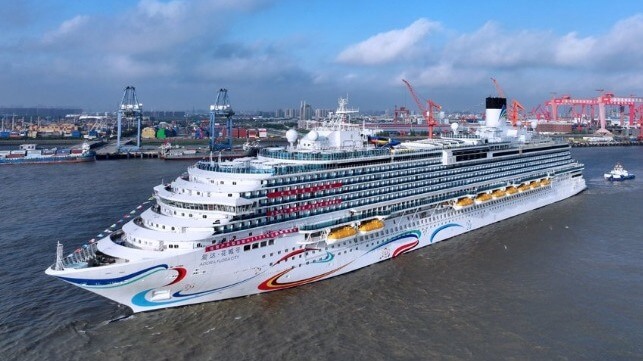
Adora Flora City started 12 days of sea trials on May 16 (CSSC)

Published May 18, 2026 6:21 PM by The Maritime Executive


The Adora Flora City, China’s second, large, domestically built cruise ship, began sea trials over the weekend. It comes as China State Shipbuilding Corp. (CSSC) highlights that it is advancing its expertise in cruise ship construction, the most complex of the shipbuilding projects, and its operator, Adora Cruises, continues to refine its product offering.

The new 141,900 gross ton cruise ship is based on the design of China’s first cruise ship, which was originally developed by Carnival Corporation and Fincantieri. The second ship, however, has been lengthened to increase passenger capacity and amenities. They are highlighting that the added 57 feet (17.4 meters) of length versus the Adora Magic City introduced in January 2024, gives the ship a sleeker exterior look. Aboard, they highlight that the atrium/plaza was doubled in size. The ship has additional entertainment spaces and more retail locations, as well as a new concept all-weather leisure space.

The ship, which is 1,119 feet (341 meters) in length, has a total of 2,130 passenger cabins. It has a passenger capacity of 5,232 people.

CSSC is also highlighting advancements in the technology aboard the ship, including more smart technologies. It is using an AI-powered system to improve passenger boarding and disembarkation, intelligent robot multi-interactive services, intelligent in-cabin features, and more digital systems to achieve paperless operations. Operationally, CSSC reports there are improvements to the automation systems, airflow balancing, water mist system, and fire alarm system.

Construction on the ship began with the first steel cutting in 2022 and assembly in 2024. She was floated in the assembly dry dock and moved out to the outfitting berth in March. The sea trials began on May 15 and are scheduled to run for 12 days. In total, CSSC reports that 149 tests and verifications will be conducted. A total of 937 engineers and technical personnel from 12 countries are aboard for the trials.


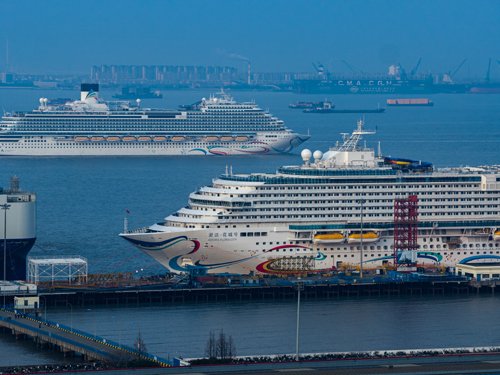
China's first large cruise ship sailing past the second one under construction in Shanghai (CSSC)


The ship anchored off Shanghai after departing the Yangtze River channel for its first tests, including propeller debugging. During the trials, the propulsion, side thrusters, anti-roll fins, power stations, communications and navigation, automation, and safety management systems will all be tested. The trials will involve 45 debugging procedures and verify key indicators, including vibration and noise, speed, and EEDI.

Demonstrating CSSC’s development of the construction process, they highlight that the ship will undergo a single sea trial versus two sets of trials on the first cruise ship. CSSC started cruise ship construction, working with Fincantieri as a consultant. Now, CSSC looks to develop its internal capabilities and expand the Chinese supply chain for cruise ships.

CSSC and Adora Cruises announced in March plans to build additional cruise ships using a Chinese-developed design and more Chinese suppliers. Adora has ordered two ships and has an option for a third, with the first ship scheduled for delivery by 2030.

CSSC reports the ship is overall 97.8 percent complete. Interior decoration is 92.3 percent completed, and commissioning is 89.9 percent complete.

The companies are highlighting that Adora Flora City is two months ahead of its construction schedule. It is now slated for delivery on November 6 and will begin cruise service from Guangzhou Nansha International Cruise Home Port. The ship will be operating five- and six-day cruises to Hong Kong and Vietnam, as well as a nine-day itinerary to Vietnam, Malaysia, and Brunei. A special 17-day cruise is also scheduled, sailing to Singapore, Malaysia, Brunei, the Philippines, Indonesia, and Vietnam, retracing what Adora called the Maritime Silk Road.

Aboard the Adora Flora City, the company reports passengers will find a “more Chinese” experience, integrating Chinese culture into dining, entertainment, and services. It has made changes to better reflect the Chinese culture as it continues to develop its cruise operations. Adora highlights its approach as “cruise and culture.”

With the introduction of the new cruise ship, Adora will have a total of three ships in service. The company was originally formed as a joint venture with Carnival Corporation, which later became a minority investor. Adora continues to develop its operations, including the introduction of its first cruise to nowhere, running for three days from Shanghai. Longer-term, the company says it is also actively planning its overseas homeport as it seeks expansion into international markets and enhancing the international competitiveness of Chinese cruise brands.


EU Funds Pilot to Demonstrate Offshore Power Zones to Charge Vessels

offshore vessel charging
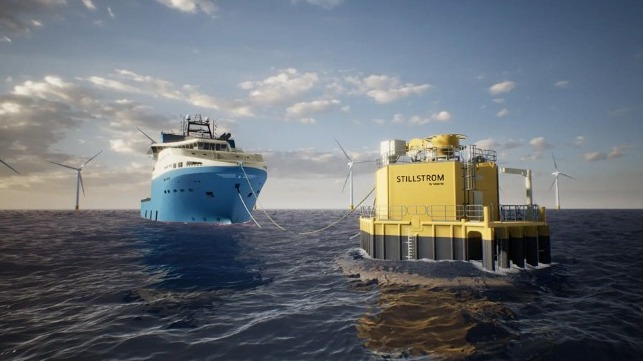
Stillstrom is developed offshore charging for wind farm vessels and in this pilot with test a pwoer zone in an anchorage (Stillstrom)

Published May 19, 2026 7:50 PM by The Maritime Executive


The European Union’s flagship Horizon Europe research and innovation program is providing a €5 million ($5.8 million) grant to an international consortium led by Stillstrom, a Maersk company, to develop and demonstrate offshore charging infrastructure for stationary vessels at anchor with their engines running. The project is due to kick off next month, June, and is expected to run for 36 months, demonstrating the concept and also assessing commercial viability and regulatory pathways to support wider adoption of offshore charging.

Efforts to develop the concepts for offshore charging were started in 2019 by what was then Maersk Supply Services and later spun off to become an independent company, Stillstron, in 2022. The company has been pursuing the development of its technology, aiming at two key segments. It looks to power offshore wind farm operations vessels through electrification. It has developed the ability for the battery-powered vessels to recharge by plugging into the wind farm.

Stillstrom also highlights that at any given time, more than 6,500 vessels are idle at approximately 200 anchorages worldwide. They estimate these vessels are collectively emitting over 30 million tons of greenhouse gases (GHGs) and associated air pollutants.

“Near shore idling vessels represent a significant and often overlooked source of GHG emissions, making them a clear and immediate opportunity for decarbonization,” explains Stillstrom CEO Kristian Borum Jørgensen. He highlights that the project will “bring together partners from across the maritime ecosystem, enabling us to collectively accelerate offshore power from concept to real-world deployment, delivering a practical and economical solution for the maritime sector.”


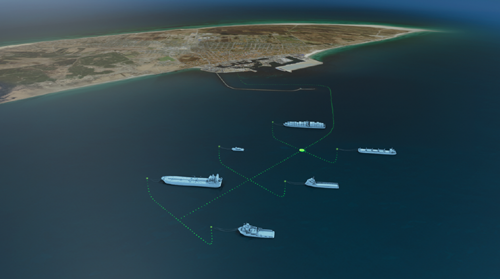
SPARK will create the first trial for a zone that could eventually charge many vessels using shore pwoer and cut emissions (Stillstrom)


The SPARK project calls for creating one of these offshore power zones outside Skagen, Denmark, one of the busiest anchorages in Northern Europe. The project will develop and test a pilot that will enable vessels to plug into an at-sea power point with electricity provided via the nearby Port of Skagen. The pilot will initially support a single ship connection to prove the concept in a live operational environment.

Stillstrom will spearhead the project, working alongside its partners Aalborg University, DNV, Maersk, MARIN, Port of Malta, Port of Skagen, and University College London.