Sunday, May 24, 2026


NATO Monitors Russian Surveillance Ship Loitering Near NATO Exercise

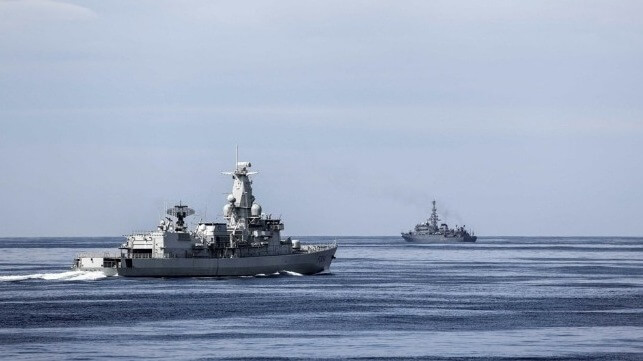
Portuguese frigate and Russian intelligence collection vessel
Portuguese frigate as it was monitoring the Russian vessel loitering near the NATO exercise (NATO Maritime Command)

Published May 22, 2026 5:00 PM by The Maritime Executive


It was a case of who’s watching whom, according to reports from NATO Maritime Command. A Russian “intelligence collection” warship was spotted by NATO, reportedly loitering nearby by as one of its largest and most demanding exercises got underway.

Named Dynamic Mongoose 2026, the operation is taking place in Norway, bringing together warships, assets, and submarines from nine allies. The Russians are rarely too far away, trying to observe the action during one of these exercises. This year, NATO reports it identified the Russian vessel Yuri Ivanov, only one of two in a class of ships Russia built for intelligence collection.

Yuri Ivanov was commissioned in 2015 and is thought to have about 120 people aboard. It is a 4,000-ton displacement vessel measuring 95 meters (312 feet). Its sister ship operates in the Black Sea and has been a target for Ukraine.

NATO commanders reported on Thursday, May 21, that the vessel was loitering in the area of the exercise, which had commenced on May 18 and runs to May 26. They call the training program one of the most demanding maritime exercises for NATO as they sail in the cold waters of Norway. The exercise launched from Trondheim, and it focuses on submarine and anti-submarine warfare capabilities.


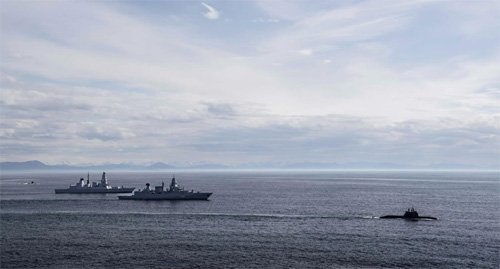
Vessels preparing for the start of the exercise (NATO)


Germany, the Netherlands, and Portugal are participating with submarines. Among the surface vessels are HDMS Esbern Snare from Denmark, FGS Sachsen from Germany, HNLMS Zeeleeuw from the Netherlands, NRP Francisco De Almeida from Portugal, and HMS Duncan and HMS Prince of Wales from Great Britain. Maritime patrol aircraft from Canada, France, Germany, Portugal, the United Kingdom, and the United States are also participating in the exercise.

During Dynamic Mongoose, the Allied submarines are maneuvering beneath the cold Norwegian Sea, testing their skills. The surface and air forces are challenged to detect, track, and counter the underwater threats. 

They also had a Russian “visitor” to deal with. NATO maritime commanders decided to assign NRP Francisco De Almeida and a Merlin Mk2 from HMS Prince of Wales to monitor the Russian vessel as it was positioned near the NATO fleet. 


NATO posted a message online of “We are watching,” but it became a challenge to know who was watching whom.


Russian Patrol Ship Improvises Using Fencing to Protect Against Drones

Russian patrol ship with protection against drones
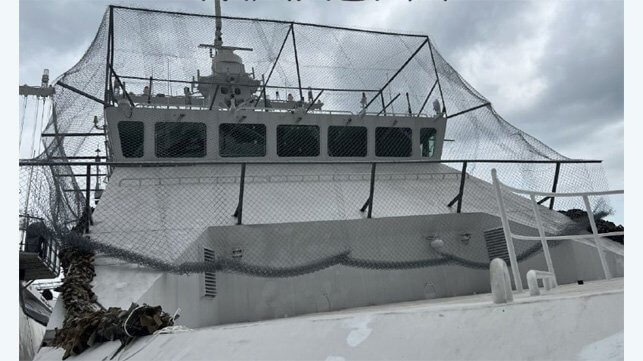
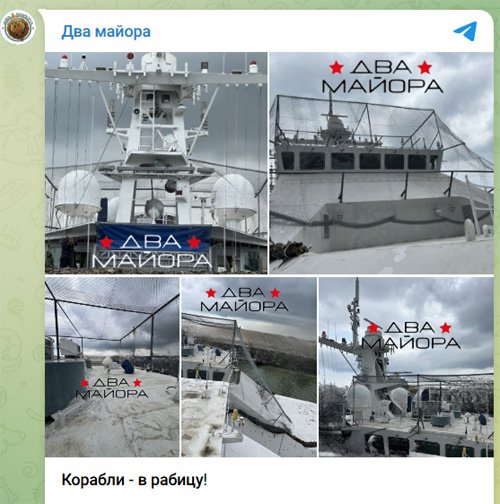
Fencing struck around the bridge and superstructure as makeshift protection against drones (DVA Major on Telegram)

Published May 22, 2026 3:41 PM by The Maritime Executive


In the more than four years since Russia invaded Ukraine in an all-out war, Ukraine has become proficient in drone technology and has frequently reported its use of its systems to attack Russian warships and other critical infrastructure. Ukrainian media this week spotted photos posted on Russian social media showing an improvised solution to add protection to Russian patrol boats.

The pro-Russian site DVA Major posted pictures showing Russian patrol boats “covered in chain-link fencing!” It says that public funding was used to buy the material and that it has been applied to more than one patrol ship.

The area around the bridge was seen draped with the fencing. It has also been applied to the top of the superstructure. 

“This solution isn't a panacea. It won't protect against all types of enemy ammunition. But if nothing is done, nothing will happen,” writes DVA Major.


The Ukrainian site Militarnyi studied the pictures, and although the vessel was not named, it believes it has identified the class of ship. It says the structure around the bridge is unique to the Project 22460 patrol ship.

Russia commissioned the first of the vessels in 2009 and uses them for various coastal patrols. The media reports are that four of the vessels are currently based in Crimea, and two more are at Krasnodar Krai. 

In February 2026, Ukraine's general staff said it had used drones to hit two border guard ships moored near the town of Inkerman in Crimea, at the easternmost end of Sevastopol Bay. The vessels damaged were Project 22460 Rubin-class fast patrol boats. Further, it was reported that Ukraine had targeted vessels of the same class in December 2025 in the Caspian Sea. Last weekend, Ukraine also reported hitting a different class of patrol ship in Crimea with drones.


Example of Project 22460 patrol ship - note the structure below the bridge -- Aleksandr Markin photo (CC BY-SA 2.0)


The 22460 patrol boats are fast, with a speed of 25 knots and 650 tons displacement. They are 62.5 meters (205 feet) in length, with reports that they have a crew of 20 and space for 14 additional people.

Other pictures were recently online of the Russian Project 21980 class, which is used for anti-sabotage operations. One of those vessels also appeared to have been fitted with a similar netting made of fencing to block drones.

It remains to be seen if it is judged an effective protection and if it will appear on other Russian ships.


An answer to many questions: Damen Fuel Flexible Tugs

Range of options is prepared for the future – whatever it may hold

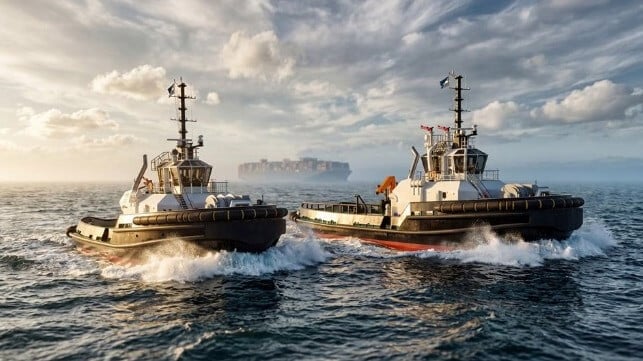
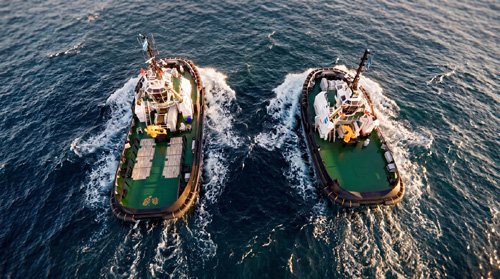
Damen Shipyards tugboats

Published May 21, 2026 5:00 AM by Damen Shipyards


The numerous new regulations facing the industry in recent years leave no room for doubt – the maritime energy transition is underway. 

To offer just one example of many, in 2024, the EU Emissions Trading System (ETS) was further rolled out to incorporate maritime transportation. True, it’s currently only applicable to vessels over 5,000 gross tonnes. This is unlikely to remain the case for long, however. Already, there are indications that the regulations could be expanded to cover all vessels over 400 gross tonnes in 2027 and below that in the near future. 

Into the carbon market 

With that, many towage companies will be expected to dramatically lower their emissions, and forced to enter the carbon market, purchasing credits to offset their carbon output – a potentially costly endeavor. 

Another strong indication that the transition is progressing is the difficulty vessel owners frequently encounter when trying to attract funding. In many cases now, lending is only available to operators able to demonstrate the sustainability of their intended investment. 

Fuel of the future? 

Even without these issues to contend with, there remains the question of what to invest in, explains Erik van Schaik, Product Manager Tugs at Damen

“A newbuild tug ordered today may still be in operation three decades from now. Who knows what the fuel picture will be five years from now, never mind 25 or 30 years?”

In reality, there will most probably be no one dominant maritime fuel type in the future. Various factors will affect which fuel will be used – availability, infrastructure, maturity of technology, and required level of energy density.

The operational profile of the vessel will certainly play a role in determining the fuel type used, he continues. 

“For example, with a predictable port-based towage operation, a fully electric, zero emissions approach makes sense. For less predictable operations farther from shore, the way forward is more likely to be a carbon-neutral approach with a fuel such as HVO or green methanol.”


Flexibility – the key to tomorrow

In short, there is a lack of clarity at present. This doesn’t mean there are no routes open to vessel owners; however, the key to the future does not lie in having the solution right here, right now. Rather, says Erik, it lies in having the flexibility to be able to respond once the future arrives. 

“That is the thinking behind Damen’s Fuel Flexible (FF) Tugs range. This is a series that provides diesel propulsion, competitive in today’s market, but prepared for what’s to come. 

“If, in the future, it becomes commercially attractive – or indeed, mandatory – to sail with hybrid propulsion, HVO or methanol, you have the possibility to switch – at that moment.”

The FF series consists of three tug types – the ASD Tug 2512 FF, the ASD Tug 2713 FF, and the ASD Tug 3313 FF. The vessels are, respectively, 25 x 12, 27 x 13, and 33 x 13 meters, offering a range of capabilities for operations in ports, close to shore, and offshore. 

Modular energy concept

With these tugs, Damen applies a modular energy concept, Erik explains. In its design of the vessels, Damen has created additional spaces which, in the future, can be used for storage and handling of alternative energy sources. For now, this space sits empty, waiting to see what the future will bring.

When the moment comes, it is ready for rapid conversion to a number of different configurations, depending on what is required or desirable. 

“The fuel flexible tugs are prepared for an easy retrofit from diesel or HVO to diesel or HVO plus methanol or diesel or HVO plus battery electric PTI/PTO hybrid.

“The existing Damen diesel tug family and the new Damen Fuel Flexible Tug family will have a comparable price per ton bollard pull. Tug owners can undertake a retrofit to a different energy source during the lifetime of the vessel when they are certain there is a business case for it. If that moment never occurs during the lifetime of the vessel, no money is lost.”  
 
The way forward

“What this means is, you have today a single platform that supports multiple configurations – diesel, HVO, hybrid, or methanol – ready for the future. Of course, there will be an investment required to convert it to a different configuration, but you will only need to do that at the point when you know for sure that the decision you are taking is relevant and likely to offer a return on investment.

“To our thinking, this is a practical way forward. While no one can offer clarity on what the future looks like, the FF range offers operators a smart solution; a range of vessels suited to today’s operations and ready, without significant adaptation, for tomorrows. The FF Tugs offer operators a means to invest in fleet renewal, cost-effectively and with confidence.”
 

This article is sponsored by Damen Shipyards Group. For more information about the tugs, please visit the company online.

The opinions expressed herein are the author's and not necessarily those of The Maritime Executive.
 

DNV Study Suggests Possibility of Eliminating Efficiency Loss From Fouling

DNV
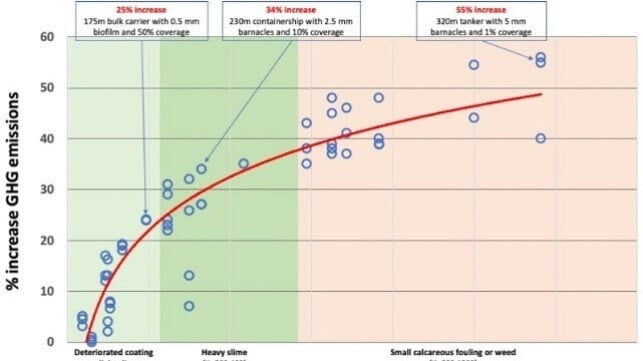
A standard reference chart showing the serious impact on fuel efficiency as fouling progresses (IMO). A DNV study shows that frequent cleanings can keep a ship's fouling level from progressing towards the right side of the curve.

Published May 21, 2026 4:51 PM by The Maritime Executive


When evaluating the antifouling properties of a hull coating - and the corresponding fuel savings that an operator can expect to achieve over time - shipowners look at how much the vessel gets slowed down by fouling over time. A poorly-chosen coating will show a large slowdown and falling fuel economy between five-year dockings; a properly-chosen coating will still show some slowing over the years, but not much. It now appears possible that the baseline for this measurement could be reset to zero: coating maker Jotun has published results that suggest that with a proprietary hull-cleaning robot, a ship can operate all the time with a continuously clean hull - for all intents and purposes, just as efficient after five years as the day it came out of the drydock. 

The study, conducted by DNV, followed 12 vessels that have used Jotun's hull-cleaning robot for more than three years (on average). A check of the ship's performance data found no measurable speed loss over time, compared to an initial one-year reference period. Physical inspections were also conducted to check for visible fouling on the underside. 

"The analysis confirmed that the hulls remained clean throughout the review period and that no measurable loss of speed occurred. This provides Jotun with third-party verification that the solution performed as intended under real operating conditions," explained Olav Rognebakke, Head of Section Hydrodynamics and Stability at DNV.

The idea is to use a cleaning-compatible coating, then clean so often that early-stage fouling is removed before it can stick to the hull and grow into something large enough to induce drag. Jotun says that by evaluating the speed loss data, DNV has shown that this level of cleanliness is operationally meaningful for the shipowner.

"Credible speed loss data matters. Without it, operators face operational and regulatory risk, and fleet decarbonisation plans can be built on the wrong assumptions. Independent verification, like through DNV, is how we turn claims into documented performance," said Morten Sten Johansen, Global Category Director for Hull Performance at Jotun.

D.E.I.

Panama Canal Names First Female Administrator as Challenges Grow

Panama Canal
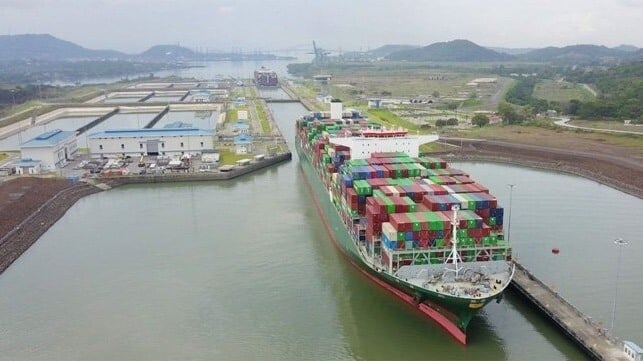
Panama Canal is seeing a surge in volumes as tankers rush to the wateway after leaving the Middle East (ACP)

Published May 21, 2026 7:36 PM by The Maritime Executive


The President of Panama, Jose Mulino, announced on Thursday the decision of the Board of Directors of the Panama Canal Authority to appoint its first-ever female administrator for the vital waterway. An engineer and the current deputy administrator, Ilya Espino de Marotta, will officially assume the leadership position on October 1, taking the reins at a critical time as the operation is seeing increased traffic and potential impacts from a brewing El Niño weather pattern and the lingering pressure from the United States after Donald Trump asserted that China was controlling the operations.

A marine engineer, a graduate of Texas A&M University, with a master's degree in Economic Engineering from Santa María La Antigua University and executive training from INCAE and the Kellogg School of Management, Espino de Marotta, the authority highlights, was selected after a national international search, consultation, and evaluation process. It notes she has over 40 years of experience and is a 35-year veteran at the Panama Canal, having overseen major projects, including the expansion programs.

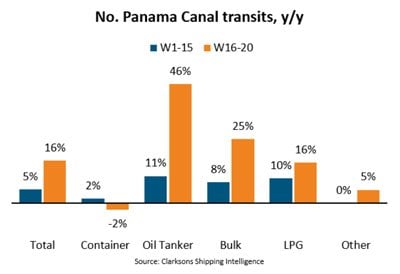
Espino de Marotta takes over as volume at the Panama Canal is increasing. The industry trade group BIMCO highlights that the disruptions in the Middle East and the closure of the Strait of Hormuz are contributing to the Panama Canal’s volumes. With oil and gas prices increasing, U.S. exports are growing, and Asia is seeking to make up the shortfall through U.S. imports.

BIMCO highlights an eight percent year over year increase in daily transits at the Panama Canal, with a current daily average of 38 vessels driven by the tanker sector. In the past five weeks, BIMCO reports there has been a 16 percent year-over-year increase in traffic at the Panama Canal.


(BIMCO - Clarksons data)


“The daily maximum capacity of the Panama Canal is around 36 to 40 transits, meaning it is currently operating close to maximum capacity,” says Filipe Gouveia, Shipping Analysis Manager at BIMCO. “The recent spike in demand has inflated auction prices and caused a 50 percent year-over-year increase in waiting times, now sitting at a 47-hour average.”

The Panama Canal Authority’s online dashboard shows a total of 83 booked vessels and 10 non-booked vessels waiting as of May 21. It says the average wait for non-booked vessels is 3.9 days northbound and 8 days southbound.

The surge in volume has also sent prices skyrocketing for the slots the AMP auctions off to vessels without bookings. Earlier in the month, brokers reported a record $4 million price paid at auction for a slot, while the average is running around $400,000, up nearly three times from the average before the war started in the Middle East.
 
BIMCO highlights that container vessels, LPG, oil tankers, and bulkers make up approximately three-quarters of the transits. The rise in energy shipments, it notes, adds to the strain as many of these vessels operate in the spot market without schedules that permit advance reservations. 

“Looking ahead, demand for Panama Canal transits could stay high for as long as disruptions in the Strait of Hormuz persist and U.S. energy exports stay strong. In the short term, congestion and waiting times could remain high and increase further in the medium term,” reports BIMCO. 

The first challenge will come in June. Beginning at midnight on June 9, the canal will begin a dry maintenance process for the east lane at Gatun Lock, and it is scheduled to run through June 17. During that time, booking slots will be cut to just 16 vessels, with the authority warning that lockage will take additional time as the vessels share the westbound lane. It will be offering 10 fewer slots than normal during the maintenance period.

Also looming and expected to start this month or next is the weather phenomenon known as El Niño, which is likely to reduce rainfall on the isthmus. The authority highlights that it is better prepared than in the 2023-2024 season, when the lack of water forced it to cut transits to 22 vessels and reduce the maximum draught.

It reports monitoring began in late 2025 and that it has kept water levels at historically high levels in Gatun Lake, which serves as the main reservoir of the operations. They also point to an unusually wet season, which helped strengthen water reserves in the lakes, while they have also maintained water-saving measures at the locks. Currently, they do not anticipate being forced to renew restrictions in 2026, but the situation requires careful monitoring and management.

Longer-term, Espino de Marotta is likely to face renewed pressures from the Trump administration, which has also demanded free passage for U.S. government ships. The authority is also planning the development of two new port terminals, one at each end of the canal, with the tender expected in the coming months. It was announced to address U.S. concerns before Panama’s courts canceled the concession of CK Hutchison. The country remains locked in a brewing legal battle or arbitration with the Hong Kong company, while it also plans to tender for new concessions to operate the two existing terminals.

The Panama Canal Authority has announced other expansion plans, including a natural gas pipeline and improvements to the logistics corridor. It also has a long-term program to improve its reservoir system and water management.


Maersk Center Downsizes Amidst Uncertainty on Path to Decarbonization

MMCZCS
An ammonia bunkering simulation at Port of Rotterdam, conducted in partnership with the Maersk Mc-Kinney Møller Center for Zero Carbon Shipping (MAGPIE / MMMCZCS)

Published May 21, 2026 9:54 PM by The Maritime Executive


Amidst uncertainty about the form and timing of shipping's green transition, the A.P. Moller Foundation's Maersk Mc-Kinney Møller Center for Zero Carbon Shipping has quietly reduced its headcount by about 30 percent. Chief technology officer Torben Nørgaard has also confirmed that he is departing to join a commercial venture. 

"Far from retreating, the Center is adapting so that we can continue to deliver on our mission, together with our partners and the wider maritime ecosystem," said CEO Bo Cerup-Simonsen in a statement earlier this week. "Drawing on the insights and experience we have gained, we are deepening our focus and directing our energy to where our impact can be greatest."

Going forward, the center plans to focus on its technical work - researching energy efficiency measures and low-carbon propulsion - and supporting the development of regulations and policies. 

Simonsen said that he is optimistic about the long-term future of the IMO's carbon emissions regulatory process. Many of the member states that are skeptical of aspects of the Net Zero Framework have reservations about implementation, but are still committed to the broader idea of the 2023 IMO Greenhouse Gas Strategy, he said - encouraging for the prospects of working out a deal down the road. 

"These [MEPC] meetings have left us in a constructive, if fragile, position. Member states are now preparing to find a way forward that can secure broad support while living up to the ambition of the 2023 IMO GHG Strategy," Simonsen said. 

The downsizing may also reflect a financial reality. With new geopolitical headwinds facing decarbonization in general, the center has shed several commercial sponsors since the start of 2025. Notable departures from the public partnership list include big names in energy, classification, shipping and marine technology, but 18 core sponsors remain. 

MONOPOLY CAPITALI$M

Baleària Completes Canary Islands Acquisition from Armas Trasmediterránea

Baleària Canary Island ferry acquisition
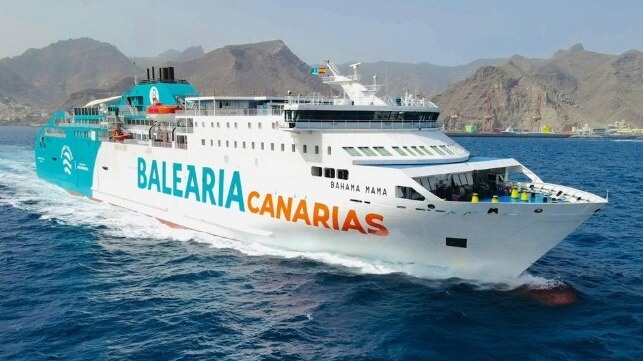
Baleària completed the Canary Islands portion of the combination reporting it will launch a new brand (Baleària)

Published May 21, 2026 8:45 PM by The Maritime Executive


Baleària, Spain’s leading maritime passenger and freight transport company, has completed the first phase of the planned acquisition of Armas Trasmediterránea, taking control of the assets in the Canary Islands. It includes both inter-island routes and connections between the mainland and the island and, according to the company, consolidates Baleària’s position as Spain’s leading operator of scheduled maritime transport while also establishing it as one of Europe’s leading ferry operators, in terms of both scale and quality.

The agreement for this acquisition was announced last August, with the company now taking control of the Canary Island assets. The procedures relating to the operations for the Strait of Gibraltar and Alboran Sea are yet to be finalized. The company said the deal would include the management of 15 ships, while other portions of the operations were being sold to DFDS.

This acquisition marks the integration of three historic Spanish shipping companies: Trasmediterránea (founded in 1916), Armas (in 1941), and Baleària (in 1998). The resulting group will have around 4,500 employees and a fleet of over 50 vessels. The combined annual traffic volume will exceed 8 million passengers and 11 million linear meters of cargo, generating a consolidated turnover of over €1 billion (nearly $1.2 billion at current exchange rates). 

"The new Baleària is ready to ensure the efficiency of the entire national maritime transport network across all its regions," said Adolfo Utorm, president of Baleària. “We are talking about a key infrastructure for territorial cohesion with the Canary and Balearic archipelagos, and with the autonomous cities of Ceuta and Melilla, as well as a vital link for political and commercial relations with Morocco and Algeria."

As part of this integration, the company has launched the Baleària Canarias brand, through which it will operate in the Canary Islands. During the transitional period, this new brand will coexist with that of Armas Trasmediterránea. 

Baleària has also committed to investing €45 million ($52 million) over the next three years in the Canary Islands to enhance the quality, digitalization, and comfort of the fleet it has acquired. The company has also guaranteed that the entire existing workforce will be retained.

It is a significant consolidation of ferry operations in Spain and its territories. Baleària called it a strategic deal that would increase its competitiveness against the multinational ferry companies.


Seven Crewmembers from MSC Elsa 3 Casualty Seek Release from India

containership sinking
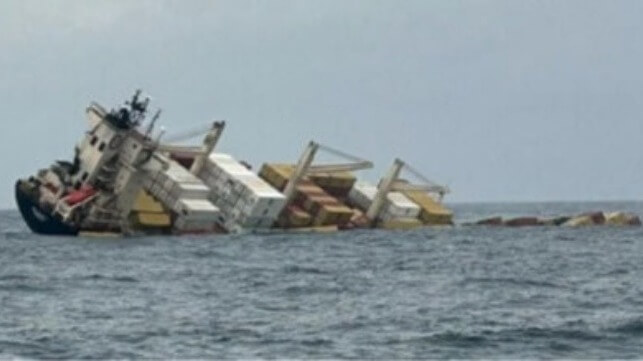
Seven crewmembers remain detained in India a year after their ship sank (DGS)

Published May 22, 2026 2:29 PM by The Maritime Executive


A year after the MSC Elsa 3 containership rolled onto its side and sank off the Indian coast, seven officers and crewmembers from the vessel remain detained in India. They are asking the High Court in Kerala for the return of their passports and permission on humanitarian grounds to return to their home countries.

The MSC Elsa 3 had listed onto its side on May 24, 2025, and later sank around 14.6 nautical miles off the Kerala coast. The Indian Coast Guard organized a rescue mission and brought all 24 crewmembers safely into the port. However, the crew says that the Mercantile Marine Department in Kochi issued a notice directing that no crewmember should leave Kochi without written permission.

The police later filed papers for charges against the vessel and its owner/operator, while the local government and the Indian authorities have filed court claims for more than $1 billion in compensation. In addition, the cargo owners filed admiralty claims, while the local fishing community and others have also filed claims in the court against MSC.

The crew told the court that the police had seized their passports. Yet they highlight that only the master of the ship was named in the police indictment. They assert that they have cooperated with the investigation and should now be released to return to their homes. They note that the Director General of Shipping allowed 15 crewmembers to depart India in August 2025.

The remaining crewmembers, including the master, chief officer, chief engineer, and second engineer, filed papers with the High Court asking for the return of their passports and contending they are being illegally detained. The crewmembers are from Russia, Ukraine, Georgia, and the Philippines.

The court held an initial hearing on the petition, and it asked for responses from the Indian government and the local government in Kerala. A follow-up hearing has been scheduled for next Friday, May 29.

Media reports are also highlighting that a year after the casualty, the shoreline continues to be polluted by the cargo. The vessel was carrying 643 containers, some transporting calcium carbide and plastic nurdles. Days after the ship sank, some of the containers began to wash ashore or break open. Around 630 metric tons of debris were recovered during a shore cleanup while a diving program sought to drain the oil from the hulk.

An environmental group is now saying that despite the government ending the cleanup, it is still finding nurdles on the beaches. It reports finding a “persistent presence of the pellets on beaches” while warning that the pellets will be a persistent threat. They theorize that strong waves and weather conditions could also be stirring up debris that remained at sea and driving it to shore.


Tanker Near Somalia Fires Warning Shots to Chase Off Suspicious Approach

pirate group in small boat
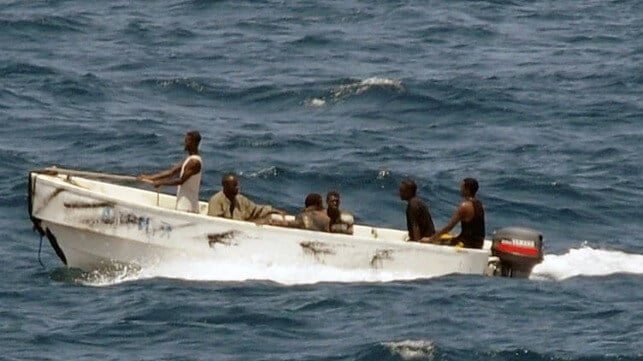
Small boat approached a tanker marking the third incident in a week (USN)

Published May 22, 2026 12:30 PM by The Maritime Executive


A tanker sailing in the Gulf of Aden reported on May 22 that its security team was forced to fire warning shots during a suspicious approach. It was the latest in the ongoing incidents in the region being linked to several active groups of Somali pirates.

The company security officer for the unidentified tanker reported the incident to the UK Maritime Trade Operations. The tanker was underway when it was approached approximately 98 nautical miles from Socotra, an island controlled by Yemen.

A small craft with five people aboard was detected approaching the tanker. The armed security team fired warning shots, which caused the small boat to change course.

It was the third approach in the last week, according to data from the EU’s Maritime Security Center for the Indian Ocean (MSCIO). On May 18, a skiff operating near Bosaso, Somalia, was reported to the EU’s Operation Atalanta. It was believed to be a pirate group seeking a merchant ship target. Three days earlier, on May 15, a suspicious high-speed boat was reported to have stopped a fishing vessel. The people aboard the boat were carrying weapons resembling AK-47 rifles.

Three vessels also remain under the control of pirate groups and are being held off the coast of Somalia. The tanker MT Honour 25 was seized on April 21, the general cargo ship Sward was seized on April 26, and the tanker Eureka was seized on May 2. The pirates are reported to be demanding $3 million for the release of the Eureka.

UKMTO warns that the piracy threat level remains severe along the Somalia coast and in the Somalia Basin. MSCIO specifically cited the highest risk to the north near the Puntland region and in the Gulf of Aden. It also rates the risk as moderate along the Somali coast. Vessels have been warned to remain at least 150 nautical miles off the coast, or to avoid the region if possible.


Dali Civil Trial to Begin June 1 After Judge Denies Motion to Delay

Dali and wreckage of Key bridge
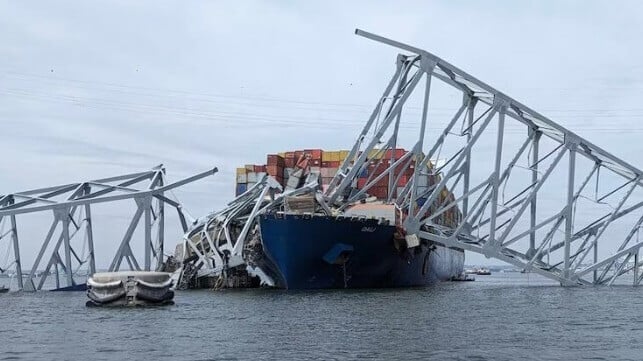
A judge refused an effort to delay the civil trial related to the Dali destroying the bridge in Baltimore in 2024 (US Army Corps of Engineers)

Published May 21, 2026 3:14 PM by The Maritime Executive


The civil liabilities case against the owners and operators of the containership Dali will commence on June 1, as scheduled, a U.S. District Court Judge ruled on Wednesday. The companies had filed a motion calling for staying the trial based on the recent criminal indictments or at least delaying it for 90 days while they resolved issues related to potential witnesses.

Judge James Bredar, who is presiding over the civil litigation and will hear the case as a bench trial (i.e., without a jury), held a hearing on May 20 to review the petition to delay filed by Grace Ocean and Synergy Marine. The companies argued the U.S. Department of Justice had delayed unsealing the criminal indictment against Synergy Marine and one of its employees to less than a month before the start of the civil trial. They also asserted that a dozen employees and crewmembers of the Dali were refusing to come to the United States to appear as witnesses due to a fear that they would be detained and that they might also not testify via video.

The crewmembers and shoreside supervisors invoked their right against self-incrimination during the pre-trial discovery phase. One person had refused to come to the United States and had their deposition taken in London. The companies said they were working with lawyers in an attempt to resolve the issue, possibly having some of the individuals appear through video testimonies, but this required additional time. They also asserted proceeding with the civil trial could harm its defense in the criminal trial

Supporting the call for a delay, the federal government was present and argued that the criminal trial should be held first. They acknowledged that it could be a year or more until the criminal trial proceeded, but asserted the federal government could compel the individuals to testify and has additional tools at its disposal not available during a civil trial.

“The right course, the best course, the most fair course, is to stay the course,” Judge Bredar told the court. He ruled the civil case was ready and that the petitioners had failed to show they would suffer significant harm if the case proceeded as scheduled on June 1.

The City and County of Baltimore, joined by lead counsel for private economic loss claimants, had filed their opposition to the move to delay the trial by Grace Ocean and Synergy. They noted that the companies had initiated this action shortly after the containership hit the bridge in 2024, seeking the limitation of liabilities even before the claims were filed. They argued that “it has been apparent that a federal indictment was a near certainty,” since the Dali destroyed the Key Bridge.

In their opposition motion, the lawyers also argued the companies “seek to use the unsealing of the indictments as an opportunity to convert the Limitation shield into a sword.”

The judge agreed that extensive time has been invested to this point and that the discovery phase has been completed to prepare for trial. In the interest of judicial efficency he said the trial should proceed as scheduled. He said the companies had failed to prove that the issues around the witnesses, or new witnesses, would be available if the trial was delayed. He also denied claims that there would be harm to the criminal case if the civil case proceeded and found that the continuing delay is a hardship to the families and others who have filed claims.

In the first phase of the civil case, Judge Bredar is set to decide on the issue of limiting liabilities. The second phase would directly address the claims from five family members of the road workers killed when the bridge collapsed, as well as the City and County of Baltimore’s claims and those filed by businesses and others claiming economic loss from the port having been closed and the loss of the vital roadway.

During the hearing, it was revealed that a sixth family has reached a settlement over its wrongful death claim against the companies. Previously, the State of Maryland also announced that it had settled its claims for a record $2.25 billion with Grace Ocean and Synergy Marine.

The U.S. Federal Government indicted two Synergy Marine companies and one individual employed by the companies as a port supervisor on criminal charges related to the destruction of the bridge and charges of lying during the investigation.