It’s possible that I shall make an ass of myself. But in that case one can always get out of it with a little dialectic. I have, of course, so worded my proposition as to be right either way (K.Marx, Letter to F.Engels on the Indian Mutiny)
Sunday, May 24, 2026
CU
Bellwether industrial metal copper is trading like an AI stock
Copper, famed for tracking shifts in the global industrial economy, is trading like a high-flying tech stock as investors bet that skyrocketing power use for artificial intelligence will fuel a surge in demand.
The highly conductive metal that’s crucial for data centers and power grids has recently been moving in near-lockstep with stocks like Nvidia Corp. and ASML Holding NV. Prices climbed to a record close last week, then retreated as AI-related equities hit turbulence, and were rallying again on Friday as investors returned to the sector.
The gyrations reflect how copper’s exposure to all the transmission lines, transformers and electrical equipment needed to power AI has become a key pillar in the bullish outlook for the metal. For now, that’s outweighing mounting worries about the Iran war’s impact on the more traditional industrial bedrock of copper demand.
“This round of the rally is mainly driven by a structural AI-themed trade,” said Xu Shendi, director of base metal trading at DH Fund Management Co., one of China’s biggest hedge funds. She is neutral to bullish on copper’s outlook, and said further gains are likely to require a fresh wave of investor inflows into the tech sector, alongside tighter mine supplies.
AI isn’t the only force behind the rally. Investors have also been piling into hard assets like copper as a hedge against inflation, while chronic underinvestment in new mines sets the market up for a severe supply deficit.
“Commodities have gone from being an overlooked asset class to becoming increasingly attractive for multi-asset investors,” said Matt Miskin, co-chief investment strategist at Manulife John Hancock Investments. “This is really a three-legged stool for copper: AI demand, inflation hedging and a run-it-hot macro environment.”
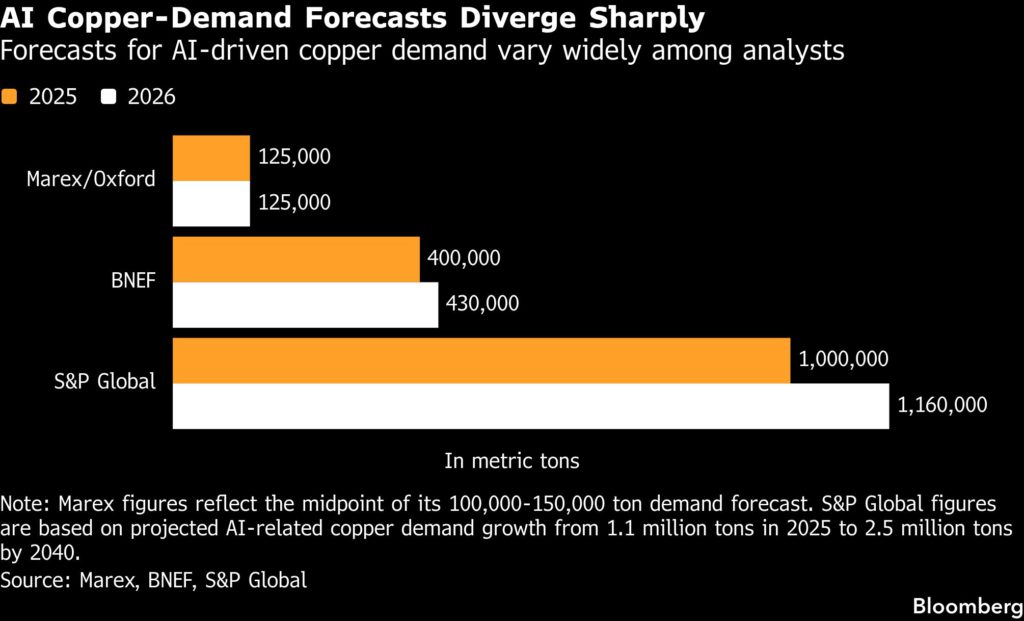
Analysts vary widely on AI’s impact on copper demand, with estimates ranging from about 125,000 tons annually over the past three years to 1.1 million tons projected for data centers in 2025. Commodities trader Mercuria expects about 350,000 tons of growth this year, up from under 400,000 tons in 2025.
While that’s only about 2.5% of annual demand, Mercuria’s head of metals research, Nicholas Snowdon, told an industry conference in Hong Kong earlier this month that he expects the AI industry’s growth to be similar to that of China’s electric-vehicle and renewables sectors, which have become a major source of copper demand in less than a decade.
Still, some warn that the copper market is pricing in the demand uplift far too early.
Recent research by commodities brokerage Marex Group and Oxford University notes that while Microsoft Corp., Alphabet Inc.’s Google and Amazon.com Inc. have committed some $580 billion to US data center projects this year, the industry is running into formidable bottlenecks in securing labor, power, equipment and permits.
“For copper, it’s not really the data centers themselves that matter most — it’s the power generation and transmission network required to support them,” said Guy Wolf, Marex’s global head of market analytics. “The AI narrative is bullish for copper, but the actual metals demand is probably further into the future than many investors assume.”
Even so, Wolf noted that there are risks for traders thinking of betting against the rally, given the sheer size of recent inflows into technology stocks.
Copper’s surge has come as money managers have added about $14 billion in net-long positions in futures markets in London and New York so far this quarter. Over the same period, the combined market capitalization of Nasdaq-100 companies has risen by $7.8 trillion, according to calculations by Bloomberg News.
“We haven’t really seen this kind of institutional interest since the China supercycle,” Wolf said, referring to the years earlier this century when rapid Chinese growth led to a commodities boom. “Even a small portfolio allocation shift into hard assets can overwhelm the market.”
Bearish investors also risk being burned by the re-emergence of a lucrative trading opportunity linked to the risk that the US will impose tariffs on imports of the metal. Copper prices on New York’s Comex have jumped above those on the LME in recent weeks, allowing traders to capture the arbitrage by shipping cargoes to the US.
LME futures were trading at about $13,630 a ton on the LME on Friday, while Comex prices were about $400 higher. Orders to withdraw copper from warehouses tracked by the LME jumped the most since 2013, in a sign that traders may be looking to move stock into Comex warehouses to capture the higher prices.
That dynamic could end up triggering fresh bidding wars among buyers seeking to secure available metal, even in an environment where demand is weakening.
Earlier in the year, a rebound in Chinese demand had supported copper’s rally, with buoyant spending in power grids and the renewable energy sector offsetting losses from the property sector, which was the engine powering copper demand for much of the 21st century. But close-to-record prices are starting to deter manufacturers.
The US premium is “driving all the metal flows that way, and China’s fundamentals do not matter any more,” said Harry Jiang, a trading manager with China Base Ningbo Group. “China is increasingly a price taker, not a price setter.”
In the past, investors have often been caught out as swift downturns in spot demand in China have upended their bullish bets on future growth. But Matthew Fine, who started investing in copper miners after joining Third Avenue Management as a portfolio manager in 2017, remains confident that the long-term trajectory is higher.
Even factoring in new demand from the AI sector, copper demand is only likely to grow at 2.7% annually through to 2040, he said. But crucially, miners look increasingly unable to keep pace, as new projects grow scarcer and more expensive to develop.
“AI may be the latest component of evolving demand, but the projected growth rates are no different than they’ve been for 125 years,” he said. “We look like, as a planet, we’re going to be short in a real way pretty soon.”
3D-Printed Copper Plates Could Cut Data Center Cooling Energy Use by 97%
A University of Illinois Urbana-Champaign team published research showing 3D-printed pure copper cooling plates could reduce data center cooling energy use from 30-40% of total power draw to just 1.1%.
The plates use a mathematical topology optimization algorithm to redesign internal fin structures into complex shapes that maximize heat transfer while slashing the pumping energy required to move coolant.
The plates are built using electrochemical additive manufacturing (ECAM), which can produce pure copper components with detail down to 30-50 micrometers -- finer than a human hair.
The artificial intelligence boom is creating an energy monster that the world is unprepared and unequipped to deal with. Providing enough energy to fuel the AI ambitions of the future as well as to support human demand and development will require advances in energy technologies that are as-yet undiscovered. “There’s no way to get there without a breakthrough,” Sam Altman, co-founder and CEO of ChatGPT firm OpenAI, said at the 2024 World Economic Forum in Davos, Switzerland.
More accurately, it will probably require several breakthroughs. Altman was referring to the need to fund nuclear fusion research when he made his infinitely quotable statement at Davos, but reigning in the AI energy monster will not only require next-gen energy generation, it will also require a great leap forward in data center design and energy efficiency. And a team of researchers from University of Illinois Urbana-Champaign, USA may have made just such a breakthrough.
An innovative form of 3D-printed copper cooling plates could revolutionize the design of data centers and slash the amount of energy needed to cool them, according to a new scientific paper published in the academic journal Cell Reports Physical Science. The team of researchers found that their innovative pure copper plate model, which was designed using a cutting-edge mathematical algorithm, uses just a fraction of the energy that conventional cooling plates use.
The potential impact of this discovery is enormous. The computer chips used to run the computations for large language models create an enormous amount of thermal energy in a process known as Joule heating. In the course of one hour, a single computer chip creates roughly enough heat to boil 50 cups of water. And AI data centers typically house hundreds of thousands of these kinds of computer chips. And, as computer chips become more and more powerful, their heat emissions climb ever higher.
As a result, cooling systems are of central importance to the functioning of data centers – and they require a whole lot of energy to run. Cooling systems currently represent a whopping 30 to 40 percent of AI data centers’ energy use. When implementing the new 3D-printed plates, that figure drops to just 1.1 percent, an astonishing and potentially game-changing savings.
“Cooling is the bottleneck in computer-chip design,” Behnood Bazmi, mechanical engineer and the paper’s first author, was quoted in a press release accompanying the publishing of the paper. “By bridging the gap between computational design and manufacturing capability, our approach provides a pathway for more energy-efficient liquid cooling of chips and other electronics.”
Cold plates are already in commercial use in data center applications, but they are designed for ease of manufacturing rather than for optimal performance. The solution presented by the University of Illinois Urbana-Champaign team addresses two critical downsides to conventional cooling systems by redesigning both the materials used as well as the way that those materials are configured.
“In a technique known as topology optimization, the researchers used a mathematical optimization algorithm to redesign the tiny internal fin structures from the conventional rectangular or cylindrical geometries into far more complex, jagged, and pointed shapes that maximize heat transfer and thermal performance, while minimizing the pumping effort required to move coolant through the plate,” New Atlas reported earlier this week.
To facilitate the construction of such a complex model, the team turned to 3D printing – more specifically, electrochemical additive manufacturing (ECAM), to build the plate’s intricate and craggy surface one layer at a time. This allows for an extremely delicate and nuanced approach to building a far more sophisticated – and therefore more energy efficient – cooling system. “ECAM can manufacture pure copper parts with very fine detail – down to 30 to 50 micrometers, less than the width of a human hair,” says study co-author Nenad Miljkovic.
Trafigura Group has moved to withdraw hundreds of millions of dollars of copper from London Metal Exchange warehouses as lucrative trading opportunities emerge in the US and China, according to people familiar with the matter.
The trading house was the main party involved in orders to withdraw more than 51,000 tons of copper from LME warehouses in the US and Asia on Friday, said the people, who asked not to be identified due to the commercial sensitivity of the matter.
The orders — which were the largest seen on the LME since 2013 — come as copper futures on New York’s Comex have surged above prices on the LME, creating a huge incentive for traders to deliver copper into the US.
Comex contracts have been trading at a premium over the LME for most of the past year, due to the possibility that the Trump administration will impose tariffs on the metal. Record volumes of copper were shipped to the country last year as traders cashed in on the arbitrage, and Trafigura’s withdrawal of stock is a sign that the seismic trading opportunity is gaining new momentum.
More than 30,000 tons of metal was ordered out of LME warehouses in New Orleans and Baltimore on Friday, and they’re likely to be delivered into Comex warehouses or to end buyers in the US market, the people said. The trading opportunity exists because Comex copper prices are inclusive of duties, while LME prices aren’t.
Nearly 20,000 tons of copper was also withdrawn from LME warehouses in Asia. While the US could be an attractive destination for some of that metal, rising prices in China are also creating incentives to ship copper there too.
With LME prices trading around $13,660 a ton on Friday, the total value of the metal that’s been ordered from the exchange is more than $700 million.
A spokesperson for Trafigura declined to comment.
(By Mark Burton and Jack Farchy)
Zambia’s Konkola reopens Chingola copper mine after 18-year shutdown
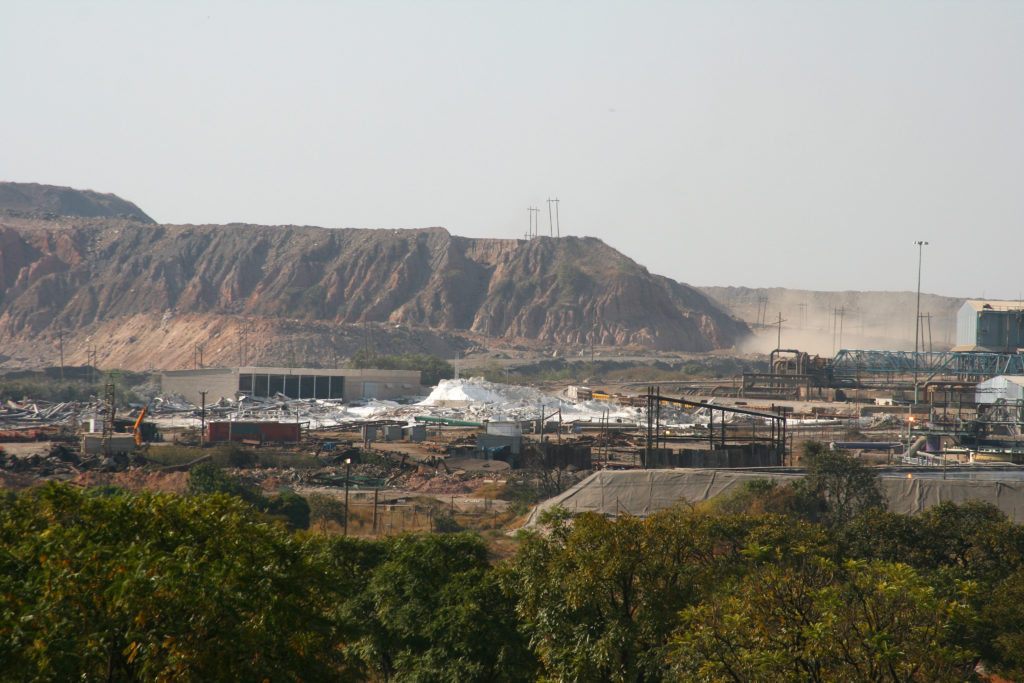
Nchanga mine in Chingola, in the Copperbelt Province of Zambia. (Image courtesy of Wikimedia Commons)
Zambia’s Konkola Copper Mines resumed mining at its Chingola “B” Mine on Thursday, 18 years after operations ceased, as Africa’s second-largest copper producing nation pushes to more than triple its annual output to 3 million tons by 2031.
The mine, part of the Nchanga mining complex, is projected to produce more than 200,000 tons of ore per month, KCM chief executive Deshnee Naidoo said in a statement.
The mine produced about 60,000 tons per month at an average grade of 2.5% between 1980 and 2003.
KCM, 79.4% owned by Vedanta Resources and 20.6% by Zambia’s state investment company ZCCM-IH, operates mines and processing plants in Chingola, Chililabombwe, Kitwe and Nampundwe.
Zambia produced 890,346 tons of copper last year, below its 1 million tons target.
(By Chris Mfula; Editing by Olivia Kumwenda-Mtambo and Peter Graff)
Codelco eyes $2 billion gain from unifying copper mines in Chile
Codelco is seeking a combined $2 billion in cost savings and additional revenue by integrating the operations of three copper mines as the state-owned Chilean company tries to offset the impact of stagnating output and rising debt.
The plan to integrate the Chuquicamata, Radomiro Tomic and Ministro Hales mines in the north of the country was recently presented by management to Codelco’s board of directors, according to people familiar with the situation, who asked not to be identified discussing confidential information
The plan envisages gains beginning to kick in as soon as 2027 as a result of unifying operational planning for the mines and sharing processing plants, possibly under a single management structure, the people said. Codelco didn’t immediately respond to requests for comment.
The proposed mine integration is part of a company-wide, four-year production plan that Codelco intends to present to the government in the coming months.
Like other copper producers, Codelco is facing inflationary pressures that have eroded the benefits of record prices for the metal. War in the Middle East has driven up the cost of energy and sulfuric acid, a key input for copper processing. Declining ore grades are also forcing producers to process a greater volume of rock to maintain output.
The need to improve efficiency is especially acute for Codelco given its heavy debt load and spending commitments. The company is already busy integrating a central Chile operation with an adjacent Anglo American Plc mine, and it increasingly relies on private-sector partnerships for exploration projects.
The proposed reorganization at Codelco’s northern mines would include sending ore from one pit to another’s plants and blending material to better align with customer needs, according to the people. One option would entail cutting management roles, although on-the-ground teams would remain intact, the people said. Talks with unions are already under way.
(By James Attwood)
India’s top copper producers oppose inclusion of scrap-based rods in standards
India’s top copper producers, including Adani, Vedanta and Hindalco, are opposing plans to make copper wire made by secondary refiners acceptable under government quality standards, saying products made from scrap pose safety risks.
The dispute has triggered a months-long standoff between large primary producers and smaller refiners over fire-refined high conductivity (FRHC) copper rods, which are mainly used in electrical applications such as transformers, power cables and wires.
Large producers argue that copper rods from smaller refiners, which mostly use scrap as raw material, should not be under the same standards because the products may not consistently meet the purity levels required for electrical applications.
“Indian fire (secondary) refiners may not have the requisite technology and hence are incapable of manufacturing the FRHC grade consistently,” the large producers said, according to the minutes of a March 23 meeting of the Bureau of Indian Standards (BIS) that was reviewed by Reuters.
The state-run BIS oversees product quality standards in India.
“Many of the manufacturers are not refining and just re-melting scrap to make substandard product,” the minutes said of the views expressed by the Indian Primary Copper Association (IPCPA).
The IPCPA’s partners include Adani, Vedanta, Hindalco and Hindustan Copper.
In the minutes, secondary producers defended their production method, saying fire refining is used to control the chemical composition of copper and meets conductivity requirements used internationally for cable manufacturing.
The BIS did not respond to requests from Reuters for comment.
IPCPA president Rohit Pathak said the industry body was seeking separate standards for FRHC copper because “fire refining which uses copper scrap as the primary input, cannot remove impurities to achieve 99.99% purity required for electrical applications.”
“Lower purity will increase overheating and fire risks. A separate standard will help ensure safe usage,” Pathak, who is also CEO of Hindalco’s copper business, told Reuters in a statement.
India’s total demand for copper rods in the fiscal year to end-March 2025 was estimated at 1.2 million metric tons, of which imports accounted for 0.1 million tons, while FRHC copper rod production stood at 0.4 million tons, according to industry estimates.
Imports are mainly sourced from the United Arab Emirates, although supplies have been disrupted this year by the Middle East conflict.
As a result of the dispute, about 400,000 tons of copper wire rod is currently being traded outside the quality control regime, an industry source said.
(By Neha Arora; Editing by Mayank Bhardwaj and Raju Gopalakrishnan)
CHART: Copper price surge mints 23 new unicorn mines
Tech venture capitalists invest in startups and get to call them unicorns. The official definition of a unicorn is a startup with a $1 billion valuation while still a private company. There are 1,765 unicorns globally, past and present.
MINING.COM believes the mining industry deserves a similar category of company to catch the imagination of the mainstream investor and compete against Silicon Valley, crypto and hyperscalers for smart (and dumb) investment dollars.
If we must, and it appears we do, we need to think of mines as the apps of the industrial economy (submissions for a better analogy welcome). Physical AI is, unfortunately, already taken.
While we’re at it, might as well rebrand junior mining. Let’s call them startups to attract more outside/bluesky capital from the likes of the Softbank Vision Fund, which, I’m happy to remind readers, invested $300 million in Wag!, a dog walking app that helpfully keeps you updated in real time about your pet’s excretions. (The app survived, the company didn’t.)
Even mining startups that have hastily added Critical Minerals to their names, or better still, Rare Earths (greater crustal abundance than copper to be fair so not that much of stretch) struggle to attract funny money from the Masayoshi Sons of this world.
Miners need to find a way to compete with world-changing companies like Opensea, a now defunct marketplace for Bored Ape Yacht Club NFTs, which peaked at a $13 billion valuation. Which is more than Ivanhoe Mines is worth today, sorry to say.
Copper is so hot right now and it seems apt that the second MINING.COM list of unicorns is also based on the bellwether metal. Data centres need copper by the block cave full (Cu can account for nearly 6% of initial outlays) and will help the industry siphon off some of the trillions of dollars flowing into compute.
The MINING.COM Unicorn Index does not seek to compare orange metal apples with tech apples. How can it? Mining simply has no equivalent to the $1 billion bike-sharing startup and NI 43-101 makes rug-pulling difficult, although not for lack of trying.
Last week copper set a new record at $6.667 a per pound, or $14,700 a tonne. Based on 2025 mine-level production numbers, at that price 75 mines throw off a nominal $1 billion or more per year just from the copper (and quite a few now do so at negative cost thanks to copper mining’s least best kept secret – byproduct credits). That’s 23 more than MINING.COM’s previous rainbow of unicorns.
Not quite 1,765 then. But we’ll take it
Nigerian Ports Blocked by Collision Between Maersk Feeder and Small Tanker
The collision reportedly took place in the Bonny Channel as the feeder was maneuvering before docking at Onne Port (Nigerian Ports Authority)
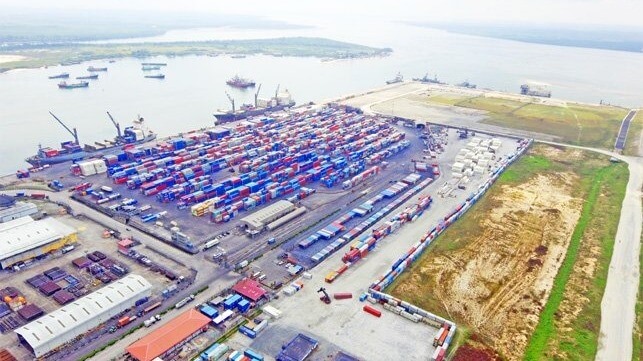
A feeder containership operated by Maersk was involved in an incident in Nigeria’s Bonny Channel, which has left the ship aground. According to media reports, the Maersk Valparaiso is blocking access to the channel and preventing ship movements at Port Harcourt and the Onne port, where it was headed.
The 23,359-dwt feeder has a capacity of 1,740 TEU and operates on a route linking Nigeria, Ghana, Togo, and Côte d'Ivoire. Built in 2010, the feeder is 175 meters (574 feet) in length. Registered in Singapore, it has been operating for Maersk since 2022.
According to a statement from the Nigerian Maritime Administration, the Maersk Valparaiso was inbound to the West Africa Container Terminal located in Onne Port on May 20. It was carrying approximately 717 containers bound for the terminal operated by Maersk’s APM Terminals.
The Daily Trend newspaper reports the vessel was maneuvering in the channel, preparing to dock at berth 4 at Onne. It collided with a small product tanker coming from the Onne Oil and Gas Free Zone. The tanker named Lady Martina grounded, and according to the Daily Trend, the Maersk vessel became “stuck in the mud” in the channel. It is reported to be waiting for a damage assessment.
The Maritime Authority responded to a call from the vessels, sending a patrol boat. It reports that five of the crewmembers aboard the product tanker sustained injuries and were taken ashore for treatment. The vessel, which is 57 meters (187 feet), was built in 1962 and had departed the terminal at Port Harcourt. According to the reports, it drifted and is aground in the Bonny Channel. The authorities are dealing with an oil spill.
The Maersk vessel’s AIS signal continues to show status as “aground” as of Thursday, May 21. The newspaper reports that the hope was that the tide would help the containership to move, but it has remained stuck. Nigerian officials are reported to be working on a plan to refloat the vessel.
For now, the access channel to both ports remains blocked. The Daily Trend quotes sources saying congestion is growing in the Bonny Anchorage. Vessels are unable to arrive or depart from the Oil and Gas Free Zone.
Onne Port was developed by the government and converted to a unique Public-Private Partnership approach by the Federal Government of Nigeria. It has emerged as Nigeria’s second-largest port for exports. APM highlights the terminal for its excellent hinterland connections to the rest of Nigeria. It reports the terminal has a capacity to handle vessels up to 4,500 TEUs and an annual throughput capacity of 361,000 TEUs.
Carnival Corporation Marks First Meal Donation in Latin America
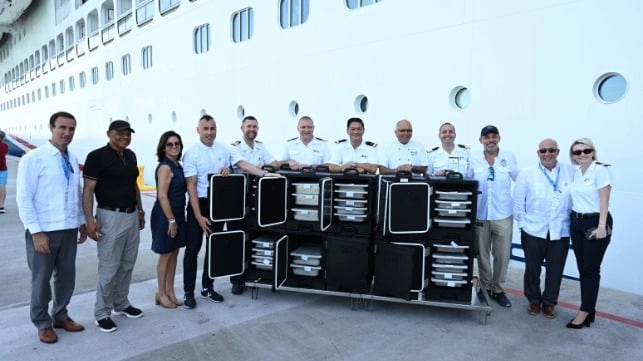
Carnival Corporation, the world's largest cruise company, today announced its first surplus meal donation in Latin America, establishing a pathway for Carnival Cruise Line ships visiting Roatán. The donation of 210 portions of prepared, unserved meals from Carnival Jubilee was provided to the municipality of Roatán for distribution to local partners serving communities in need.
Part of Carnival Corporation’s Less Left Over strategy to reduce food waste, the company’s meal donation program safely redirects high-quality surplus meals to help address food insecurity in port communities where the company’s ships call. With the addition of Roatán, the program has expanded to 18 ports since 2017, providing more than 320,000 meal portions to global communities since its inception, with plans to continue expanding the model into new markets.
“Expanding our surplus meal donation program to Latin America is an important step in our Less Left Over strategy and an example of how collaboration can turn surplus into support for communities,” said Vicky Rey, vice president of government affairs for Latin America, Carnival Corporation. “This work requires clear processes, strong government collaboration and shared commitment, and we are especially grateful to President Asfura for helping facilitate this first donation so quickly, along with the federal and local leaders who helped make it possible.”
“This first donation shows what can happen when the right partners come together with a shared purpose,” said Ron McNab, mayor of Roatán. “Prepared, unserved meals can now safely move from ship to shore to support schools, hospitals and community organizations across Roatán. We are grateful to Carnival Corporation and Carnival Cruise Line for helping to bring this program to life.”
“Surplus meal donation starts with strong food safety standards and close coordination between our shipboard teams and our partners ashore,” said Schalkie Badenhorst, director of food operations, Carnival Cruise Line. “Our team members help make this work possible by identifying high-quality unserved meals remaining after service and ensuring they are handled and transferred ashore in accordance with our food safety requirements.”
The announcement builds on Carnival Corporation’s long-standing presence in Roatán through Isla Tropicale, its cruise destination in Honduras. Isla Tropicale is one of seven exclusive destinations in Latin America and the Caribbean designed for Carnival Corporation guests traveling on one of its eight global cruise lines. Since opening in 2009, the destination has represented a total company investment of $93 million, welcomed close to 9 million visitors and generated approximately $750 million in economic impact. Isla Tropicale supports more than 1,300 local jobs, benefiting vendors, tour operators, transportation providers and others tied to its operations.
Carnival Corporation’s Less Left Over strategy has reduced its per-person food waste by 47% since 2019, avoiding more than $250 million in surplus food costs, while continuing to deliver award-winning dining experiences to its more than 13.5 million guests. The strategy spans dozens of small and large programs, practices and technologies across its world-class cruise lines, designed to cut food waste by 50% by 2030 (vs. 2019).
The products and services herein described in this press release are not endorsed by The Maritime Executive.
Singapore Issues First Authorization for Ammonia Bunkering Trials
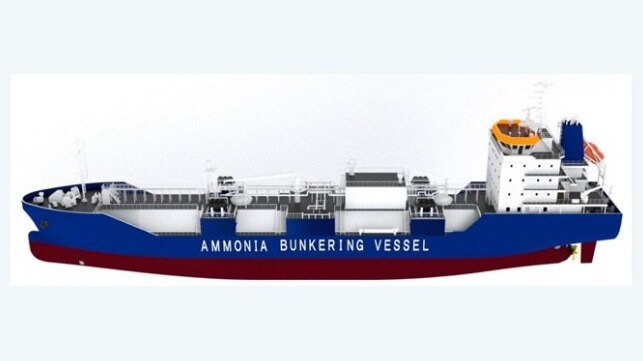
Itochu ordered the first ammonia bunker vessel which will start the bunkering trials in late 2027 (Itochu)
Singapore’s Maritime and Port Authority recently granted the first authorization for an ammonia bunker operation that will use ship-to-ship fuel transfers. The program is being developed by subsidiaries of Japan’s Itochu Corporation and will be used to fuel the newly built ammonia bulkers for the joint venture between Mitsui O.S.K. Lines and CMB.TECH.
Itochu reports that the authorization was granted following MPA’s review of comprehensive safety studies, risk assessments, and business plans for ammonia bunkering in Singapore developed by Itochu's Singapore-based subsidiary ZETA Bunkering. The authorization became effective on May 15, 2026, for a trial period up to two years, subject to MPA’s prevailing regulatory framework.
The companies ordered the first newbuild ammonia bunker vessel in June 2025, which is being built by Japan’s Sasaki Shipbuilding. The vessel, which will have a capacity of approximately 5,000 cbm of ammonia marine fuel, is expected to be delivered in September 2027.
Once the vessel is placed into service, the plan is to conduct the demonstration trials in conjunction with the MOL-CMB.TECH joint venture. The companies announced in March 2025 that they had agreed to joint ownership of three ammonia-fitted 210,000 dwt Newcastle bulk carriers. The vessels are being built at Qingdao Beihai Shipyard in China and will operate under a 10-year charter to MOL. The companies also placed an order at China Merchants Jinling Shipyard (Yangzhou) for a total of six chemical tankers. Two of the vessels will be ammonia-fitted on delivery, and the other four will be built ammonia-ready. CMB.TECH will own the vessels, which will operate under charter to MOL Chemical Tankers.
Singapore is at the forefront in the development of ammonia as an alternative marine fuel. The first-ever ship bunkering and trials were done under the authorization of the MPA for the Fortescue vessel, an offshore support vessel that was converted for ammonia operations. The test of the Fortescue vessel were conducted in early 2024, and the vessel was authorized for registration in Singapore.
Itochu says through these demonstrations and subsequent ammonia bunkering trial operations, it will work closely with MPA and other maritime stakeholders to develop infrastructure, technologies, and operational standards for ammonia bunkering that prioritize safety and environmental sustainability. Itochu will also formulate detailed implementation plans, conduct risk assessments, and establish emergency response measures, ensuring that safety and environmental protection remain paramount.
These trials will enable Itochu to establish safe and sustainable ship-to-ship bunkering operations using ammonia as marine fuel. It aims to commercialize the ammonia bunkering business in Singapore and at major maritime hubs worldwide.
RINA Awards AiP for Energy Harvesting Ship That Could Become Green Supplier
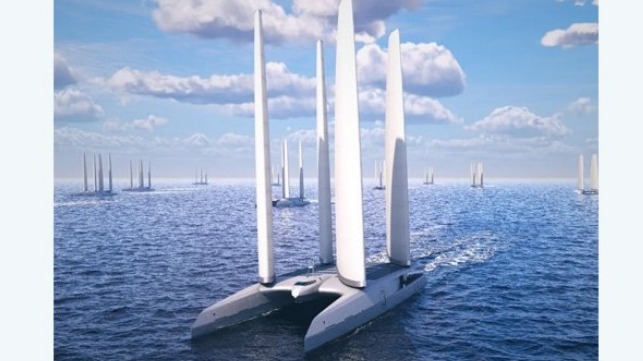
Drift's vessels would produce and store green hydrogen as they sail making them the first net-positive vessels (Drift)
RINA awarded an Approval in Principle (AiP) certificate to a unique concept vessel that would be an energy-harvesting ship, designed to produce green hydrogen as it sails the world and supply it to ships and other users. The approval was issued to Drift Energy, a UK-based start-up launched in 2021.
The company says it is following a roadmap towards building the world’s first net-positive vessel. Drift plans to launch its first ship during 2027, subsequently moving to series production. It reports already having a current orderbook of more than 30 vessels.
DRIFT’s energy harvesting ships would harness deep ocean wind to produce green energy at sea and deliver it worldwide. The vessels use hydrokinetic turbines under the hull to produce electricity, which is then converted via electrolysis into green hydrogen fuel and stored onboard for delivery to ports and other demand centers around the world. They would also incorporate a proprietary AI-enabled routing technology, which would enable the ships to locate and follow optimal weather patterns, achieving ultra-high load factors compared to other renewable energy sources.
Each vessel would have an onboard megawatt-class electrolyzer to produce and store gigawatts of green hydrogen. The hydrogen payload would be stored in standard 40-foot containers, ready to be lifted ashore. Alternatively, the hydrogen can be pumped ashore, and the vessel will also be able to directly bunker other vessels in port or at anchor. Future capability will also allow refueling at sea.
“The AiP validates the vessel’s feasibility from a class perspective and is a key step towards full plan approval,” said Ben Medland, Drift Energy’s Founder and CEO. “Our ships are set to play a pivotal role in the global energy transition, and I am delighted that DRIFT is defining the framework that such innovative vessels will be evaluated against in the future.”
It is the first time that an AiP has been awarded for an energy-harvesting ship, and, through RINA’s risk?based Approval in Principle framework, it confirms that DRIFT’s novel design meets safety levels equivalent to established marine industry standards while enabling clean energy generation at sea.
Patrizio Di Francesco, North Europe Special Projects Business Development Manager and Principal Engineer at RINA, said, “Through close technical collaboration with Drift Energy, RINA has assessed a novel design that introduces new approaches to the generation and transport of clean energy at sea, while addressing classification and safety requirements from the earliest stages of development.”
Drift also highlights the advantages over other forms of green hydrogen generation. It notes that the ships can be built and delivered in significantly less time than is required to develop wind farms. They will also be able to position the ships to maximize their yield based on shifting wind patterns, and the moveability of the ships means they can not only generate the alternative fuel, but it can also be brought to where it is needed.
In addition to the potential to provide marine fuel, Drift points to the opportunities with superyachts. It says it can also supply heavy industry and deliver green hydrogen to small island nations that will not have the generation capabilities.
NATO Monitors Russian Surveillance Ship Loitering Near NATO Exercise
Portuguese frigate as it was monitoring the Russian vessel loitering near the NATO exercise (NATO Maritime Command)
It was a case of who’s watching whom, according to reports from NATO Maritime Command. A Russian “intelligence collection” warship was spotted by NATO, reportedly loitering nearby by as one of its largest and most demanding exercises got underway.
Named Dynamic Mongoose 2026, the operation is taking place in Norway, bringing together warships, assets, and submarines from nine allies. The Russians are rarely too far away, trying to observe the action during one of these exercises. This year, NATO reports it identified the Russian vessel Yuri Ivanov, only one of two in a class of ships Russia built for intelligence collection.
Yuri Ivanov was commissioned in 2015 and is thought to have about 120 people aboard. It is a 4,000-ton displacement vessel measuring 95 meters (312 feet). Its sister ship operates in the Black Sea and has been a target for Ukraine.
NATO commanders reported on Thursday, May 21, that the vessel was loitering in the area of the exercise, which had commenced on May 18 and runs to May 26. They call the training program one of the most demanding maritime exercises for NATO as they sail in the cold waters of Norway. The exercise launched from Trondheim, and it focuses on submarine and anti-submarine warfare capabilities.
Vessels preparing for the start of the exercise (NATO)
Germany, the Netherlands, and Portugal are participating with submarines. Among the surface vessels are HDMS Esbern Snare from Denmark, FGS Sachsen from Germany, HNLMS Zeeleeuw from the Netherlands, NRP Francisco De Almeida from Portugal, and HMS Duncan and HMS Prince of Wales from Great Britain. Maritime patrol aircraft from Canada, France, Germany, Portugal, the United Kingdom, and the United States are also participating in the exercise.
During Dynamic Mongoose, the Allied submarines are maneuvering beneath the cold Norwegian Sea, testing their skills. The surface and air forces are challenged to detect, track, and counter the underwater threats.
They also had a Russian “visitor” to deal with. NATO maritime commanders decided to assign NRP Francisco De Almeida and a Merlin Mk2 from HMS Prince of Wales to monitor the Russian vessel as it was positioned near the NATO fleet.
NATO posted a message online of “We are watching,” but it became a challenge to know who was watching whom.
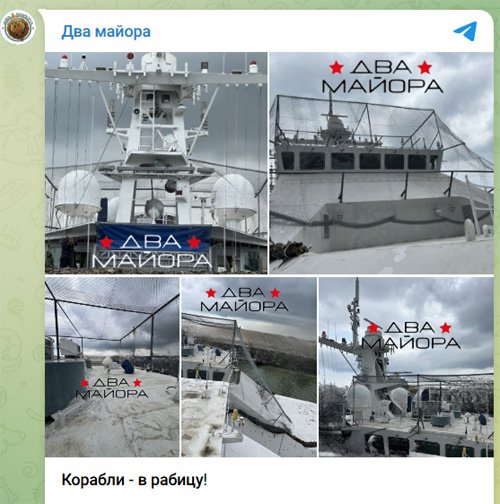
Russian Patrol Ship Improvises Using Fencing to Protect Against Drones
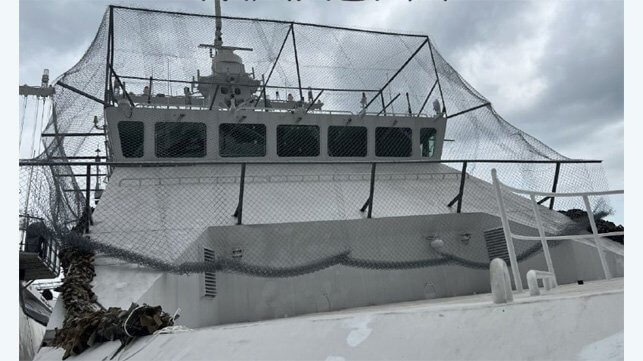
Fencing struck around the bridge and superstructure as makeshift protection against drones (DVA Major on Telegram)
In the more than four years since Russia invaded Ukraine in an all-out war, Ukraine has become proficient in drone technology and has frequently reported its use of its systems to attack Russian warships and other critical infrastructure. Ukrainian media this week spotted photos posted on Russian social media showing an improvised solution to add protection to Russian patrol boats.
The pro-Russian site DVA Major posted pictures showing Russian patrol boats “covered in chain-link fencing!” It says that public funding was used to buy the material and that it has been applied to more than one patrol ship.
The area around the bridge was seen draped with the fencing. It has also been applied to the top of the superstructure.
“This solution isn't a panacea. It won't protect against all types of enemy ammunition. But if nothing is done, nothing will happen,” writes DVA Major.
The Ukrainian site Militarnyi studied the pictures, and although the vessel was not named, it believes it has identified the class of ship. It says the structure around the bridge is unique to the Project 22460 patrol ship.
Russia commissioned the first of the vessels in 2009 and uses them for various coastal patrols. The media reports are that four of the vessels are currently based in Crimea, and two more are at Krasnodar Krai.
In February 2026, Ukraine's general staff said it had used drones to hit two border guard ships moored near the town of Inkerman in Crimea, at the easternmost end of Sevastopol Bay. The vessels damaged were Project 22460 Rubin-class fast patrol boats. Further, it was reported that Ukraine had targeted vessels of the same class in December 2025 in the Caspian Sea. Last weekend, Ukraine also reported hitting a different class of patrol ship in Crimea with drones.
The 22460 patrol boats are fast, with a speed of 25 knots and 650 tons displacement. They are 62.5 meters (205 feet) in length, with reports that they have a crew of 20 and space for 14 additional people.
Other pictures were recently online of the Russian Project 21980 class, which is used for anti-sabotage operations. One of those vessels also appeared to have been fitted with a similar netting made of fencing to block drones.
It remains to be seen if it is judged an effective protection and if it will appear on other Russian ships.
An answer to many questions: Damen Fuel Flexible Tugs
Range of options is prepared for the future – whatever it may hold
The numerous new regulations facing the industry in recent years leave no room for doubt – the maritime energy transition is underway.
To offer just one example of many, in 2024, the EU Emissions Trading System (ETS) was further rolled out to incorporate maritime transportation. True, it’s currently only applicable to vessels over 5,000 gross tonnes. This is unlikely to remain the case for long, however. Already, there are indications that the regulations could be expanded to cover all vessels over 400 gross tonnes in 2027 and below that in the near future.
Into the carbon market
With that, many towage companies will be expected to dramatically lower their emissions, and forced to enter the carbon market, purchasing credits to offset their carbon output – a potentially costly endeavor.
Another strong indication that the transition is progressing is the difficulty vessel owners frequently encounter when trying to attract funding. In many cases now, lending is only available to operators able to demonstrate the sustainability of their intended investment.
Fuel of the future?
Even without these issues to contend with, there remains the question of what to invest in, explains Erik van Schaik, Product Manager Tugs at Damen.
“A newbuild tug ordered today may still be in operation three decades from now. Who knows what the fuel picture will be five years from now, never mind 25 or 30 years?”
In reality, there will most probably be no one dominant maritime fuel type in the future. Various factors will affect which fuel will be used – availability, infrastructure, maturity of technology, and required level of energy density.
The operational profile of the vessel will certainly play a role in determining the fuel type used, he continues.
“For example, with a predictable port-based towage operation, a fully electric, zero emissions approach makes sense. For less predictable operations farther from shore, the way forward is more likely to be a carbon-neutral approach with a fuel such as HVO or green methanol.”
Flexibility – the key to tomorrow
In short, there is a lack of clarity at present. This doesn’t mean there are no routes open to vessel owners; however, the key to the future does not lie in having the solution right here, right now. Rather, says Erik, it lies in having the flexibility to be able to respond once the future arrives.
“That is the thinking behind Damen’s Fuel Flexible (FF) Tugs range. This is a series that provides diesel propulsion, competitive in today’s market, but prepared for what’s to come.
“If, in the future, it becomes commercially attractive – or indeed, mandatory – to sail with hybrid propulsion, HVO or methanol, you have the possibility to switch – at that moment.”
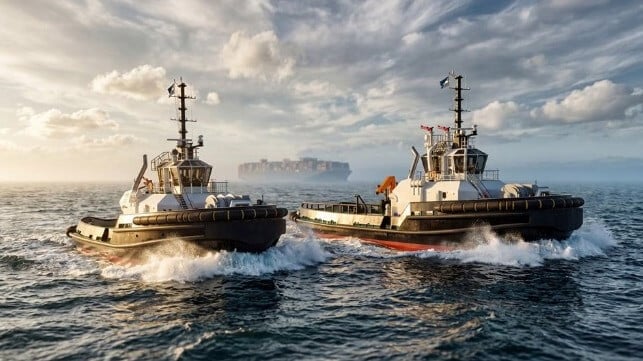
The FF series consists of three tug types – the ASD Tug 2512 FF, the ASD Tug 2713 FF, and the ASD Tug 3313 FF. The vessels are, respectively, 25 x 12, 27 x 13, and 33 x 13 meters, offering a range of capabilities for operations in ports, close to shore, and offshore.
Modular energy concept
With these tugs, Damen applies a modular energy concept, Erik explains. In its design of the vessels, Damen has created additional spaces which, in the future, can be used for storage and handling of alternative energy sources. For now, this space sits empty, waiting to see what the future will bring.
When the moment comes, it is ready for rapid conversion to a number of different configurations, depending on what is required or desirable.
“The fuel flexible tugs are prepared for an easy retrofit from diesel or HVO to diesel or HVO plus methanol or diesel or HVO plus battery electric PTI/PTO hybrid.
“The existing Damen diesel tug family and the new Damen Fuel Flexible Tug family will have a comparable price per ton bollard pull. Tug owners can undertake a retrofit to a different energy source during the lifetime of the vessel when they are certain there is a business case for it. If that moment never occurs during the lifetime of the vessel, no money is lost.”
The way forward
“What this means is, you have today a single platform that supports multiple configurations – diesel, HVO, hybrid, or methanol – ready for the future. Of course, there will be an investment required to convert it to a different configuration, but you will only need to do that at the point when you know for sure that the decision you are taking is relevant and likely to offer a return on investment.
“To our thinking, this is a practical way forward. While no one can offer clarity on what the future looks like, the FF range offers operators a smart solution; a range of vessels suited to today’s operations and ready, without significant adaptation, for tomorrows. The FF Tugs offer operators a means to invest in fleet renewal, cost-effectively and with confidence.”
This article is sponsored by Damen Shipyards Group. For more information about the tugs, please visit the company online.
The opinions expressed herein are the author's and not necessarily those of The Maritime Executive.
DNV Study Suggests Possibility of Eliminating Efficiency Loss From Fouling
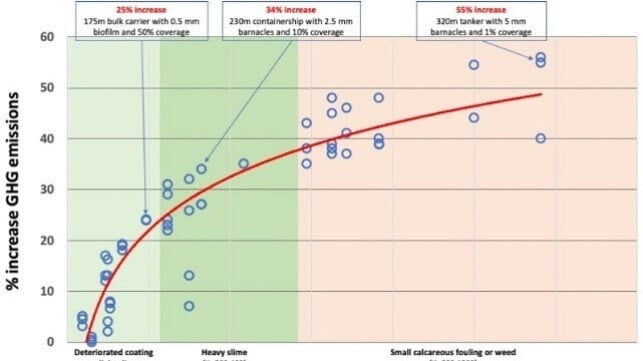
A standard reference chart showing the serious impact on fuel efficiency as fouling progresses (IMO). A DNV study shows that frequent cleanings can keep a ship's fouling level from progressing towards the right side of the curve.
When evaluating the antifouling properties of a hull coating - and the corresponding fuel savings that an operator can expect to achieve over time - shipowners look at how much the vessel gets slowed down by fouling over time. A poorly-chosen coating will show a large slowdown and falling fuel economy between five-year dockings; a properly-chosen coating will still show some slowing over the years, but not much. It now appears possible that the baseline for this measurement could be reset to zero: coating maker Jotun has published results that suggest that with a proprietary hull-cleaning robot, a ship can operate all the time with a continuously clean hull - for all intents and purposes, just as efficient after five years as the day it came out of the drydock.
The study, conducted by DNV, followed 12 vessels that have used Jotun's hull-cleaning robot for more than three years (on average). A check of the ship's performance data found no measurable speed loss over time, compared to an initial one-year reference period. Physical inspections were also conducted to check for visible fouling on the underside.
"The analysis confirmed that the hulls remained clean throughout the review period and that no measurable loss of speed occurred. This provides Jotun with third-party verification that the solution performed as intended under real operating conditions," explained Olav Rognebakke, Head of Section Hydrodynamics and Stability at DNV.
The idea is to use a cleaning-compatible coating, then clean so often that early-stage fouling is removed before it can stick to the hull and grow into something large enough to induce drag. Jotun says that by evaluating the speed loss data, DNV has shown that this level of cleanliness is operationally meaningful for the shipowner.
"Credible speed loss data matters. Without it, operators face operational and regulatory risk, and fleet decarbonisation plans can be built on the wrong assumptions. Independent verification, like through DNV, is how we turn claims into documented performance," said Morten Sten Johansen, Global Category Director for Hull Performance at Jotun.
D.E.I.
Panama Canal Names First Female Administrator as Challenges Grow
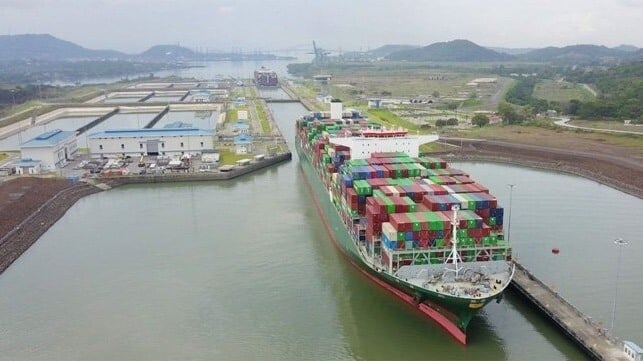
Panama Canal is seeing a surge in volumes as tankers rush to the wateway after leaving the Middle East (ACP)
The President of Panama, Jose Mulino, announced on Thursday the decision of the Board of Directors of the Panama Canal Authority to appoint its first-ever female administrator for the vital waterway. An engineer and the current deputy administrator, Ilya Espino de Marotta, will officially assume the leadership position on October 1, taking the reins at a critical time as the operation is seeing increased traffic and potential impacts from a brewing El Niño weather pattern and the lingering pressure from the United States after Donald Trump asserted that China was controlling the operations.
A marine engineer, a graduate of Texas A&M University, with a master's degree in Economic Engineering from Santa María La Antigua University and executive training from INCAE and the Kellogg School of Management, Espino de Marotta, the authority highlights, was selected after a national international search, consultation, and evaluation process. It notes she has over 40 years of experience and is a 35-year veteran at the Panama Canal, having overseen major projects, including the expansion programs.
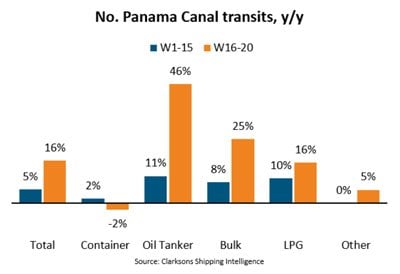
Espino de Marotta takes over as volume at the Panama Canal is increasing. The industry trade group BIMCO highlights that the disruptions in the Middle East and the closure of the Strait of Hormuz are contributing to the Panama Canal’s volumes. With oil and gas prices increasing, U.S. exports are growing, and Asia is seeking to make up the shortfall through U.S. imports.
BIMCO highlights an eight percent year over year increase in daily transits at the Panama Canal, with a current daily average of 38 vessels driven by the tanker sector. In the past five weeks, BIMCO reports there has been a 16 percent year-over-year increase in traffic at the Panama Canal.
(BIMCO - Clarksons data)
“The daily maximum capacity of the Panama Canal is around 36 to 40 transits, meaning it is currently operating close to maximum capacity,” says Filipe Gouveia, Shipping Analysis Manager at BIMCO. “The recent spike in demand has inflated auction prices and caused a 50 percent year-over-year increase in waiting times, now sitting at a 47-hour average.”
The Panama Canal Authority’s online dashboard shows a total of 83 booked vessels and 10 non-booked vessels waiting as of May 21. It says the average wait for non-booked vessels is 3.9 days northbound and 8 days southbound.
The surge in volume has also sent prices skyrocketing for the slots the AMP auctions off to vessels without bookings. Earlier in the month, brokers reported a record $4 million price paid at auction for a slot, while the average is running around $400,000, up nearly three times from the average before the war started in the Middle East.
BIMCO highlights that container vessels, LPG, oil tankers, and bulkers make up approximately three-quarters of the transits. The rise in energy shipments, it notes, adds to the strain as many of these vessels operate in the spot market without schedules that permit advance reservations.
“Looking ahead, demand for Panama Canal transits could stay high for as long as disruptions in the Strait of Hormuz persist and U.S. energy exports stay strong. In the short term, congestion and waiting times could remain high and increase further in the medium term,” reports BIMCO.
The first challenge will come in June. Beginning at midnight on June 9, the canal will begin a dry maintenance process for the east lane at Gatun Lock, and it is scheduled to run through June 17. During that time, booking slots will be cut to just 16 vessels, with the authority warning that lockage will take additional time as the vessels share the westbound lane. It will be offering 10 fewer slots than normal during the maintenance period.
Also looming and expected to start this month or next is the weather phenomenon known as El Niño, which is likely to reduce rainfall on the isthmus. The authority highlights that it is better prepared than in the 2023-2024 season, when the lack of water forced it to cut transits to 22 vessels and reduce the maximum draught.
It reports monitoring began in late 2025 and that it has kept water levels at historically high levels in Gatun Lake, which serves as the main reservoir of the operations. They also point to an unusually wet season, which helped strengthen water reserves in the lakes, while they have also maintained water-saving measures at the locks. Currently, they do not anticipate being forced to renew restrictions in 2026, but the situation requires careful monitoring and management.
Longer-term, Espino de Marotta is likely to face renewed pressures from the Trump administration, which has also demanded free passage for U.S. government ships. The authority is also planning the development of two new port terminals, one at each end of the canal, with the tender expected in the coming months. It was announced to address U.S. concerns before Panama’s courts canceled the concession of CK Hutchison. The country remains locked in a brewing legal battle or arbitration with the Hong Kong company, while it also plans to tender for new concessions to operate the two existing terminals.
The Panama Canal Authority has announced other expansion plans, including a natural gas pipeline and improvements to the logistics corridor. It also has a long-term program to improve its reservoir system and water management.



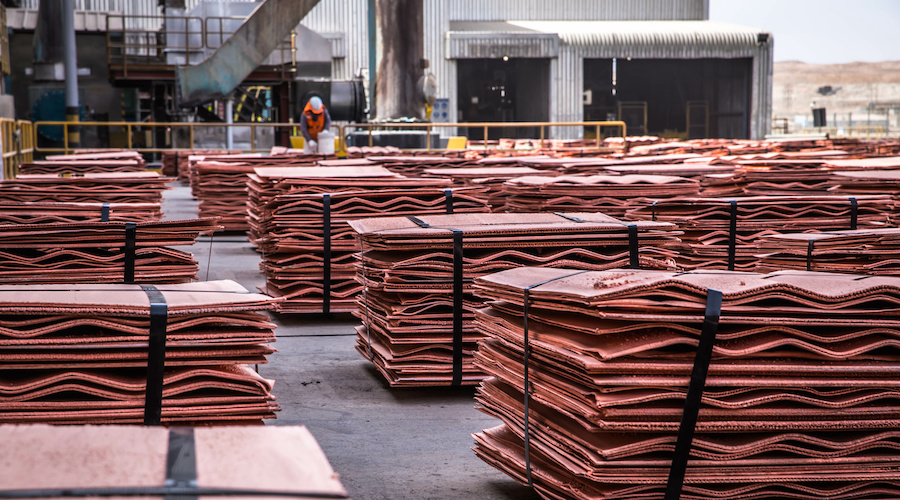

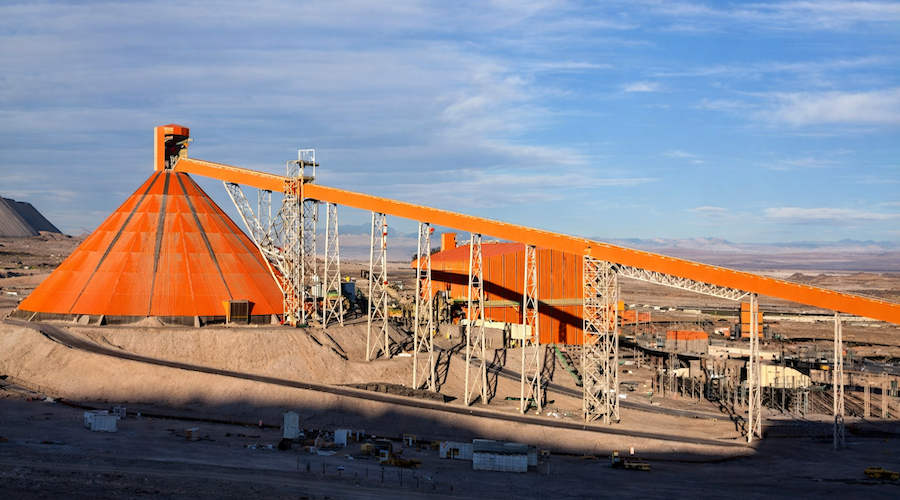 Ministro Hales copper mine. (Image courtesy of Codelco | Flickr.)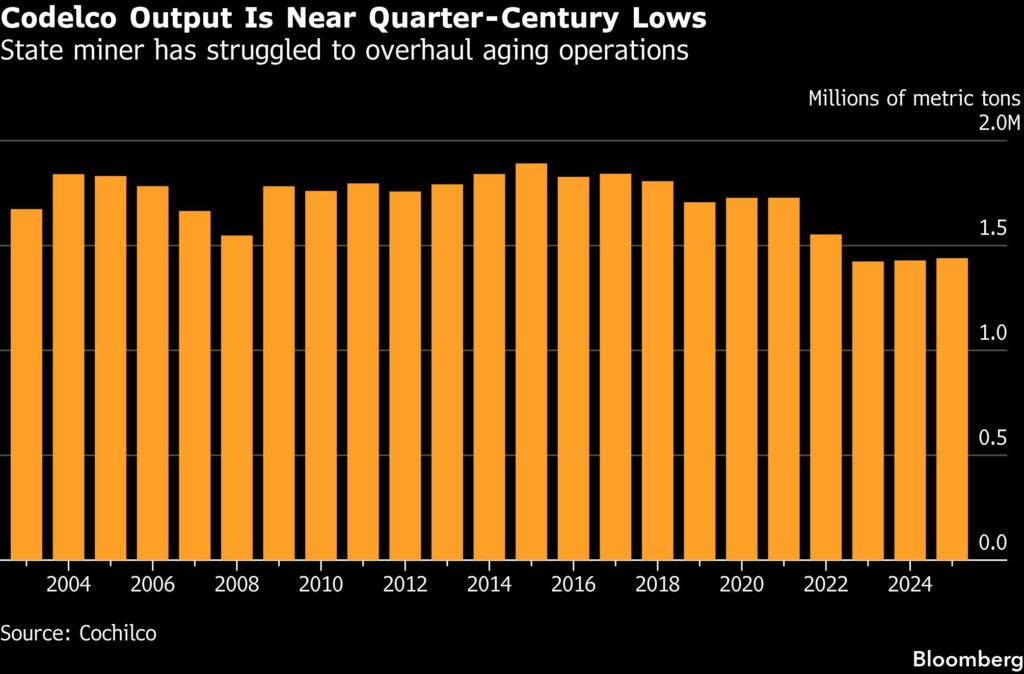





.jpg)