LA REVUE GAUCHE - Left Comment

It’s possible that I shall make an ass of myself. But in that case one can always get out of it with a little dialectic. I have, of course, so worded my proposition as to be right either way (K.Marx, Letter to F.Engels on the Indian Mutiny)

Sunday, May 24, 2020

   XI'S CHINA
OFTEN OVERLOOKED IS THE CONFUCIAN SCHOLAR MENCIUS AND HIS INFLUENCE IN THE CURRENT PHILOSOPHY OF CHINA AS IT CONFRONTS LIBERALISM NOT WITH MAOISM BUT CONFUCIANISM AND LEGALISM


DEFEND THE BOURGEOIS REVOLUTION; 
LIBERTY, EQUALITY, FRATERNITY
AGAINST THE STALINIST CONFUCIAN/MENCIUS

REGIME IN BEIJING 

Mencius - China Highlights

https://www.chinahighlights.com › travelguide › china-history › mencius
Mencius (孟子) was an famous Confucian scholar and philosopher during the ... Some Confucians like Xun Zi and others such as Legalism philosophers in Qin ...

Legalism and Chinese Philosophy - Cn

https://web.cn.edu › kwheeler › chinese_legalism

(Mencius is often held up as a contrasting example of a Confucian philosopher in opposition to the legalistic doctrine of Hsün-tzu). The difference also appears ...

Overview

  • Three competing belief systems (Confucianism, Daoism, and Legalism) came to prominence during the Warring States period of Chinese history.
  • Confucianism is an ethic of moral uprightness, social order, and filial responsibility.
  • Daoism was a philosophy of universal harmony that urged its practitioners not to get too involved in worldly affairs.
  • Legalism is a theory of autocratic, centralized rule and harsh penalties.
  • These three philosophies influenced early Chinese empires; some even became official state ideologies.

Warring states period: Confucius, Kong Fuzi, Daoism (article ...

https://www.khanacademy.org › ... › Ancient and Imperial China

Daoism influenced many elements of later Chinese philosophy, especially Chinese Buddhism. Confucianism, Legalism, and Daoism all each played a role ...

Chinese Philosophy: Social and Political Thought ...

https://www.encyclopedia.com › humanities › chinese-philosophy-social-a...

Apr 5, 2020 - And the legalists tried to extend the role of punishment more broadly to ... Confucius was the first Chinese thinker to advocate that these values ...

MENCIUS AND HIS PHILOSOPHY OF GOODNESS | Facts ...

factsanddetails.com › china › cat3 › sub69 › entry-5566

Jump to Xun Zi and the Legalists - The Legalists exalted the state and sought its prosperity and ... China.org; China Daily; Japan News; Times of London; 


Mencius (Stanford Encyclopedia of Philosophy)


https://plato.stanford.edu › entries › mencius


by B Van Norden - ‎2004 - ‎Cited by 18 - ‎Related articles
Oct 16, 2004 - Mencius (fourth century BCE) was a Confucian philosopher. ... in the 17th century) of the Chinese “Mengzi,” meaning Master Meng. ... but it was a syncretic form of the philosophy that included elements of Daoism, Legalism, ...
‎Life and Confucian ... · ‎Mencius and His ... · ‎Later Influence and ... · ‎Bibliography

Legalism in Chinese Philosophy (Stanford Encyclopedia of ...


https://plato.stanford.edu › entries › chinese-legalism


by Y Pines - ‎2014 - ‎Cited by 20 - ‎Related articles
Dec 10, 2014 - Legalist thinkers contributed greatly to the formation of China's empire ... of the followers of Confucius 孔子 (551–479 BCE) and Mozi 墨子 (ca.


Mencius | Chinese philosopher | Britannica


https://www.britannica.com › Philosophy & Religion › Philosophers


Mencius, early Chinese philosopher whose development of orthodox Confucianism earned him the title “second sage.” Chief among his basic tenets was an ...
Missing: LEGALIST ‎| Must include: LEGALIST

EUGENE PLAWIUK at 11:53 PM No comments:
Share
‘Hong Kong is burning’: Former lawmaker on China’s plans for a new security law

Hong Kong is ‘anxious, angry and frightened,’ ex-lawmaker says of China’s proposed security law


DEFEND THE BOURGEOIS REVOLUTION;
LIBERTY, EQUALITY, FRATERNITY
AGAINST THE STALINIST CONFUCIAN/MENCIUS
REGIME IN BEIJING


PUBLISHED FRI, MAY 22 2020

Yen Nee Lee@YENNEE_LEE

KEY POINTS


China’s proposed national security law has made the people in Hong Kong “very anxious, angry and frightened,” said Emily Lau, a former Democratic Party member of the Hong Kong Legislative Council.

“The big companies are also very nervous, their investors are nervous because Beijing is going to crack down on Hong Kong, take away our freedoms, our personal safety, our rule of law,” she told CNBC.

The draft law, which Beijing said is “highly necessary,” will prohibit secession, subversion of state power, terrorism activities and foreign interference, reported Reuters.

But opposition politicians and activists said it goes against the “one country, two systems” framework that allows Hong Kong to maintain a largely separate legal and economic framework from China.


‘Hong Kong is burning’: Former lawmaker on China’s plans for a new security law


Opposition politicians in Hong Kong have spoken up against Beijing’s proposed national security law for the city, claiming that it violates China’s “promise” of autonomy and freedom to the Hong Kong people.

“I think we’re talking from a very anxious, angry and frightened Hong Kong,” said Emily Lau, a former Democratic Party member of the Hong Kong Legislative Council.

“The big companies are also very nervous, their investors are nervous because Beijing is going to crack down on Hong Kong, take away our freedoms, our personal safety, our rule of law,” she told CNBC’s “Street Signs Asia” on Friday.

The Democratic Party is one the largest opposition political parties in Hong Kong, and has the third-largest presence in Legislative Council. Lau is a former chairperson of the party.

Beijing announced the draft national security law during the National People’s Congress, an annual meeting of China’s top legislative body. The law, which Beijing said is “highly necessary,” will prohibit secession, subversion of state power, terrorism activities and foreign interference, reported Reuters.


We are not fighting for independence or the overthrow of the Communist Party with force and violence...Emily LauFORMER MEMBER, HONG KONG LEGISLATIVE COUNCIL

Reports of the proposed legislation sparked activist calls for a protest march on Friday, potentially renewing widespread pro-democracy demonstrations that swamped the city for much of last year — but came to a halt due to the coronavirus outbreak in the beginning of this year.

Hong Kong is ruled under the “one country, two systems” policy, which gives the city self-governing power, a largely separate legal and economic framework from China, and various freedoms including limited election rights. It was a framework that was put in place for 50 years, after the former British colony returned to China in 1997.


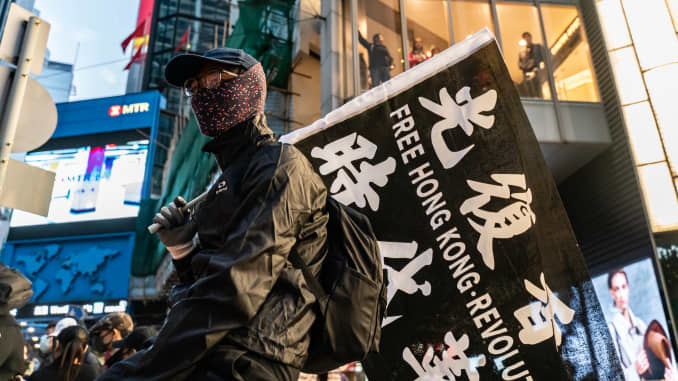
A protester holds a flag that says “Free Hong Kong. Revolution of Our Time” at a demonstration on December 8, 2019 in the city.
Anthony Kwan | Getty Images News | Getty Images


Lau said the protests are not a push for Hong Kong’s independence from China.

“We are not fighting for independence or the overthrow of the Communist Party with force and violence,” she said.

“We just want the Chinese government to keep the promise in the 1984 Sino-British Joint Declaration in which Britain handed Hong Kong over to China under ‘one country, two systems’ that we can preserve our free lifestyle until 2047,” she added.

That sentiment is shared by many other politicians and activists.


Tanya Chan, a pro-democracy lawmaker from the Civic Party, said the introduction of the draft law marked the “saddest day in Hong Kong’s history.”

“It confirms one country, one system,” she told reporters in Hong Kong, indicating the draft legislation is a violation of the “one country, two systems” framework.

CNBC reached out to the Chinese government for comment on the politicians’ remarks but has yet to hear back.

No one knows for sure what will happen at the end of the 50 years, when the policy is expected to cease in 2047, but Hong Kong’s leader Carrie Lam had previously said the one country, two systems” policy could continue beyond the initial 50 years.
‘Time to put an end to it all’

In an editorial published on Friday, Chinese state media Global Times pushed back at criticisms that the proposed law goes against the “one country, two systems” framework.

“On the contrary, the draft law is a move aimed at preventing external forces from meddling in HK (Hong Kong) affairs. It would also deter the power HK extremists. The decision would reestablish a stable environment where the ‘one country, two systems’ principle could work smoothly,” it read.

Hong Kong security law a ‘really serious blow’ to ‘one country, two systems’ notion, says expert


The editorial also blamed “internal and external opposition forces” for “manipulating security loopholes” in the city.

“For the year of 2019, HK did not enjoy a single peaceful day. It was like a city in an undeveloped country engulfed in turmoil. Stores and subway stations were damaged, roads were blocked, and innocent people were attacked and burned. College students were prevented from attending classes,” it said.

“Due to the chaos, HK fell sharply in the global rankings. Now is the time to put an end to it all.”

But Lau — the former lawmaker — said the proposed security legislation will not only affect the Hong Kong people. She said it will also impact a large number of foreign citizens and multi-national companies that have benefited from the city’s freedom.

“I think Hong Kong people have to, we have to stand up for our rights, we have to stand up for our principles,” she said. “But I also call on the international community ... to do something for us.”

— CNBC’s Huileng Tan and Lilian Wu contributed to this report.


Hong Kong Lawmaker On China's Controversial New Security Laws


NPR's Scott Simon talks with Emily Lau about China's plan for new national security laws affecting the region, which would punish antigovernment protests and secessionist behavior.

May 23, 2020
Heard on Weekend Edition Saturday
NPR

Transcript 

NPR's Scott Simon talks with Emily Lau about China's plan for new national security laws affecting the region, which would punish antigovernment protests and secessionist behavior.
br />
SCOTT SIMON, HOST:


China plans to tighten its grip on Hong Kong. This week, the National People's Congress in Beijing announced a new national security and anti-sedition law the pro-democracy advocates warn could upend the one country two systems framework. Emily Lau is a former Democratic Party member of the Hong Kong Legislative Council. And she joins us now from Hong Kong. Ms. Lau, thanks so much for being with us.


EMILY LAU: Thank you.


SIMON: This proposed law criminalizes, quote, "treason, secession, sedition, and subversion against the government." And the state says it's aimed at preventing external forces from meddling in Hong Kong. What's wrong with that?


LAU: Well, they have been making such accusations for quite a number of years, but nobody has ever come up with any evidence of foreign interference and all that. And now without consulting the 7 million Hong Kong people, suddenly, out of the blue in Beijing, they announced that they're going to make this law for us. And they will pass it. I'm sure. The rubber stamp parliament of Beijing will pass it on Thursday next week. And the Hong Kong people are terrified. We don't know the definition of all these terms that you just mentioned. Who is going to come in? Are the people going to be arrested and taken back to mainland China to be tried? None of these things are clear.


SIMON: Well, help us understand how you're concerned this law might be used - assuming it passes.


LAU: We don't know. Just now, there are already reports that there will be demonstrations, marches tomorrow. And, of course, these are taking place without the authorization of the police. And the police said they are going to go all out to arrest them. So we are going to have all these confrontations tomorrow, and the law is not yet passed. But once it's passed, I'm sure there will be more, more such clashes. Is that what Hong Kong wants? They say the business community would welcome the law because it will bring prosperity and stability. But I don't think so. It will make many people, including business people, very anxious.


SIMON: The one country, two systems framework, to remind our listeners, gives Hong Kong a largely separate legal and even economic system from China. You think this this law could begin to upend that.


LAU: Exactly, because in 1997, when Hong Kong was handed by Britain over to Chinese Communist rule, the Chinese Communist government gave an undertaking that there would be a separate system in Hong Kong. Hong Kong people can continue to enjoy our free lifestyle, our rule of law, personal safety - all these things which the people in mainland China do not enjoy. And we should have that for 50 years. Now they are going to implement Chinese laws in Hong Kong. So it is really getting rid of one country, two systems. And that's why people are so angry. And they are so terrified. And we call on the international community - people in America and elsewhere in the free world - to speak out for Hong Kong and to tell the Chinese Communist government to cool it and not to suppress us - not to oppress us like that.


SIMON: Ms. Lau, are you concerned about police and Chinese government reaction if protests begin to pick up in Hong Kong this weekend and in the weeks that follow?


LAU: Well, exactly. It's very sad. There are many, many people, particularly young people, who are very upset. And they are not afraid of going out to confront the police. So in the coming days and weeks and months, I guess you will see scenes of very violent clashes. I hope no one will be killed. And we don't want that to happen. And that need not happen. If people can behave in a civilized manner, sit down and talk to your own people, instead of beating them up and locking them up. That's no way to behave.


SIMON: Emily Lau is a former Democratic Party member of the Hong Kong Legislative Council. Thanks so much for being with us.


LAU: Thank you.


Copyright © 2020 NPR. 


EUGENE PLAWIUK at 11:49 PM No comments:
Share
In full: 191 parliamentarians and policymakers from 23 countries slam Beijing for ‘assault’ on Hong Kong freedoms and rule of law


by HONG KONG FREE PRESS 24TH MAY 2020

A coalition of 191 parliamentarians and policymakers from 23 countries have issued a statement condemning Beijing’s “unilateral introduction of national security legislation in Hong Kong,’ and calling for sympathetic governments to unite against this ‘flagrant breach of the Sino-British Joint Declaration.”

File photo: via Flickr.The letter comes after Beijing announced plans to roll out national security legislation in the autonomous city.


The initiative was led by the former governor of Hong Kong Chris Patten, and the former UK Foreign Secretary Sir Malcolm Rifkind. The list of signatories included ex-prime ministers, foreign secretaries, defence ministers, as well as legal and human rights experts and diplomats.

Lord Patten of Barnes said: “The statement shows growing and widespread international outrage at the decision by the Chinese government to unilaterally impose national security legislation in Hong Kong. The breadth of support, which spans all political parties and four continents, reflects both the severity of the situation and ongoing unified international support for the principle of one-country, two-systems.”


Ex-British foreign secretary and patron for NGO Hong Kong Watch, Sir Malcolm Rifkind said: “This is the most serious threat to the people of Hong Kong that there has been from the Chinese Government since 1997. The people of Hong Kong need, and deserve, our support.”


The statement in full:

We, the co-signed, write to express grave concerns about the unilateral introduction of national security legislation by Beijing in Hong Kong.
This is a comprehensive assault on the city’s autonomy, rule of law, and fundamental freedoms. The integrity of one-country, two-systems hangs by a thread.

It is the genuine grievances of ordinary Hong Kongers that are driving protests. Draconian laws will only escalate the situation further, jeopardising Hong Kong’s future as an open Chinese international city.

If the international community cannot trust Beijing to keep its word when it comes to Hong Kong, people will be reluctant to take its word on other matters. Sympathetic governments must unite to say that this flagrant breach of the Sino-British Joint Declaration cannot be tolerated.

Signatories:


Rt. Hon Lord Patten of Barnes, former Governor of Hong Kong


Rt. Hon Sir Malcolm Rifkind, former Foreign Secretary and Defence Secretary:
Canada
Members of Parliament
Kenny Chiu MP
Garnett Genius MP, Shadow Minister for Multiculturalism & Canada-China Relations
Erin O’Toole MP, Shadow Minister for Foreign Affairs
John Williamson MP
Members of the Senate
Senator Leo Housakos, former Speaker of the Senate
Senator Jim Munson
Senator Thanh Hai Ngo
Former Ministers
Irwin Colter, former Minister of Justice and Attorney General
David Kilgour, former Canadian Secretary of State for Asia-Pacific and former MP
Former Premiers
Bob Rae, former NDP Premier of Ontario and Federal Liberal MP

USA


Members of the Senate


Senator Benjamin L Cardin, Ranking Member of the Senate Small Business Committee


Senator Ted Cruz, Member of the Senate Foreign Relations Committee


Senator Edward J Markey, Ranking Member of the Subcommittee on East Asia, the Pacific, and International Cybersecurity Policy


Senator Robert Menendez, Ranking Member, Senate Foreign Relations Committee


Senator Marco Rubio, Acting Chair of the Senate Intelligence Committee


Members of the House of Representatives


Congressman Robert B Aderholt


Congressman Ami Bera, Chairman of the Subcommittee on Asia, the Pacific, and Non-proliferation, House Foreign Affairs Committee


Congressman Eliot L Engel, Chairman of US House of Representatives Committee on Foreign Affairs


Congressman Mike Gallagher


Congressman Vicky Hartzler


Congressman Michael T McCaul, ranking member of US House of Representatives Committee on Foreign Affairs


Congressman James McGovern, co-chair of the Congressional Executive Commission on China


Congressman Adam B Schiff, Chairman of the US House Permanent Select Committee on Intelligence


Congressman Adam Smith, Chairman of US House of Representatives Committee on Armed Services


Congressman Christopher Smith, former Chair of the House Veterans’ Affairs Committee


Congressman Tom Suozzi


Congressman Ted Yoho, ranking member of the Subcommittee on Asia, the Pacific, and Non-proliferation, US House of Representatives Committee on Foreign Affairs


Former Ambassadors


Grover Joseph Rees, former USA Ambassador to East Timor


EU


Former EU Special Envoys


Jan Figel, former Deputy Prime Minister of Slovakia and EU Special Envoy for Promotion Freedom of Religion or Belief outside of the EU (2016-19)


Members of the European Parliament


Petras Austrevicuis MEP (Renew Europe, Lithuania)


Jose Ramon Bauza Diaz MEP (Renew Europe, Spain)


Francois-Xavier Bellamy MEP (European People’s Party, France)


Vladimír Bilčík MEP (European People’s Party, Slovakia)


Reinhard Buetikofer MEP (Greens, Germany)


Katalin Cseh MEP (Renew Europe, Hungary)


Pascal Durand MEP (Renew Europe, France)


Engin Eroglu MEP (Renew Europe, Germany)


Anna Fotyga MEP, (European Conservatives & Reformists) Poland former Foreign Secretary of Poland


Michael Gahler MEP (European People’s Party, Germany)


Evelyne Gebhardt MEP (Socialists & Democrats, Germany)


Markéta Gregorová MEP (Greens, Czech Republic)


Bernard Guetta MEP (Renew Europe, France)


Rasa Jukneviciene MEP, (European People’s Party, Lithuania) former Minister of Defence of Lithuania and former President of the NATO Parliamentary Assembly


Eugen Jurzyca MEP (European Conservatives & Reformists, Slovakia)


Karin Karlsbro MEP


Moritz Körner MEP


Andrius Kubilius MEP (European People’s Party, Lithuania), former Prime Minister of Lithuania


Miriam Lexmann MEP (European People’s Party, Slovakia)


Javier Nart MEP (Renew Europe, Spain)


Lucia Ďuriš Nicholsonová MEP (European Conservatives & Reformists, Slovakia)


Urmas Paet MEP (Renew Europe, Estonia), former Foreign Secretary of Estonia


Peter Pollák MEP (European People’s Party, Slovakia)


Michaela Šojdrová MEP (European People’s Party, Czech Republic)


Ivan Štefanec MEP (European People’s Party, Slovakia)


Romana Tomc MEP (European People’s Party, Slovenia)


Hilde Vautmans MEP (Renew Europe, Belgium)


Guy Verhofstadt MEP (Renew Europe, Belgium), former Prime Minister of Belgium


Germany


Peter Heidt MP, Germany


Eckhard Gnodtke MP, Germany


Gyde Jensen MP, the Chair of the Human Rights and Humanitarian Aid Committee, Germany


Sweden


Joar Forssell MP, Sweden


Hampus Hagman MP, Sweden


David Josefsson MP, Sweden


Frederik Malm MP, Sweden


Lorentz Tovatt MP, Sweden


Denmark


Viggo Fischer MP, Denmark


Ireland


Senator Ronan Mullen


Lithuania


Mantas Adomenas MP


Arvydas Anusauskas MP


Audronius Azubalis MP, former Minister of Foreign Affairs


Laurynas Kasciunas MP


Gabrielius Landsbergis MP


Radvilė Morkunaite-Mikuleniene MP


Emanuelis Zingeris MP, Chair of the Subcommittee on Transatlantic Relations and Democratic Development


Žygimantas Pavilionis MP, former Ambassador of Lithuania to the United States of America


Slovakia


Members of Parliament


Alojz Baránik MP


Ján Benčík MP


Peter Cmorej MP


Ondrej Dostál MP


Gábor Grendel MP, Deputy Speaker


Jarmila Halgašová MP


Radovan Kazda MP


Miroslav Kollár MP


Vladimíra Marcinková MP


Peter Osuský MP


Peter Pollák MP


Juraj Šeliga MP, Deputy Speaker


Andrej Stančík MP


Romana Tabák MP


Marián Viskupič MP


Anna Zemanová MP


Miroslav Žiak MP


Jana Žitňanská MP


Former Member of Parliament


František Šebej, former MP and Chair of the Foreign Affairs Committee,


Malaysia


Andrew Khoo, Advocate and Solicitor, High Court of Malaya in Malaysia, former Co-Chair of the Human Rights Committee, Bar Council Malaysia


Charles Santiago MP, Chair of ASEAN Parliamentarians for Human Rights


Myanmar


U Kyaw Min San, Member of the Bago Regional Parliament and former legal adviser to the International Commission of Jurists Office


South Korea


Jung-Hoon Lee, former Ambassador for Human Rights, South Korea


India


Dr John Dayal, former President of the All India Catholic Union and Member of the National Integration Council, India


Indonesia


Rafendi Djamin, former Representative of Indonesia to the ASEAN Inter-Governmental Commission on Human Rights, Indonesia


Yuyun Wahyuningrum, Representative of Indonesia to the ASEAN Inter-Governmental Commission on Human Rights, Indonesia


Australia


Members of Parliament


Kevin Andrews MP, Former Australian Defence Minister, Chairman of the Human Rights sub-committee of the Australian Parliamentary Committee on Foreign Affairs, Defence, and Trade


Vicki Dunne MP


Andrew Hastie MP, Chairman of the Parliamentary Joint Committee for Intelligence and Security, Australia


Ian Goodenough MP


Peter Khalil MP, Member of the Joint Standing Committee Foreign Affairs Defence and Trade


Janelle Saffin MP


Dave Sharma MP, Member for Wentworth


Phillip Thompson MP, Member of the Joint Standing Committee on Foreign Affairs, Defence and Trade


Tim Wilson MP


Members of the Senate


Senator Eric Abetz, former Leader of the Government in the Senate


Senator Alex Antic


Senator Slade Brockman, Senator for Western Australia


Senator Matthew Canavan, former Minister for Resources and Northern Australia


Senator Claire Chandler


Senator David Fawcett, Chair of the Joint Standing Committee Foreign Affairs, Defence, and Trade, former Assistant Minister for Defence


Senator Kimberley Kitching, Shadow Assistant Minister for Government Accountability and member of the Joint Standing Committee Foreign Affairs, Defence, and Trade


Senator Matthew O’Sullivan


Senator James Paterson


Senator Tony Sheldon


Senator Amanda Stoker


New Zealand


Simeon Brown MP


Marama Davidson MP, Coleader of the Green Party of Aotearoa/New Zealand


Simon O’Connor MP, Chair of the Foreign Affairs, Defence, and Trade Committee


Latest
‘Double standards and hypocrisy’: Hong Kong gov’t rebukes foreign criticism over national security law plan 

Law Soc. condemns attack on lawyer at national security law demo as ex-Hong Kong leader offers HK$300k reward 

Hong Kong businesses share their struggle for survival amid downturn

TAGGED:Article 23Chris PattenNational Security


HONG KONG FREE PRESS

Hong Kong Free Press is a new, non-profit, English-language news source seeking to unite critical voices on local and national affairs. Free of charge and completely independent, HKFP arrives amid rising concerns over declining press freedom in Hong Kong and during an important time in the city’s constitutional development. More by Hong Kong Free Press


EUGENE PLAWIUK at 11:23 PM No comments:
Share
‹
›
Home
View web version

About Me

My photo
EUGENE PLAWIUK
View my complete profile
Powered by Blogger.