LA REVUE GAUCHE - Left Comment

It’s possible that I shall make an ass of myself. But in that case one can always get out of it with a little dialectic. I have, of course, so worded my proposition as to be right either way (K.Marx, Letter to F.Engels on the Indian Mutiny)

Friday, September 02, 2022

Downer, Turnbull, Trump and a poke in the Five Eyes

Just a diplomat doing his job? A new book puts the spotlight back on Australia, Russia and interference in the US election.
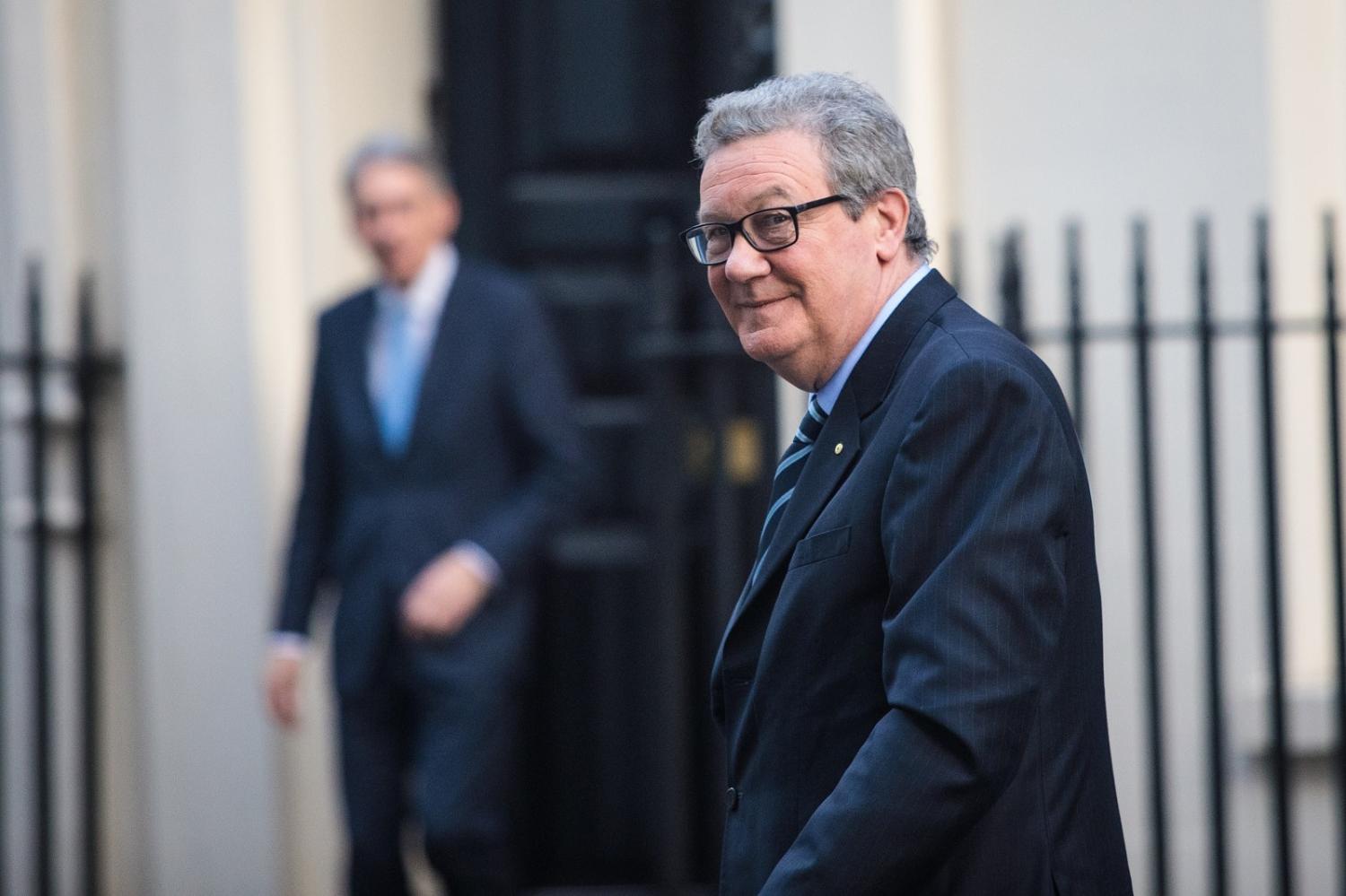

Australian High Commissioner to the United Kingdom Alexander Downer at Number 11 Downing Street, 24 January 2017 (Jack Taylor/Getty Images)

DANIEL FLITTON
THE INTERPRETER
Published 1 Sep 2022 Australia in the World
 Follow @danielflitton

“What he did would have got any other ambassador sacked. It was reckless and self-indulgent and put the Australian government in a very awkward position.”

Strong comments from Malcolm Turnbull. Even more remarkable considering that the former prime minister was reflecting on the performance of Alexander Downer, a fellow Liberal, Australia’s longest-serving foreign minister, a former UN special envoy and Australia’s one-time High Commissioner in London – the job where Turnbull’s barbs are aimed. “Foolish behaviour … blundering … blurting out political gossip … worst possible way to do it.”

Downer’s notorious 2016 drinks with Donald Trump aide George Papadopoulos have again hit the headlines, the wine bar chat said to have triggered an FBI investigation into Russian interference into the US presidential election that year. Or the “Rigged Witch Hunt”, as Trump would have it.

The latest adventure into this prickly history comes via extracts from a newly released book, The Secret History of the Five Eyes, by journalist and filmmaker Richard Kerbaj. And the book – canvassing the controversies and intelligence ties between Australia, the United States, the United Kingdom, Canada and New Zealand – has quickly caused a stir.

Some have described Downer’s actions as “those of a diplomat doing what he was paid to do: gather information in Australia’s national interest”.

Former UK Prime Minister Theresa May reportedly confessed doubts about continuing a “special relationship” with Washington after unfounded allegations of British eavesdropping on Trump. China, meanwhile, is complaining about details in the book of American pressure on Britain to force Huawei out of the country’s 5G network. Canadian spies are accused of knowing that an informant helped smuggle British teenager Shamima Begum into Syria to join Islamic State, a claim that Prime Minister Justin Trudeau has now pledged to examine. (Begum is in a long-running legal stoush in a bid to return home after being stripped of citizenship.)

But back to Downer and concern that what Papadopoulos allegedly said at the drinks “should only have been passed on to the Americans via the most discreet intelligence community channels”, as Turnbull put it to Kerbaj.

To refresh the timeline: Downer met Papadopoulos at Kensington Wine Rooms in London in May 2016, hearing, he says, Papadopoulos claim Russia had a dirt file on Trump’s Democratic rival Hillary Clinton.

“It sounded bad, but my attitude at the time was who would know whether this was even true,” Downer is quoted by Kerbaj.
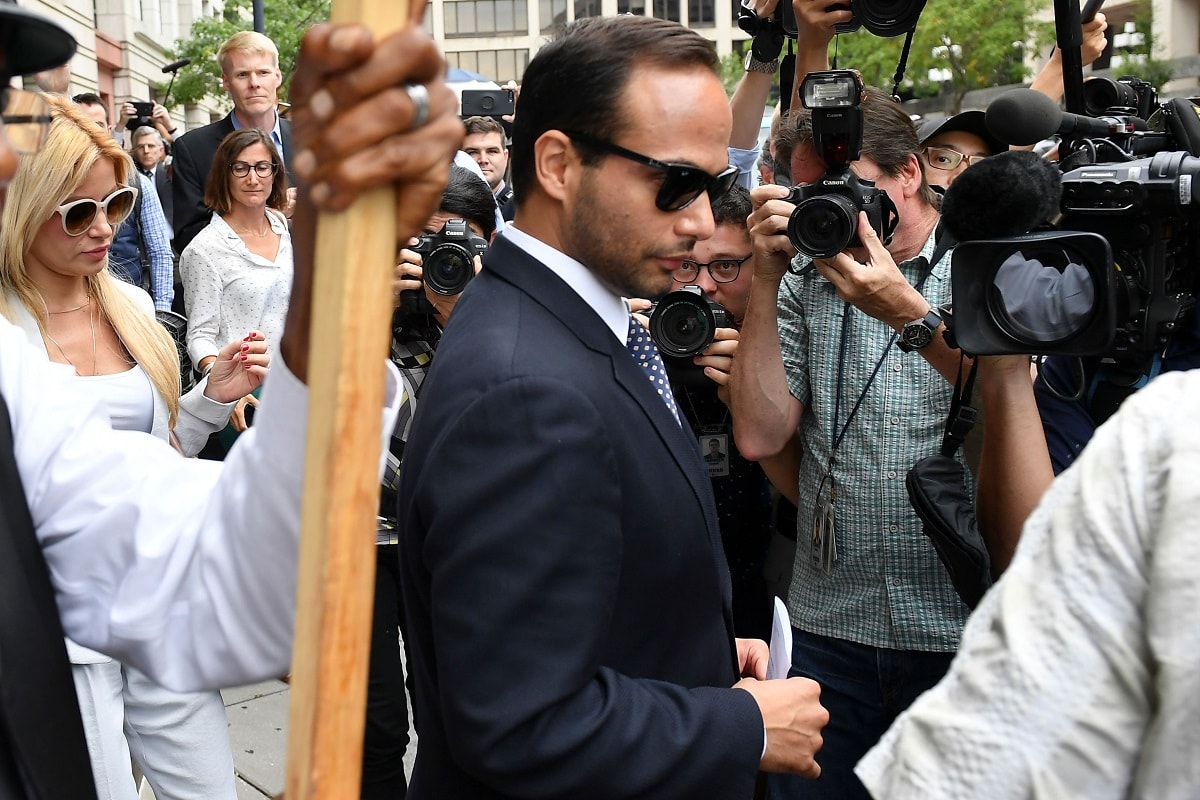
Foreign policy adviser to US President Donald Trump’s election campaign, George Papadopoulos leaves the US District Courts on 7 September 2018. Papadopoulos was jailed for 14 days for lying to FBI agents over contacts with Russians that set off a federal probe into possible collusion with Moscow (Mandel Ngan/AFP via Getty Images)

Afterwards, Downer sent a cable back to Canberra reporting the conversation. Some six weeks went by until July when Trump was officially endorsed as the Republican candidate. Downer then decided to bring the Papadopoulos claims directly to the attention of the US chargé d’affaires in London, Elizabeth Dibble.

“He had no authority from Canberra to do this,” Turnbull wrote in his 2020 memoir, “and the first we heard of it in Australia was when the FBI turned up in London and wanted to interview Downer.”

Cue what is by now a long-standing debate.

Some have described Downer’s actions as “those of a diplomat doing what he was paid to do: gather information in Australia’s national interest”. Joe Hockey, who had to contend with the fallout in Washington as Australia’s ambassador at the time and warning it could have put intelligence sharing at risk, has also defended the actions of his former colleague.

Other questions have been raised about the urgency with which the information from Downer’s initial cable was passed on to the Americans (or whether it was passed on at all). Trump pressed Scott Morrison to examine Australia’s role. Papadopoulos, who spent a fortnight in prison for lying to investigators and was later pardoned by Trump, casts the whole episode in vastly conspiratorial terms.

Downer, while admitting he would have voted for Trump, has been dismissive:

I’ve had to put up with four years of Trump and some of his fringe cronies claiming I was part of a conspiracy with Hillary Clinton, the FBI, CIA, MI6, Italian intelligence, ASIS, Ukrainian spies and who knows who else, to bring him down. Twitter is full of demands from the hysterical right that I be sent to Guantánamo Bay.

So, rewind. In 2016 – before the Trump presidency, Brexit, “fake news”, the “deep state” and the passing parade of Putinistas that has turned modern politics into a circus – it might not have been obvious what was about to be unleashed. But in Turnbull’s view, Downer’s action brought into question “the discipline and professionalism of our foreign service”, which was enough for him to be sacked. Why wasn’t he?

“Alexander was a good friend of mine and the foreign minister, Julie Bishop. He is our longest-serving foreign minister, a former leader of the Liberal Party. And at the time we learned of his foolish behaviour we had every interest in keeping it confidential.”

But this raises another enduring and yet unanswered question about this whole messy episode. Why wasn’t Downer’s involvement kept confidential, given the Five Eyes intelligence sharing network is built on trust and secrecy?
EUGENE PLAWIUK at 2:48 PM No comments:
Share
Putin Brings India And China To Russia For War Games Defying US

India has also shelved moves to jointly produce helicopters and put on hold another plan to buy about 30 fighters from Russia.

 September 01, 2022 

India has avoided taking sides over Russia's war in Ukraine.

Russia is holding major military exercises involving China and India as President Vladimir Putin pushes back against attempts by the US and its allies to isolate him over his invasion of Ukraine.

More than 50,000 troops and 5,000 pieces of military equipment, including more than 140 aircraft and 60 warships, are due to take part in the week-long Vostok-2022 war games that start Thursday in Russia's far east, including naval drills in the Sea of Japan.

The regular exercises bring together member states and partners of the Shanghai Cooperation Organization and the Russian-led Collective Security Treaty Organization of former Soviet republics.

Even as the US is wooing India as a defense partner and urging it not to undermine international sanctions on Russia over the war in Ukraine, the New Delhi government is sending a small 75-strong military detachment to the army drills. They include Gurkha troops and representatives from the navy and air force, though India isn't dispatching naval or air assets to Russia.

India, which has previously attended the exercises, has avoided taking sides over Russia's war in Ukraine, partly because of its reliance on Moscow as its main weapons supplier amid persistent border tensions with neighboring China and Pakistan. Still, the south Asian nation voted against Russia on the issue for the first time in a procedural vote last week at the United Nations Security Council that allowed Ukrainian President Volodymyr Zelenskiy to address the body via video link.


Chinese service members take part in a ceremony opening Vostok 2022 military exercises at a firing ground in the far eastern Primorsky region, Russia, on Wednesday. | RUSSIAN DEFENSE MINISTRY / VIA REUTERS

India has also shelved moves to jointly produce helicopters and put on hold another plan to buy about 30 fighters from Russia.

The Defense Ministry in Beijing said China's army, air and naval forces are taking part in the drills, which aim to strengthen military coordination. The Chinese Communist Party-backed Global Times said the exercises this year will focus on possible threats, especially from the US in the Pacific region.

China has refused to criticize Russia for its six-month-long invasion of Ukraine and condemned US and European sanctions against Moscow. But it has steered clear of siding with Putin by providing technology and military supplies for Russia's war effort because of the risk of US secondary sanctions.

The Chinese role in the drills "cannot be seen as support" for Russia over the conflict, said Vasily Kashin, a Russian military expert at Moscow's Higher School of Economics. "It just shows us that the military-to-military ties are going on as usual."


Russia's ally Belarus is also taking part in Vostok-2022 along with the former Soviet republics of Kazakhstan, Kyrgyzstan, Armenia, Azerbaijan and Tajkistan and other states including Syria, Algeria, Mongolia, Laos and Nicaragua.


EUGENE PLAWIUK at 2:41 PM No comments:
Share

Watch: Police rescue 150 stolen pet cats from meat traders in China

The police in the eastern province of Shandong nabbed a gang stealing pet cats to sell their meat for human consumption.

Scroll Staff
Yesterday · 
EUGENE PLAWIUK at 2:37 PM No comments:
Share
‘Literal shipwreck treasure’ from famous doomed Dutch vessel the Batavia resurfaces in Australia

Tony Moore
Sep 01 2022

TONY MOORE/SYDNEY MORNING HERALD
Four priceless silver coins from the 1629 shipwreck have been taken from a diver in Queensland, Australia.

Four priceless silver Dutch coins from a ship that foundered off the West Australian coast in 1629 have resurfaced in Queensland.

The coins are from the wreck of the Batavia, which in 1628 set off for its maiden journey from Amsterdam to the capital of the Dutch East Indies, Batavia – near present-day Jakarta.

The doomed voyage of the Batavia is a tale of mutiny, murder and mayhem from the pre-colonial days.

And 363 years after the ship sank, the four coins were stolen by a diver.

They came to authorities’ attention when the diver moved to Queensland from West Australia and tried to get a permit to keep them.

Australian federal authorities alerted maritime archaeologist Celeste Jordan from the Department of Environment and Science, who explained the find on Wednesday.

“This is literal shipwreck treasure. I don’t know what more excitement anyone could have than literally touching shipwreck treasure.

“For Queensland to have coins from a WA shipwreck is very rare. They rarely cross state lines.

“So to be able to hold them, to be able to examine them is extremely rare,” she said.

Jordan said because the coins pre-dated European colonisation of Australia, “for a lot of people, these coins are literally the oldest thing they will see in history”.

The Dutch East India Company was “huge in the spice trade” at the time and the Batavia was one of seven ships making its way around South Africa’s Cape of Good Hope before it was wrecked on June 4, 1629.

“Batavia is probably the most famous of the four Dutch East Indies shipwrecks off the Western Australian coast because of the mutiny.

“There were 115 people systematically murdered by Jeronimus Cornelisz and his cronies.”

Cornelisz subsequently had both hands cut off and died on the gallows on October 2, 1629.

Jordan said the Queenslander, who willingly gave over the coins after being told his prize was illegal, told her he had taken them from the Batavia wreck on Morning Reef, near Beacon Island.

She said the earliest coin was from the 1560s.

“The last digit is not there on this one.

“This next one is from 1614, and this one clearly says 1623. And this one, the fourth one, doesn’t have a date,” she said.

TONY MOORE/SYDNEY MORNING HERALD
Shipwreck expert Celeste Jordan says the oldest of the four coins dates to the 1560s, while the youngest is from 1623.

“On one coin from 1614 you can see whoever it is, I’m assuming it is potentially the Dutch king of the time, he has a sword, he is in armour and holding a shield or a bag and the shield actually has a small dragon on there,” she said.

“The dragon is roaring, his tongue is out, his wings are out, which is quite a fun detail,” she said.

Examining a coin from 1623, “you can see the detail in the feathers here and the other side of the coin also has quite beautiful detail in the gentleman’s armour”.

“You can also see the armour in the coin, you can see it is undated. But you can see the man’s hair and beautiful collar and all the metal of his armour.”

TONY MOORE/SYDNEY MORNING HERALD
One of four silver coins from the 1629 wreck of the Dutch East India flagship, the Batavia.

The oldest coin has silver detailing which looks part of a crown.

“If I turn it over you get part of the shield. It also has some cracking in the coin itself.

“I think one of the most interesting things about this coin here is that somebody has tried to clip a piece of silver from this coin.”

It has been illegal since 1976 to take objects from historic shipwrecks.

The coins will be returned within weeks to the Western Australian Shipwrecks Museum in Fremantle, which holds and displays a significant collection of Batavia artefacts.

READ MORE:
* Israeli archaeologists find treasure in ancient shipwrecks
* The cruel curse of shipwrecks: Money, misery and mystery
* New Zealand shipwrecks you can visit
* Colombia has billions in sunken treasure off its coast, but ownership is still disputed
* Treasure hunter found 3 tonnes of sunken gold, and can't leave jail until he says where it is
EUGENE PLAWIUK at 2:33 PM No comments:
Share

The Most Important Election in the Americas is in Brazil


BY VIJAY PRASHAD
SEPTEMBER 1, 2022
Facebook
TwitterRedditEmail

Photograph Source: Ricardo Stuckert/PR – Agência Brasil – CC BY 3.0 BR

Former Brazilian President Luíz Inácio Lula da Silva (known as Lula) runs about on stage at the Latin America Memorial in São Paulo. He was there on August 22, 2022, speaking at a book launch featuring photographs by Ricardo Stuckert about Lula’s trips around the world when he was the president of Brazil from 2003 to 2010. Lula is a man with a great deal of energy. He recounts the story of when he was in Iran with his Foreign Minister Celso Amorim in 2010, trying to mediate and end the conflict imposed by the United States over Iran’s nuclear energy policy. Lula managed to secure a nuclear deal in 2010 that would have prevented the ongoing pressure campaign that Washington is conducting against Tehran. There was relief in the air. Then, Lula said, “Obama pissed outside the pot.” According to Lula, then-U.S. President Barack Obama did not accept the deal and crushed the hard work of the Brazilian leadership in bringing all sides to an agreement.

Lula’s story puts two important points on the table: he was able to build on Brazil’s role in Latin America by offering leadership in far-off Iran during his previous tenure as president, and he is not afraid of expressing his antipathy for the way the United States is scuttling the possibility of peace and progress across the world for its own narrow interests.

The book release took place during Lula’s campaign for president against the current incumbent—and deeply unpopular—President Jair Bolsonaro. Lula is now in the lead in the polls ahead of the first round of Brazil’s presidential election to be held on October 2.

Fernando Haddad, who ran against Bolsonaro in 2018 and lost after receiving less than 45 percent of the vote, told me that this election remains “risky.” The polls might show that Lula is in the lead, but Bolsonaro is known to play dirty politics to secure his victory. The far right in Brazil, like the far right in many other countries, is fierce in the way it contests for state power. Bolsonaro, Haddad said, is willing to lie openly, saying offensive things to the far-right media and then when challenged about it by the mainstream media, he tends to feign ignorance. “Fake news” seems to be Bolsonaro’s best defense each time he is attacked. The left is far more sincere in its political discourse; leftists are unwilling to lie and eager to bring the issues of hunger and unemployment, social despair and social advancement to the center of the political debate. But there is less interest in these issues and less noise about them in a media landscape that thrives on the theatrics of Bolsonaro and his followers. The old traditional right is as outflanked as the far right in Brazil, which is a space that is now commanded by Bolsonaro (the old traditional right, the men in dark suits who made decisions over cigars and cachaça, are unable to supplant Bolsonaro).

Both Bolsonaro and Lula face an electorate that either loves them or hates them. There is little room for ambiguity in this race. Bolsonaro represents not only the far right, whose opinions he openly champions, but he also represents large sections of the middle class, whose aspirations for wealth remain largely intact despite the reality that their economic situation has deteriorated over the past decade. The contrast between the behavior of Bolsonaro and Lula during their respective presidential campaigns has been stark: Bolsonaro has been boorish and vulgar, while Lula is refined and presidential. If the election goes to Lula, it is likely that he will get more votes from those who hate Bolsonaro than from those who love him.

Former Brazilian President Dilma Rousseff is reflective on the way forward. She told me that Lula will likely prevail in the election because the country is fed up with Bolsonaro. His horrible management of the COVID-19 pandemic and the deterioration of the economic situation in the country mark Bolsonaro as an inefficient manager of the Brazilian state. However, Rousseff pointed out that about a month before the election, Bolsonaro’s government—and the regional governments—have been rolling out policies that have started to lighten the burden on the middle class, such as the lifting of taxation on gasoline. These policies could sway some people to vote for Bolsonaro, but even that is not likely. The political situation in Brazil remains fragile for the left, with the main blocs on the right (agro-business, religion and the military) willing to use any means to maintain their hold on power; it was this right-wing coalition that conducted a “legislative coup” against Rousseff in 2016 and used “lawfare,” the use of law for political motives, against Lula in 2018 to prevent him from running against Bolsonaro. These phrases (legislative coup and lawfare) are now part of the vocabulary of the Brazilian left, which understands clearly that the right bloc (what is called centrão) will not stop pursuing their interests if they feel threatened.

João Paulo Rodrigues, a leader of the Landless Workers Movement (MST) is a close adviser to the Lula campaign. He told me that in the 2002 presidential election, Lula won against the incumbent Fernando Henrique Cardoso because of an immense hatred for the neoliberal policies that Cardoso had championed. The left was fragmented and demoralized at that time of the election. Lula’s time in office, however, helped the left mobilize and organize, although even during this period the focus of popular attention was more on Lula himself rather than the blocs that comprised the left. During Lula’s incarceration on corruption charges, which the left says are fraudulent, he became a figure that unified the left: Lula Livre, “Free Lula,” was the unifying slogan, and the letter L (for Lula) became a symbol (a symbol that continues to be used in the election campaign). While there are other candidates from Brazil’s left in the presidential race, there is no question for Rodrigues that Lula is the left’s standard-bearer and is the only hope for Brazil to oust the highly divisive and dangerous leadership of President Bolsonaro. One of the mechanisms to build the unity of popular forces around Lula’s campaign has been the creation of the Popular Committees (comités populares), which have been working to both unify the left and create an agenda for the Lula government (which will include agrarian reform and a more robust policy for the Indigenous and Afro-Brazilian communities).

The international conditions for a third Lula presidency are fortuitous, Rousseff told me. A wide range of center-left governments have come to power in Latin America (including in Chile and Colombia). While these are not socialist governments, they are nonetheless committed to building the sovereignty of their countries and to creating a dignified life for their citizens. Brazil, the third-largest country in the Americas (after Canada and the United States of America), can play a leadership role in guiding this new wave of left governments in the hemisphere, Rousseff said. Haddad told me that Brazil should lead a new regional project, which will include the creation of a regional currency (sur) that can not only be used for cross-border trade but also for holding reserves. Haddad is currently running to be the governor of São Paulo, whose main city is the financial capital of the country. Such a regional currency, Haddad believed, will settle conflicts in the hemisphere and build new trade linkages that need not rely on long supply chains that have been destabilized by the pandemic. “God willing, we will create a common currency in Latin America because we do not have to depend on the dollar,” said Lula in May 2022.

Rousseff is eager for Brazil to return to the world stage through the BRICS bloc (Brazil, Russia, India, China and South Africa), and offer the kind of left leadership that Lula and she had given that platform a decade ago. The world, Rousseff said, needs such a platform to offer leadership that does not rely on threats, sanctions and war. Lula’s anecdote about the Iran deal is a telling one since it shows that a country like Brazil under the leadership of the left is more willing to settle conflicts rather than to exacerbate them, as the United States did. There is hope, Rousseff noted, for a Lula presidency to offer robust leadership for a world that seems to be crumbling due to the myriad challenges such as climate catastrophe, warfare and social toxicity.

This article was produced by Globetrotter.

Vijay Prashad’s most recent book (with Noam Chomsky) is The Withdrawal: Iraq, Libya, Afghanistan and the Fragility of US Power (New Press, August 2022).

EUGENE PLAWIUK at 2:31 PM No comments:
Share
Hezbollah at 40 stronger than ever but has more enemies

By Bassem Mroue | AP
September 1, 2022 


A  Hezbollah member wears a vest with Arabic that reads: “40 years and we stay with Hussein (the Prophet Muhammad’s grand son),” during the holy day of Ashoura that commemorates the 7th century martyrdom of the Prophet Muhammad’s grandson Hussein, in the southern suburb of Beirut, Lebanon, Aug. 9, 2022. Forty years since it was founded, Lebanon’s Hezbollah has transformed from a ragtag organization to the largest and most heavily armed militant group in the Middle East. (AP Photo/Hussein Malla)


BEIRUT — Forty years since Hezbollah was founded at the height of Israel’s 1982 invasion of Lebanon, the group has morphed from a ragtag organization to the largest and most heavily armed militant group in the Middle East.
Are you on Telegram? Subscribe to our channel for the latest updates on Russia's war in Ukraine.

The Iranian-armed and funded Hezbollah, which has marked the anniversary with ceremonies in its strongholds in recent weeks, dominates Lebanon’s politics and plays an instrumental role in spreading Tehran’s influence throughout the Arab world.

But the Shiite powerhouse, once praised around the Arab world for unrelentingly standing against Israel, faces deep criticism on multiple fronts.

At home in Lebanon, a significant part of the population opposes its grip on power and accuses it of using the threat of force to prevent change. Across the region, many resent its military interventions in Iraq and in Syria’s civil war, where it helped tip the balance of power in favor of President Bashar Assad’s forces.

There is no specific date on when Hezbollah was founded, starting as a small, shadowy group of fighters helped by Iran’s paramilitary Revolutionary Guard. But the group says it happened during the summer of 1982.

The 40th anniversary comes this year as Hezbollah officials have warned of a possible new war with Israel over the disputed gas-rich maritime border between Lebanon and Israel.

Over the years, Hezbollah has boosted its military power. It boasts of having 100,000 well-trained fighters. And now its leader says they have precision-guided missiles that can hit anywhere in Israel and prevent ships from reaching Israel’s Mediterranean coast, as well as advanced drones that can either strike or gather intelligence.

“Hezbollah has evolved tremendously in the past four decades in its organizational structure, global reach, and regional involvements,” says Middle East analyst Joe Macaron.

Hezbollah’s biggest achievement over the past 40 years was its guerrilla war against Israeli forces occupying parts of southern Lebanon. When Israel’s army was forced to withdraw in May 2000 — without a peace deal like the ones it reached with Egypt, Jordan and the Palestinians — the victory brought Hezbollah praise from around the Middle East.

“Who would have imagined that our enemy could be defeated?” Hezbollah’s chief spokesman Mohammed Afif said a press conference held in July to mark the anniversary.

But since the withdrawal, the controversy over Hezbollah has steadily grown as its role has changed.

In 2005, Lebanon’s former Prime Minister Rafik Hariri, the most powerful Sunni politician in the country at the time, was killed in a massive truck bomb in Beirut. A U.N.-backed tribunal accused three Hezbollah members of being behind the assassination. Hezbollah denies the charges.

Hezbollah was blamed for other assassinations that followed, mostly targeting Christians and Sunni Muslim politicians and intellectuals critical of the group. Hezbollah denies the accusations.

“Hezbollah’s danger to Lebanon is huge,” says journalist and former Cabinet minister May Chidiac who lost an arm and a leg in a 2005 assassination attempt with explosives placed in her car. She said Hezbollah has been expanding Iran’s influence in Lebanon, “and this is a long-term plan that they have been working on for 40 years.”

Asked if Hezbollah is to blame for the attempt on her life, Chidiac said: “Of course. There is no doubt about that. All these assassinations are linked.”

Lebanese have been sharply divided by Hezbollah’s determination to keep its weapons since Israel’s withdrawal. Some call for its disarmament, saying only the state should have the right to carry weapons. Others support the group’s stance that it must continue to be able to defend against Israel.

Hezbollah fought Israel to a draw in a 34-day war in the summer of 2006. Israel today considers Hezbollah its most serious immediate threat, estimating that the militant group has some 150,000 rockets and missiles aimed at it.

In early July, the Israeli military shot down three unmanned aircraft launched by Hezbollah heading toward an area where an Israeli gas platform was recently installed in the Mediterranean Sea. Hezbollah leader Hassan Nasrallah warned that Israel will not be allowed to benefit from its gas fields in the disputed maritime border area before a deal is reached with Lebanon.

Maj. Gen. Ori Gordin, the incoming head of Israel’s Northern Command, described Hezbollah as a “serious threat,” due to both its proximity to Israel and its arsenal.

“This is a very strong terror army,” he told The Associated Press in Jerusalem. “Not as strong as the Israeli military, not as strong as the Israeli air force. We are in a completely different place when it comes to our military capabilities. But it can do some significant damage. I have to say that.”

Afif, the Hezbollah spokesman, said that “as long as there is an aggression, there will be resistance.”

In 2008, the government of Western-backed Prime Minister Fouad Saniora decided to dismantle Hezbollah’s telecommunications network. Hezbollah responded by capturing by force Sunni neighborhoods in Beirut. It was the worst internal fighting since the 1975-90 civil war ended and marked a breach in Hezbollah’s pledge never to use its weapons at home.

Perhaps the most controversial decision Hezbollah has made was by sending thousands of fighters to Syria since 2013 to back Assad against opposition fighters, as well as against al-Qaida-linked fighters and the Islamic State group.

The intervention “meant becoming entangled in the internal conflict of a neighboring Arab country rather than fulfilling Hezbollah’s claimed mandate of resistance against Israel,” Macaron said.

Across the Arab world, it cemented an image of Hezbollah as a sectarian Shiite force fighting mainly Sunni insurgents and spreading Iran’s power.

Hezbollah was also accused of helping Iranian-backed Houthi rebels in Yemen, leading at least six Arab countries to list the group as a terrorist organization.

Within Lebanon, Hezbollah has used its powerful support among the Shiite community and tough tactics to gain political dominance.

In 2016, it secured the election of its Christian ally Michel Aoun as president, then it and its allies won a parliament majority in subsequent elections.

But that also sealed its role as part of a governing system whose decades of corruption and mismanagement have been blamed for Lebanon’s economic collapse, starting in late 2019. With the currency crumbling and much of the population thrown into poverty, the political elite, which has been running Lebanon since the 1975-90 civil war ended, has resisted reforms.

Massive protests demanding the removal of those politicians began in late 2019, and days afterward, hundreds of Hezbollah supporters attacked the protesters in downtown Beirut, forcing them to flee. In October, Hezbollah supporters and a rival militia had an armed clash in Beirut over investigations into the 2020 devastating explosion at Beirut’s port.

Voters punished Hezbollah and its allies in this year’s elections, making them lose their parliamentary majority.

One former senior figure in Hezbollah, Sobhi Tufaili, pointed to the new image of the group as part of the system in a recent interview with a local TV station.

“There is a ship full of thieves,” he said, “and Hezbollah is its captain and protector.”
____


Associated Press writer Josef Federman contributed to this report from Jerusalem.
EUGENE PLAWIUK at 2:23 PM No comments:
Share

Mary Peltola Thanks Supporters After Alaska House Special Election Win

Mary Peltola defeated Sarah Palin and Nick Begich, becoming the first Alaska Native in Congress.


EUGENE PLAWIUK at 2:18 PM No comments:
Share

Abrams, Warnock decry 'inhumane' healthcare policy in joint Marietta rally

Chart Riggall, Marietta Daily Journal, Ga.

Thu, September 1, 2022 

Sep. 1—MARIETTA — Two of the biggest names in Georgia politics were met with a roar of support by Cobb's Democratic faithful as they embraced under the shade of a tree behind the Cobb County Civic Center Wednesday.

With just over two months until Election Day, U.S. Sen. Raphael Warnock and gubernatorial candidate Stacey Abrams asked voters to send the former back to Washington "for a nice, long six-year term" and the latter to the governor's mansion.

"We had a warm-up in 2018," said Abrams of her first gubernatorial run. "We proved ourselves in 2020, and because we're Southern, we sent them two U.S. senators in 2021."

A crowd of over 100 attendees, including press and staff, was on-hand for the joint rally. The event was originally set to be a Warnock-only affair, but Abrams — whose black SUV trailed behind Warnock's unmistakable bus — was announced as a late addition earlier in the day.

Both candidates have consistently called for Gov. Brian Kemp to expand Medicaid in Georgia, which advocates have said would insure hundreds of thousands of low-income residents. Warnock and Abrams pointed to the news Wednesday morning that Wellstar Health System is reportedly considering closing Atlanta Medical Center as evidence the expansion is needed.

"It's not because they don't have enough patients — they've got enough. It's not that the resources necessary don't exist — they do exist. It is because we have a governor who refuses to expand Medicaid," said Abrams.

Warnock called the nation's healthcare shortcomings "the most shocking and the most inhumane" of its injustices.

Neither candidate — indeed, none of the speakers Wednesday — mentioned President Joe Biden by name. Cobb Democratic Party Chair Jacquelyn Bettadapur attributed that to Warnock's focus on policy.

"It's an emphasis on the work," Bettadapur said. "I find that with Warnock, he emphasizes the work and removes himself from the personalities and the ideologies and sort of all the nonsense that goes on in Washington."

Added state Rep. Teri Anulewicz, D-Smyrna, who introduced Abrams, "We were focused on Cobb County, and I know I was focused on all of the ways that I know Sen. Warnock has been here for Cobb County, and how he has had Cobb County's back in Washington," citing his advocacy for Lockheed Martin to win new aerospace contracts.

Indeed, between Warnock's calls for greater "moral imagination" and for activists to "pray with your legs" he weaved a thread of purported policy achievements. He name-checked 2021's American Rescue Plan Act and the recently passed Inflation Reduction Act, and the CHIPS and Science Act which aims to boost American semiconductor production.

"Imagine the United States of America, the KIA plant (in West Point) — or name some other plant — waiting on chips to come from China that we can make right here in Georgia," he boomed.

He also highlighted his work with Republican Sen. Ted Cruz of Texas to designate a proposed extension to Interstate 14 from Texas to Georgia.

"Yeah, him," Warnock joked. He later said, "There's a road that runs through Texas that also runs through Georgia. And there's a road that runs through our humanity that's bigger than politics, that's bigger than partisan bickering, that's bigger than the culture wars that folks are trying to drag us into."

The crowd was unfazed by Republican protesters who lined Fairground Street and denounced Warnock while waving signs for Senate hopeful Herschel Walker.

"I'm so disappointed at higher taxes, bigger government ... I'm for less government. I think the federal government is too corrupt at this point, and (Warnock) has gone along with the system," said John Barnes of Marietta.

Barnes argued Walker's well-publicized personal issues have been overblown.

"Even though all of us have things in the background, he's a likely very good candidate," he added. "...When we look at all of our candidates in Washington, everybody has something that could be said about them. And what I want is people voting for America, smaller government, less regulations, and returning rights back to the states."

Rosie Turner, a Warnock supporter who recently moved to Mableton from Augusta, said she was largely enthused by Warnock and Abrams' remarks. But there was a major point she felt was overlooked.

"I can see he's working from the religious and spiritual standpoint, as well as the political point of view, which is, I think, very nice. But I wish he would address the abortion thing, and that's something I want to talk to him about. Because I think it's a human right," said Turner.

EUGENE PLAWIUK at 2:15 PM No comments:
Share

Baiting Tigers and Poking Dragons – A Kungfu Perspective on China and Taiwan


BY MALIK DIAMOND
 SEPTEMBER 1, 2022
Facebook
TwitterRedditEmail

Image by Alejandro Luengo.

“He will win who knows when to fight and when not to fight.”

-Sun Tzu, The Art of War, circa 5th century B.C.

Nancy Pelosi’s recent saber-rattling jaunt to Taiwan has put the Fear into a lot of sensible people, and with good reason. Sometimes I wonder if people like her secretly want to die in a nuclear holocaust, or if being a shill for the arms industry simply requires epic stupidity. I suspect it’s both.

It’s clear that her visit was orchestrated to fill a certain type of American with jingoistic fervor. Over the years, the western imperial world has gotten a lot of mileage out of selling the Yellow Peril. Yet the military budget of the United States dwarfs that of China. Pelosi and her ilk are pumping fear over threats that don’t really exist.

Communist China regards Taiwan as a renegade province. Some say China has a legitimate claim, and maybe that’s true. As far as I’m concerned, the claim of any state has about as much moral weight as the claim John Wayne Gacy had to the children he raped and murdered. The Right of Might has inspired many imperial powers to occupy Taiwan, from the Dutch to the Japanese. I get it that there are strategic reasons why China won’t consider Taiwanese independence—particularly considering how cozy Taiwan’s government has always been with the U.S.—but strategy is not the same as morality. Regardless, my basic feeling on the China vs. Taiwan matter is that it’s none of my business. Then again, I’m not the CIA.

The inherently racist character of America views China as simultaneously weak, dangerous, and sexy. I’ve heard plenty of talk in my life about the “deviousness” of the Chinese, yet in popular American culture they’re consistently feminized, and just about every other pasty techbro I come across in San Francisco is either dating or fantasizing about dating a Chinese woman. How could a body politic like this possibly be clear-headed about any potential conflict with China? In addition, in America anti-communist sentiment is damn near instinctual; for all practical purposes, leftism here is dead, murdered by cointelpro and capitalist brainwashing.

Americans are dumb and they specialize in bluster. The U.S. is a relatively new country, and its citizens have no sense of their own history, let alone that of other countries. China, meanwhile, is the world’s oldest continuous civilization. You don’t reach that point by falling into every sucker’s trap that comes along. It’s no secret that the U.S. government’s big strategy is to provoke Russia and China into resource-depleting wars. It obviously worked on Iron Fist Puto, but I doubt Chinese leaders will be so easily hoodwinked.

However, that doesn’t mean they’ll roll over if seriously threatened. I doubt that a sinister and disingenuous idiot like Pelosi understands China well enough to realize the dragon she’s poking can and will defend itself. If that happens, either China will win—in the sense that Vietnam won, i.e. by preventing defeat… or all of us will lose.

Personal experience can be a powerful vaccination against bigotry. For example, during the Bush II regime America was saturated with propaganda about psychotic Muslim terrorists, but I was impervious to that bullshit partly because I went to grade school with people from several different Islamic cultures—specifically Iranians, Pakistanis, and Afghanis. As a kid I may not have known (or cared) about their cultural particularities, but I also knew they weren’t a bunch of alien zealots.

My interest in the history, culture, and politics of China began when I was in my early twenties. It was a direct outgrowth of my interest in kungfu, which I began studying in 1999 while attending UCLA. The on-campus recreation center offered a wide variety of martial arts classes, and I signed up for as many as I could fit into my schedule. I soon found myself immersed in the “kungfu underground,” known in China as the Jianghu—literally, “Rivers & Lakes,” a reference to the fringe habitats of kungfu practitioners both historical and folkloric.

The Los Angeles area has long had a thriving martial arts culture, partly due to the film industry; many martial artists have come to Hollywood to be stuntmen and fight choreographers. While I was living in L.A. I met a number of skilled kungfu masters, many of whom taught in parks to a small handful of students. I encountered some great people, along with plenty of frauds and freaks. I spent a lot of time at Chinese tea shops and restaurants. I learned Mandarin. And for the record, no, I didn’t date any Chinese women—despite recommendations from a number of middle-aged Chinese hostesses.

There are a couple of teachers I met who were quite famous in their milieu; they have since passed away. This included Hawkins Cheung, a former kungfu-brother of Bruce Lee, both of them having been students of the now-famous master Ip Man. I also met Dr. Jiang Haoquan, who was a master of several kungfu styles, a champion gymnast and diver, and a heavyweight boxing champion; in 1985—at the age of 68—he had an exhibition match with Muhammad Ali. When I met Dr. Jiang he was in his 80s, still powerful and agile, and married to much younger woman.

Dr. Jiang had been a kungfu-brother of Chang Dongsheng, one of the most famous and highly skilled masters of the twentieth century. Chang was a devout Muslim from the Hui ethnic group in northern China. At twelve years old he began studying the art of Shuai Jiao—usually called “Chinese wrestling” in English, it’s actually a throwing art; the Chinese never developed ground-based competition bondage arts like Greco-Roman wrestling or Brazilian Jujitsu.

According to reputation, Chang fought in hundreds of competitions and challenge matches, both friendly and not-so-friendly, and was never defeated.

Chang also taught Shuai Jiao at the Nanjing Central Guoshu Academy, created by Chiang Kai-Shek’s Kuomintang (KMT) in 1928. The Chinese state has long cast a wary eye upon martial artists, with their secret societies and their tendency to rebel against state control; the Boxer Rebellion is merely the most well-known example of kungfu trouble-making. Unregulated civilian martial arts practice inherently undermines the state monopoly on violence. The KMT dealt with this by following Japan’s example and organizing martial arts under the purview of the state. Thus was born the world’s first kungfu university.

Chang Dongsheng later became an instructor for the Red Wall paratroopers, an elite KMT military unit that fought both the Japanese and the Communists. He fled with the defeated KMT to Taiwan, where he was appointed senior instructor for the Central Police University. He also taught a number of KMT dignitaries, bodyguards, and other state-sponsored miscreants. According to one story I heard, when Chang retired from active service, Chiang Kai-Shek summoned him into the dictator-for-life office and offered him whatever he wanted. As a man whose service came from a powerful sense of honor and loyalty, Chang declined. Chiang Kai-Shek took the Taiwanese flag off the wall, folded it up, and gave it to Chang. Until he died of cancer in his 70s, Chang continued to conduct Shuai Jiao demonstrations with his uniform jacket open, signaling that he remained willing to accept any and all challengers.

The Communists had a different approach to dealing with the potential subversiveness of kungfu practitioners: they worked them to death in labor camps or murdered them outright. When the Cultural Revolution arrived, it destroyed much of what remained of kungfu’s legacy. For decades the practice was outlawed; masters had to teach in secret. The People’s Republic eventually engineered a facsimile version of kungfu, the acrobatic sport known as Modern Wushu. Their first major propaganda effort for promoting this new sport was the 1982 film Shaolin Temple, starring a young prodigy named Jet Li, now an internationally famous action star. The temple itself is now a popular tourist attraction, and China is adamantly pursuing the inclusion of Modern Wushu in the Olympics.

Chiang Kai-Shek and the KMT were a glorified cabal of villainous gangsters. But then again, civilization itself has never been anything but a protection racket enforced by a glorified cabal of villainous gangsters. In that sense, the KMT is fairly old-fashioned. The Chinese Communist state, on the other hand, is thoroughly modern—a mechanical beast engineered by totalitarian ideology. It may have lifted an unprecedented number of its citizens out of poverty, but it has done so with a terrifying trail of atrocities and environmental holocaust. A combination of the Qing dynasty’s corruption and predation by European imperial powers set the stage for Mao and his cult.

Due to the influence of film and television, most Americans have a somewhat romanticized view of kungfu, and of Asian martial arts in general. Much of the history of these arts and their practitioners is far uglier than the average middle-class mom dropping her kid off at the local dojo would care to imagine. Even the beloved fighting monks of the Shaolin Temple™, mythical origin place of many kungfu styles, in reality were essentially a private militia; Buddhist temples were some of the largest landholders in dynastic China. Like all private armies, the Shaolin monks committed their share of atrocities.

Through much of China’s history, martial arts were largely a working-class trade skill; the career options of a “kungfu professional” were mostly limited to military service, private security for merchants and trade caravans, entertainment, banditry, and organized crime. To an extent, this is still true; two of the first Chinese masters to teach kungfu publicly in America, Lau Bun and T.Y. Wong, both served as Tong enforcers. They mediated disputes, kept drunks in line, collected gambling debts, and trained the Tong muscle.

For that matter, many of my fellow thugs-for-hire at the security company I work for, all Black men, are kungfu practitioners—several are former students of one of our supervisors, who used to have a kungfu school in East Oakland. When I’m sitting in my car all night keeping an eye out for bandits, I like to think of myself as part of a proud, international working-class tradition.

In conclusion, a story from my days as a kungfu student:

It was sometime around the year 2000, in the city of Alhambra, California. Having assisted in moving furniture to clear a practice space, I was standing off to the side in the meticulously decorated living room of my kungfu teacher, watching as a visiting master prepared to give a demonstration of his grappling skill. His competitor in this friendly match was another student, a gym-built American who was a former collegiate wrestling champion, and had spent several post-grad years expanding his fighting repertoire with Judo and Jujitsu. The student out-weighed the visiting master by a good twenty pounds of solid muscle.

The master, who was in his 50s, invited the student to give his best try at taking him down. What happened next was unlike anything I’ve ever witnessed, before or since: not only did the student fail to take the master down, but he was so thoroughly out-classed that he could only laugh at his own failure. The master foiled all attempts at being controlled; every clash ended with him sitting on top of the student, striking poses and giggling. It was amazing, and it was hilarious. I was hooked; I wanted that skill, and so I became a student of that master. I’ll never make it to his level, but I’ll say this: I’m not an easy person to put into a “compliance hold.”

Now riddle me this: just what do you think the American response would be if its precious military forces went on the warpath against China and were likewise defeated and humiliated? Remember, these are the same forces that failed to subdue a bunch of poorly armed Afghani militants.

Let me put it another way: do you like mushroom clouds?

I’m not afraid of China. I’m afraid of Americans.

Malik Diamond is a hip hop artist, cartoonist, author, educator, and martial arts instructor. Born and raised in the San Francisco Bay Area, he is the descendant of kidnapped Africans, conquered Natives, and rural laborers of the Scots-Irish, Swiss, and German varieties. He currently lives in Oakland, California, with two brown humans and a white cat. E-mail: malikdiamond (at) hotmail (dot) com

EUGENE PLAWIUK at 2:12 PM No comments:
Share
‹
›
Home
View web version

About Me

My photo
EUGENE PLAWIUK
View my complete profile
Powered by Blogger.