Sunday, June 29, 2025

Pew study finds Trump gained with Catholics, nonwhite Protestants in 2024

(RNS) — The president won over a majority of Protestants and Catholics. He did much better among Hispanic and Asian Protestants.
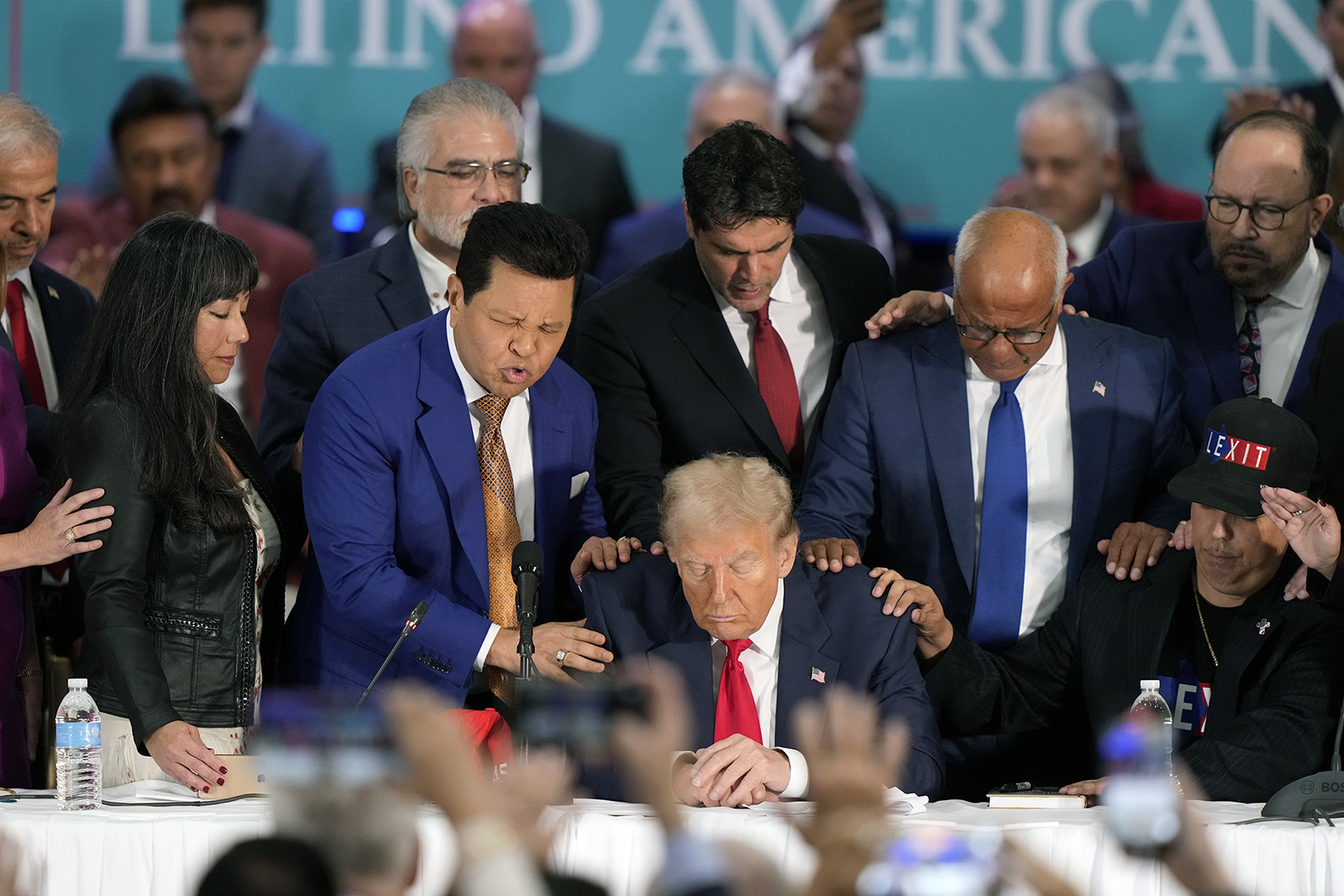

Latino leaders pray over Republican presidential nominee former President Donald Trump, front center, as he participates in a roundtable with Latino leaders, Oct. 22, 2024, in Doral, Fla. (AP Photo/Lynne Sladky)

Yonat Shimron
June 26, 2025

(RNS) — White evangelicals’ love affair with Donald Trump has been well documented over the years, and their unflagging support for the president was no different in the 2024 election.

But a new study examining the 2024 vote among nearly 7,100 verified voters shows the president won over the affections of many other Protestants beyond evangelicals — and Catholics too.

The Pew Research poll released Thursday (June 26) shows that Trump bested his performance among all U.S. Protestants, winning 62% of their votes, up 3 percentage points from the 2020 election, when Trump lost to Joe Biden. And Trump won 55% of the Catholic vote, up 6 percentage points from 2020.

Most surprisingly, Trump did exceptionally well among minority race Protestants (a category that includes Hispanic and Asian Protestants, but not Blacks), winning 70% of their vote, up from 55% in 2020. He did better with Blacks too, winning 15% of the Black Protestant vote, up 6 percentage points over 2020. Still, overwhelmingly, Black Protestants voted Democratic.

“What the overall study shows is that Donald Trump was able to expand his coalition,” said John Green, emeritus director of the Bliss Institute of Applied Politics at the University of Akron. “He maintained his religious supporters among white Christians but then reached out particularly to the Hispanic and minority communities to really pick up some people.”

Unaffiliated voters, including atheists, agnostics and those who say they have no particular religious affiliation, overwhelmingly voted for the Democratic candidate, with 70% voting for Kamala Harris and only 28% for Trump.

RELATED: Prayer in school divides Americans as Texas law takes effect
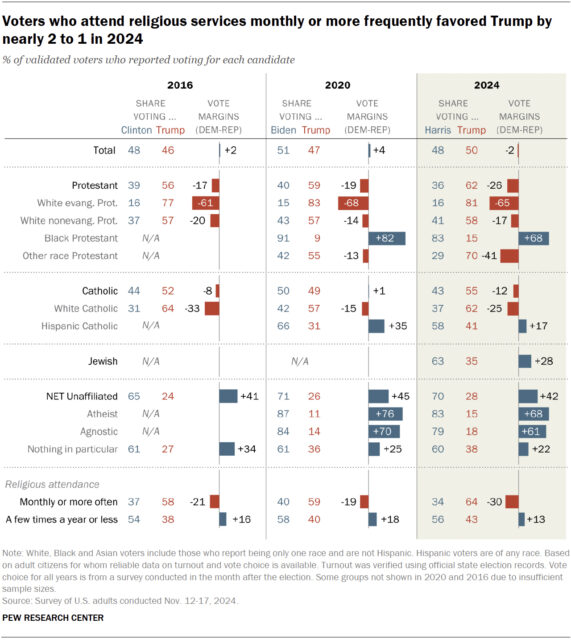

“Voters who attend religious services monthly or more frequently favored Trump by nearly 2 to 1 in 2024” (Graphic courtesy Pew Research Center)

The study was made up of validated voters, meaning those who said they voted and were recorded as having voted in at least one of the three commercial voter files that Pew checked. (Exit polls, which are available almost immediately after the election, are considered less reliable because not all registered voters who said they voted actually voted.)

The Pew study also shows that in 2024 Trump won a larger share of voters who attend religious services monthly — 64%, up from 59% in 2020. People who attend religious services have proved to be reliable voters even as their proportion of the population continues to fall. Indeed, the study found that voters who attend religious services monthly favored Trump by nearly 2-to-1 in 2024 (64%-34%).

“The people remaining in religious institutions turn out to vote at much higher numbers,” said Green. “One reason is that voting behavior is communal. If the people I hang out with vote, I’m more likely to vote. It’s a connectedness phenomenon.”

Trump’s improving numbers among Catholics overall might be explained by the fact that there was no Catholic candidate in the presidential race this time. President Biden, who is Catholic, won 50% of the Catholic vote in 2020. In 2024, both presidential candidates were Protestant.


The Rev. Gabriel Salguero. (Photo courtesy of The Gathering)

But Trump’s vast improvement among nonwhite Protestants, especially Hispanic and Asian Protestants, is harder to understand given Trump’s promise of a crackdown on immigration.

Gabriel Salguero, president and founder of the National Latino Evangelical Coalition, said there were a host of issues that led Hispanic evangelicals to vote for Trump — among them, a more traditional understanding of marriage and sexual identity, a focus on economic issues and a belief that Trump would only go after immigrants who were violent criminals.

“It’s not one issue because Latino evangelicals are not one-issue voters,” said Salguero, who is a pastor of an Assemblies of God church in Orlando, Florida. “This list of issues, from the economy to social issues around pro-life, around biblical understandings of marriage, and in addition to the economic things, plus, the Trump administration was intentional in outreach to Latino evangelicals by going to their churches, having spots on their radio station, yielded an impact.”

Salguero said he will be looking to see how Latino evangelicals vote in the 2026 midterms.

Many of the larger demographic divisions that have characterized American politics for several decades also showed up in the study. Trump had a 14-point advantage among voters who did not attend college (56% to 42%), double his margin in 2016. He won voters living in rural areas by 40 points (69%-29%), higher than his margins in 2020 or 2016. And older voters favored Trump: 54% voted for Trump in 2024, compared with 52% in 2020. Younger voters tended to favor the Democratic candidate.

Among the 7,100 validated voters, the margin of error was plus or minus 1.5 percentage points.


Republican presidential nominee former President Donald Trump watches a video screen at a campaign rally at the Salem Civic Center, Nov. 2, 2024, in Salem, Va. (AP Photo/Evan Vucci)


AMERIKAN GESTAPO

Pastor films as masked federal agents arrest Iranian Christian asylum-seekers in LA

(RNS) — The arrests sparked angst in the community and have concerned advocates of Iranian Christians who’ve fled persecution from the Islamic regime.

U.S. Border Patrol agents detain two Iranian Christian individuals, Tuesday, June 24, 2025, in Los Angeles. (Video screen grabs via Ara Torosian)
Fiona André
June 27, 2025

(RNS) — Two Iranian Christian asylum-seekers were arrested by masked federal agents in Los Angeles on Tuesday (June 24), days after a wider sweep by U.S. Immigration and Customs Enforcement targeting Iranian nationals in the U.S. in the wake of the recent conflict between the U.S. and Iran.

In a three-minute video clip captured by their pastor and posted on Instagram, a couple can be seen flanked by agents wearing vests emblazoned with “border patrol federal agents.” As the husband is arrested, the wife can be seen convulsing on the ground in what the pastor, Ara Torosian, described as a panic attack.

The woman had called Torosian, hoping he might be able to intervene in the arrest, he said. The pastor told the agents the husband was an asylum-seeker as they carried out the arrest, to which one responded, “It doesn’t matter, sir, we’re just following orders, he’s got a warrant,” according to the video footage.

A spokesperson for U.S. Customs and Border Protection, which includes Border Patrol, said the couple had been flagged “as subjects of national security interest.”

“During a targeted enforcement operation in Los Angeles, Border Patrol agents apprehended two Iranian nationals unlawfully present in the U.S.,” the CBP spokesperson said in a statement to RNS.

After her panic attack, immigration agents escorted the woman to Ronald Reagan UCLA Medical Center. They remained at the hospital to “guard the subject receiving medical care,” the CBP spokesperson wrote. The wife has since been discharged and both individuals are now in the custody of Immigration and Customs Enforcement’s Enforcement and Removal Operations, according to the CBP statement.

The pastor’s video clip, widely shared on social media, sparked outrage within Los Angeles’ Iranian community, home to nearly 600,000 Iranian Americans.

Torosian, an Iran-born pastor at Cornerstone Church West LA, said the scene shocked him and reminded him of his home country, which he fled in 2010.

“Seeing this masked man on the floor, with this woman, I got triggered. I said, ‘Where am I?’ in one moment. I said, ‘Where I am, in the street of Tehran or the street of Los Angeles?’” Torosian told RNS.

Over the weekend, 11 Iranians were arrested by ICE across the country for confirmed or alleged ties with terrorist organizations, according to a DHS statement. The arrests came after a brief conflict between Iran and the U.S. and on the heels of the Israel-Iran war.

On June 13, Israel launched an air campaign on Iran targeting the country’s military and nuclear infrastructures. Iran launched hundreds of missiles into Israel in retaliation. On Sunday, the U.S. intervened in support of Israel by targeting Iran’s nuclear facilities. On Tuesday, Iran and Israel agreed to a ceasefire.

The arrests sparked angst in the Iranian-American community and have concerned advocates of Iranian Christians who’ve fled persecution from the Islamic regime.

In a statement, Jamal Abdi, president of the National Iranian American Council, denounced the U.S. detentions as “racial profiling and indiscriminate mass arrests of Iranians across the country, all under the guise of ‘national security.’”

“Like many Iranian Americans, those arrested often came to the U.S. in search of opportunity and freedom from an authoritarian government. Now, their mere identity now appears to be grounds for arrest in the so-called ‘land of the free,’” wrote Abdi in the statement.

Matthew Soerens, vice president of advocacy and policy at World Relief, an evangelical organization that resettles refugees, described the scene from the video as startling.

“Seeing individuals who fled persecution on account of their Christian faith be detained by masked officers over the desperate pleas of their pastor is something I never thought I’d see in the United States,” he wrote in a statement to RNS.

RELATED: For one Iranian family and their church, Trump’s refugee freeze leaves son in exile

According to Torosian, the couple, who have requested asylum, immigrated in 2024 through CBP One, a mobile app introduced during Joe Biden’s presidency. Until its termination by President Donald Trump in January, the feature enabled immigrants to schedule asylum appointments at a port of entry.

In the video, one arresting agent tells Torosian that CBP One is “no longer valid anymore.”

“That’s why he’s being arrested,” another agent adds.

The couple are members of Cornerstone Church, a nondenominational church that offers services in English, Spanish and Farsi. They fled Iran to escape persecution due to their Christian faith, according to the pastor.

On Monday, two other members of Cornerstone Church, who had also applied for asylum, were arrested at North LA’s Federal Building, where they were scheduled for an appointment. On Sunday, after the service, the couple had told Torosian they were afraid to go to the appointment after hearing of arrests at immigration court hearings. They are now being detained at a South Texas Family Facility, said Torosian.

“As a pastor and a spiritual leader, one of my goals is to teach the Bible, a priority, and the same time, I’m asking them to be a good citizen,” said Torosian, who advised them to go.

The White House did not specifically comment on the couple’s arrest or the status of their asylum request when asked for comment.

“Any foreign citizen who fears persecution — including Iranians — are able to request asylum and have their claims adjudicated,” Abigail Jackson, spokesperson for the White House, said in a statement to RNS on Thursday.

Open Doors International, an evangelical organization monitoring Christians’ persecution worldwide, in a January report ranked Iran in the top 10 countries to watch worldwide due to government oppression and persecution of Christians. The Iranian Islamic regime recognizes only two historic Christian communities, Armenian and Assyrian Christians, but those groups aren’t allowed to have contact with Muslim converts to Christianity and are treated as second-class citizens, according to the Open Doors report.

Muslim converts to Christianity are subjected to worse treatment, according to the report, including arrest, persecution and “long prison sentences for ‘crimes against national security.'”

“The government sees these Iranian Christians as an attempt by Western countries to undermine Islam and the Islamic regime of Iran,” states the report.

An estimated 4 million Iranian Christians are in exile, the majority of whom live in Turkey.

“Americans, and especially American evangelicals like me, need to wake up to the startling reality that a significant share of those being detained and threatened with deportation have no criminal conviction whatsoever and have been lawfully present right up until the administration abruptly illegalized them as they pursue deportation quotas,” wrote World Relief’s Soerens in his statement.

RELATED:

If passed, the Trump administration’s new tax and spending bill would allocate more funding to immigration enforcement, argues Soerens, and potentially increase similar arrests, including that of “fellow Christians who fear persecution or even martyrdom if deported.” On Thursday, the White House announced it hoped Congress would pass the bill by next week.

Following this week’s arrests, the church’s leadership advised attendees not to come on Sunday as they fear the church will be raided. The congregation created a fund to cover the rent for the two couples for this month.

“America gave us freedom here, but unfortunately, I had to tell my people not to come to church, which is shocking. In Iran, we hide ourselves, and they close our buildings. Now in America, because I’m afraid and I have to protect my people, I’m saying, ‘Guys, don’t come to the church,'” said Torosian.

Jack Jenkins contributed to reporting.


This fight was supposed to have been put to bed 160 years ago
 Tennessee Lookout
June 27, 2025 
See Full Bio


U.S. Immigration and Customs Enforcement, photographed during a May dragnet in South Nashville. (Photo: John Partipilo/Tennessee Lookout)

U.S. Immigration and Customs Enforcement agents riled up folks when they conducted a dragnet in a South Nashville neighborhood a month ago and detained nearly 200 people.

But city streets aren’t the only place where federal agents are picking up immigrants for deportation. The Davidson County Sheriff’s Office confirmed Thursday it has released 283 inmates to ICE custody in 2025, notably higher than last year’s number.

Oddly enough, the sheriff’s office doesn’t have information on whether those inmates have legal documentation to be in the country. It sends fingerprints collected in the booking process to national databases, including those ICE is able to access, according to spokesman Jon Adams.

ICE contacts the sheriff’s office to request a detainer, then picks up the inmate, leaving the local agency with nothing but a number of people released to federal custody.

Based on the 283 inmates released by the Davidson County Sheriff’s Office to U.S. Immigration and Customs Enforcement, Metro Nashville appears to be cooperating with the federal agency on deportation, despite claims to the contrary by Republican lawmakers.

The Davidson County Sheriff’s Office hasn’t participated in the 287(g) screening program for immigrant inmates since 2012 when Sheriff Daron Hall said it was so successful it was no longer needed. For the five years the department used the program, it processed more than 10,000 undocumented immigrants for removal from the country, according to a WPLN report.

But based on the jail pickups, Metro Nashville appears to be cooperating with the feds, even though Republican lawmakers are hammering at Democratic Mayor Freddie O’Connell after he raised concerns about the Nashville sweep. Metro inadvertently posted the names of three ICE agents, then removed them, and O’Connell updated a years-old executive order requiring personnel to notify the mayor’s office if they encounter any federal agents, including those from ICE. Those moves spurred Republican legislation to punish governments that ID ICE agents, and GOP leaders have called on O’Connell to rescind the notification order.

Since opting out of the program, the sheriff’s office no longer serves as an extension of the federal ICE program. But based on the number of jail deportations, they have quite a few encounters with the federal agents.

Republican leaders have said repeatedly over the last few months that new laws are needed to remove undocumented criminals who pose a public safety threat.

Those have been under way, though, for nearly two decades.

Former President Barack Obama removed more than 4 million people, earning him the moniker “deporter in chief.” Former President Joe Biden deported 271,000 immigrants in 2024, according to a BBC report. Over the first four months of this year, the Trump administration removed about 200,000 people from the country.

Based on those numbers, undocumented immigration is nothing new, and neither are deportations. Some just cause more chaos than others.

Trying to get off the radar

Tennessee State University broke ground Thursday on two academic buildings for the College of Agriculture, but the historically Black college will remain under a state microscope for a good minute.

As part of an agreement signed last week with state leaders, the university must meet several financial requirements in order to shift more than $90 million from a 2022 capital grant to campus operations over the next three years.


In addition to making a quarterly report to the Tennessee Board of Regents, comptroller and commissioner of Finance and Administration, TSU must meet deficit reduction goals and cut yearly expenses, fix state audit findings, come up with a space use and real property plan, and set find an enrollment figure it can handle without going broke.

State officials reached the agreement with TSU and interim President Dwayne Tucker after forcing out former President Glenda Glover and replacing the board of trustees in 2024.

TSU and Glover caught the ire of Republican senators when the university sought last-second approval to lease apartments for student housing when it started an aggressive scholarship program after the COVID pandemic. The university used a federal grant to fund the scholarships, then ran out of money.


In the last year, state leaders have been micromanaging the university’s money with Tucker, who is working without pay, to put TSU on stronger financial footing.

The estimated $90 million buildings for the Food and Animal Sciences and Environmental Sciences programs will support the university’s academic, research and agriculture extension missions.

“This project underscores the state’s continued confidence in our university and the strength of our land-grant mission,” Tucker said in a statement.
“The hard work starts now,” state Comptroller Jason Mumpower recently told Dwayne Tucker, interim president of Tennessee State University. (Photo: John Partipilo/Tennessee Lookout 2024)

Republican senators have said consistently they want TSU to succeed, yet they didn’t show any confidence in the administration until recent months. State officials allowed TSU to take an advance last fall on the $250 million in capital funding, just to make payroll and stay afloat.

A state study found TSU had been shorted by as much as $500 million over many decades, while a federal report said the university was shorted by more than $2 billion, a figure Republicans are rejecting. Either way, TSU has battled with finances for years, struggling to balance the books and resolve audit findings, even if state investigations found no wrongdoing.


State Comptroller Jason Mumpower, one of Glover’s biggest critics, said he has confidence in Tucker. After the recent signing of a memorandum of understanding, Mumpower said he told the interim president that “the hard work starts now.”

The question is whether they can repair decades of underfunding, bad management and, some might say, neglect on the part of a lot of people in high positions.
Cepicky’s pick


Republican state Rep. Scott Cepicky said on a podcast this week he’s picking House Speaker Cameron Sexton to win the 7th Congressional District seat expected to be vacated by U.S. Rep. Mark Green.

“The wild card here is Sexton,” Cepicky said on “3 Dudes with a View,” a Columbia production. He added that his “gut feeling” is Sexton will win if he gets in.

Sexton’s office has consistently declined comment, but he is set to make a big announcement in August.

For the second time, Green announced his decision to leave the post, once Congress votes on the president’s budget plan.

Cepicky declined to comment Thursday to the Lookout on whether Sexton told him he will run for the post.

The prediction is tempered somewhat because Cepicky also said Sen. Bill Powers could be a strong candidate, even though Powers announced last week he won’t run.

While Sexton’s potential candidacy is bandied about, former Tennessee General Services Commission Matt Van Epps announced this week that Nashville car dealership magnate Lee Beaman and his wife, Julie, will be finance co-chairs for his 7th District campaign.

Beaman also served as treasurer of U.S. Rep. Andy Ogles’ first campaign when he was late filing his Federal Election Commission report and reported raising much less money than he initially claimed. The FBI was investigating him, but Trump squashed that probe when Ogles came to his defense.

Beaman also was the sole donor of $50,000 to Volunteers for Freedom PAC, which put $24,000 into an ad buy backing Ogles, raising questions about illegal coordination between the campaign and PAC.
AI argument

State Sen. Bo Watson joined Republican lawmakers from across the country Thursday in urging Congress not to approve a 10-year moratorium on artificial intelligence laws as part of the president’s budget bill.

Watson, chair of the Senate finance committee, adamantly opposes a ban on states and local governments regulating artificial intelligence systems, models and decision systems for children’s online safety, consumer protections, transparency and accountability measures and “generative AI harms,” which could build up societal biases in data and potentially allow sensitive personal data to be stolen. (This is making my brain hurt.)


For an administration who has really been focused on returning authority back to the states, this is one aspect of this piece of legislation that I’m quite disappointed in.


– Sen. Bo Watson, R-Hixson

Watson invoked Tennessee’s new law preventing “deep fakes” and the ELVIS Act, which protects artists from infringement on their voices and images, during a Thursday webinar on the subject with lawmakers nationwide who oppose the federal ban. The moratorium would withhold broadband funding in exchange for doing nothing.

“For an administration who has really been focused on returning authority back to the states, this is one aspect of this piece of legislation that I’m quite disappointed in,” said Watson, a member of the state’s council overseeing AI policy.

Watson, a Hixson Republican, added that Congress is so slow to act that by the time it deals with problems stemming from AI, the states will be left to “wrestle” with the consequences.

“That’s why it’s critically important that this part of the bill be removed,” Watson said, and states be allowed to work with the feds on AI laws.

It might not be the only rough part of the federal legislation.

Congress also is considering cutting Medicaid spending that could cause Tennessee’s TennCare program to lose $16 billion in federal funding, according to U.S. Sen. Thom Tillis of North Carolina, brother of former Tennessee state Rep. Rick Tillis.

The pending and potential budget buster for Tennessee is accompanied by a massive uptick in national spending for ICE and border patrol and an overall increase that even former DOGE director Elon Musk opposes.

This proposed expansion of federal control over AI coincides with U.S. deportation efforts nationwide despite opposition in many states, renewing the age-old states’ rights argument that was supposedly put to rest 160 years ago. Some folks want the states to prevail only when it’s politically expedient, presenting a bit of a contradiction.

“Got in a little hometown jam / So they put a rifle in my hand / Sent me off to a foreign land / To go and kill the yellow man.” *

*”Born in the USA,” Bruce Springsteen
'We do that': Trump stuns Fox News host by admitting crimes against China

David Edwards
June 29, 2025
RAW ST0RY


President Donald Trump left Fox News host Maria Bartiromo speechless after he seemingly admitted to crimes against China.

"You've announced an agreement with the Chinese Communist Party, which China will export the rare earth minerals," Bartiromo explained during a Sunday interview with Trump.

"But it should have never gotten that way because we should have been doing the, they call it magnets, it's a rare earth, but they call it magnets," Trump opined. "And they're making those magnets for us right now, and it — things are well."

"Well, I noticed that because it seems like you go so far with China, but you don't sort of use the leverage that you can use," Bartiromo said. "Well, we did just arrest three or four Chinese nationals who tried to bring a pathogen into the country that gets people sick and destroys the food supply."

"You don't know where that came from, though," Trump responded.

"Well, there was one that he signed, that he would be, one of them signed a paper saying that he would value Mao Zedong's value system," Bartiromo countered. "And then they hacked and they hack into our telecom system. They've been stealing intellectual property. They — fentanyl, COVID. I mean, you know, all of this stuff. So, how do you negotiate with obviously a bad actor and trust them on economics?"

"You don't think we do that to them?" Trump insisted. "So we do a lot of things."

Bartiromo was briefly stunned.

"That's the way the world works?" she asked.

"That's the way the world works," Trump replied. "It's a nasty world."

"And then you just do a trade deal?" Bartiromo wondered.

"We do. Well, we made a lot of money with this trade deal," Trump remarked.


Watch the video below from Fox News or at the link.


KULTUREKAMPF

'He wasn't ready': Fox News trashes Pete Hegseth after presser crashes and burns


David Edwards
June 29, 2025 


U.S. Defense Secretary Pete Hegseth closes his eyes as he stands by U.S. President Donald Trump (not pictures), in the Oval Office at the White House, in Washington, D.C., U.S., March 21, 2025. REUTERS/Carlos Barria

Fox News contributor Liz Claman criticized Defense Secretary Pete Hegseth after a question from correspondent Jennifer Griffin "triggered" him at a recent press conference on Iran.

"For Secretary Pete Hegseth, the main target was the media," Fox News host Howard Kurtz said Sunday of last week's statements to the press. "Liz, who do you think those anti-press comments were aimed at? Who was the audience for saying you all hate Trump, and that's why you want to tear them down?"

"I don't think that Secretary Hegseth was good at communicating there," Claman replied. "He had a script; he was ready to go on attack. And when he went after Fox News' Jennifer Griffin, if you notice... She asked a question that was a follow-up to another reporter's question, which was actually quite magnanimous, but it was very calm saying, well, wait, can you just address what the previous reporter asked about those satellite photos that showed a bunch of trucks two days before the B-2 brilliant bombing attacks."

"He just got extremely triggered, and he said, Jennifer, you're the worst," she continued. "And he seemed to have a very sensitive nerve that was somehow touched by reporters who were simply asking questions."

Claman argued that Hegseth should leave the press conferences "to the generals who are calm, collected, and almost professorial in explaining things."


"Pete Hegseth was ready, I don't know for what, but he really kind of got triggered there," she added. "It made it look like he wasn't ready to answer a question that was quite obvious.

Watch the video below from Fox News or at the link.


Source: Inequality

My first years as an American worker after immigrating here in 2003 were a crash course on labor exploitation.

Because I was an undocumented immigrant I lived in fear every day while working brutal 12 hour construction shifts for a wage that barely kept me afloat. Not everything was bad though — that experience shaped my sense of solidarity and introduced me to the labor movement and community organizing.

After many years of grueling work, I got married and was able to go to college to follow my dream of studying business.

Once I got to school though, the way my classes focused on profits above everything else made me worried about recreating the same working experiences I had gone through.

A trip to Spain in 2010 presented me with an alternative path.

While studying abroad, two of my friends from Cincinnati and I had the opportunity to visit the Mondragon Corporation, a federation of worker cooperatives that employs over 80,000 people in the Basque country.

As the rest of Spain was suffering through the 2008 global recession, with over a quarter of the country out of work, unemployment remained in the single digits among the work-owned businesses and many communities they were based in.

Inspired by what we saw at Mondragon, my friends and I decided we wanted to replicate the model back home. That is when Michael Peck, former Mondragon North American delegate, and Co-op Cincy, a non-profit that creates union worker co-op businesses in partnership with organized labor came up with the idea for a green construction business, which I developed during a class on entrepreneurship. That is when Sustainergy Cooperative was born.

After raising roughly $40,000 from community loans, credit loans, and in-kind contributions, in 2013 ourdream became a reality.

Since then, we’ve performed free energy assessments for over 5,000 Cincinnati homeowners, working with them to upgrade building insulation, weatherization and install solar panels at prices affordable to working-class families.

But what I’m more proud of is the truly family sustaining jobs we’ve been able to provide for our community.

It took a while to get our system off the ground — I wasn’t able to pay myself for the first two years — but we now can really support our worker-owners and pay out between $7 and $10K a year in dividends on top of wages and other benefits.

When Yovany, a worker-owner at Sustainergy and another first generation immigrant, recently had his car stolen, our co-op’s revolving loan fund helped him avoid extractive payday lenders.  Additionally thanks to his yearly paid dividends as a worker-owner, he was able to afford to buy a home.

All of our workers have a vested interest in the success of Sustainergy, and our open book management means everyone knows exactly where our profits are going.

Sustainergy is not alone in Cincinnati — there are now 15 worker cooperatives in the city under the Co-op Cincy umbrella. We’re providing an alternative to extractive business models and employing more than 150 people along the way.

This alternative is especially important for immigrants and other vulnerable communities. We’re always told that the only way to succeed in this country is to work really, really hard. But the reality is that that isn’t always enough. By sharing profits — and risks — we can help guarantee one another a good life.

Our model is popular outside of urban areas too. Cincinnati is a progressive island in a deeply conservative sea.

When I introduce Sustainergy to my clients outside of the city, I often feel unwelcome at first, for being an immigrant. But when I tell them that Sustainergy is worker owned, that we share the profit among the workers, that we reinvest in the local economy, they love it.

You can unite conservatives and progressives behind improving conditions for working-class people, and cooperatives are a great way to do it.

Flequer Vera is a co-founder of the Sustainergy worker co-op and Co-op Cincy.

Source: Resilience

When Hurricane Maria struck Puerto Rico in 2017, it didn’t just tear roofs off homes and flood city streets. It wiped out the island’s centralized electrical grid, plunging nearly the entire population into darkness. For weeks—months in some places—hospitals operated by flashlight, water pumps went dry, and families struggled to stay alive without refrigeration, air conditioning, or communication.

Similarly, in 2021, a winter storm in Texas brought one of the world’s wealthiest energy producing states to its knees. Frozen gas pipelines, overwhelmed infrastructure, and poor planning left millions without heat or power during sub-freezing temperatures.

These were not failures of nature. They were failures of system design.

The question isn’t how to make these systems stronger. It’s whether we should be building entirely different ones—and as we build, how we might pay what’s due to those historically left behind.

The Fragility of Centralized Systems

Traditional infrastructure—massive, centralized, and capital-intensive—is increasingly misaligned with the inherent risks of the 21st century. Centralized grids and water systems are highly efficient when they work, but brittle when they don’t. A single, isolated fault can cascade into catastrophe. In a time of escalating climate threats—heatwaves, megafires, floods, and more—this fragility is a risk we can no longer afford.

The era of climate stability is over. Infrastructure designed for yesterday’s weather patterns is buckling under today’s extremes. The frontlines of this collapse aren’t limited to conflict zones or island nations. They include urban centers, rural communities, and the Global South.

The Energy Gap

Take away climate change, and take away natural disasters, and you still have a crisis woven into the very fabric of our existing systems. According to the United Nations, roughly 685 million people worldwide still live without electricity. Other organizations put that number much higher, citing issues of communities being connected to the grid but seeing little to no power delivered.

Electricity favors the urban, the wealthy, the privileged. Those without electricity—often those already facing poverty, discrimination, and marginalization—see their challenges perpetuated.

No electricity means no light for children to study at night, no power for healthcare, no energy to pump clean water or irrigate crops. This is energy poverty: a silent, insidious crisis that blocks progress on nearly every aspect of human welfare. And it makes communities vastly more vulnerable to climate shocks.

When disaster strikes, resilience depends on the ability to communicate, to power medical devices, to refrigerate food, to access clean water. Without electricity, none of this is possible.

This global energy gap isn’t just a development issue. It’s a security issue. It’s a justice issue. And it’s a defining, and yet overlooked, issue of our time.

The Rise of Decentralized Solar

Fortunately, our status quo mega-grids are not the only option. Another model exists—one that’s faster, cheaper, more flexible, and more just. Decentralized solar solutions like microgrids, solar-powered water pumps, and off-grid refrigeration are transforming the possibilities of energy access.

At the Solar Electric Light Fund (SELF), we’ve seen firsthand what this shift looks like in practice. In Uganda, solar-powered water pumps now bring clean water directly to villages that once depended on unsafe surface water. In Benin, solar-powered vaccine refrigerators keep medicines cold at rural health clinics where grid power is unreliable or nonexistent. In Haiti, solar electricity lights up schools, providing stability and opportunity in a country grappling with crisis.

Solar project in Benin

Solar systems can be installed in days, not years. They don’t require multi-million-dollar investments or decades-long planning cycles. They’re resilient in ways centralized systems can never be because they’re modular, locally owned, and built for the realities of climate disruption.

Restoring Equity and Agency

Beyond the technical advantages, decentralized energy represents a shift in power in the truest sense. These technologies give communities the ability to chart their own development path, rather than wait on distant governments, utility companies, or aid organizations.

When a village owns its solar microgrid, it controls not only electricity—but its own future. Local priorities can be met with local solutions. The modular nature of these systems means that a village can start small, address immediate needs, and grow its energy capacity over time. Maintenance jobs, training programs, and educational opportunities follow.

But building agency is just part of the story. In a world where the communities most vulnerable to climate collapse are not the ones who caused it, energy is also a matter of justice and repair. That’s why we must talk about reparations.

Solar project in Haiti

The Case for Climate Reparations

Here’s the uncomfortable truth: today, the communities suffering climate change’s harshest impacts—with the fewest tools to adapt—are often those who contributed least to it.

Africa produces just 3-4% of global carbon emissions, yet it suffers some of the harshest climate impacts—droughts, floods, and extreme heat. Meanwhile, wealthy nations have built their prosperity on centuries of fossil fuel use and extractive colonial economies that drained both resources and autonomy from the Global South.

What’s owed is not charity. It’s justice.

The idea of climate reparations is gaining ground at global forums, but it must move from rhetoric to reality. Clean energy investment is one of the most direct, practical, and transformative forms this can take.

Access to energy is access to life-saving healthcare, to education, to economic opportunity. It is a platform for human rights. In this light, every solar panel installed is not a gift—it is a small, overdue act of repair.

Solar project in Uganda

Moving Forward

True resilience isn’t about making the grid bigger. It’s about making systems smarter, accessible, and locally adaptable.

Policymakers and funders must broaden their focus from megaprojects and support investment in long-term, community-owned infrastructure. Philanthropy should prioritize projects that don’t just deliver technology but build also local capacity and ownership.

We need bold ideas: restructuring incentives for green investment in the Global South, implementing carbon taxes on Global North corporations with proceeds earmarked for climate-impacted regions, and embedding climate justice in every decision about infrastructure and development.

The future isn’t just something to survive—it’s something to shape. And the power to do so belongs to all of us.


Source: Originally published by Z. Feel free to share widely.

Federal officials, then-Governor of Indiana Eric Holcomb, union leaders, company representatives, and dozens of guests assembled at Heidelberg Materials in Mitchell, Indiana, last year to celebrate a milestone for North America’s second-largest cement plant.

The U.S. Department of Energy awarded the company up to $500 million through the Inflation Reduction Act (IRA) for a groundbreaking modernization project aimed at building industrial might, strengthening supply chains, and revolutionizing a critical industry.

With that support in hand, company representatives drilled a 7,300-foot-deep test well and took other steps to launch the carbon-capture initiative at the heart of the effort. Production workers, represented by United Steelworkers (USW) Local 7-00030, looked forward to widening their impact on the local economy and leading the nation into a new manufacturing era. Community leaders united behind the initiative.

And then Donald Trump stabbed them all in the back.

On May 30, he summarily canceled billions in IRA funding at Heidelberg Materials and dozens of other companies, stopping some cutting-edge manufacturing projects in their tracks and leaving others with uncertain futures.

Trump claims to want to build manufacturing power and make more products domestically. But that’s just more of his empty bluster.

He showed his disregard for the economy and contempt for working people by gutting the IRA, a law indisputably moving America in the right direction.

“It was a big deal,” said Local 7-00030 president Doug Duncan, who leads about 115 workers at Heidelberg Materials, noting the project would have supported 1,000 temporary construction jobs and generated dozens of permanent positions.

“It would have been good for the local economy. It would have been a whole new facility that would have been built,” he explained, adding that the company already performed “a lot of engineering and other site preparation work.”

“I’m not so sure what’s going to happen now,” he said.

The USW and other unions helped to push the IRA through Congress without a single Republican vote in August 2022.

The legislation unlocked billions for the new training, technology, equipment, and other infrastructure needed to keep huge swaths of America’s economy globally competitive. The legislation also capped insulin costs, empowered Medicare to negotiate lower drug prices, and addressed other priorities of ordinary Americans, none of which mattered to congressional Republicans.

The IRA’s passage occurred at just the right time for Heidelberg Materials, which opened a new plant in Mitchell in June 2023 to triple production capacity, meet “U.S. cement supply chain constraints,” and accommodate growing demand for materials needed to build everything from bridges to water treatment plants.

Duncan recalled that the USW and the company collaborated on the pursuit of the IRA funding because it offered a path forward on a shared goal: ensuring the new plant operated with the most advanced technology and with optimum viability while setting the gold standard for sustainability in an energy-intensive industry.

“We would have captured over 2 million tons of carbon a year,” observed Duncan, pointing out that the decarbonization infrastructure would have rivaled the footprint of the cement plant itself.

Amid a flurry of headlines praising the project, officials and workers held an event at the plant to mark the historic occasion.

“This is what Hoosiers are all about,” declared Holcomb, who was one of the dignitaries in attendance that day and, unlike other Republicans, grasped the IRA’s transformative potential.

“We’ve long been pioneers, and now we’re pioneering the future of cement,” added Holcomb, whose term ended in January 2025.

Other workplaces also celebrated IRA funding awards. Now, like Heidelberg Materials, they’re stuck, sometimes in the middle of construction.

“This isn’t ‘cute’ to me,” said USW Local 2140 president Ron Woods, who likened Trump’s blithe abandonment of the IRA to the sick amusement that Trump and his crackpot sidekick, Elon Musk, derived from wielding their chainsaw against the federal work force and agencies serving ordinary Americans.

“This administration is screwing over the United States,” Woods said.

Woods works at U.S. Pipe in Bessemer, Alabama, which last year was awarded up to $75.5 million in IRA funds to install new electric-induction melting furnaces.

As planned, the project had the potential to boost manufacturing capacity and sustainability, securing the future of a plant that’s decades old and an anchor of the local economy. In addition, it would have created dozens of high-paying jobs as well as opportunities for current workers to advance.

In all, the law would have created millions of jobs nationwide and left a “lasting impact” on the economy, according to a study commissioned by the American Clean Power Association, a trade group.

And it would have led entire sectors into a new era.

Among other examples, Libbey Glass in Toledo, Ohio, O-I Glass in Zanesville, Ohio, and Gallo Glass in Modesto, California, were awarded tens of millions each for new furnaces.

These furnaces, the heart of the glassmaking operation, must be rebuilt periodically. IRA investments provided an opportunity to modernize these facilities, take sustainability to a new level, and better position the industry to compete against foreign producers.

“I think, as a whole, the glass industry is kind of struggling,” observed Anthony Vergara, president of USW Local 17M, which represents about 700 workers at Gallo.

While Vergara anticipates Gallo rebuilding its furnace without the IRA, he said the promised support would have helped to deliver the “big turn” the whole industry needs for long-term survival.

“It definitely would have been a good thing,” he said.

This article was produced by the Independent Media Institute.


David McCall is the international president of the United Steelworkers Union (USW).