Monday, January 05, 2026

The EU’s Extralegal Sanctions Regime


What Goes Around


EU Sanctions against the block’s own citizens and residents are a horrible development toward a totalitarian future. Their extralegal nature is what gives them their force. A proffered explanation.

It has come as a shock to many of us in the alternative media sphere when, on December 15, the EU put the esteemed analyst, political commentator, and former Swiss Army colonel Jacques Baud, on its Russia-Sanctions list. He was one of several newly sanctioned individuals (alongside, for instance, the popular French journalist, Xavier Moreau). Baud is already the second Swiss to be sanctioned. In June 2025, the EU announced that Nathalie Yamb, a Swiss-Cameroonian activist against neocolonialism, would be sanctioned.

Being on the EU sanctions list is a devastating event for the people concerned, especially if they reside in an EU country or a closely associated state like Switzerland, Norway, or the UK. It means banks will freeze their accounts, credit companies will cancel their cards, they are not allowed to enter into contracts with EU-affiliated companies or private persons, and no business in the EU is allowed to have dealings with them, which, in theory, even precludes them from buying bread and other necessities of life. Furthermore, many international businesses will cancel all their services to them, including mail providers, social media platforms, etc. Even Swiss banks freeze or cancel accounts, out of fear they might get in trouble if they don’t comply with EU regulations. I recently interviewed two sanctioned people, Nathalie Yamb and Hüsseyin Dogru, and their testimonies are heartbreaking. For an equally harrowing account by Jacques Baud, see the most recent interview with him on Nima Alkhorshid’s Dialogue Works channel. Nathalie also posted a short video, in which she gives an overview of the ordeal (post in French, subtitles in English).

Are Sanctions Against EU Citizens and Residents Illegal?

As of early January 2026, there were 59 private individuals on the EU’s Russia sanctions list. Originally, this tool was levied only against Russian businessmen and people living in Russia (which was already problematic in my view), but since 2024, the EU has begun using sanctions as a political sledgehammer to crack down on various forms of dissent. Yamb, for instance, was sanctioned mostly for her activism against France’s neocolonial behavior in Africa, and Dogru for being a vocal German journalist for the Palestinian cause. The little text snippets that serve as justifications for the decision to include them in the sanctions list even mention those non-Russia-related activities for their listing.

Naturally, one would assume that in a free and liberal society, based on the rule of law, sanctions against citizens and residents must be illegal. Right? In fact, the EU parliamentarian Michael von der Schulenburg has commissioned a report that is very clear in its verdict. Sanctions, it holds, break existing EU law on individual freedoms (see my interview with him here).

However, the problem we have is that while sanctions are doubtlessly a breach of some EU law, there is other EU law that allows the Council to take these measures. Procedurally, the EU is not in breach of its competences because sanctions are not a domestic policing matter but a foreign policy decision.

Foreign Policy, For Domestic Purposes

I will not go into the details of the accusations against the sanctioned individuals. That would be beside the point. Whether the reasons given for the sanctions have merit or not is not the issue. The problem everyone should understand is that the accusations don’t need to constitute illegal behavior. There are no laws in the EU or its member states that forbid doing what the people on the Russia-Sanctions list have been doing. On the contrary. Many of the activities, including civil activism (Nathalie Yamb), journalism (Hüsseyin Dogru), or the publication of geopolitical analysis (Jacques Baud) are explicitly protected liberties.

That’s the point. Since the acts committed are not crimes, the sanctions against them are not judicial measures, either. The EU explicitly says so on its sanctions explainer homepage:

Restrictive measures or ‘sanctions’ are an essential tool of the EU’s Common Foreign and Security Policy. They allow the EU to respond to global challenges (sic) and developments that go against its objectives and values.

Decisions on sanctions are taken by the Council of the European Union by unanimity.

EU sanctions are targeted and aim at those responsible for the policies or actions the EU wants to influence. They do not target a country or population.

Sanctions are not punitive (sic) and instead seek to bring about a change in the policy or conduct of those targeted, with a view to promoting the objectives of the EU’s Common Foreign and Security Policy.

Great. Isn’t it?

The EU has managed to create a system under which the executive branch is within its legal rights, under its foreign policy arm to designate behavior of its citizens as “undesirable” and then impose the most draconian measures imaginable—all without trial or conviction. Everything Baud, Yamb, Dogru, and others did (and still do) is perfectly legal in the EU. But the Council of the European Union has the power to impose coercive measures on them to “encourage” a change of behavior. And because member states are treaty-bound to implement EU sanctions, there is no recourse to domestic courts for the victims.

What an accomplishment. The EU has sneakily outmaneuvered the legal safeguards of its member states against arbitrary political persecution.

Not illegal. Extralegal.

So, I think this is key to understanding what’s happening: the sanctions are not illegal in the sense of a breach of protocol. They are part of the powers the Lisbon Treaty grants the EU Council, and they have a set and well-defined process behind them. They are legal in a purely formal sense of the word (leaving aside the questions of conflict with other branches of EU law that the von der Schulenburg’s Report raises). What the sanctions do is they create a regime that allows the circumvention of safeguards against political persecution. In this sense, they must be understood as extralegal measures. They create a space for the persecution of people not subject to the legal system as we know it.

That is why all the usual principles of justice do not apply to the sanctions question. Due process, the assumption of innocence, the right to be heard before conviction, etc. All of these fundamental bedrocks of the legal system don’t come into play because the sanctions themselves are not judicial measures.

The only recourse victims of this system have is to appeal to the European Court of Justice (ECJ). But—and here comes a very big but—the ECJ will only check if the sanctions decision is formally consistent. It will not check whether the accusations and the imposed sanctions regime are proportional or infringe on basic rights of the sanctioned individuals. The ECJ will only make sure the rationale given is correct. What this means is that only if the victims can show that the little blurb in the sanctions database is factually incorrect, the ECJ might issue an order for the EU Council to delist them. However, if the accusations are consistent, then the ECJ will uphold the sanctions. Hence, as long as the Council doesn’t lie in the sanctions rationale, more or less anything goes. The ECJ will defer to the EU Council regarding the political importance of sanctioning someone. It does not interfere with the logic of taking sanctions. Sounds incredible, but I talked to a sanctions law scholar, Alexandra Hofer, from the University of Utrecht, and she explains the situation in these terms.

And to make matters worse, even when the ECJ finds that the Council used an incorrect rationale (aka the accusations are lies), the Council, at any time, can simply list the individuals again with an adjusted rationale. Then, the legal circus begins anew for the victims, as they have to bring a new case to the ECJ. This happened, for instance, to Petr Aven and Mikhail Fridman, two Russian businessmen who won their case against the EU Council in 2024, but remain on the sanctions list until today with an adjusted rationale. The EU Council has effectively absolute and infinite power over who gets sanctioned.

The right of the sanctioned individuals to appeal to the ECJ is at best a paper-thin fig leaf for the EU to pretend that proper legal recourse is possible. In fact, granting the victims this form of fake access to the ECJ makes it (probably) even harder for them to win in other courts. For instance, since the sanctions create a severe infringement on their human rights, there is no question that human rights courts (there are several) might be used to challenge the regime. However, for the courts to act, one of the largest hurdles is proving that all domestic remedies have been used up. Hence, before the ECJ has been addressed, the chances for the victims to have a human rights court pick up their case seem relatively slim (it is, nevertheless, an avenue the victims should probably explore with their legal teams).

Turning the Weapons Inward

I wish I could say that this is the first time a Western institution has pulled such a dirty trick on civil society. But it is not. As Nathalie Yamb, in my interview with her, pointed out, EU countries and the USA have been using sanctions for decades to put extralegal pressure on activists and journalists in Africa and elsewhere. In fact, this is standard neocolonial behavior. This is why we cannot discuss sanctions without addressing Europe’s unresolved colonial mindset.

The USA, too, has been using sanctions as a tool to crack down on legal behavior, for instance, with its attack on personnel from the International Criminal Court (ICC) or, most recently, the sanctions on the UN Special Rapporteur on the occupied Palestinian territories, Francesca Albanese.

Just as the Patriot Act after 9/11, suddenly gave the US government the ability to use security services internally that were meant to protect the nation from external enemies only, the expansion of EU sanctions against people within the EU (or Schengen area) is transforming a dirty foreign policy tool into an even uglier domestic policy tool.

The weapons to fight dirty outside are being turned inward. This is a prime example of why being silent when our states commit crimes overseas will, in the end, come to haunt us domestically. The chickens are coming home to roost. Unfortunately, as always, the first ones to suffer this are the people who fought against the injustices abroad already. Nathalie Yamb being the prime example.

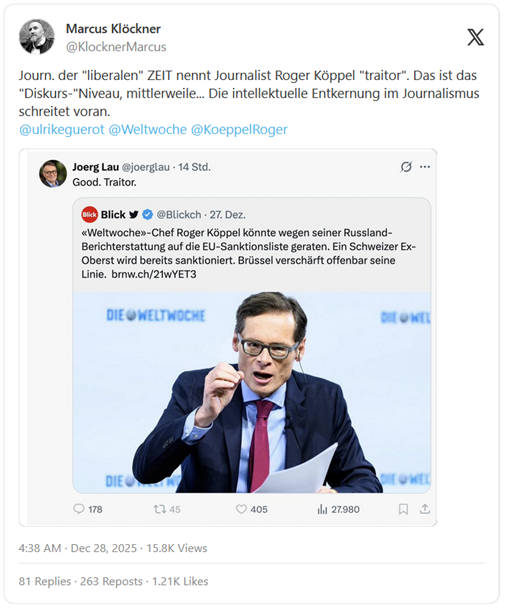
Right now, there are various pundits in the blogosphere and in mainstream media who more or less argue along the lines of “deserves them right, traitors.” These people, too, one day will understand what this system means if it is allowed to foster and grow in its draconian scope. By then, it will be too late. Either this stops now, or the future for freedom and democracy in the EU is bleak.
The Eurocratic Death of Democracy

The only hope I have is in popular uproar against this sanctions regime of doom. Political repression needs political answers. However, it will take a lot to put this genie back in the bottle. Even on a national level, the member states seem pretty happy with the new tool.

Florian Warweg, a courageous German journalist who was on my show before, actually asked his government spokespeople at the Federal Press Club (Bundespressekonferenz) on December 17 about the case of Jacques Baud and the legality thereof. The smug answer he got from Martin Giese of the German Foreign Ministry tells us most of what we need to know about how these gray bureaucrats perceive their actions and what they have in store:

(…) people who do such things can be sanctioned if the legal grounds exist and if there is a corresponding decision by the Council of the European Union. That happened this Monday, it will continue to happen, it has happened in the past, and anyone operating in this field must expect that it could also happen to them. (…)

All those who do not agree with their sanctioning have all possible legal means to challenge it. They can appeal to the Council, and they can also bring the case before the European Court of Justice.

What a blatant intimidation attempt. Seems like a pretty straightforward admission that there is more to come. After all, as I established above, the sanctions do have legal grounds in the purely formal sense, and the victims can indeed call on the very institution that took the sanctions decision and its rubber-stamp court that will only check the formalities. Seems very fair, right?

Here you go. This is how democracy dies (again). By executive decree and bureaucratic smug. Well done, European Union.

Pascal Lottaz a (Swiss) academic in Japan, Associate Professor at Kyoto University, working on neutrality in IR. He also runs the YouTube show "Neutrality Studies", where he explores world politics with various guests. Read other articles by Pascal, or visit Pascal's website.


Oceans struggle to absorb Earth’s carbon dioxide as microplastics invade their waters


University of Sharjah
Microplastic sources and pathways 

image: 

Sources, pathways and their interconnectedness for MPs transport. Concept adapted from Environmental Health Program, 2023. Microplastics Sources, Pathways and Fate Conceptual Diagram. Redrawn by the authors with minor modifications.

view more 

Credit: Journal of Hazardous Materials: Plastics (2026). DOI: https://doi.org/10.1016/j.hazmp.2025.100032


Leon Barkho, University of Sharjah

A new study reveals that microplastics are impairing the oceans’ ability to absorb carbon dioxide, a process scientists find crucial for regulating Earth’s temperature.

Defined as tiny plastic fragments smaller than five millimeters in size, microplastics have become ubiquitous. They are found almost everywhere, from deep ocean waters, freshwater sources, air, soil, Arctic ice, and even human bodies. Their pervasiveness poses serious risks to the environment. They carry toxins that living creatures, including humans, ingest, triggering a host of diseases, disrupting the ecosystem, harming aquatic life, and reducing soil fertility.

Now researchers have found that despite the global urgency of climate change, the role of microplastics in this crisis, particularly their presence in marine environments, has received limited attention. “Climate disruption and plastic pollution are two major environmental challenges that intersect in complex ways. MPs (microplastics) influence biogeochemical processes, disrupt oceanic carbon pumps, and contribute directly to greenhouse gas (GHG) emissions,” they write in a study published in the Journal of Hazardous Materials: Plastics.

“In marine ecosystems, MPs alter the natural carbon sequestration by affecting phytoplankton and zooplankton, which are key agents of carbon cycling. Additionally, the plastisphere, a microbial community colonizing MPs, plays a significant role in GHG (greenhouse gas production) due to its diverse microbial networks.”

While widely recognized as pollutants, “our study shows they also interfere with the ocean’s ability to absorb carbon dioxide, a process critical for regulating Earth’s temperature,” said Dr. Ihsanullah Obaidullah, Associate Professor of Integrated Water Processing Technologies at the University of Sharjah and the study’s corresponding author.

 Dr. Obaidullah added, “Microplastics disrupt marine life, weaken the 'biological carbon pump,’ and even release greenhouse gases as they degrade. Over time, these changes could lead to ocean warming, acidification, and biodiversity loss, threatening food security and coastal communities worldwide.”

A hidden climate threat

Dr. Obaidullah describes the study as a “collaborative perspective” involving scientists from China, Hong Kong, Pakistan, and the United Arab Emirates. “We have highlighted an overlooked link between microplastics and climate change. We call for urgent global action to address this emerging threat.”

The authors, who published their research under the title “Microplastics and Global Warming: A Hidden Climate Threat Uncovered in a New Perspective,” present a scoping review that maps the nature, range, and extent of existing research on the topic. By identifying gaps in the literature, they uncover a hidden greenhouse effect rarely highlighted before.

“Oceans are Earth’s largest carbon sink,” explained Dr. Ihsanullah. “Microplastics are undermining this natural shield against climate change. Tackling plastic pollution is now part of the fight against global warming.”

The study emphasizes that “biological carbon pumping” – the ocean's natural process that transfers carbon from the atmosphere into the deep sea layers – is the primary mechanism linking microplastics to global warming and climate change. “MPs interfere with this process by reducing phytoplankton photosynthesis and impairing zooplankton metabolism,” the authors note.

Another connection, the authors indicate, is related to the plastisphere, an assembly of microbes in aquatic settings that form biofilms on surfaces. “The plastisphere is home to a variety of microorganisms, the majority of which are involved in biological processes like the nitrogen and carbon cycles.” Alarmingly, they maintain, microplastics also emit greenhouse gases during degradation, exacerbating their impact on climate systems.

Unseen connections

The researchers adopted an integrative narrative approach to analyze previous studies, rather than a systematic or scoping review. Their analysis is grounded in desktop research, drawing on peer-reviewed articles, reports from international organizations, and other authoritative sources to critically synthesize knowledge on microplastics, ocean health, climate change, and related socio-environmental issues.

Unlike protocols such as PRISMA, no rigid inclusion or exclusion criteria were applied.  Instead, the emphasis was placed on conceptual integration and thematic linkage across disciplines, said Dr. Ihsanullah. A total of 89 studies published mainly after 2015 were reviewed, covering literature from 2010 to 2025. This approach enables a holistic discussion of emerging evidence, knowledge gaps, and policy implications in the context of climate change, the Sustainable Development Goals (SDGs), and human rights.

The study seeks to address knowledge gaps in the literature, which, according to the authors, have largely concentrated on identifying microplastics and developing cleanup strategies.  They write, “The extent to which microplastics affect climate change, ocean health, and associated systems is currently unknown. This can be mostly because the issue is novel, intricate, and multifaceted. The significant ecological effects of plastic pollution in the oceans are well recognized, but its exact connections to these extensive environmental processes are not well understood.”

To bridge the gaps, the researchers explore the multifaceted effects of microplastics on ocean health and climate change, urging future studies to highlight the internal linkages between microplastics and climate change dynamics. Such dynamics, they argue, could foster a shift in “perspective in research and policymaking.”

By considering the ecological and economic dimensions of microplastic ocean impact, the study aims to enhance an understanding of plastic pollution and support the development of more effective mitigation strategies, particularly in addressing microplastics’ role in exacerbating environmental challenges such as oxygen depletion and ecosystem destabilization.”

Ubiquitous and versatile

Plastics are not only pervasive but also remarkably versatile, affordable, and durable. They are integral to modern life, used in everything from food, medicine, retail packaging, construction of pipes, insulation and windows, plane parts, interiors for fuel, electronics, consumer goods, and healthcare applications

As a result, the worldwide generation of plastics is massive. A 2025 U.N. report estimates that annual plastic production exceeds 400 million tonnes, half of which is designed for single use, and less than 10 percent of it is recycled. Projections indicate that, without intervention, annual plastic production could triple by 2060.

To date, the world has produced over 8.3 billion tonnes of plastic, with 80 percent ending up in landfills or the environment. Alarmingly, only nine percent of the massive volume is recycled.

While plastics deliver undeniable benefits to society, the authors warn that “their environmental footprint across the entire life cycle has become a growing concern. These plastics, being highly persistent, have become a pressing global environmental challenge.

“The increasing demand for and excessive consumption of plastic have led to serious challenges for human and ecosystem health, posing threats to environmental sustainability and food safety.”

Integrated action is required to address issues

The researchers urge policymakers not to underestimate the long-term impact of microplastics on ecosystems and human life, even if their current effects appear minimal. They caution that “while their (microplastics) current impacts may seem minor, their growing accumulation suggests future significance. The impact of MPs on ocean health, particularly concerning potential ocean warming and acidification, remains an area of concern.”

The authors call for an integrated approach, stressing that microplastic pollution and climate change cannot be addressed in isolation.  “In this way, the effects of climate change could be lessened by taking appropriate action to slow down the production of microplastics,” they note.

Among other recommendations, the authors urge the United Nations to revisit its Sustainable Development Goals, pointing out that “plastics are currently represented by a single indicator, which may not adequately capture the widespread risks posed by microplastics across diverse ecological systems.”

They also advocate for immediate and coordinated efforts to “develop governance frameworks that tackle both MP pollution and climate change, particularly their links to ocean acidification and warming.”

To safeguard the oceans and preserve their ability to absorb carbon dioxide, they outline key priorities which include reducing single-use plastics, improving waste management, promoting biodegradable alternatives, and advancing research on how microplastics influence ocean temperature and carbon cycles.

Additionally, they recommend leveraging AI-driven monitoring and innovative materials to curb plastic waste.

When asked about future research directions, Dr. Ihsanullah said, “Our next step is to quantify the climate impact of microplastics and develop integrated solutions. This is not just an environmental issue; it’s a global sustainability challenge.”

A forecasting model analysis on impact of the Inflation Reduction Act for non-insulin diabetes drugs on Louisiana Medicare costs


KeAi Communications Co., Ltd.


A forecasting study published in Pharmacoeconomics and Policy analyzes the impact of the Inflation Reduction Act (IRA) on diabetes drug costs for Medicare in Louisiana, USA. The authors found that that price negotiations for three non-insulin drugs are projected to save approximately US$400 million over five years (2026−2030). A key driver of savings is a shift in medication use, as patients are expected to switch from non-negotiated to negotiated drugs due to lower costs.

“The findings serve as a new, state-level forecast on the financial impact of a major federal policy. By modeling the effect of Medicare drug price negotiations under the Inflation Reduction Act (IRA) specifically for Louisiana, we learn that the policy's benefits can be substantial at the local level, particularly for states with high chronic disease burdens,” shares lead and corresponding author Debra Winberg.

The results also show significant savings from two combined effects: direct price discounts on negotiated drugs and a change in patient behavior. “The model anticipates that patients switch from non-IRA drugs to IRA drugs at a higher rate than inflation once lower prices are in effect. This behavioral shift is a crucial finding: it means savings are amplified beyond simple price cuts because more people use the cost-effective medications,” says Winberg,

In context, these findings shine a new light on how policy can improve an existing process of escalating drug spending. “For years, the high cost of diabetes medications has strained Medicare budgets and forced tough choices. Our model suggests that the IRA's negotiated “maximum fair price" is not just a theoretical tool but a practical mechanism that can reverse cost trends,” Winberg explains.

By 2030, the total projected costs for these drugs in Louisiana are expected to be about USD 42 million lower than they would have been without the IRA.

Notably, the new method used historical Medicare claims data from 2016−2020 to project future costs. “While simpler than some complex economic models, this approach was chosen because no direct policy precedent for the IRA exists, making more complicated models risky. The clarity of this method makes the substantial USD 400 million savings projection even more striking and understandable for policymakers,” says Winberg.

###

Contact the author: Debra Winberg, Department of Health Policy and Management, Celia Scott Weatherhead School of Public Health and Tropical Medicine, Tulane University, New Orleans, LA, 70112, USA. dwinberg@tulane.edu

The publisher KeAi was established by Elsevier and China Science Publishing & Media Ltd to unfold quality research globally. In 2013, our focus shifted to open access publishing. We now proudly publish more than 200 world-class, open access, English language journals, spanning all scientific disciplines. Many of these are titles we publish in partnership with prestigious societies and academic institutions, such as the National Natural Science Foundation of China (NSFC).