


_64217.jpg)
Blykalla said it chose Norrsundet in the municipality of Gävle as the location for its nuclear facility due to its strategic location between two key bidding zones, an existing port, key infrastructure, and industrial heritage – reducing construction complexity while addressing regional power shortages with predictable baseload power. The proposed plant will have a total generating capacity of 330 MWe.
"This application is a historic first for Sweden," said Blykalla CEO Jacob Stedman. "We're not just planning an advanced reactor park - we're building Sweden’s energy future and putting the country at the forefront of the global nuclear power renaissance. Building new energy infrastructure is critical, and the energy systems of the future need to be predictable, reliable and fossil-free. As AI and electrification grow worldwide, we need to accelerate the deployment of predictable, clean baseload power. That's exactly what Blykalla's technology does, and we are uniquely positioned to meet this moment."
The Ministry of Climate and Enterprise said the government will now assess whether the application meets the requirements, whether the proposed activity is justified and whether there are conditions for preparedness and for handling the nuclear material being handled and the nuclear waste that is generated. The government review of the application launches a comprehensive approval process involving multiple agencies, including the Land and Environmental Court and Swedish Radiation Safety Authority. The government will then produce a facility plan to guide decisions on how land and water areas will be used.
The ministry noted the municipality of Gävle needs to approve both the plan and the application before the government can make a decision to approve a nuclear facility. "The approval does not replace the permit review according to the Environmental Code and the Nuclear Activities Act," it said. "However, the government's approval replaces the permissibility review that the government must otherwise carry out according to Chapter 17 of the Environmental Code."
_c2dd3e92.jpg)
Rendering of the SEALER building in Norrsundet (Image: Blykalla)
Blykalla - formerly called LeadCold - is a spin-off from the KTH Royal Institute of Technology in Stockholm, where lead-cooled reactor systems have been under development since 1996. The company - founded in 2013 as a joint stock company - is developing the SEALER (Swedish Advanced Lead Reactor). A demonstration SEALER (SEALER-D) is planned to have a thermal output of 80 MW.
Subject to the necessary permits and final investment decisions, the commercial-scale Norrsundet facility could become operational in the first half of the 2030s.
In February, the Swedish government announced several proposed measures to make it easier to establish new nuclear power in the country. The new legislation introduces an early-stage government approval process designed to improve predictability and accelerate the deployment of new nuclear capacity. The following month, Kärnfull Next submitted an application to build a power plant based on small modular reactors (SMRs) in the municipality of Valdemarsvik in Östergötland county in southeastern Sweden, becoming the first application under the country's new Act on Government Approval of Nuclear Facilities. It marked the first application for the establishment of new nuclear power in Sweden 50 years.
"New nuclear power is an important piece of the puzzle for Sweden's energy independence," said Acting Minister of Climate and Environment Johan Britz. "The concern we are now seeing in the world clearly shows how vulnerable we are becoming from our dependence on fossil fuels – and how crucial it is to expand fossil-free electricity production. Thanks to our new permit review, more actors now dare to invest in nuclear power."
In October 2022, Sweden's incoming centre-right coalition government adopted a positive stance towards nuclear energy. In November 2023, it unveiled a roadmap which envisages the construction of new nuclear generating capacity equivalent to at least two large-scale reactors by 2035, with the equivalent capacity of up to 10 new large-scale reactors (which may include small modular reactors) coming online by 2045. A new act on state aid entered into force on 1 August 2025, since when interested companies have been able to apply for the aid.
The Swedish government received the first such application in December to support proposals for either five GE Vernova Hitachi BWRX-300 reactors or three Rolls-Royce SMRs to provide about 1500 MW capacity at Ringhals on the Värö Peninsula. The application came from Videberg Kraft AB, a project company owned by Vattenfall AB and backed by a series of industrial firms via the Industrikraft i Sverige AB consortium.
_15918.jpg)
PreussenElektra - a subsidiary of EOn Group - applied in October 2017 for approval to decommission and dismantle the 1,360 MWe pressurised water reactor which entered commercial operation in February 1985, and was shut down in December 2021.
The Lower Saxony Ministry for the Environment, Energy and Climate Protection issued the first decommissioning and dismantling permit to the company for the Grohnde plant in December 2023, with dismantling work beginning in the following month.
The dismantling process to date has included the removal of components from the primary cooling circuit. Simultaneously, the newly constructed waste treatment centre has commenced operations. There, all dismantled materials are broken down, radiologically measured, cleaned, and, after official approval, either disposed of or recycled. On 7 April this year, PreussenElektra announced that all the used nuclear fuel assemblies in the storage pool at Grohnde had been transferred to an on-site interim storage facility. To achieve fuel-free status, a total of 694 fuel assemblies were transferred from the plant's storage pool into CASTOR used fuel storage casks.
PreussenElektra submitted the application for the second decommissioning permit in January 2024. This permit allows further key decommissioning work to proceed, including the removal of the reactor pressure vessel and the surrounding biological shield.
During a visit to the plant on 15 May, Lower Saxony's Minister for the Environment, Energy and Climate Protection, Christian Meyer, officially presented PreussenElektra with the second and final permit for the plant's decommissioning. With this, all necessary permits for the complete dismantling of the plant are now in place.
Starting later this year, one of the most technically demanding phases of the decommissioning process will begin: the dismantling of the reactor pressure vessel's internal components. Planning for this is already under way. The first cut is currently scheduled for early 2027. The project is expected to be completed by mid-2028.
"I thank everyone involved for their excellent work on the decommissioning application," said Environment Minister Christian Meyer. "With the final decommissioning permit now granted and the reactor building being free of nuclear fuel, we are creating clarity and the conditions for the safe and sustainable decommissioning of the Grohnde nuclear power plant and its interim storage on site. The decommissioning of nuclear facilities must be safe, transparent, and under strict nuclear regulatory oversight. Our shared goal is a swift, competent, and responsible decommissioning process."
Guido Knott, Chairman of the Management Board of PreussenElektra, said: "With the second permit, we now have all the legal prerequisites to carry out the dismantling of the KWG consistently and according to plan. Our aim is to implement the dismantling safely, efficiently and quickly - with the clear goal of completing the nuclear dismantling by the mid-2030s and being able to use the site for future projects as soon as possible."
In a third, conventional phase, the dismantling will take place after clearance from nuclear regulatory oversight. The dismantling of Grohnde is scheduled for completion by 2039. Afterwards, the power plant site will be available for redevelopment.
PreussenElektra is responsible for the decommissioning of eight nuclear power plants in Germany. Isar 2 was the last of the PreussenElektra plants to cease operations on 15 April 2023. The Brokdorf and Grohnde plants were shut down on 31 December 2021. With the already decommissioned Isar 1, Stade, Unterweser and Würgassen plants, all of PreussenElektra's nuclear facilities are now in various phases of decommissioning and dismantling. The company's goal is to dismantle its power plant fleet by 2040.
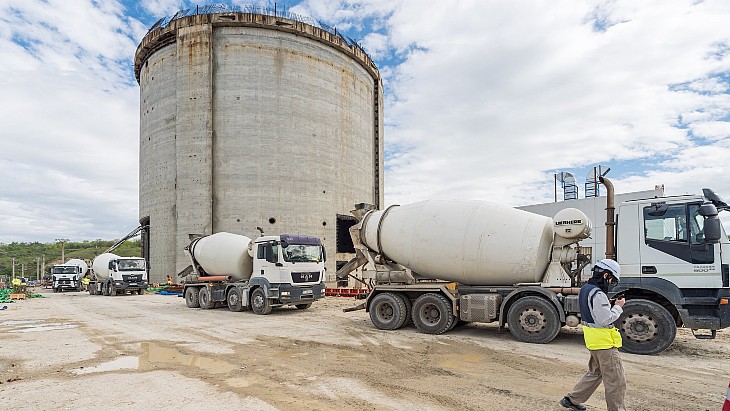
About 3470 cubic metres of concrete was used for the foundation, which the company says was the equivalent of about 380 concrete mixer truck-fulls, and was the most complex such operation since unit 2 was built.
The new waste facility is designed for the handling, processing and interim storage of waste, both from the refurbishment of unit 1 and the long-term commercial operation of both the plant’s units.
Cosmin Ghita, General Manager of Nuclearelectrica, said: "The pouring of the first concrete for the construction of the infrastructure required for the refurbishment of unit 1 holds a significance similar to that of the pouring of the first concrete during the construction of unit 1. After 30 years of operation at high nuclear safety standards and with world-class performance in terms of capacity factor, unit 1, through the refurbishment programme, will continue to operate for another 30 years starting in 2030. Another 30 years of energy security, 5 million MW produced annually, and 5 million tons of CO2 avoided annually - a strategic project for Romania's energy security."
Cernavoda is the only nuclear power plant in Romania and consists of two 650 MWe Candu reactors. Unit 1 went into commercial operation in 1996 and unit 2 in 2007.
The unit 1 refurbishment project began in 2017 and is currently in the second of three phases, in preparation for implementation. The project is scheduled to enter its third and final phase of development in 2027 with the shutdown of unit 1 for refurbishment.
Background
Candu units are pressurised heavy water reactors designed to operate for 30 years, with a further 30 years available subject to refurbishment. This includes the replacement of key reactor components such as steam generators, pressure tubes, calandria tubes and feeder tubes. It involves removing all the reactor's fuel and heavy water and isolating it from the rest of the power station before it is dismantled. Thousands of components, including those that are not accessible when the reactor is assembled, are inspected, and all 480 fuel channels and 960 feeder tubes are replaced during the high-precision rebuild.
In December 2024 Nuclearelectrica signed the engineering, procurement and construction contract for the estimated EUR1.9 billion (USD1.97 billion) refurbishment with a consortium of Korea Hydro & Nuclear Power, AtkinsRealis's Candu Energy, Canadian Commercial Corporation and Ansaldo Nucleare.
The civil construction works began in September 2025 after the company received approval from Romania's nuclear regulator (CNCAN) for the construction of the Intermediate Radioactive Waste Repository. The company said the expansion of the intermediate storage capacity of low and medium radioactive waste was a key part of sustaining long-term operation of the plant.
_41419_35341.jpg)
In a post on the social media site X on Sunday, the International Atomic Energy Agency (IAEA) said: "Emergency diesel generators are currently providing power to the NPP's unit 3. The IAEA is following the situation closely and is in constant contact with the UAE authorities, ready to provide assistance if needed."
It added that Director General Rafael Mariano Grossi "expresses grave concern about the incident and says military activity that threatens nuclear safety is unacceptable. The director general reiterates call for maximum military restraint near any NPP to avoid the danger of a nuclear accident".
A separate post, from the UAE's foreign ministry, said that Foreign Minister Abdullah bin Zayed held a phone call with Grossi during which they discussed the incident "and UAE-IAEA relations and ways to further enhance them across various fields in support of the peaceful use of nuclear energy in line with the highest international standards of safety, security and non-proliferation".
The UAE's defence ministry said that the drone was one of three that "entered the country’s territory from the western border direction". The other two were "successfully intercepted". It said that investigations were under way to determine the source of the attacks.
The UAE's Federal Authority for Nuclear Regulation (FANR) posted a statement on X saying: "FANR confirms that the incident did not affect the safety of the Barakah Nuclear Power Plant or the readiness of its essential systems. There has been no release of radioactive material, radiological safety levels remain within normal ranges, and there is no risk to the public or the environment. No injuries have been reported.
"FANR are maintaining close coordination with the plant operator and the relevant national authorities to verify all aspects of the incident and to confirm the continued integrity and readiness of plant systems. As part of its independent regulatory oversight, FANR is assessing the event in accordance with established national procedures and maintaining continuous monitoring of radiological conditions and plant status.
"The Barakah Nuclear Power Plant was designed, licensed, and is operated in accordance with the highest international standards of nuclear safety and security. Multiple independent layers of protection are built into every aspect of the plant's design and operation to ensure the safe and secure production of clean electricity under a wide range of conditions. The protection of the public, workers, and the environment remains FANR's highest priority. The Authority will continue to provide rigorous and independent regulatory oversight to ensure the continued safe and secure operation of the Barakah Nuclear Power Plant."
Fatih Birol, Executive Director of the International Energy Agency, posting on X on Sunday, said: "Attacks on energy infrastructure have multiplied recently, affecting lives & livelihoods around the world. Today’s attack on the Barakah nuclear power plant in the UAE is an alarming example. I urge all countries to avoid the targeting of civilian energy infrastructure."
World Nuclear Association issued a statement saying: "Our colleagues at the Barakah Nuclear Power Plant and the IAEA have confirmed that everyone is safe at the plant, that the plant has not suffered direct damage, and that emergency procedures have been effectively activated and the plant is operating safely.
"We call on those responsible for military activity of any kind in the proximity of this nuclear power plant, and all civilian energy facilities, to revisit the agreements of the Geneva conventions. Attacks on energy infrastructure are reckless and unacceptable; it is vital that protections afforded to civilian infrastructure - especially nuclear power plants - are reaffirmed and respected."
Background
The Barakah plant - in the Al Dhafra Region of Abu Dhabi - is owned by ENEC and operated by Nawah, a joint nuclear operations and maintenance subsidiary of the ENEC and the Korea Electric Power Corporation.
Construction of the four Korean-designed APR-1400 units at Barakah began in 2012, with work on unit 4 beginning in 2015. Unit 1 began commercial operation in April 2021, unit 2 in March 2022. Unit 3's start-up was in September 2022, and it began commercial operation in February 2023. Unit 4 entered commercial operation in September 2024.
The USA and Israel launched attacks on Iran on 28 February, saying they were targeting Iran's leadership and its military infrastructure. Iran has retaliated - including attacks on neighbouring states. The conflict is continuing, although there is currently an official ceasefire, which is aimed at allowing talks seeking an agreement on ending the conflict.
The IAEA has warned about avoiding military action in the areas of nuclear power plants in the Ukraine-Russia war, and in March the agency reported that "a projectile incident" took place 350 metres from the Bushehr Nuclear Power Plant reactor in Iran.
The combined entity will operate under the NextEra name and be 74.5% owned by NextEra Energy shareholders and 25.5% by Dominion Energy shareholders. It will serve around 10 million accounts across Florida, Virginia, North Carolina and South Carolina.
The combined entity will have 110 GW of generating capacity, including considerable nuclear energy capacity - NextEra Energy Resources, along with its affiliate company Florida Power & Light Company, operates seven nuclear units at four sites: Turkey Point and St Lucie in Florida; Seabrook in New Hampshire; and Point Beach in Wisconsin. Additionally, it plans to restart the Duane Arnold plant in Iowa, which ceased operations in 2020. The plant is scheduled to become operational at the beginning of 2029, pending regulatory approvals. A power purchase agreement with Google was announced last October.
In January NextEra Energy said it could add up to 6 GWe of small modular reactor generating capacity at its existing nuclear power plant sites or potential new sites, primarily to meet demand from data centres.
More than 40% of the electricity Dominion Energy generates is from its nuclear plants - Millstone Nuclear Power Station in Connecticut, North Anna and Surry nuclear power plants in Virginia and VC Summer in South Carolina.
John Ketchum, chairman, president and CEO of NextEra Energy, said: "This is a historic moment for our two companies and for the states we are privileged to serve. Electricity demand is rising faster than it has in decades. Projects are getting larger and more complex. Customers need affordable and reliable power now, not years from now. We are bringing NextEra Energy and Dominion Energy together because scale matters more than ever - not for the sake of size, but because scale translates into capital and operating efficiencies. It enables us to buy, build, finance and operate more efficiently, which translates into more affordable electricity for our customers in the long run."
Robert Blue, chair, president and CEO of Dominion Energy, said: "This combination brings together two strong operating platforms and creates an even stronger energy partner for Virginia, North Carolina, South Carolina and Florida, with the scale and balance sheet to deliver the generation, transmission and grid investments our customers and economies need."
The proposal is that Ketchum will serve as chairman and CEO of the combined company and Blue will serve as president and CEO of regulated utilities and as a member of the board of directors. The combined company's board of directors will include 10 directors from NextEra Energy and four from Dominion Energy. The announcement includes a proposal for USD2.25 billion in bill credits for Dominion customers in Virginia, North Carolina and South Carolina over the two years after the deal closes.
The two sides expect the deal to close in 12 to 18 months "subject to customary closing conditions and approvals by the shareholders of NextEra Energy and Dominion Energy, the expiration or termination of the waiting period under the Hart-Scott-Rodino Antitrust Improvements Act, approval by the Federal Energy Regulatory Commission under Section 203 of the Federal Power Act and approval by the Nuclear Regulatory Commission".
Leading clean energy utility, NextEra Energy (NYSE:NEE), has agreed to buy Dominion Energy (NYSE:D) in an all-stock transaction valued at $66.8 billion, marking the largest power utility acquisition on record. The merger unites Florida-based NextEra Energy and Virginia-based Dominion Energy to create the world’s largest regulated electric utility, a power sector titan with an enterprise value exceeding $400 billion including debt.
The historic consolidation is directly driven by the artificial intelligence infrastructure boom, with high-performance AI hardware having triggered a massive surge in electricity demand. NextEra, a global leader in wind and solar power, will leverage its clean energy assets to meet the carbon-free electricity requirements of tech hyperscalers like Alphabet (NASDAQ:GOOG), Microsoft (NASDAQ:MSFT), Amazon (NASDAQ:AMZN) and Meta Platforms (NASDAQ:META).
NextEra previously secured high-profile deals, including an agreement with Google to revive Iowa’s Duane Arnold nuclear plant.
Dominion operates in Virginia and the Carolinas, with Northern Virginia home to the world’s largest concentration of data centers, also known as the “Data Center Alley”.
PJM Interconnection, the largest U.S. power grid operator, has projected that summer peak demand in the Dominion Energy zone (encompassing Northern Virginia’s Data Center Alley) to grow by 5.4% annually over the next decade. Because hyperscale data centers run continuously at high load factors, they drive up demand evenly, causing winter peak loads to rise at a 4% annualized rate.
However, the mega-merger faces a complex review process since it requires antitrust clearance and approvals from the Federal Energy Regulatory Commission (FERC) alongside state public utility commissions in Florida, Virginia, and the Carolinas.
Thankfully, Wall Street is generally bullish that the current federal administration’s general openness to corporate mergers may provide a smoother path toward finalization.
By Alex Kimani for Oilprice.com
Under the agreement, Dominion shareholders will receive 0.8138 shares of NextEra Energy for each Dominion share they own, giving NextEra investors roughly 74.5% ownership of the combined company and Dominion shareholders about 25.5%. The transaction is expected to close within 12 to 18 months, pending shareholder and regulatory approvals.
The combined company would serve around 10 million customer accounts across Florida, Virginia, North Carolina, and South Carolina and control approximately 110 gigawatts of generation capacity spanning natural gas, nuclear, renewables, and battery storage. The companies said more than 80% of the merged business would be regulated operations.
The deal comes as U.S. utilities race to secure scale and capital to meet rapidly rising electricity demand driven by artificial intelligence, data centers, industrial reshoring, and electrification trends. NextEra said the combined company would have more than 130 GW of large-load opportunities in its development pipeline.
To ease regulatory and political concerns over customer impacts, the companies proposed $2.25 billion in bill credits for Dominion customers in Virginia, North Carolina, and South Carolina over two years after closing. They also pledged to retain dual headquarters in Juno Beach, Florida, and Richmond, Virginia, while maintaining Dominion’s regional utility brands.
NextEra Chief Executive John Ketchum said the transaction was designed to improve operating efficiency and lower long-term customer costs as utilities face increasingly complex and capital-intensive infrastructure needs. Dominion CEO Robert Blue said the merger would strengthen the companies’ ability to fund new generation, transmission, and grid upgrades.
The companies expect the merger to immediately boost adjusted earnings per share and project more than 9% annual adjusted EPS growth through 2032. They also said the larger balance sheet could improve credit metrics and lower financing costs.
The merger would significantly expand NextEra’s already dominant position in U.S. power markets. The company is currently the largest renewable energy and battery storage developer in the world through NextEra Energy Resources, while Dominion brings major regulated utility operations and one of the largest offshore wind development portfolios in the United States.
The transaction will require approval from the Federal Energy Regulatory Commission, the Nuclear Regulatory Commission, and multiple state utility regulators, including commissions in Virginia, North Carolina, and South Carolina.
By Charles Kennedy for Oilprice.com
Pressure is mounting on the European Union to ban Russian uranium imports, a shift that could strengthen the position of Canadian suppliers including Cameco (TSX: CCO) (NYSE: CCJ) as utilities race to secure alternative nuclear fuel sources.

The EU has already moved to phase out Russian oil, gas and coal, but uranium and nuclear fuel services remain embedded in Europe’s reactor fleet. Russia still accounted for nearly one-quarter of the bloc’s uranium enrichment services last year, while state-owned Rosatom continues to supply fuel across the continent.
A spokesperson for the European Commission told MINING.COM that work on a proposal to phase out Russian nuclear fuels was “ongoing”.
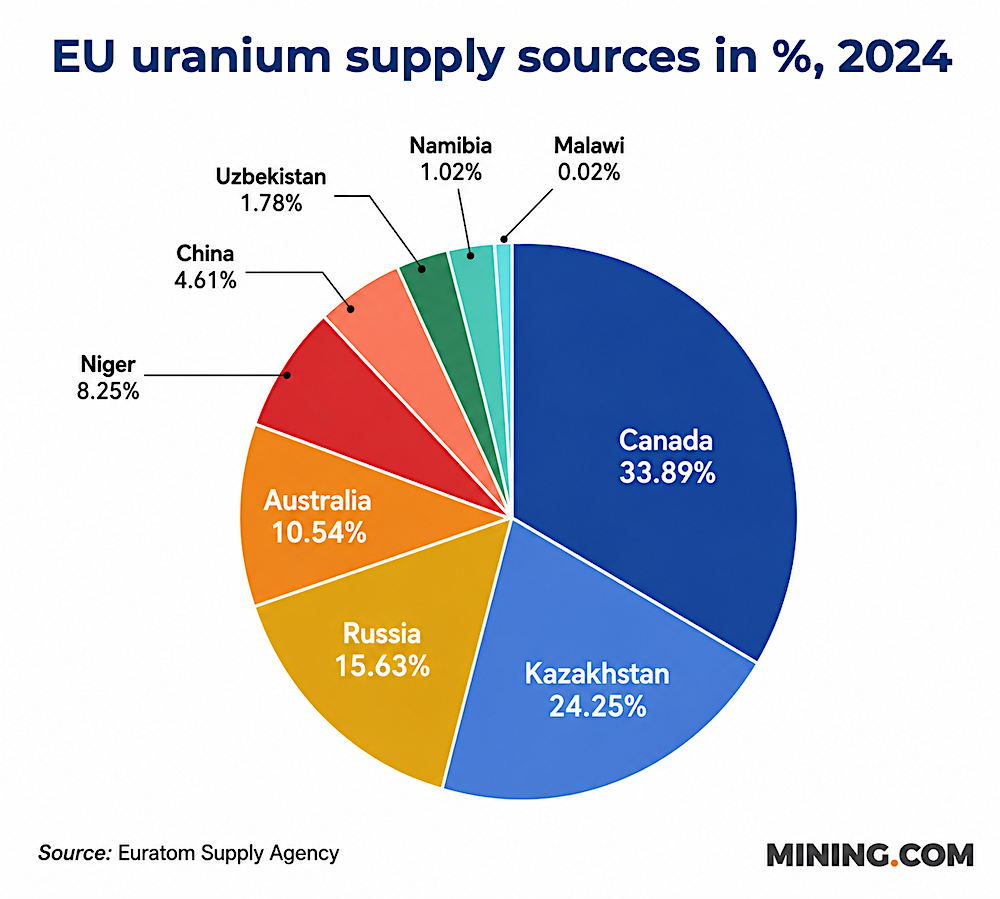
Canada supplied more than 30% of the EU’s uranium imports in 2024, making it the bloc’s largest source of the fuel.
“Cameco is well positioned to benefit from Europe’s move away from Russian nuclear fuel, though much of the shift has already occurred through utility self-sanctioning rather than formal EU bans,” a company spokesperson told MINING.COM.
“While Russian uranium itself is increasingly consumed domestically, Canada has been the EU’s largest uranium supplier since 2022, and Cameco’s high-grade, geopolitically secure assets align with utilities’ focus on supply security.”
The shift comes as Europe expands nuclear generation to bolster energy security and meet climate targets after Russia’s 2022 invasion of Ukraine exposed the risks of depending on imported fossil fuels.
Poland is advancing plans for its first nuclear plant using Westinghouse AP1000 reactors, while Bulgaria plans to add two more AP1000 units at Kozloduy. Cameco owns 49% of Westinghouse.
CEO Tim Gitzel recently said the company also sees opportunities in Slovakia, Slovenia and Croatia as countries seek long-term uranium supply deals and alternatives to Russian technology.
Replacing Russian fuel services, however, will be slow. Rosatom controls about 43% of global uranium enrichment capacity, far ahead of rivals Urenco and Orano.
Mykhailo Babiichuk of Kyiv-based think tank DiXi Group said uranium mining supply can be diversified within a few years, but replacing Russian enrichment services could take up to a decade because Western capacity remains limited.
“Overall, while front-end diversification is progressing, a complete phase-out of Russian nuclear fuel cycle services is a medium- to long-term process rather than a rapid shift,” Babiichuk said.
For reactors designed around Russian fuel systems, the transition is already underway. Westinghouse has signed supply agreements for Soviet-designed VVER reactors in countries including Finland, Bulgaria and Slovakia, while Ukraine has fully shifted away from Russian nuclear fuel. Cameco said those conversions could lock utilities into Western fuel supply chains for decades.
All eyes are now on Hungary where Rosatom is is building the delayed Paks II nuclear project there, though analysts say a future government could reconsider the arrangement as political support for closer EU alignment grows.
Even without a formal EU ban, utilities have already begun distancing themselves from Russian supply chains. The broader restructuring of Europe’s nuclear fuel market may ultimately cement Canada’s role as one of the West’s most important uranium suppliers.
Andreas Walstad has written extensively about energy issues for almost two decades. Dividing his time between London and Brussels, he has a special focus on energy policy and regulation. He regularly speaks and moderates discussion panels at conferences.
Santos has started oil production from the Pikka phase 1, with flows established through the LACT meter into the Pikka sales oil line. The project is expected to ramp up to 20,000 barrels per day gross over the next few weeks before reaching a planned plateau of 80,000 bpd gross in the third quarter.
Santos operates the Pikka Unit with a 51% stake, while Repsol holds the remaining 49%.
The company said production will be intermittent during late-stage commissioning as key subsystems come online. Output is expected to hold at around 20,000 bpd for about a month until water injection begins following the start-up of the Seawater Treatment Plant.
At first oil, 28 development wells had been drilled, with 21 stimulated and flowed back in line with expectations. First sales revenue is expected two to three months after first oil, with Santos and Repsol alternating tanker shipments from the Port of Valdez.
Pikka is a key growth project for Santos and one of the most closely watched new oil developments on Alaska’s North Slope. The project targets the Nanushuk reservoir, which Santos described as a new-generation play within an established global oil basin.
The start-up also strengthens Santos’ longer-term Alaska growth story. The company pointed to its Quokka appraisal results earlier this year and said it had reported 177 million barrels of oil equivalent in net 2C contingent resources for the Quokka Unit at the end of 2025. Santos said future development of the Quokka and Horseshoe units could support further North Slope production growth, subject to appraisal, planning, and final investment decisions.
By Charles Kennedy for Oilprice.com
Ford Energy, a wholly owned subsidiary of Ford Motor Company, has signed a five-year framework agreement with EDF Power Solutions North America that could see EDF procure up to 4 GWh of DC Block battery energy storage systems annually.
The agreement represents a total potential volume of up to 20 GWh over the term, with deliveries expected to begin in 2028.
The deal positions Ford Energy as a supplier to EDF Power Solutions’ expanding portfolio of grid-scale storage projects across the United States, where demand for utility-scale batteries is rising alongside renewable power deployment and grid reliability needs.
The agreement highlights the growing importance of domestically supplied battery storage as utilities and renewable developers look to reduce supply-chain risk, firm intermittent wind and solar output, and add flexibility to the power grid.
Ford Energy’s DC Block system is a standardized 20-foot containerized battery storage unit with 5.45 MWh of rated capacity. It uses lithium iron phosphate prismatic cells and is available in two-hour and four-hour discharge configurations.
The systems are designed for grid-scale uses, including frequency regulation, voltage support, energy arbitrage, peak load shifting, demand response, backup power, and microgrid integration.
By Charles Kennedy for Oilprice.com
Cement accounts for roughly 7–8% of global CO? emissions, and experts increasingly see carbon capture as unavoidable because many emissions come directly from the chemical production process itself.

For years, carbon capture and storage (CCS) has existed in a strange political limbo.
Governments praise it in climate strategies. Heavy industry quietly depends on it in their net-zero roadmaps. Environmental groups alternately dismiss it as a fossil fuel lifeline or reluctantly admit it may be necessary after all.
Yet despite the endless conferences, white papers, and billion-euro announcements, very few projects ever make it past the PowerPoint stage.
That is why Denmark’s latest CCS tender matters far beyond Scandinavia.
Aalborg Portland — Denmark’s single largest CO? emitter — has officially won support under the country’s carbon capture tender. The project will capture, transport, and permanently store 1.25 million tonnes of CO? annually from 2030 onward.
In practical terms, Europe is now about to witness something unprecedented: the first truly large-scale deployment of carbon capture at a cement plant.
Not a pilot project. Not a demonstration facility. Not another carefully curated “proof of concept.” A real industrial-scale decarbonization effort attached to one of the hardest sectors on Earth to clean up.
And that changes the conversation entirely.
The Industry Climate Policy Quietly Avoided
Cement rarely dominates climate debates. Most people associate emissions with coal plants, oil refineries, airlines, or steel mills. Cement somehow escapes public attention despite being one of the largest industrial climate problems on the planet.
Yet the sector is responsible for roughly 7–8% of global CO? emissions — more than aviation and maritime shipping combined.
The problem is structural. Unlike electricity generation, where emissions largely come from burning fuels, a substantial share of cement emissions comes directly from chemistry itself. Producing clinker requires heating limestone, which releases CO? during the calcination process. Even if every kiln in Europe suddenly ran on renewable electricity tomorrow, those process emissions would still exist.
This makes cement one of the few sectors where carbon capture is not simply useful. It is arguably unavoidable. Politicians know this. Industry certainly knows this. Climate modelers have known it for years.
But knowing something intellectually and funding it politically are two very different things. Until now, very few governments were willing to place serious bets on industrial-scale cement decarbonization. Denmark just did.
From Climate Theory to Industrial Reality
The Aalborg Portland project is not built around futuristic promises or experimental technology that may eventually work sometime in the 2040s. It starts from a far more realistic assumption: society still needs cement.
Europe is not going to stop building bridges, hospitals, apartment blocks, offshore wind foundations, tunnels, ports, rail infrastructure, or data centers anytime soon. Even the energy transition itself depends heavily on concrete.
The only real question is whether the cement behind that infrastructure remains carbon-intensive. Denmark’s answer appears to be no.
The project aims to capture 1.25 million tonnes of CO? annually from cement production in Aalborg, making it one of Europe’s largest industrial CCS projects overall. And scale matters enormously. Because scale is precisely where carbon capture has historically struggled.
The technology itself is no longer the primary issue. Capturing CO? from industrial flue gases is well understood. Engineers solved most of the technical fundamentals years ago. The real barriers have always been economics, infrastructure, regulation, transport logistics, and long-term storage certainty.
In other words, the hard part was never chemistry. The hard part was politics and industrial coordination. Denmark now appears to be solving both simultaneously.
This is what mature climate policy actually looks like: not slogans, not symbolic activism, but legally binding contracts attached to measurable industrial emission reductions. Ironically, that may also explain why the story has not generated more headlines. Competent policymaking rarely goes viral.
The Microsoft Reality Check
The tender also revealed something else about the current state of the carbon capture market. Gaia Carbon Capture — another bidder in the process — declined the option to become a marginal bidder with reduced contract volume. That decision likely complicates its previously announced 2.95 million tonne carbon removal agreement with Microsoft.
And that detail may become one of the most revealing aspects of the entire story. For years, the carbon removal sector has been dominated by announcements: partnerships, memoranda of understanding, future offtake agreements, and enormous future targets.
Actual operational projects, however, remain comparatively rare. Denmark’s tender effectively forced the market to separate ambition from execution. Aalborg Portland crossed the finish line. Others, at least for now, did not.
That may sound harsh, but it is healthy for the sector. Carbon capture cannot survive indefinitely on theoretical megatonnes and optimistic renderings. The industry now needs operational projects capable of functioning reliably at industrial scale under real market conditions. That is exactly what Denmark is incentivizing.
Europe’s First Real Cement CCS Test
The significance of Aalborg Portland extends far beyond Denmark itself. If successful, the project could become the template for cement decarbonization across Europe. And Europe desperately needs one.
The EU has spent years discussing industrial competitiveness, strategic autonomy, green industry, and climate leadership. But those ambitions increasingly collide with a difficult economic reality: Europe’s heavy industries face high energy prices alongside growing regulatory complexity. Without workable decarbonization pathways, many industries may simply move production elsewhere — often to regions with weaker environmental standards. That would not reduce global emissions. It would merely relocate them.
CCS offers one of the very few credible pathways capable of keeping industrial production in Europe while still meeting climate targets. This is particularly true for cement, steel, chemicals, and waste-to-energy facilities. The Aalborg project therefore represents something larger than a factory upgrade. It is a stress test for Europe’s industrial climate strategy itself.
Can Europe decarbonize hard-to-abate industries without deindustrializing in the process? Denmark is now attempting to prove that the answer is yes.
The Quiet Normalization of Carbon Capture
Perhaps the most important aspect of this project is psychological rather than technical. Carbon capture is slowly transitioning from “controversial climate experiment” into ordinary industrial infrastructure. That shift matters enormously.
Every major industrial technology initially appears expensive, politically divisive, and commercially unrealistic. Offshore wind once looked financially absurd. Solar power spent decades dismissed as symbolic environmentalism. Then scale happened. Infrastructure matured. Costs fell. Normalization followed.
Carbon capture may finally be entering that same phase. And cement is exactly where that transition needed to happen.
Because if CCS can work economically in cement production — one of the toughest industrial sectors imaginable — then it becomes much harder to argue that the technology is merely a fossil fuel distraction. Instead, it starts looking like what it probably always was: A necessary industrial climate tool that arrived politically before societies were ready to accept it.
Denmark may have just accelerated that acceptance curve. Quietly. Without fanfare. And with 1.25 million tonnes of annual CO? reductions attached to a single cement plant. That is no longer climate theory. That is industrial transformation.
By Leon Stille for Oilprice.com