Thursday, June 18, 2026

STUPID LAW

Scotland for the win: Massachusetts becomes first US state to 'legalise' haggis

Scotland for the win: Massachusetts becomes first US state to legalise haggis
Copyright Canva


By David Mouriquand
Published on

The Scottish staple has been illegal in the US since the 1970s. Following a pre-World Cup campaign by one of Scotland's leading butchers and the efforts of a Scottish podcaster, Massachusetts has become the first US state to finally legalise haggis. Officially. Ish.

The Scots have only gone and done it.

No, we’re not talking about Scotland's first game win against Haiti last Sunday for their first World Cup game since 1998.

We’re referring to the fact that the Tartan Army has managed to make haggis legal again. In one US state. For now...

Last month, we reported how one of Scotland’s leading butchers, Simon Howie Butchers, had launched a campaign for the US to legalise haggis ahead of the World Cup.

The not immediately appealing but downright delicious Scottish delicacy has been illegal in the US since the 1970s, due to federal food regulations relating to the consumption of offal – specifically sheep lung, which constitutes up to 15 per cent of the traditional haggis recipe.

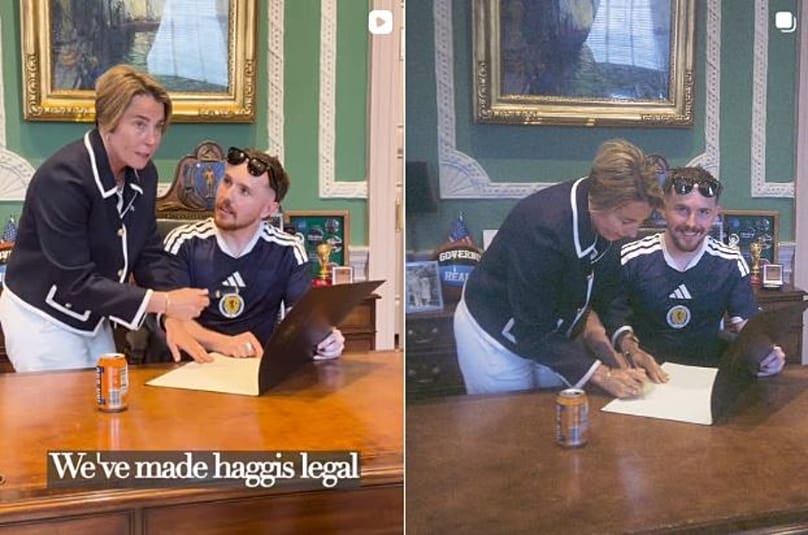
Now, David McIntosh Jr, a Scottish podcaster and Tartan Army member, met with the governor of Massachusetts Maura Healey. Healey went on to sign an "executive order" on Wednesday to make haggis legal.

In a video posted on social media by McIntosh Jr from the State House in Boston, Healey can be seen signing the paper. The caption read: "We've made haggis legal in Massachusetts. [Un]official."

While individual states do not have the power to legalise haggis, since food safety and import standards are governed at a federal level, it’s a start.

Governor Healey with McIntosh Jr
Governor Healey with McIntosh Jr Instagram screenshot - massgovernor

Governor Healey previously applauded the arrival of Scottish fans for the World Cup.

“The Tartan Army has brought the energy, joy, and enthusiasm to Massachusetts," she said. "This is truly what the World Cup is all about.”

She added: “Between the bagpipes, the kilts, and thousands of Scotland fans turning Boston into their home away from home, the Tartan Army has made quite an impression on Massachusetts.”

Indeed, more than 20,000 Scotland fans travelled to Massachusetts for Scotland’s first game at Boston Stadium, and as well as enjoying the football, the Tartan Army have been making the most of their time in the US... by drinking them dry.

A number of bars in Boston have reported that they have been running low on beer since the Scots arrived. Last week, a new law (the “Tartan Army Bill”) was passed allowing more than 140 bars and restaurants to stay open longer.

The Tartan Army has also brought another tradition to Boston: traffic cones as headgear.

Fans have started placing orange traffic cones on the heads of statues in the city - a tradition associated with the statue of the Duke of Wellington outside the Gallery of Modern Art in Glasgow. Since the late 1980s, a cone has been atop the statue’s head. It is deligently replaced whenever it is removed.

Scotland’s next game is on Saturday 20 June against Morocco, also at Boston Stadium. The team currently top Group C, following their win against Haiti and Brazil’s draw against Morocco.


‘If Ukraine burns, so will Moscow,’ Zelenskyy says after refinery fire

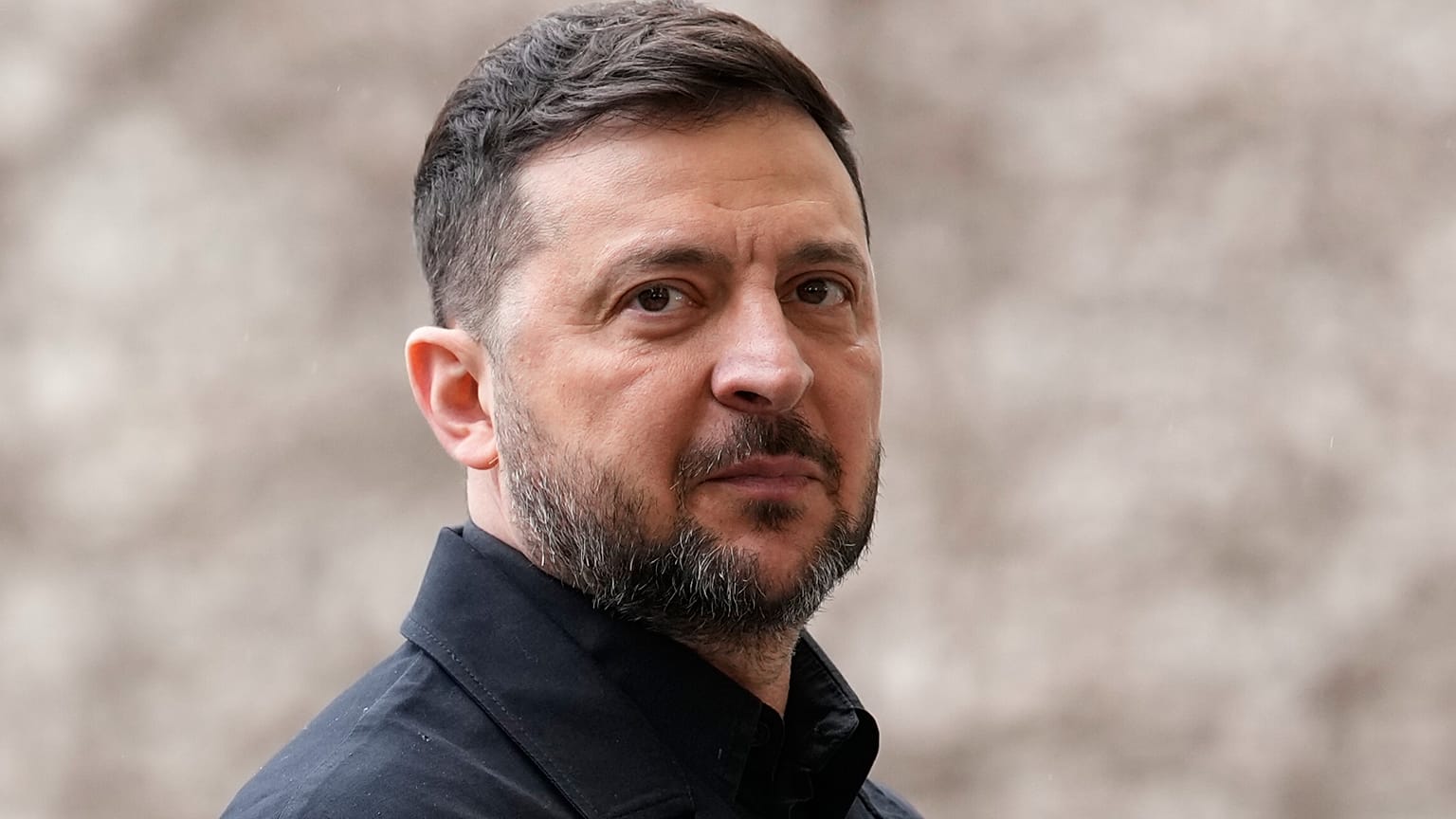
Ukraine's President Volodymyr Zelenskyy attends a welcome ceremony ahead of German-Ukrainian government consultations in Berlin Germany, Tuesday, April 14, 2026.
Copyright AP Photo
By Sasha Vakulina
Published on

The Ukrainian president said on Thursday that Kyiv will respond to all Russian attacks and that the morning strike on Moscow’s refinery — in response to Russia's attack on a UNESCO-protected cathedral earlier this week was “entirely justified.”

“If Putin does not want to end this war and wishes to continue it — we will not sit quietly, we will respond,” Ukrainian President Volodymyr Zelenskyy said in his comments on Ukraine’s strike on Moscow's oil refinery on Thursday morning.

“If Ukraine burns, so will Moscow," Zelenskyy said.

Ukraine’s president said Kyiv’s drone strike on the Moscow oil refinery is Kyiv’s response to Russia’s attack against the Kyiv-Pechersk Lavra, one of the most important historic and religious symbols of Ukraine.

“We were at the Lavra, and I said we will prepare a response and you will see it. I think you are seeing it now,” Zelenskyy said, insisting that all Kyiv wants is to end Russia’s war.

“We do not want this war and never have. Everyone knows this, and our partners know it too," he explained.

Zelenskyy also stressed that Moscow air defence — the strongest and most elaborate in the country — could not intercept Ukraine's drone attack, which he called “entirely justified”.

“As you can all see, regardless of the three rings of air defence that Moscow has in place, we have said that we will target them," he said.

Moscow oil refinery is one of the largest in Russia, supplying about 40% of the Moscow fuel market and the majority of the region's petrol.

It also provides aviation fuel to all four of Moscow's major airports and has a processing capacity of more than 12 million tonnes of crude oil per year, according to Ukraine's General Staff.

Speaking with the reporters in the presidential WhatsApp chat, Zelenskyy also called for increased pressure on Russia.

He argued that sanctions should target the country's energy sector, shadow fleet, oil and gas revenues, banking system, weapons production and defence industry “so that Russia realises there is no point in waging war. “

“The main thing is for the Russian people to begin to realise that it is just one man, Putin, who is waging this war, whilst it is the people who are paying the price for everything. “

This is why the pressure on Russia's leader Vladimir Putin should intensify from Ukraine, Europe and the US, Zelenskyy said.

“It is also time for the Russians to come to their senses and put pressure on their leader,” he concluded.


Ukraine strikes Moscow oil refinery for second time this week

Image of a reported attack on the Moscow region.
Copyright Andrey Vorobyov/Telegram

By Nathan Rennolds
Published on

It comes as Ukrainian President Volodymyr Zelenskyy met with NATO Secretary General Mark Rutte in Brussels.

Ukraine launched a wave of drone attacks across Moscow early on Thursday morning, as it continued to target the Russian energy industry.

In a series of posts on Telegram, Moscow mayor Sergey Sobyanin said air defences had intercepted 180 UAVS approaching the capital but that "several" had managed to strike a refinery in what he called a "massive" attack. It is the second time the refinery has been hit this week.

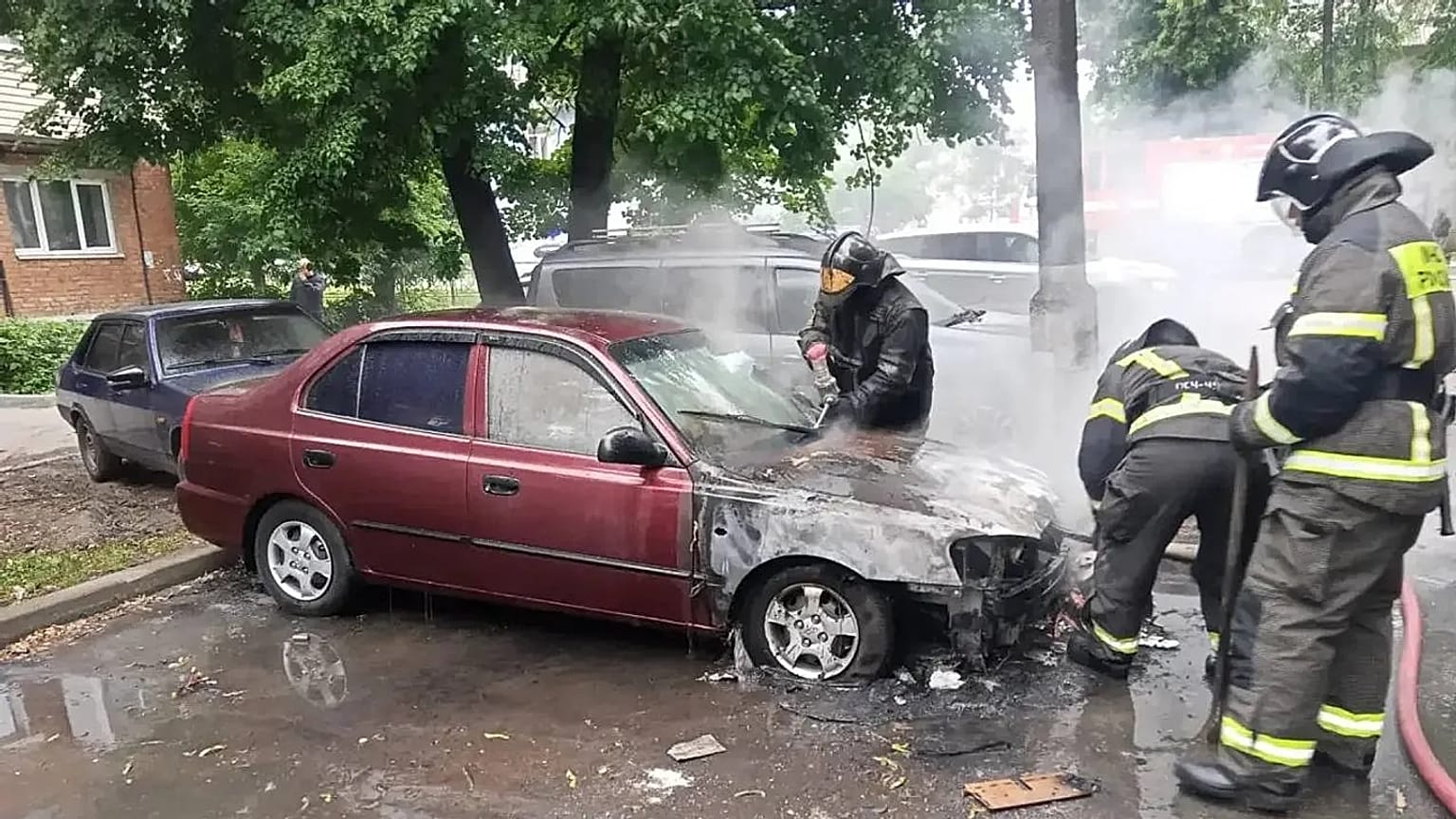
Video footage circulating on social media appears to show an enormous explosion and major fire at the scene. Emergency services are attending attack sites around the city, per Sobyanin.

Andrey Vorobyov, the governor of the Moscow region, said a fire caused by drone debris also broke out at a shopping centre in the southeast of Moscow and that another drone struck an apartment building in Zhukovsky, damaging part of a fire escape.

Ukrainian President Volodymyr Zelenskyy confirmed the attack on the refinery in a post on X, sharing a video appearing to show the aftermath of the strikes.

"Targets were also struck in the Rostov region and in temporarily occupied territories of Ukraine," he wrote.

Kyiv has stepped up strikes on Russian energy facilities in recent months in what Zelenskyy has described as a "just" campaign of "long-range sanctions" against Moscow.

Ukrainian forces have particularly targeted Russian oil facilities, including refineries, terminals and depots. Last week, Zelenskyy announced that his forces had struck the Kuibyshev refinery in Russia's Samara region, as well as two oil infrastructure facilities in the Vladimir region.

Russia carried out its own attack on the Ukrainian energy sector on Wednesday night, targeting an energy infrastructure facility in the Poltava region, per local authorities. Further strikes on an industrial facility and a business in the same region left one person injured, the Poltava Regional State Administration reported.

Zelenskyy said Russia used 1,920 attack drones, 1,790 guided aerial bombs, and 17 missiles against Ukraine last week.

It comes as the Ukrainian leader arrived in Brussels on Wednesday, where he met with NATO Secretary General Mark Rutte.

He said the pair discussed the NATO Prioritised Ukraine Requirements List (PURL), a procurement mechanism for Ukraine, as well as his talks with G7 leaders earlier in the week.

Zelenskyy had met with his G7 counterparts in France as he renewed his pleas for more air defense missiles and increased pressure on Moscow.

Zelenskyy said after the meeting that they had agreed on the "additional strengthening of Ukraine’s air defense" and new measures against Moscow.

Russian President Vladimir Putin is hosting leaders from across Southeast Asia this week at the ASEAN-Russia summit in Kazan.

Leaders from 11 countries including Cambodia, Thailand, Vietnam and Singapore will be attending the meeting, where they are expected to discuss strategic partnerships and potential new areas of political, economic and humanitarian cooperation.


Is Britain Becoming A War Economy? Russia, Ukraine And The Cost Of Confrontation – OpEd


President of Ukraine Volodymyr Zelenskyy with the United Kingdom’s Secretary of State for Defense, John Healey on January 9, 2026.
Photo Credit: Ukraine Presidential Press Service


June 17, 2026 
By Talal Nizameddin

The resignation of the Defense Secretary John Healey set in motion a string of resignations to pressure the government into major increases in military spending despite immense pressures on the British economy. This occurred within a week of the UK visit by Ukraine’s President Volodymyr Zelenskyy and ahead of a crucial G7 summit in France that announced more military support to the war effort.

While the resignation’s timing surprised many, the momentum has been building for years, fueled by a political culture that demands increased militarization that has placed Russia on top of the list of world enemies.

Russia’s President Vladimir Putin is an archetypal authoritarian ruler, if not autocrat, depending on how we perceive the system he rules over. Under him Russia has also become more militarized and more belligerent, picking up from the war on Chechnya he inherited when he first became president in 2000 to invade Georgia in 2008, occupy Crimea in 2014 as part of a wider encroachment on Ukrainian sovereignty, and finally launch a full-scale invasion against the country in 2022.

During that time Putin also sent troops to Syria to help fellow authoritarian Bashar Assad crush a popular rebellion with blood-curdling cruelty. Russia’s ultimately failed intervention in Syria was in many respects a turning point and dovetailed into Moscow’s concerns about the wider Arab Spring and the largest ever protests against Putin in Russia between 2011 and 2012. This marked Russia’s decisive pivot to the East and the point of no return with the West.


All this seems to validate British and Western belligerence towards, and isolation of, Russia and reconfirm the inevitability of war. A counter narrative suggests that Britain and the West carry a burden of guilt for pushing Russia and Putin to where they are now. Lest we forget that Putin was welcomed as a sober-minded partner in the 2000s after the excesses of the inebriated Yeltsin era.

Putin himself seemed to display every intention of joining the Western family. Russia was the first to extend support in the war against al-Qaeda in 2001, granting access to US bases in Central Asia in aid of Washington’s war on terrorism.

The US-led coalition invasion and occupation of Iraq in 2003 under deliberately false premises served to enhance the view in Moscow that the West cannot be trusted. For Putin and his security elite, this was never about Saddam Hussein but rather about control of the world’s energy supplies and to gain critical geostrategic advantage around Russia.

The Russian political elite came to consider the West as always speaking with a forked tongue. NATO expansion continued unabated since the 1990s, despite pleas and warnings from Moscow that Russia would have to respond. With the expansion came the establishment of military bases with defensive and offensive missiles that hugely undermined Russia’s ‘balance of terror’ capability that had kept the superpowers at bay for the decades of the Cold War.

Today, aside from Ukraine, an arc of countries from its Arctic northwest to its southern Black Sea are NATO members that reinforces Russia’s fear of strategic encirclement on its European front. Ukraine is the only remaining ‘outlet’ breaking the NATO chain. There is a widely circulated scene on social media of Putin’s extended laughter, he doesn’t laugh much, when a Western interviewer suggested that NATO’s military expansion towards Russia was really aimed at Iran.

Moreover, Russia has long been resentful and unconvinced by Western moralizing on human rights, which again has proven to be selective. One does not need to be a Russia sympathizer to observe how the country has been readily excluded from international cultural and sporting events while, controversially, other obvious ones in the spotlight have not.

A hopeful sign flickered when European leaders meeting in London in early June emphasized ‘deep and meaningful security guarantees’ for Ukraine, rather than explicitly insisting on NATO membership. The big three, Britain, France and Germany, are at a strategic crossroads given US fickleness exemplified by its current president and serious economic challenges.

But the continuation of the war in Ukraine may well define the character of Europe in the long run. The British economy is stuttering, with funds being diverted away from basic social services towards military spending.

The government has set a 5 percent of total GDP target exactly a year ago at the NATO summit in the Hague on security and defense that outpaces major domestic sectors and investments, including a net zero environmental target. The latest clash with the defense establishment is over Starmer’s hesitation in committing to a 3.5 percent government spending target to be front-ended at the expense of further cuts to core services. The other option is tax increases to fund defense, which comes with its own political and economic risks.

The time may have come to question the inevitability of eternal conflict with Russia and over Ukraine and whether the business of war has superseded pragmatic national security interests.

Countries that have been most vocal in their attack on Russia have been rewarded with billions of Euros and dollars, most recently a $51 billion package in SAFE loans to Poland primarily intended for defense.

When viewed from Moscow, populist newspapers particularly on the right such as The Mail and even TheTelegraph have been relentlessly stoking hostility towards Russia. The Sun in its true-to-form simplicity refers to the Russian President as Mad Vlad. Ostensibly moderate media have merely echoed the message. A recent article in The Independent authored by the controversial anti-Russia businessman Bill Browder, unabashedly incited and cheered for more confrontation and less diplomacy with Russia.


In response Russia has recoiled deeper and sought refuge in Asia. Russia’s hawks espousing the inevitable clash of civilizations model feel vindicated as politicians resolve to heal wounded cultural pride inflicted by Western rejection and haughtiness.

Putin has focused on cultivating relations with China, Turkey, Iran and other regional powers in Asia, with mixed results. More Russians, according to domestic polls, feel China and Asia as their more natural and trusted environment. Not unusual where Western hostile discrimination, sadly includes swathes of respectable academia, that considers allied Poles, Ukrainians and as bona fide Europeans and Russians as oriental Tatars.

Yet whether by design or folly, Europe and the US and their massively funded military and intelligence establishments seem not to have thought through simple scenarios for Russia after Putin, or what a transition period would look like in case of an internal collapse. Instead militarization is being normalized that is now encroaching on individual rights, as the government reviews laws to control social media and the right of protest.

The West can no longer boast the political, military, economic and yes, even cultural superiority it felt it enjoyed in the past. Economic decline is now a reality, especially for the young.

Without rewarding Russia’s invasion of Ukraine it is now time, more than ever, to rein in the war impulse and seriously recalibrate to plan for Russia to be, if not as potential partner, then at least a constructive member of the wider international community. The West needs a strong, stable Russia as much as it needs the West to rebuild fairer and more sustainable economies for the future of Europe.


About Talal Nizameddin
Dr. Talal Nizameddin is the author of "Putin and Eurasian Relations: Russia into the Shadows" (Routledge, 2026). He has written extensively on Russian foreign policy, Eurasian geopolitics and Middle Eastern affairs.
View all posts by Talal Nizameddin →


Moscow uses 'Russian Houses' in Africa to lure recruits into war in Ukraine, investigation shows

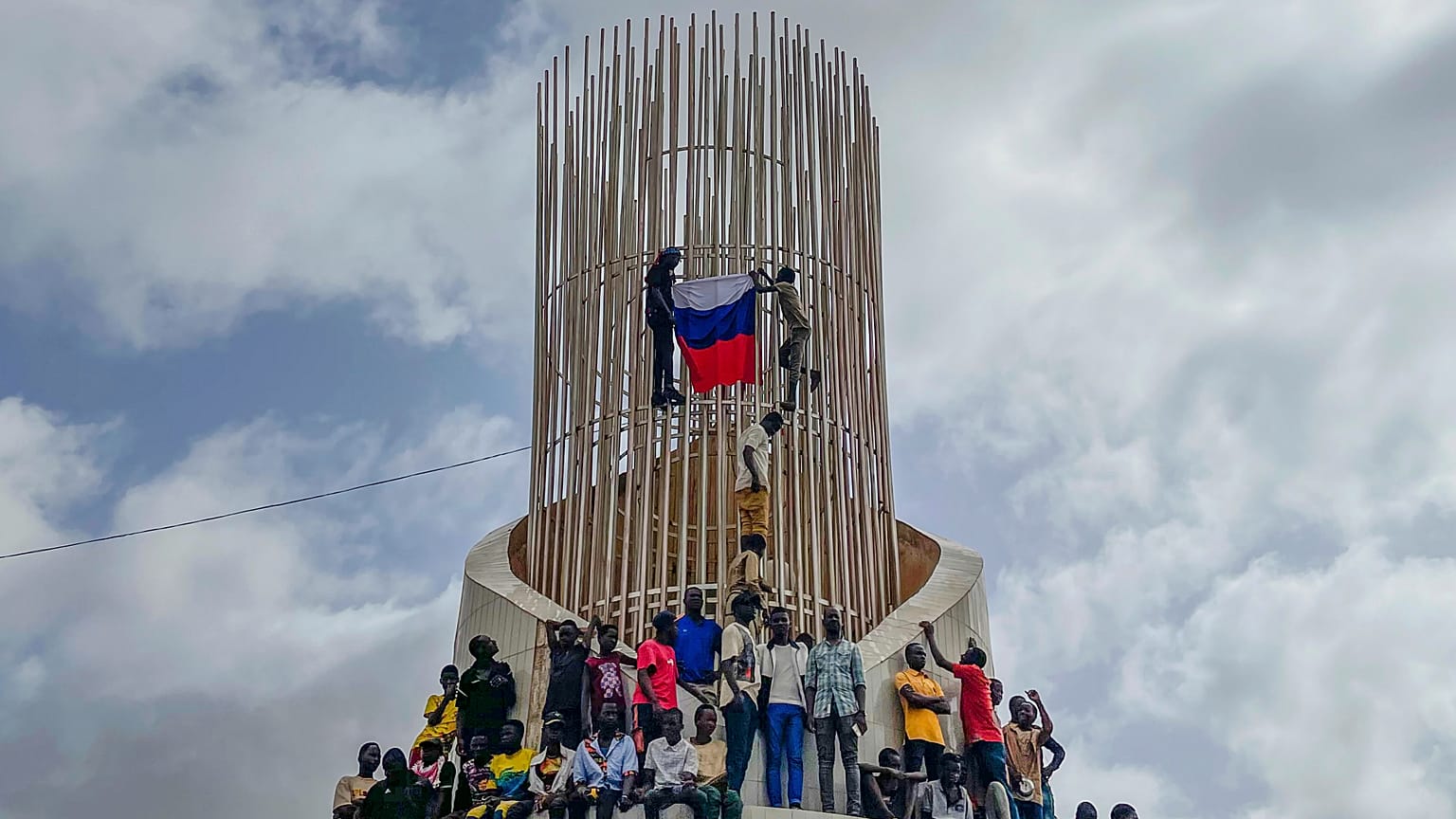
FILE - Supporters of Niger's ruling junta hold a Russian flag in Niamey, Niger, on Aug. 3, 2023.
Copyright AP Photo

By Sasha Vakulina & Aleksandar Brezar
Published on

Ukrainian military intelligence has revealed that Russia's expanding network of "Russian Houses" functions as a recruitment pipeline for its war, luring young Africans with promises of education and jobs before some are sent to the front lines or into drone factories.

Moscow is waging “a war for the minds” of Africans by rolling out a hybrid network of so-called "Russian Houses" in addition to arms supplies and direct military aid to military juntas in Africa, Ukraine’s military intelligence (HUR) revealed in its recent investigation.

According to earlier research, “Russian Houses” in Africa, targeting above all the youth, are already operating or opening in at least 22 countries, as part of Russia’s strategy to consolidate its influence on the continent.

HUR now revealed that Moscow is currently planning to open centres of influence in eight African countries: Nigeria, Senegal, Liberia, Sierra Leone, Togo, Mali, Mozambique, and São Tomé and Príncipe.

This is being carried out through Russia's federal cooperation agency, Rossotrudnichestvo, in collaboration with the Centre for Public Diplomacy (CPD), an organisation founded in 2024 with the stated aim of expanding the existing network, specifically targeting Africa.

The CPD’s official mission is to convey "accurate" information about Russia to Africans.

Brussels has sanctioned Rossotrudnichestvo, freezing its assets in July 2022 for spreading disinformation tied to the invasion of Ukraine.

Yet it has continued to expand its African footprint despite the penalties, operating more than 85 official branches abroad.

Ukraine's Foreign Intelligence Service said Russia allocated $1.85 billion (€1.6bn) for foreign propaganda operations in its 2026 federal budget, a 54% increase on the previous year — a sum exceeding the entire annual education budgets of several West African states.

What goes on inside Russian Houses in Africa?

According to available information, the centres screen Soviet and Russian films, often on patriotic themes, and distribute ideologically vetted literature.

They also teach the Russian language and coach young people on how to move to Russia as students or workers.

Organisers sell an image of a "happy Russia,” but according to HUR, in practice that promise often curdles: some recruits sign contracts with the Russian military and are sent straight to the deadliest parts of the front lines in Ukraine.

In 2025, then-head of Rossotrudnichestvo Yevgeny Primakov Jr announced that the government would fund more than 5,000 African students to attend university in Russia.

The educational opportunity is often the most salient motivator for locals to engage with the organisation.

Most strikingly, in January of this year, Primakov Jr himself publicly admitted that a "well-known African private military company" — widely understood to mean Wagner Group, rebranded as Africa Corps following the death of founder Yevgeny Prigozhin — had been directly involved in establishing Russian Houses in Mali and the Central African Republic, and that some of its members had since moved into formal Russian state positions.

Ukraine's Centre for Countering Disinformation described the admission as confirmation that the centres function as elements of hybrid operations rather than neutral cultural institutions.

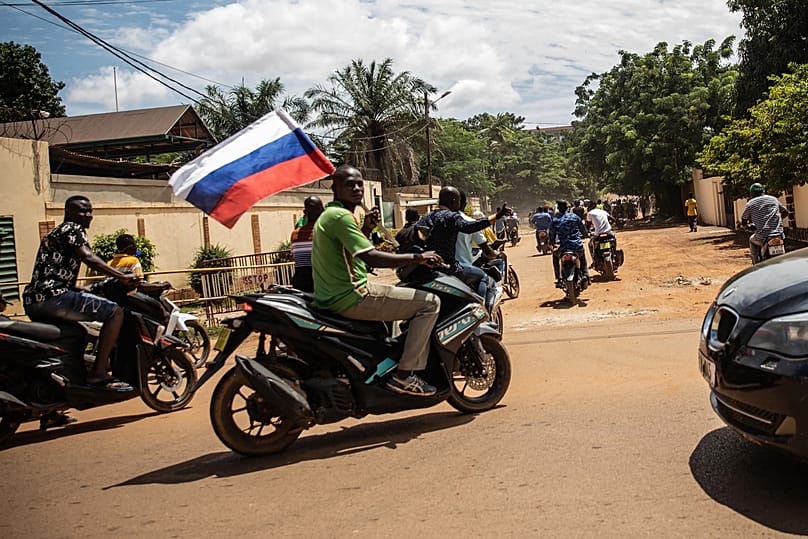
FILE: Supporters of Captain Ibrahim Traore parade wave a Russian flag in the streets of Ouagadougou, Burkina Faso, 2 October 2022
FILE: Supporters of Captain Ibrahim Traore parade wave a Russian flag in the streets of Ouagadougou, Burkina Faso, 2 October 2022 AP Photo

The Bangui Russian House in the Central African Republic is run by Dmitry Sytyi, a figure who also controls Wagner's operations in the country and reportedly uses the centre as a logistics hub for the group's gold, diamond and timber trafficking, according to media reports.

The expansion of Russian Houses has closely followed the rise of pro-Russian military juntas, particularly in West Africa: centres opened in Mali in 2022, Burkina Faso in January 2024 and Niger in October 2024, all following coups in which Wagner or its successor forces became the new regimes' primary security providers.

Wagner and Africa Corps, which is controlled by the Russian Ministry of Defence, are among the most ruthless armed groups on the continent and are directly implicated in mass civilian killings and other war crimes.

In April, three human rights organisations — TRIAL International, the Pan-African Lawyers Union and the International Federation for Human Rights — filed the first case of its kind before the African Court on Human and Peoples' Rights, seeking to hold Mali's government responsible for hosting and failing to prevent abuses by Wagner and its successor force.

Run by friends of Putin

Journalist and former Duma member Primakov Jr is the grandson of former Russian Prime Minister Yevgeny Primakov, who also served as head of the KGB First Chief Directorate, overseeing its transition to Moscow's foreign intelligence service, the SVR.

The elder Primakov was a staunch advocate of the theory of Russian supremacy and one of the main architects of the Kremlin's idea of multilateralism, a thin ideological veneer meant to act as a cover to Moscow's aspirations for control over former Soviet republics and elsewhere and a key cog of Russian President Vladimir Putin's influence machine abroad.

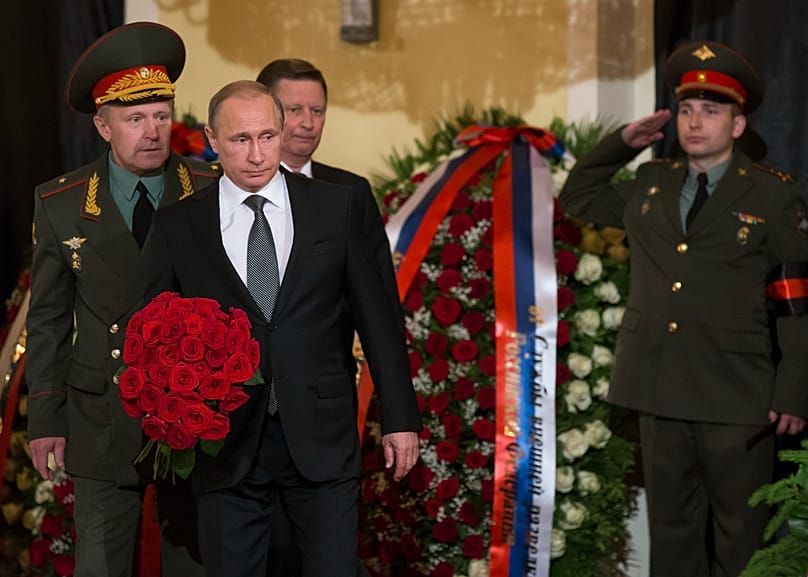
FILE: Russian President Vladimir Putin arrives to attend a civil funeral for former Russian Prime Minister Yevgeny Primakov, in Moscow's House of the Unions, 29 June 2015
FILE: Russian President Vladimir Putin arrives to attend a civil funeral for former Russian Prime Minister Yevgeny Primakov, in Moscow's House of the Unions, 29 June 2015 AP Photo

Primakov Jr has direct ties to Putin. He served as one of Putin's official "trusted representatives" during the 2018 presidential campaign and was elected to the Duma that same year on the ruling United Russia party's list before being appointed chief of Rossotrudnichestvo in 2020.

He is under EU, UK, Canadian and Australian sanctions for his role in promoting the annexation of occupied Ukrainian territories.

Putin dismissed Primakov Jr as head of Rossotrudnichestvo in April of this year, replacing him with Igor Chaika, son of Russia's former prosecutor general Yuri Chaika and a figure separately sanctioned by the US Treasury in 2022 for developing plans, reportedly with the assistance of Kremlin spokesperson Dmitry Peskov, to destabilise Moldova's pro-Western government, according to a report by think tank CEPA.

Igor Chaika and his elder brother Artem were the subject of Alexei Navalny's corruption investigation.

In a 2015 film, Navalny's foundation found that the two had used their father's position to amass fortunes through rigged state contracts, the seizure of a state-owned shipping company whose director was later found dead, and undisclosed property abroad, including villas in Switzerland and Greece.

Artem was placed under US Magnitsky Act sanctions in 2017 for using his father's position to "dishonestly obtain state property and state contracts." Yuri Chaika, who served as prosecutor general for 17 years, was never removed from office over the allegations and later joined Russia's Security Council as Putin's presidential envoy.

Recruiting Africans into Russian military

According to a report by the Danish Institute for International Studies (DIIS), Russian information warfare has expanded significantly in the Global South since 2022, particularly in Africa.

DIIS said Russia brands itself in Africa as an anti-colonial partner to sway political elites and publics through “regime survival packages," which include weapons, political advisors and influence campaigns

“Between June and September 2025, the number of Russian military service promotion posts aimed at foreigners on the platform VK increased from 621 to 4,600. This meant that by mid-2025, one in three contract announcements targeted foreigners, compared to only 7% in 2024," the DIIS report said.

According to the Washington-based Africa Centre for Strategic Studies, through a shadowy network of online recruiters, Russia has quietly assembled a pipeline funnelling thousands of Africans from nearly every country on the continent into the front lines and factories supporting Moscow’s war effort in Ukraine.

“These were not the destinations the young Africans thought they had signed up for. Many were looking for jobs, training, or opportunities abroad. Drawn by promises of life-changing salaries, they instead found themselves trapped in a war far from their home countries," the Africa Centre said.

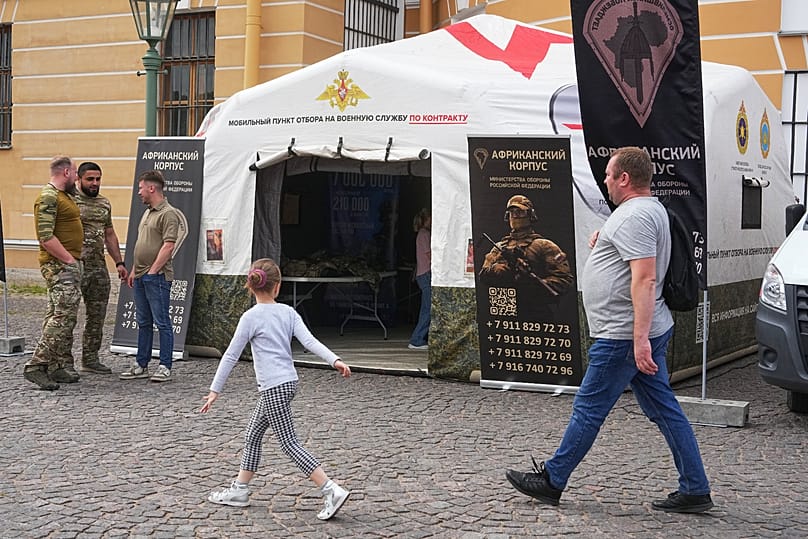
A child walks past a mobile recruiting centre in St Petersburg with a poster promoting contract military service in the African Corps, 12 June 2026
A child walks past a mobile recruiting centre in St Petersburg with a poster promoting contract military service in the African Corps, 12 June 2026 AP Photo

Misled by Moscow’s recruiters, some have been pressed into military service and forced at gunpoint toward the front lines, where casualty rates are exceptionally high, according to the Africa Centre.

Majority Leader of the Kenya National Assembly Kimani Ichung’wah testified in February that once they arrive in Russia, these recruits are “basically just given a gun to go and die."

Others have been trapped in drone factories, like the Russian Alabuga Special Economic Zone (ASEZ) in Tatarstan, a republic in the east-central part of European Russia.

ASEZ is a public-private industrial complex known first and foremost for producing Shahed-136 drones for Russia’s military.

DIIS revealed that Russian recruitment is also increasingly targeting young African women — Nigerian students in particular — to work in drone factories, including Alabuga, supporting Russia’s military war machine.

'Ideological weapon of slow-acting harm'

Ukraine’s military intelligence stated that with more Russian Houses opening in Africa, Moscow’s recruitment on the continent will only intensify.

The final goal, according to HUR, is “to cultivate an entire generation of ideologically loyal Africans in order to conceal its colonial exploitation of their countries while using people as a cheap source of military manpower”.

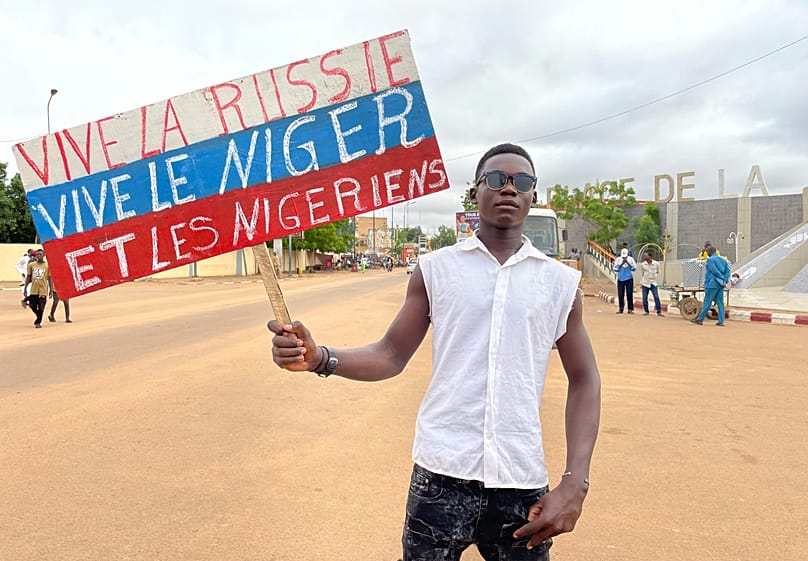
FILE: A supporter of Niger's ruling junta holds a placard in the colours of the Russian flag at the start of a protest in Niamey, Niger, 3 August 2023
FILE: A supporter of Niger's ruling junta holds a placard in the colours of the Russian flag at the start of a protest in Niamey, Niger, 3 August 2023 AP Photo

“An illustrative example is Sudan, where Kremlin-controlled groups polluted water resources with mercury due to predatory artisanal gold mining,” HUR said, pointing out that “pollution of this scale cannot be eliminated for years – it is an ecological weapon of slow-acting harm."

“The local population in this scheme is viewed solely as cheap labour – both at Russian enterprises within African countries, and at the factories in Russia itself, where Africans end up after ‘training’ in the 'Russian Houses.'”

How many Africans have already been recruited?

In April, HUR revealed the Kremlin's plans to recruit at least 18,500 foreign mercenaries to fight against Ukraine by the end of 2026.

Ukraine's Center for Countering Disinformation stated that Russian Houses serve as key hubs within this shadow recruitment infrastructure.

In June, Ukraine's Ministry of Foreign Affairs confirmed that at least 2,965 citizens from 36 African countries had taken part in combat on Russia's side.

Recruitment of Africans escalated in 2024, according to the Africa Centre, which stated that African recruits appear to be assigned to especially expendable battlefield roles.

This was backed by the testimonies of survivors and evidence found by investigators, both of whom showed that Africans were commonly used in high-risk assaults.

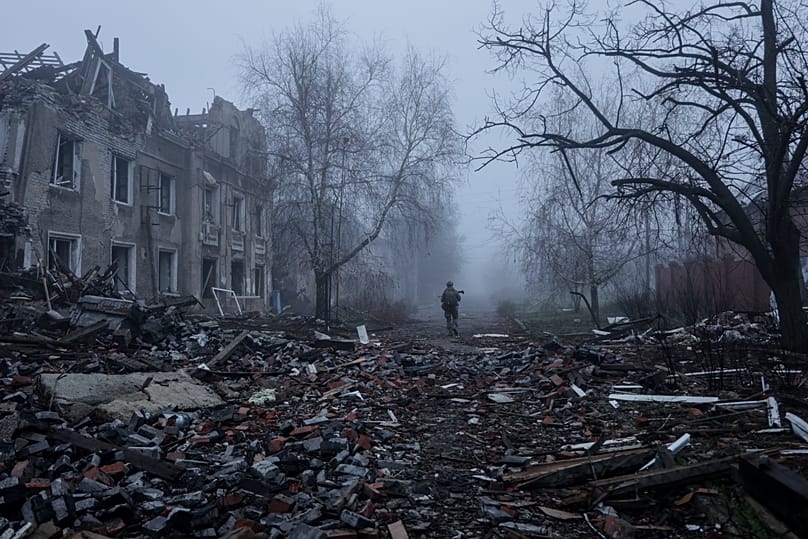
FILE: A Ukrainian soldier goes along a street in the frontline town of Kostyantynivka, the site of heavy battles with the Russian troops in the Donetsk region, Ukraine, 28 Nov
FILE: A Ukrainian soldier goes along a street in the frontline town of Kostyantynivka, the site of heavy battles with the Russian troops in the Donetsk region, Ukraine, 28 Nov AP Photo

Not every expansion attempt has succeeded. In September 2024, authorities in Chad arrested Russian operatives immediately after the opening ceremony of a planned Russian House in N'Djamena, having already detained two others at the airport days earlier, a rare instance of government intervention against Russia's attempts to harden its presence.

Separately, an investigation published in Nigerian outlet TheCable identified 272 Nigerian nationals who had enlisted through associated channels, of whom 55 were reported dead. Russian Ambassador to Nigeria Andrey Podyelyshev dismissed reports of recruitment through these channels as "misleading" in February.

Several African states, including Kenya, Ghana and Nigeria, have repeatedly demanded explanations from Moscow and called for an end to the illegal recruitment of their citizens, but the Russian foreign ministry has continued to ignore those demands**.**

When asked about Russia’s deceptive recruitment of Africans for Moscow’s war in Ukraine, Peskov denied involvement, stating in May that “We are unaware of any such cases.”

 

Poland arrests suspect in killing of Russian artist critical of Putin, PM Donald Tusk says

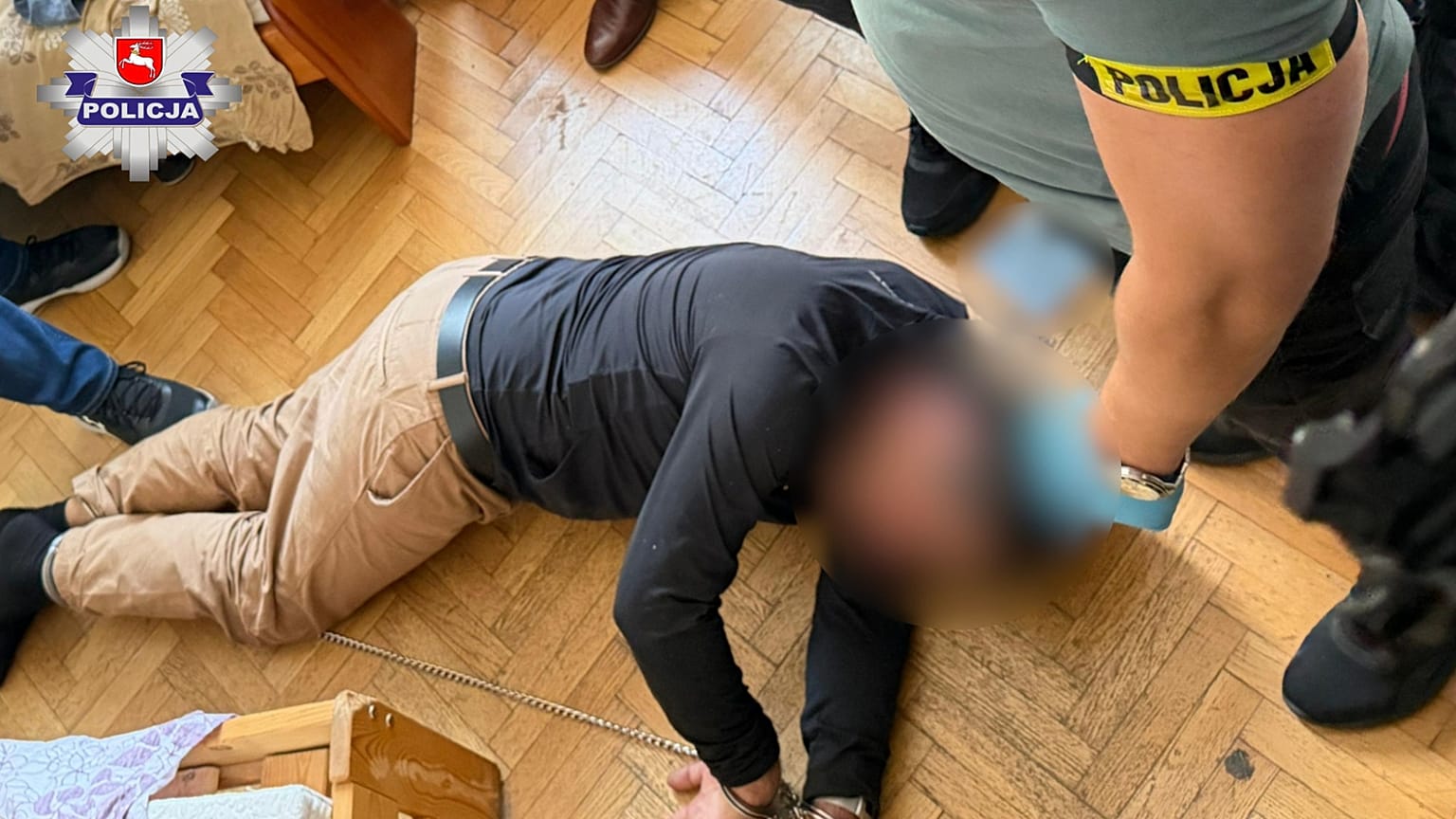
Police arrest a man suspected of links to the shooting of Russian artist Semyon Skrepetsky near Warsaw, 18 June, 2026
Copyright https://x.com/PolicjaLubelska

By Katarzyna Kubacka & Gavin Blackburn
Published on

Since it launched its full-scale invasion of Ukraine in 2022, Russia has been accused of trying to assassinate its opponents abroad, including targeting exiled activists in France and Lithuania.

Polish police have arrested a man suspected of participating in the murder of a Russian artist critical of President Vladimir Putin, Prime Minister Donald Tusk said on Thursday.

The suspect in the daylight murder, which took place on Monday, "is using a Georgian passport," Tusk wrote in a post on X.

"Services are working to establish the mastermind," he added.

Interior Minister Marcin Kierwiński confirmed the Georgian passport at a news conference in Warsaw and said the suspect is 36 years old.

Kierwiński said the man is suspected of links to organised crime and is being linked by police to other crimes committed in Poland, including some dating to 2022.

“We consider it possible that foreign intelligence services may have been involved,” said Tomasz Siemoniak, Poland’s security services minister, who spoke at the press conference alongside the interior minister.

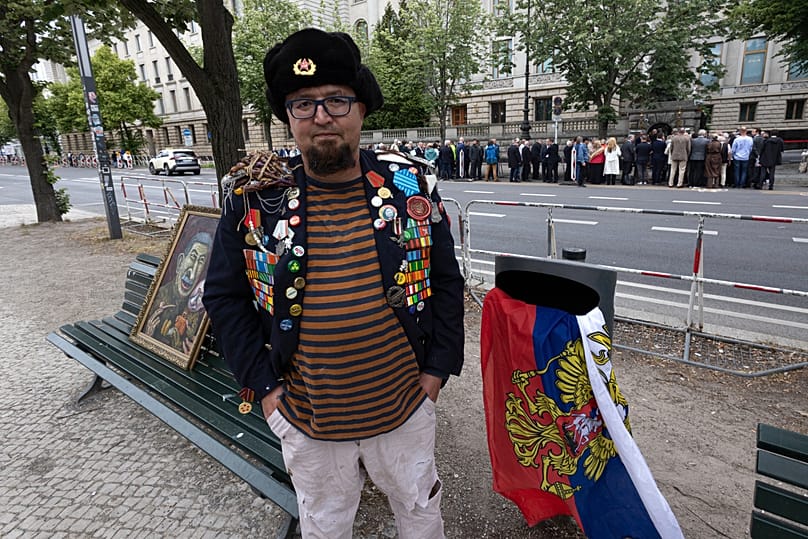
Semyon Skrepetsky poses for a photo with one of his paintings near the Russian Embassy in Berlin, 12 June, 2026
Semyon Skrepetsky poses for a photo with one of his paintings near the Russian Embassy in Berlin, 12 June, 2026 AP Photo

“Foreign services sometimes hire criminals to carry out operations. We have seen this in previous years. While those cases did not involve murder, criminals were hired to conduct assaults in other countries. We are therefore taking this possibility very seriously,” Siemoniak said.

Semyon Skrepetsky, whose real name is Robert Kuzovkov, was fatally shot three times by an unidentified man armed with a handgun in Biała Podlaska, eastern Poland, according to officials.

When the artist fell to the ground, he was approached by the assailant, who fired two more shots at close range.

Tusk said on Wednesday the artist's death was probably a "political murder."

"If it was commissioned by Russia, then this is also a very serious matter with an international dimension," he continued.

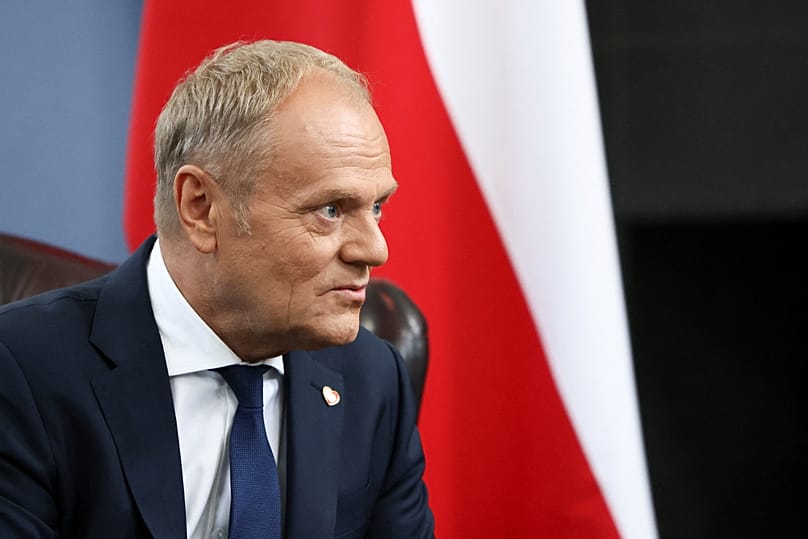
Poland's Prime Minister Donald Tusk at RAF Northolt near Uxbridge, 27 May, 2026
Poland's Prime Minister Donald Tusk at RAF Northolt near Uxbridge, 27 May, 2026 AP Photo

The Polish government says it offered Skrepetsky protection in the past, which he declined.

Two Belarusian citizens were detained in connection with the artist's death but they have since been released.

Skrepetsky was known for his sometimes provocative caricatures, which targeted prominent Russian political figures, ranging from Putin and Soviet leader Joseph Stalin to opposition figure Alexei Navalny and head of the Chechen Republic, Ramzan Kadyrov.

One of his best-known works reinterprets a classical Orthodox icon, depicting Stalin cradling Putin in place of the Virgin Mary holding the infant Jesus.

Skrepetsky moved to Poland in 2021, saying he feared political persecution in Russia.

In exile, he attended Russian opposition events while openly criticising the opposition itself.

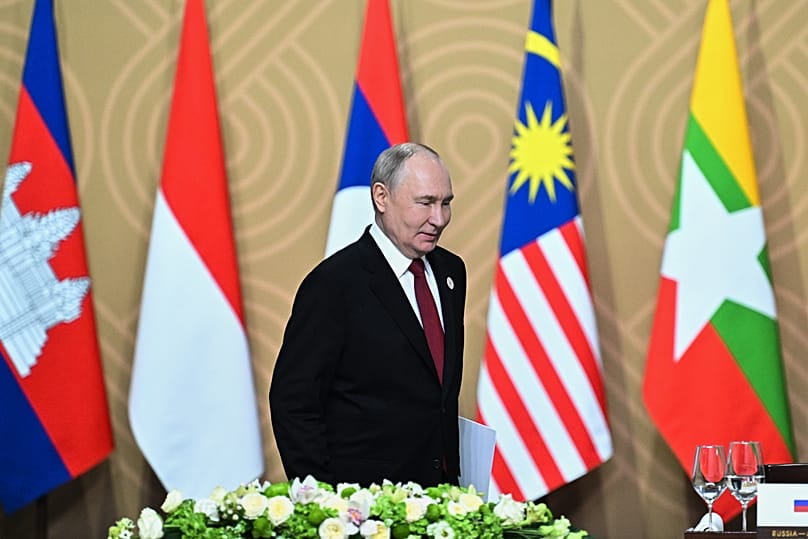
Russian President Vladimir Putin attends the Russia-ASEAN summit in Kazan, 18 June, 2026
Russian President Vladimir Putin attends the Russia-ASEAN summit in Kazan, 18 June, 2026 AP Photo

Since it launched its full-scale invasion of Ukraine in 2022, Russia has been accused of trying to assassinate its opponents abroad, including targeting exiled activists in France and Lithuania.

Officials in Germany have also broken up plots targeting the head of a German weapons supplier to Ukraine and a Ukrainian military official.

Moscow has denied any involvement in these attacks.