Saturday, August 01, 2026

Cameco Announces IPO Plan For Westinghouse


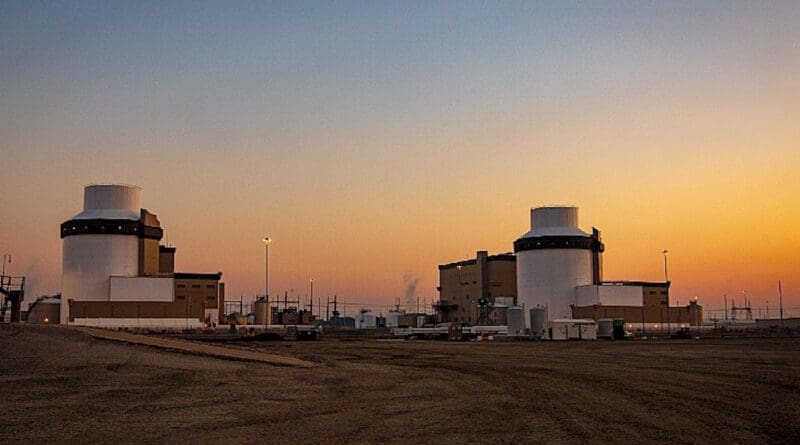
The plan is for Vogtle 3 and 4 to be joined by many more AP1000s in the US (Image: Westinghouse)

August 1, 2026
World Nuclear News


Key Takeaways:

Westinghouse Electric Company, jointly owned by Cameco and Brookfield, has confidentially filed for an initial public offering of its common stock, though share numbers and pricing remain undetermined.

The company reports a strong global pipeline of 91 potential AP1000 reactors totaling about 105 GWe, spanning the US, Europe, Canada, India, Saudi Arabia and other markets, with deployment windows from the mid-2030s onward.

Cost and construction timelines are projected to improve significantly with repeated builds: overnight capital costs could fall from $20–26 billion per near-term unit to $14–17 billion for “Nth-of-a-kind” projects, while build times shorten by 20–30%.


Westinghouse Electric Company, which is owned jointly by Cameco and Brookfield Renewable Partners, has confidentially submitted a draft registration statement relating to a proposed initial public offering of its common stock.

Announcing the registration ahead of its quarterly results call, Cameco said the number of shares to be offered and the price range for the proposed stock market offering have not yet been determined, and said the proposed offering would be subject to market and other conditions.

Westinghouse, which supplied the world’s first commercial pressurised water reactor (PWR) in 1957 in Shippingport, Pennsylvania, is one of the world’s largest nuclear services businesses. A strategic partnership of Cameco Corporation and Brookfield Renewable Partners acquired the company for a total enterprise value of approximately USD8 billion in a transaction completed in 2023: Westinghouse had previously been acquired out of bankruptcy by Brookfield Business Partners in 2018. Currently, Cameco owns a 49% interest and Brookfield owns the remaining 51%.

Speaking during Cameco’s results call, CEO Tim Gitzel said the company was “extremely limited” in what it could say under US Securities and Exchange Commission rules about the initial public offering (IPO). Nevertheless, the Westinghouse business segment featured heavily in Cameco’s quarterly results call, and its management’s discussion and analysis (MDMA) document for the quarter which ended on 30 June.

Westinghouse’s technology platform operates across the nuclear power value chain, Cameco said in its quarterly update, with 57% of the global operating fleet of 417 reactors using its technology, making it “one of the most strategically important franchises in the global nuclear power industry” with “growing global opportunities for its technologies”.

The MDMA documents a pipeline of deployment opportunities for 91 potential AP1000 reactors totalling some 105GWe across its global markets. These include: up to 10 units supported through American Nuclear Supply Chain Loans announced by the US Department of Energy earlier this year, with a commercial operation timeframe by the mid-2030s; up to 10 further US units supported through the strategic partnership between Cameco, Brookfield and the US Department of Commerce announced in 2025, for commercial operation by the mid-to-late 2030s; the resumption of the two-unit VC Summer project, for commercial operation by the early-mid 2030s; three units at Lubiatowo-Kopalino in Poland, for operation in the mid-2030s; two units each in Bulgaria (Kozloduy units 7 and 8) and Ukraine (Khmelnitsky units 5 and 6), for commercial operation by the mid-to-late 2030s; 11 units described as “FEED-Stage Projects” (FEED is front-end engineering and design) in the Netherlands, Slovenia, Finland/Sweden, and the USA, with a late-2030s timeframe; and up to 51 units in Canada, India, Saudi Arabia, Slovakia, the USA, and “other European countries”, with a deployment timeframe of late 2030s-early 2040s.

This list is ordered in terms of how close those opportunities are to final investment decisions, said Dominic Kieran, Global Managing Director of Cameco UK who is also the chair of Westinghouse’s Board of Directors. For those countries and projects further down the list, “it’s not that we see them as lower probability, it’s just that we see them as slightly earlier in the process of getting to final investment decision”, said Kiearn. For a “couple” of those, “we are seeing very, very strong recognition of need for nuclear in baseload energy generation”, he added.

Economic benefits

The MDMA includes illustrative economics for reactors deployed in the near term versus so-called Nth-of-a-kind deployments – that is, after five deployments of two reactor units located on a single project site for a total of 10 units, and a sustained demand of at least two reactor units per year, is achieved.

The nuclear construction period – from first nuclear concrete to commercial operation – is estimated as around 66 months per unit for near-term deployments, reducing by 20-30% for Nth-of-a-kind deployments. Meanwhile, the overnight capital costs decrease from USD20-26 billion for near-term deployments to USD14-17 for Nth-of-a-kind.

With a complete reactor design – AP1000s are in operation, Westinghouse is well positioned for the procurement aspects of new projects, and few bottlenecks are perceived around construction, Kieran said, adding that while, “certainly not without risks” the company has been “prudent” in its assessment.

Cameco President and Chief Operating Officer Grant Isaac spoke to the significance of the US government funding, including the importance of securing long-lead items to support construction projects. A standardised design, sequential construction projects, and “simplifying” projects – not by changing designs but by incorporating lessons learned – is the key to get to Nth-of-a-kind as quickly as possible, he added. “Nobody needs to fear nuclear new build – in fact, we need to embrace it,” he said.


About World Nuclear News

World Nuclear News is an online service dedicated to covering developments related to nuclear power. Established in 2007, WNN has grown rapidly to welcome over 40,000 individual readers to the website each month, while its free daily and weekly emails both reach more than 16,000 people. These figures represent a broad audience that includes not only nuclear professionals but also journalists, researchers, opinion leaders, policy-makers, and the general public.
View all posts by World Nuclear News →


Wind and solar overtake fossil fuels in Germany for the first time ever

Wind and solar overtake fossil fuels in Germany for the first time ever
Carbon Brief's analysis of Energy Institute data shows renewables generated 225 TWh in 2025 against 217 TWh from fossil fuels — a milestone Germany shares with the EU as a whole, even as it leans harder on renewables than neighbours to compensate for its nuclear phaseout. / bne IntelliNewsFacebook
By bne IntelliNews August 1, 2026

More of Germany's electricity came from wind and solar power than from fossil fuels for the first time ever in 2025, according to Carbon Brief's analysis of Energy Institute Statistical Review of World Energy data. Wind and solar together generated 225 terawatt hours (TWh) of electricity, 44% of the total, against 217 TWh (43%) from fossil fuels – a milestone Germany shares with the EU as a whole, which also saw wind and solar overtake fossil-fuel generation for the first time in 2025.

The shift reflects two decades of rapid growth in solar and onshore wind under Germany's "Energiewende" strategy, as the country transitions away from both coal and nuclear power. Germany aims to install 115 gigawatts (GW) of onshore wind by 2030, and approved a record 20.8 GW of new capacity in 2025 alone. Official targets require economy-wide net-zero emissions by 2045, an 80% renewables share of electricity consumption by 2030, and a "largely climate neutral" power system by 2035.

Germany has to lean on renewables harder than neighbours such as France and the UK to hit those goals, precisely because of its nuclear phaseout – a core plank of the Energiewende that remains politically settled despite recent pushback. Centre-right Chancellor Friedrich Merz described the phaseout as a "strategic mistake" earlier this year, but his government has ruled out returning to conventional nuclear power. Coal remains the bigger near-term challenge: Germany still relies on it far more than most other European countries, with an official phaseout deadline of "no later than" 2038, though experts believe the country is on track to eliminate coal from its power supply years ahead of that date despite pressure during the recent energy crisis to slow the transition.

Renewables now face a different kind of opposition, however: mounting resistance from the far-right Alternative for Germany (AfD), even as the current coalition simultaneously pursues new gas-fired power plants of its own – legislated as a bridge technology, with the plants intended to convert to run on green hydrogen by 2045 to stay consistent with the climate-neutrality target. Very few voices outside the AfD are calling to scrap the coal phaseout altogether, but the government is due to publish a review of its timelines in August, which will be the next test of how firmly Berlin intends to hold the line.

Europe enters the Pyrocene age of fire that makes its own weather

Europe enters the Pyrocene age of fire that makes its own weather
The Bordeaux wildfire that forced 300,000 evacuations has produced France's first recorded pyrocumulonimbus cloud — a fire so intense it generates its own thunderstorms, lightning and winds that spread the blaze further. / bne IntelliNewsFacebook
By bne IntelliNews July 31, 2026

FEATURE | Europe/Climate | Environment | July 30, 2026

"The Pyrocene is here," climate researcher Peter Dynes wrote on X on July 28, as wildfires near Bordeaux began generating huge pyrocumulus clouds intense enough to create their own weather – winds and lightning capable of igniting new fires. "An era where fires don't just respond to the weather; they help create it," he wrote.

The Gironde region fire has since been confirmed as France's first recorded pyrocumulonimbus event: a fire cloud that develops when an intense blaze releases enough heat to send a rapidly rising column of hot air, smoke and moisture into an unstable atmosphere, building into a full thunderstorm cloud reaching up to 50,000 feet. These clouds generate their own lightning and violent surface winds, making the fire's behaviour erratic and unpredictable – lightning strikes from the cloud can ignite entirely new fires kilometres from the original blaze, while the winds it produces can drive the fire in directions firefighters did not anticipate.

The scale of the response reflects the scale of the danger: more than 300,000 people have been evacuated across the Gironde region and into Western Madrid as the fire spread across the border, with nearly 2,500 firefighters, 1,500 military personnel and around 1,200 police deployed to contain it. Temperatures near 38C have continued to fan the flames even as crews battle the blaze on the ground.

Pyrocumulonimbus clouds are not new – they have been documented in Canadian and Californian wildfires for years, most famously during Australia's 2019-2020 "Black Summer" – but a first recorded case in France marks the phenomenon's arrival in a part of Europe not previously associated with fire behaviour this extreme. The term "Pyrocene" itself, coined by environmental historian Stephen J. Pyne in 2015, describes a proposed new epoch defined by the growing role of human-influenced fire in shaping the planet – an alternative, fire-centred lens on the same period usually called the Anthropocene.

The Bordeaux fire is a data point for that argument rather than proof of it: one pyrocumulonimbus event does not establish a trend on its own. But it fits a pattern of increasingly extreme fire behaviour recorded in Canada, the western US and Australia over the past decade, now reaching a French wildfire for the first time – a reminder that a hotter, drier climate does not just make fires bigger, it can change the physics of how they behave.

 TACO


Trump Appears To Backtrack, Says US Should Be ‘Careful’ About Granting Ukraine Patriot License


Test firing of a US Patriot missile. Photo Credit: Jason Cutshaw, U.S. Army Space and Missile Defense Command

August 1, 2026
RFE RL

Key Takeaways:

President Trump said the United States must be “very careful” about granting Ukraine a license to produce Patriot missiles, stating that his administration has not yet agreed to share the technology despite ongoing discussions.

Ukrainian President Zelenskyy continues to press for stronger air defenses as Russian ballistic missile attacks intensify, while both sides remain far apart on the terms of any negotiated end to the war.

Ukraine has stepped up deep drone strikes inside Russia, targeting energy and logistics sites including multiple warehouses of the online retailer Wildberries, disrupting a portion of the company’s capacity.

President Donald Trump said the United States should be “very careful” about granting Kyiv a license to produce Patriot missiles as Ukraine seeks greater air defense capabilities to protect itself against Russia’s daily air attacks.

“These weapons are incredible. We have to be very careful about letting somebody build them,” Trump told journalists at a Cabinet meeting at Camp David on July 31, adding that his administration “have not agreed” to that yet.

“We’re talking about it. But it’s a hard thing to give away that kind of technology,” he said.

The US president’s comments came as Ukrainian President Volodymyr Zelenskyy returned to Kyiv from Washington, where the two leaders had discussed the possibility during what was described as a “good” meeting at the White House.

In recent weeks, Zelenskyy has urged Washington and Kyiv’s European allies to bolster the country’s air defenses amid escalating Russian ballistic missile attacks and help the country prepare for yet another harsh wartime winter.

Moscow has long targeted Ukraine’s energy infrastructure during the coldest months, leaving thousands of people without heat or electricity in freezing temperatures.

Writing on Telegram on July 31 after a phone call with US Vice President JD Vance, Zelenskyy said that “as Russia’s air attacks on our country continue unabated, air defense — specifically Patriot interceptors against ballistic missiles — remains a top priority.”

Reporting from the Ukrainian village of Radushne in the Dnipropetrovsk region on the same day, RFE/RL’s Ukrainian Service captured local residents mourning members of a family that had been almost entirely wiped out by a shocking Russian missile attack the previous day.


“This is an enormous tragedy for all of us, for our entire community,” a neighbor of the family named Luchia said, as six of the family’s 10 members were killed when the missile destroyed their home.

The White House has increasingly sought a negotiated solution to end the war in Ukraine since early 2025, when Trump took office. However, despite a number of meetings held over the past year, Kyiv and Moscow remain far apart in their negotiating terms.

As Kremlin is sticking to its hard-line position, demanding, among other things, full control over Ukraine’s key eastern Donetsk region, during July 31 meeting at Camp David, Trump said both sides “are going to have to make concessions” to end more than four-year-old war.

At the same time, trying to shift the initiative at the battlefield to its side, Ukraine has in recent months stepped up its deep strikes on energy and military infrastructure inside Russia, attacking facilities up to 1,000 kilometers from its border.

On July 31, Ukrainian drones continued to attack targets in Russia, including additional facilities belonging to the country’s largest online retailer, Wildberries, with regional officials and monitoring channels on Telegram reporting strikes in at least two regions.

The retailer said the strikes sparked a fire at its warehouse in the Volgograd region, reporting no injuries following the attack.

Another attack on a Wildberries facility was reported in Zelenodolsk in Russia’s oil-rich Republic of Tatarstan. According to the videos published online, the strike caused minor smoke, but no large-scale fire broke out.

Local residents also reported explosions in Kazan, the capital of Tatarstan, while the republic’s authorities said temporary restrictions had been imposed at airports in the region amid a drone alert, adding no damage or casualties had been reported.

In recent weeks, Ukrainian forces have struck at least 13 Wildberries warehouses across multiple Russian regions amid claims that the company is used to transport military-related goods.

Media reports estimate the Ukrainian drone campaign may have disrupted roughly 10 percent of Wildberries’ total warehouse capacity, potentially affecting the retailer’s logistics network across Russia.


About RFE RL
RFE/RL journalists report the news in 21 countries where a free press is banned by the government or not fully established.
View all posts by RFE RL →


America's missile shield is running low just as Ukraine asks for more

America's missile shield is running low just as Ukraine asks for more
CSIS estimates US Patriot and THAAD interceptor stocks have fallen by a third and a half respectively since the Iran war began, prompting a record $58.6bn Lockheed contract — even as Boeing refuses Kyiv a licence to build its own. / bne IntelliNews
By bne IntelliNews July 31, 2026

A renewed Iran war would test already-diminished US interceptor inventories, the Center for Strategic and International Studies (CSIS) warned in a July 27 analysis by Mark F. Cancian and Chris H. Park, as combat operations since a ceasefire collapse have drawn further on stocks that were already stretched by the war's first phase.

The story of how those stocks got this low, and what Washington and its allies are now doing about it, runs through three linked developments over the past week.

The depletion: a third of Patriots, half of THAAD

CSIS estimates the US now holds roughly 759-827 Patriot interceptors and 234-278 THAAD interceptors, down from about 2,330 and 452 respectively before the war — a fall of around a third for Patriot and roughly half for THAAD. "The air defense campaign has been largely successful with high — though not perfect — interception rates," CSIS found, but sustaining that rate has required extensive use of interceptors even as Iranian launches have continued at a lower rate than before the ceasefire. Replenishing high-end stocks at this scale could take years, CSIS and outside analysts warn, despite expanded production efforts, leaving limited capacity for other contingencies if demand stays high.

The US Army has awarded Lockheed Martin (NYSE: LMT) a contract worth up to $58.6bn to produce PAC-3 MSE interceptors, converting an earlier one-year, $4.7bn deal into a seven-year procurement plan covering fiscal years 2026-2032, Reuters reported. Lockheed says the funding will let it triple PAC-3 MSE production capacity by the end of 2030 and grow headcount at its Camden, Arkansas plant by half, to around 1,850 jobs from 1,200; the company is investing a further $8bn-9bn through 2030 to modernise more than 20 US facilities, including new munitions centres in Alabama and Arkansas.

Even as it rebuilds its own stockpile, Boeing (NYSE: BA) — which manufactures the PAC-3 seeker head — has refused to license Ukraine to produce the component itself, Die Welt's Christoph Wanner reports. The Ka-band AESA seeker is the central bottleneck in the whole system, and Boeing needs around seven years to triple its own output even with expansion under way; building a full Ukrainian supply chain, factories and licences from scratch would take longer still.

The refusal leaves Kyiv's own request — 300 Patriot missiles before winter, which President Volodymyr Zelenskiy has raised directly with President Donald Trump — competing for a supply that Washington itself is now racing to rebuild for its own coalition commitments in the Gulf.

Russia begins mass production of cheap, upgraded Banderol cruise missile

Russia begins mass production of cheap, upgraded Banderol cruise missile
Ukraine's military intelligence says the 2026-model missile is faster and harder to intercept, and is now being fired from ground launchers in Crimea as well as drones and helicopters. / bne IntelliNewsFacebook
By bne IntelliNews August 1, 2026

Russia has begun mass production of its cheap but powerful Banderol cruise missile, with the 2026-model variant modernised and significantly different from the 2025 version, Ukraine's Main Intelligence Directorate (GUR) said.

The S8000 Banderol, developed by sanctioned defence contractor Kronstadt, reportedly carries a 150 kg warhead, flies 350-450 km and reaches speeds of 550-600 km/h.

The missile, which began development in 2021, is the latest addition to the Russian army as both sides are engaged in a drones arms race seeking to improve their cost-to-kill ratio by producing ever more cheap drones that have taken over the battlefield.

Russia’s workhorse Geran-2 drone, based on the Iranian-designed Shahed-136 loitering munition, have also had an upgrade to the Geran-4 and Geran-5, which are jet propelled and so fast they can evade Ukraine’s new class of interceptor drone. It is also faster and much more accurate Kh-101 cruise missiles, said Vladyslav Vlasiuk, President Volodymyr Zelenskyy’s commissioner for sanctions policy Bloomberg reports.

“This is a very dangerous gizmo,” Vlasiuk told journalists as he showed off part of a Banderol fired last year. “The majority of strikes on the port infrastructure in Odesa are with Banderols.” Vlasiuk said 80% of the strikes on the Greater Odesa port are made using this missile.

The speed of the Banderol is also the main problem for Ukrainian air defence: interceptor drones cannot catch the missile, and Ukraine lacks sufficient numbers of dedicated anti-aircraft missiles to bring it down instead. The Banderol was originally launched only from Orion medium-altitude drones and Mi-28 helicopters; it is now also being fired from ground-based launchers stationed in occupied Crimea.

The missile is also cheap, costing around $150,000-$300,000 each and relies on repurposed Chinese civilian mini jet engines. Ukraine estimates Russia is producing hundreds of Banderols per year, but production could be slowed if sanctions are tightened.

GUR has previously said 2025-built Banderol samples contained components sourced from the US, China, Japan, Switzerland, South Korea and Australia – a supply chain that continues into the 2026-model missile and points to persistent gaps in sanctions enforcement even as Moscow scales up output.


COMMENT: Ukraine's refinery campaign is turning oil into Russia's weakest economic link

COMMENT: Ukraine's refinery campaign is turning oil into Russia's weakest economic link
Riddle Russia's Vakhtang Partsvania argues that Kyiv's shift from export terminals to refineries has found the one part of Russia's oil sector that sanctions alone could never touch: domestic fuel supply. / bne IntelliNewsFacebook
By bne IntelliNews August 1, 2026

Ukraine's long-range drone campaign against Russia's oil industry is simultaneously hitting three sensitive areas of the war economy at once: fuel production, domestic logistics of petroleum products, and fiscal stability, Vakhtang Partsvania argues in a comment for Riddle Russia.

The strikes have not collapsed the oil sector as a whole and have not cut off Russia's export revenues – but they have shifted the structure of the losses, forcing Russia to export more crude instead of refining it domestically, at the cost of value added, regional fuel shortages, rising gasoline prices, accelerating inflation and ever more expensive compensatory budget payments.

The pivot point was the strike on the Moscow Refinery in Kapotnya, one of Russia's largest plants with annual capacity of around 11mn tonnes of crude. The Moscow region accounts for 14% of Russia's passenger cars – 7.4mn of 53mn nationwide – handles 19% of the country's road freight, and its aviation hub carries roughly 40% of Russia's passenger air traffic; a prolonged shutdown there is as much a logistics problem as a production one, since even fuel sourced from elsewhere must still reach the capital through an already-strained transport network.

"Russia's oil sector had long been considered one of the most resilient parts of the economy," Partsvania writes. "Strikes on refineries, however, exert a different kind of pressure. Sanctions reduce export margins and raise transaction costs. Drone attacks impair the physical ability to refine oil and supply the domestic market. This is no longer a question of a discount to Brent or freight rates — it is a question of the availability of gasoline, diesel, and jet fuel inside the country."

That is already reflected in the trade figures: Russian production of coke and petroleum products fell 13.5% y/y in May 2026, with the January-May decline running at almost 5%. More recent estimates published by the Financial Times put the fall in throughput at 45% in July.

Strikes intensified from late March, when the year-on-year decline was already around 9%; May marked the steepest fall in years. Repair is also harder than it looks – modern refining needs complex secondary processing units (isomerisation, cracking, hydrotreating) whose specialised components, pumps, catalysts and electronics were often sourced from Western suppliers now blocked by sanctions, producing what Partsvania calls a "double strike": the drone causes physical damage, and sanctions prolong recovery. Repeated hits compound the problem – the Ryazan and Saratov refineries have each been struck 15 times, accumulating equipment "fatigue" that raises failure risk even without new strikes.

The consequences have already reached households and the central bank. Fuel-purchase restrictions – per-person limits, jerry-can bans, priority supply for essential services – have spread to 83 Russian regions. Weekly gasoline prices rose 3.0% and 1.6% in the second half of June alone, with diesel up 2.7% and 2.2%, and price rises registered in 82 regions – sharpest in annexed Sevastopol, at 30%. The Bank of Russia's decision to cut its key rate by just 25 basis points on June 19, to 14.25%, reflected exactly this pressure: rising fuel prices amplifying inflation risk and narrowing the room for monetary easing. Nevertheless, political pressure on CBR governor Elvia Nabiullina by Russian President Vladimir Putin himself, who called for more rate cuts twice in two months, saw the governor cut rates again to 14% in July.

Partsvania argues there has been a shift in Ukrainian targeting logic: earlier strikes on export terminals produced dramatic visuals but limited economic effect, since tank farms are designed to lose individual tanks rather than whole facilities, and loadings usually resume once pipeline and rail links survive. Refineries sit at a narrower chokepoint between crude production and the domestic fuel market – knocking out processing capacity does not make the oil disappear, but it turns the oil itself into the problem, since not every refinery can absorb redirected volumes or produce the right product mix, and moving fuel to deficit regions strains the same railways and pipelines already under pressure elsewhere in the war economy.

Ukraine's refinery strikes settle into a routine of damage, repair and restart

Ukraine's refinery strikes settle into a routine of damage, repair and restart
Perm and Ryazan are the latest Russian refineries hit, with Kazakhstan now stepping in to refine some of Russia's crude as the campaign grinds on. / bne IntelliNewsFacebook
By Ben Aris in Berlin July 31, 2026

Ukraine's long-range drone campaign against Russian oil refineries has become routine enough that analysts are now describing it as a predictable cycle rather than a series of shocks: strike, assess damage, repair, restart - repeated across plant after plant for months.

As IntelliNews reported, Russia’s oil refining sector is battered but not broken. Ukraine’s long-range drones have now hit all 30 of Russia’s major refineries, but as it is firing drones, not the far more destructive ballistic missiles Russia has, Russia’s oil refineries are able to repair much of the damage fairly quickly.

"We seem to be getting more information than usual on drone-struck Russian refineries lately," the account according to the Russian Oil & Gas Monitor, noting Perm had lost 38% of its primary distillation capacity and Ryazan may be offline for two weeks after both were struck within days of each other. "This take-damage-repair-restart cycle is starting to become routine."

As IntelliNews reported, while the fall in oil refining through put has fallen from a 13.5% decline in May to an estimated 45% now, according to the Financial Times, the shortages and queues at tank stations are receding as more imported oil from Belarus, Kazakhstan and India begin to reach Russia.

Perm: a symbol of the campaign's reach

A drone attack caused a fire at Lukoil's Perm refinery on July 30 and forced the shutdown of its CDU-5 primary crude distillation unit, which has a throughput capacity of 12,930 tonnes a day and accounts for around 34% of the plant's total processing capacity, two industry sources told Reuters. Perm has a project refining capacity of about 13.1mn tonnes a year, ranking it among Russia's 10 largest refineries.

Ukrainian President Volodymyr Zelenskiy said his forces had also struck an export terminal and a military enterprise in Rostov region the same week, part of what Kyiv frames as a systematic effort to degrade the refining capacity and export infrastructure funding Russia's war effort.

The campaign has been running for months, including the Omsk refinery strike in July, at the time the largest and deepest strike of the campaign.

Tuapse: the strikes' visible legacy

Damage from earlier strikes on the Black Sea refinery at Tuapse - the plant Vladimir Putin once visited in 2013 to launch what was then Russia's most sophisticated oil-processing unit - remains visible from space months later, the Financial Times reported, calling the plant a symbol of how far Ukraine can now strike with precision deep inside Russian territory.

The cumulative effect across plants is genuine but not catastrophic in any single instance: Russian Oil & Gas Monitor cautioned there is "no way to estimate the impact on gasoline and diesel output" from any one strike in isolation, since damaged plants have also been coming back online over the same period, complicating any clean read on how much fuel Russia is actually producing at a given moment.

Friendly countries step in to refine Russian crude

Russia's escalating fuel shortages, driven by Ukraine's sustained drone campaign against its refineries, have forced Moscow to lean increasingly on Belarusian gasoline. Belarus shipped a record 141,000 tonnes of gasoline to Russia between June 1-25 alone - 2.4 times May's volume and a huge jump from the mere 1,000 tonnes it sent a year earlier - as Minsk's two modern refineries became a critical crutch for Moscow's stricken fuel market, reversing the two countries' traditional trade relationship. The windfall briefly made Belarusian fuel a fixture on the St Petersburg commodity exchange before Minsk's refineries sold out their July batches and sales collapsed.

India has also become a stopgap supplier. With roughly a quarter of Russia's refining capacity knocked offline and gasoline output down at least 13.5%, Moscow banned diesel exports until July 31 and imported at least 60,000 tonnes of petrol from India, on top of existing supply from Belarus and Kazakhstan. Deputy prime minister Alexander Novak has now admitted the shortages are directly tied to Ukrainian refinery strikes - a crisis spreading from filling-station queues into freight, agriculture and retail just as peak harvest season pushes diesel demand higher.

And Kazakhstan is in talks to refine Russian crude as Moscow faces fuel shortages, with the resulting products sold on the Kazakh domestic market and some potentially re-exported back to Russia, Reuters reported, though Kazakhstan says any deal must first guarantee supply for its own consumers. Astana's Kondensat refinery is already processing Russian oil and exported petrol to Russia for the first time in July - a small but symbolically significant reversal of the usual regional flow of refined products.


Turkey takes Russian firefighting jets while sanctions leave Spain's grounded

Turkey takes Russian firefighting jets while sanctions leave Spain's grounded
Ankara's refusal to join Western sanctions gets it two Be-200 aircraft from Moscow; Madrid's compliance has left its own Kamov helicopter fleet unable to fly. / bne IntelliNewsFacebook
By Ben Aris in Berlin August 1, 2026

Russia has sent two Be-200 amphibious firefighting aircraft to Turkey following a request from Turkish authorities, as wildfires burn across the country, the Daily Turkic reported on July 30.

The gesture is only possible because Turkey, a Nato member, has consistently declined to join Western sanctions on Russia over the war in Ukraine - a stance that has repeatedly drawn criticism from allies but has also kept channels open for exactly this kind of practical cooperation as extreme wildfires become a near-annual crisis across the Mediterranean and southern Europe, following Europe's record 2025 wildfire season and Turkey's own 50,000 evacuations in 2025.

Madrid, on the other hand, has joined the EU sanctions regime and is now paying the price. As a direct result, none of its ten contracted Russian-made Kamov Ka-32 firefighting helicopters - among the most capable aircraft of their kind - are currently flying. EU sanctions on manufacturer Kamov have cut off spare parts and barred the Russian technicians required to certify the aircraft airworthy, prompting Europe's aviation regulator EASA to pull the Ka-32's flight certificate, Newsbase reported. Spain's wildfires have already burned around 153,000 hectares this year, concentrated in the Madrid, Avila and Toledo provinces and the fires continue to rage, causing the government to declare a state of emergency.

The episode captures an uncomfortable trade-off for European sanctions policy: the same restrictions designed to squeeze Russia's economy have also stripped a frontline EU state of firefighting capacity precisely when climate-driven wildfires are becoming more frequent and more destructive.

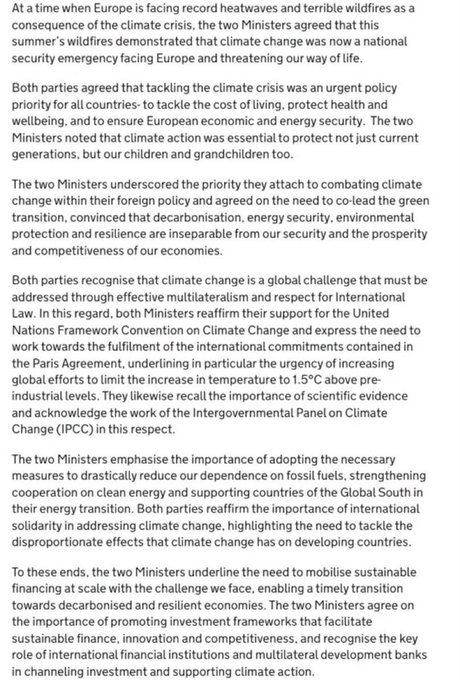
The UK and Spain issued a joint statement on the wildfires this week declaring that "this summer's wildfires demonstrated that climate change was now a national security emergency facing Europe and threatening our way of life," with both governments agreeing that tackling the climate crisis was "an urgent policy priority for all countries" and that climate action was essential "to protect not just current generations, but our children and grandchildren too."

Joint UK-Spain government statement on the 2026 European wildfires.

Wildfires are turning parts of Europe into an insurance nightmare

Beyond the immediate firefighting-capacity problem, Europe's insurers and policymakers are grappling with a harder question: who pays? As IntelliNews reported, one study estimates that extreme weather has already caused around $28 trillion of damage and that bill is getting bigger every year during the annual disaster season.

"What's happening in Europe this summer isn't unique," deputy governor of the Bank of France Agnes Benassy-Quere said, "these heatwaves and forest fires are part of a marked global increase in extreme weather events that imposes real costs on households, businesses, and governments," Politico reported.

Weather-related extremes cost the EU economy more than €200bn ($233bn) in economic losses between 2021 and 2024, according to European Environment Agency data cited in the report, and insurers are responding by raising prices and pulling out of higher-risk areas altogether - shifting the cost onto governments and individuals. Insurance companies are already reassessing the premiums needed for the popular catastrophe bonds and starting to review their risk assessments in general due to the literally off-the-chart weather events. In Europe, 75% of natural-disaster damages are not insured at all, according to NGO Reclaim Finance, citing European Insurance and Occupational Pensions Authority data.

Insured wildfire losses in Europe have grown by an estimated 8-11% a year in real terms since 1970, according to Swiss Re's Nikhil da Victoria Lobo, who called wildfires "the fastest-growing weather peril globally" even though they still account for a relatively small share of Europe's total insured catastrophe losses so far. In France, where a wildfire still burns through Gironde and Landes, at least 240 homes have been lost and around 130,000 workers are currently unable to work because of the fires, with the government promising to cover evacuees' accommodation and rebuilding costs.

The European Central Bank and the EU's insurance regulator have called on Brussels to set up an EU-level reinsurance scheme and a public natural-disaster fund - an acknowledgment that national insurance markets alone may not be able to absorb losses of this scale as extreme weather becomes the norm rather than the exception.