Wednesday, September 02, 2026

Industrial AI Needs An Authority Test Before It Touches The Physical World – Analysis


Image: ChatGPT


September 2, 2026

By Burak Oktenli

Key Takeaways:

Once industrial AI can write setpoints or isolate kit—not just recommend—the test is authority, not average accuracy: what it may change, on what evidence, for how long, who interrupts, and when it must abstain.

Give every acting system a documented authority envelope that narrows as consequence or sensor quality worsens; use twins and “ugly data” (drift, stale values, comms loss) to measure scope, abstention, reversion time, and a log of why permission existed—not only the command issued.

Five Eyes agentic-AI guidance, NIST OT/smart-manufacturing work, and the EU AI Act’s high-risk calendar (2027–28) already point that way: put envelopes in procurement and revalidate after model or plant changes, so the plant knows where the AI stops.


A model can be accurate and still be unsafe if its permissions, evidence thresholds, fallback logic or audit trail are wrong. Before AI writes to a plant, grid or industrial process, operators should test what it is allowed to do – not only how well it predicts.

Industrial artificial intelligence is crossing an important boundary. For years, most deployments predicted failures, forecast demand, optimized schedules or recommended process changes while a human or conventional control system remained responsible for execution. Increasingly, AI is being connected to tools that can write settings, isolate equipment, change operating parameters or trigger workflows that reach the physical process.

At that point, accuracy stops being the only validation question.


A model can be highly accurate on average and still be given permissions that are too broad. It can keep acting after sensor quality deteriorates. It can make a defensible recommendation under one operating state and continue using the same authority after the evidence supporting that state has gone stale. It can leave a perfect log of what command was issued while failing to preserve why the system was allowed to issue it.

The additional question is authority: What may the system change? On what evidence? For how long? Who can interrupt it? What forces it to abstain? And what happens when control has to return to a person?
Cyber Agencies Are Already Warning About Permission, Not Just Performance

A useful signal came in May, when six national cybersecurity agencies across the Five Eyes published joint guidance on the careful adoption of agentic AI services. The document is aimed primarily at tool-using software agents rather than industrial controllers, so the two should not be conflated. But its governance logic is directly relevant wherever AI can act instead of merely advise.


The guidance tells operators to limit privileges, define trigger-action protocols that automatically restrict permissions when unexpected behavior appears, separate duties, record delegation chains, use explicit expiry for delegated authority and require stronger approval for higher-stakes actions.

That is a different security vocabulary from conventional model validation. It treats the dangerous object not simply as a prediction but as a prediction coupled to permission.

Operational technology makes that coupling more consequential because software outputs can become pressure, temperature, flow, voltage, speed, valve position, chemical concentration or physical movement.

NIST’s Guide to Operational Technology Security emphasizes that OT systems interact directly with the physical environment and must be secured while preserving their distinctive performance, reliability and safety requirements. Its 2026 smart-manufacturing AI roadmap likewise places autonomous systems and digital twins among the technologies reshaping manufacturing while stressing the need for trustworthy, explainable and reliable operation in high-stakes industrial environments.

The implication is simple: when AI gains write access to a physical process, model assurance and authority assurance become separate test problems.
Accuracy Answers the Wrong Question Once AI Can Act

Suppose an optimization model predicts an energy-saving setpoint correctly 97 percent of the time. That number says nothing about whether the system should be allowed to write the setpoint during a sensor disagreement, after a communication delay, while a maintenance override is active, or when one of the variables feeding the model has not refreshed for ten minutes.


A plant can therefore have an accurate model inside an unsafe permission architecture.

The same distinction applies outside manufacturing. An AI system in a power network may forecast load accurately but still need narrow authority over switching actions. A building-management system may predict thermal demand well while requiring hard limits on which zones, valves or emergency systems it may change. An autonomous warehouse optimizer may make good routing decisions but still need an immediate reversion path when people enter a restricted movement area.

The engineering question is no longer merely, “Does the AI make the right prediction?” It becomes, “Can the AI be wrong safely?”
Give the System an Authority Envelope

Before live deployment, every AI system capable of changing an industrial process should have a documented authority envelope: the set of actions it may initiate, the assets and variables it may write to, the evidence required for each class of action, the duration of each permission, and the conditions that force abstention, escalation or human approval.

The envelope should narrow as consequence rises. A system may be allowed to adjust a low-consequence scheduling variable autonomously while only recommending a change to a safety-relevant setpoint. A permission that is safe for ten minutes during stable operations may be unsafe after a sensor fault, alarm, maintenance intervention or major configuration change.

Expiration matters because industrial authority is often contextual. Permissions should not silently survive the evidence that justified them.

This is the same underlying control principle I have described in the context of AI agents as an authority envelope: define what the system is allowed to reach and do, and enforce that boundary technically rather than treating it as a behavioral preference. In a plant, the envelope is physical as well as digital.
Use the Digital Twin to Test Authority, Not Just Performance

Digital twins, operator-training simulators, hardware-in-the-loop rigs and isolated process testbeds create an obvious place to test that envelope before the AI touches live equipment.

The test environment must be fit for purpose. It should match the relevant plant configuration closely enough to represent the hazards being exercised, remain isolated from live control, and be synchronized often enough that operators are not certifying yesterday’s plant. A weak or outdated twin can create false confidence.


Simulation should therefore complement rather than replace hazard analysis, factory and site acceptance testing, independent protection layers and production monitoring.

But a validated twin can expose a class of failure that ordinary historical backtesting often misses: an AI system whose model performance looks acceptable while its operational authority is not.
Four Measurements Matter

Scope. Did the system attempt or retain access beyond the functions approved for the scenario? A safe result is not enough if the system used an unsafe path to reach it.

Abstention. When evidence quality fell below the acceptance threshold, did the system stop, downgrade to advisory mode, narrow its permitted actions or request human review?

Reversion. How long did it take to restore effective human control and an accurate operating picture? The acceptable time should come from the process hazard analysis, not from a universal AI benchmark.

Traceability. Can the event record reconstruct who or what held authority, which evidence triggered the action, what changed, why it changed, when the permission expired and how control returned to a person?

These measurements turn an abstract governance principle into an acceptance test.
Test the Ugly Data

Clean historical data are not enough. The authority test should deliberately create the conditions in which a plausible AI system is most likely to become overconfident.

Introduce slow sensor drift. Feed stale but believable values. Create disagreement between instruments. Delay communications. Remove context that is normally present. Inject manipulated readings that stay inside normal-looking ranges. Simulate maintenance modes, partial network loss and an operator who does not acknowledge a handoff immediately.

Then ask two separate questions.

Did the model’s output degrade appropriately?

And did the system’s permission to act contract as confidence in the evidence declined?

The second question is the one conventional accuracy testing tends to miss.

The International Rules Are Moving in the Same Direction

Regulators are also moving toward lifecycle controls for high-consequence AI. The European Union’s AI Act implementation framework now has enforcement in place for the provisions already applicable, while high-risk rules for certain critical-infrastructure uses are scheduled for December 2027 and high-risk AI embedded in regulated products for August 2028.

The details of those regimes will matter, but operators do not need to wait for a regulation to discover that a permission boundary is an engineering property.

The Five Eyes guidance, NIST’s OT security work and Europe’s high-risk approach differ in legal form and scope. Yet they converge on a practical point: systems that can take consequential action need bounded access, human oversight, monitoring, traceability and tested fallback behavior.

Industrial AI programs should convert that convergence into procurement language now.
Put Authority in the Acceptance Criteria

A vendor supplying AI that can influence a physical process should be required to state and demonstrate more than model accuracy.

The acceptance package should specify the approved action set, evidence thresholds, permission expiration, escalation path, safe-state behavior, maximum reversion time, logging and provenance requirements, and the conditions under which the system must fall back from autonomous execution to recommendation only.

Material changes to the model, sensors, thresholds, process configuration or connected tools should trigger targeted revalidation of the authority envelope, not merely a fresh accuracy report.

That does not mean freezing industrial AI. It means treating permissions as part of the controlled configuration.
The Plant Should Know Where the AI Stops

Industrial automation already has a mature culture of commissioning, acceptance testing, hazard analysis and independent protection. AI should extend that discipline rather than bypass it.


The temptation will be to focus on the exciting metrics: prediction accuracy, optimization gains, reduced downtime and faster response. Those numbers matter. They are not enough once the model can act.

Before an AI system touches pressure, temperature, flow, voltage or movement, make it prove not only that it understands the process well enough to help operate it.

Make it prove that it knows where its authority ends.


About Burak Oktenli

Burak Oktenli holds an MBA and a Master of Professional Studies in Applied Intelligence from Georgetown University. His research addresses the governance of authority in autonomous and AI-enabled systems, and his writing has appeared at the Modern War Institute at West Point, RUSI, RealClearDefense, RealClearMarkets, and Geopolitical Monitor. He is the author of Authority Architectures for Autonomous Systems, a ten-volume series on how authority in autonomous systems is delegated, monitored and recovered, at authority-architecture.me.

View all posts by Burak Oktenli →
Feds And 22 States Sue Amazon, Alleging Deceptive Advertising Scheme


An Amazon warehouse near Newport, Delaware. (Photo by Jacob Owens/Spotlight Delaware)

September 1, 2026
Stateline
By Alex Brown


Key Takeaways:

The FTC and 22 state AGs sued Amazon Monday in W.D. Wash., alleging an “invented auction participant” and reserve-price design inflated sponsored-product and placement bids for more than a million sellers over 7+ years, with costs passed to shoppers.

Ferguson and Rhode Island AG Neronha want penalties, restitution, and an injunction; Amazon calls the theory a misread of relevance-weighted auctions and says inflation-adjusted CPC was flat 2019–2024 after a 1.5-million-page review.

Context: Amazon is the world’s No. 3 digital ad seller (~$68bn last year); it separately paid $2.5bn last year to settle FTC Prime-enrollment claims.


(Stateline) — The Federal Trade Commission and attorneys general from 22 states sued Amazon Monday, claiming the online retail company used artificial bids to inflate costs for advertisers, bringing in tens of billions of dollars.

The complaint alleges that Amazon used an “invented auction participant” to drive up prices for advertising placements and sponsored product spots on its online store. The lawsuit quotes a former company employee who said the system allowed the company to charge prices “beyond what [can] be achieved through advertiser competition.”


“Amazon has millions of advertising customers who were misled into paying significantly higher prices,” FTC Chairman Andrew Ferguson said in a statement. “These higher costs were largely passed on to American consumers.”

The complaint says that Amazon has carried out the scheme for more than seven years, increasing prices for more than a million brands and sellers.

The FTC’s lawsuit was filed along with the attorneys general of Alaska, Arizona, California, Colorado, Florida, Idaho, Illinois, Indiana, Iowa, Kentucky, Louisiana, Maryland, Nebraska, New Jersey, New York, North Carolina, Oklahoma, Pennsylvania, Rhode Island, South Carolina, Vermont and Washington.

“As alleged, this is a textbook example of illegal behavior by a corporation which places profits above all else,” Rhode Island Attorney General Peter Neronha, a Democrat, said in a statement. “The ubiquity of Amazon in American society pushes small- and medium-sized businesses to engage with the Company in order to stay afloat.”

Per Neronha’s statement, the coalition is pursuing “civil penalties, restitution, costs and fees, and injunctive relief.”

In a blog post responding to the lawsuit, Amazon said that “the FTC’s claim fundamentally misunderstands how advertisers operate.” The company asserted that the average cost-per-click for sponsored product search ads remained flat adjusted for inflation from 2019 to 2024.

“After reviewing approximately 1.5 million pages spanning six years, the FTC leans on a handful of simplified communications to allege a companywide effort to deceive,” Amazon wrote in its blog. “That is patently false.”

The company claims its “soft reserve prices” allowed it to award advertisements to the most relevant bids, rather than the highest bid amount, while still charging the true market value of an ad placement.


The complaint was filed in U.S. District Court for the Western District of Washington. Amazon is headquartered in Seattle.

Amazon is the third-largest digital advertising business worldwide, according to CNBC, behind only Google and Meta, with more than $68 billion in ad revenue last year.

Last year, Amazon and the FTC agreed to a $2.5 billion settlement over separate allegations that the company deceptively enrolled customers in Prime subscriptions and made it difficult for them to cancel.


Stateline reporter Alex Brown can be reached at abrown@stateline.org


About Stateline

Stateline journalists illuminate the big challenges and policy trends that cross state borders. We cover health care, education, the environment and other issues that shape our daily lives — and can be influenced by unseen forces. Stateline is part ofStates Newsroom, the nation’s largest state-focused nonprofit news organization, with reporting from every capital.
View all posts by Stateline →


Star Trek Day: London Science Museum aims for Vulcan salute Guinness World Record

Copyright NBC screenshot - Star Trek - Canva

By David Mouriquand
Published on

Star Trek fans are hoping to set a simultaneous Vulcan salute world record to celebrate the iconic show’s 60th anniversary next week.

This year’s Star Trek Day is a special one. Taking place on Tuesday 8 September, the 2026 edition of the annual celebration will mark the seminal show’s 60th anniversary.

How best to celebrate? By breaking a record, naturally.

Hundreds of fans are gearing up to set the Guinness World Record for the largest simultaneous Vulcan salute at London’s Science Museum.

For the heathens amongst you, the Vulcan salute is the gesture made famous by Leonard Nimoy's character Spock. It involves raising your hand, palm forward, with the middle and ring fingers parted. The split fingers form a “V” shape - and do keep your thumb pointing outward, there’s a good first officer.

It first appeared in the 1967 episode of the TV series titled “Amok Time” and is usually accompanied by the phrase “Live long and prosper”.

If verified by an adjudicator, the simultaneous Vulcan salute attempt would set a new Guinness World Record, as none currently exists in the category.

Leonard Nimoy at the LA premiere of "Star Trek Into Darkness" - Tuesday 14 May 2013 AP Photo

Glyn Morgan, head of collections and principal curator at London’s Science Museum, said: "It feels very special to bring Star Trek fans together at the Science Museum for an official Guinness World Record attempt on Star Trek Day.”

“For 60 years, Star Trek has connected bold storytelling with big questions about science, technology and what might be possible in the future, themes that sit at the heart of the Science Museum.”

He added: “After a popular Star Trek Lates earlier this year, we’re delighted to invite fans back for another evening exploring the ideas, imagination and real-world science behind the franchise, and a final opportunity to experience the Star Trek Warp Trail.”

The free Star Trek Warp Trail includes props and uniforms from the shows and films, and explores the lasting connection between the franchise’s visionary storytelling and real-world scientific innovation. The popular trail will close on Sunday 13 September.

Elsewhere, Trekkies will have no shortage of ways to celebrate the 60th anniversary, as fan events, screenings, and partnerships are rolling out across the globe next week.

Live long and salute.


What's behind France's plan to survey school children on sexual violence?


By Estelle Nilsson-Julien
Published on

For the first time, France's annual school questionnaire on bullying — which has been handed out to pupils since 2023 — will include questions on sexual violence. Pupils will be able to choose whether or not they wish to remain anonymous in this questionnaire, to be distributed in November.

Ringing school bells marked the start of the new year academic year in France on Tuesday. This year, the government has introduced a string of unprecedented measures, including a ban on mobile phones in primary and secondary schools, as well as new steps to tackle sexual violence.

For the first time, France's annual school questionnaire on bullying — which has been handed out to pupils since 2023 — will include questions on sexual violence. Pupils will be able to choose whether or not to they wish to remain anonymous in this questionnaire, which will be distributed in November.

Speaking to French broadcaster BFMTV on 25 August, France's education minister Édouard Geffray, said that around 10 million pupils, ranging from primary to secondary school, would complete the form, designed "with school staff, parents' associations and a committee of experts, including child psychiatrists". According to the minister, the results could be "seismic".

Teachers will collect the forms first. If any responses raise concerns, school leaders are then expected to step in, either by reporting the case to the relevant regional education authority or, in more serious situations, referring it to the justice system.

This initiative comes in the wake of numerous child sexual violence scandals in France, particularly in supervised childcare services. In Paris alone, there are 203 criminal investigations underway into alleged acts of violence, including sexual violence, in schools and in after-school settings, according to the latest official figures dated 26 August.

Despite these alarming figures, schools are still the main place where child sexual abuse reports are filed, with on average 80,000 reports a year, according to France's education minister.

Estimates made in 2023 by the CIIVISE (the Independent Commission on Incest and Sexual Violence against Children) assessed that around 160,000 children are victims of sexual violence every year in France, with 77% of this abuse occurring in a family environment. That amounts to one child being raped or sexually assaulted every three minutes.

Parents divided on the matter: "School must be a sanctuary"

According to France's education minister, questions about sexual violence will be tailored to pupils' ages. Despite this, parents have mixed feelings.

For Samuel Bougnat, a father of a three-year-old, the measure is a step in the right direction, "I think school has a role to play in providing support and in reporting possible violence, because school should be a sanctuary, a place where children can feel confident enough to talk about things that may be happening at home"."

Another father of two young children who preferred to remain anonymous also backed the measure, "personally, I think it is pragmatic given that all children are supposed to go through school at some point; so if there is one place where we can spot things that are problematic and dangerous for children, it is there."

"As a parent, I will be paying close attention to how these forms are rolled out through, especially to ensure that they are appropriate for younger children", he added.

Others, like Caroline Varas, who has a four-and-a-half-year-old son, are less convinced. "I am not entirely sure that school should be responsible for this. I think it should be collaborative work: with independent parents' associations, the local council and the school."

"If it is only the school dealing with it, they will cover themselves, protect themselves. I found out afterwards that there had been violence – not sexual violence, but violence – in my child's school. There is a missing intermediary between the school and parents", she added.

Child protection organisations express concerns

Laura Morin-Baudet, who heads L'Enfant Bleu, a Paris-based non-profit that fights child abuse, says she "welcomes" the fact that the education ministry is taking up the issue of child sexual violence, but also voiced doubts about the practical side of things.

"It all depends on the conditions children answer these questions in. If the child feels comfortable, has the feeling that their friend sitting next to them cannot necessarily see their answers, then perhaps, indeed, they will end up saying something. But on the other hand, if they have the slightest doubt, if they are afraid, if they are unsure where these documents will go, we unfortunately know that they will not necessarily confide."

For Laura Morin-Baudet, alongside any such questionnaires, it is still key to carry out prevention and raise awareness in schools.

"We know just how poorly trained teachers and childcare professionals are in this area. Our organisation regularly receives calls from professionals who tell us: 'I have observed this and that, what can I do, how should I act?' So we know there is that need."

"Sometimes signs can manifest themselves through words, but it can also be through behaviour. It may be a child who suddenly becomes very agitated when they were not before, or conversely a child who withdraws completely. And that is where an adult's gaze can interpret things and build upa relationship of trust."

Differing stances from teachers' unions

According to Jean-Rémi Girard, president of the National Union of Lycées and Collèges, schools and higher education (SNALC), "the vast majority" of teachers support the initiative.

"For us, the most important thing is that school should be a safe place for our pupils and, in fact, for everyone. That does not mean we are the ones who will do the work of the justice system, quite clearly. But we are nonetheless able to talk to pupils, to go and see a little what is happening, to take an interest in children's living conditions and to gather information so that we can then pass the baton to the police and the justice system."

"Sometimes very young children are not aware of how serious what has happened to them is. With the form, very simple questions will allow us not to make a diagnosis, but at least to identify a first point that needs attention."

For her part, Béatrice Laurent, secretary of the education union UNSA Éducation, speaks of a "dilemma".

"We cannot be against a programme that allows children to report violence they may have suffered. But the immediate question is whether a written questionnaire is the right format."

"Our concern also relates to how these questionnaires will be processed. Is there enough staff in the education system to deal with the reports that children are going to make? It would be truly tragic for children to disclose what has happened to them and for nothing to happen afterwards."

France's education ministry did not respond to Euronews' questions about the specific details of the questionnaire, or about how the justice system would intervene if the results turned out to be "seismic", as the country's minister has suggested.

The ministry said that work to prepare the questionnaire is underway and that it was therefore premature to provide more precise answers.


Signs before puberty could predict painful periods, study finds

Study identifies non-painful symptoms before first period linked to future menstrual pain.
Copyright Cleared/Canva


By Marta Iraola Iribarren
Published on


A new study has found that non-painful symptoms in young girls, such as fatigue and dizziness, could help predict who is at risk of painful periods later on.

Experiencing non-painful symptoms, such as fatigue and dizziness, before the first period might signal a higher risk of dysmenorrhoea — painful menstruation for the years to come, according to a new study published in The Lancet Child & Adolescent Health.

Many women struggle with period pain, which starts in adolescence and can affect their lives for years after. Researchers hope that addressing some of the symptoms before a person's first menstrual period could reduce the burden of dysmenorrhoea on young women.

“Identifying risk factors for dysmenorrhoea, especially severe dysmenorrhoea, has the potential to improve outcomes for female adolescents through early and more targeted treatment,” the authors wrote.

The researchers analysed data from over 2,000 adolescents and found that non-painful somatic symptoms – such as fatigue, dizziness, gastrointestinal problems, nightmares or sensory changes – and advanced pubertal development at ages nine to ten are strong indicators of future menstrual pain.

Dysmenorrhoea is common in adolescence and is often dismissed as inevitable or left untreated, the authors wrote. It can interfere with daily functioning and lead to other chronic pain conditions; however, little is known about its risk factors, and the lack of research before the first period is hindering efforts to identify those at risk.

Previous research has found that approximately 70% of female adolescents experience menstrual pain, and in 20% of cases it has a significant impact on their daily activities.

The study also found that sleep problems were strongly associated with a greater impact of pain on daily activities. Researchers say that addressing sleep disturbances before the first period could help to reduce the pain burden.

For example, cognitive behavioural therapy targeting this issue in adolescents with chronic pain shows promise for easing both the sleep problems and the resulting pain interference.

“These findings raise the possibility of identifying at-risk individuals before pain becomes a lifelong issue,” the authors wrote.


British energy giant BP names Ian Tyler as chair after boardroom turmoil

Ian Tyler appointed bp Chair
Copyright BP/All rights reserved

By Doloresz Katanich
Published on


British energy giant BP has appointed Ian Tyler as its permanent chair following the abrupt removal of his predecessor over governance and conduct concerns in May.

BP has appointed Ian Tyler as its permanent chair after months of upheaval at the top of the British energy giant.

Tyler takes up the position immediately following a search that considered both internal and external candidates, BP said on Wednesday.

BP shares were little changed in early London trading. They have gained around 25% since the beginning of the year, broadly matching the rise in rival Shell’s shares.

Tyler had served as interim chair since 26 May, when BP abruptly dismissed his predecessor, Albert Manifold, after less than eight months in the role.

At the time, BP said the board had identified “governance oversight and conduct issues it deems unacceptable”. Manifold has disputed the company’s account and sought legal advice.

BP shares fell as much as 9% following the announcement of his departure before recovering some of those losses.

Tyler joined BP’s board as a non-executive director in April 2025. He is a former chief executive of construction group Balfour Beatty and currently chairs building materials company Grafton Group.

BP said Tyler had worked alongside more than 15 chief executives during a non-executive career spanning listed and privately owned companies in the oil and gas, natural resources and engineering sectors.

“Ian brings significant experience providing challenge and support to executive teams, while maintaining strong governance and oversight on behalf of shareholders,” said Dame Amanda Blanc, BP’s senior independent director.

Tyler will lead the board as it oversees chief executive Meg O’Neill’s restructuring programme. Her priorities include simplifying BP’s portfolio, strengthening its balance sheet and imposing tighter investment discipline.

BP is seeking to reduce net debt to between $14 billion (€12bn) and $18 billion (€15.4bn) by the end of 2027. The company estimated in July that its net debt stood at between $22 billion and $23 billion at the end of June.

The debt target formed part of a strategic reset announced in February 2025, when BP shifted investment back towards oil and gas, reduced planned spending on low-carbon businesses and promised tighter capital allocation.

BP also announced that Blanc, who oversaw the searches that led to the appointments of both Manifold and Tyler, would not seek re-election at next year’s annual general meeting. She will leave the board once a successor has been appointed.


Cargo ship with 10 crew sinks off Istanbul after collision, maritime authorities say

Cargo ships anchored in the Marmara sea near the Bosphorus Strait in Istanbul, 8 April, 2025
Copyright AP Photo

By Burcu Basaran & Gavin Blackburn
Published on

The collision occurred 18 nautical miles (33 kilometres) off the Silivri district on the western edge of Istanbul province, the governor's office said on X.

A cargo ship sank in the Marmara Sea near Istanbul after colliding with a second vessel, with rescuers searching for 10 people who were on board, Turkish officials said on Wednesday

The incident occurred before dawn when the ALSU, an empty oil tanker, collided with the Tuğberk İmamoğlu, a cargo ship carrying rolled steel, which sank shortly after, the transport ministry's maritime directorate said on X.

The collision occurred 18 nautical miles (33 kilometres) off the Silivri district on the western edge of Istanbul province, the governor's office said on X.

"Due to the Tuğberk İmamoğlu not responding to any calls and the crew not answering their mobile phones...it is believed the dry cargo ship has sunk," the maritime directorate said.

The ALSU's captain had reported the collision as happening at 3:15 am, with 14 search and rescue vessels dispatched to the area backed by a helicopter, it said.

"Life-saving equipment, including a lifeboat belonging to the Tuğberk İmamoğlu which had 10 crew members on board, has been found at sea. Unfortunately, the crew members were not inside."

The ALSU, which was damaged in the collision, was also joining in search and rescue efforts, it said.

At the time of the collision, the Tuğberk İmamoğlu was carrying 4,200 tons of rolled sheet metal, it said.

The maritime directorate initially said the ALSU was carrying 3,000 tonnes of motor oil, but later said the tanker was empty in a detail confirmed by the governorate.

The incident took place three days after deadly ferry accident off Turkish-occupied northern Cyprus in which eight Turkish nationals died with rescuers still hunting for another 20 people listed as missing.


How Taiwan's AI stock boom has ordinary people borrowing to invest

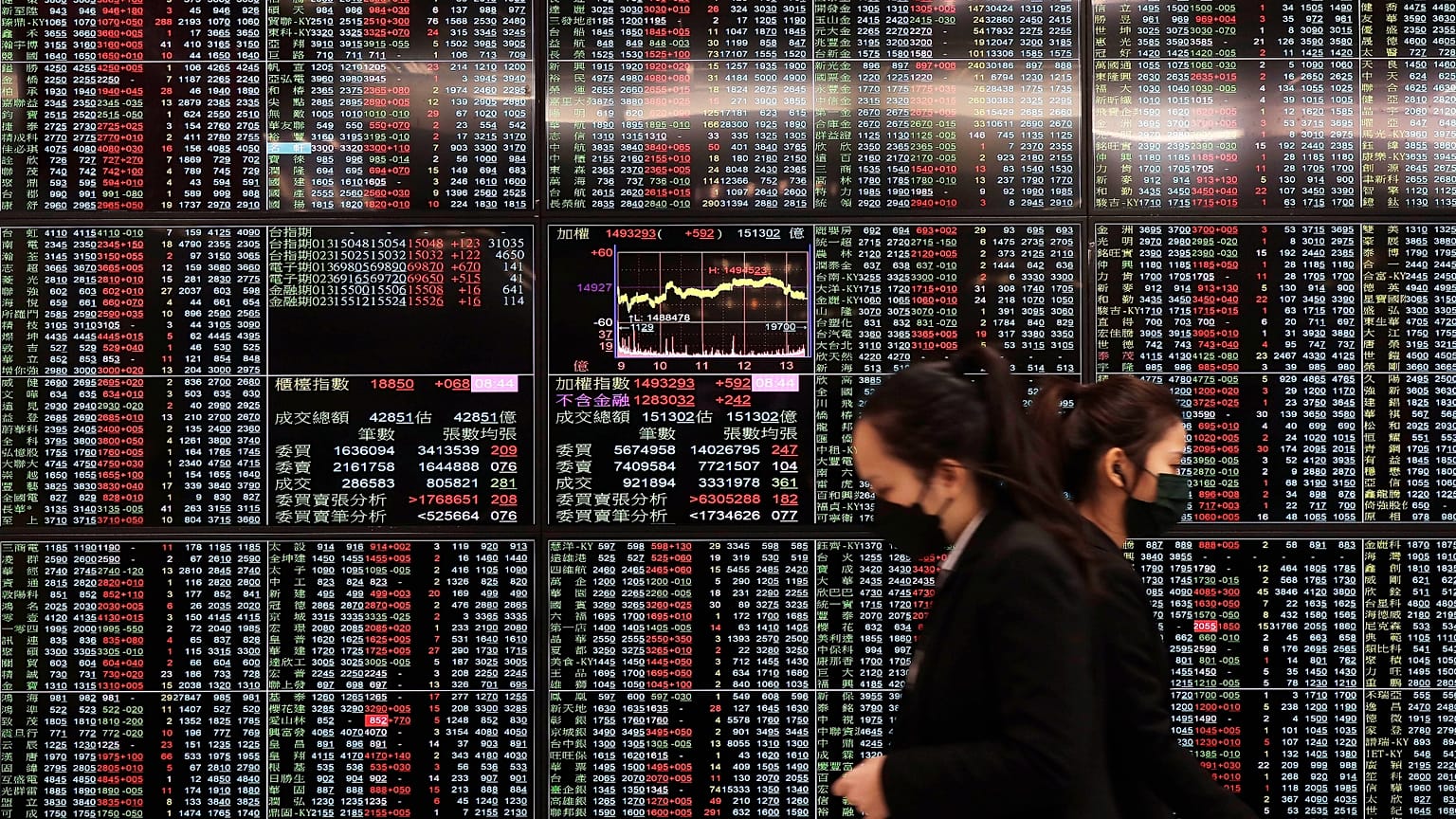
FILE - People walk past an electronic stock board at Taipei Exchange in Taipei, Taiwan, Monday, Jan. 30, 2023.
Copyright AP Photo/(AP Photo/Chiang Ying-ying)

By Una Hajdari with AFP
Published on

People across Taiwan are taking out loans and even remortgaging their homes to chase gains in an AI-fuelled stock boom — and not everyone is coming out ahead.

Taiwan is in the grip of a borrowing frenzy — but not for houses or cars. This year, people are taking out loans to buy stocks.

As Taiwan's stock market soared this year, real-estate worker Lucas Chen borrowed NT$5 million (€136,000) to buy tech shares, and within six months he had quadrupled his money.

Chen is one of a growing number of people using debt to buy into the island's stock market, which soared 59% in the first half of the year thanks to booming demand for AI hardware made by chip giant Taiwan Semiconductor Manufacturing Co (TSMC) and others.

But while the prospect of vast returns has lured and repaid many handsomely, others have suffered hefty losses or been tricked by scammers, prompting authorities to issue warnings about the risks.

"The first half of the year was really crazy. It was absolutely wild," said Chen, who makes a base salary of up to NT$50,000 (about €1,360) from his job.

The 34-year-old began trading in the stock market 10 years ago, saving up his bonuses to buy chip titan TSMC, which accounted for about 45% of the Taiwan Stock Exchange at the end of 2025.

At the start of this year, Chen saw "a good opportunity" to increase his investments and took out three bank loans worth NT$5 million, using his new Tesla as collateral for two of them.

The bet paid off.

Chen's tech investments, half of them in TSMC, surged nearly 70%, pumping up his holdings by about NT$20 million (€544,000) by late June.

"The older generation would say borrowing money isn't a good thing," Chen told AFP, adding that if you did the maths carefully, the risks were "controllable".

Financial influencer Yeh Yu-shuo has enjoyed the fruits of the market but has also seen the downside of the stock-buying frenzy in his Facebook group, where hundreds of thousands of members trade investment advice.

"I've reviewed posts saying they want to jump off a building," Yeh said.

One anonymous poster said in early August he had invested NT$10 million (about €272,000), including a NT$6 million (about €163,000) mortgage, in recent months and had lost nearly half of it.

"Since last month I've been waking up in the middle of the night in a panic," the poster said.

"I've already sought treatment from a psychiatrist, and I even went to Zinan Temple, but none of it has helped at all. Right now, all I want is to get my money back as quickly as possible."

'Buying stocks like crazy'

Global stock markets have surged this year to record highs as tech firms ramped up spending on AI data centres, hardware and software.

However, the rally hit a wall in July, hammering the tech sector on concerns over when that cash will see a return and warnings that company valuations had gone too far.

Anticipation of a US interest rate hike has also weighed on sentiment and could curb demand for stocks, particularly tech firms, which rely on borrowing to fuel their investments.

While some people in Taiwan have used their savings or borrowed from family to invest, many have relied on banks or brokers to fund their stock purchases.

Norman Yin, a professor of money and banking at National Chengchi University, said young people have been "buying stocks like crazy".

Taiwanese banks are sitting on "unprecedented" levels of deposits, partly due to stagnant property prices, and are very willing to lend.

"If I borrow money from a bank to buy stocks, I could make more in one day than I earn from my salary in a month," Yin said, noting fresh graduates often made around NT$40,000 (about €1,090) per month.

"It's faster and easier than sitting in an office and working hard."

Meanwhile, margin trading — in which investors use funds borrowed from a broker to buy securities — rose nearly 20% in the first half from the previous six months, Taiwan Stock Exchange data show.

Taiwan's Financial Supervisory Commission told AFP that overall "credit risk remains under control".

The stock exchange has started publishing videos on social media warning young investors of the risks of defaulting on their loans.

'Windfall for our generation'

Social media platforms in Taiwan are rife with posts about people making huge sums and quitting their jobs to trade full time.

Marketing specialist Jerry Lee, 30, said he has watched with some envy as friends post about their gains in their group chat.

"When you see someone make two or three months' salary in two days, oof, that's really painful," said Lee, who describes himself as a conservative investor.

Social media gives the impression that "everyone is making money," he said.

"When it's dropping they won't tell you about it."

Taiwan's stock index fell about 16% from its record high on 22 June to 30 July, while South Korea's market — the poster child of the global tech-led surge this year — plunged about 40%.

Still, Yeh said he had confidence in Taiwan's stock market "as long as TSMC remains stable". The Taiex has recovered almost all the losses sustained in the summer sell-off.

Chen said the opportunity to make money would keep him investing.

"This is a windfall for our generation," he said.


Ryanair's Boeing 737 stairs tied to hundreds of passenger falls, study says

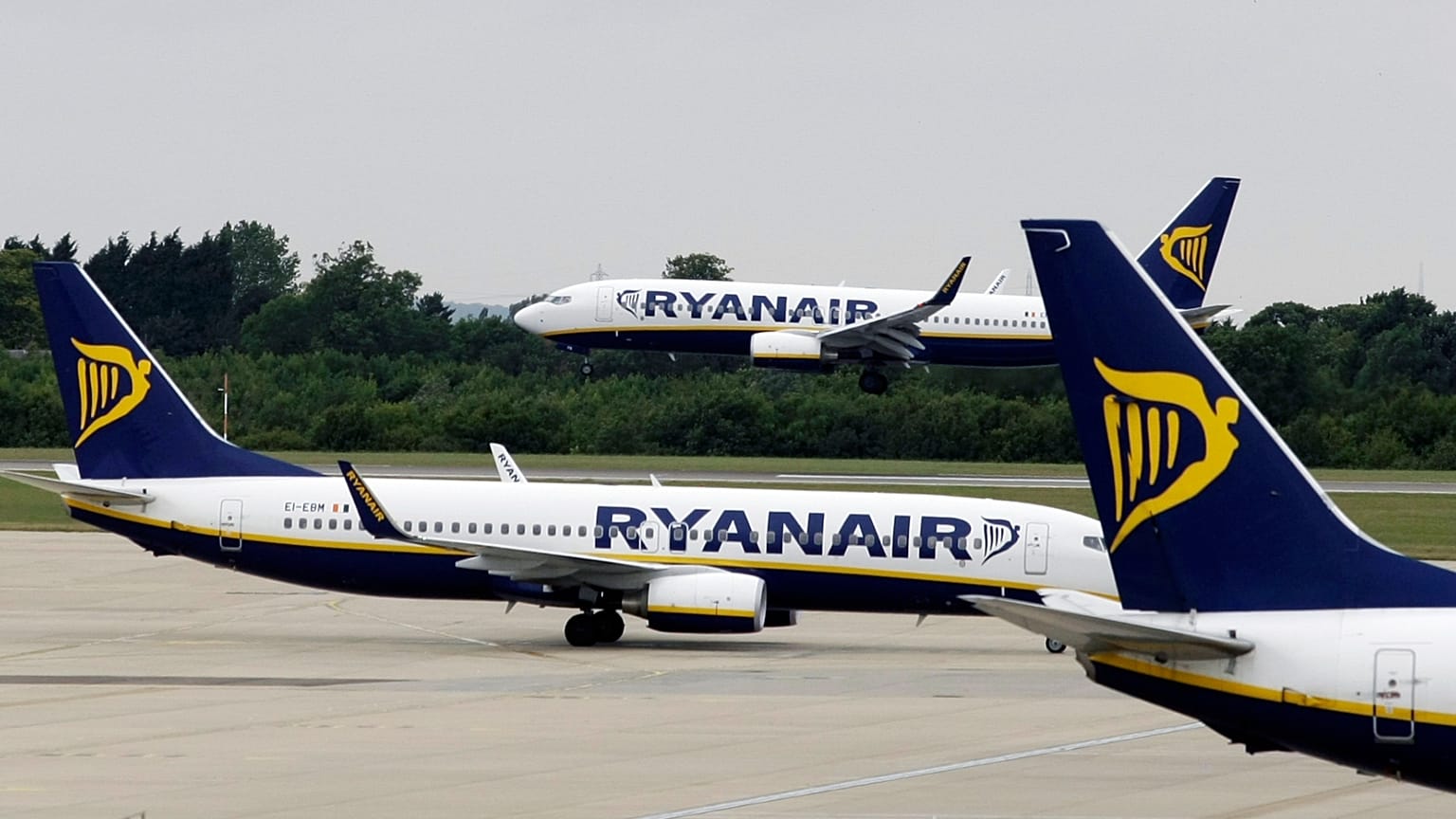
File photo dated Tuesday 21 July 2009: Ryanair planes at Stansted Airport, England. (AP Photo/Matt Dunham)
Copyright Copyright 2016 The Associated Press. All rights reserved.

By Arnold Koka
Published on

Ryanair's Boeing 737 comes with retractable onboard stairs that cut costs and turnaround times, but an Italian safety study has linked them to hundreds of passenger falls since 2021.

Ryanair's Boeing 737 hides a hazard just outside the cabin door: its retractable onboard stairs.

Passengers who have used them have faced a significantly higher risk of falling than those using stairs provided by airports. That is the conclusion of a study by Italy's National Agency for Flight Safety (ANSV), published in August 2026.

The study analysed falls reported in Italy during boarding and disembarkation between 2023 and 2025. Of 104 incidents, 85 involved passengers who used the forward integrated stairs of Boeing 737 aircraft, accounting for 82% of cases, according to Corriere della Sera.

The scale of the figures is even clearer when set against total passenger numbers. Over the same period the Irish airline carried around 27% of all passengers in Italy. The other carriers, which make up the remaining 73%, recorded 19 falls between them.

The trend is not confined to Italy. Since 2021 Ryanair has registered 489 falls on stairs, 360 of them, or 73%, on the Boeing 737's integrated stairway. According to ANSV, that is three times as many falls as those recorded on airport stairways.

To track and analyse the incidents, ANSV used the ECCAIRS system, the digital platform run by the European Union Aviation Safety Agency (EASA). The system collects and analyses aviation safety data from EU countries.

Why the stairs are riskier

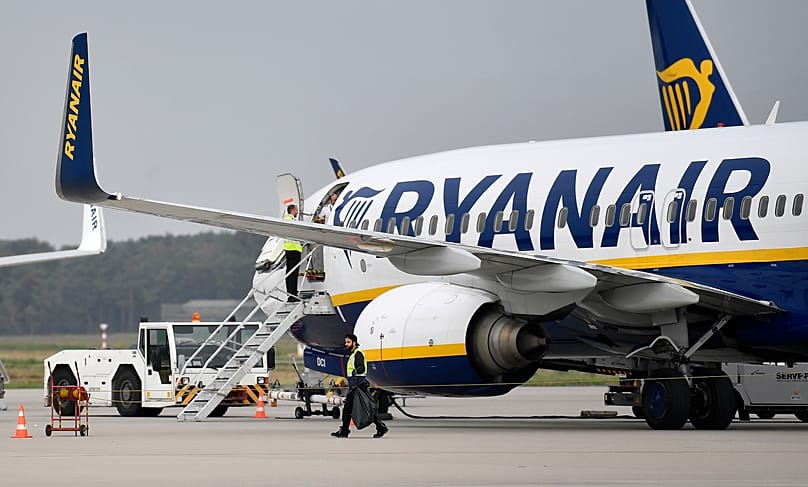
For disembarkation, airlines often hire mobile stairs from airports. Ryanair's Boeing 737 instead has the option of an integrated system that can be deployed while parked, allowing passengers to disembark without airport handlers. This cuts disembarkation times and ground-service costs.

The integrated stairway has 12 steps, about 61 centimetres wide and 20 centimetres high, with a tread depth of 25 centimetres and an inclination of 35 degrees.

ANSV's investigation found the dimensions "are at the limits for step height and steepness" compared with those used by airport operators, "who have lower steps and, usually, a less pronounced inclination, and platforms and treads that are considerably larger."

In this Sept. 12, 2018 file photo, a Ryanair plane parks at the airport in Weeze, Germany. FILE - In this Sept. 12, 2018 file photo, a Ryanair plane parks at the airport in Weeze, Germany.

It also notes that the first step of the stairway is asymmetrical for passengers on the way down because of the shape of the fuselage in relation to the step.

According to Ireland's air accident investigation unit (AAIU), EU regulations do not impose requirements on the size of integrated stairs because they are not deemed critical to flight operations.

ANSV's study began with three incidents in Genoa, Venice and Bologna, in which three people suffered "serious injuries".

In Genoa on 22 March 2025, one person was taken by ambulance to hospital after a fall that occurred "most likely due to the inattention of the passenger," according to ANSV's reports.

Two days later in Venice, another passenger suffered serious injuries after falling from the integrated stairs. According to staff, the passenger was carrying two suitcases and was not holding the handrail. In the Bologna incident, the passenger also fell while carrying two bags.

After these incidents, Ryanair updated its disembarkation protocol, and since 23 July cabin crew have been repeating the warning to use the handrail also in the language of the country of origin and destination.

The problem with the integrated stairs on the Boeing 737 had already been examined by the aviation safety agencies of Ireland and Spain (CIAIAC) after falls in 2021 in Dublin and in 2024 in Alicante.

Following those incidents, the Spanish agency urged Boeing to redesign the stairway, reducing its steepness and increasing the surface area of the steps. CIAIAC also called on Ryanair to abandon use of the integrated system and rely solely on stairs provided by airport operators.

No investigation carried out so far has concluded that the system is defective. ANSV has endorsed the Spanish recommendations to Boeing and Ryanair, while attributing the falls to human factors such as inattention and failure to use the handrail.