It’s possible that I shall make an ass of myself. But in that case one can always get out of it with a little dialectic. I have, of course, so worded my proposition as to be right either way (K.Marx, Letter to F.Engels on the Indian Mutiny)
Tuesday, June 09, 2026
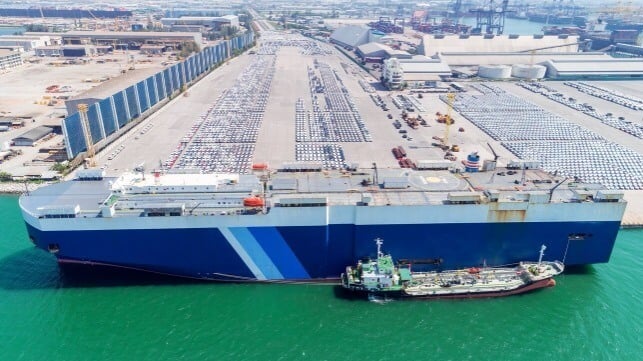
ABS Proposes Using Efficiency Credits to Augment IMO Carbon Rules
The world's shipping interests are divided into two main camps on the question of carbon regulation at IMO. The first wants to stay within the bounds of the previously-negotiated Net Zero Framework, centered on a carbon levy and a fuel subsidy fund to be administered by IMO. The second camp wants to alter or remove the levy and reschedule the rollout with gradual implementation, with the timetable linked more closely to current operational realities. ABS has taken a technical view to bridging the gap and finding consensus, and has proposed a simple solution: crediting efficiency measures, not just green fuels.
Like most stakeholders, ABS recognizes the serious "chicken-or-egg" challenge for scaling up green fuels: they won't be available everywhere from day one, and some vessels will need a different solution. Not all ships trade on predictable routes, and it will be tough to distribute new fuels in far-flung ports visited by tramp-trade vessels. "Progress toward the IMO midterm-measures must be grounded not only in ambition, but also in the operational realities of the fleet it is intended to govern," says ABS.
Adding incentives to use all available alternatives - including LNG, the most widely-distributed option - is one way to get at this problem. Linking rule implementation with the pace of scaling of alternative fuels and clean energy technology is another way to avoid going faster than the industry can follow at an economical rate, ABS says. But the best compromise option for the immediate term could be to prioritize efficiency gains.
"Over the last decade we have seen efficiency gains in excess of 20 percent and significant additional gains remain achievable," the class society says. There are still more options to add efficiency, including voyage optimization, air lubrication and wind-assisted propulsion (where the service profile favors it). AI-driven routing and decision-making aids can also help.
On this basis, ABS sees potential for IMO to incorporate carbon credits for energy efficiency into the structure of the NZF rules, as envisioned by Liberia's alternative proposal. Since the rollout for green fuel is expected to be slow, and efficiency gains can be had right away, "this would provide industry with a credible bridging mechanism," ABS concluded.
This would create incentives for owners to act early and make investments in efficiency, cutting emissions by up to 20 percent without even a drop of green fuel. Surplus credits could be traded between fleets, allowing the ships that are easiest to make more efficient to "subsidize" the most difficult-to-decarbonize parts of the fleet. Credit-trading between shipowners would also de-emphasize reliance on the IMO-administered fund, which is a sticking point for the U.S. delegation.
"Our analysis indicates that the strongest path forward is one that combines a refined fuel-intensity approach with meaningful recognition of energy efficiency as a compliance pathway. This would provide the industry with a more resilient and workable basis for progress," ABS concluded.
Crew Rescued After Container Feeder Sinks off Singapore
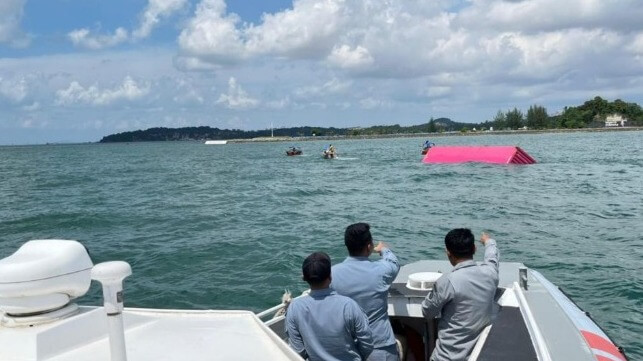
Responders were still monitoring lost containers from the ship over the weekend (Courtesy Baklama)
On Friday night, a small container ship went down in the middle of the Strait of Singapore, just hours after leaving the pier.
At about 2200 hours local time on June 5, the small container feeder Golden Star 1 - a local vessel involved in coastal trading - began taking on water, and she quickly went down at a position about three nautical miles north of Batam, in the middle of the strait. The ship had nine crewmembers and about 100 containers on board.
Golden Star 1 had departed the pier at PSA Tanjong Pagar Terminal at about 2000 hours and headed southeast, towards the traffic lanes. At 2230 her course became erratic, and she drifted back westward before disappearing off AIS at about 2245 (per AIS data provided by Pole Star Global).
Indonesia's coast guard retrieved the crew from the water off the coast of Batam and brought them safely to shore. All were rescued, and no injuries were reported.
The response to the sinking continues, including monitoring efforts to manage the hazard of floating containers from the Golden Star 1's cargo. Baklama (the Indonesian Coast Guard) is leading the operation and has multiple vessel assets on scene.
Golden Star 1 was a 1995-built container feeder flagged in Tanzania, a "very high risk" flag on the Paris MoU black list. Her last port state control inspection was in 2022, and inspectors noted corrosion issues on her decks.
USCG Calls Off New Search for Missing Yacht Cruiser Lynette Hooker
Coast Guard divers search the bottom of the Bay of Abaco (USCG)
The U.S. Coast Guard is investigating the disappearance of U.S. national Lynette Hooker as a possible crime, but has not been able to find her body.
Last month, U.S. citizens Brian and Lynette Hooker were on a trip through the Bahamas aboard their sail cruising yacht, Soulmate. On the night of April 4, Lynette Hooker disappeared, and Mr. Hooker reported her absence early the next morning. He said that she had gone over the side of their small 8-foot dinghy, taking the engine's kill switch lanyard with her, and he had gone adrift in the boat and lost sight of her. Bahamian authorities questioned and then released Mr. Hooker, but the Coast Guard Investigative Service is leading its own parallel probe under U.S. jurisdiction.
Lynette Hooker's remains have not yet been found. Last week, in hopes of discovering evidence at a new location in the Bay of Abaco, the Coast Guard re-launched an extensive search using divers, ROVs, UAVs and a cadaver dog. It had support from the authorities in the Bahamas' police and armed forces during the search, and mobilized a Fast Patrol Cutter and a dive team for the operation. As of Friday, that search has been called off, the service said.
The dinghy has been taken into custody and dispatched to the U.S. for forensic teams to examine. The sailboat Soulmate has also been seized for the investigation.
Brian Hooker has since returned to the United States, and has consistently denied any wrongdoing in the case.
Tanker Awaiting Scrapping Stuck in Limbo by US Sanctions
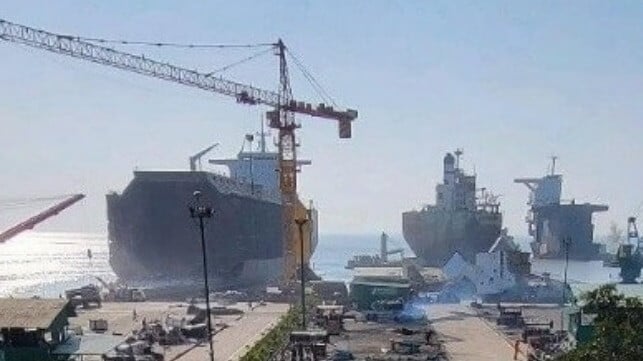
A product tanker expected to be beached in Bangladesh is instead stuck in the anchorage due to US sanctions
The Bangladeshi scrappers community and the cash buyers are dealing with what they termed a “highly unusual incident” after one of the ships that was in the process of changing hands for scrapping was suddenly included by the U.S. State Department on the sanctions list. The buyers point out that it creates a legal and commercial uncertainty as they are barred from trading in the vessel.
The product tanker named Maymei was listed as sold for scrap as of May 22. Built in 1997, it is a 44,936 dwt tanker that was registered in Palau. It was owned by a Chinese company based in Hong Kong and associated with the Iranian petrochemical trade. According to the Business Standard newspaper in Bangladesh, the ship had an approximate scrap value of $4.96 million.
The ship’s AIS history shows it departed Ningo, China, in mid-April and arrived off Chattogram, Bangladesh, on May 22. It officially entered the anchorage on May 26, and its paperwork was being processed.
However, the U.S. State Department on May 28 announced it had listed the tanker and its managers, Ever Shining Limited, as part of the sanctions against Iran during an effort that targeted a total of eight ships and their managers. State said the ship had loaded petrochemical products from Iran in July 2024. Another ship, Flora, managed by the same company, however, was accused of loading Iranian products on at least 14 occasions since 2023.
The cash buyers told the newspaper that they believe the sanctions are preventing them from completing the transaction and beaching the ship. The companies involved are worried about the legal ramifications, while noting that the scrapping should be permitted to proceed, as it definitely removes the ship from service.
For now, the cash buyer and the scrapper are reporting that the ship remains at anchor, and the funds have not been released. They are reporting that the principal owner has agreed to take back the ship, and they expect that process to begin shortly.
The newspaper highlights it would be a rare instance when a ship failed to reach the recycling yard, and more so because of sanctions.
Indian Crew Airlifted from Burning Tanker Disabled by US Forces off Oman
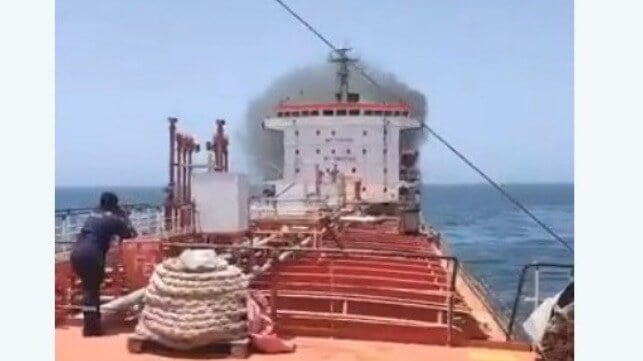
Indian crew was evacuated from a burning product tanker off Oman (social media video)
The Indian crew of a sanctioned, shadow fleet tanker abandoned ship on Monday, June 8, after a fire was reported aboard the ship. U.S. Central Command later acknowledged the strike, saying the vessel was disabled after it violated the ongoing blockade against Iran by attempting to sail to an Iranian port.
The product tanker now operating under the name of Marivex reported the fire around 1330 local time on June 8, with the crew requesting an immediate evacuation. Pictures show the crew being hoisted from the deck to a helicopter, with reports saying the vessel’s lifeboat was damaged by the fire and the crew was unable to launch the boat or rafts.
The UK Maritime Trade Operations labeled the incident “suspicious,” reporting the ship was on fire 15 nautical miles northeast of Masirah, Oman.
CENTCOM later confirmed that a F/A-18 Super Hornet from USS Abraham Lincoln fired a precision munition into the ship's engineering and steering spaces. The U.S. said it acted after the crew failed to comply with directions from its forces.
Built in 2009, the ship is claiming to be operating under the false flag of Madagascar since taking on its latest name in February 2026. Previously it was registered in Palau. The ship is 12,800 dwt, and its AIS signal showed it was coming from India bound for Duqm, Oman. The latest signals place it anchored on the coast of Oman in the Arabian Sea.
The United States Treasury Department sanctioned the vessel in December 2025 under its previous name of Arihant. The U.S. listed it as one of 29 vessels involved in the Iranian oil petrochemical trade, reporting the tanker had transported hundreds of thousands of barrels of Iranian fuel oil and bitumen within the Persian Gulf since July 2025.
Indian officials confirmed the evacuation of 24 sailors but did not comment on the cause of the fire aboard the ship. Its embassy in Oman posted a message thanking the Omanis for their assistance. Pictures show the crew uninjured, posing for a photo with the rescue helicopter in Oman.
CENTCOM said U.S. forces have now disabled seven non-compliant vessels while redirecting 134 ships that complied with instruction. It also reports that supporting humanitarian aid, U.S. forces allowed 42 vessels to pass since initiating the blockade on April 13.
Four Indian Seafarers Rescued from Abandoned Ship After 10 Months
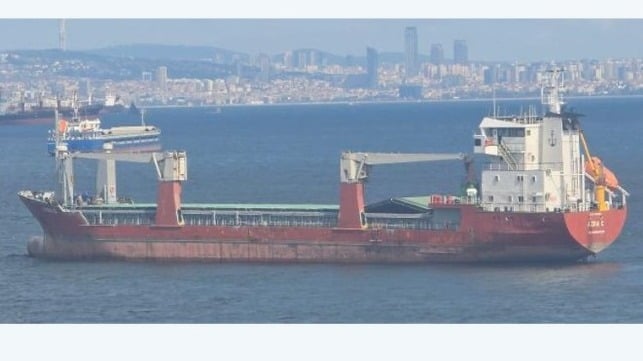
Azra C anchored in Turkey September 2025 (Captain M. Jend photo - courtesy of VesselFinder)
It took intervention from the Turkish government to finally rescue four Indian seafarers who had been stuck on a decrepit cargo ship after the owner of the vessel was arrested as part of an International drug sting. While most of the crew was repatriated several months ago, four individuals remained on the ship since July 2025, waiting for replacements and back pay, both of which never arrived.
The vessel named Azra C (4,257 dwt) arrived in Turkey in July 2025, and according to reports, it was awaiting repairs and a planned drydocking. In August 2025, the vessel was inspected and received a whopping 54 deficiencies. Built in 1986, the 60-meter (197-foot) cargo ship had been operating for a Turkish company since 2023 and was registered in Mongolia.
The International Labour Organization lists the vessel abandoned as of October 1, 2025, reporting there were 15 crewmembers: 13 from India, and one each from Egypt and Turkey. The owners and the agents initially assured the ILO that the ship was awaiting repairs and that the back pay would be cleared in 15 days.
By December 2025, India’s Directorate General of Shipping was getting involved, and the crew reported that over the next several months, it sought the help of the International Transport Workers’ Federation, the port state, the flag state, the harbor master, the P&I, and others.
The situation went from bad to worse when the owner was arrested in January 2026, and the port agents stopped responding, saying they too were not paid. The ITF and others tried to provide basic supplies. By March, the crew wrote to the ILO saying they were down to 800 litres of diesel, no more than 20 days of drinking water, and that the bunkers would run out by the end of the month. They reported they were running the emergency generator for five to six hours for cooking and charging batteries.
In late March, the ILO reports that the majority of the crew were repatriated with partial pay. However, to meet international regulations, four crewmembers were forced to stay behind to maintain the safety of the ship. By May, the four remaining crew wrote the ILO saying they had not been paid in eight to nine months, they only had 30 to 40 liters of diesel still aboard, and no one was helping them.
Turkey’s Transport and Infrastructure Minister, Abdulkadir Uralogly heard about the crew’s fate in a story in the Turkish daily Hurriyet and ordered that their repatriation be expedited. The paper speculated that the Azra C had been destined for a drug smuggling job, but its engine broke down and the owner switched to another ship, which was captured off the Canary Islands. The agents said the situation was a problem since the arrest, as there was simply no one to talk to about the crew’s fate.
Arrangements were made for Turkey’s coastal safety authority to take control of the ship. The crew was removed from the ship on its lifeboat at the end of last week and handed over to the consulate to complete their repatriation.
India’s Shipping Ministry highlighted just today that it has arranged to repatriate more than 3,500 seafarers, many coming from the ships trapped in the Persian Gulf. The ITF highlights that Indian nationals are the most affected nationality as the number of cases of ship abandonment continues to rise.
The ITF reports 2025 was a record year for abandonments, with 410 ships reported and 6,233 seafarers impacted. Turkey was the worst country for abandonment, with 61 cases last year. So far in 2026, the ITF told the French news agency AFP that an additional 151 cases of abandonment of ships have been reported.
Top photo of Azra C anchored off Turkey in September 2025 (Captain M. Jend photo – courtesy of VesselFinder)
Retailers Forecast Early US Import Peak Season Followed by Further Declines
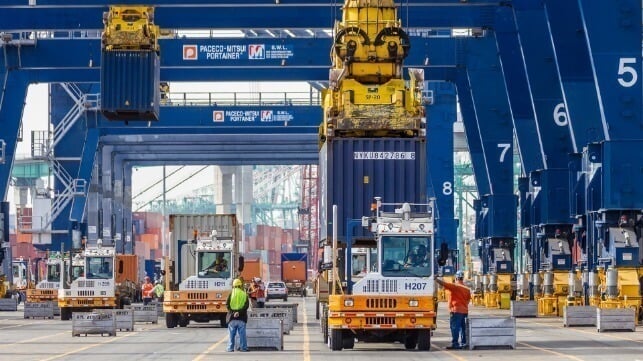
Retailers expect an early peak season and further declines overall in import container volumes (Port of Los Angeles file photo)
In an effort to get ahead of some of the potential price increases due to fuel costs and possible new tariffs from the Trump administration, the National Retail Federation expects retailers to accelerate their import schedule. They believe this will create an early peak season, further aided by soft year-over-year comparisons before import volumes resume their year-over-year declines.
“We expect to see a year-over-year increase this month that’s partly driven by retailers bringing in merchandise early because of higher costs from tariffs or fuel prices that could come starting in August,” said NRF Vice President for Supply Chain and Customs Policy Jonathan Gold. “Nonetheless, the ongoing trend is for lower imports as the conflict in Iran continues to cause higher inflation and economic uncertainty.”
The NRF’s forecast in the Global Port Tracker expects a short-lived bump up in numbers, maintaining levels above an aggregate 2 million TEU per month at the major U.S. ports and year-over-year increases for May (2.14 million TEU) and June (2.25 million TEU). June is likely to be the best month of the year according to the NRF forecast, and put the first half of the year at 12.6 million TEU, up less than one percent over 2025. Also aiding the comparison were the sharp declines in import container volumes after April 2025 and the introduction of Donald Trump’s global reciprocal tariffs, which were later overturned by the courts.
“We have increased our outlook for June cargo volume as retailers bring forward their peak season cargo to mitigate increasing shipping costs as carriers pass along the sharply rising cost of fuel and because of concerns about punitive replacement tariffs,” said Ben Hackett, founder of Hacket Associates. “The current import surge will likely last into July, with an early peak season that resembles the more recent pattern of raised volume rather than a sharp peak. After this, we expect a weakening in import volume as consumer uncertainty remains high and the impact of increasing inflation takes its toll.”
The outlook is for an early peak compared to typical years when imports are strongest in July and August as retailers prepare for key selling seasons. The NRF expects year-over-year declines for July, August, and September and a flat October. The retail trade group has not yet issued its end of year 2026 forecast, but expects that, as tariffs and higher shipping costs remain a concern, imports will remain at lower levels.
NATO IN THE GULF
European Mine-Clearance Force for Strait of Hormuz Forming Up
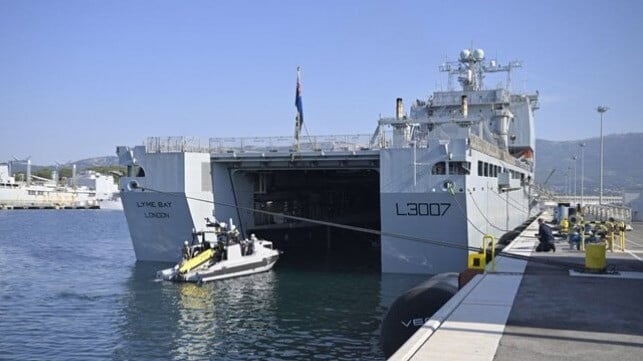
RFA Lyme Bay alongside in Toulon, loading French mine clearance equipment, June 1 (French Navy)
Negotiations between Iran and the United States appear to be continuing, but with misleading statements emerging from both sides as to how much progress is being made. Those leaking information about the negotiations seem more interested in influencing the progress of the talks than in conveying the truth. But it seems likely that both sides are aiming initially for an extension of the ceasefire to then facilitate further negotiations, accompanied by some form of reopening of the Strait of Hormuz.
Despite bluster and bluff, both sides seem keen to find a settlement, President Trump wanting to secure his political position before the midterm elections. Iran needs to gain immediate relief from the crippling economic and financial effects of sanctions and the blockade, with shortages threatening internal unrest in Iran unless resolved quickly. Whether Israel or the Gulf States, who are not direct parties to the negotiations, will be happy with what is agreed bilaterally is far from certain, and these interested outsiders might do much to sabotage any agreement made by Iran and the United States if threats are not removed and freedom of navigation in the Strait of Hormuz is not re-established.
If, however, an extension to the ceasefire is agreed, it would be destabilizing if either Iran or the United States were involved in clearing the Strait of Hormuz, ready for the huge volume of shipping that will seek to either leave or enter the Strait. With the inward and outward channels of the Traffic Separation Scheme (TSS) in the narrows both lying in Omani territorial waters, and as a state that has sought both to remain neutral and observant of the IMO’s existing 1966-based Strait of Hormuz TSS, Oman will be ready to marshal traffic in the Strait from its naval Hormuz Control station on the island of Didamar, which lies mid-Strait.
But clearance of the water from the threat of mines is a very different matter.
Oman’s Maritime Security Centre warned all shipping on May 29 that an object floating close to the inner/northernmost channel of the TSS was probably a sea mine, cautioning shipping to be on special alert and to report any suspicious sightings. Several days later, a well-informed source told The Maritime Executive that about 20 possible floating mines had been identified in high-resolution satellite imagery of the same area. Whatever the case, ship owners will seek to have some assurance that the TSS navigation channels are free of mines before transits commence.
A naval force is forming up to take on the mine clearance mandate. Developed as an Anglo-French coordinated coalition of over 40 nations, the flagship of the force is likely to be the French aircraft carrier FS Charles de Gaulle (R91), which is already in position in the Arabian Sea with escorts including the Royal Navy air defense destroyer HMS Dragon (D35). The UK’s RFA Lyme Bay (L3007) is likely to be the main mothership for the deployment of autonomous mine clearance drones, and having loaded British equipment in Gibraltar on May 26, arrived in Toulon on May 30 to load French autonomous mine clearance equipment. The landing ship dock RFA Lyme Bay is well-suited to the role, having a well deck and being equipped with bow and azimuth thrusters.
More conventional mine clearance capabilities may be delivered by the Italian Navy’s ITS Crotone (M 5558) and ITS Rimini (M 5561), supported by the patrol vessel ITS Montecuccoli (P455), which all left Italy for the Gulf in mid-May. The Dutch minesweeper HNLMS Willemstad (M864) was nearing Gibraltar on June 4.
The German Defense Minister Boris Pistorius has announced the forward deployment to the Mediterranean of the minesweeper FGS Fulda (M1058), with a supporting air defense frigate, the Elbe Class replenishment ship FGS Mosel (A512), and a maritime surveillance aircraft, ready for a move into the Gulf once it is safe.
Many other nations, including those from Asia, have declared readiness to join the force, but integrating non-NATO ships will probably be a second-phase activity once command and control arrangements are well established. Once the force is activated, many ships are likely to use the shore and replenishment facilities at the port of Duqm, which are designed for this purpose and can be short-leased.
EU Imposes Sanctions Calling For Strait of Hormuz Freedom of Navigation
The European Council announced on Monday that it was imposing sanctions, including on Iran’s IRGC, while calling for freedom of navigation through the Strait of Hormuz. The move comes as the Europeans also appear to be setting the stage for a mine clearance program in the Strait of Hormuz.
The Council said it was extending its legal framework targeting those involved in Iran’s actions and policies threatening the freedom of navigation in the Middle East. It said the actions are contrary to international law and infringe upon established rights of both transit and innocent passage through international straits. It also follows the move by the Council in March supporting the UN Security Council resolution while emphasizing the need to ensure maritime security and respect the freedom of navigation.
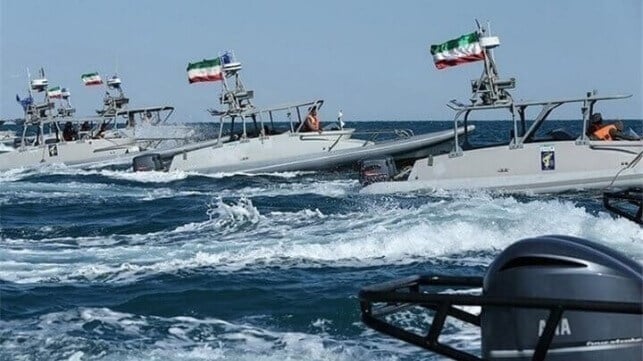
In today’s action, the Council listed the Hormozgan Provincial Command of the Islamic Revolutionary Guard Corps Navy (IRGCN), which was previously listed by the EU. The Council highlighted that the IRGC Navy has assumed control of the Strait of Hormuz and implemented a toll system whereby vessels are now required to provide identifying documentation, as well as cargo and destination information, which is ultimately passed onto the Hormozgan Provincial Command. Using this information, the Hormozgan Provincial Command screens vessels and determines which ones are allowed to transit through the strait, sometimes after paying tolls.
The United States has already sanctioned the tolling system and the launch of Iran’s Persian Gulf Strait Authority. The U.S. said it was a front for the IRGC and IRGC Navy to control the waterway, while Donald Trump has repeatedly said the Strait must be open as part of any peace agreement.
The EU Council reported it also listed two indiivduals which is said were directly supporting Iran’s actions impeding lawful transit passage and freedom of navigation. Mohammad Akbarzadeh, Deputy Commander for Political Affairs of the IRGC Navy and its spokesperson, was included with the Council citing his threats to use missiles or drones against vessels transiting the strait. Hamid Hosseini, a representative of Iran’s Oil, Gas and Petrochemical Products Exporters’ Union and a member of Iran’s Chamber of Commerce, was included for promoting the policy of submitting, undergoing assessment, and paying transit fees to Iranian authorities for safe passage through the Strait of Hormuz.
With today’s listings, the European Council noted that restrictive measures under this amended framework now apply to 26 natural and legal persons and 27 entities from a range of countries. Those listed under the sanctions regime are subject to an asset freeze, and it is prohibited to provide them with funds or economic resources, either directly or indirectly. Additionally, a travel ban to the EU applies to all natural persons listed.
While the Europeans have not formally announced their plan for mine clearance in the Strait of Hormuz, actions appeared to show a force being formed in anticipation of progress in the talks between the United States and Iran. British, French, Italian, Dutch, and German assets all appeared to be moving toward the formation of the effort. It is anticipated that the Europeans would go forward once an agreement and stability are achieved in the region.
Famed Lightship Turned Museum Collides with Sailboat off Germany
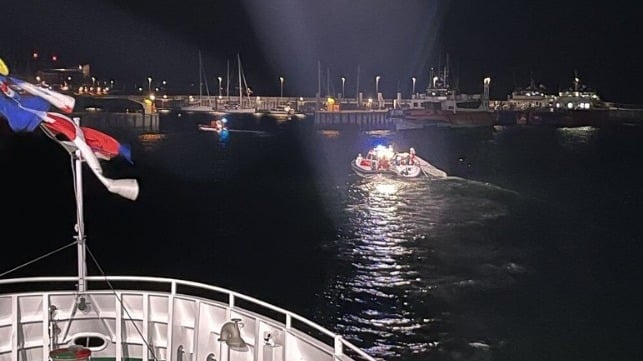
German sea recue teams responded to the badly damaged, demasted sailboat (DGzRS)
Germany’s sea rescue teams responded overnight on June 7 to reports that a historic lightship now operating as a museum ship and an 11.5-meter (nearly 38-foot) sailboat collided approximately one nautical mile off the port of Heligoland, Germany. No one was injured, but the sailboat was demasted and badly damaged in the collision.
The rescue boats Verena and Hermann Marwede, along with the federal government’s vessel Neuwerk were each dispatched to the scene of the collision. Paramedics from the Neuwerk boarded the sailboat and confirmed a Dutch man and woman aboard were uninjured. An engineer from the Hermann Marwede also went aboard to aid in securing the damaged sailboat. The Verena took the sailboat in tow.
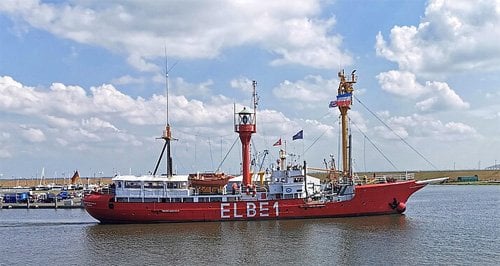
Officials said it was unclear how the two vessels collided. The sailboat was under full sail at the time of the incident, while the lightship Bürgermeister O'Swald was underway returning from several days on display and hosting open ship visits in Wyk auf Föhr, Germany.
The Bürgermeister O'Swald, commonly known as Elbe 1 because of her operating position or Red Lady for her livery, holds the title of the largest lightship ever built. She measures over 57 meters (187 feet) in length, and when in service, had a crew of 27 people. Her light stands 15 meters (49 feet) above the waterline.
Work started on the ship in 1941 at the Jos. L. Meyer Shipyard in Papenburg, but she was delayed and only commissioned in 1948. For the next 40 years, she was the lightship helping to guide vessels traveling on the Elbe, located approximately 15 miles off the busy German seaport of Cuxhaven. During her long career, reports indicate she was struck more than 50 times by vessels sailing on the Elbe. She was retired in 1988, the last lightship to hold the position on the Elbe. Since 1990, she has been a private museum ship.
There were no reports of damage to the lightship. She returned to her berth in Cuxhaven. The Helgoland water police are investigating the cause of the collision.
Despite Iranian Blockade, ADNOC Picks Up Pace of Oil Export Sales
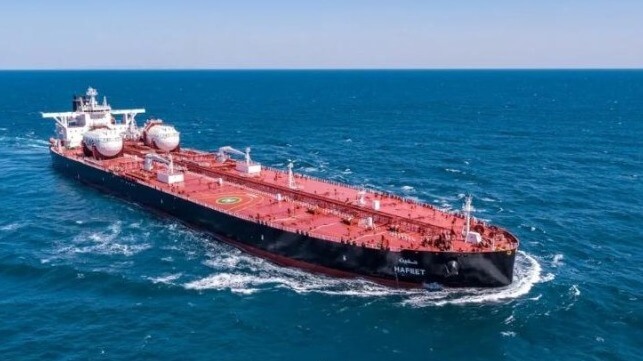
The ADNOC VLCC Hafeet has been linked to Hormuz transits by Reuters (Lana P / VesselFinder)
UAE state oil company ADNOC is selling more of its crude than might be expected given the Iranian blockade of the Strait of Hormuz. This week, it announced a tender for 14 million barrels of oil, including some that has to be delivered from the "bottled-up" side of the strait, according to Bloomberg and Reuters. It is the second such tender in two weeks, and is seen by many as a sign that ADNOC is optimistic about the prospects for peace - or confident in its ability to slip cargoes quietly through the waterway and out to market, even in the absence of a U.S.-Iran ceasefire deal.
Last week's tender offered crude from three Arabian Gulf fields, Upper Zakum, Das and Umm Lulu, all of which load in the Gulf and are normally exported via the Strait of Hormuz.
In past tenders in April, ADNOC reportedly told bidders that it would be able to deliver the crude via ship-to-ship transfer off the coast of Fujairah, in the Gulf of Oman. The deliveries from laden vessels confirm past reporting that ADNOC's oil is arriving on the eastern side of the strait by tanker, as some market participants have quietly intimated for some time.
Reuters first reported on an ADNOC program to send oil through the strait back in early May; the news agency's sources indicated that the oil major has used its own VLCCs to load in the Arabian Gulf and discharge via STS transfer in the Gulf of Oman, braving the risk of Iranian attack in the process. One of these tankers, the Barakah, was hit by two drones and damaged off Oman on May 4. The ship had just discharged via STS transfer and was in ballast, and no injuries were reported.
ADNOC may be moving some cargoes through the waterway, but overall export volumes out of the Gulf region are still far below normal. In May, OPEC export volumes hit a 40-year low. Total vessel crossings (including dry cargo ships) are still little more than a trickle at about eight in total from June 5-7, according to Kpler.
The AFL-CIO's maritime unions are calling for comprehensive cargo policies to generate the revenue base for an American maritime revival. Commercial and government cargo interests often pick foreign-flag carriers when the law allows, since foreign operators are the least-cost option. Since this has a deleterious long-term effect on the health of America's maritime industry, the AFL-CIO's maritime affiliate unions (MEBA, MM&P and SUP) are calling for expanded cargo preference laws to force more government agencies to "Ship American" with taxpayer dollars, along with tax incentives for commercial shippers who choose to move their freight to market on American vessels.
The biggest piece of the puzzle is government cargo. As a freight customer, the federal government does not face the commercial pressures that incentivize private companies to pick the cheapest viable shipping option. Federal cargoes are a critical source of revenue for the U.S.-flagged deep sea fleet, and through "cargo preference" laws, federal agencies are legally required to "Ship American" for most goods - but often don't, and rarely face any penalty for overlooking the law.
"Congress should require regular audits of cargo preference compliance and transparent reporting of violations and corrective actions to Congress," the AFL-CIO wrote. "Congress must codify full U.S.-flag carriage for government cargo and vest clear authority and accountability for non-availability determinations with the Maritime Administrator."
At present, the Cargo Preference Act of 1954 - which governs civilian agencies' cargoes - only requires 50 percent of federal freight to be shipped on American bulkers, boxships and tankers each year. The requirements for military cargoes - governed by a separate act from 1904 - cover 100% of all defense shipments, but may be waived at the discretion of the Secretary of Defense if there is no American vessel "available at a fair and reasonable rate." Military food and clothing cargoes are covered by the strict Berry Amendment to the Buy American Act, which requires that these goods must be made in the United States and then shipped to wherever troops are located; petroleum is not covered by the amendment and can be procured abroad, reducing tonne-mile demand for tanker tonnage.
The current Maritime Administrator - Capt. Stephen Carmel, a longtime maritime executive in Jones Act and U.S.-flagged shipping - has often said that cargo is the linchpin for the revival of American maritime. In budget hearings before Congress last month, Carmel noted that federal petroleum cargoes are in particularly short supply, and that this adds risk to plans for the expansion of the Tanker Security Program fleet of U.S.-flagged tankers.
Tax incentives
In the letter, the AFL-CIO called for significant tax incentives for commercial cargo owners to join in the "Ship America" plan for international cargo shipments. "Congress must amend the Internal Revenue Code to allow an enhanced deduction equal to 200 percent of eligible international shipping expenses incurred by private shippers using qualified U.S.-flag vessels, with vessel eligibility overseen by the Maritime Administration and effective for taxable years beginning after enactment," recommended the union.
In addition, the union called for a significant incentive for American mariners who choose to "go deep-sea." At present, working on a U.S.-flagged ship overseas incurs the same U.S. tax rate as any work within the United States. Instead, the AFL-CIO called for the IRS to extend its Section 911 foreign earned income exclusion to U.S. vessels in international commerce. This would give deep-sea U.S.-flagged shipping a profound recruitment advantage over Jones Act domestic shipping, which would still be exposed to U.S. income tax liabilities; it would also provide a major financial incentive for trained merchant mariners to stay in the industry rather than departing for shoreside employment.