Rights Group Warns Israel’s Genocide Isn’t Over in Gaza
Israel has killed at least 400 Palestinians and injured over 1,100 others since the ceasefire began in October.
By Sharon Zhang ,
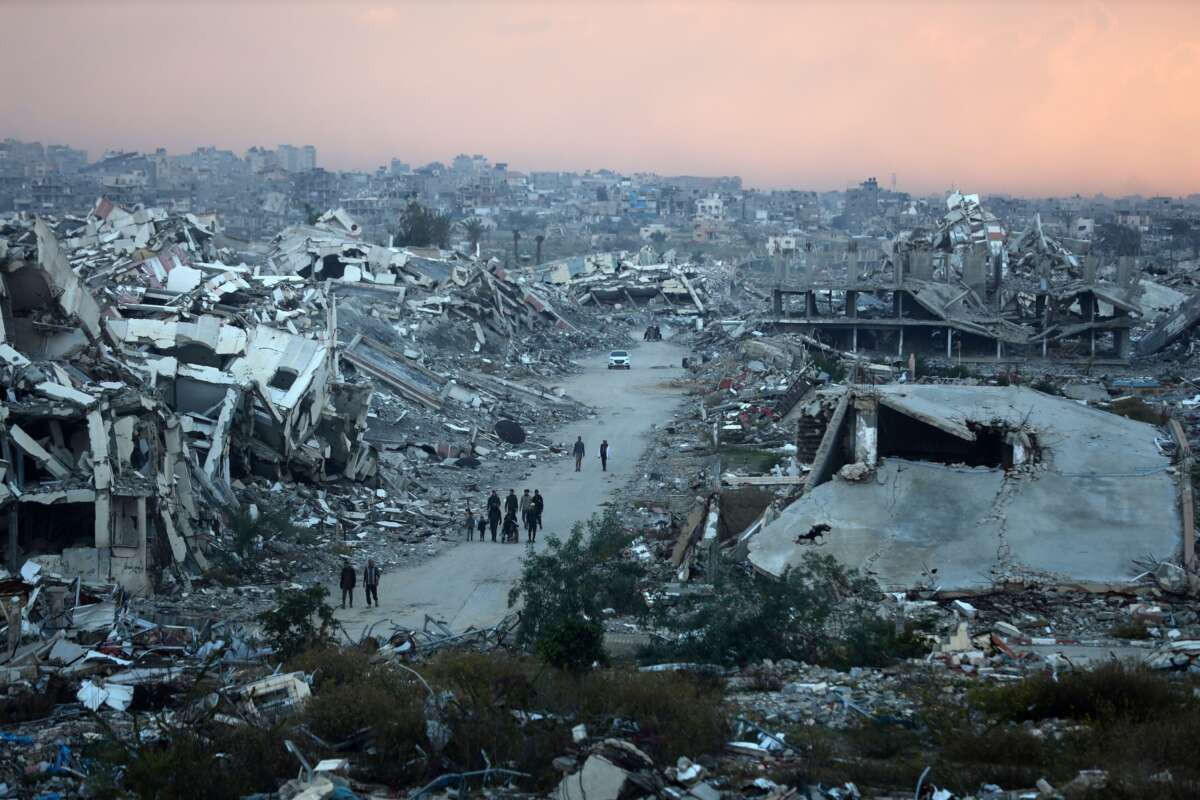
Human rights groups have reiterated that the “ceasefire” deal in Gaza hasn’t stopped Israel from continuing its genocide of Palestinians, killing hundreds in the 12 weeks since the agreement began.
Israeli human rights group B’Tselem said in a statement on Thursday that “the genocide in Gaza is not over.”
“Since the ‘ceasefire’ was declared on 10 October 2025, Israel has been continuing its onslaught on the ground,” the group said. “The so-called ceasefire has been in effect for 75 days. In practice, Israel is continuing its campaign of killing, destruction, displacement and complete control of Palestinians’ lives in Gaza. The international community must stop enabling this façade and take action to help the people of Gaza.”
B’Tselem noted that Israel has killed 405 Palestinians and injured 1,114 since the ceasefire began on October 10 as of Monday, through continued strikes and military attacks.
Just last week, Israeli forces bombed a wedding in Gaza, killing six Palestinians and wounding others as the couple sought to have a moment of joy amid the violence. Gaza officials have said that Israel has committed 875 violations of the ceasefire thus far.
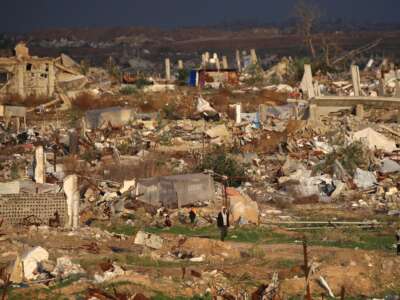
Gaza health officials have also said that several Palestinian children and infants have died due to exposure to cold, wet winter conditions. The UN says that Israel has been blocking food, shelter, and other essential humanitarian supplies like medicine since March, leaving millions exposed to the harshest conditions.
“Refusing to let it in is a choice — one that deprives people inside Gaza of the means to survive and recover,” the UN Relief and Works Agency for Palestine Refugees (UNRWA) said on Friday.
B’Tselem noted that, as of December 16, Israel had only allowed 57 percent of 556 planned aid missions to proceed.
Israel has claimed in public statements that it is allowing the requisite 600 trucks of aid in per day since the ceasefire began, but even Israel’s own internal accounting suggests that authorities have only allowed in 459 trucks per day on average, with a significant proportion consisting of commercial goods; the UN reported earlier this month that only 113 trucks of UN-coordinated aid have been allowed to enter per day on average.
Israel is also continuing to exert control over Palestinians’ lives in other ways, including its ongoing occupation past the “yellow line” in Gaza as well as its continued demolition of buildings in Gaza.
“Nearly 1 million people who lived east of the line before the genocide are now crowded west of it in unlivable conditions,” said B’Tselem.
Amnesty International Secretary General Agnès Callamard shared B’Tselem’s statement, noting that Amnesty has also warned of the farce of the ceasefire. “This is [Amnesty’s] conclusion as well. Israel’s genocide in Gaza is continuing,” Callamard said.
Amnesty warned last month that Israel is “continuing to deliberately inflict conditions of life calculated to bring about [Palestinians’] physical destruction” in Gaza, even after receiving all of the remaining living Israeli captives.
“The ceasefire risks creating a dangerous illusion that life in Gaza is returning to normal. But while Israeli authorities and forces have reduced the scale of their attacks and allowed limited amounts of humanitarian aid into Gaza, the world must not be fooled,” Callamard warned.
Turkey Has A Crucial Role In The Rebuilding Of Gaza – OpEd

A family in Rafah, Gaza. Photo Credit: Tasnim News Agency
By Dr. Sinem Cengiz
After more than two years of Israel’s war on Gaza, a conflict that has left thousands of Palestinians dead, a breakthrough occurred in October with the signing of a US-led Gaza ceasefire agreement in Sharm El-Sheikh, Egypt. With the truce now in place, the time has come to move to the next phase of the agreement: the establishment of an International Stabilization Force.
Turkiye was one of four countries that signed the agreement alongside the US, Egypt, and Qatar. This agreement was not the achievement of a single party, but a collective effort aimed at Gaza’s future. As such, each signatory bears significant responsibility for implementing it.
President Recep Tayyip Erdogan’s personal diplomacy with the leaders of the other guarantor states, along with the constructive dialogue maintained by Turkish institutions, including the Foreign Ministry and intelligence services, with their regional counterparts, helped bring the process to this stage. However, Israel continues to pursue a spoiler strategy to disrupt the process. The main pretext for this strategy is Turkiye’s inclusion.
There are now growing divergences between the US and Israel regarding Turkiye’s role. Washington’s position is clear: It considers Turkiye’s role crucial and supports its inclusion in the post-Gaza framework. Regional countries share this view, seeking to broaden regional cooperation for Gaza by involving all key actors. Turkiye maintains close ties with all four guarantor states. Qatar is a key ally, working closely with Ankara to bring Hamas to the negotiating table and encourage the group toward disarmament. Egypt, particularly after the normalization of ties with Ankara, has strengthened its security cooperation with Turkiye. The Gaza war has further consolidated Turkish-Egyptian relations, as Cairo increasingly views Turkiye as a reliable security actor in the region, despite disagreements over some aspects of its foreign policy.
For Washington, including Turkiye in post-war arrangements is essential, particularly regarding Hamas’ position. On Wednesday, Turkish Foreign Minister Hakan Fidan met Hamas political bureau officials in Ankara to discuss the Gaza ceasefire and advancing the agreement to its second phase. On Monday, US Ambassador to Turkiye Tom Barrack met Israeli Prime Minister Benjamin Netanyahu in an effort to ease Israeli concerns about Turkiye. However, a real breakthrough is likely to depend on the meeting between Netanyahu and US President Donald Trump in Florida, scheduled for Monday. This will be the latest attempt to revive the Gaza plan, which aims to move from a ceasefire toward a new governing arrangement in Gaza, the deployment of a peacekeeping force, and the disarmament of Hamas.
In this meeting, even if Trump appears to agree — unwillingly — with Israel’s veto on Turkiye, mediators such as Egypt and Qatar will keep pressure to have Turkiye on their side. If Trump fails to convince Israel on Turkiye’s inclusion, then it is expected to at least initially push for a Turkish role framed as “symbolic” or limited. For Ankara, this would not be a problem. Turkiye is not insisting on a leading role in post-war arrangements; rather, it seeks to complement the roles played by Egypt, Qatar, and other regional actors. A secondary role does not conflict with Turkiye’s vision for Gaza.
However, even a limited Turkish role remains a concern for Israel, which views any Turkish troops in Gaza as crossing a “red line.” This reflects Israel’s long-standing rejection of deploying Turkish troops in the territory. In reality, Israel’s opposition stems from its desire to maintain maximum operational freedom in Gaza.
Moreover, Israel, whose forces are exhausted after prolonged operations and which lacks a naval force, is particularly concerned about Turkiye’s military and intelligence capabilities in the region. Israel argues that Turkiye’s relations with Hamas, which Ankara views as a liberation movement rather than a terrorist organization, is the problem. However, Hamas’ disarmament depends on the establishment of a new Palestinian governing entity and the presence of international peacekeepers, with Turkiye acting as a guarantor. In reality, without Turkiye’s involvement, the disarmament of Hamas may not even be realized. Turkiye has already played a prominent role in the first phase of the Gaza agreement, including efforts to secure the return of hostages. Trump himself acknowledges this and publicly thanked Ankara for using its influence to encourage Hamas to accept the peace plan.
Turkiye is, therefore, an indispensable actor and guarantor, given its active communication channels with Hamas, experience in humanitarian operations, and significant military and reconstruction capabilities. It has decades of experience in post-conflict zones across the world and is now ready to contribute to one of the world’s toughest post-conflict areas through all means if possible. According to reports, Turkiye has already planned to have roughly 2,000 personnel, including ground forces, as well as specialists in logistics and explosive ordnance disposal, for potential participation in the peacekeeping force.
Given Trump’s good relations with Erdogan, it is likely that he will try to bring options to assign Turkiye a role in the ISF. These roles may not — at the first stage — include Turkish troops patrolling in Gaza but may have a critical role in shaping policy and rebuilding the enclave. If Netanyahu continues to reject Turkiye’s inclusion, it is time for Washington to come up with a concrete plan for the second phase of the agreement in the meeting with the Israeli leader. Rather than attempting to fully convince him — given that he views Turkiye’s presence as an existential threat — the goal should be to reach a point where he agrees to disagree while allowing the process to move forward.
• Dr. Sinem Cengiz is a Turkish political analyst who specializes in Turkiye’s relations with the Middle East. X: @SinemCngz
Arab News
Arab News is Saudi Arabia's first English-language newspaper. It was founded in 1975 by Hisham and Mohammed Ali Hafiz. Today, it is one of 29 publications produced by Saudi Research & Publishing Company (SRPC), a subsidiary of Saudi Research & Marketing Group (SRMG).
No comments:
Post a Comment