Experts Question Russia's Ability and Desire to Attack NATO
- Senior European officials, including NATO chief Mark Rutte and top German and Polish generals, have issued frequent and serious warnings in 2025 about the possibility of a direct conflict with Russia.
- Skeptics argue that Russia's inability to subdue Ukraine and the lack of concrete evidence for an immediate attack suggest these warnings may be used to push NATO members to meet defense spending commitments or gain political leverage.
- The long-term risk of a military provocation is considered likely, especially if the war in Ukraine freezes, though the timeline for a full-scale attack on a NATO member like Estonia is debated, ranging from the near future to 5-10 years away.
The polite applause faded and NATO chief Mark Rutte arranged his papers neatly on the rostrum. It took him 62 seconds to get to the point.
“The dark forces of oppression are on the march again,” he said. “We are Russia’s next target.”
Rutte’s speech in Berlin on December 11 was just the latest in an unprecedented series of warnings of direct conflict with Russia made in 2025 by senior European officials and intelligence agencies.
In February, Danish intelligence said “Russia sees itself in conflict with the West and is preparing for a war against NATO;” in June, Germany’s top general said an attack may come within four years; in November, his words were echoed by his Polish counterpart -- two days after German Defense Minister Boris Pistorius said “some military historians even believe we have already had our last summer of peace.”
This list of warnings is far from exhaustive. Rutte has been most frequent.
In January, he urged NATO members to hike defense spending or get Russian language classes, while in June he said an attack could be coordinated with a Chinese assault on Taiwan.
His December 11 speech was his loudest alarm bell yet, speaking of “the scale of war our grandparents or great-grandparents endured” with “mass mobilization, millions displaced.”
What's Behind The Warnings?
The frequent comments have made headlines -- and raised question marks, especially with the United States showing waning interest in maintaining the levels of security support it has given Europe in the past.
“This is something that I’ve been pondering especially as there is no evidence at all that Russia can or wants to attack NATO,” John Foreman, a former British military attache in Moscow and Kyiv, told RFE/RL.
“I think a number of politicians and military types are using the specter of the Russian threat for more prosaic reasons: Rutte to encourage NATO nations to meet their spending commitments. The Poles to get more NATO on their territory,” he added.
Other skeptics have pointed out that after nearly four years of war Russia has been unable to subdue Ukraine -- even if it has been edging forward this year at enormous cost in casualties and equipment.
Teemu Tammikko, from the Finnish Institute of International Affairs, also said that Russia did not appear “willing and able to attack NATO for the moment.”
But he told RFE/RL’s Russian Service that President Vladimir Putin’s grip on power was “dependent on an external threat,” meaning “in the longer term, some kind of direct military provocation is likely, especially if the war in Ukraine freezes.”
Some argue this is already happening, such as with Russian drone and air incursions into NATO airspace. But the warnings issued this year hint at much darker scenarios.
Attack On Estonia
A paper issued by the European Council on Foreign Relations (ECFR) on December 18 focuses on fears of a direct attack on Estonia to test the willingness of the United States and other NATO allies to fight.
“In Europe, this anxiety sits atop a deeper fear: that the American government, distracted by domestic politics and tempted by retrenchment, might soon reduce its presence or attach conditions to its role in Europe’s defense,” it says.
Describing Estonia as “small, flat, and exposed,” the report says a 2016 wargame predicted Russian forces could seize the capital within 60 hours of an invasion.
But it also says that Russia would need 5-10 years after the end of the war in Ukraine “to refit and rearm for such an attack” -- a much longer timeframe than those posited by Rutte, Pistorius, and others.
It’s notable that US officials have not repeated European warnings.
The recently released National Security Strategy argues that “European allies enjoy a significant hard power advantage over Russia by almost every measure, save nuclear weapons.”
But it also acknowledges the need for US diplomatic engagement “to mitigate the risk of conflict between Russia and European states.”
'Warmongers'
Kremlin officials have denounced European leaders as “warmongers” and denied any desire to attack. They were making similar comments about Ukraine on the eve of their full-scale invasion in February 2022, though this does not automatically mean there are plans for further aggression.
“Russia is not pursuing the military goals attributed to our country,” Deputy Foreign Minister Sergei Ryabkov said on December 22. “As the President of Russia has already said, we are even prepared to guarantee this legally as part of a settlement” of the war in Ukraine, he added.
But any such commitment would be unlikely to be taken seriously by many in the West. Russia also signed and then broke promises to respect Ukraine’s borders in the 1994 Budapest Memorandum.
Ultimately, it may all depend on one man.
“As we know, Russia is not a democracy. Such a decision would essentially just be a result of Vladimir Putin deciding that he wanted to attack a European country which is a NATO member state, or another European country, so we just have no way of knowing,” Elizabeth Braw, of the RUSI defense and security think tank, told RFE/RL’s Russian Service.
“That's why you see military leaders all over Europe saying we have to be prepared for something to happen tomorrow. It may happen five years, 10 years from now or never, but you can't bank on it.”
By RFE/RL
Vessels Damaged as Russia Intensifies Attacks on Ukraine’s Ports
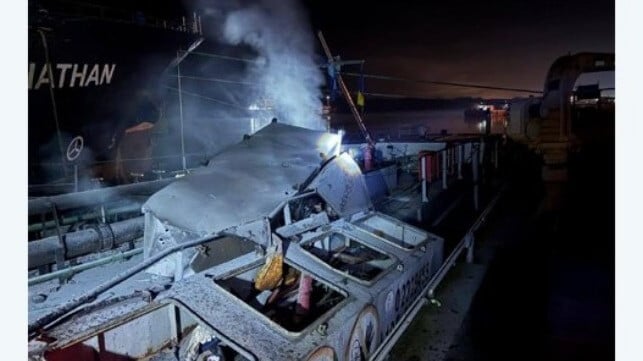
Russia appears to be intensifying its assault on the Black Sea ports of Ukraine. The relentless barrage continued for a second night at the Port of Odesa with reports of damage to multiple vessels and port infrastructure.
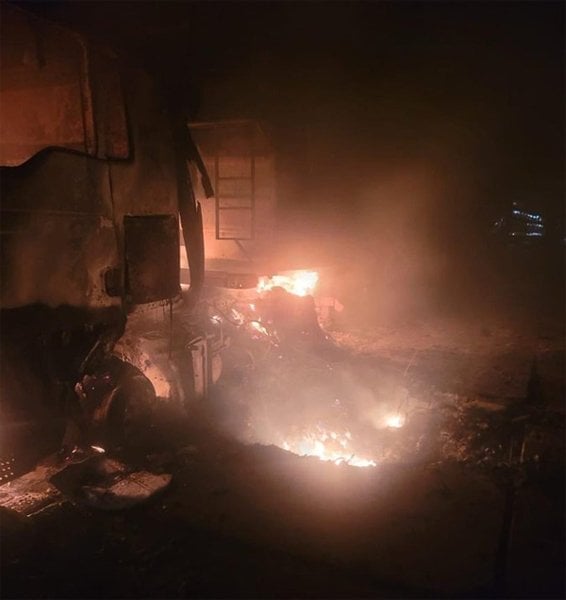
Ukraine says the attack consisted of 99 drones and one ballistic missile. They reported shooting down or jamming 73 of the drones, but 26 struck 16 locations in Ukraine.
It was the second consecutive night of strikes in Odesa, causing damage to administrative buildings, grain elevators, other equipment, and warehouses. A cargo ship registered in Palau and a barge owned by Slovakian interests were both reported damaged in the port. The barge named Majestic, the Slovakian officials said, had been damaged in a previous attack and was no longer seaworthy. No Slovakians were aboard the vessel, they reported.
Ukraine said there were no injuries from the latest attack. The previous night, one person was killed, and two others were injured.
(Oleksii Kuleba photo)
The officials asserted that Russia has escalated the attacks on the region after vowing to cut off Ukraine from the Black Sea after the attacks on the oil tankers. The Ukrainians assert that Russia is deliberately destroying energy and civilian infrastructure, leaving people without power, water, and heating amidst the cold winter temperatures. They assert that Russia has increased its focus on destroying logistics through the seaport attacks, aiming at the Ukrainian economy and food security.
Beyond Odesa, there were reports of strikes in the Izmail district that also damaged port infrastructure.
A drone strike on the terminal at Mykolaiv region damaged a vessel registered in Liberia.
Ukrainian officials said efforts were underway to restore the damage to the power system. Port workers are reported to be surveying the extent of the damage.

No comments:
Post a Comment