With sea levels rising and warmer oceans fuelling more powerful waves, France is preparing to lose 500,000 hectares of coastline by 2100. People in one coastal community in the south-west tell RFI why they're sacrificing some structures to the advancing sea.
Issued on: 19/01/2026 - RFI
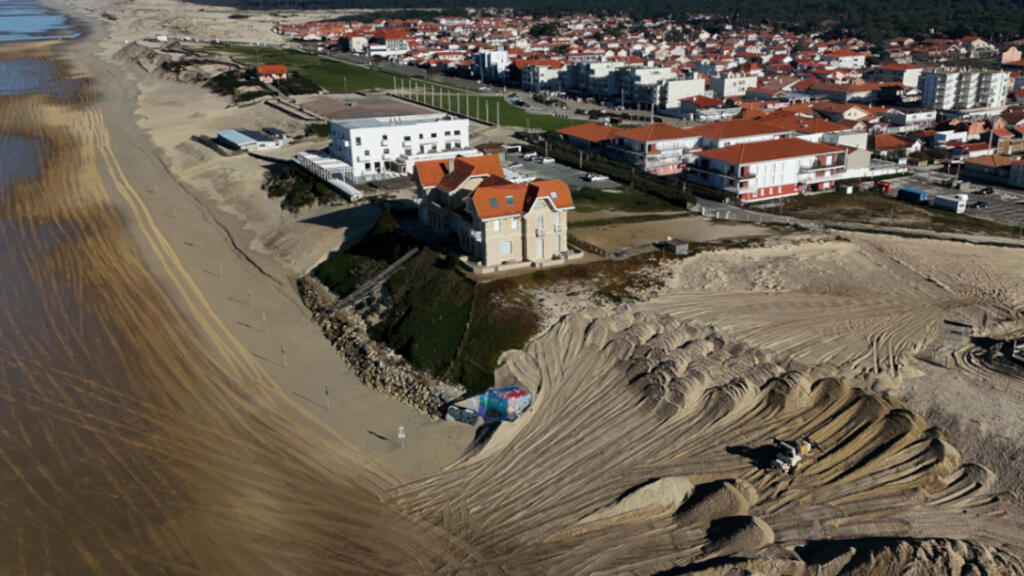
A mechanical excavator brings sand to reinforce dunes next to buildings threatened by coastal erosion in Biscarosse, south-western France, on 17 January 2025
. © Christophe ARCHAMBAULT / AFP
Winter is storm season in Labenne, a seaside resort on France's southern Atlantic coast.
On the beach, a World War II bunker is half buried by the dunes. The lifeguard station will soon be overtaken too; the town council has had to build another one, farther from the beach.
"We're well aware that even the beach car park is doomed to disappear," says Stéphanie Chessoux, Labenne's mayor.
"Like businesses, we will have to take this natural progression into account. The elements are reclaiming their rights."
Surrendered to sea and sand
This part of France loses around two metres of coast a year to erosion.
In Labenne, more and more land has turned into sand dunes. They surround the site of the town's former sanatorium, where tuberculosis patients once came to breathe the sea air.
Constructed in the 1920s, the concrete building contained asbestos, presenting health risks as it fell into disrepair. Local authorities had it demolished last October.
Winter is storm season in Labenne, a seaside resort on France's southern Atlantic coast.
On the beach, a World War II bunker is half buried by the dunes. The lifeguard station will soon be overtaken too; the town council has had to build another one, farther from the beach.
"We're well aware that even the beach car park is doomed to disappear," says Stéphanie Chessoux, Labenne's mayor.
"Like businesses, we will have to take this natural progression into account. The elements are reclaiming their rights."
Surrendered to sea and sand
This part of France loses around two metres of coast a year to erosion.
In Labenne, more and more land has turned into sand dunes. They surround the site of the town's former sanatorium, where tuberculosis patients once came to breathe the sea air.
Constructed in the 1920s, the concrete building contained asbestos, presenting health risks as it fell into disrepair. Local authorities had it demolished last October.
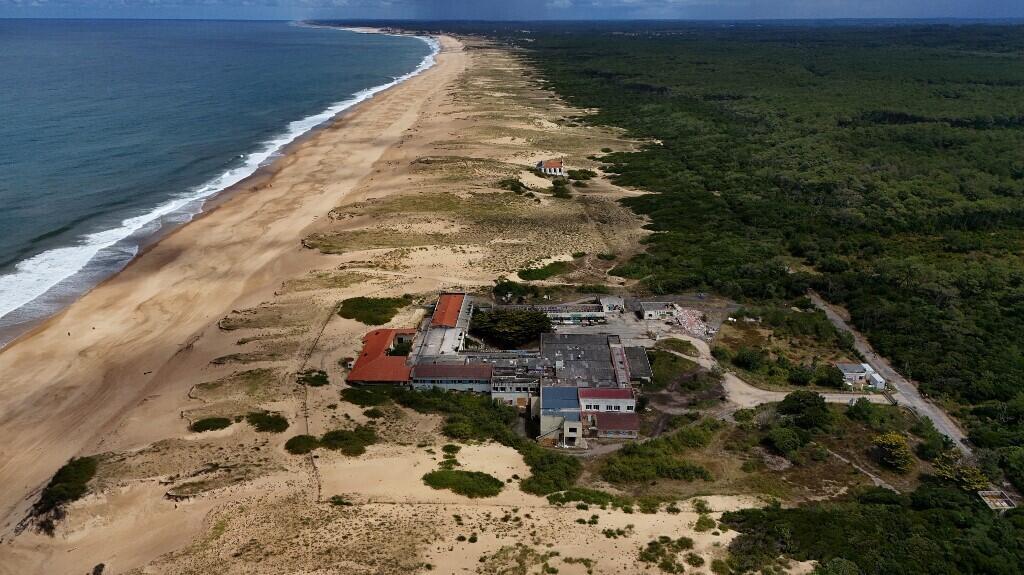
An aerial view of the old sanatorium before it was demolished, by the Atlantic ocean in Labenne, south-western France, on 24 July 2025.
© AFP - CHRISTOPHE ARCHAMBAULT
"The ocean has advanced, but the building also deteriorated due to its proximity to the ocean, sand and salty air, which wore down everything made of metal inside the concrete," explains Laure Guilhem-Tauzin of the Coastal Protection Agency, where she focuses on the Aquitaine region.
By knocking the structure down, "the idea was first and foremost to give nature back its rights and prevent marine pollution in the medium term", she says.
"And also to prevent an investor who underestimated the costs of investment and depreciation from redeveloping the building, which would have had to be demolished 15 or 20 years later."
French towns left uninsured as climate change increases risks
"The ocean has advanced, but the building also deteriorated due to its proximity to the ocean, sand and salty air, which wore down everything made of metal inside the concrete," explains Laure Guilhem-Tauzin of the Coastal Protection Agency, where she focuses on the Aquitaine region.
By knocking the structure down, "the idea was first and foremost to give nature back its rights and prevent marine pollution in the medium term", she says.
"And also to prevent an investor who underestimated the costs of investment and depreciation from redeveloping the building, which would have had to be demolished 15 or 20 years later."
French towns left uninsured as climate change increases risks
Nature-based solutions
Now, the 12,000-square-metre site is being turned over to a project to plant vegetation that can help stabilise the sand.
The area will be planted with species adapted to growing on dunes, says Guilhem-Tauzin. "It traps sand and holds the dunes in place. When there are storms, it stops the sand going inland."
The project is an example of "nature-based solutions", she explains, which are often the most effective. "A floodable marsh protects a green space behind the coast better than a sea wall, which can break in one go."
Across France, as many as 50,000 buildings could be threatened by shrinking coastlines by 2100.
In the long term, some experts say the country will have to consider more radical options, such as managed retreat – moving communities away from the coast and allowing the sea to reclaim low-lying land.
No comments:
Post a Comment