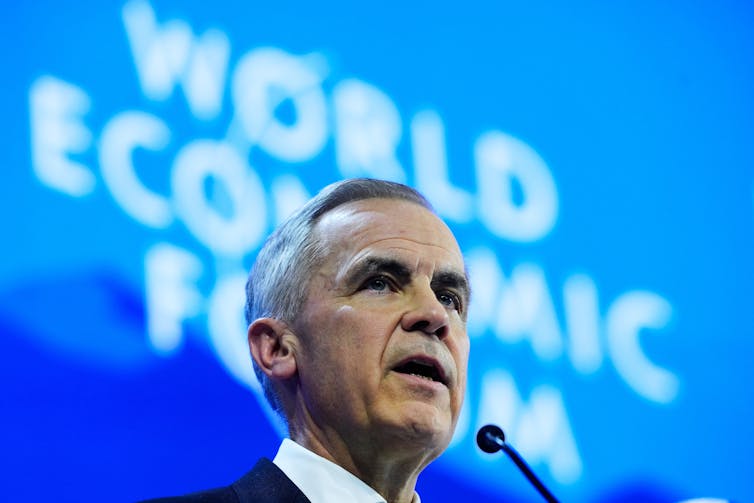
Prime Minister Mark Carney speaks during the Annual Meeting of the World Economic Forum in Davos, Switzerland, on Jan. 20, 2026.
(AP Photo/Markus Schreiber)
Published: January 21, 2026
THE CONVERSATION
It was a moment of global clarity. Prime Minister Mark Carney’s speech to the world’s political and economic elite gathered in Davos this week described global realities, past and present, with a candour and nuance rarely heard from a serving politician.
The message was twofold.
First, Carney made clear that the world has changed, and the old comfortable ways of global politics are not coming back. Those who wait for sanity to return are waiting in vain. We are in a world increasingly shaped by the threat and the use of hard power. All states must accept that reality.
Despite this, Carney’s second and more hopeful message was that while the globally powerful may act unilaterally, others — notably “middle powers” like Canada — are not helpless.
By finding ways to co-operate on areas of shared interest, states like Canada can pool their limited resources to build what amounts to a flexible network of co-operative ties. Taken together, they can provide an alternative to simply rolling over and tolerating whatever great powers like the United States dole out.
There’s also little choice in the matter if countries want to remain independent. As he eloquently put it: “If we’re not at the table, we’re on the menu.”
From ‘elbows up’ to capitulation and back
The speech represented a remarkable departure from Canada’s usual approach to its relationship its neighbour to the south.
For all the talk of “elbows up” during the 2025 federal election campaign, the Carney government has been somewhat ambivalent since then. It’s placed its hopes in achieving a renewed trading relationship and normalized relations with the U.S. through a combination of good faith negotiations and a steady stream of conciliatory gestures on issues that seemed to matter most to U.S. President Donald Trump.
That resulted in Canada committing significant funds to combat a largely non-existent fentanyl trafficking problem and to meet American demands for increased military funding. At times the conciliation verged on placation, as when Canada unilaterally ended relatiatory tariffs on American goods to no discernible effect.
This strategy clearly was not working, however, as Carney made clear in Davos.
While neither America, nor Trump, were mentioned by name, there’s no doubt who’s driving the dramatic global changes Carney was describing. At times the veneer became very thin as Carney reiterated Canada’s support for the sovereignty of Greenland as a territory of Denmark.
In fact, the speech was remarkably blunt in its rebuke of America’s foreign policy during Trump’s second term, drawing attention, as others have, to how U.S. actions leave almost everyone, including Americans, worse off
.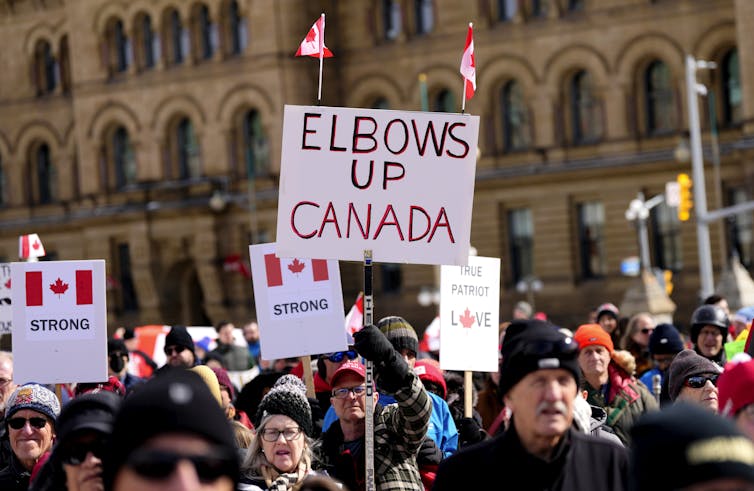
People participate in a rally in response to U.S. President Donald Trump’s threats to Canadian sovereignty on Parliament Hill in Ottawa in March 2025. THE CANADIAN PRESS/Justin Tang

People participate in a rally in response to U.S. President Donald Trump’s threats to Canadian sovereignty on Parliament Hill in Ottawa in March 2025. THE CANADIAN PRESS/Justin Tang
Trump’s response
That not-so-subtle barb was not lost on the audience, either in the room or across the Atlantic in the White House.
Trump wasted little time in firing back in the manner and style the world has become accustomed to. During his own address to the World Economic Forum the next day, Trump delivered a rambling and at times confusing speech.
He reiterated his intent to annex Greenland while confusing the island multiple times with neighbouring and also sovereign Iceland, and he took time to single out Carney by name.
“Canada lives because of the United States,” he said. “Remember that, Mark, next time you make your statements.”
The comments provided helpful proof of Carney’s argument, demonstrating the naked threat of power by the American president to coerce its neighbour and ostensible ally. It revealed the kind of “gangster” mindset we see often from Trump, as he effectively said: “Nice country, Mark. Be a shame if something happened to it.”
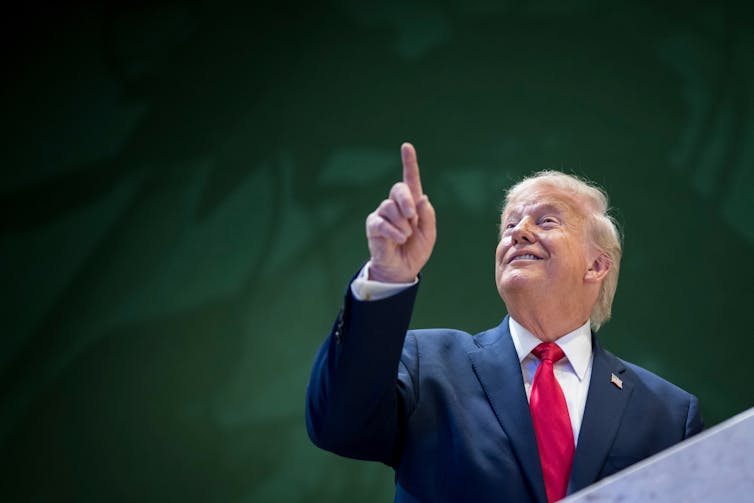
U.S. President Donald Trump gestures in the hallway after his special address during the 56th annual meeting of the World Economic Forum in Davos, Switzerland, on Jan. 21, 2026. (Gian Ehrenzeller/Keystone via AP)
Critique of past
As blunt as Carney’s assessment of the present was — that the rules-based, liberal international order has faded away — in some ways his critique of the past was even more remarkable. The prime minister spoke with a candour one wouldn’t expect to find at the podium at Davos.
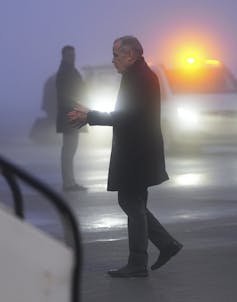
Prime Minister Mark Carney departs Zurich, Switzerland on Jan. 21, 2026, after attending the annual World Economic Forum in Davos. THE CANADIAN PRESS/Sean Kilpatrick
Effectively, Carney correctly characterized the old order as one defined as much by its hypocrisy as by its rules. He acknowledged that countries like Canada benefited from a system in which rules are applied unevenly, and superpowers continue to shape outcomes.
This idea, along with the need to look ahead in order to survive a new order, appeared to underpin Carney’s exhortation not to mourn the rapidly vanishing old order.
Carney clearly hopes a new system may emerge that is not only more resilient to diverse and unpredictable threats, but is more honest and just.
By finding common ground on shared issues, middle powers can act in accordance with their own values and interests, instead of deferring to the proclaimed values of global power that are frequently violated in practice. Power will always matter, but it doesn’t have to be all that matters.
Effectively, Carney correctly characterized the old order as one defined as much by its hypocrisy as by its rules. He acknowledged that countries like Canada benefited from a system in which rules are applied unevenly, and superpowers continue to shape outcomes.
This idea, along with the need to look ahead in order to survive a new order, appeared to underpin Carney’s exhortation not to mourn the rapidly vanishing old order.
Carney clearly hopes a new system may emerge that is not only more resilient to diverse and unpredictable threats, but is more honest and just.
By finding common ground on shared issues, middle powers can act in accordance with their own values and interests, instead of deferring to the proclaimed values of global power that are frequently violated in practice. Power will always matter, but it doesn’t have to be all that matters.
History in the making?
Carney’s Davos remarks were powerful by any measure. But will he back up his words with action in the months and years ahead?
His speech was met with a rousing standing ovation, and has justly received plaudits from around the world for its clear-eyed description of a less forgiving world order and its vision for how states like Canada can continue to thrive within it.
Whether it proves a speech for the ages, however, depends on what happens next. If Canada is serious about charting a new path, distinct from the great powers of the world, it must do more than talk. Acts like deploying symbolic forces to Greenland if necessary will show a seriousness of purpose. Canada cannot expect others to stand with it if it doesn’t stand with them.
Similarly, Canada must reject schemes like Trump’s “board of peace,” a thinly disguised attempt to replace institutions of global governance with a body composed by and serving at the president’s whim.
Carney has captured the world’s attention with this speech. There’s a lot hanging on what he does with that attention.
One venue, two speeches – how Mark Carney left Donald Trump in the dust in Davos
 Canadian prime minister, Mark Carney, gained widespread approval for his Davos speech, which he delivered in French and English. EPA/Gian Ehrenzeller
One leader donned the cloak of statesmanship at Davos this week. It wasn’t Donald Trump
Published: January 21, 2026
Mark Carney delivers his speech at Davos, January 21 2026.
Contrasting visions
The coming year is one of inflection for Trump’s presidency. His Republican party may well lose control of the House and possibly the Senate in the November midterms, which would severely curtail his ability to impose his will unfettered.
Trump is focused on his legacy and demands he’s up there with former US presidents Thomas Jefferson, James Monroe, James Polk and William McKinley, expanding the American empire and its physical footprint. This may be a step too far, even for a president with such vast economic and military power.

Disclosure statement
Mark Shanahan has a new edited collection of essays, Trump Unbound, due for publication by Palgrave Macmillan in October 2026.

One leader donned the cloak of statesmanship at Davos this week. It wasn’t Donald Trump
THE CONSVERSATION
The meeting and venue were the same, but the style and tone of the two most anticipated keynote speeches at the World Economic Forum in the Swiss town of Davos could not have been more different. On Tuesday, January 20, Canadian prime minister Mark Carney addressed the assembled political and business leaders as one of them: a national leader with deep expertise in finance.
He spoke about a “rupture” in the world order and the duty of nations to come together through appropriate coalitions for the benefit of all. It was a paean to multilateralism, but one that recognised that the US would no longer provide the glue to hold alliances together. Carney never mentioned the US by name in his speech, instead talking of “great powers” and “hegemons”.
Carney’s quiet, measured and evocative case-making demonstrated his ability to be the leader France’s Emmanuel Macron would like to be and the UK’s Keir Starmer is too cautious to be. He was clear, unequivocal and unafraid of the bully below his southern border. In standing up to the US president, Donald Trump, he appeared every inch the statesperson.
The meeting and venue were the same, but the style and tone of the two most anticipated keynote speeches at the World Economic Forum in the Swiss town of Davos could not have been more different. On Tuesday, January 20, Canadian prime minister Mark Carney addressed the assembled political and business leaders as one of them: a national leader with deep expertise in finance.
He spoke about a “rupture” in the world order and the duty of nations to come together through appropriate coalitions for the benefit of all. It was a paean to multilateralism, but one that recognised that the US would no longer provide the glue to hold alliances together. Carney never mentioned the US by name in his speech, instead talking of “great powers” and “hegemons”.
Carney’s quiet, measured and evocative case-making demonstrated his ability to be the leader France’s Emmanuel Macron would like to be and the UK’s Keir Starmer is too cautious to be. He was clear, unequivocal and unafraid of the bully below his southern border. In standing up to the US president, Donald Trump, he appeared every inch the statesperson.
Mark Carney delivers his speech at Davos, January 21 2026.
Then, on January 21, Trump took the stage. There was none of Carney’s self-awareness and nor did he read the room recognising the strengths, talents and economic power of the audience. Trump started with humour, noting he was talking to “friends and a few enemies”.
But he quickly shifted to a riff on the greatest hits of the first year of Trump 2.0 with the usual weaving away from his script down the rabbit holes of his perceived need for vengeance. Joe Biden still takes up far too much of Trump’s head space, but the next hour could be summed up as: “Trump great: everyone else bad.”
The president is the most amazing hype man for his own greatness, but it’s a zero-sum game. For him to win, others must lose, whether that’s the UK, Macron or the unnamed female prime minister of Switzerland whom he mocked for the poverty of her tariff negotiation skills. It’s worth noting Switzerland has no prime minister and its current president is a man.
While Carney was at pains to connect with his audience of allies, Trump exists happily in his own world where support – and sovereign territory – can be bought, and fealty trumps all. As ever, Trump played fast and loose with facts, wrapping real successes, aspirations and his unique view of the truth into a paean to himself.
He actually returned to his script to make the case for taking Greenland. The case is built on a notional need for “national and international security”, underscored by pointing out the territory is “in our hemisphere”. As so many commentators have said, collective security will do the job Trump insists that only the US can – and won’t require Denmark to cede territory. But Trump is sounding ever-less the rational actor.
But he quickly shifted to a riff on the greatest hits of the first year of Trump 2.0 with the usual weaving away from his script down the rabbit holes of his perceived need for vengeance. Joe Biden still takes up far too much of Trump’s head space, but the next hour could be summed up as: “Trump great: everyone else bad.”
The president is the most amazing hype man for his own greatness, but it’s a zero-sum game. For him to win, others must lose, whether that’s the UK, Macron or the unnamed female prime minister of Switzerland whom he mocked for the poverty of her tariff negotiation skills. It’s worth noting Switzerland has no prime minister and its current president is a man.
While Carney was at pains to connect with his audience of allies, Trump exists happily in his own world where support – and sovereign territory – can be bought, and fealty trumps all. As ever, Trump played fast and loose with facts, wrapping real successes, aspirations and his unique view of the truth into a paean to himself.
He actually returned to his script to make the case for taking Greenland. The case is built on a notional need for “national and international security”, underscored by pointing out the territory is “in our hemisphere”. As so many commentators have said, collective security will do the job Trump insists that only the US can – and won’t require Denmark to cede territory. But Trump is sounding ever-less the rational actor.
Contrasting visions
The coming year is one of inflection for Trump’s presidency. His Republican party may well lose control of the House and possibly the Senate in the November midterms, which would severely curtail his ability to impose his will unfettered.
Trump is focused on his legacy and demands he’s up there with former US presidents Thomas Jefferson, James Monroe, James Polk and William McKinley, expanding the American empire and its physical footprint. This may be a step too far, even for a president with such vast economic and military power.
Donald Trump’ delivers his speech at Davos, January 21 2026.
Carney’s speech played well both at home and around the world. His line, “If we’re not at the table, we’re on the menu,” clearly resonated with his fellow western leaders. His vision for how “the power of legitimacy, integrity and rules will remain strong if we choose to wield them together”, also offered a positive vision in a dark time.
Trump told the audience that he would not use “excessive strength of force” to acquire Greenland. But, ever the real estate developer, he demanded “right, title and ownership” with an ominous threat: “You can say no – we will remember.”
As Trump laid out his grand vision of protecting and cherishing the rich and aligning nations to do America’s bidding, it was in stark contrast to Carney. The hyperbole and self-aggrandising, the insults and threats, and the singular vision of seeing the world only through the personal impact it has on him mark the US president out as remarkable, even exceptional.
But is this the exceptionalism the US wants? Is America about more than the strongman politics of economic and military coercion?
The immediate reaction in the US was relief, jumping on the line that Trump won’t take Greenland by force. It will be telling to look at the commentary as the country reflects on the president’s aim of lifting America up, seemingly by dragging the rest of the world down.
One leader donned the cloak of statesmanship at Davos this week. It wasn’t Donald Trump
Trump told the audience that he would not use “excessive strength of force” to acquire Greenland. But, ever the real estate developer, he demanded “right, title and ownership” with an ominous threat: “You can say no – we will remember.”
As Trump laid out his grand vision of protecting and cherishing the rich and aligning nations to do America’s bidding, it was in stark contrast to Carney. The hyperbole and self-aggrandising, the insults and threats, and the singular vision of seeing the world only through the personal impact it has on him mark the US president out as remarkable, even exceptional.
But is this the exceptionalism the US wants? Is America about more than the strongman politics of economic and military coercion?
The immediate reaction in the US was relief, jumping on the line that Trump won’t take Greenland by force. It will be telling to look at the commentary as the country reflects on the president’s aim of lifting America up, seemingly by dragging the rest of the world down.
One leader donned the cloak of statesmanship at Davos this week. It wasn’t Donald Trump
Author
Disclosure statement
Mark Shanahan has a new edited collection of essays, Trump Unbound, due for publication by Palgrave Macmillan in October 2026.
.

No comments:
Post a Comment