The infringement of Muslims’ religious rights has intensified in ICE jails under Trump 2.0, civil rights advocates say.
By Marianne Dhenin ,
Truthout/TheAppeal
March 18, 2026
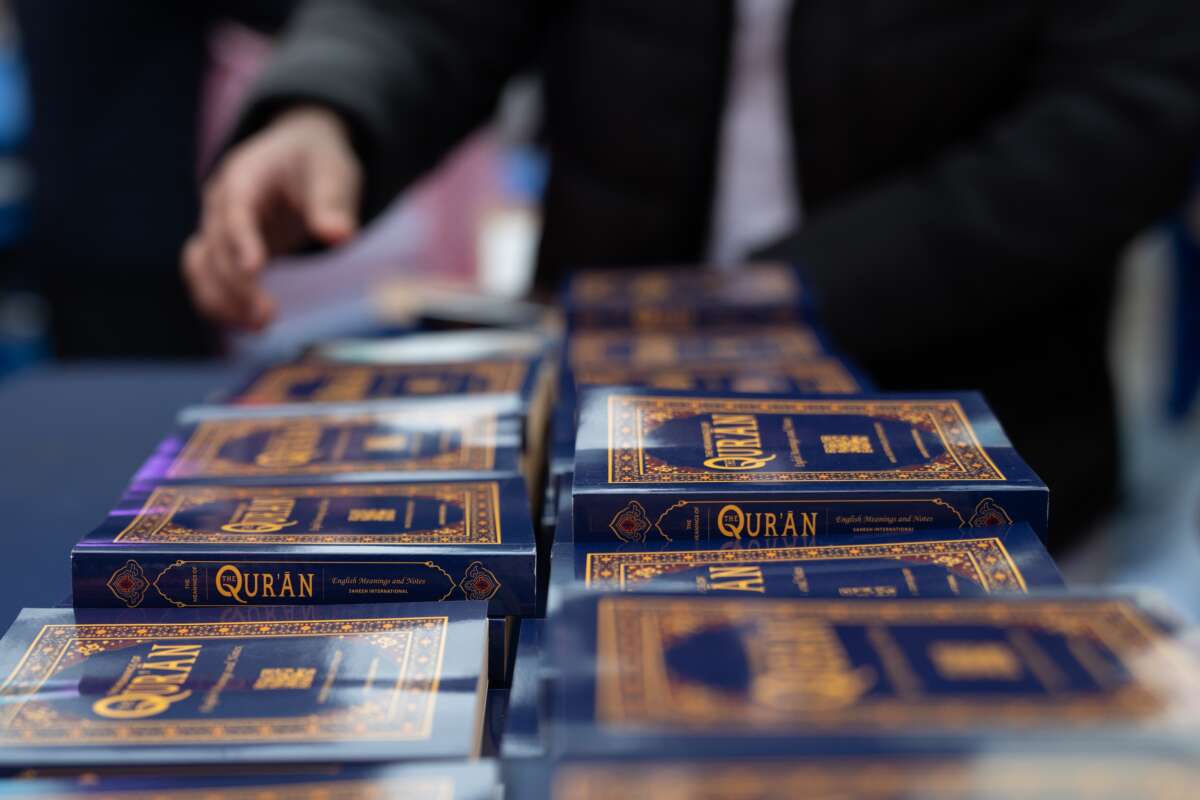
Access to Qurans is crucial for observing Ramadan, but ICE jails have repeatedly denied Muslim immigrants access to them, in addition to imposing inflexible mealtimes incompatible with fasting from dawn to sunset. Here, Qurans appear on a table in New York City during a Ramadan gathering in 2024.David Dee Delgado / Getty Images
The second Ramadan under Trump 2.0 has come with new denials of rights for Muslims detained in the administration’s fast-growing network of immigration jails.
Ramadan, which began in mid-February and will end this week, is one of the holiest months in the Islamic calendar. Muslims observe it as a month of fasting each day from sunrise to sunset, engaging in communal prayer, studying the Quran, and performing acts of charity and community service. Many of these practices are made difficult in immigration jails, where inflexible mealtimes, prohibitions on gathering, and a denial of access to items such as Qurans, prayer mats, or religious dress are the norm year-round. This is the case even though immigration detention is a form of civil detention, and it is not supposed to be punitive.
“The very least that people who are detained are entitled to is the right to practice their religion with dignity, yet they are often unable to exercise this basic right,” Faiza Duale, deputy legal director at the Council on American–Islamic Relations (CAIR) Washington, told Truthout. “This is especially troubling during Ramadan, a holy month of additional devotion and a time when there are greater spiritual rewards for that devotion.”
The number of people detained by Immigration and Customs Enforcement (ICE) has shot up to 75,000 compared to just 40,000 about a year ago, before Donald Trump returned to office. These individuals are warehoused across more than 225 facilities, which have come under mounting criticism, including from members of Congress. Critics condemn the inhumane living conditions, lack of oversight, and denial of basic rights like access to legal representation.
Religious practice is another fundamental right often denied or at least made difficult for those held in immigration jails. Although ICE’s own standards require that detainees be “provided reasonable and equitable opportunities to participate in the practices of their respective faiths,” civil rights advocates who spoke to Truthout said that, oftentimes, religious accommodations are not offered or met when requested.

Muslim Jailhouse Lawyers Are Reshaping the Fight for Prisoners Rights
Incarcerated Muslims are building on a legacy of community resistance that goes way beyond our current moment. By Khawla Nakua , Truthout September 22, 2023
“The way that religious needs are accommodated in these systems is very poorly developed or nonexistent,” Maria Kari, attorney and executive director at Project TAHA, told Truthout.
“They’re not getting enough calories to sustain their fasting and their health.”
Kari is part of the legal team representing Yaakub Ira Vijandre, a Filipino American journalist and pro-Palestine activist who has been jailed by ICE since October 2025. Vijandre is a Deferred Action for Childhood Arrivals (DACA) recipient, but in September, U.S. Citizenship and Immigration Services announced it intended to terminate that status due to statements he made on social media. He was later arrested at gunpoint and transferred to Bluebonnet Detention Facility in Texas, and then to the Folkston ICE Processing Center in Georgia.
Still imprisoned after more than five months, Vijandre is now one of the thousands of Muslims practicing their faith from within an immigration jail this Ramadan. While data on detainees’ religions is not published, advocacy groups offer some insights from their work in the facilities. For example, CAIR-Texas estimates that at least 5 percent of the almost 19,000 people detained in the state are Muslims.
“There are a significant amount of Muslims from all over the world — from countries like Palestine, and Jordan, and Turkey, and Egypt — who are detained in these facilities,” Dyaa Terpstra, operations director at CAIR-New Jersey, which has been advocating for improved accommodations for Muslims at Delaney Hall in Newark, told Truthout.
Agents at the Georgia facility where Vijandre is being held confiscated religious texts that he had intended to spend the remainder of Ramadan studying.
Through friends and family, Vijandre has taken to sharing his Ramadan routines and the difficulties of practicing them in immigration jail on Instagram. His series of Ramadan missives includes reports of suhur, the pre-dawn meal, being offered too late, meaning Muslim detainees could be forced to fast from one evening to the next. Kari told Truthout that sometimes some of the Muslim detainees are denied suhur altogether, and others share their meals — meaning, Kari said, “They’re not getting enough calories to sustain their fasting and their health.”
Last Ramadan, Kari was part of the legal team representing Ward Sakeik, a stateless Palestinian American woman, who was detained in February on the way home from her honeymoon in the U.S. Virgin Islands, despite being in the process of obtaining a green card. She was held for almost five months in two different Texas immigration jails before being released last July. Sakeik experienced similar problems with meals not being offered at the right times.
“She’d be given a meal four hours before the fast was supposed to open, and the food’s going to go bad. It’s just going to taste awful. There’s not going to be any opportunity to warm it up or get fresh food at the time her fast broke,” Kari told Truthout. “There were instances where the time to break her fast came and went, and she got no food for hours.”
Advocacy groups in Washington also told Truthout that this Ramadan, they have received reports that Muslim detainees at the Northwest ICE Processing Center in Tacoma, Washington, have been given non-halal meals or offered their evening iftar meals hours after sunset, meaning they are forced to fast longer than needed.
Lack of religious accommodations for Muslim detainees does not end with mealtimes. Recently, agents at the Georgia facility where Vijandre is being held confiscated religious texts that he had intended to spend the remainder of Ramadan studying.
Detainees have reported not being able to congregate to pray at the right times or at all.
Kari told Truthout that agents even tried to confiscate his Quran. “The only reason they didn’t take it away is because another detainee chimed in and said, ‘That’s like his Bible,’ [and] they did end up taking away his other books that were religious texts — and that was nothing but punitive.”
Some detainees at Delaney Hall did not have access to Qurans at all until a recent CAIR-New Jersey campaign delivered dozens of them in various languages alongside other items, including kufis, religious education materials, prayer mats, and hijabs.
“These items are not just items,” Terpstra told Truthout. “Practicing our faith is really core to our identity, it is essential for our existence, our being as Muslims, to be able to connect with our Creator by reading His words, the Quran, by being able to pray properly, by being able to fast properly.”
Elsewhere, detainees have reported not being able to congregate to pray at the right times or at all. This is the case at the Northwest ICE Processing Center in Washington, where Duale told Truthout, “Detainees are not able to pray the Friday prayers that are required for Muslim men, which results in them being unable to practice their religion to the extent that they want to.”
That’s also the case at Folkston ICE Processing Center, where agents “randomly break up congregational prayers for no reason at all, give detainees a hard time, move them around in units,” Kari told Truthout. A recent COVID-19 outbreak at the facility has resulted in quarantine measures, further limiting congregational prayer.
A lack of religious accommodations in immigration jails, particularly during Ramadan, which requires schedule changes, is not new. “Regardless of who’s in the White House, we have had Muslim religious rights being infringed on,” Kari told Truthout. “Muslim prisoners are always having to turn to the courts for basic things.”
“Faith becomes what they hang onto during their time in prison. It’s kind of the strongest protection for their mental and physical health when they’re in these isolated, awful, and inhuman conditions.”
However, advocates also told Truthout that the Trump administration’s fast-paced scaling-up of immigration detention operations and its penchant for shuttling detainees from one facility to the next, seemingly without reason, has created confusion and brought in new agents who lack training and knowledge of their obligations and detainees’ rights.
“Those that we have spoken to speak about the difficulty of practicing their faith at Delaney Hall with the disorganization, the dysfunction of the operation,” Terpstra told Truthout. “This isn’t something extra that we’re asking for; they have a moral and legal obligation to uphold our civil and religious rights to be able to practice our faith properly and meaningfully.”
The targeting of Muslim communities has also spurred an increase in the number of detainees needing Ramadan accommodations this year. “Faith becomes what they hang onto during their time in prison. It’s kind of the strongest protection for their mental and physical health when they’re in these isolated, awful, and inhuman conditions,” Kari told Truthout. The indignities of being denied the full practice of their religion, she said, “build up and are crushing to the spirit of somebody who’s already in this place that’s designed to crush the spirit.”
An urgent appeal for your support: 6 Days to raise $38,000
Truthout relies on individual donations to publish independent journalism, free from political and corporate influence. In fact, we’re almost entirely funded by readers like you.
Unfortunately, donations are down. At a moment when independent journalism is urgently needed, we are struggling to meet our operational costs due to increasing political censorship.
Truthout may end this month in the red without additional help, so we’ve launched a fundraiser. We have 6 days to hit our $38,000 goal. Please make a tax-deductible one-time or monthly donation if you can.
This article is licensed under Creative Commons (CC BY-NC-ND 4.0), and you are free to share and republish under the terms of the license.

Marianne Dhenin
Marianne Dhenin is an award-winning journalist and historian. Find their portfolio or contact them at mariannedhenin.com.
The second Ramadan under Trump 2.0 has come with new denials of rights for Muslims detained in the administration’s fast-growing network of immigration jails.
Ramadan, which began in mid-February and will end this week, is one of the holiest months in the Islamic calendar. Muslims observe it as a month of fasting each day from sunrise to sunset, engaging in communal prayer, studying the Quran, and performing acts of charity and community service. Many of these practices are made difficult in immigration jails, where inflexible mealtimes, prohibitions on gathering, and a denial of access to items such as Qurans, prayer mats, or religious dress are the norm year-round. This is the case even though immigration detention is a form of civil detention, and it is not supposed to be punitive.
“The very least that people who are detained are entitled to is the right to practice their religion with dignity, yet they are often unable to exercise this basic right,” Faiza Duale, deputy legal director at the Council on American–Islamic Relations (CAIR) Washington, told Truthout. “This is especially troubling during Ramadan, a holy month of additional devotion and a time when there are greater spiritual rewards for that devotion.”
The number of people detained by Immigration and Customs Enforcement (ICE) has shot up to 75,000 compared to just 40,000 about a year ago, before Donald Trump returned to office. These individuals are warehoused across more than 225 facilities, which have come under mounting criticism, including from members of Congress. Critics condemn the inhumane living conditions, lack of oversight, and denial of basic rights like access to legal representation.
Religious practice is another fundamental right often denied or at least made difficult for those held in immigration jails. Although ICE’s own standards require that detainees be “provided reasonable and equitable opportunities to participate in the practices of their respective faiths,” civil rights advocates who spoke to Truthout said that, oftentimes, religious accommodations are not offered or met when requested.
Muslim Jailhouse Lawyers Are Reshaping the Fight for Prisoners Rights
Incarcerated Muslims are building on a legacy of community resistance that goes way beyond our current moment. By Khawla Nakua , Truthout September 22, 2023
“The way that religious needs are accommodated in these systems is very poorly developed or nonexistent,” Maria Kari, attorney and executive director at Project TAHA, told Truthout.
“They’re not getting enough calories to sustain their fasting and their health.”
Kari is part of the legal team representing Yaakub Ira Vijandre, a Filipino American journalist and pro-Palestine activist who has been jailed by ICE since October 2025. Vijandre is a Deferred Action for Childhood Arrivals (DACA) recipient, but in September, U.S. Citizenship and Immigration Services announced it intended to terminate that status due to statements he made on social media. He was later arrested at gunpoint and transferred to Bluebonnet Detention Facility in Texas, and then to the Folkston ICE Processing Center in Georgia.
Still imprisoned after more than five months, Vijandre is now one of the thousands of Muslims practicing their faith from within an immigration jail this Ramadan. While data on detainees’ religions is not published, advocacy groups offer some insights from their work in the facilities. For example, CAIR-Texas estimates that at least 5 percent of the almost 19,000 people detained in the state are Muslims.
“There are a significant amount of Muslims from all over the world — from countries like Palestine, and Jordan, and Turkey, and Egypt — who are detained in these facilities,” Dyaa Terpstra, operations director at CAIR-New Jersey, which has been advocating for improved accommodations for Muslims at Delaney Hall in Newark, told Truthout.
Agents at the Georgia facility where Vijandre is being held confiscated religious texts that he had intended to spend the remainder of Ramadan studying.
Through friends and family, Vijandre has taken to sharing his Ramadan routines and the difficulties of practicing them in immigration jail on Instagram. His series of Ramadan missives includes reports of suhur, the pre-dawn meal, being offered too late, meaning Muslim detainees could be forced to fast from one evening to the next. Kari told Truthout that sometimes some of the Muslim detainees are denied suhur altogether, and others share their meals — meaning, Kari said, “They’re not getting enough calories to sustain their fasting and their health.”
Last Ramadan, Kari was part of the legal team representing Ward Sakeik, a stateless Palestinian American woman, who was detained in February on the way home from her honeymoon in the U.S. Virgin Islands, despite being in the process of obtaining a green card. She was held for almost five months in two different Texas immigration jails before being released last July. Sakeik experienced similar problems with meals not being offered at the right times.
“She’d be given a meal four hours before the fast was supposed to open, and the food’s going to go bad. It’s just going to taste awful. There’s not going to be any opportunity to warm it up or get fresh food at the time her fast broke,” Kari told Truthout. “There were instances where the time to break her fast came and went, and she got no food for hours.”
Advocacy groups in Washington also told Truthout that this Ramadan, they have received reports that Muslim detainees at the Northwest ICE Processing Center in Tacoma, Washington, have been given non-halal meals or offered their evening iftar meals hours after sunset, meaning they are forced to fast longer than needed.
Lack of religious accommodations for Muslim detainees does not end with mealtimes. Recently, agents at the Georgia facility where Vijandre is being held confiscated religious texts that he had intended to spend the remainder of Ramadan studying.
Detainees have reported not being able to congregate to pray at the right times or at all.
Kari told Truthout that agents even tried to confiscate his Quran. “The only reason they didn’t take it away is because another detainee chimed in and said, ‘That’s like his Bible,’ [and] they did end up taking away his other books that were religious texts — and that was nothing but punitive.”
Some detainees at Delaney Hall did not have access to Qurans at all until a recent CAIR-New Jersey campaign delivered dozens of them in various languages alongside other items, including kufis, religious education materials, prayer mats, and hijabs.
“These items are not just items,” Terpstra told Truthout. “Practicing our faith is really core to our identity, it is essential for our existence, our being as Muslims, to be able to connect with our Creator by reading His words, the Quran, by being able to pray properly, by being able to fast properly.”
Elsewhere, detainees have reported not being able to congregate to pray at the right times or at all. This is the case at the Northwest ICE Processing Center in Washington, where Duale told Truthout, “Detainees are not able to pray the Friday prayers that are required for Muslim men, which results in them being unable to practice their religion to the extent that they want to.”
That’s also the case at Folkston ICE Processing Center, where agents “randomly break up congregational prayers for no reason at all, give detainees a hard time, move them around in units,” Kari told Truthout. A recent COVID-19 outbreak at the facility has resulted in quarantine measures, further limiting congregational prayer.
A lack of religious accommodations in immigration jails, particularly during Ramadan, which requires schedule changes, is not new. “Regardless of who’s in the White House, we have had Muslim religious rights being infringed on,” Kari told Truthout. “Muslim prisoners are always having to turn to the courts for basic things.”
“Faith becomes what they hang onto during their time in prison. It’s kind of the strongest protection for their mental and physical health when they’re in these isolated, awful, and inhuman conditions.”
However, advocates also told Truthout that the Trump administration’s fast-paced scaling-up of immigration detention operations and its penchant for shuttling detainees from one facility to the next, seemingly without reason, has created confusion and brought in new agents who lack training and knowledge of their obligations and detainees’ rights.
“Those that we have spoken to speak about the difficulty of practicing their faith at Delaney Hall with the disorganization, the dysfunction of the operation,” Terpstra told Truthout. “This isn’t something extra that we’re asking for; they have a moral and legal obligation to uphold our civil and religious rights to be able to practice our faith properly and meaningfully.”
The targeting of Muslim communities has also spurred an increase in the number of detainees needing Ramadan accommodations this year. “Faith becomes what they hang onto during their time in prison. It’s kind of the strongest protection for their mental and physical health when they’re in these isolated, awful, and inhuman conditions,” Kari told Truthout. The indignities of being denied the full practice of their religion, she said, “build up and are crushing to the spirit of somebody who’s already in this place that’s designed to crush the spirit.”
An urgent appeal for your support: 6 Days to raise $38,000
Truthout relies on individual donations to publish independent journalism, free from political and corporate influence. In fact, we’re almost entirely funded by readers like you.
Unfortunately, donations are down. At a moment when independent journalism is urgently needed, we are struggling to meet our operational costs due to increasing political censorship.
Truthout may end this month in the red without additional help, so we’ve launched a fundraiser. We have 6 days to hit our $38,000 goal. Please make a tax-deductible one-time or monthly donation if you can.
This article is licensed under Creative Commons (CC BY-NC-ND 4.0), and you are free to share and republish under the terms of the license.
Marianne Dhenin
Marianne Dhenin is an award-winning journalist and historian. Find their portfolio or contact them at mariannedhenin.com.

No comments:
Post a Comment