Trump’s panicked plea goes largely ignored by world leaders: 'No country stepped forward’
Alexander Willis
March 15, 2026
The U.S.-Israeli siege on Iran has rattled global stability and sent “tremors” through the world economy, leading to the International Energy Agency announcing on Sunday the largest release of its emergency oil stockpiles in history.
Alexander Willis
March 15, 2026
RAW STORY
President Donald Trump issued a plea Saturday to several countries in the hopes that they would “send ships” to a major shipping route off the coast of Iran to help the United States’ war effort against the Middle East nation, a plea that as of Sunday afternoon appeared to go largely ignored.
In response to the U.S.-Israeli joint military siege launched late last month, Iran has vowed to attack any sea vessels aligned with the United States and its allies that attempt to pass through the Strait of Hormuz, a major shipping route through which 20% of the world’s oil trade flows. As a result, oil prices have skyrocketed, reportedly sparking panic within the Trump administration.
“Hopefully China, France, Japan, South Korea, the UK, and others, that are affected by this artificial constraint, will send Ships to the area so that the Hormuz Strait will no longer be a threat by a Nation that has been totally decapitated,” Trump wrote in a social media post on Saturday.
Well over 24 hours later, however, Trump’s plea was “met with little in the way of immediate commitments from the nations he named,” The Wall Street Journal reported Sunday.
The strongest response Trump received was from South Korea, with its Foreign Ministry saying that it “takes note” of Trump’s request and that it would “closely coordinate and carefully review” the ongoing conflict, Nikkei Asia reported Sunday.
President Donald Trump issued a plea Saturday to several countries in the hopes that they would “send ships” to a major shipping route off the coast of Iran to help the United States’ war effort against the Middle East nation, a plea that as of Sunday afternoon appeared to go largely ignored.
In response to the U.S.-Israeli joint military siege launched late last month, Iran has vowed to attack any sea vessels aligned with the United States and its allies that attempt to pass through the Strait of Hormuz, a major shipping route through which 20% of the world’s oil trade flows. As a result, oil prices have skyrocketed, reportedly sparking panic within the Trump administration.
“Hopefully China, France, Japan, South Korea, the UK, and others, that are affected by this artificial constraint, will send Ships to the area so that the Hormuz Strait will no longer be a threat by a Nation that has been totally decapitated,” Trump wrote in a social media post on Saturday.
Well over 24 hours later, however, Trump’s plea was “met with little in the way of immediate commitments from the nations he named,” The Wall Street Journal reported Sunday.
The strongest response Trump received was from South Korea, with its Foreign Ministry saying that it “takes note” of Trump’s request and that it would “closely coordinate and carefully review” the ongoing conflict, Nikkei Asia reported Sunday.
The U.S.-Israeli siege on Iran has rattled global stability and sent “tremors” through the world economy, leading to the International Energy Agency announcing on Sunday the largest release of its emergency oil stockpiles in history.
.png)
David McAfee
March 14, 2026
RAW STORY
President Donald J. Trump spurred a variety of alarmed reactions on Saturday after he asked other countries to help the U.S. with the Iran war amid escalating tensions in the Strait of Hormuz.
"The United States of America has beaten and completely decimated Iran, both Militarily, Economically, and in every other way," Trump wrote, before shifting to call for international cooperation. He urged countries reliant on oil transit through the strait to "take care of that passage," promising substantial U.S. assistance and coordination to ensure "everything goes quickly, smoothly, and well." Trump framed the effort as a long-overdue "team" approach that would foster "Harmony, Security, and Everlasting Peace!"
The post drew immediate online backlash, with critics highlighting what they saw as a glaring contradiction: claiming total Iranian defeat while seeking help to secure the vital waterway, through which roughly one-fifth of global oil flows.
Professor Phillips P. O'Brien, a noted historian and strategist, described the message as "a work of art" worthy of preservation. He pointed out the irony: if Iran's military capability is "100% destroyed," why plead with frequently insulted allies to intervene in the Gulf?
Online reactions spread rapidly. PatriotTakes, which monitors right-wing extremism, quipped that Trump was "sending out invitations to WWIII."
MS NOW's Chris Hayes called it an "instant classic."
Detractors mocked the pivot as evidence of overreach in the ongoing U.S.-Iran conflict, where recent airstrikes—including on Kharg Island's military targets—have disrupted shipping but not fully neutralized threats like mines or asymmetric attacks. Supporters, however, viewed it as pragmatic leadership, emphasizing U.S. dominance and the need for shared burden in global security.
The statement also underscores broader challenges in Trump's foreign policy approach: bold claims of triumph paired with appeals for multilateral support in a region where unilateral action has proven costly. As oil prices surge and tanker traffic remains vulnerable, the post highlights the delicate balance between projecting strength and acknowledging real-world limitations in securing critical chokepoints.
Tense meeting looms for Trump as world leader vows to be 'candid' about US-sparked chaos
Alexander Willis
March 15, 2026
RAW STORY
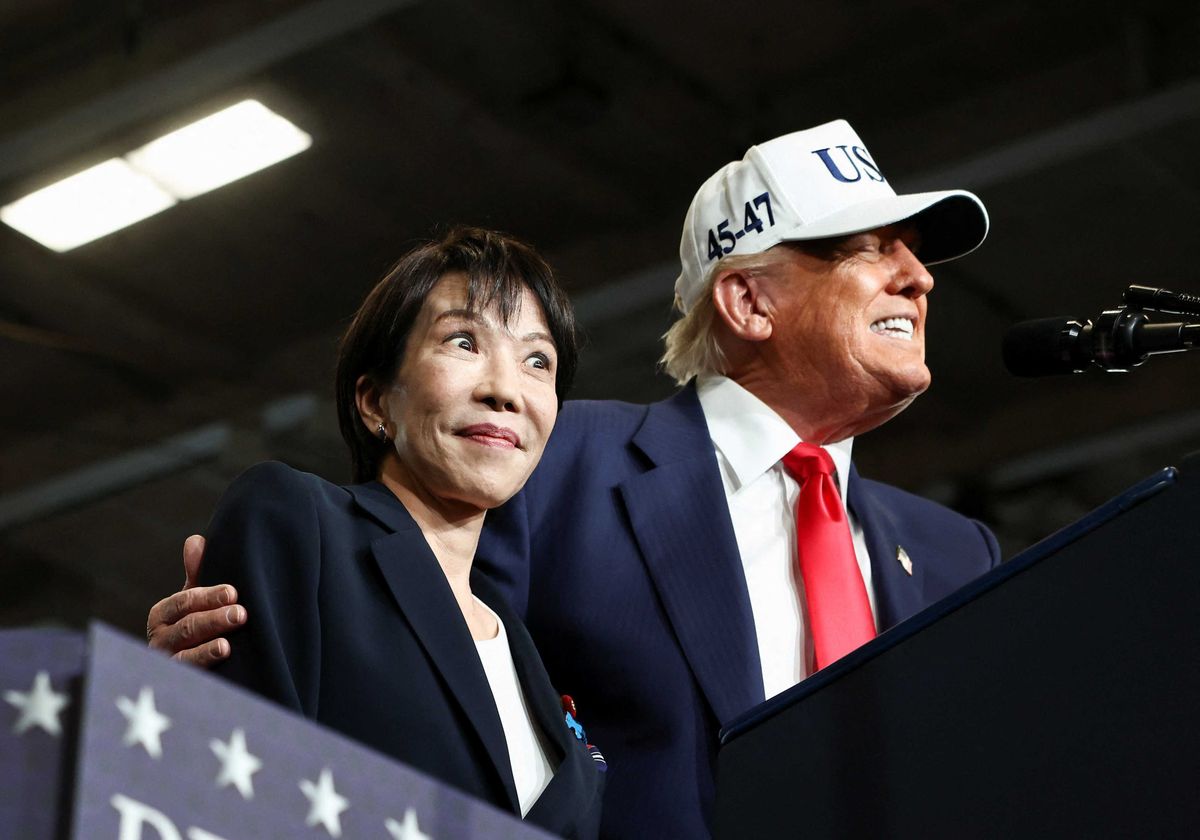
Japanese PM Sanae Takaichi reacts as Donald Trump speaks in Yokosuka, Japan. REUTERS/Evelyn Hockstein
President Donald Trump’s upcoming meeting with Japanese Prime Minister Sanae Takaichi may end up becoming a tense standoff after the newly re-elected leader vowed to be “candid” about the economic pain the Trump administration had inflicted on the East Asian nation.
“If President Donald Trump is expecting effusive praise for his war on Iran when Japan’s prime minister arrives in Washington on Thursday, he is likely to be disappointed,” wrote Bronwen Maddox, director of the British foreign-policy think tank Chatham House in the organization’s report Sunday.
“Sanae Takaichi, re-elected in February in a landslide victory, says she intends to be ‘candid’ in pointing out that Japan’s oil-dependent economy is suffering badly from the conflict.”
Oval Office visits, Maddox noted, have often “become bear traps” for foreign leaders, perhaps most notably for Ukrainian President Volodymyr Zelenskyy when he was chastised last year by Trump and Vice President JD Vance for nearly an hour. However, given the historic disruption to oil trade sparked by the Trump administration’s attack on Iran, Takaichi is expected to be blunt with Trump, Maddox wrote.
“She will want reassurance about the US’s security umbrella, the cornerstone of Japanese foreign policy since 1945,” Maddox wrote. “Trump is likely to repeat instead his demand for Japan to pay more for its own defence.”
As the world’s fifth largest importer of oil, Japan’s economy has been hit hard by the disruption in oil trade, with 95% of Japan’s oil imports coming from the Middle East. Japan’s cost of living has spiked as a result, leading Maddox to predict Takaichi may “want to use the good rapport she struck up with the U.S. president at a meeting in October to make the point about the impact of the war on other countries.”
No comments:
Post a Comment