US, Japan to focus rare earths cooperation on select group of minerals at first
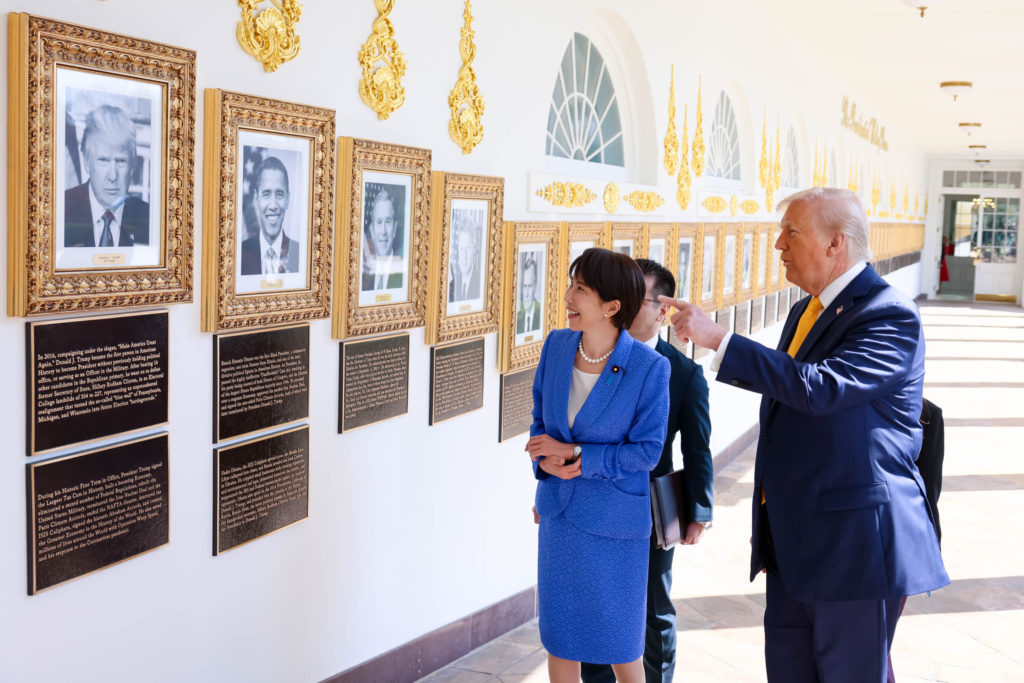
The US and Japan on Thursday released an action plan for their efforts to develop alternatives to China for critical minerals and rare earths supply chains, focusing initially on price floors for a select group of minerals.

A joint US-Japan statement released by the US Trade Representative’s Office during Japanese Prime Minister Sanae Takaichi’s visit to the White House said the two countries aimed to deliver “concrete, near-term results towards securing mutual supply chain resilience.”
The statement said the two countries will discuss coordinated trade policies such as a border-adjusted price floor mechanism, “focusing in the first instance on a select group of critical minerals.” They did not identify which minerals would be considered first for price floors.
Takaichi and US President Donald Trump signed a framework agreement on rare earths in October 2025 in Tokyo as both countries were struggling with Chinese export controls.
The action plan announced on Thursday does not mention China by name, but refers to a need to correct “distortions resulting from pervasive non-market policies and practices (that) have left critical minerals supply chains of market-oriented economies vulnerable to a myriad of disruptions, including economic coercion.”
The two sides will consult on how price floors and other trade provisions can fit into a plurilateral critical minerals supply agreement involving other countries, the statement said.
They also will work to identify specific projects in each country and elsewhere for critical minerals mining, processing and manufacturing that meet internationally recognized responsible business practices and that should get priority financing and policy support, the statement added.
US-based Albemarle, the world’s largest lithium producer, is “exploring opportunities” for potential Japanese investment or supply deals with the company’s under-construction North Carolina lithium project, according to the statement.
An Albemarle spokesperson said the company had nothing to add.
Japan’s Mitsubishi Materials is in talks with Indiana-based ReElement Technologies for a potential equity stake or joint venture, according to the statement. A representative for ReElement was not immediately available to comment.
Tokyo and Washington also agreed to share information on mining standards, technical cooperation, and geological mapping of potential critical mineral deposits. They also agreed to coordinate stockpiling of critical minerals, rapid responses to prevent supply disruptions and joint actions to address economic coercion, the statement said.
(By David Lawder and Ernest Scheyder; Editing by Paul Simao and Daniel Wallis)
U.S. Approaches Chile for Critical Mineral Supply
- The U.S. is negotiating a supply deal with Chile for rhenium, a rare and critical mineral essential for defense and aerospace, with Chile controlling about 50% of global supply.
- Rhenium is indispensable due to its extreme heat resistance and lack of substitutes, making it vital for jet engines, turbines, and military systems.
- The move is part of a broader U.S. strategy to secure critical minerals and reduce dependence on China through global partnerships and strategic reserves.
Oil and gas prices are hogging headlines, but while the world watches the Middle East, U.S. officials have been busy elsewhere. Chile, the world’s biggest supplier of one particular critical mineral, is in talks with the U.S. on a supply agreement for rhenium—an element seen as vital for national security.
Rhenium is a genuinely rare element that has an extremely high melting point of around 3,180 degrees Celsius, which makes it extra resistant to both heat and wear, according to the USGS. This, in turn, makes rhenium highly prized in the defense industry. Since most rhenium is extracted as a by-product from copper mining, it is little surprise that Chile is the largest producer, seeing as the South American state is also the world’s top copper producer. It accounts for 50% of global rhenium supply, per UPI, which reported the news about the talks.
“Chile controls nearly half of a mineral that the United States and China cannot produce in sufficient quantities. Washington reinstated rhenium to its critical minerals list in 2025 and explicitly included it in the bilateral mining agreement with Chile. That makes it a genuine geopolitical asset, not just a mining one,” UPI quoted an engineering professor from Chile’s Adolfo Ibanez University as saying.
Indeed, the Trump administration has prioritized critical minerals from day one. The overwhelming reliance of most of the world on China for both supply and, more importantly, processing of rare earths and other critical elements had started to become a cause for concern in both the United States and the European Union, but the U.S. under Trump has been a lot quicker in taking action.
Last year, Washington closed a deal with Australia’s government to cooperate in the development of a local critical mineral supply. The deal, worth more than $3 billion, according to the White House, could open up access to resources worth $53 billion or more—theoretically. Australia is one of the most mineral-rich countries in the world. It is home to some of the largest reserves of lithium as well as rare earths, tungsten, vanadium, manganese, cobalt, copper, and other metals and minerals used in key industries. The deal with the Trump administration would help boost the production of these metals and minerals and diversify the U.S. supply chain.
Then this year, President Trump announced he would set up a strategic national reserve for critical metals and minerals worth $12 billion to make sure the United States does not get vulnerable to supply shifts from China. The reserve would include rare earths and some of the most in-demand metals and minerals, such as lithium, cobalt, nickel, and graphite, which are used in weapons systems, satellites, batteries, data centers, and industrial motors.
Yet when it comes to weapons systems, rhenium is a lot more valuable than the rest of these metals and minerals. It has no substitutes and its role in defense and aerospace applications is critical as part of specialized alloys—rhenium, in short, is literally indispensable. “It is the metal that allows aircraft engines and military turbines to withstand extreme temperatures without deforming,” according to Professor Victor Perez from Adolfo Ibanez University.
The global race for critical minerals is still on, even if it is not all over the news. And the United States just made an important move in Chile, which is part of a broader move to gain greater exposure to South America’s mineral resources. Every such move counts. The U.S. has a lot of catching up to do with China in the field of critical minerals and speed counts, especially in the current geopolitical situation.
By Charles Kennedy for Oilprice.com
No comments:
Post a Comment