Monday, April 06, 2026


Maine Maritime Academy Welcomes Historic Arrival of T/S State of Maine
Maine Maritime Academy

Published Apr 4, 2026 1:08 PM by The Maritime Executive


[By: Maine Maritime Academy]

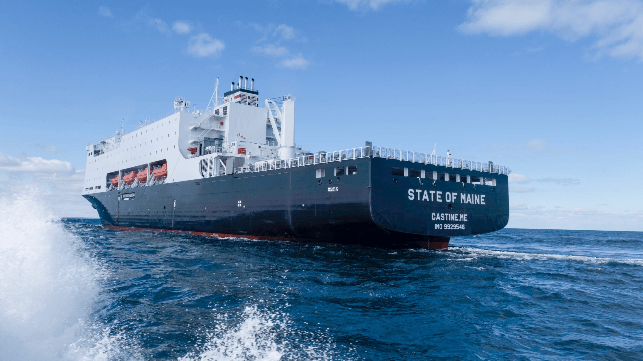
Maine Maritime Academy, in partnership with the U.S. Department of Transportation’s Maritime Administration (MARAD), TOTE Services, and Hanwha Philly Shipyard, on March 31 welcomed the training ship State of Maine, one of the nation’s newest National Security Multi-Mission Vessels (NSMV), during a formal delivery ceremony at Ocean Gateway.

The vessel arrived in Portland Harbor on March 21, where it was greeted by a ceremonial water salute marking its first entry into port.

The State of Maine is the third of five purpose-built NSMVs developed to modernize the training capabilities of the nation’s state maritime academies. The vessel will serve as Maine Maritime Academy’s primary training ship, preparing cadets for careers in the U.S. Merchant Marine and supporting federal humanitarian and disaster response missions, addressing a critical shortage of qualified officers necessary to crew government and commercial owned sealift ships.

“Maine Maritime Academy is internationally recognized as a leader in maritime education and this vessel represents a major step forward in our mission to train the world’s finest mariners,” said Maine Maritime Academy President Craig Johnson. “As our first purpose-built training ship, the State of Maine will provide world-class learning experiences for cadets pursuing unlimited tonnage licenses. It’s a game-changer for our mission and a powerful reflection of what’s possible through strong partnerships and shared vision.”

At 525 feet and valued at $330 million, the State of Maine is the largest and most technologically advanced vessel ever operated by the Academy. It is the institution’s first purpose-built training ship and features two full-sized, fully operational bridges and engine rooms, providing cadets with immersive, hands-on, training environments.

"A strong merchant marine means a strong America. By equipping Maine Maritime Academy with a state-of-the-art vessel to train future merchant mariners, we are fulfilling President Trump's promise to restore America's maritime dominance," said U.S. Transportation Secretary Sean P. Duffy. "Today we aren't just delivering a vessel--we are charting a course
toward a more resilient and successful America."

During today’s ceremony, MARAD formally transferred operational control of the vessel to Maine Maritime Academy, marking a major milestone in the modernization of the nation’s maritime
training fleet.

"We are incredibly proud to partner with Maine Maritime Academy to deliver the State of Maine,” said Maritime Administrator Stephen M. Carmel. Together, MARAD and MMA are transforming maritime education and ensuring our nation remains ready and resilient.” State maritime academies train over half of all new officers essential to the economy and national security. Beyond training, the new NSMVs feature modern medical facilities, a helipad, and capacity for 1,000 people, providing critical sealift and storage for disaster relief and humanitarian missions.

"Today marks the delivery of the State of Maine, the third of five National Security Multi-Mission Vessels delivered under TOTE Services’ oversight and management, and a major step forward for maritime training in the United States,” said Jeff Dixon, President of TOTE Services. These purpose-built training ships are an investment in the future of our industry, equipping the next generation of mariners while strengthening our nation’s readiness to respond to humanitarian needs. We are proud to deliver the State of Maine for the Maine Maritime Academy, continuing TOTE Services’ long-standing commitment to innovation, excellence, and the U.S. maritime community.”

“Today’s ceremony celebrating State of Maine is a moment of pride for everyone at Hanwha Philly Shipyard and our partners,” said David Kim, CEO of Hanwha Philly Shipyard, Inc. Seeing this vessel now with Maine Maritime Academy and ready for use by the next generation of maritime students is a testament to the talent, dedication, and teamwork of our workforce. State of Maine will carry forward the mission of training future maritime leaders and represents another step in our commitment to innovation, excellence, and building a lasting legacy in U.S. shipbuilding.”

National leaders laud the NSMV program and its arrival at Maine Maritime Academy: The Honorable Elaine L. Chao, 18th U. S. Secretary of Transportation & 24th U. S. Secretary of Labor: “The delivery of the new State of Maine marks a significant milestone in strengthening America's maritime future. This state-of-the-art training vessel will provide cadets at Maine Maritime Academy with hands-on, real-world experience essential to developing the next generation of U.S. merchant mariners. The State of Maine will enhance our nation's readiness to respond to humanitarian crises and disaster relief operations, representing a critical investment in those who will carry forward the proud tradition of the U.S. Merchant Marine.“

Rep. John Rutherford (FL-05): “The successful delivery of the State of Maine, the third of five National Security Multi-Mission Vessels (NSMVs) constructed for our nation’s state maritime academies, is a great example of what disciplined execution of shipbuilding looks like. When the federal government works with experienced vessel construction managers, like Jacksonville's own TOTE Services, we see greater accountability taken and more effective risk management in action, which provides an acquisition model that can be used and replicated by our federal government for other non combatant vessels in the future, especially where cost control, schedule discipline, and mission requirements must be balanced.”

Rep. Joe Courtney (CT-02), Ranking Member of the House Seapower and Projection Forces Subcommittee: “Today's delivery of the State of Maine, the third of the fleet of five National Security Multi-Mission Vessels (NSMV) authorized by Congress in the FY17 National Defense Authorization Act, is a continuation of efficient and on-time construction at the Philly shipyard. The rapid production cadence of the massive ships is an example of the success of the vessel construction manager (VCM) model, which originated in Congress with the advice and support of American shipbuilders. The delivery of the State of Maine is tangible proof that ‘Made in America’ shipbuilding can succeed. Congratulations to the Maine Maritime Academy for this exciting milestone and to the midshipmen who train upon this state-of-the-art vessel.”

The products and services herein described in this press release are not endorsed by The Maritime Executive.
 

Transportation Department Invests Nearly Half a Billion into U.S. Ports

U.S. Department of Transportation’s Maritime Administration (MARAD)

Published Apr 5, 2026 5:19 PM by The Maritime Executive


[By: U.S. Department of Transportation’s Maritime Administration]

The U.S. Department of Transportation’s Maritime Administration (MARAD) today announced $488,628,000 in funding to restore American maritime dominance and revitalize American ports, shipyards and maritime capabilities.

The funding will support projects that:

  • Improve ports ability to load and unload good
  • Streamline supply chain movements
  • Modernize ports’ infrastructure and operations
  • Support America’s vibrant seafood and seafood-related businesses

“The Trump Administration is getting back to basics and investing hard-earned American dollars in restoring the nation’s maritime dominance,” said U.S. Transportation Secretary Sean P. Duffy. “We’re refocusing on what matters – revitalizing our ports with the latest technology and infrastructure to keep our economy humming.”

“Thanks to President Trump and Secretary Duffy, we are investing in much-needed port infrastructure that will strengthen our supply chains,” said MARAD Administrator Stephen M. Carmel. “America’s ports fuel our economy, bolster domestic energy, and cut costs for hardworking families, making them worthy of taxpayer investment."  

The Port Infrastructure Development Program (PIDP) aims to modernize America’s ports and strengthen our supply chains, helping reduce time and costs for shippers, and drive down the cost of goods for American families. The U.S. has more than 300 ports operated by states, counties, municipalities, and private corporations.

Under Secretary Duffy, the grant program’s revamped criteria includes new priorities for projects located in Qualified Opportunity Zones, projects that incorporate innovative technology, and projects that support national multimodal freight goals.

The PIDP program will also allocate at least 25 percent of the available funding—totaling $122,157,000—for “Small Projects at Small Ports.” Eligible applicants include port authorities, states, local governments, indigenous Tribal nations, counties, and other entities.

The products and services herein described in this press release are not endorsed by The Maritime Executive.
 

World Fuel Services & West Coast Clean Fuels Establish Methanol Bunkering

World Fuel Services
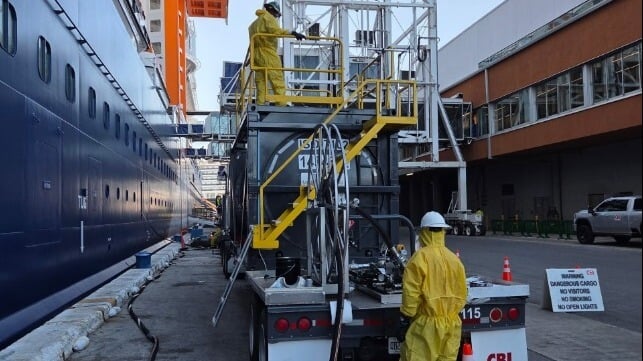
Methanol bunker fuel delivery in South Florida; World Fuel Services Image Caption: Methanol bunker fuel delivery in South Florida

Published Apr 5, 2026 11:27 PM by The Maritime Executive


[By: World Fuel Services]

World Fuel Services, in collaboration with West Coast Clean Fuels, has established a proven methanol bunkering capability available to vessel owners and operators across U.S. ports. The companies successfully completed an over-the-water methanol bunker fuel delivery in South Florida, demonstrating a safe, scalable, and regulatory-compliant solution ready for deployment nationwide. 

Shipowners and operators evaluating methanol as a marine fuel now have access to a fully operational bunkering capability backed by U.S. Coast Guard-approved procedures, trained personnel, and purpose-built equipment. West Coast Clean Fuels is currently the only operator in the U.S. whose truck-to-ship methanol bunkering procedures have been approved by U.S. Coast Guard, and its infrastructure is designed for rapid deployment to additional ports on demand.

The capability is the result of years of rigorous preparation, including comprehensive risk assessments, development of operational and emergency response procedures, equipment procurement, and personnel training - all developed in coordination with the United States Coast Guard to meet the highest safety and regulatory standards. Recent regulatory guidance has incorporated elements of this work, reflecting how the operational approach developed by West Coast Clean Fuels and World Fuel has helped inform evolving industry standards. 

"Our procedures didn’t just meet regulatory requirements - they helped shape them. The U.S. Coast Guard’s recent guidance reflects the operation we’ve developed. Bringing that collaborative work to life with World Fuel is exactly the kind of milestone that demonstrates we are ready to deliver methanol bunkering across U.S. ports,” said Matt Campbell, Technical Manager, West Coast Clean Fuels.

"World Fuel's established global marine fuel platform allows us to deliver and transact methanol bunkering solutions efficiently and reliably to customers," said Brad Hurwitz, senior vice president, supply and trading, World Fuel. "Shipowners and operators evaluating methanol as a marine fuel require both technical expertise and marine fuel delivery experience. This enhanced capability of World Fuel with West Coast Clean Fuels provides customers practical turnkey access to integrate methanol into existing fuelling strategies."

World Fuel and West Coast Clean Fuels are ready to support methanol bunkering needs across the United States, offering vessel owners and operators a reliable, compliant, and immediate accessible solution as the maritime industry transitions toward lower-emission fuel alternatives. 

The products and services herein described in this press release are not endorsed by The Maritime Executive.
Italian Navy Surges Ahead with Carrier TB-3 Strike Drones

Italian drone carrier based
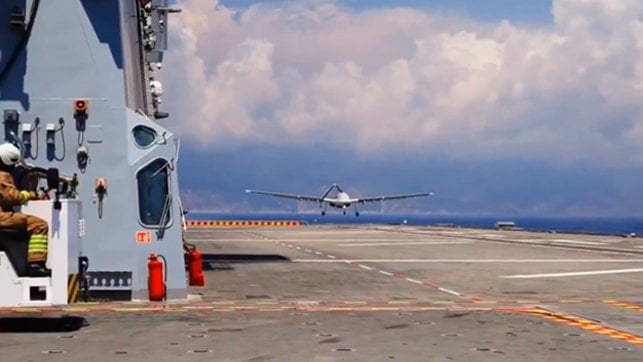
Bayraktar TB-3 returning from a strike mission comes in to land aboard TCG Anadolu (from Bayraktar video)

Published Apr 4, 2026 2:47 PM by The Maritime Executive


Last year, The Maritime Executive reported on the Turkish Navy and drone manufacturer Bayraktar’s apparent success in mounting TB-3 strike drone missions from the deck of TCG Anadolu (L400), the Turkish Navy’s amphibious assault ship. During Exercise Sea Wolf 2025 held in the Eastern Mediterranean in mid-May 2025, Bayraktar’s TB-3 navalized drones, an upgraded version of the widely-exported TB-2 drone but featuring a retractable undercarriage and folding wings to permit below deck hangar storage, were seen conducting take-offs and landings from the flat top. These same drones were seen carrying out strike missions on ground targets using Rokestan MAM-L precision-guided missiles, which have a 22kg warhead and a stand-off range of 10 miles. 

The armed TB-3s took off without catapult assistance using the full 720 feet length of TCG Anadolu’s flight deck and ski ramp, and recovered using about 330 feet of deck. Landings and take-offs were conducted using an autonomous flight control system.  

The TB-3 has extremely attractive flight characteristics: long endurance of up to 32 hours, and a range of more than 500 miles at medium altitude.  Carrying a multi-mode AESA (Active Electronically Scanned Array) radar, developed for the TB-3 by Turkish company Arselan, a carrier strike group with a constellation of TB-3s could have persistent, wide area surveillance, with redundancy and overlap, plus the capacity to take on, for example, asymmetric warfare targets or coastal anti-ship missile batteries at range. A capability to maintain continuous wide-area surveillance using the TB-3’s radar would be a huge operational enhancement even for navies flying the Hawkeye E2-C surveillance aircraft, let alone for those such as the Royal Navy relying on makeshift helicopter-borne surveillance systems.

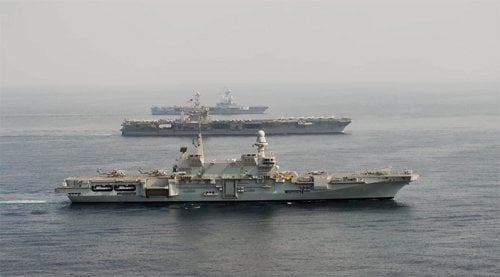
The TB-3 was developed in Turkey when it was thought that TB-3s could be deployed on the TCG Anadolu in tandem with F-35Bs.  The operational concept was to preserve the F-35Bs for difficult and priority missions, leaving the TB-3s to mount a continuous low-cost overhead surveillance presence, with the capability to engage unsophisticated targets well beyond the range before they could present a close-in engagement threat.  But while the Turkish Navy could not realize this dual capability concept, the Italian Navy, with F-35Bs replacing Sea Harriers aboard its light carrier ITS Cavour (C550), was ready to do so.


ITS Cavour, alongside USS Harry S. Truman and FS Charles de Gaulle (USN)

The Italian TB-3s are being built in Italy in a joint venture with Leonardo, and are due for operational certification this year.

The deployment of Italian TB-3s is a stark illustration of how some navies have adopted the Ukrainian survivalist model of rapid, low-cost procurement, leveraging technical innovation, whilst others string out the development and experimental phase for years without quite managing to find funding for operational deployments.  It took a long time for the tank to replace the horse.  But in a period of rapid technological change in the nature of warfare, victory usually goes to the side forced to innovate the fastest.


Op-Ed: An Urgent Need for Quicker and Cheaper Naval Procurement

LUCAS
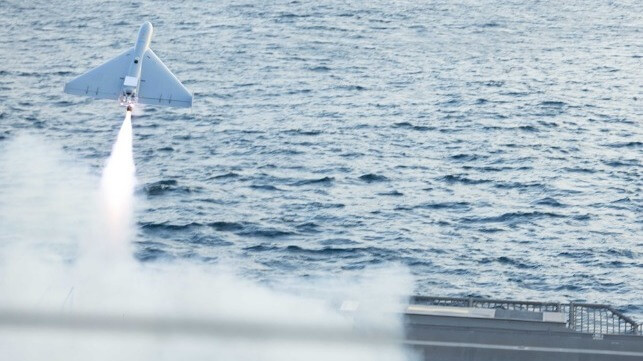
A LUCAS attack drone test-launches from the deck of a Littoral Combat Ship, Dec. 2025. The design was reverse-engineered from an Iranian model for procurement speed and low cost (USN)

Published Apr 5, 2026 1:45 PM by The Maritime Executive


Conflict in Ukraine, over the last several years in the Near East, and now over Iran, has done nothing to undermine a truth established in warfare for centuries: success cannot be achieved unless the winning side has sailors who are well-trained, tenacious and skillfully led, this moral and human component to fighting capability often being overlooked.

But at the same time, recent experience in particular demonstrates that the ability to innovate technically – at a pace faster than one’s enemy – is up there alongside the moral and human component as a key battle-winning ingredient. Technical innovation comes both in the form of new weapons systems, but also in the ability to field defenses against whatever novel capability your enemy is deploying.

In the Black Sea, Ukrainian sea and air drones have swept the surviving units of the Russian Black Fleet out of the Crimea - from where they threatened Odesa - to far-away Novorossiysk, allowing merchant traffic to resume from Ukrainian ports. On land, drones constantly overhead for a depth of up to 50 miles behind the frontline are preventing the Russians from resupplying forward positions, and are breaking up assault formations even before they get near assembly areas. In the deep strike zone, Ukrainian Flamingo FP-5 cruise missiles, now in volume production, are systematically destroying Russia’s western oil and gas export terminals. These are all new systems, domestically produced, at low cost and in a hurry.

With the Houthis having conducted an extended proof of capability demonstration, providing years of warning of what such systems were capable of by drastically reducing merchant traffic through the Red Sea, their Iranian sponsors are using the same drones and missiles systems to close down the Strait of Hormuz. Iran is damaging not only forward U.S. naval and ground force locations but is also causing serious damage to the critical infrastructure in GCC countries. Years were squandered not deploying cheap and effective counter-measures to defeat these systems, whose capabilities and survivability were well-advertised; the Iron Dome counter-battery system showed that there are technical solutions to the problem, but very few – some now the victims of Iranian aggression – have responded to the capability deficit with any urgency.

Lulled by decades of relative peace, speed and urgency of capability deployment is a recurring issue. Both the United Kingdom and the United States navies have been working on remote mine clearance technologies for many years. Both withdrew their minesweeper flotillas from the Gulf in the weeks before the outbreak of the current conflict, but before the new technology had been procured and deployed. Why is it taking so long to deploy the new technology, and who permitted these glaring capability gaps to emerge against well-known and escalating threats?

Both the United Kingdom and the United States have a similar ‘taking forever’ approach to drone capability flying off ships, having been conducting trials for years. The United Kingdom in particular could have ameliorated the shortage of F-35s and airborne early warning and made their two carriers credible platforms by getting drones into service. Instead, the Italians and Turks have demonstrated how - with will, drive and vision - the TB-3 drone can be brought into naval service quickly, delivering in this instance both strike and persistent surveillance capability. It is a similar story with groundbreaking sea mine clearance technology being developed by firms such as ZeroUSV and sea drones by MGI Engineering: procurement is being drawn out and stymied by every conceivable bureaucratic obstacle.

Traditional well-established military powers are being outclassed and outgunned by nations with less sclerotic procurement systems – either nations with drive and ambition, or those motivated by pressing national security issues, such as Azerbaijan, Israel, Ukraine – and of course Houthi-controlled Yemen and Iran. The Chinese are likely to be a much more demanding competitor, and likely to be a lot less forgiving of any adversary who falls behind in the technology race.

European nations in particular need to do better. With support from the United States much less certain, there is particular need to speed up both the scale and the innovative character of defense procurement. Armin Papperger, CEO of Germany's Rheinmetall AG, recently disparaged the pioneering value of Ukraine's “housewife-built” drone-related technology – which has successfully fended off Russian aggression and is now eagerly being snapped up by Gulf states. This can be taken as a warning that defense procurement should not be left solely in the hands of the traditional military-industrial complex. Disruptors and innovators are needed to speed delivery, introduce technical innovation and to lower costs.

There are signs that the requirement for urgency is being understood, not the least in the horrified reaction to the message from Rheinmetall. The UK Ministry of Defence’s Nightfall program - launched in January - seeks to have three competitors test-firing new low-cost 300 mile-range tactical ballistic missiles before the end of this year, as a precursor to production for Ukraine. If the Nightfall program succeeds, it will be a wake-up call for the European armaments industry and a pathfinder for a new style of rapid procurement.

The opinions expressed herein are the author's and not necessarily those of The Maritime Executive.


Agility at Sea: Geopolitical Shocks Reshape Energy Shipping

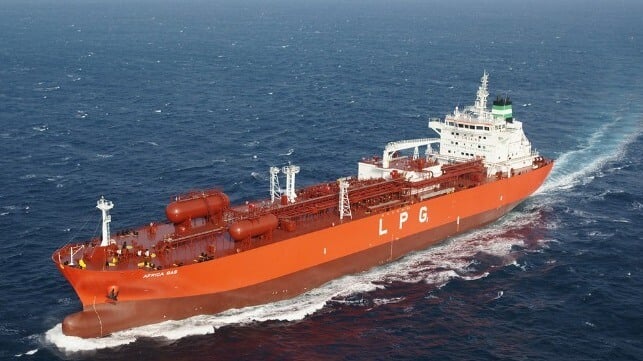
Demand for LPG has soared in Africa, driving need for vessels like the Africa Gas, above (Hyundai Mipo press handout)

Published Apr 5, 2026 3:26 PM by Glenn Schatz


Conflict in the Middle East has practically halted shipping traffic through the Strait of Hormuz. The narrow passageway is not technically closed, but the risks now dissuade most attempts at passing through. Tanker traffic has dropped roughly 90 percent. Around 400 vessels, many just sitting full of oil, wait anchored or sheltering in the Gulf. Maersk, MSC, Hapag-Lloyd, and CMA CGM all suspended transits. Insurers pulled war risk coverage almost immediately, and freight rates experienced massive hourly volatility. The Strait moves about a fifth of the world's oil supply on a normal day; now, however, the amount is negligible.

This de facto closure of Gulf trade seriously impacts importers in Asia and Europe, with an even heavier impact on fast-growing economies like those in Africa. Africa's demand for LPG and refined products has outstripped almost every other region in terms of growth. This indicates an optimistic future for a prosperous Africa, but currently, it has seriously strained markets and shortened the timelines for commoditized purchases. Delays from rerouting, geopolitical crisis, or lack of supply can cause major inconveniences. The gap between when there is a demand signal and when delivery is expected is now quite short, and the Hormuz crisis has made that gap a first-order problem.

Additionally, port infrastructure has not kept up with the rapid growth for materials and energy supply. Most of the legacy ports along West and East Africa can only dock vessels in the 10,000–15,000 DWT range. New deep-water terminals are set to open across Morocco, Senegal, and Nigeria. These are genuine upgrades that will scale trade significantly; however, they will only serve industrial corridors without replacing the distributed, higher-frequency supply that most of the continent actually depends on. Similar to value chains in parts of South and Southeast Asia, growing demand requires faster, more varied delivery, forcing smaller parcels to arrive more often. More frequent shipping is quite expensive even in normal times, but when a corridor like Hormuz tightens, it can kill markets that rely on the smaller weekly imports.

A few commodities traders are handling the crisis better than others. They are the ones who built flexible vessel portfolios before this Hormuz crisis ever happened. Companies like Vitol, Trafigura, Glencore, and BGN Group have been able to maintain commercial structures that let them shift parcel sizes and route options whenever conditions might suddenly change. Petredec, for example, a specialist in LPG, designed its fleet around varied port constraints currently being faced in Africa. BW LPG, the largest VLGC fleet operator in the world, has been adding mid-sized chartering capacity alongside its core large-vessel business. And Geneva based BGN Group has gone even further by venturing with South Korea's HMM on a pair of 88,000 cubic-metre VLGCs for high-volume routes. They have also partnered with Al Seer for a further five VLGCs, while maintaining smaller tonnage for shallower ports. Trammo and other LPG specialists are building similar depth.

BGN Groups’ Shipping Director Ozan Turgut has said that the system was established to address an increasing imbalance between energy needs and port infrastructure across developing countries. According to Mr. Turgut: “Hybridized shipping serves two purposes. First, it allows energy to reach far more demand centers without relying on costly rail or road transfers. Second, it allows us to supply rapidly growing economies whose energy demand is rising faster than port modernization. In many of these markets, ports were simply not built for today’s vessel sizes and a hybrid shipping model helps bridge that gap.”

Another development in hybridized logistics strategies is exemplified by NYK’s recently delivered Lucent Pathfinder. The ship is a dual-fuel VLGC that can run on LPG or heavy fuel oil, with meaningfully lower emissions than conventional diesel. BGN Group chartered the ship, sustainably expanding their portfolio. Former U.S. Federal Maritime Commissioner Rob Quartel has argued, “The West's oil dependence is a strategic liability; our rivals are building the zero-emission future now.”

There is a third layer that has not received enough attention in the African context, namely, coastal redistribution. Battery-electric vessels are not made for long-haul voyages, but the economics of electric vessels do start to make sense for shorter coastal hops, inter-port feeder runs, the Gulf of Guinea corridor, and routes between East African ports. Research has suggested that battery electrification becomes cost-competitive on routes under roughly 1,500 km. Nonetheless, the challenge in Africa remains the lack of charging infrastructure. Port development programmes and multilateral lenders could overcome that gap faster if the sector treated coastal electrification as logistics infrastructure rather than a climate project.

Conversely, digital infrastructure is streamlining physical infrastructure like ports and customs authorities. As Dr. Oluseye Akomolede, founder and CEO of Arcadia ECS, notes, “AI is about to become both a major driver of global energy demand and an essential tool for managing the infrastructure that delivers it. As shipping networks, ports, and logistics systems grow more complex, AI-driven monitoring, optimization, and security technologies will play an increasingly important role in keeping supply chains resilient.” Arcadia ECS is developing deep-learning systems that can secure ports, energy facilities, and other critical infrastructure without slowing operations.

The hybrid model of working large vessels for deeper water terminals, mid-sized vessels for legacy ports, and electrified feeders for short distance hopping redistribution is not new in shipping theory. But the cost of not having this capacity is growing significantly. The Hormuz crisis highlights a broader global challenge facing fast-growing energy importers

Traders and logistics companies that built portfolio flexibility in advance are keeping cargo moving in the midst of the uncertainty. For emerging market buyers, hybridization presents a tempo advantage where cargo arrival will be reliable, and supply chains can hold even with increased diversification. Yet this model goes beyond the confines of emerging markets with the Hormuz crisis demanding increased flexibility across the board. Indeed, network and logistics flexibility will prove a crucial component to traders' competitive edge where reliability is no longer guaranteed at scale.

Glenn Schatz is co-founder of a zero-emission shipping company and formerly a program manager at the U.S. Department of Energy, as well as a submarine veteran and former adjunct professor at the U.S. Naval Academy. The views expressed are those of the author and do not reflect the official policy or position of the U.S DoD or the U.S. Government.

The opinions expressed herein are the author's and not necessarily those of The Maritime Executive.


Amidst War, Iran's Merchant Fleet is Enjoying Boom Times

The IRISL-operated container ship Rayen (IMO 9820245) (VesselFinder/Ya Ray Yang)

Published Apr 5, 2026 2:35 PM by The Maritime Executive


The merchant marine tends to sail on regardless in time of war, notwithstanding the risk. As the risk goes up, so do cargo rates. And so also does demand for the goods being carried.

For ships of the Iranian merchant navy, dominated by the state-owned but US-sanctioned Islamic Republic of Iran Shipping Lines (IRISL) and its subsidiaries, the current war is no exception. Business is booming.

The immediate evidence is on show in Iran’s ports. Since the start of the war on February 28 and throughout March, there were on average more than 20 arrivals and departures of cargo vessels every day in the Bandar Abbas commercial port - 22 vessels for example arrived on April 4. At the smaller port of Chah Bahar outside the Gulf and close to the border with Pakistan, there were 10 ships in port on April 5, and in recent weeks there have been on average two or three arrivals and departures every day.

Tanker traffic has also picked up, encouraged by the dramatic rise in oil and LNG prices since the war began, with dark fleet or Iranian-flagged tankers able to transit through the Strait of Hormuz without hindrance. A novel component of this uptick in traffic has been the resumption of deliveries of Iranian oil to India, for the first time since May 2019, authorized by a 30-day US waiver on the purchase of Iranian oil at sea. The first such delivery could have been by the OFAC-sanctioned Ping Shun (IMO 9231901), which lifted 600,000 barrels of crude at Kharg Island on March 4 and is now reporting her destination as China.

The apparent import of rocket fuel ingredients from China is also still in process. It is difficult from open sources alone to be sure what cargo is being carried on any particular ship. This is particularly so as weapons systems-related (or dual-use) materials contravening UN Security Resolution 1929 can easily be hidden among the large volume of cargo and containers which flow in normal times between China and Iran. Sodium perchlorate manufactured in China is shipped in sacks of pellets loaded into containers, and is the primary material used to manufacture ammonium perchlorate, which in turn makes up 70 percent of the standard fuel load of most of Iran’s solid-fueled ballistic missiles. The template for such journeys was provided by IRISL’s Golbon (IMO 9283033) and Jairan (IMO 9167291), which both loaded in Chinese ports in January last year and unloaded in Bandar Abbas in late March. Their cargoes of sodium perchlorate are believed to have been the combustibles for the massive explosion that occurred in the Bandar Abbas commercial port on April 26, 2025.

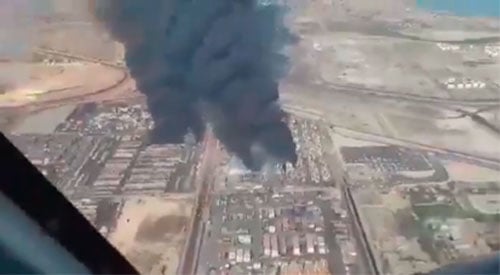
The explosion at the Rajaei Port container park in Bandar Abbas

Sodium perchlorate was converted into ammonium perchlorate solid rocket fuel primarily at Parchin, which has recently been subject to major attacks. Solid rocket fuel powers most of Iran’s inventory of ballistic missiles, including the medium range Khybar-Shikan and Fattah missiles and the shorter-range Fateh-110 and Zolfaghar missiles. The same material has also been intercepted en route to the Houthis in Yemen, where it is used to fuel the Palestine-2 missiles which have in recent days once again been fired at Israel.

Five IRISL ships, all OFAC sanctioned and showing similar repeat voyage characteristics on this route, have now arrived in Iranian waters ex China. Hong Kong-flagged HAZ-B cargo vessel Barzin (IMO 9820269) left Zhuhai on March 2 and arrived in Chah Bahar on March 22. Iranian-flagged HAZ-A cargo vessel Rayen (IMO 9820245) sailed from Zhuhai on March 13 and arrived Chah Bahar on March 29. Iranian-flagged HAZ-A cargo vessel Shabdis (IMO 9349588) left Zhuhai on March 2 and arrived in Chah Bahar on March 31. A fourth vessel is heading for Chah Bahar, the Iranian-flagged Zardis (IMO 9349679), which left from Zhuhai on March 21, and may still not have docked yet. A fifth vessel, the Iranian-flagged Hamouna (IMO 9820271) headed straight for Bandar Abbas, and was anchored off on April 5. Rail connections from Chah Bahar to the rest of Iran are incomplete, but the Iranians may consider it easier to truck hazardous goods from Chah Bahar rather than risk an entry into Bandar Abbas with an explosive cargo.

Notwithstanding the proven links of these cargo vessels to the manufacture of solid rocket fuel used to power Iran’s ballistic missiles, both the Chinese and Iranian authorities seem content to continue shipping sodium perchlorate on what is now a thoroughly compromised route. Their confidence in safety from interception on the route is sufficient to not use the available railway line connections from China through Tashkent in Turkmenistan to Iran instead, a route which can carry 40-foot (FEU) containers.


Iran Claims to Have Hit an MSC Container Ship in the Mideast

MSC Ishyka Manuel Hernandez Lafuente Vesselfinder 2015
MSC Ishyka (Manuel Hernandez Lafuente / Vesselfinder, 2015)

Published Apr 5, 2026 1:35 PM by The Maritime Executive


On Saturday, Iran's Islamic Revolutionary Guard Corps claimed a drone strike on an MSC container ship at a position in the Gulf region. 

"A drone struck the vessel . . . linked to the Zionist regime in the Strait of Hormuz; the ship caught fire," the IRGC claimed in a statement on X, naming the target vessel as the MSC Ishyka.

A vessel broadcasting the name MSC Ishyka III - but listed in Equasis as MSC Ishyka (IMO 9154206) - operates on a regional route between India, Africa and the Arabian Gulf. Based on the ship's most recent AIS signature, MSC Ishyka III is not in the Strait of Hormuz, but at berth in Manama, Bahrain (per Pole Star Global). 

Like hundreds of other merchant vessels, MSC Ishyka III was trapped inside the Gulf when U.S. forces attacked Iran on February 28, and was at berth in Manama on that date. Her AIS signal disappeared from tracking that afternoon, and remained off for one month. 

The ship reappeared on the morning of April 2 at a different nearby berth in Manama. About 24 hours later, her AIS transmission ceased once more and has not reappeared; it is possible that she may have transited elsewhere after that point, and her exact position cannot be confirmed. Given the vessel's AIS-dark status, it is unclear if the ship has been continuously at Bahrain or if she has been engaged in intra-Gulf trade, which continues despite substantial risk. 

As of Sunday, no authorities or bystanders have corroborated the strike; the IRGC has previously claimed success in attacks that did not occur or that missed their target. UKMTO has omitted the claimed drone strike on MSC Ishyka III from its official daily list of confirmed shipping incidents in the Gulf. 

The MSC Ishyka III is a 34,000 dwt container feeder built in 1997. She has been operated by MSC since 2014, and is currently owned by Pasithea Oceanway Ltd., a holding company with a mailing address at an MSC office in Cyprus.

Despite the IRGC's claims, MSC has no discernable links to Israel beyond providing shipping services to Israeli ports. The Ishyka itself has no direct ownership or operational ties to Israeli interests, and has not called in Israel in at least the past six months. Iran-linked Houthi rebels have previously targeted MSC ships based on a claimed but apparently unfounded link to Israeli shipping. 

Top image: MSC Ishyka (Manuel Hernandez Lafuente / Vesselfinder, 2015)


Human Remains Reportedly Found on Thai Bulker Attacked by Iranians

bulker burning in Persian Gulf
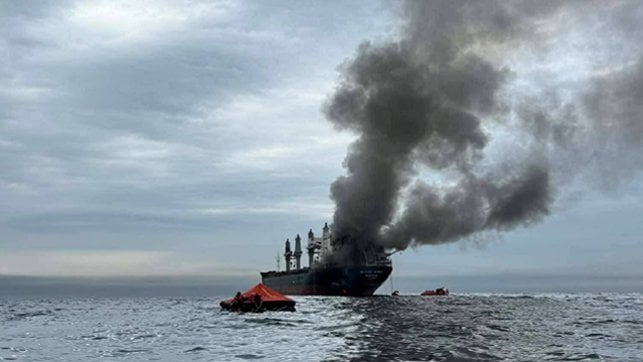
Three crewmembers were reported missing after the attack on the Mayuree Nree (Royal That Navy)

Published Apr 3, 2026 5:47 PM by The Maritime Executive


The Thai shipping company Precious Shipping reported on Friday, April 3, that human remains had been located aboard its vessel, the Mayuree Naree, more than three weeks after the ship was attacked near the Strait of Hormuz. The company had reported that three crewmembers were missing after the attack, and the ship was abandoned.

The company had previously said it appeared unlikely that the crewmembers would be located. The Royal Omani Navy rescued 20 crewmembers who abandoned the ship, with the reports indicating that the three missing crewmembers had likely been trapped in the engine room, which was hit and on fire.

The Mayuree Naree (30,193 dwt) was set ablaze off the coast of Oman on Wednesday morning, March 11, as one of possibly four commercial ships attacked at that time by Iran. It was approximately 11 nautical miles north of Oman when it was hit, likely by a missile.


The ship had remained afloat, and last week, Iranian TV reported it had drifted ashore near Qeshm Island. The report said an inspection had found there were no crewmembers on board. 

Few details were provided on the discovery, other than that it was within the affected area of the vessel. Bangkok-based Precious Shipping said the number of individuals and any identities had not yet been confirmed.

The ship was the eleventh ship reported to have been attacked or struck by debris as the conflict began on February 28. Reuters has totaled the reports, saying that 22 merchant ships have been struck in the Persian Gulf over the past month.

News of the discovery came shortly after a report that another one of the cargo ships that was attacked, AD Ports’ Safeen Prestige, had sunk after drifting and burning in the Persian Gulf. It was attacked and set on fire on March 4, and unconfirmed reports suggested it was attacked a second time by the Iranians. The last images showed the ship engulfed in a fire.

The International Maritime Organization and labor organizations have all called for efforts to protect and repatriate seafarers from the region. As with the Houthis, who attacked ships in the Red Sea, the groups are again demanding that seafarers not be dragged into the conflict and should be protected for their safety and the vital role they play in global trade.


Sweden Releases Shadow Tanker Detained on Suspicion of Oil Pollution

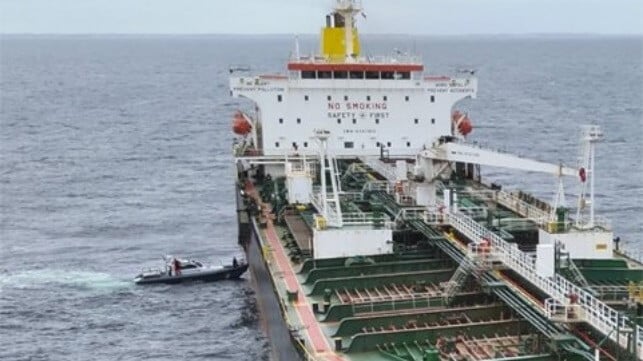
detained shadow fleet tanker
The Swedish Coast Guard and police boarded the tanker but could not prove the environmental violation while the registry was confirmed (Kustbevakningen)

Published Apr 5, 2026 4:00 PM by The Maritime Executive


The Swedish Coast Guard released the detained shadow fleet product tanker Flora 1, saying the environmental violations related to an oil spill in the Swedish EEZ could not be proven. The Coast Guard remained critical of the lack of clarity around the ship’s flag but said there was no possibility of further investigation after it received confirmation of its registry.

Swedish prosecutors earlier had said they had filed charges against two of the crewmembers aboard a shadow fleet tanker related to the oil pollution incident. On Thursday, April 2, a monitoring plane had spotted an approximately eight-mile-long oil slick in the Swedish EEZ and identified the Flora 1 as the suspect in the case. The tanker was directed to anchor off Ystad, Sweden, and was boarded by the authorities for an investigation. The Swedish Coast Guard reported it had discovered “various uncertainties.”

Prosecutors explained, however, that they were limited by international treaties over what they could do regarding the oil spill because it was in the EEZ, not closer to Swedish territorial waters. However, they reported that two crewmembers have been questioned and were being charged on suspicion of violating the Act on Measures to Combat Pollution from Ships. They were not detained and were not arrested.

The Coast Guard received a search warrant, which it told local media would permit it to enter areas of the ship. Questions have been raised about the seaworthiness of the tanker, which was built in 2005, as well as the legitimacy of its flag registry. The product tanker has 24 crewmembers aboard, who, according to the Coast Guard, are of various Asian nationalities. Databases list the ship as owned by Chinese interests in Hong Kong.

On Saturday, April 4, Cameroon confirmed that the ship is registered in its maritime registry. The ship, however, had been displaying Sierra Leone as its registry, which raised the uncertainties. It was also noted that the ship had changed its identity three times in 2025, and its ownership was unclear. Further, since 2023, it has been listed as having reported registry in St. Kitts and Nevis, Gabon, Panama, Djibouti, Palau, Benin (false), and Sierra Leone, according to the data in Equasis.

With the flag clarified and unable to prove the environmental violations, the Coast Guard reported it no longer had a legal basis to detain the Flora 1. The ship got back underway, and as of late on Sunday, it was off Denmark, heading out of the Baltic. The tanker was outbound from Russia, declaring it was bound for Brazil, when the Swedish Coast Guard detained it for the investigation.

"The suspicions do not lead to prosecution, but shipping should know that Swedish authorities are working together to maintain order at sea. We are acting to increase maritime safety and protect the environment. If there is a suspicious vessel, we intervene based on the prevailing conditions," said Daniel Stenling, deputy head of the Coast Guard's operational department.

Sweden, however, continues to detain two other ships linked to Russia under the authority of the Swedish Transport Agency. Both ships were cited for deficiencies during inspections and are required to correct the issues before they can sail. Prosecutors have also arrested the captains from each of the ships on charges that they presented false information to the police during the investigation. The flag registry of both ships is believed to be false. Sweden is requiring proof of flag registry and insurance before the ships will be permitted to sail.


Report: Russia Faces Logistical Nightmare in Redirecting Yamal LNG to Asia

Yamal Novatek icebreaker
File image courtesy Novatek

Published Apr 5, 2026 3:46 PM by The Maritime Executive


With Russia’s Yamal LNG exports rebounding amidst the war in the Middle East, new research reveals that a logistics challenge is likely to impact the project as early as 2027. While most of the Yamal shipments are currently heading to ports in Europe, Moscow has announced a pivot to the Asian market. In January, the European Union also approved a ban of Russian LNG imports to the bloc from January 2027. These shifts will add pressure to Russia’s existing transport fleet for Yamal LNG, according to Norway’s Center for High North Logistics (CHNL) - unless energy shortages from the ongoing Arabian Gulf conflict force Europe to change course.

The operational Russian LNG fleet includes 14 Arc7, 6 Arc4 and 5 non-ice-class LNG carriers. The researchers calculated the capability of the fleet to serve the Asian market when redirecting of shipments begins from 2027. Notably, the estimates do not account for maintenance, weather delays, port congestion and structuring transshipment cycles.

“If all flows are redirected to Asia, the fleet will be able to complete approximately 120-130 voyages per year. This is more than two times lower than the export volumes of 2024-2025,” projected CHNL.

The reduction is explained in part by the longer distances to Asia. In addition, Yamal LNG depends highly on Arc4 and non-ice-class vessels for transshipment operations, significantly limiting navigation options in the winter months. Again, shorter European routes ensure higher turnover for the relatively small transport fleet.

For Yamal LNG to retain its market edge, CHNL said that the project’s logistics scheme will require adjustments. This includes expansion of the ice-class tonnage, which Russia is struggling to build due to massive sanctions on its shipbuilding sector. Since 2023, Russia has only managed to complete two Arc7 vessels, which are part of the five partially built hulls originally supplied by South Korea.

Other options to resolve the impending logistical bottleneck include increasing transshipment capacity for a long voyage around Europe to reach Asia. Data from Eikland Energy shows that Russian gas producer Novatek would need to charter 25-35 additional tankers from 2027 to effectively redirect LNG to Asia using the Suez Canal or Cape of Good Hope route during the winter season. This would help Yamal LNG maintain its current export levels of 18 million tons per year.

Europe remains the largest customer of Yamal LNG, with France and Belgium being the primary destination. Out of 270 shipments from the port of Sabetta in 2025, 88 were destined to France, followed by 57 to Belgium and another 50 to China. The three countries together absorbed more than two-thirds of the total annual shipments.

This dynamic has changed with the ongoing war in the Middle East. In February, 100% of all Yamal LNG exports went to Europe, according to data by the campaign group Urgewald. All 21 shipments made in February, equivalent to 1.5 million tons of LNG, were destined to EU ports. Zero shipments went to China or Asia, down from four cargoes during the same period last year.


Lone Russian Corvette Flies the St. Andrew’s Flag in the Med

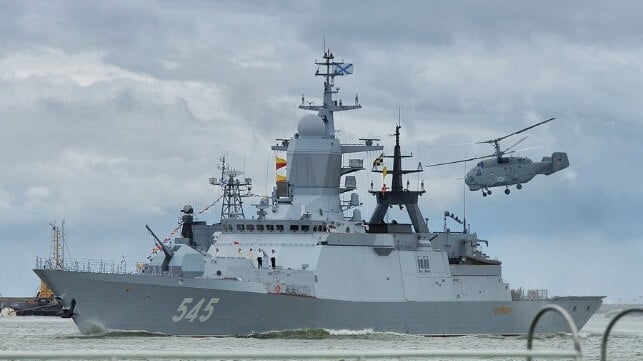
RFS Stoykiy (Russian Ministry of Defense file image)

Published Apr 5, 2026 5:45 PM by The Maritime Executive


At a time of active conflict involving both Lebanon and Israel, and when the French Navy has deployed at full strength to prevent further attacks on the British Sovereign Base Area in Cyprus, the strength of the Mediterranean Flotilla has sunk to a single ship flying the St. Andrew’s Flag of the Russian Navy.

On March 31, the Improved Kilo (Project 636.6) class submarine RFS Krasnodar (B-265) and its shadowing tug Altay (IMO 4622404) passed westwards back through the Strait of Gibraltar, having transited the English Channel on entry in mid-December last year. In its three month stint in the Mediterranean, Krasnodar first made a port call in Algiers, and passed back through Algiers with the Altay on its return journey.

On the basis of NATO anti-submarine patrol paths tracking the submarine, the Krasnodar appears to have spent most of its time in the central Mediterranean, where in December the dark fleet Omani-flagged tanker Qendil (IMO 9310525) was attacked, as was the Russian-flagged LNG carrier Arctic Metagaz (IMO 9243148) later on March 3. A Kilo-class submarine is not well suited to helping deter or react to such attacks.

The Krasnodar has conducted previous patrols in the Mediterranean. Although now based in the Baltic, the boat was formerly assigned to the Black Sea Fleet – and in effect may still therefore be nominally assigned to the Mediterranean Flotilla.

The sole Russian naval vessel remaining in the Mediterranean is the Steregushchiy-class corvette RFS Stoykiy (F545), last identified off Tartus at the end of March, but seen west of Cyprus and alongside in Tartus earlier in the month. The Stoykiy has had an eventful patrol, passing through the English Channel in late November, circumnavigating Africa, participating in Exercise Mosi-26 in Cape Town in early January, then making a port call in the Seychelles. It was next scheduled to exercise with the Chinese and Iranian navies in Exercise Maritime Security Belt 2026 off Bandar Abbas. 

Clearly aware something was afoot, the Chinese 48th Flotilla did not turn up, and the Stoykiy stayed only one night on February 18, conducting a very brief exercise with the Iranian Navy as it left the next day - a gesture which was clearly much appreciated by the Iranians. Most of the Iranian vessels participating in this short passage exercise were sunk days later as the Stoykiy was beating a retreat through the Red Sea to Tartus.

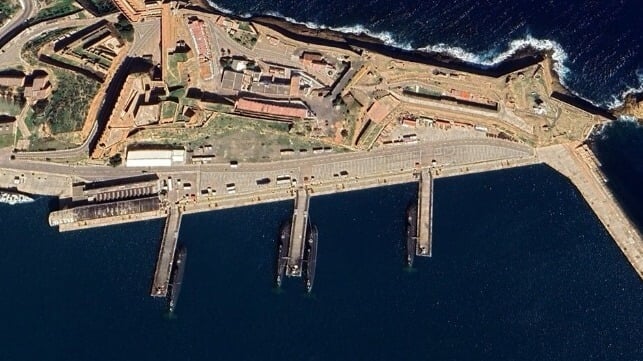
The Russian Navy, contrary to predictions, appears to have retained some restricted visiting rights in Tartus, and the Russian airfield at Khmeimim further up the Syrian coast remains active. The Russians appear not to have sought a new facility, with the port of Tobruk in Libya considered a strong candidate.  Instead, the Russians are leveraging their long-term training presence to make more frequent port calls in Algiers. Algiers is some distance away from the technical support which might be available at the Algerian naval base of Mers el Kebir, where a Russian team help maintain Algeria’s six Kilo-class submarine

Algerian Navy Kilo Class submarines alongside at their base in Mers al Kebir, March 2025 (Google Earth/Airbus)