Amidst War, Iran's Merchant Fleet is Enjoying Boom Times
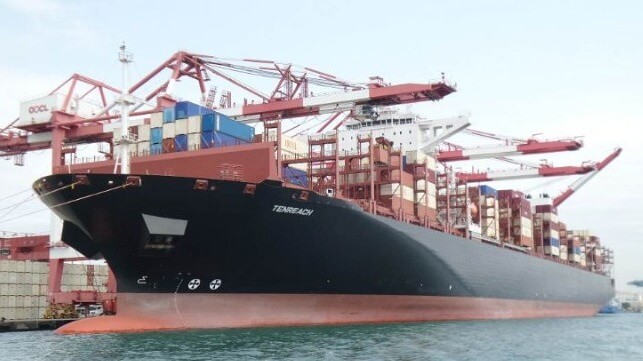
The merchant marine tends to sail on regardless in time of war, notwithstanding the risk. As the risk goes up, so do cargo rates. And so also does demand for the goods being carried.
For ships of the Iranian merchant navy, dominated by the state-owned but US-sanctioned Islamic Republic of Iran Shipping Lines (IRISL) and its subsidiaries, the current war is no exception. Business is booming.
The immediate evidence is on show in Iran’s ports. Since the start of the war on February 28 and throughout March, there were on average more than 20 arrivals and departures of cargo vessels every day in the Bandar Abbas commercial port - 22 vessels for example arrived on April 4. At the smaller port of Chah Bahar outside the Gulf and close to the border with Pakistan, there were 10 ships in port on April 5, and in recent weeks there have been on average two or three arrivals and departures every day.
Tanker traffic has also picked up, encouraged by the dramatic rise in oil and LNG prices since the war began, with dark fleet or Iranian-flagged tankers able to transit through the Strait of Hormuz without hindrance. A novel component of this uptick in traffic has been the resumption of deliveries of Iranian oil to India, for the first time since May 2019, authorized by a 30-day US waiver on the purchase of Iranian oil at sea. The first such delivery could have been by the OFAC-sanctioned Ping Shun (IMO 9231901), which lifted 600,000 barrels of crude at Kharg Island on March 4 and is now reporting her destination as China.
The apparent import of rocket fuel ingredients from China is also still in process. It is difficult from open sources alone to be sure what cargo is being carried on any particular ship. This is particularly so as weapons systems-related (or dual-use) materials contravening UN Security Resolution 1929 can easily be hidden among the large volume of cargo and containers which flow in normal times between China and Iran. Sodium perchlorate manufactured in China is shipped in sacks of pellets loaded into containers, and is the primary material used to manufacture ammonium perchlorate, which in turn makes up 70 percent of the standard fuel load of most of Iran’s solid-fueled ballistic missiles. The template for such journeys was provided by IRISL’s Golbon (IMO 9283033) and Jairan (IMO 9167291), which both loaded in Chinese ports in January last year and unloaded in Bandar Abbas in late March. Their cargoes of sodium perchlorate are believed to have been the combustibles for the massive explosion that occurred in the Bandar Abbas commercial port on April 26, 2025.
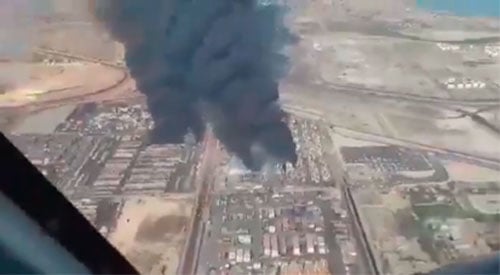
The explosion at the Rajaei Port container park in Bandar Abbas
Sodium perchlorate was converted into ammonium perchlorate solid rocket fuel primarily at Parchin, which has recently been subject to major attacks. Solid rocket fuel powers most of Iran’s inventory of ballistic missiles, including the medium range Khybar-Shikan and Fattah missiles and the shorter-range Fateh-110 and Zolfaghar missiles. The same material has also been intercepted en route to the Houthis in Yemen, where it is used to fuel the Palestine-2 missiles which have in recent days once again been fired at Israel.
Five IRISL ships, all OFAC sanctioned and showing similar repeat voyage characteristics on this route, have now arrived in Iranian waters ex China. Hong Kong-flagged HAZ-B cargo vessel Barzin (IMO 9820269) left Zhuhai on March 2 and arrived in Chah Bahar on March 22. Iranian-flagged HAZ-A cargo vessel Rayen (IMO 9820245) sailed from Zhuhai on March 13 and arrived Chah Bahar on March 29. Iranian-flagged HAZ-A cargo vessel Shabdis (IMO 9349588) left Zhuhai on March 2 and arrived in Chah Bahar on March 31. A fourth vessel is heading for Chah Bahar, the Iranian-flagged Zardis (IMO 9349679), which left from Zhuhai on March 21, and may still not have docked yet. A fifth vessel, the Iranian-flagged Hamouna (IMO 9820271) headed straight for Bandar Abbas, and was anchored off on April 5. Rail connections from Chah Bahar to the rest of Iran are incomplete, but the Iranians may consider it easier to truck hazardous goods from Chah Bahar rather than risk an entry into Bandar Abbas with an explosive cargo.
Notwithstanding the proven links of these cargo vessels to the manufacture of solid rocket fuel used to power Iran’s ballistic missiles, both the Chinese and Iranian authorities seem content to continue shipping sodium perchlorate on what is now a thoroughly compromised route. Their confidence in safety from interception on the route is sufficient to not use the available railway line connections from China through Tashkent in Turkmenistan to Iran instead, a route which can carry 40-foot (FEU) containers.
Iran Claims to Have Hit an MSC Container Ship in the Mideast
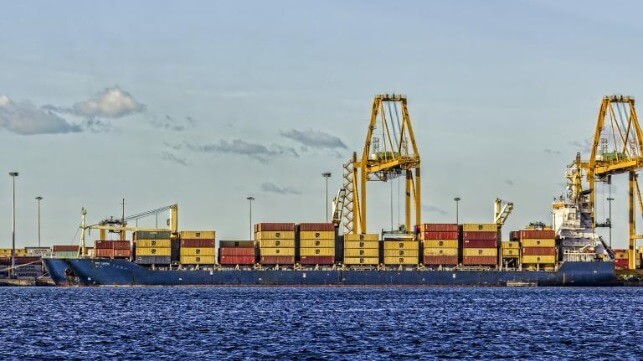
On Saturday, Iran's Islamic Revolutionary Guard Corps claimed a drone strike on an MSC container ship at a position in the Gulf region.
"A drone struck the vessel . . . linked to the Zionist regime in the Strait of Hormuz; the ship caught fire," the IRGC claimed in a statement on X, naming the target vessel as the MSC Ishyka.
A vessel broadcasting the name MSC Ishyka III - but listed in Equasis as MSC Ishyka (IMO 9154206) - operates on a regional route between India, Africa and the Arabian Gulf. Based on the ship's most recent AIS signature, MSC Ishyka III is not in the Strait of Hormuz, but at berth in Manama, Bahrain (per Pole Star Global).
Like hundreds of other merchant vessels, MSC Ishyka III was trapped inside the Gulf when U.S. forces attacked Iran on February 28, and was at berth in Manama on that date. Her AIS signal disappeared from tracking that afternoon, and remained off for one month.
The ship reappeared on the morning of April 2 at a different nearby berth in Manama. About 24 hours later, her AIS transmission ceased once more and has not reappeared; it is possible that she may have transited elsewhere after that point, and her exact position cannot be confirmed. Given the vessel's AIS-dark status, it is unclear if the ship has been continuously at Bahrain or if she has been engaged in intra-Gulf trade, which continues despite substantial risk.
As of Sunday, no authorities or bystanders have corroborated the strike; the IRGC has previously claimed success in attacks that did not occur or that missed their target. UKMTO has omitted the claimed drone strike on MSC Ishyka III from its official daily list of confirmed shipping incidents in the Gulf.
The MSC Ishyka III is a 34,000 dwt container feeder built in 1997. She has been operated by MSC since 2014, and is currently owned by Pasithea Oceanway Ltd., a holding company with a mailing address at an MSC office in Cyprus.
Despite the IRGC's claims, MSC has no discernable links to Israel beyond providing shipping services to Israeli ports. The Ishyka itself has no direct ownership or operational ties to Israeli interests, and has not called in Israel in at least the past six months. Iran-linked Houthi rebels have previously targeted MSC ships based on a claimed but apparently unfounded link to Israeli shipping.
Top image: MSC Ishyka (Manuel Hernandez Lafuente / Vesselfinder, 2015)
Human Remains Reportedly Found on Thai Bulker Attacked by Iranians
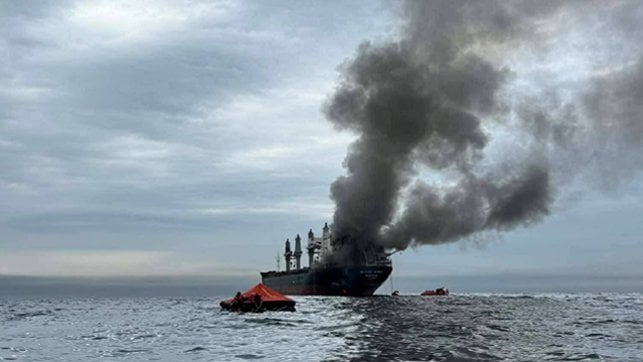
The Thai shipping company Precious Shipping reported on Friday, April 3, that human remains had been located aboard its vessel, the Mayuree Naree, more than three weeks after the ship was attacked near the Strait of Hormuz. The company had reported that three crewmembers were missing after the attack, and the ship was abandoned.
The company had previously said it appeared unlikely that the crewmembers would be located. The Royal Omani Navy rescued 20 crewmembers who abandoned the ship, with the reports indicating that the three missing crewmembers had likely been trapped in the engine room, which was hit and on fire.
The Mayuree Naree (30,193 dwt) was set ablaze off the coast of Oman on Wednesday morning, March 11, as one of possibly four commercial ships attacked at that time by Iran. It was approximately 11 nautical miles north of Oman when it was hit, likely by a missile.
The ship had remained afloat, and last week, Iranian TV reported it had drifted ashore near Qeshm Island. The report said an inspection had found there were no crewmembers on board.
Few details were provided on the discovery, other than that it was within the affected area of the vessel. Bangkok-based Precious Shipping said the number of individuals and any identities had not yet been confirmed.
The ship was the eleventh ship reported to have been attacked or struck by debris as the conflict began on February 28. Reuters has totaled the reports, saying that 22 merchant ships have been struck in the Persian Gulf over the past month.
News of the discovery came shortly after a report that another one of the cargo ships that was attacked, AD Ports’ Safeen Prestige, had sunk after drifting and burning in the Persian Gulf. It was attacked and set on fire on March 4, and unconfirmed reports suggested it was attacked a second time by the Iranians. The last images showed the ship engulfed in a fire.
The International Maritime Organization and labor organizations have all called for efforts to protect and repatriate seafarers from the region. As with the Houthis, who attacked ships in the Red Sea, the groups are again demanding that seafarers not be dragged into the conflict and should be protected for their safety and the vital role they play in global trade.
No comments:
Post a Comment