ALT FUELS
Mining Giant Vale Orders World's First Ethanol-Powered Giant Bulkers
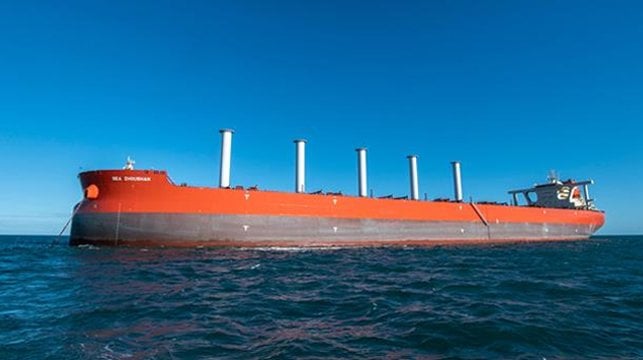
Vale reports it has entered into an agreement with China’s Shandong Shipping Corporation to build the first large ocean-going vessels that will use ethanol as their primary fuel. It is an adaptation of its current design for the massive Guaibamax vessels (325,000 dwt) and follows news from earlier this year that reported Vale and Everllence were working on ethanol as a marine fuel for its engines.
According to Vale, the agreement with Shandong includes 25-year contracts for the construction of two vessels, with an option for additional ships. The adoption of these second-generation Guaibamax vessels, which are 340 meters (1,115 feet) long and have a capacity of 325,000 tonnes, is part of the Brazilian mining company’s multi-fuel strategy. In addition to ethanol, these vessels will be capable of using methanol and heavy fuel oil, and their design also allows for conversion to use liquefied natural gas (LNG) or ammonia.
Shipping companies and the engine manufacturers have reported they are exploring ethanol as an alternative fuel. While there are concerns over supply, it is easier to handle than ammonia, which is toxic and highly corrosive. Maersk reported last December that it was exploring ethanol aboard its pioneering methanol-fueled feeder ship Laura Maersk. Everllence reported in September 2025 that it had success testing ethanol on its large two-stroke engines in the factory.
“The use of ethanol as fuel in the ships that transport our ore, combined with the adoption of rotor sails to harness wind energy, places Vale in a unique position for the energy transition in global shipping over the coming decades, whilst driving similar initiatives in the sector,” said Rodrigo Bermelho, Vale’s Director of Shipping.
Considering the full fuel cycle from well to wake, Vale highlights that ethanol can reduce carbon emissions by around 90 percent (in the case of second-generation ethanol) compared with heavy fuel oil. In addition to maritime transport, Vale’s adoption of ethanol in its logistics operations includes trials on trucks at its operations and on locomotives on the Vitória a Minas Railway (EFVM).
The new ethanol-powered ships will be similar to 10 other dual-fuel vessels (methanol and heavy fuel oil) that Shandong will deliver to Vale starting in 2027. The second generation of the Guaibamax will be equipped with five rotor sails to provide wind-assisted propulsion, as well as more efficient engines, hydrodynamic devices, a shaft generator, frequency inverters, and silicone paint, among the energy efficiency improvements. Vale says this set of technologies applied will reduce GHG emissions by around 15 percent compared to the current generation of Guaibamax. These technologies and alternative fuels are being tested as part of Vale’s Ecoshipping program.
The mining giant had reported in October 2024 that it was proceeding with the installation of rotors on one of its 400,000 dwt vessels. It was part of an agreement with the Japanese owners of the NSU Tubarao and Anemoi Marine. The company also added Norsepower rotors to one of its Capesize bulkers.
Vale’s chartered fleet includes first-generation Valemax vessels since 2011, second-generation Valemax vessels since 2018, and, since 2019, the first generation of Guaibamax. According to the company, these vessels are among the most efficient in the world and can reduce CO2 equivalent emissions by up to 41 percent compared to a standard capesize vessel.
Exmar’s Pioneering Ammonia Dual-Fuel Gas Carriers Named at Hyundai Shipyard
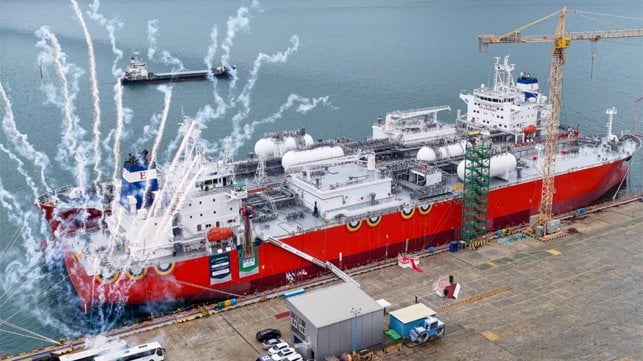
Two innovative vessels, which are being billed as the world’s first mid-size gas carriers with ammonia dual-fuel engines, were named as they are nearing completion. The vessels, which were ordered in 2023 and 2024 by Exmar, a specialist in gas shipping, are being built at the Ulsan, South Korea, shipyard of HD Hyundai Heavy Industries and are viewed as the cutting edge for a new era in shipping.
The ships, which are each 46,000 cubic meter gas carriers, were named Antwerpen and Arlon in honor of two Belgian cities. Each measures 190 meters (623 feet) in length and is specifically designed for the transport of liquefied gas cargoes, including ammonia and LPG. Exmar highlights that the vessels were deliberately lengthened 10 meters (approximately 33 feet) in the design stage, along with a slight increase in beam to achieve a meaningfully higher cargo intake compared to the standard design. Hyundai developed the proprietary technology and the three tanks, which provide 45,000 cbm storage below deck, and two 500 cbm deck tanks.
HD Hyundai highlights that ammonia (NH3) can be stored in pressurized tanks at around 8 bar or in refrigerated tanks at -33°C without the need for cryogenic technology. In liquid form, it has about 1.7 times higher storage density than liquefied hydrogen (-253°C) at the same volume, making it suitable for large-scale, long-distance transport and storage of hydrogen.
One of the key features of the design is the ability to use cargo as fuel. Exmar says this creates significant operational flexibility and environmental advantages. It reports that the ammonia dual-fuel technology enables CO2 emission reductions of up to 90 percent during navigation.
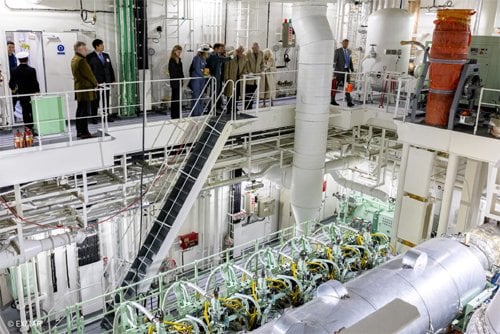
The mid-sized gas carriers are the first to be outfitted with the ammonia dual-fuel engines (Exmar)
The ships also feature shaft generators and a selective catalytic reduction (SCR) system to reduce nitrogen oxide emissions.
The safety concerns about ammonia were addressed by equipping the vessels with advanced detection and mitigation systems. They have an ammonia gas detector for real-time leak monitoring and an ammonia purge recovery unit. These ships are the first of four being built for Exmar. They are currently completing outfitting and are scheduled for delivery in May and late June.
For HD Hyundai, the vessels represent a significant achievement in its strategy to pursue high-value vessels and new technologies. It highlights the ammonia gas carriers as the next step following its 2016 delivery of the world’s first methanol-powered petrochemical product carrier and the 2023 delivery of the first methanol-powered containership. Designs for the ammonia gas carriers were developed through a partnership involving HD Hyundai, HHI-EMD, Wartsila Gas Solutions, WinGD, Lloyd's Register, and Exmar
While the expectations remain high for ammonia as an alternative maritime fuel, DNV highlights that there are only three ships in the world currently operating with ammonia, two tugs and one offshore supply vessel. However, it calculates that there are currently 46 vessels on order, with as many as 18 scheduled for delivery in 2026 and reaching 46 vessels by 2030.
HD Hyundai highlights the forecast by the International Energy Agency that projects ammonia will account for eight percent of marine fuel demand by 2030. It is projected to rise to 46 percent by 2050. Ammonia is also seen as a likely carrier, as it can be used to transport hydrogen when combined with a cracking process at the destination.
EcoNavis to Validate and Demonstrate Improved Design for Wind Rotors
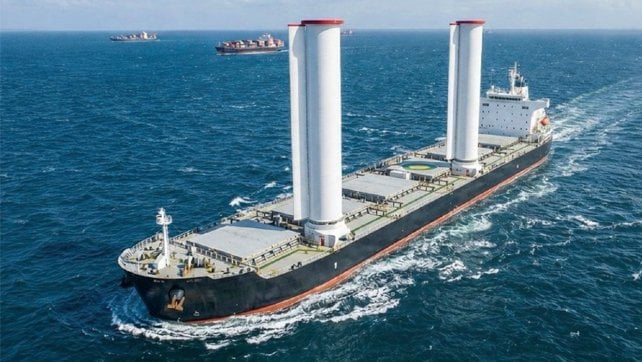
Scotland-based EcoNavis Solutions believes it has a technological innovation that can enhance the performance of wind rotors. With wind-assisted propulsion gaining increased interest, the company is using a Scottish Enterprise research grant to move its concept from the drawing board to validation and demonstration.
The basic concept of the wind rotor promoted by Anton Flettner in the 1920s remains largely unchanged after more than a century. The spinning rotor captures the energy of the wind to provide additional thrust for ships and has become one of several competing technologies in the sector.
EcoNavis, however, points out that there are limitations to the original technology that impact its reliability. Issues such as a change in wind direction can reduce the effectiveness and also mean that ships require more route planning to maximize the effectiveness of the technology.
The company has patented a tail-appendage device, which it says can increase thrust, reduce power demand, and widen the range of wind angles in which the rotor sail can operate efficiently. The tail enables the company to essentially broaden the rotor’s effective “wind window” and reshape the wind flow in the rotor’s wake.
It delivers higher thrust with lower torque demand. EcoNavis reports initial simulations indicate an increase in thrust of up to 10 percent with a 5 percent reduction in torque.
“Flettner rotors already offer one of the highest lift-to-drag ratios among wind-assisted devices, with a relatively modest footprint, but the main drawback has been the narrow band of wind angles – typically beam and stern-quarter winds,” said EcoNavis CEO and founder Dr. Batuhan Aktas. “By recovering energy that would otherwise be lost and optimizing the flow behind the rotor, we can provide a Flettner rotor design with a greater operational range.”
The fixed aerodynamic appendage downstream helps to stabilize the airflow behind the rotor. The company says it will permit the rotor to continue to generate thrust as wind conditions change.
By recovering energy that would otherwise be lost and optimizing the flow behind the rotor, EcoNavis believes its EcoRotor Sail can offer greater operational range. It says shipowners can have greater flexibility in route planning and more consistent performance over a typical trading year without fundamental changes to vessel operations.
The next phase will move into physical testing. Development of the EcoRotor Sail is being backed by a £100,000 ($133,000) research grant from Scottish Enterprise to take the £265,000 ($352,000) project through to validation and demonstration stages.
No comments:
Post a Comment