Defending birthright citizenship is not only about protecting children of immigrants. It is about preserving a constitutional framework that recognizes our shared humanity and limits the government’s ability to decide whose rights matter.
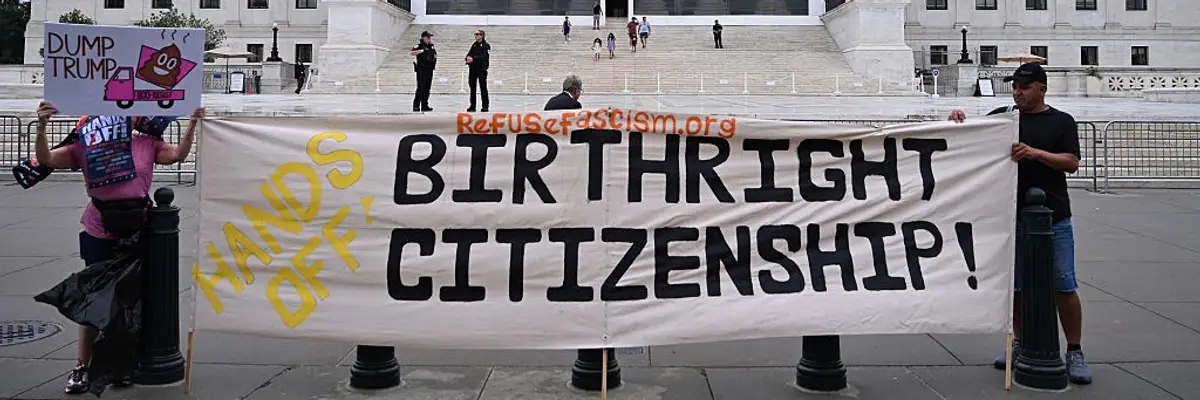
Demonstrators holds up an anti-Trump sign outside the US Supreme Court in Washington, DC, on June 27, 2025.
(Photo by Alex Wroblewski / AFP via Getty Images)
Damareo Cooper
Mar 31, 2026
For more than 150 years, the 14th Amendment has been an uncompromising line: If you are born on US soil, you are a citizen. That principle is so foundational, many of us take it for granted.
But that principle is under attack.
On April 1, the Supreme Court will hear oral arguments challenging President Donald Trump’s effort to end birthright citizenship. At the center of the case is an executive order issued on the first day of Trump’s second term to end Birthright Citizenship for children of undocumented parents.
The justices will now decide whether a president can rewrite one of the clearest promises embedded in American law.
If the court strikes down birthright citizenship, it would let the government decide who counts as American based on the circumstances of their birth.
On the surface, threatening the rights of children born in the United States might seem like an immigration debate. But history tells a different story.
Birthright citizenship was never an abstract ideal. It was a response to America’s long history of dehumanization—a past that Trump and his MAGA allies are now openly trying to resurrect. The 14th Amendment was designed to dismantle a system that denied Black people a political voice, treated us as property, and denied our humanity.
Ratified in 1868, the amendment overturned Dred Scott v. Sandford, which declared that Black people “had no rights which the white man was bound to respect.” Birthright citizenship was meant to be simple and permanent so no government could take it away based on race, ancestry, or political whim.
For formerly enslaved people and their descendants, it guaranteed recognition as full citizens in their own country. But the 14th Amendment did more than correct the injustices of slavery: It expanded who counts as American.
The Constitution says plainly that anyone born in the United States and subject to its laws is a citizen. That principle was reaffirmed by the Supreme Court in United States v. Wong Kim Ark, which ruled that a man born in San Francisco to Chinese immigrant parents was a citizen, establishing that US-born children of immigrants are citizens. This was despite the fact that Chinese immigrants at the time were barred from naturalization under the Chinese Exclusion laws.
The case now before the court seeks to undo that understanding.
If the court strikes down birthright citizenship, it would let the government decide who counts as American based on the circumstances of their birth.
The 14th Amendment’s authors understood the danger of that approach. Once citizenship becomes conditional, every other right soon follows.
Ending birthright citizenship would affect everyone—not just children of immigrants—in a system that has long questioned the belonging of people of color, including Black Americans.
Who must prove their citizenship? Who is presumed to have it? Who gets stopped, questioned, or detained? Who lives under suspicion?
History answers clearly: Marginalized communities pay the price first.
I write this as someone who has spent more than 15 years organizing for racial justice and as a Black man whose citizenship was once explicitly denied by law. Today, I see how systemic racism—from policing to voter suppression—continues to shape the livelihoods of Black Americans.
And that danger does not stop with birthright citizenship: These attacks threaten the entire 14th Amendment, including the Equal Protection and Due Process Clauses that underpin victories against segregation, discrimination, voter suppression, and unchecked government power.
If the government can redefine citizenship, unequal treatment under the law becomes easier to justify. Civil rights become conditional. Equal protection becomes negotiable. State power expands while accountability shrinks.
We have seen this playbook before. After Reconstruction came Jim Crow. During industrialization came the Chinese Exclusion Act. Black workers were excluded from key New Deal protections. The gains of the civil rights movement were followed by voter suppression and mass incarceration.
Each time progress threatened entrenched power, the response was restriction rather than inclusion.
The 14th Amendment was written to break that cycle.
Defending birthright citizenship is not only about protecting children of immigrants. It is about preserving a constitutional framework that recognizes our shared humanity and limits the government’s ability to decide whose rights matter.
So the stakes could not be clearer during these Supreme Court arguments.
Birthright citizenship is more than law. It is the promise that America’s diversity, struggle, and resilience matter. It is the legacy of those who fought to be recognized as fully human—and the foundation of a democracy that must belong to all of us.
March 31, 2026
RAW STORY
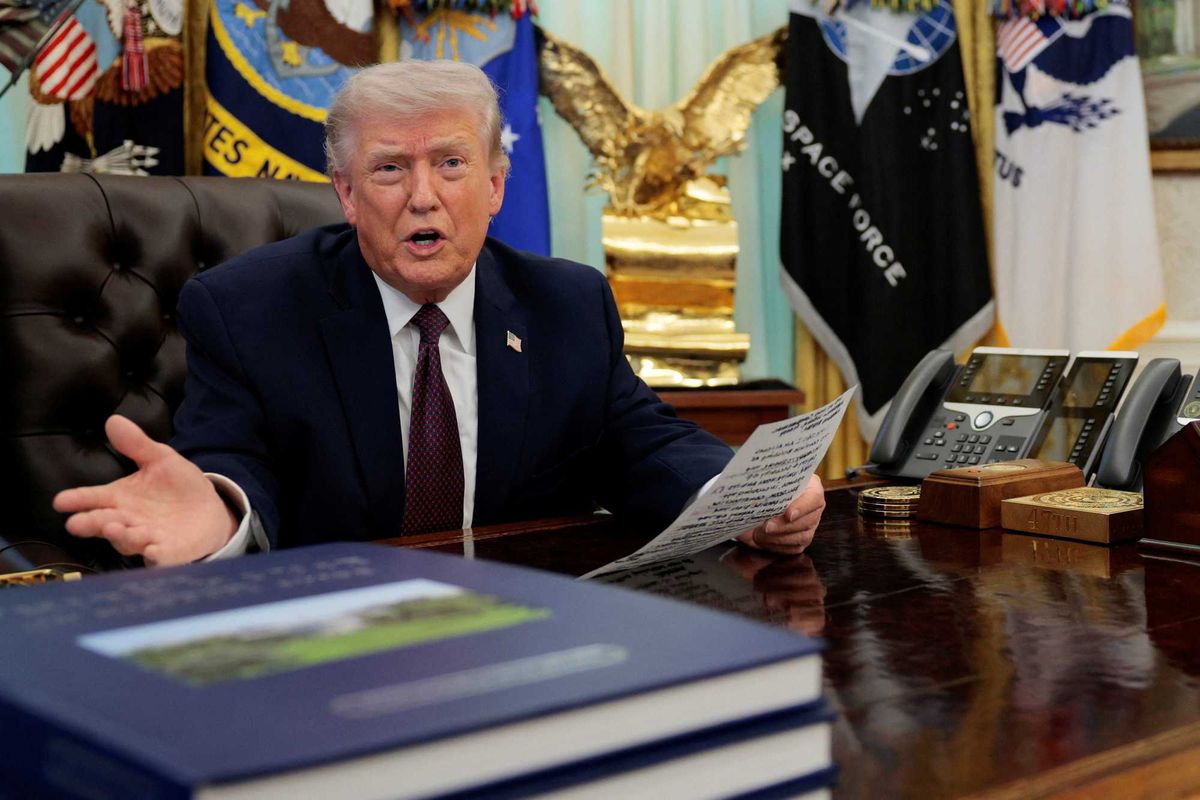
U.S. President Donald Trump speaks during the signing ceremony for an executive order on mail ballots, in the Oval Office of the White House in Washington, D.C., March 31, 2026. REUTERS/Evan Vucci
President Donald Trump is planning to make an "unprecedented" appearance at the Supreme Court on Wednesday, according to a new report.
The Associated Press reported on Tuesday that Trump plans to attend oral arguments on Wednesday as the court debates the birthright citizenship case on its docket. Trump's appearance will make him the first sitting president in U.S. history to attend oral arguments at the court, according to the report.
"The Republican president’s official schedule, sent out by the White House, included a stop at the Supreme Court, where justices will hear Trump’s appeal of a lower court ruling that struck down his executive order limiting birthright citizenship," the report reads in part.
"The order, which Trump signed on the first day of his second term, declared that children born to parents who are in the United States illegally or temporarily are not American citizens," it added. "It’s an about-face from the long-standing view that the Constitution’s 14th Amendment and federal law since 1940 confer citizenship to everyone born on American soil, with narrow exceptions."
Trump has repeatedly railed against judges who rule against his administration's policy efforts. For instance, he said a federal judge in Washington, D.C. was "completely wrong" to order him to seek Congressional approval before continuing to build his signature White House ballroom.
Ending birthright citizenship would impact Asians and Latinos most, study finds
Penn State
UNIVERSITY PARK, Pa. — Established in 1868 with the ratification of the 14th Amendment to the U.S. Constitution, birthright citizenship grants citizenship to all persons born on U.S. soil regardless of the parents’ citizenship status. If birthright citizenship is ended, the number of children born without a defined legal status in the United States may reach up to 6.4 million by 2050, according to a new study by Penn State researchers published today (March 31) in the journal Demography.
The largest absolute impact of the policy change would affect Latino immigrants, who would comprise more than 90% of U.S.-born people without legal status — what the study authors call “unauthorized” for brevity — in the country by 2050. However, the undocumented Asian population would experience the largest relative growth of any other immigrant group — with 41 “unauthorized” births per 1,000 Asians without legal status, compared to 17 births per 1,000 Latinos without legal status, according to the researchers. The researchers attributed the fivefold increase in “unauthorized” Asian births to the number of Asians in the country on student and work visas whose children would no longer be granted citizenship.
“The policy ending birthright citizenship slated to be argued before the Supreme Court in April would expand the definition of an undocumented parent to someone with any kind of non-immigrant visa, like a student visa or work visa, and that’s the part that would really change a lot of lives for Asian families,” said Nicole Kreisberg, study co-author and assistant professor of public policy at Penn State.
Many Asian immigrants arrive to the U.S. on temporary student or work visas, and then it takes them another decade to get a green card, added study co-author Jennifer Van Hook, distinguished professor of sociology and demography at Penn State.
“We know from our prior research that about half of Asians who initially come as students end up staying permanently, and so they’re coming in the middle of the family-building parts of their lives,” she said, explaining that the new policy would leave their children designated as “unauthorized,” or without citizenship. “These are often highly educated people contributing to our economy, and to disenfranchise their children would be a big loss for them.”
To see how the policy change would impact immigrant groups, the researchers first estimated the number of undocumented immigrants in the U.S. by comparing immigration data from the U.S. Census Bureau’s American Community Survey to legal residency data from the Department of Homeland Security. They also looked at census and immigration data from other countries, like Mexico, to deduce and adjust for the number of undocumented immigrants missing from U.S. government data.
The research team then modeled projections of the “unauthorized” and temporary nonimmigrant population in the U.S. to the year 2050, taking into account current age- and group-specific fertility, mortality and migration rates. They ran three scenarios: a status quo scenario, which defined all children born to immigrant and nonimmigrant parents as U.S. citizens, in accordance with the current law; scenario 1, which classified births as “unauthorized” if born to two undocumented parents; and scenario 2, which classified births as “unauthorized” if born to two undocumented parents, two nonimmigrant parents or a combination of the two. Scenario 2 models the language of the policy being brought before the Supreme Court, the researchers noted.
The researchers found that scenario 1 resulted in 5.3 million children being born to undocumented parents over the next 25 years, with 3 million of these children still living in the U.S. by 2050. Adding the children born to nonimmigrant parents in scenario 2 increased the number of “unauthorized” births to 6.4 million, with 3.4 million of these children staying in the country. Latinos would comprise 93% of the “unauthorized” U.S.-born population in 2050 in scenario 2, while the number of “unauthorized” Asian births would increase five-fold.
“We found that the proposed change to birthright citizenship would create an undocumented population among families who have done everything the legal way, like obtain nonimmigrant visas for work or study,” said Kreisberg, who is also a co-funded faculty member of Penn State’s Social Science Research Institute (SSRI).
When immigrants have had opportunities and equality before the law, they have overperformed in schooling, job outcomes, entrepreneurship, investment in new businesses and so forth, and their success helps everybody, said Van Hook, who also directs the Population Research Institute in SSRI. She noted a July 2024 report released by the nonpartisan Congressional Budget Office, which projected that the immigration surge in the first half of the 2020s would result in an $8.9 trillion boost to the country’s gross domestic product over the next decade, largely from additional wages subject to payroll and income taxes.
“Thinking about the kinds of workers we need in the future given our information economy, we depend heavily on a highly educated workforce,” she said. “If we put barriers up for millions of these children, we are effectively sabotaging ourselves.”
The policy might also result in a brain drain, with highly skilled workers relocating to other countries before having children, the researchers said.
“Higher education pours a lot of resources into educating students, including our international students,” Van Hook said. “If we’re now essentially pushing them out of the country right after that investment, what are we doing? That’s a wasted investment.”
The Eunice Kennedy Shriver National Institute of Child Health and Human Development and Penn State, through its Population Research Institute, supported this research.
Journal
Demography
Article Title
Ending Birthright Citizenship Would Have Disparate Impacts on U.S.-born Children of Asian and Latino Immigrants
Article Publication Date
31-Mar-2026
No comments:
Post a Comment