Divide and Conquer? Paul Robeson and Jackie Robinson in the USA
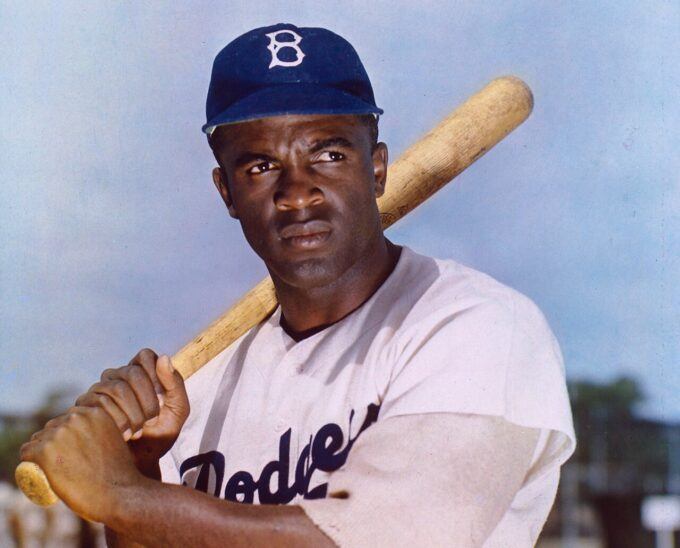
Photograph Source: Harry Warnecke / Frank Livia / Robert F. Cranston / William Klein – National Portrait Gallery, Smithsonian Institution – CC0
Paul Robeson and Jackie Robinson never met in person. During certain periods in their lives, both men were held up by white America as examples of proof that in the US anyone can make it if they apply themselves. Of course, left unsaid in this myth are at least two truths. The first truth is if a person trying to make it is not white-skinned, their efforts will have to be at least twice that of most white men and, secondly, even if they face racism and prejudice along the way, those who aren’t white men must bear it with grace, indeed with submission. Their pride must be suspended except when it is deemed appropriate; in other words when it won’t offend the white supremacists and their system of domination.
Paul Robeson rejected this dynamic. Jackie Robinson struggled with it most of his life. Sportswriter and author Howard Bryant discusses both men and their lives in an age when very few Black men (and even fewer women) even had an opportunity to be noticed for their athletic and entertainment prowess, much less their intellect. The text, titled Kings and Pawns: Jackie Robinson and Paul Robeson in America, opens with Jackie Robinson’s appearance before a 1949 House UnAmerican Activities Committee (HUAC) hearing designed to denigrate Paul Robeson, whose socialist politics and rejection of US anti-communism had earned him the wrath of many US residents, especially those inclined to seeing a communist behind almost anyone who supported an end to white supremacy’s control over the political and economic structures in the nation. Although neither man had ever met, Robinson decided to accept the urging of the man who helped him get into Major League Baseball, Branch Rickey.
Despite the mythology surrounding Rickey—a mythology that turns him into an anti-racist hero and champion of a racially integrated world of sports in the United States—Bryant suggests the more honest truth was that Rickey was like most other white people in the United States at the time. He didn’t really want African-American players in Major League Baseball (MLB), but understood somewhere in his business mind that their presence was unavoidable. More importantly, Rickey was as anti-communist as most US residents, if not more so. Jackie Robinson was anti-communist, too. He also felt beholden to Rickey for his role in getting Robinson onto the Brooklyn Dodgers roster. So, when Rickey asked Robinson to testify, Robinson agreed, Rickey coached him on what to say, and Robinson mostly followed the script he was given. I am reminded of Ralph Ellison’s character in the novel Invisible Man and his realization of “What and how much I had lost by trying to do only what was expected of me instead of what I myself had wished to do?” It was only later after Robinson realized that MLB and many (if not most) of its white fans only liked Robinson when he acted the way they thought Black people should act in the US. In other words, Robinson should keep his mouth shut and play ball.
As Bryant and other biographers describe it, Robinson could only do this for so long. Eventually, he reacted, his anger turning off many fans and members of the professional baseball world. Meanwhile, Paul Robeson, who had been one of the greatest singers, college football players and screen actors in the United States, saw his income disappear and his life under threat. His persecution by the government and intimidation from the American right is perhaps best exemplified by the attacks on his entourage and the concert-going public who showed up for his 1949 concerts in Peekskill, New York. Those attacks were organized by far-right citizens’ groups and backed by local police. Bryant’s text makes the point that both men experienced the irrational hatred of US white supremacy in their own way.
Howard Bryant used to write for the Boston Herald sports section. He was one of the few Black writers to ever appear on those pages. As any sports fan knows, professional sports in Boston have a reputation as being one of the most racist places for a Black athlete to play; a vocal element of its fan base is known for its racist abuse. While this is no longer as true as it once was, it is a legacy that continues to taint Boston sports, especially its baseball team, the Red Sox, who were one of the last teams to sign a Black player. I mention Bryant’s job with the Herald to point out his familiarity with professional sports, the players, the owners and managers, and the fans. When he wrote for the Herald, it was the paper of Boston’s white working class, who identified with its more right-wing columnists and editorial policy than they did with the Globe’s conventional liberalism. (An older friend of mine, whose politics are right wing, called the Globe a commie paper—and he wasn’t joking.) Bryant knew his audience and his columns seemed intended to make them see their world differently. His 2002 book, Shut Out: A Story of Race and Baseball in Boston, remains one of the best books on Boston sports ever written.
Kings and Pawns is an incisive story of two men whose lives became fodder for political and social issues much greater than either individual could control. It’s also a commentary on the damage perpetrated by racist and supremacist politics and culture. Most importantly, it’s a history of the United States at a time somewhat like the current one, which is reason enough to read this book and consider its meaning.
No comments:
Post a Comment