
Greenpeace said on April 8 that fossil fuel operators in parts of eastern Europe are continuing to burn methane in potential breach of new EU rules banning routine flaring, raising concerns over energy waste and environmental harm.
Research by Greenpeace units in Croatia and Hungary found repeated flaring at oil and gas facilities during February and March, despite an European Union regulation that came into force on February 5 prohibiting the practice under normal operating conditions.
The group said it used a combination of field monitoring and satellite analysis to track emissions, including cameras installed near sites in Dugo Selo and Ivanić-Grad, close to Zagreb. Footage captured activity every 90 seconds and indicated frequent flare-ups, particularly near residential areas.
Satellite data from the VIIRS Nightfire system, which detects heat signatures from gas flaring, recorded 71 flare events in Croatia and 205 in Hungary over the two-month period, according to Greenpeace.
According to the NGO, flaring sites were detected in Bulgaria, Croatia, Hungary, Poland, Romania and Slovakia since February 6, as well as in aspiring EU members Bosnia & Herzegovina and Serbia.
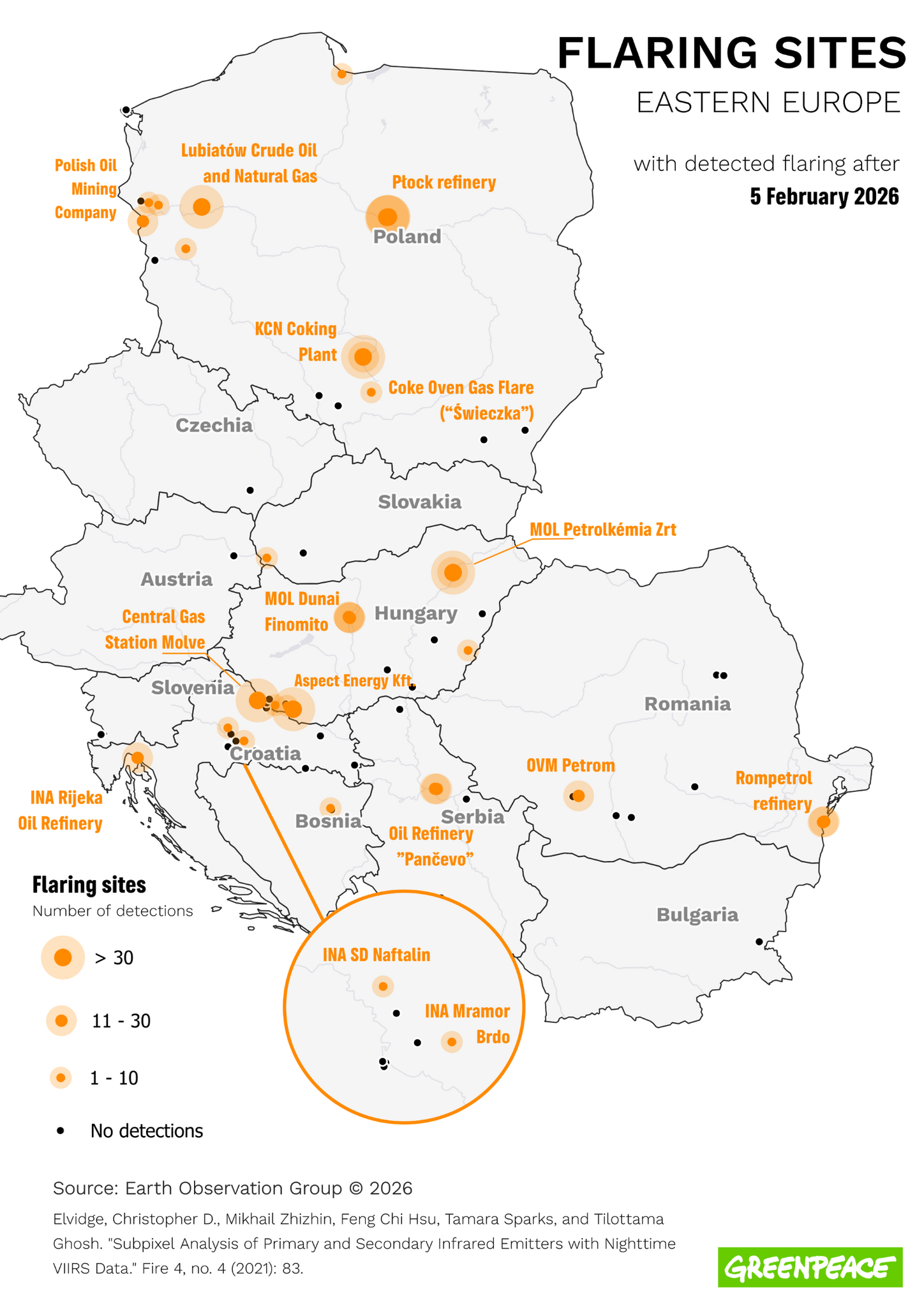
The findings suggest the new rules have yet to significantly curb the practice, the group said.
“Isn't that another hypocrisy? The government talks about energy security, and allows companies to waste energy and thus avoid the costs of complying with regulations. This is an irresponsible act towards citizens and the environment,” said Petra Andrić of Greenpeace Croatia.
Routine flaring involves burning off excess gas during oil and gas production rather than capturing it for use. Environmental groups say the practice wastes energy at a time of heightened concern over supply, while contributing to climate change and air pollution.
Methane, the primary component of natural gas, is a potent greenhouse gas with a significantly higher warming effect than carbon dioxide over the short term. In addition to climate impacts, flaring can expose nearby communities to harmful substances, including volatile organic compounds.
Greenpeace said Croatia adopted legislation implementing the EU methane regulation only at the end of March, but added that the delay does not affect the regulation’s applicability.
The group urged authorities to enforce the rules more strictly and accelerate a shift away from fossil fuels.
“We call on the government to strictly implement the new regulations on methane and draw up a plan to abandon fossil gas by 2035. Real energy security is based on domestic renewable sources. Croatia has enormous potential for solar and wind energy,” Andrić said.
No comments:
Post a Comment