The Pennsylvania Supreme Court ruling is part of a nationwide trend to challenge life without parole sentences.
By Sonali Kolhatkar ,
April 12, 2026
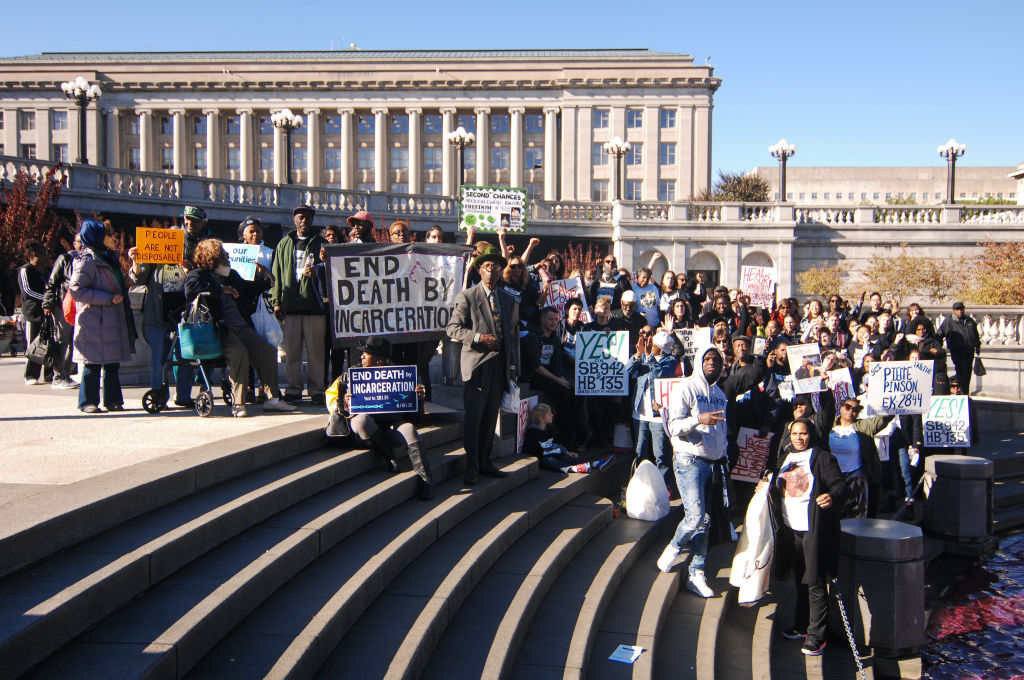
Hundreds rallied to end life without the possibility of parole in Harrisburg, Pennsylvania, on October 23, 2019.Cory Clark / NurPhoto via Getty Images
In late March, Pennsylvania’s Supreme Court issued a momentous ruling overturning mandatory life sentences for people convicted of felony murder, also known as second-degree murder. Activists and advocates hailed the ruling as a victory that was years in the making and has the potential to impact the lives of more than a thousand people in the state, a majority of whom are Black.
Those sentenced to life without parole (LWOP) are, by definition, never allowed to go before a parole board and can only ever win freedom if the governor of their state grants them clemency. The ACLU calls LWOP sentences “permanent removal from society with no chance of reentry, no hope of freedom,” and therefore, “short of execution, the harshest imaginable punishment.” It’s no wonder activists involved in ending LWOP refer to it as “death by incarceration.”
Five states — Pennsylvania, Iowa, Louisiana, Mississippi, and North Carolina — require mandatory life sentences without the possibility of parole for felony murder convictions. According to the Center for Constitutional Rights, Pennsylvania has the nation’s highest per capita rate of people serving death by incarceration sentences. Such a conviction — in spite of its name — doesn’t mean the person accused is directly responsible for a death. One can also be convicted of a felony murder if one’s actions indirectly and unintentionally resulted in someone’s death.
In late March, Pennsylvania’s Supreme Court issued a momentous ruling overturning mandatory life sentences for people convicted of felony murder, also known as second-degree murder. Activists and advocates hailed the ruling as a victory that was years in the making and has the potential to impact the lives of more than a thousand people in the state, a majority of whom are Black.
Those sentenced to life without parole (LWOP) are, by definition, never allowed to go before a parole board and can only ever win freedom if the governor of their state grants them clemency. The ACLU calls LWOP sentences “permanent removal from society with no chance of reentry, no hope of freedom,” and therefore, “short of execution, the harshest imaginable punishment.” It’s no wonder activists involved in ending LWOP refer to it as “death by incarceration.”
Five states — Pennsylvania, Iowa, Louisiana, Mississippi, and North Carolina — require mandatory life sentences without the possibility of parole for felony murder convictions. According to the Center for Constitutional Rights, Pennsylvania has the nation’s highest per capita rate of people serving death by incarceration sentences. Such a conviction — in spite of its name — doesn’t mean the person accused is directly responsible for a death. One can also be convicted of a felony murder if one’s actions indirectly and unintentionally resulted in someone’s death.
That was the case for a Black man named Derek Lee, who in 2014 was involved in a robbery where his accomplice’s actions resulted in a death. Because of Pennsylvania’s mandatory sentencing law, Lee was condemned to spend the rest of his life in prison. The Abolitionist Law Center filed an appeal on his behalf, resulting in the historic Pennsylvania Supreme Court ruling that mandatory LWOP for second-degree murder was in violation of the state constitution’s prohibition on cruel punishment.
“All of us who do this work know people who have been in for 20, 30, 40, 50 years even,” said Kris Henderson, co-founder and co-executive director of Amistad Law Project and founding member of the Coalition to Abolish Death by Incarceration (CADBI). “Many people who could come home today, would be an asset to their communities … but there’s just really no mechanism for them to come home right now.”
These Women Face Death by Incarceration, But They’re Organizing for Their Lives
A new report highlights the experiences those sentenced to death by incarceration in Pennsylvania’s women’s prisons. By Victoria Law , Truthout April 21, 2023
Following the court ruling, Pennsylvania’s lawmakers have 120 days to create a mechanism ensuring the state’s compliance so that people like Lee have recourse. Henderson hopes that “the legislature will pass a bill that will allow all people who are serving death by incarceration for felony murder to have a chance to come home, that they will all be parole eligible after a certain number of years.”
People who are sentenced to LWOP are often very young when they begin serving their sentences. That was the case with Phillip Ocampo, who, according to his mother Lorraine Haw, was only 18 years old when he was arrested and has served 32 years in Pennsylvania prisons. “If this Supreme Court ruling hadn’t happened, he was basically going to be in prison for the rest of his life,” said Haw.
The groundwork for the court ruling was laid more than a decade ago when CADBI was founded. Henderson recalled it was a time when Philadelphia had been home to “this anti-carceral, anti-prison movement for years and years. And so many of us had been working together for years in different sorts of configurations at different moments.”
CADBI’s co-founders began by sending letters to people in prison serving LWOP sentences, urging them to send family members and loved ones to an organizing meeting. “Hundreds of people showed up,” said Henderson. “Hundreds of people who didn’t know anything about a movement to abolish death by incarceration, didn’t know anything about organizing in general.”
Among them was Ocampo’s mother. “We’ve gone in front of lawmakers, we’ve gone to legislators, we’ve gone inside prisons to talk about it. We’ve held rallies,” said Haw. Ocampo is her only child and Haw has made it her life’s goal to free him and others like him. “It was hard at the beginning because every time I talked about my son, I would have to cry. But I’m not there only for my son. I’m there for everybody that’s in the same situation as he is.”
Thomas Schilk is a writer and artist serving a LWOP sentence in Pennsylvania. In an interview, his sister Joanne Schilk said, “My brother always wants people to know … although he did not kill anyone or [have] the intent to kill anyone, he did real harm, which he believes he should be accountable for.” She feels that after 42 years in prison, “he has taken accountability for his crime and has proven to be deserving of a second chance at freedom.”
Like Haw, Joanne Schilk has been active with CADBI for years, attending rallies, making legislative visits, and lobbying state lawmakers to end LWOP sentences as well as supporting medical parole and compassionate release bills. “I helped recruit people from other counties such as Bucks and Lancaster to give them a voice and to encourage involvement, to lean on lawmakers by being a voice for their loved ones serving life sentences,” she said.
That activism, together with sympathetic people in positions of power, paved the way for the Supreme Court ruling. Pennsylvania Gov. Josh Shapiro, who filed an amicus brief in support of Lee’s appeal, was formerly the state attorney general and had been directly involved in commuting life sentences. In Philadelphia, where more than 500 people are serving LWOP, District Attorney Larry Krasner has also publicly expressed support for an end to mandatory life sentences.
“I thought my eyeballs were going to be swollen from so much crying,” said Haw, recalling how she felt when the Pennsylvania Supreme Court ruling was announced. “I was so ecstatic, and I couldn’t believe it.”
Schilk concurred, saying, “I absolutely could not believe that something had finally happened in such a huge way. I felt like I couldn’t breathe, I was so happy. I just sobbed and shook.”
The reliance on LWOP sentences nationwide is in flux, caught in a tug-of-war between abolitionist grassroots activists and “tough-on-crime” politicians. Even in states where such sentences are not mandatory, LWOP can be applied to people who did not intend to kill or whose accomplices committed the murder in question. According to a 2025 report by The Sentencing Project, 16 percent of people in prison nationwide — that’s about 200,000 people — are serving life sentences. The proportion of those with LWOP sentences is up 68 percent from 2003.
Yet, since 2005, the U.S. Supreme Court ruled in several cases that life sentences for people convicted as juveniles were unconstitutional (although the court’s new conservative majority has taken the court in the opposite direction).
After the U.S. Supreme Court’s rulings on juvenile lifers, hundreds of incarcerated Pennsylvanians were able to come home, and according to Henderson, some among them are now involved in the movement to end LWOP for everyone. “They were leaders when they were incarcerated, and now are leaders at home, literally as executive directors of organizations, working for different organizations, really helping lead our movement,” said Henderson.
The Pennsylvania Supreme Court ruling is part of a nationwide trend to challenge life sentences without parole. In 2018, California changed how it applies LWOP sentences, requiring intent to murder. As a result, hundreds of people had their sentences reduced. However, thousands remain stuck behind bars, including Dortell Williams, a prominent essayist and activist. Efforts to soften and overturn LWOP sentences have stalled in the state. States like New York and Minnesota are also in the midst of reforms to LWOP sentencing.
Meanwhile, in Pennsylvania, hundreds of families await the possibility of their loved ones being released. “Our hope,” said Henderson, “is that the legislature acts, and acts quickly, to allow all these people to be able to come home.”
When asked what she would do if her son were released, Haw said, “I tell everybody, the day my son comes home, y’all better go see him and get your ‘hellos’ and your ‘goodbyes,’ because I plan to hide my son for two weeks to keep him for me, just me, just him and I, to catch up on all the years that I didn’t get to have him.”
Schilk is also hopeful about her brother’s potential release. “Finally, there is a real chance for our loved ones to make a case for themselves and to be given a fair sentence for their release from prison,” she said.
This article is licensed under Creative Commons (CC BY-NC-ND 4.0), and you are free to share and republish under the terms of the license.

Sonali Kolhatkar
Sonali Kolhatkar is a monthly contributor to Truthout. She is an award winning multimedia journalist and author. She is the host and executive producer of Rising Up With Sonali, a nationally syndicated weekly television and radio program airing on Pacifica stations and Free Speech TV. She was most recently Senior Editor at YES! Media covering race, economy, and democracy, and is currently Senior Correspondent for the Economy for All Project at the Independent Media Institute, and a monthly columnist for OtherWords, a project of the Institute for Policy Studies. Her writings have been published in LA Times, Salon, The Nation, In These Times, Truthdig, and more. Her books include Talking About Abolition: A Police-Free World is Possible (Seven Stories, 2025), Rising Up: The Power of Narrative in Pursuing Racial Justice (City Lights, 2023), and Bleeding Afghanistan: Washington, Warlords, and the Propaganda of Silence (Seven Stories, 2006). Her first novel, Queen of Aarohi will publish in 2027 by Red Hen Press. Her website is www.SonaliKolhatkar.com.
No comments:
Post a Comment