Spain's Sánchez builds anti-Trump coalition looking for political lifeline at home

Spanish PM led a progressive conference in Barcelona bringing together world leaders opposing MAGA politics, as Brazil's Lula lashed out at warlords and tech billionaires. "They're destroying democracy, workers and nature."
Pedro Sánchez rallied global leaders in Barcelona this weekend at a two-day convention billed as the “progressive CPAC”, crowning himself leader of the international left while grappling with mounting challenges at home.
The Spanish leader warned of an international “reactionary wave” fuelling hate speech, sexism, war and division, without explicitly naming US President Donald Trump.
"It doesn't matter how much they scream, or how many lies they spread," Sánchez said in a speech on Saturday. "The time for the reactionary, ultra-right has come to an end."
Brazilian President Luiz Inácio Lula da Silva echoed the remarks, criticising those “who call themselves patriots but put their sovereignty up for sale and call for sanctions”.
Chants of “No to war” could be heard at the Fira auditorium in Barcelona.
The guest list included South African President Cyril Ramaphosa, Colombian President Gustavo Petro and Mexican President Claudia Sheinbaum. All three have clashed with US President Donald Trump over tariffs and migration, while South Africa has also faced allegations of “anti-white” racism — claims echoed by tech billionaire Elon Musk.
A European delegation included German Vice-Chancellor Lars Klingbeil, UK Foreign Secretary David Lammy, Italy’s opposition leader Elly Schlein, and Belgian politician Paul Magnette. Tax-the-rich economist Gabriel Zucman was also in attendance.
European Council President António Costa cancelled at the last minute, citing personal reasons, and skipped a gathering perhaps considered too political for his role.
Mexico's Sheinbaum participated in an event about protecting democracies but did not join the more political rally on Saturday. A US-Mexico-Canada trade agreement is under review by the Trump administration and delicate talks about terms are ongoing.
Progressive CPAC to counter global MAGA
Sánchez said the Barcelona conference — unofficially billed as a left-wing answer to the conservative gathering CPAC — would serve to unite “progressive forces” under a single banner. A source involved in the preparations told Euronews that Brazil had asked Spain to move the event earlier to spring, with April ultimately chosen as the date.
While none of the leaders mentioned US President Donald Trump by name, references to the American leader surfaced repeatedly, alongside criticism of his policies. From tariffs to the war in Iran, officials called for a progressive response to "a reactionary wave."
Minnesota Governor Tim Walz, who ran alongside Hillary Clinton in her failed presidential bid against Donald Trump, addressed a large crowd on Saturday during the inaugural Global Progressive Mobilisation, describing Trump as “trigger-happy” with no actual plan.
Walz denounced a seemingly authoritative drift under the Trump, suggesting "we need to call that what it is. That's fascism. Or at least it's fascist curious as they would be."
Brazil's president Lula joined in the criticism of the war in Iran, and greeted Spain's decision to deny access to US forces to use Spanish military bases to strike Iran.
"I want to salute friend, Pedro Sánchez, for having the courage (to say no)," Lula added.
A difficult week for Sánchez at home
By often taking an independent stance - from Gaza to the war in Iran - the Spanish prime minister has captured a global audience, leading a bloc of left-wing leaders.
Euronews first reported about plans to organise a convention for socialist parties and the international left in March.
Euronews also reported that Sánchez sought to capitalise on public discontent over the war in Iran and the unpopularity of Trump to boost his international profile.
His stance has earned him applause, but also criticism from the White House.
Trump has repeatedly said he “wants nothing to do with Spain” and has criticised Sánchez as a bad leader who is “not paying” his fair share for NATO protection. He also threatened to impose a full trade blockade, although no measures have been announced.
The convention wraps a difficult week for the Spanish prime minister after his wife, Begoña Gómez, was charged with corruption and is set to face trial following a two-year investigation. The couple have denied any wrongdoing.
Sources close to Sánchez speaking to Euronews describe the case as politically motivated and expect Gómez to be acquitted.
“While others open wounds, we want to mend them and cure them,” said Spanish Prime Minister Pedro Sánchez.
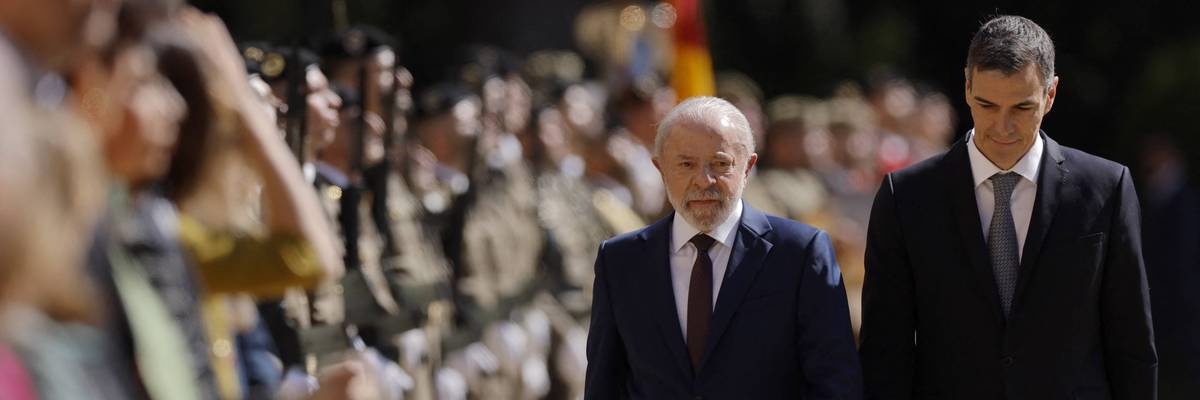
Brazilian President Luiz Inacio Lula da Silva and Spain’s Prime Minister Pedro Sánchez (R) review the troops during a welcoming ceremony upon the Brazilian president’s visit at the Palacio de Pedralbes in Barcelona on April 17, 2026.
(Photo by Oscar Del Pozo/AFP via Getty Images)
Julia Conley
Apr 17, 2026
COMMON DREAMS
Arriving in Spain on Friday for a two-day visit that will center on a gathering of progressive leaders from more than 100 political parties across five continents, Brazilian President Luiz Inácio Lula da Silva emphasized that the summit was not “an anti-Trump meeting.”
But the contrast between US President Donald Trump’s violent foreign and domestic policies and the international meeting, which will focus on wage inequality and electoral strategy for progressives, was unmistakable as Spanish President Pedro Sánchez opened the gathering at a press conference in Barcelona on Friday.
Spanish PM Says Ceasefires ‘Always Good News,’ But Trump Deserves No Praise
“We want to double our efforts to work for peace and for a reinforced multilateral order. While others open wounds, we want to mend them and cure them,” said Sánchez.
Da Silva—who is commonly called Lula—and Sánchez, as well as other leaders who will be attending the weekend event, have spoken out forcefully against Trump’s policies and the rise of the far right in the US, Germany, Italy, and other European countries.
Sánchez has refused to allow US fighter planes to use Spanish military bases for missions in the US-Israeli war on Iran and closed the country’s airspace to American military aircraft—plus doubled down on his condemnation of Trump and Israeli Prime Minister Benjamin Netanyahu’s war even after the US president threatened Spain with a trade embargo.
Lula expressed solidarity with Pope Leo this week after the pontiff denounced the Iran war, and Mexican President Claudia Sheinbaum, who will also attend the meeting, took aim last month at Trump’s claim that her country is the “epicenter of cartel violence”—blaming the US for the flow of illegal weapons into Mexico.
Lula emphasized that the 3,000 attendees of the summit, which will include the IV Meeting in Defense of Democracy as well as a gathering called the Global Progressive Mobilization on Saturday, will “discuss the state of democracy, to see what went wrong and what we have to do to repair it.”
The Brazilian president added that “Brazil and Spain are side by side in the trenches together.”
“We are an example that it is possible to find solutions to problems without giving into the empty promises of extremism,” said Lula. “Democracy must go beyond just voting and bring real benefits to people’s lives.”
Sánchez added that “in a world that doubts and fragments, Spain and Brazil open a new chapter convinced that our countries have something the world needs: the strength to build bridges where others raise walls.”
The Global Progressive Mobilization meeting will include roundtables dedicated to discussing economic inequality and other issues at a time when, as one report showed earlier this month, the richest 0.1% of people on the planet are stashing more than $2.8 trillion in tax havens—more than the wealth owned by the entire bottom 50% of humanity.
The economic hardships of working people have only been exacerbated by the war on Iran, which has sent global energy prices soaring.
US Sen. Chris Murphy (D-Conn.) is the only federal US official planning to attend the gathering, while New York City Mayor Zohran Mamdani—who has swiftly taken steps toward enacting a universal childcare program and announced a plan to tax second homes valued at over $5 million since taking office in January, is scheduled to participate virtually.
Also on Saturday, Lula and Sánchez will host the IV Meeting in Defense of Democracy, a summit first held in 2024 with the aim of combating “extremism, polarization, and misinformation.”
European Council President António Costa, South African President Cyril Ramaphosa, Colombian President Gustavo Petro, and leaders from Albania, Ghana, and Lithuania are among those attending the meeting on democracy.
Lula said the large number of attendees is evidence that progressive governments are winning more influence around the world despite the rise of authoritarian political parties.
“Our flock is growing. We must give hope to the world,” said Lula. “Otherwise, what happened with [Nazi leader Adolf] Hitler is going to happen.”
Economist Gabriel Zucman, who joined Mamdani this week in publishing an op-ed calling for an end to regressive tax systems and highlighting a proposal for a 2% tax on the wealth of those with more than €100 million, or $117 million, expressed hope that the global left is amassing power by building a cooperative international movement.
“The good news is that, from Zohran Mamdani and [Congresswoman] Alexandria Ocasio-Cortez in New York to Pedro Sánchez in Spain, from Lula in Brazil to [Green Party Leader] Zack Polanski in the UK, we may be seeing the early signs of a new cross-border alliance taking shape against global oligarchy,” said Zucman. “And I have no doubt that in this fight—the defining battle of the 21st century—democracy will prevail. See you in Barcelona this weekend to press ahead!”
.jpg)
President Cyril Ramaphosa at the Spain–South Africa Business Forum.
April 18, 2026
By SA News
President Cyril Ramaphosa has called for deeper trade ties, strengthened democratic partnerships and a more equitable multilateral system at the Spain–South Africa Business Forum during his working visit to the Kingdom of Spain.
Addressing delegates at the Business Forum on Friday, President Ramaphosa said the visit underscores the shared commitment between the two nations to build a modern, dynamic and mutually beneficial economic relationship.
“This visit reflects the strength of our longstanding partnership and our shared commitment to building a modern, dynamic and mutually beneficial economic relationship,” he said.
Framing his address around trade expansion, democratic values and the importance of multilateral cooperation, the President highlighted the steady growth in economic ties between the two countries.
“In 2025, total trade between South Africa and Spain reached approximately 2.8 billion Euros. South Africa’s exports to Spain reached 1.3 billion Euros, a 10 percent increase over the previous year.
“This makes Spain our fastest-growing major trading partner within the European Union,” the President said.
He emphasised that the relationship between the two economies is complementary rather than competitive.
“Our countries do not compete. We complement each other, demonstrating how strategic partnerships can strengthen global value chains,” he said.
President Ramaphosa noted that more than 150 Spanish companies operate in South Africa, supporting over 20 000 jobs across sectors including renewable energy, infrastructure, technology and tourism.
He further pointed to Spain’s investment of over 2.1 billion Euros in South Africa’s just energy transition as a strong signal of confidence.
“It is a statement of confidence not merely in our economy, but in our future,” he said.
Diversifying trade and strengthening value chains
While acknowledging the strength of bilateral trade, the President cautioned that the relationship remains concentrated in a narrow range of exports.
“Even though our trade relationship is strong, it remains structurally imbalanced. It is concentrated in a narrow range of products,” the President said.
He said diversification is critical to building resilience, particularly as motor vehicles for the transport of goods account for nearly half of South Africa’s exports to Spain.
President Ramaphosa identified critical minerals, green industrialisation and advanced manufacturing as key areas for future cooperation, especially as the global economy transitions to cleaner energy.
“South Africa holds the world’s largest reserves of platinum group metals. These critical minerals sit at the heart of hydrogen fuel cell technology, clean energy systems and the future of electric mobility,” President Ramaphosa said.
He said Spain’s growing leadership in the hydrogen economy presents an opportunity for alignment.
“South Africa brings the resource base. Spain brings technological capability, investment and market access. Together, this creates the foundation for a new kind of partnership, a collaboration across the value chains of the future,” he said.
Call for fair global rules and inclusive multilateralism
Placing the discussion within a broader global context, the President stressed the importance of fair and inclusive rules in international trade and climate governance.
“As we expand trade, we must ensure that the rules governing global commerce are fair and support development,” President Ramaphosa said.
He cautioned that emerging regulatory measures, such as the European Union’s carbon border policies, should not disadvantage developing economies.
“But new regulatory frameworks, including the EU Carbon Border Adjustment Mechanism, must not become instruments that inadvertently punish developing economies for emissions they did not historically cause,” he said.
While reaffirming South Africa’s commitment to climate action, he called for stronger support mechanisms within global frameworks.
“We are not opposed to the principle of carbon accountability. What we ask is that climate measures be accompanied by the necessary climate finance, technology transfer and transitional arrangements that the Paris Agreement and successive COP commitments have promised,” the President said.
Investment, industrial cooperation and shared prosperity
The President used the platform to position South Africa as an attractive investment destination, highlighting a pipeline of 85 projects valued at over 62 billion Euros across key sectors such as energy, infrastructure, digital connectivity and pharmaceuticals.
“Our message to every Spanish company in this room is that South Africa is open for business,” he said.
He encouraged Spanish firms to partner with South Africa as long-term collaborators in building industries that support inclusive growth.
“We invite you to partner with us not only as investors, but as long-term industrial partners, as co-builders of industries that will serve our people and yours for generations,” President Ramaphosa said.
Concluding his address, President Ramaphosa underscored the broader significance of the partnership between the two nations.
“We have an opportunity to connect European technological strength with African growth. We have an opportunity to build supply chains that are resilient, sustainable and inclusive,” he said.
He added that such cooperation can drive shared prosperity across both regions.
“Most importantly, we have an opportunity to create prosperity that is genuinely shared in Madrid and in Johannesburg, in Seville and in Durban,” the President said.
The President arrived in Spain on Thursday for a Working Visit that runs until 18 April, where he is participating in the In Defence of Democracy Initiative and engaging with political and business leaders to reinforce bilateral relations between South Africa and Spain.
The President is also scheduled to have an audience with King Felipe VI at the Zarzuela Royal Palace today.
On Saturday, he will be in Barcelona where he is scheduled to hold a bilateral meeting with President Pedro Sánchez at the Fira de Barcelona, before delivering remarks at the plenary session on Extremism and Inequality.
The President is accompanied by the Minister of International Relations and Cooperation, Ronald Lamola, and the Minister of Trade, Industry and Competition, Parks Tau.

SA News
Government Communication and Information System (GCIS) established the SA Government News Agency to enable all media locally and abroad to have easy and fast access to fresh government information, news and current affairs at no cost.
By AFP
April 15, 2026

Spain's Prime Minister Pedro Sanchez speaks during a press conference in Beijing on April 14, 2026 - Copyright AFP Delil SOULEIMAN
Imran Marashli
Spain’s Pedro Sanchez hosts a summit of world progressives this week with greater global clout as turbulent relations with US President Donald Trump bolster his image as a left-wing hero.
Clashes with Trump, virulent criticism of Israel and a championing of immigration have set the Socialist prime minister apart in Europe, which has in the last years tilted to the right.
The latest episode was his staunch opposition to the US-Israeli war on Iran, with Trump threatening trade retaliation after Spain denied the use of its bases.
Sanchez broke with NATO allies last year by refusing to agree to Trump’s demand that alliance members hike defence spending to five percent of GDP.
He is also the highest-profile Western leader to call Israel’s devastating two-year war against Hamas in Gaza a “genocide”.
For Ignacio Molina, a senior fellow at Madrid’s Elcano Royal Institute, Sanchez has earned Spain recognition for a “coherent” stance in the Global South, particularly in the Arab world and Latin America.
“It works out well for the government, because it has gained a lot of leadership, influence and presence in many countries,” Molina told AFP.
Of the countries adopting a similar stance, Spain is the “most relevant” because others are not in NATO, such as Ireland, or outside the European Union, for example Norway, he added, citing nations who also recognised a Palestinian state in 2024.
“Spain has achieved a weight among the European Union’s big countries that it did not have before,” agreed Joan Botella, a political science professor at the Autonomous University of Barcelona.
– ‘Trump’s nemesis’ –
Sanchez has gained attention in international media, penning articles for The New York Times and Le Monde diplomatique.
“Pedro Sanchez has become the standard-bearer for Western political opposition to the US president,” The Wall Street Journal wrote in March, while the Financial Times called the Socialist “Trump’s nemesis in Europe”.
Bathing in the new-found limelight, the current president of the Socialist International will host leading leftist figures at the two-day Global Progressive Mobilisation beginning in Barcelona on Friday.
Brazil’s Luiz Inacio Lula da Silva, South African President Cyril Ramaphosa and Mexico’s Claudia Sheinbaum are due to attend alongside 400 mayors and more than 100 parties.
Sanchez and Lula will deliver the keynote address on Saturday at the gathering, which organisers say aims to rally progressives in times of turmoil marked by the rise of the far right.
Progressives must “unite, tell citizens that we belong to something that goes beyond domestic politics, our borders — and that is having a positive, humanist outlook,” Sanchez said on Tuesday during his fourth visit to China in as many years.
The rise of Sanchez’s stock abroad contrasts with his polarising image at home.
He has never commanded a parliamentary majority since taking office in 2018 and is under pressure from corruption investigations into relatives and former close political allies.
– ‘Absorb left-wing vote’ –
Botella said Sanchez was “playing the foreign policy card hard, because it’s an area he’s comfortable in, and in which a majority of Spanish public opinion is favourable to him”.
More than 68 percent of Spaniards opposed the war on Iran, including voters of the conservative main opposition Popular Party (PP), according to a March poll published in El Pais newspaper.
“Spaniards have a certain inferiority complex when they go out into the wider world. In that sense, the profile that Sanchez’s figure has acquired satisfies many people beyond his electoral base,” Botella told AFP.
On the other hand, the PP says he has used foreign policy exclusively for domestic purposes, to rally fractious left-wing forces and distract attention from the negative headlines.
Other Western leaders have preferred to handle Trump with tact on trade, defence and foreign policy.
Sanchez “is trying to use this image of a progressive leader, opposed to Trump” to “strengthen his political position” and “absorb the left-wing vote”, said Juan Tovar Ruiz, a professor of international relations at the University of Burgos.
“That has consequences at European level. Right now, I think Spain is in a clearly minority position,” he warned.
For Molina, Sanchez’s stance risked alienating some traditional allies governed by the right, such as Germany and Italy, but “in the end, what is gained is rather more than what may be lost.”
No comments:
Post a Comment