Severe Climate System Eruption
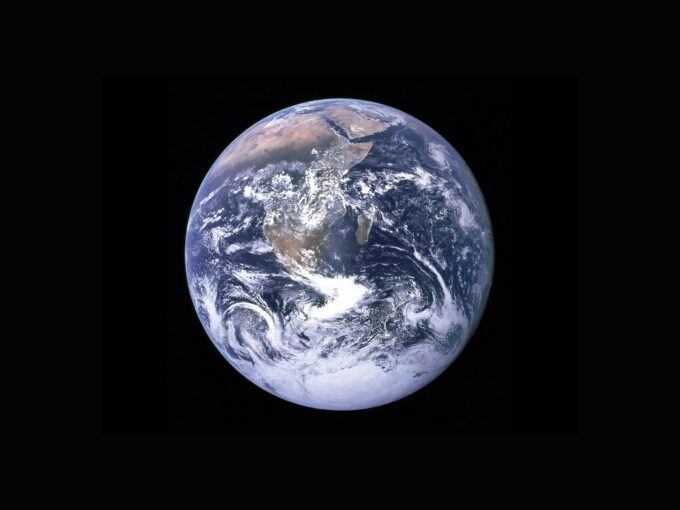
Image by NASA.
The planet’s climate system has turned erratic. Scientific reports over the past 24 months signal trouble ahead as forecasts become impossible with a helter-skelter system. It’s almost like the planet is regurgitating the anthropogenic (human) input of the past couple hundred years within two years, the biggest planetary vomit of all time.
Studies over the past two years increasingly refer to major fundamental shifts that change everything civilization has been built upon, best expressed by John Marsham, professor of Atmospheric Science/University of Leeds: “Our entire infrastructure & civilization are based around a climate that no longer exists.”
For example, recent studies claim scientific models of sea levels have been, and still are, way off base, way too low. Seas are rising uncomfortably fast and coastal megacities are not prepared. A recent article in YaleEnvironment360 entitled A More Troubling Picture of Sea Level Rise Is Coming Into View d/d April 9, 2026 claims; “Scientists have uncovered a ‘blind spot’ in the research on rising seas, revealing that tens of millions of people thought safe from coastal flooding are at risk of inundation. Across much of the world, sea levels are higher than previously assumed and land is sinking faster.”
That ‘sinking feeling’ is global warming (GW) on a binge. This threat to “life as we know it” has already done what scientists thought highly improbable: The rate of global warming nearly doubled in only one decade. Evidence of this is found in the prestigious publication Nature d/d March 6, 2026: Climate Change is Speeding Up – the Pace Nearly Doubled in Ten Years.
The GW binge extends to the oceans covering 2/3rds of the planet. A July 2025 study published in ScienceDaily says severe ocean overheating may be causing a fundamental climate shift. Over a two-year period, ocean heatwaves with temperatures up to 3-5C above normal lasted for 500 days nonstop covering 96% of the world’s oceans. This is an unprecedented and jaw-dropping event. The rattled lead scientist of the study exclaimed: “I am scared.” (Source: Record-Breaking 2023 Marine Heatwaves. Science, July 24, 2025)
In 2025 alone, the ocean gained a staggering 23 Zetta Joules of heat. That amount of energy is roughly equal to about 37 years of total global primary energy use at 2023 levels (~620 Exa Joules per year). The findings are based on work by more than 50 scientists representing 31 research institutions across the globe, published January 14th, 2026, ScienceDaily: The Ocean Absorbed a Stunning Amount of Heat in 2025. Sources: Institute of Atmospheric Physics and Chinese Academy of Sciences).
While every corner of the planet experiences a climate system going bonkers, it should come as no surprise that Antarctica Just Saw the Fastest Glacier Collapse Ever Recorded published in ScienceDaily d/d February 26, 2026. The Hektoria Glacier retreated five miles in only two months, and one-half collapsed in record time. It’s the fastest glacier collapse ever recorded. That’s global warming hard at work.
It was two years ago when a meeting of 450 polar scientists had this to say about Antarctica: “Recent research has shown record-low sea ice, extreme heatwaves exceeding 40°C (104°F) above average temperatures, and increased instability around key ice shelves. Shifting ecosystems on land and at sea underscore this sensitive region’s rapid and unprecedented transformations. Runaway ice loss causing rapid and catastrophic sea-level rise is possible within our lifetimes. Whether such irreversible tipping points have already passed is unknown.” ( Our Science, Your Future: Next Generation of Antarctic Scientists Call for Collaborative Action, Australian Antarctic Research Conference, November 22, 2024)
Meanwhile, at the top of the world, permafrost is abruptly releasing greenhouse gases. A new study, Unaccounted Emissions from Abrupt Permafrost Thaw and Wildfires Could Impact Global Carbon Budgets shows much faster events than accounted for in the IPCC’s carbon budget to supposedly keep global mean temperatures at or below 1.5°C pre-industrial (it’s already there). The study in Nature Communications Earth & Environment d/d Jan. 24, 2026, claims rapid Arctic warming “reduces the remaining allowable carbon budgets from 2025 onward by 25 % ± 12 %” to avoid exceeding 1.5°C. This is a huge reduction in allowable carbon budgets vis a vis current projection by the IPCC. The study reaches a conclusion not accounted for in global warming models: “The impact of including abrupt thaw, high-latitude fire, and post-fire thaw on total estimated permafrost emissions is possibly very substantial, more than doubling total cumulative emissions from permafrost-affected soils this century.” Once again, rapid climate change has impact beyond all historical precedent as the culprit of an erupting climate system.
A major international 20-year study published in Nature (February 2025) discovered a massive worldwide terrestrial glacial meltdown underway that directly impacts sea level rise, another threat not included in current analyses of potential sea level rise. The study discovered “staggering volumes of ice loss,” e.g., 273B tons ice loss per year over a 20-year study. Of concern, momentum is accelerating. For example, the first half of the study, or 10-years, registered 231B tons per year. The second half registered 314B tons/year or an increase of nearly 40% acceleration of terrestrial glacier loss, sans Greenland and Antarctica.
“This year may be remembered as one of the gravest for marine mammals on record. Or, more worryingly, a sign that our ocean environment is changing so drastically that in some places and seasons, it’s becoming uninhabitable for the life it holds.” (Marine Mammals are Dying in Record Numbers Along the California Coast, LA Times, October 3, 2025)
Only a handful of gloom and doom forecasters 10-15 years ago correctly predicted today’s climate system. Now they say it’ll get worse. No mainstream scientists or experts 10 years ago came close to anticipating this raucous climate system that fulfills a standard military adage ‘take no prisoners.’ Still, most commentators, feeling obligated to hang on to threads of hope, claim ‘technology will save us’ or ‘we still have time’ blah, blah, blah. Yet, the evidence over the past 24 months shows that every aspect of the climate system is already flying off the handle, and quickly. Forget ‘we’ve got time’. We’re in the midst of a climate system hailstorm. Buckle up.
No comments:
Post a Comment