Trump As The GOAT (According to Him)
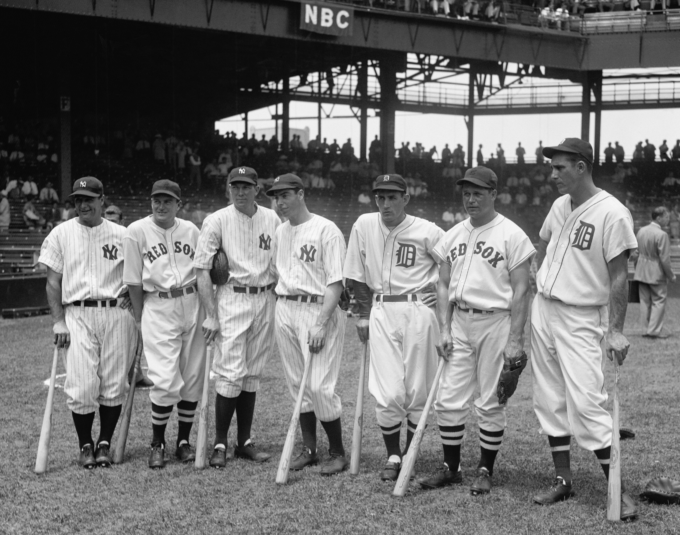
Seven of the American League’s 1937 All-Star players: Lou Gehrig, Joe Cronin, Bill Dickey, Joe DiMaggio, Charlie Gehringer, Jimmie Foxx, and Hank Greenberg. Image Wikipedia.
Seventy-five years ago, my father and I gazed down from the stands at Joe DiMaggio and Mickey Mantle in the outfield at Yankee Stadium. I was thrilled by the sight of two heroes of my time, but Dad was not impressed. He had seen Babe Ruth.
I think about that now, in a time desperate for such symbolic representatives of our better selves, which we once derived from sports figures like Mickey, Joe, and the Babe. They distracted us from pain and poverty. They gave us hope. I wonder if the answer to “Where Have You Gone, Joe DiMaggio?” — that line from Simon and Garfunkel’s famed song “Mrs. Robinson” — is the same as to so many other wrenching questions these days: Donald Trump.
Consider the following: Until he wore himself (and his welcome) out with such excess, he was indeed superb at commanding attention and winning ugly. He was, in short, a loud, vulgar, greedy, self-absorbed cock of the walk who came to epitomize a new gilded age of power and irresponsibility. And yet, he also somehow came to represent citizens who felt oppressed and disdained by the new elite.
No, you’ve got it wrong. I’m not thinking about Donald Trump (not yet anyway). I’m describing Babe Ruth, the first of the Top Jock role models who captured the spirit of an American age. For the next hundred years, the Babe’s spawn strutted through America’s arenas until they petered out in basketball star Michael Jordan’s commercialism. Jordan was, like the rest of them, the best at what he did, while also embodying the zeitgeist of his time with a “greed is good” mantra exemplified by his notorious “Republicans buy sneakers, too” line (which he may never have said seriously).
From Babe Ruth to Michael Jordan, with the likes of Joe Louis, Jackie Robinson, Arnold Palmer, Joe Namath, Muhammad Ali, Billie Jean King, Dale Earnhardt, and Tiger Woods (among others) in between, Americans have regularly, if sometimes controversially, used sports figures to represent their aspirations.
Anointing Donald Trump as our current Top Jock figure is neither an attempt to curry favor — do you think I want to be the Minister of Sport? — nor an attempt to denigrate the position. It’s just an effort to better understand why those apparitional figures from SportsWorld seem to have disappeared from our collective consciousness in the age of You Know Who.
Where Did the Top Jocks Go?
This effort of mine started to take shape when I suddenly realized that, for the first time (in my memory) since childhood, America now seems to have no Top Jock, no celebrity athlete whose talent and personality captures our moment. Those who might be considered — LeBron James, Tom Brady, and Serena Williams — somehow seem to lack the sort of charisma Donald Trump does indeed have to reach beyond their hardcore fans to the rest of us.
After almost 70 years of following sports and writing about it professionally, I recently realized that I couldn’t recall another time when I wouldn’t have been able to name an already agreed-upon Top Jock, or at least propose half a dozen candidates. So, what’s up? In this fragmented Trumpian moment of ours, is sports finally losing its hold on us? Have we been losing our love for jocks for the first time in my memory? After all, highly accomplished athletes like Pete Rose and Barry Bonds are now being denied Hall of Fame plaques on moral grounds, while high school and college athletes are becoming teenage millionaires thanks to new laws regarding their ownership of their own images.
It seemed like an appropriate moment for summing up.
Having spent the past 20 years as TomDispatch‘s Jock Culture correspondent, I felt the need for a reckoning. What had I learned from the 50 essays I’d written so far? Was there any kind of personal touchdown I could point to? Had I truly caught the relationship between sports and the larger society — how they do or don’t reflect, direct, and/or motivate each other? Can I still face the issue of trans athletes or what rules there might be for which kinds of non-athletic transgressions should keep players out of sports halls of fame, or even explain how pro football and basketball have now essentially become Black sports? Must I keep analyzing the symbolism of games rather than just enjoying them? Can I feel comfortable in a world where brain trauma is treated as a reasonable cost of violent entertainment (much as school shootings are a permissible price for gun love)?
And, yes, I came to wonder just where Joe DiMaggio had gone and whether some other charismatic avatar of a fanatical cult might, in fact, have replaced him and all those other jock idols?
More than politicians (even Franklin D. Roosevelt or John F. Kennedy) or entertainers (Frank Sinatra, Elvis Presley, or the Beatles), sports figures — maybe because of the shooting star nature of their professional lives — had long been designated the avatars of American culture. And that was true even if, with the rarest of exceptions (perhaps Billie Jean King and Muhammad Ali), they left little of lasting spiritual value or impact.
And now, of course, we have DJT (Donald J. Trump) as the MVP (most valuable player) of, it seems, every competition. I suspect that he — or at least the world he represents — is the reason why we have no real sporting heroes anymore. After all, he sucks all the air out of all arenas, while providing an ongoing reality show that seems to fill our days and nights, superceding sports in every way imaginable.
Donald Trump eternally demands to be the GOAT — the Greatest of All Time — while distinctly turning our world into a Trumpian sports event.
Suggesting a Theory
I was surprised to find that, in most of the 50 essays I’d written for TomDispatch, whether they were purportedly about baseball, NASCAR, or the Super Bowl, there was always at least a passing reference to Donald Trump and, in all too many cases, he was the leading character. That led me to wonder whether such a reality just represented this particular writer’s obsession or had Trump truly enveloped our collective consciousness?
And, I wondered as well: was this inevitable? According to AI, when I tried to use it recently, I’ve described Jock Culture as helping to ingrain “the national psyche… with exclusivity, sexism, homophobia, and winning at any cost… a danger to the common good,” while I evidently predicted that “society will become a darker, more despotic place if it continues unchecked.”
There’s no question that the United States has become a significantly darker, more despotic place since, on January 17, 2017, just-about-to-be-president Donald Trump first appeared in a Jock Culture column of mine (the seventeenth, if you’re keeping count). The headline was “Football is Trump Ball Lite” and heralded an authentic call for democracy from an unlikely place, the most Trumpish of sports.
As I wrote then:
“Pro football actually helped prepare us for the new president’s upset victory by normalizing a basic tenet of jock culture: anyone not on the team is an enemy, the Other. And it’s open season on opponents, the fans of opponents, critics, and women (unless they’re cheerleaders or moms). Trash talking is the lingua franca of this Trumpian moment, bullying the default tactic.
“Yet pro football has also provided us with the single most vivid image of current American resistance to racism. Last summer, before a pre-season game, San Francisco 49ers quarterback Colin Kaepernick sat during the playing of the national anthem as a symbol of his refusal ‘to show pride in a flag for a country that oppresses black people and people of color.’”
The outcome, however, would prove shocking. Trump, who entered the Oval Office three days after that column of mine appeared, won two of his three matches, while Kaepernick never played again after that 2016-2017 season.
Maybe we shouldn’t have been shocked, though. Maybe the predictors never got the odds right. Maybe they didn’t understand what we wanted from our sports idols — or what their limits were. How about this: Consider the relative paucity of sports figures in the Epstein Files, especially compared to groups like academics, financiers, politicians, and even comedians. Jeffrey Epstein pursued people who could be useful to him as enablers, investors, connectors, or victims. Woody Allen was high on the list, but there was no Lebron James or Tom Brady (although Brady’s long-time owner, billionaire Robert Kraft of the New England Patriots, certainly made the cut).
Was it because celebrity athletes have no need of being set up with playthings or because Epstein didn’t believe they had the kind of clout that could benefit his power network?
Among the more recognizable names that did crop up on his sporting roster, however, were Casey Wasserman, the president of the Los Angeles Organizing Committee for the 2028 Olympic and Paralympic Games, and several fellow NFL owners alongside the 84-year-old Kraft, who apparently solicited advice from Epstein while facing a 2019 charge for soliciting prostitution. (He beat the rap.)
Another NFL owner in the lineup was Steve Tisch, the 76-year-old part owner of football’s New York Giants. As a Hollywood producer with credits like Forrest Gump and Risky Business, you might think he could have collected playmates on his own. In 2013, however, Epstein e-mailed Tisch, “I can invite the (Russian) …to meet if you like.” Tisch quickly replied, “Is she fun?”
A few weeks later, concerning a (name redacted) woman, Tisch asked, “Is my present in NYC?” After Epstein replied, “Yes,” Tisch asked, “Can I get my surprise to take me to lunch tomorrow?”
Epstein then wrote him: “I am happy to have you as a new but …shared interest friend.”
Trump, of course, was the sports figure — he owned a professional football team in the 1980s — whose mentions in the Epstein Files were most eagerly anticipated. His name, in fact, does come up thousands of times, although so far involving nothing of the existentially horrifying nature that his enemies had been waiting for and his allies presumably fearing.
Commander in Cheat
Trump’s standing in the sports world has never seemed particularly high. Even golfers tend to roll their eyes and agree with Rick Reilly, who wrote his book Commander in Cheat: How Golf Explains Trump, about the way the president used to bully and whine his way across the greens.
Trump was spectacularly unsuccessful in his attempts to buy a National Football League team. In the 1980s, he tried to bulldoze his way into the sport as the owner of the New Jersey Generals of the new United States Football League (USFL), which played its games in the spring to avoid competition with the NFL.
Trump was a leader in the USFL’s lawsuit to force a merger with the NFL, which resulted in a pyrrhic victory — his side won the case, but the awarded damages came to $3.76 (and no, that is not a typo!). It sounded like a typical tale of Trump buffoonery.
Trump declared himself a fan of college football (an attempt to show disdain for the pros who had rejected him) and suffered further rejection from various championship teams who rebuffed his invitations to the White House.
Still, his administration clearly does what it wants when it comes to sports. In selling the war against Iran, for instance, it ran a series of video montages juxtaposing military bomb strikes and hard college and pro football hits. One such hit was a punishing block thrown in 2012 by Nebraska receiver Kenny Bell against a Wisconsin defensive back. Bell, a former NFL player as well, told the Washington Post that he was “disgusted” by the montage. “For that play to be associated with bombing human beings makes me sick,” he said. “I don’t want anything to do with images like that.”
Other athletes decried the usage on moral grounds, but there was no immediate complaint from the NFL itself, which is usually quick to protest any infringement of its copyrighted material. Was that supposed repository of our toughest athletes spooked by Trump? Was he, in fact, the Top Jock after all?
“This White House is vindictive and bullying,” commented Professor Rebecca Tushnet of Harvard Law School. “So, if you’re the NFL, why tempt its wrath?”
Why would they even want to? After all, aren’t they on the same Top Jock team?
As for the rest of us, we may just have to keep hitting back until we can write a new song, “Where Have You Gone, Donald Trump?”
And we will know just where.
This piece first appeared on TomDispatch.
No comments:
Post a Comment