Ukraine seizes Russian position without using soldiers in a battlefield first

It began not with a charge of infantry, but with the quiet advance of machines.
In a development that could reshape modern warfare, Ukrainian forces have, for the first time, captured a Russian position using only unmanned systems – a coordinated assault carried out entirely by drones and ground-based robots, without a single soldier entering the battlefield, reported United24 Media.
President Volodymyr Zelenskiy described the operation as a watershed moment. “The occupiers surrendered, and this operation was carried out without the participation of infantry and without losses on our side,” he said, framing it as both a tactical success and a glimpse into the future of war.
The assault was not a single machine acting alone, but a layered system – an integrated “combat stack” of aerial drones and unmanned ground vehicles (UGVs) performing reconnaissance, attack, logistics and occupation in sequence. From above, drones identified targets and mapped defensive positions in real time. On the ground, remotely operated robots advanced, firing into trenches and bunkers, resupplying themselves, and ultimately forcing the defenders to surrender.
Western analysts are already giving this approach a name: the “Drone Wall doctrine” – a form of warfare in which machines absorb the most dangerous phases of combat, while human soldiers remain behind the line.
At the heart of the operation was a diverse fleet of robotic systems. Combat units such as the Rys and Protector, equipped with machine guns including the heavy Browning M2, provided firepower capable of engaging not only infantry but also lightly armoured targets. Logistics platforms such as TerMIT and Volia delivered ammunition and equipment, while medical evacuation units like Ardal ensured casualty extraction if needed. Other systems, including the self-destructing Ratel robot, were designed for high-risk assault roles.
Each machine played a defined role, but together they formed a continuous operational loop – reconnaissance, strike, advance, sustain – executed without direct human presence on the battlefield.
The implications are profound. Over the past three months alone, Ukrainian robotic systems have carried out more than 22,000 missions, according to Zelenskiy. In March, over 9,000 such operations were recorded, marking a sharp acceleration in their deployment. The number of military units using ground robots has more than doubled, rising from 67 late last year to 167 this spring.
Commander-in-Chief Oleksandr Syrskyi said robotic operations increased by 50% in March compared to February, underscoring how rapidly unmanned systems are being integrated into frontline tactics.
This shift is being driven as much by necessity as by innovation. Along a roughly 1,000-kilometre frontline, where both sides deploy dense networks of surveillance and strike drones, traditional infantry assaults have become increasingly costly. Within 20 to 25 kilometres of the front line, exposure often means near-certain casualties.
For Ukraine, which faces a numerically larger adversary, replacing soldiers with machines in high-risk roles has become a strategic imperative.
“Losing a robot is manageable, but losing a combat-ready soldier is not,” Lieutenant Colonel Oleksandr Afanasiev, a commander of an unmanned systems unit, told BBC News.
Yet this is not fully autonomous warfare – not yet. The systems remain human-controlled, dependent on communications links that can be jammed, and require maintenance crews behind the lines. Infantry, too, remains essential for holding and fortifying captured ground.
What has changed is the nature of the breakthrough itself.
Until recently, robots supported soldiers – delivering ammunition, evacuating the wounded. Now, they are taking the lead in assault operations, entering contested zones, engaging the enemy, and even compelling surrender.
As IntelliNews reported, two years ago Ukraine already unleashed four-legged ‘robodogs’ against Putin’s army. Earlier this year, a ground robot was used to force three Russian soldiers to lay down their arms. The latest operation goes further: a position captured entirely by machines, from first contact to final occupation.
For Zelenskiy, the significance is stark. “This is about high technologies in defence of the highest value – human life,” he said.
In that sense, the operation may mark more than a tactical innovation. It suggests the emergence of a new paradigm – one in which war is no longer defined by how many soldiers can be sent forward, but by how many can be kept out of harm’s way.
And on that battlefield, the machines are no longer just assisting. They are leading.
Russian Strike Hits Foreign-Flagged Bulker Off Coast of Odesa
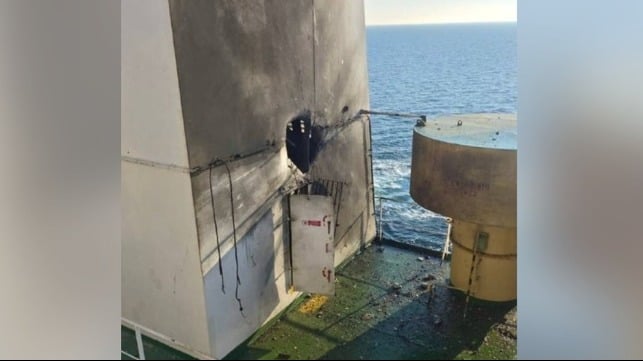
On Tuesday morning, Russian forces hit a foreign-flagged merchant ship at a port in the Odesa region, according to Ukrainian authorities. It is the latest in a long string of Russian strikes on civilian vessels in and around Ukraine, part of Moscow's effort to damage the Ukrainian economy.
"A Russian drone hit a civilian merchant ship under the Liberian flag, which was heading along the sea corridor to load corn," Ukraine’s Ministry of Community and Territorial Development said in a brief notice. "The crew managed to quickly extinguish the fire. Fortunately, no one was injured. The ship continued its movement and reached the port."
Reuters has identified the vessel as the Lady Maris (IMO 9228071), a bulker flagged in Liberia, owned in the UAE and managed in India.
In addition, the Russian strike hit the port of Izmail and damaged an additional ship flagged in Panama.
Operations continue, the agency said. "Ukraine continues to ensure the operation of the sea corridor and fulfill export obligations, despite constant risks," said the ministry.
On Wednesday morning, Russia struck again with a volley of ballistic missiles and a total of more than 300 long-range attack drones, according to Ukraine's air force - the majority reportedly built to the Iranian-derived Shahed drone design. Port-related warehouses and administrative buildings were hit in the Odesa region.
Russian attacks have reportedly cut Ukraine's grain shipping activity by about one third, forcing exporters and shipowners to continually reroute shipments from one loading terminal to another in order to take advantage of functioning infrastructure. The attacks could worsen, warned Ukrainian President Volodymyr Zelensky: the country's armed forces have so far been able to fend off the worst Russian ballistic missile strikes using U.S.-supplied Patriot batteries and PAC-3 interceptors, paid for by European nations and donated to Ukraine. Those interceptors are now in high demand and short supply due to ultra-high consumption in the Mideast, a consequence of the Israeli-American conflict with Iran.
"If the war drags on, there will be fewer weapons for Ukraine," Zelensky told German broadcaster ZDF. "We have such a shortage right now – worse than ever."
No comments:
Post a Comment