It’s possible that I shall make an ass of myself. But in that case one can always get out of it with a little dialectic. I have, of course, so worded my proposition as to be right either way (K.Marx, Letter to F.Engels on the Indian Mutiny)
Monday, April 06, 2026
Why 12°C is the sweet spot for keeping mangoes fresh longer?
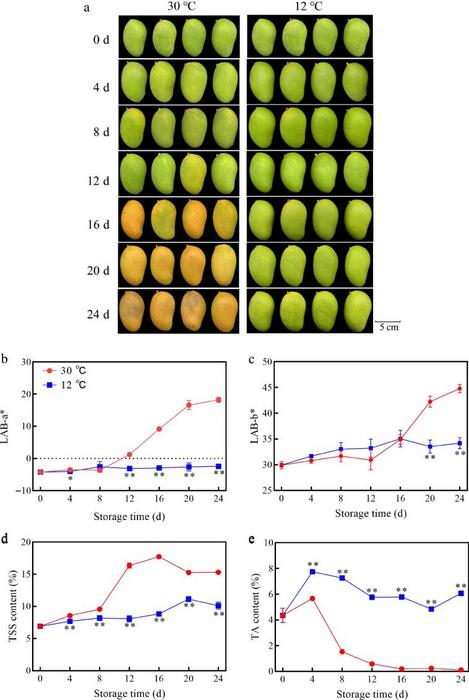
Changes in (a) fruit appearance, (b) a* value, (c) b* value, (d) TSS content, and (e) TA content of mango fruits stored at 30 and 12 °C. Vertical bars represent the standard error of the mean, the asterisks indicate significant difference between two groups at corresponding sampling point (* p < 0.05, ** p < 0.01).
By examining fruit physiology, cell structure, antioxidant systems, and gene expression, researchers found that moderate low-temperature storage preserves firmness, slows ripening, and enhances antioxidant defenses in ‘Tainong No.1’ mango. The findings uncover the biological mechanisms behind temperature-based preservation and provide practical guidance for cold-chain transport of tropical fruits.
Mango (Mangifera indica) is one of the world’s most widely cultivated tropical fruits, prized for its rich flavor and nutritional value. However, as a climacteric fruit, mango continues to respire and ripen after harvest, making it highly susceptible to rapid softening, water loss, and decay. In tropical regions, most mangoes are transported at ambient temperatures around 26–30°C, which accelerates ripening and shortens shelf life. Low-temperature storage is widely used to slow fruit metabolism, but tropical fruits are vulnerable to chilling injury if temperatures drop too low. While previous observations suggested that 12°C could preserve ‘Tainong No.1’ mango, the biological mechanisms behind this effect remained unclear.
A study (DOI:10.48130/tp-0025-0034) published in Tropical Plants on 28 January 2026 by Yuanzhi Shao & Wen Li’s team, Hainan University, demonstrates that storage at 12 °C effectively preserves postharvest mango quality by enhancing antioxidant defense and maintaining reactive oxygen species homeostasis, providing a scientific basis for optimizing cold-chain management of tropical fruits.
In this study, researchers systematically evaluated the effects of storage temperature (12 °C vs. 30 °C) on postharvest mango quality over 24 days by combining physiological measurements, microscopic observation of pulp cell structure, biochemical assays of antioxidant compounds, enzyme activity analysis, gene expression profiling (qRT-PCR), and multivariate correlation analysis. Quality parameters including color (a*, b*), total soluble solids (TSS), titratable acidity (TA), weight loss, firmness, respiration rate, malondialdehyde (MDA), reactive oxygen species (ROS), phenolics, flavonoids, and vitamin C were monitored alongside antioxidant enzyme activities (APX, SOD, PAL, POD) and related gene expression. The results showed that although visual differences were minor during the first 12 days, mangoes stored at 30 °C exhibited rapid yellowing after 16 days, whereas fruit at 12 °C retained color, reflecting suppressed chlorophyll degradation. TSS at 30 °C rose sharply and peaked at day 16 before declining, while at 12 °C it increased gradually; TA decreased much faster at 30 °C but remained significantly higher at 12 °C. Microscopy revealed that pulp cells stored at 12 °C maintained intact cell walls and starch granules even at 24 days, whereas those at 30 °C showed early wall thinning, starch depletion, and eventual collapse. Physiologically, weight loss reached over 17% at 30 °C but remained below 4% at 12 °C, and firmness decline was markedly delayed at 12 °C. The respiratory peak occurred on day 16 at 30 °C but was postponed to day 24 at 12 °C, extending the preclimacteric phase. Biochemically, 12 °C storage reduced MDA and ROS accumulation while maintaining higher vitamin C, phenolics, and flavonoids. Antioxidant enzymes exhibited stronger or more sustained activity at 12 °C, supported by upregulation of genes such as MiAPX1, MiAPX2, MiSOD1, and MiSOD2. Correlation analysis confirmed that ROS and MDA positively correlated with weight loss and softening, whereas SOD, phenolics, and flavonoids were negatively associated with ROS, demonstrating that 12 °C storage preserves mango quality by enhancing antioxidant defense and maintaining redox homeostasis.
The findings provide practical guidance for mango cold-chain logistics. Maintaining storage temperatures near 12°C can significantly extend shelf life while avoiding chilling injury. This temperature allows mangoes to be harvested earlier, transported over long distances, and ripened at destination markets with reduced losses.
This research was funded by the Hainan Province Agricultural Reclamation Team Joint Innovation Project (Grant No. HKKJ202432), the National Key Research and Development Program Project (Grant No. 2023YFD2300803–7), and Hainan University Mango Industry Technology System Construction Project.
Tropical Plants (e-ISSN 2833-9851) is the official journal of Hainan University and published by Maximum Academic Press. Tropical Plantsundergoes rigorous peer review and is published in open-access format to enable swift dissemination of research findings, facilitate exchange of academic knowledge and encourage academic discourse on innovative technologies and issues emerging in tropical plant research.
(a) The growth of total bacteria, molds, and yeasts on the epidermis of lilies during storage. (b) Statistics of the growth of total bacterial colony numbers. (c) Statistics of the growth of molds and yeast colony numbers. (ns represents no significant difference between day 0 and day 60 for each treatment group; * represents the difference between day 0 and day 60 for each treatment group, p < 0.05; ** p < 0.01; *** p < 0.001; **** p < 0.0001, respectively).
By inhibiting microbial growth, strengthening antioxidant defense systems, and stimulating beneficial secondary metabolites, the method effectively slows post-harvest deterioration. The findings suggest that plasma-based preservation could provide a safe, chemical-free solution for reducing food waste and improving storage stability in high-value horticultural crops.
Fresh lilies are widely valued as edible vegetables and medicinal ingredients, especially in regions such as Lanzhou, China. However, their high moisture content and active metabolism make them vulnerable to browning, microbial infection, and rapid quality loss during storage. Conventional preservation methods—including chemical fumigation, coatings, and controlled atmosphere storage—can delay spoilage but often suffer from limitations such as uneven treatment, chemical residues, or environmental concerns. These challenges have prompted researchers to explore alternative technologies that can extend shelf life while maintaining food safety and product quality.
A study (DOI: 10.48130/fia-0025-0051) published inFood Innovation and Advanceson 22 January 2026 by the team of Jun Wang (Northwest A & F University) and Zhengshi Chang (Xi'an Jiaotong University), reports that optimal plasma pretreatment significantly reduces microbial contamination and enhances antioxidant capacity, ultimately improving storage quality and prolonging the shelf life of lily bulbs.
To evaluate the effectiveness of CDP treatment, researchers collected freshly harvested lily bulbs and exposed them to corona discharge plasma for varying durations—2, 4, 6, 8, and 10 minutes—before storing them at 4 °C for 60 days. Multiple indicators of quality were measured during storage, including color change, microbial counts, tissue firmness, cellular integrity, enzyme activity, and antioxidant properties. Microbial analysis revealed that plasma treatment substantially suppressed bacterial, mold, and yeast populations on lily surfaces. For example, samples treated for six minutes showed a bacterial sterilization rate of over 78% at the beginning of storage and maintained significantly lower microbial loads even after 60 days. The treatment effectively slowed spoilage and prevented the rapid decay observed in untreated samples. Physical quality assessments further confirmed the protective effects of plasma exposure. While untreated bulbs experienced noticeable softening during storage, CDP-treated samples retained greater firmness, with the four-minute treatment maintaining about 30% higher hardness after 60 days. Measurements of relative conductivity and malondialdehyde (MDA)—indicators of membrane damage and lipid oxidation—also showed reduced cellular deterioration in treated bulbs. These findings suggest that plasma treatment helps preserve cell membrane integrity and slows physiological aging during storage. The researchers also investigated biochemical responses to plasma treatment. They observed significant increases in antioxidant enzyme activities, including superoxide dismutase (SOD), catalase (CAT), and ascorbate peroxidase (APX). These enzymes help neutralize reactive oxygen species and protect plant tissues from oxidative stress. Meanwhile, the levels of beneficial secondary metabolites such as phenolic compounds and flavonoids were markedly elevated, particularly in bulbs treated for six minutes. Enhanced antioxidant capacity was confirmed by higher DPPH, ABTS, and FRAP values during storage. Microscopic observations revealed that plasma exposure created micro-scale pores on the lily surface, improving mass transfer and stimulating metabolic responses that promote antioxidant synthesis.
Overall, the research demonstrates that corona discharge plasma is a promising non-thermal preservation technology capable of improving the post-harvest stability of lily bulbs. By simultaneously suppressing microbial growth, strengthening antioxidant defenses, and promoting bioactive compounds, CDP treatment offers a safe and environmentally friendly alternative to chemical preservation methods. The technology may provide valuable new opportunities for extending the shelf life of fresh produce, reducing post-harvest losses, and enhancing the sustainability of horticultural supply chains.
Food is essential to life and relevant to human health. The rapidly increasing global population presents a major challenge to supply abundant, safe, and healthy food into the future. The open access journal Food Innovation and Advances (e-ISSN 2836-774X), published by Maximum Academic Press in association with China Agricultural University, Zhejiang University and Shenyang Agricultural University, publishes high-quality research results related to innovations and advances in food science and technology. The journal will strive to contribute to food sustainability in the present and future.
This synergistic system suppresses microbial growth, degrades pesticide residues, and maintains fruit quality, significantly extending the shelf life of cherry tomatoes and offering a safer, more sustainable approach for fresh produce preservation.
Fresh fruits and vegetables are highly susceptible to postharvest deterioration and contamination. Cherry tomatoes, with their thin skin and high moisture content, are particularly vulnerable to microbial spoilage and rapid quality loss during storage. Meanwhile, pesticides such as chlorpyrifos are widely applied in agriculture to control pests and diseases, often leaving residues that may threaten food safety and consumer health. Current strategies for pesticide removal—including physical, chemical, and biological approaches—frequently face limitations such as incomplete degradation, potential formation of harmful by-products, and limited scalability. Although emerging technologies like cold plasma and edible coatings show promise, each method alone has constraints in penetration depth, stability, or degradation efficiency, highlighting the need for integrated solutions to improve both food safety and postharvest preservation.
A study (DOI: 10.48130/fmr-0026-0001) published inFood Materials Research on 30 January 2026 by Jie Zou’s team, Jiangsu Product Quality Testing & Inspection Institute, reports that combining a DAT/SA composite coating with DBD plasma significantly enhances microbial inhibition, extends shelf life, and increases chlorpyrifos degradation efficiency in cherry tomatoes.
To develop the preservation system, researchers synthesized chiral D-cysteine/gold nanoparticle-modified titanium dioxide (DAT) nanoparticles and incorporated them into a sodium alginate (SA) matrix to form a functional composite edible film. The DAT nanoparticles were produced through citrate reduction of gold salts followed by surface functionalization and photodeposition onto TiO₂ particles. These nanoparticles were then dispersed in sodium alginate solutions at different concentrations to prepare composite films with tunable physicochemical properties. Film performance was evaluated by measuring water solubility and water vapor permeability, and the formulation containing 0.3% DAT was selected for further experiments due to its optimal mechanical strength and barrier performance. Cherry tomatoes were treated using a combined coating–plasma strategy. Fruits were first immersed in the film-forming solution, air-dried, and then exposed to DBD plasma at 140 kV for three minutes. The treated tomatoes were stored for 11 days under controlled conditions while quality parameters—including weight loss, decay rate, microbial counts, firmness, and soluble solids—were monitored. Results showed that the integrated treatment effectively suppressed microbial growth. Compared with untreated samples, the combined system reduced total bacterial counts by up to 1.28 log CFU/g, demonstrating strong antimicrobial activity. Fruit quality was also better maintained: tomatoes treated with DAT/SA coating and plasma retained higher firmness, reaching 1.36 times that of untreated fruit after 11 days, while weight loss was significantly reduced. The onset of decay was delayed, extending the storage life by more than four days compared with the control. In addition to preservation, the system significantly enhanced pesticide removal. Chlorpyrifos residues were analyzed using UPLC–MS after QuEChERS extraction. While natural degradation removed about 31.35% of residues, the combined plasma–coating treatment achieved 65.86% degradation, far exceeding individual treatments. Residue levels fell well below regulatory limits, indicating improved food safety. This enhanced degradation is attributed to the interaction between plasma-generated UV radiation and the photocatalytic DAT nanoparticles, which produce reactive oxygen species capable of breaking down pesticide molecules.
Overall, the study demonstrates that integrating plasma technology with functional edible coatings can provide a powerful dual-function strategy for fresh produce preservation. The DAT/SA film acts as a protective barrier that reduces moisture loss and slows ripening, while DBD plasma generates reactive species that eliminate microbes and degrade pesticide residues. Together, these processes produce a synergistic effect that improves food safety and prolongs shelf life without relying on chemical preservatives.
The open-access journal Food Materials Research (e-ISSN 2771-4683) is published by Maximum Academic Press in partnership with Nanjing Agricultural University. The article types include original research papers, reviews, methods, editorials, short communications, and perspectives. All articles published in Food Materials Research represent significant advances in the genetic, molecular, biochemical, physiological processes and pathways related to food materials and sources and will provide scientific information towards overcoming technological limitations in developing conventional and alternative foods.
No comments:
Post a Comment