Saturday, March 21, 2026


Chile's border wall targets a problem already in decline


ANOTHER FASCIST WALL AGAINST THE MULTITUDE

Chile's border wall targets a problem already in decline
"This is not just a trench, it is much more, it is a system," Chilean President Kast said. "We want to use excavators to build a sovereign Chile, a Chile that has been violated by illegal immigration, by drug trafficking, by organised crime."
By Alek Buttermann March 18, 2026

José Antonio Kast's fortified frontier project combines trenches, electrified fencing and military deployment, but unauthorised crossings had already fallen by more than half before he took office.

Five days after taking office, Chilean president José Antonio Kast stood before heavy machinery in the Atacama desert and watched excavators break ground on what he called a new era of national sovereignty. The site was Chacalluta, the main land crossing between Arica and the Peruvian city of Tacna, and the work underway, three-metre-deep trenches cut into the earth by the Chilean Army's Corps of Military Labour, was the opening act of his administration's most visible policy: the Plan Escudo Fronterizo.

"This is not just a trench, it is much more, it is a system," Kast told reporters. "We want to use excavators to build a sovereign Chile, a Chile that has been violated by illegal immigration, by drug trafficking, by organised crime."

The figures complicate that framing. According to Chile's National Migration Service, unauthorised crossings through the northern border peaked at roughly 56,000 in 2021 and had already fallen to 26,275 by 2025, a decline of more than half, before Kast's policies came into effect. The country also remains, by regional standards, among the safest in Latin America, and no conclusive link has been established between migration and the rise in vehicle theft, kidnapping and homicide that Kast cited on the campaign trail.

What the numbers cannot fully capture is the political logic of the project. Migration had become, as Alejandro Mejía, professor of political science at Peru's Universidad Nacional Mayor de San Marcos, told La República, "the cornerstone of the campaign that brought Kast to the presidency." The wall is as much a communication strategy as a security one.

The plan envisions a layered architecture extending over more than 520 kilometres, from Chacalluta in the north to the crossing at Colchane near the Bolivian border. Initial works are concentrated near boundary markers 1 and 15 on the Peru frontier, skirting the formal Chacalluta crossing and a rail line. Official transit points will remain open.

Beyond the trenches, the design calls for walls and fencing of up to five metres, electrified perimeter barriers, thermal surveillance towers, radar systems and autonomous drones equipped with facial recognition. Military and police units are to maintain a permanent presence along the full length. Interior Minister Claudio Alvarado, who travelled north with Kast, set a 90-day benchmark: "Chile should be able to see the results of this border control work within the next three months."

Financing is being drawn from internal state resources, specifically the Army's budget and the Ministry of Public Works, without open public tender or private contractors. The total cost has not been disclosed. The speed of this approach facilitates deployment but limits scrutiny, particularly if the project expands to its proposed scale.

Legally, the government moved in parallel with the construction. In his first days at the Palacio de La Moneda, Kast signed decrees appointing a retired vice-admiral as presidential commissioner for the entire northern zone, expanding military authority in border areas and tightening migration law. Legislation submitted to Congress proposes reclassifying unauthorised entry as a criminal offence rather than an administrative violation, and restricting social benefits for irregular migrants.

The most legally sensitive aspect of the project may not be the wall itself but its location. Miguel Ángel Porras, an international law specialist at Lima-based firm Ugaz Zegarra, told Infobae that construction near the so-called Triángulo Terrestre, a 3.7-hectare coastal strip that remains a live point of contention despite the 1929 Treaty of Lima governing the broader land boundary, could be read as unilateral demarcation.

"There is no legal impediment for a country to erect physical barriers on its territory to protect its border," Porras said. "However, if the wall is built in disputed areas, especially near the Triángulo Terrestre, it can be interpreted as a unilateral demarcation act and strain international relations." In that scenario, he noted, Peru retains the right to bring a fresh case before the International Court of Justice in The Hague, the same tribunal that resolved the two countries' maritime boundary dispute in 2014 but left the terrestrial limit contested.

The Peruvian government has so far kept its response measured. Foreign Minister Hugo de Zela said Lima respects Chilean sovereignty and was monitoring the works for any impact on national security and human rights. He noted that Chile was acting within its own territory and that the barrier could, in one reading, reduce irregular entries into Peru as well. Peru has nevertheless reinforced police and military presence in Tacna and declared a state of emergency in the region. Former prime minister Denisse Miralles warned that Peru would not hesitate to take its own measures if territorial integrity were compromised.

On the central question of whether the wall will work, expert opinion is sceptical. Porras pointed to the US-Mexico barrier, the Spanish enclaves of Ceuta and Melilla, and Israel's fencing as evidence that physical barriers redirect rather than reduce migration flows, pushing routes into more remote and dangerous terrain while raising the cost and risk for migrants. "These measures are showy and do not stop the flow of migrants," he said. "It is a populist measure that seeks to show immediate results to the electorate, but it does not resolve the migratory phenomenon or the underlying security."

Porras also warned of an "embudo", or funnel, effect on the Peruvian side of the border, where migrants blocked from crossing into Chile could accumulate in vulnerable conditions and generate pressure on local authorities in Tacna. That concern has already prompted Lima to act: a binational migration cooperation committee, drawing in both foreign ministries and interior ministries, has been established to coordinate responses.

Economic ties between the Tacna-Arica corridor add a further complication. The area has long been bound by significant cross-border trade and tourism, and any disruption to mobility, even if aimed at irregular crossings, risks spillover effects on formal commercial activity. Mejía, the UNMSM political scientist, noted that the mutual economic dependence of the two northern cities is substantial, and called for the reactivation of the Chile-Peru Binational Cabinet, which has not met since 2022. "It is a vital space to place irregular migration as the principal bilateral agreement for short-term action," he said.

Kast, a seasoned right-wing politician who resoundingly won the December presidential runoff election, secured a 57% approval rating in the Cadem poll taken the weekend after the groundbreaking, suggesting the rapid deployment has resonated domestically. He has called on the entire political spectrum to support the border effort, including acknowledging the progress made by his left-wing predecessor Gabriel Boric, but not at the speed we estimated, he added. Defence Minister Fernando Barros Tocornal sought to reassure Lima that expulsions of irregular foreign nationals would not direct people toward Peruvian territory, framing the policy as consistent with good bilateral relations.

The deeper drivers of migration, economic instability and political crises in Venezuela and other countries of origin, remain beyond Chile's control. Whether the Plan Escudo Fronterizo narrows the flow further, pushes it elsewhere or simply photographs well at a groundbreaking ceremony may become clear within the 90-day window the government has set for itself.



Multitude: war and democracy in the Age of Empire /. Michael Hardt and Antonio Negri. p. cm. Sequel to: Empire. Includes index. ISBN 1-59420-024-6. 1 ...

4.3 The Multitude against Empire. 393. Notes. 415. Index. 473. Page 11. PREFACE. Empire is materializing before our very eyes. Over the past several decades, as ...


  Istanbul Blog

ISTANBUL BLOG: Bedtime reading for Trump. Condemnation and denunciation from Arab and Islamic countries affirmed

ISTANBUL BLOG: Bedtime reading for Trump. Condemnation and denunciation from Arab and Islamic countries affirmed
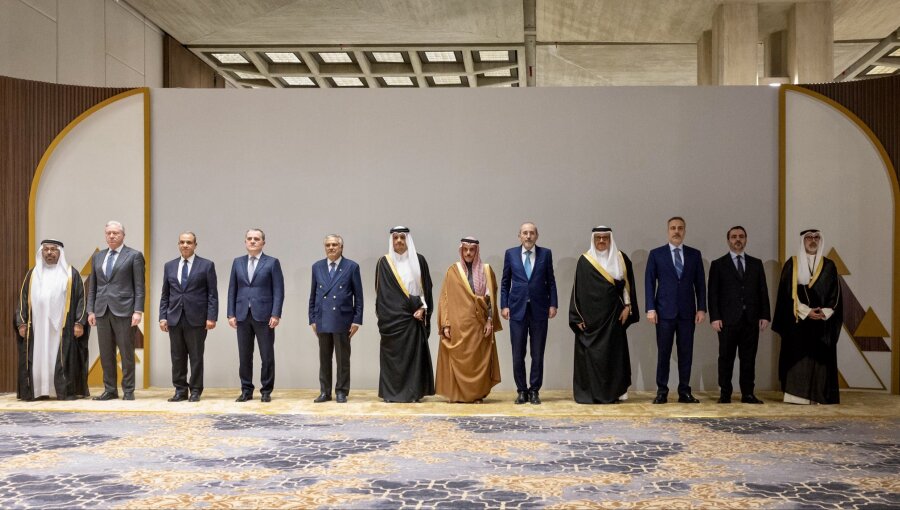
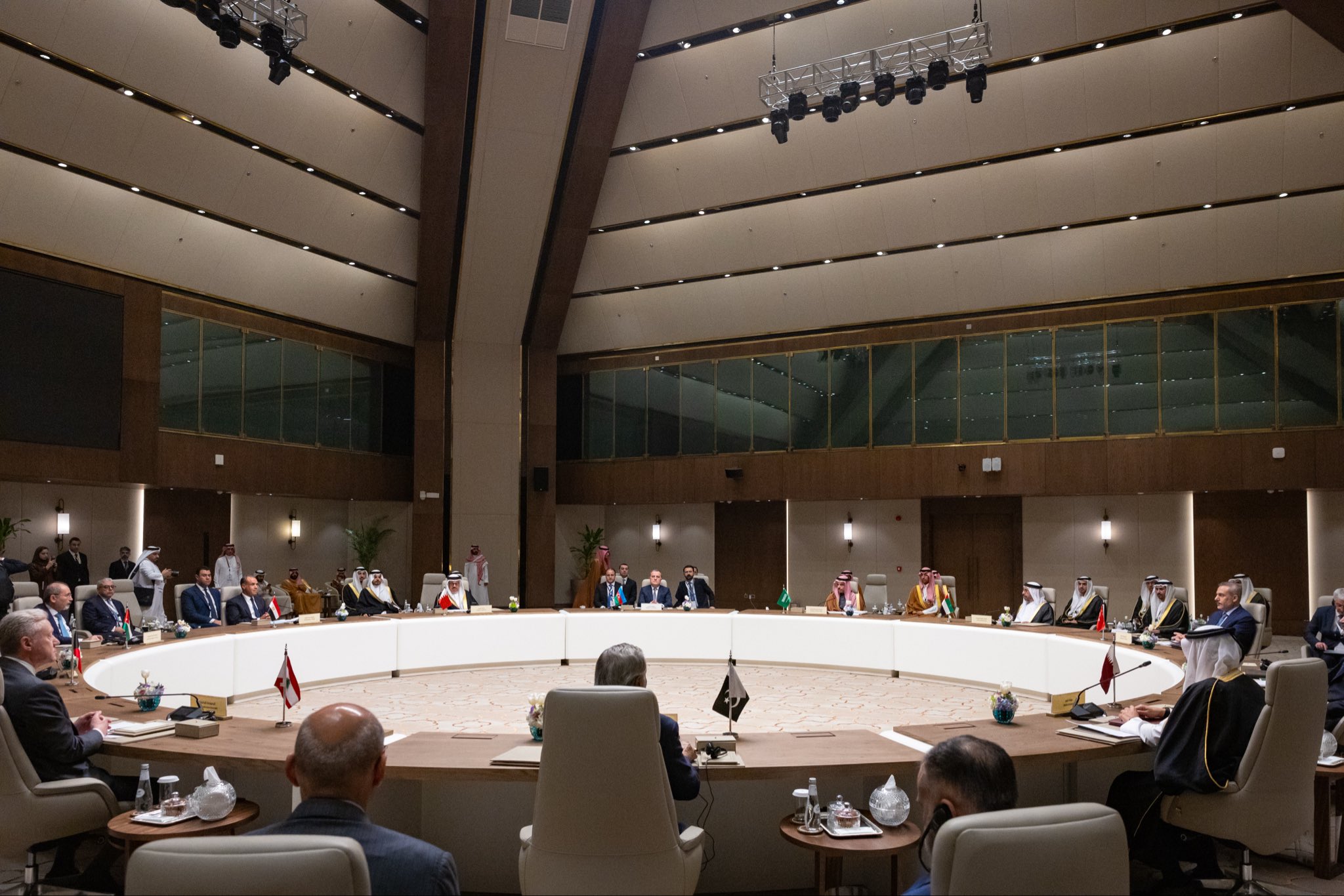
The top diplomats of Azerbaijan, Bahrain, Egypt, Jordan, Kuwait, Lebanon, Pakistan, Qatar, Saudi Arabia, Syria, Turkey and the UAE met in Riyadh. Turkey's Hakan Fidan is third from right. / @KSAmofaEN
By Akin Nazli in Belgrade March 19, 2026

While Donald Trump in the White House was adding coherence to his explanation of why it is the US and Israel have unleashed a massive military assault on Iran (this just in from the wires, Trump’s explanation of Israel attacking Iran’s biggest gas field: “Yeah I did, I told him [Israeli PM Benjamin Netanyahu] don’t do that [attack the gas field] … And he won’t do that [though he did do that] … We’re independent. We get along great. It’s coordinated. But on occasion, he’ll do something, and if I don’t like it … So, we’re not doing that any more.”), in Riyadh, there was a big gathering of top diplomats.

The foreign ministers of Azerbaijan, Bahrain, Egypt, Jordan, Kuwait, Lebanon, Pakistan, Qatar, Saudi Arabia, Syria, Turkey and the UAE held a consultative ministerial meeting on Wednesday, 29 Ramadan 1447, in the Saudi capital on the Iranian attacks, Turkey’s foreign ministry announced on March 19, particulary referring to Iran’s response to the Israeli attack on the gas field, South Pars, with strikes on Gulf Cooperation Council (GCC) countries.

The ministers affirmed their condemnation and denunciation of the deliberate Iranian attacks conducted with ballistic missiles and drones on residential areas, civilian infrastructure, including oil facilities, desalination plants, airports, residential buildings and diplomatic premises, the parties said in a joint statement following the meeting.

Whatever I

“The ministers further affirmed that such attacks could not be justified under any pretext or in any manner whatsoever,” the statement also read.

And the ministers stressed the right of states to defend themselves in accordance with Article 51 of the United Nations charter.

They called on Iran to immediately halt its attacks. They affirmed the necessity of respecting international law, international humanitarian law and the principles of good neighbourliness as a first step toward ending the escalation, achieving security and stability in the region and promoting diplomacy as a means to resolve the crisis.

Whatever II

The ministers emphasised that the future of relations with Iran would depend on respecting the sovereignty of states and non-interference in their internal affairs as well as refraining from violating their sovereignty or their territories in any manner whatsoever and not using or developing Iranian military capabilities to threaten countries of the region.

The ministers stressed the need for Iran to abide with implementing Security Council Resolution 2817 (2026), which calls for an immediate halt to all attacks, the unconditional cessation of any provocative acts or threats against neighbouring states along with the cessation of support, financing and arming of affiliated militias in Arab countries, which Iran is carrying out to serve its goals, against the interests of these countries.

Editorial problems

“Furthermore,” Iran was urged “to refrain from any measures or threatening aimed at closing or obstructing international navigation in the Strait of Hormuz or threatening maritime security in Bab al-Mandab,” the statement also said (this section appeared to have escaped the proofreader).

Reaffirmation of condemnation of Israel’s attack on Lebanon

The ministers reaffirmed support for the security, stability and territorial integrity of Lebanon and for the activating of the sovereignty of the Lebanese state over all its territories and supporting the Lebanese government's decision to limit weapons to the state. They also condemned Israel's aggression against Lebanon and its expansionist policy in the region.

Proofreader asleep again

“The ministers reaffirm their commitment to continuing intensive consultation and coordination in this regard, to monitor developments and assess emerging issues in a way that ensures the formulation of common positions and the adoption of necessary legitimate measures and procedures to protect their security, stability, and sovereignty, and to halt the Iranian heinous attacks on their territories,” the statement added.

Hakan Fidan in Riyadh

Turkish foreign minister Hakan Fidan represented Turkey at the gathering.

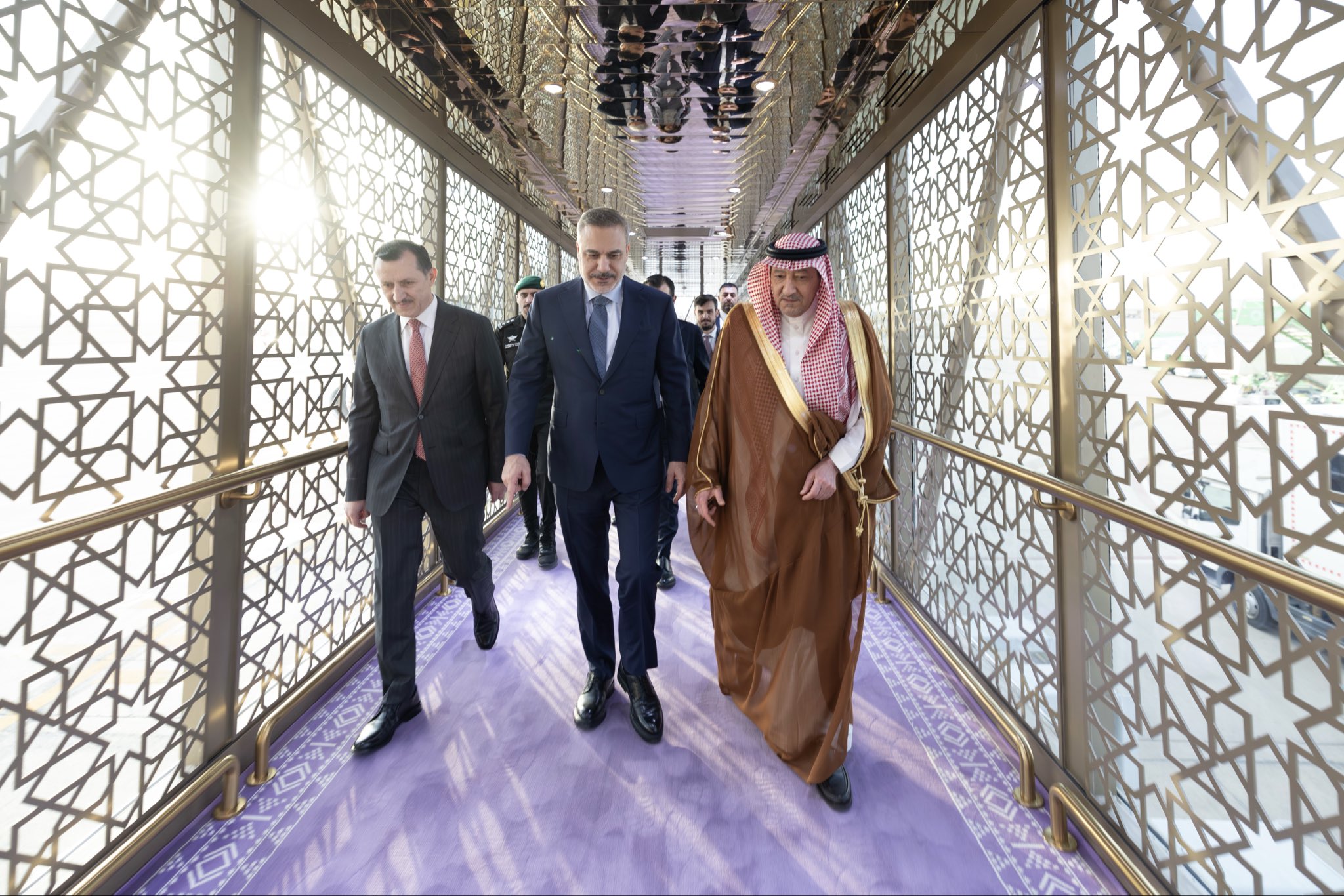
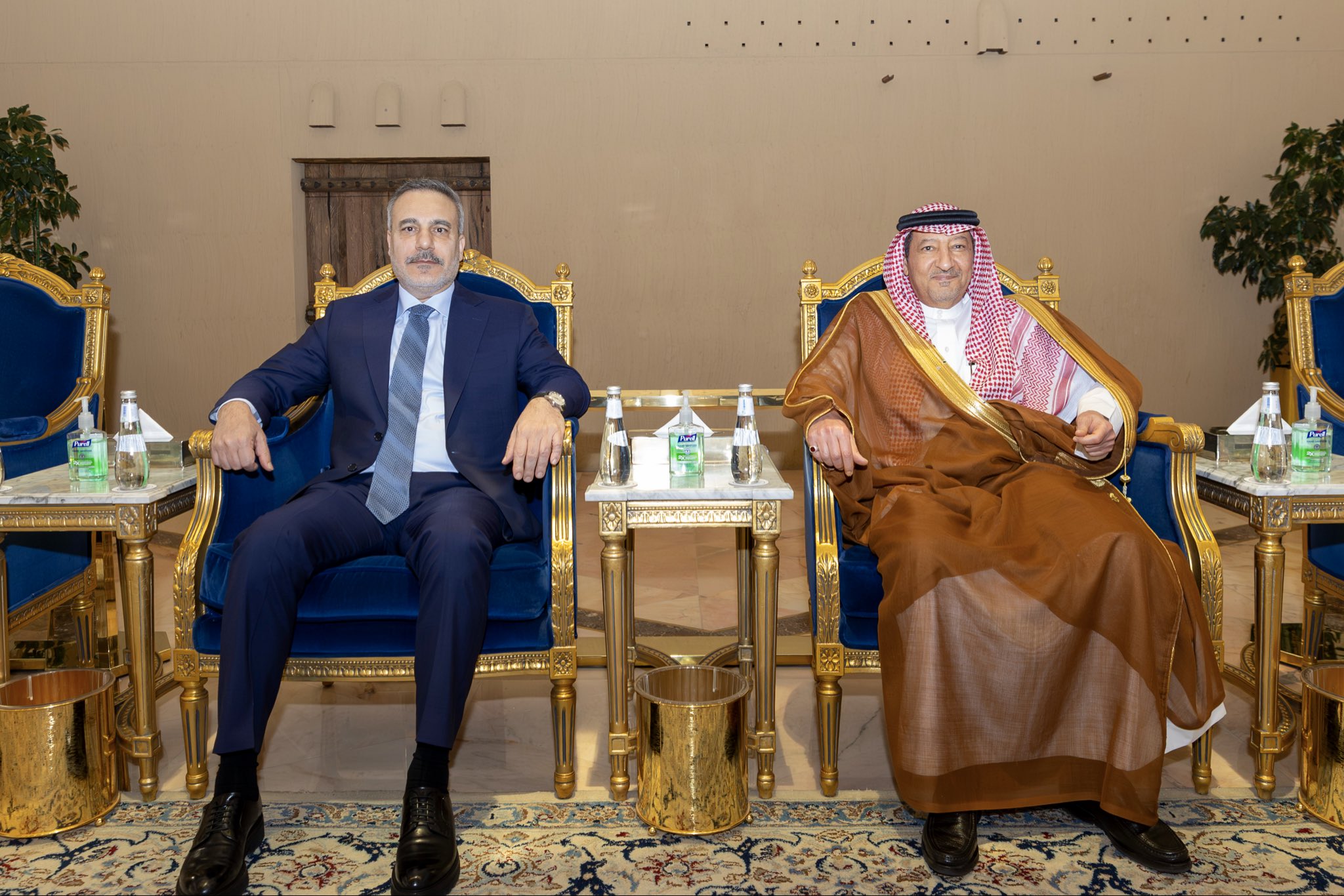
On March 18, Waleed Abdulkarim El Khereiji (@W_Elkhereiji, seen right, above) received Fidan upon his arrival at King Khalid International Airport in Riyadh.

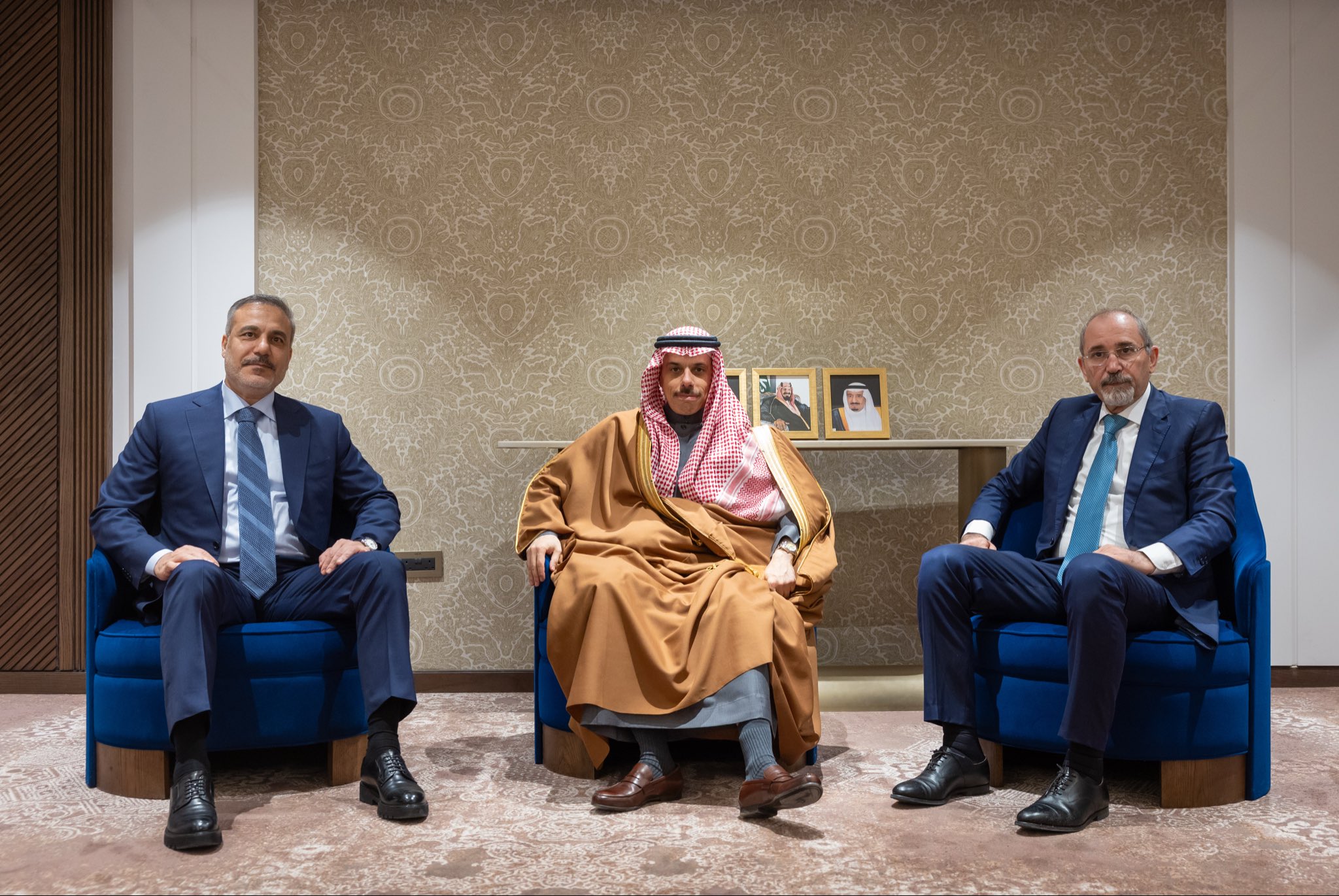
Later, Fidan met with Saudi foreign minister Prince Faisal bin Farhan (@FaisalbinFarhan, middle) and Jordan’s foreign minister Ayman Fasadi (@AymanHsafadi, right) on the sidelines of the consultative meeting of the foreign ministers of a number of Arab and Islamic countries.

Fidan further participated in a consultative ministerial meeting leg with counterparts.

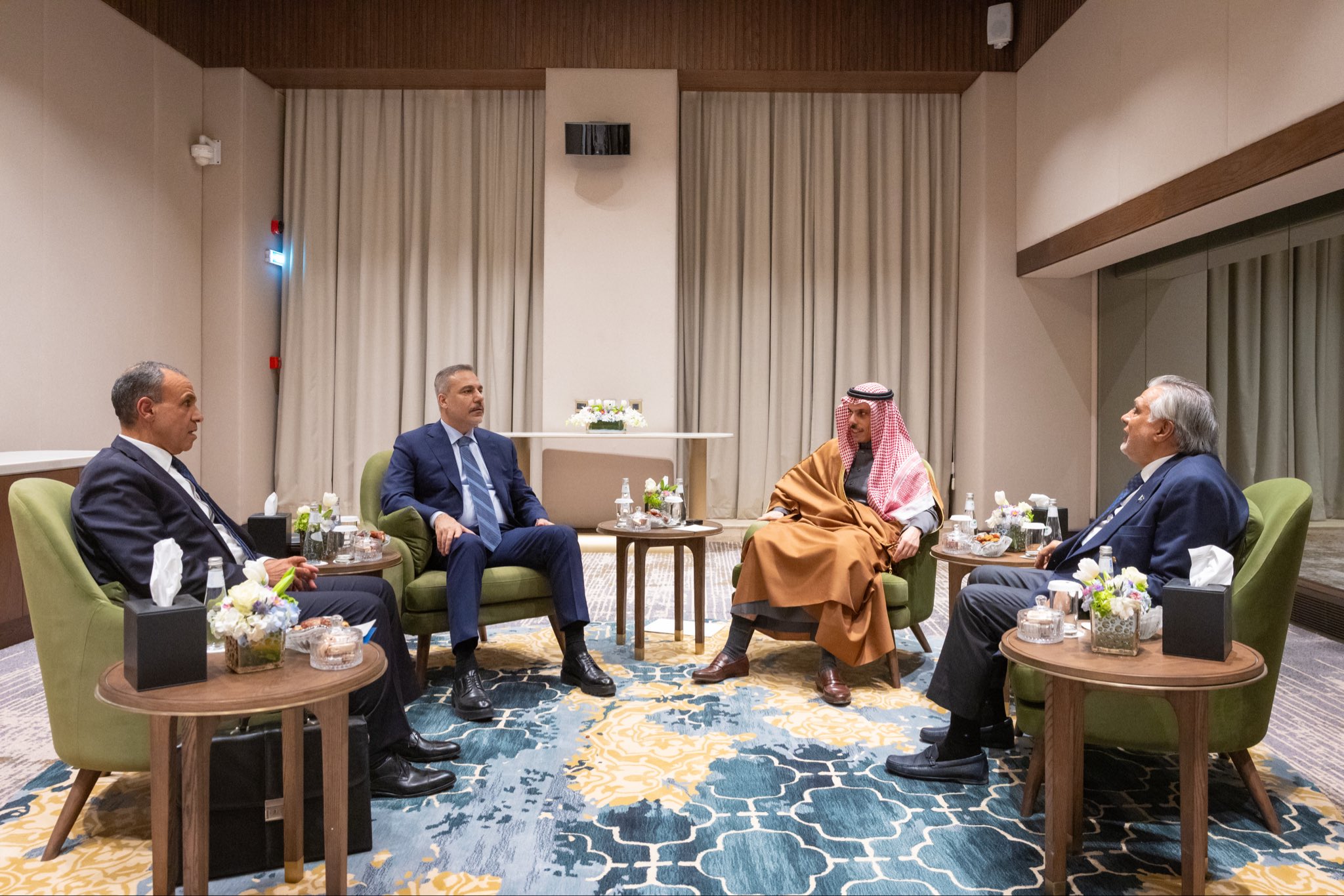
After posing with all of the meeting participants following the gathering, Fidan held a coordination meeting (of the type that Trump so enjoys) with the foreign ministers of Pakistan (right), Saudi Arabia (second right) and Egypt (left). This was a sidelines meeting. It was on the sidelines of the consultative meeting.


Renewables supply nearly half of EU electricity in 2025

Renewables supply nearly half of EU electricity in 2025
Europe produces just under half of its power from renewables, which will provide a very useful buffer against the 2026 oil shock. / bne IntelliNews
By bne IntelliNews March 21, 2026

Almost half (47%) of the European Union’s electricity was generated from renewable sources in 2025, according to new data from Eurostat, which will provide a significant buffer at a time when the fossil fuel markets have been plunged into chaos by the start of Operation Epic Fury.

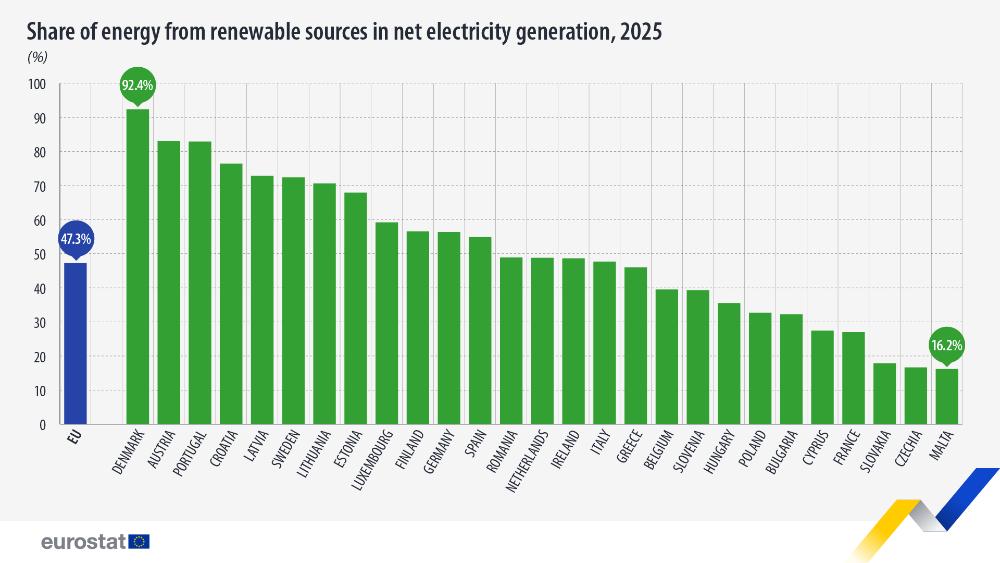
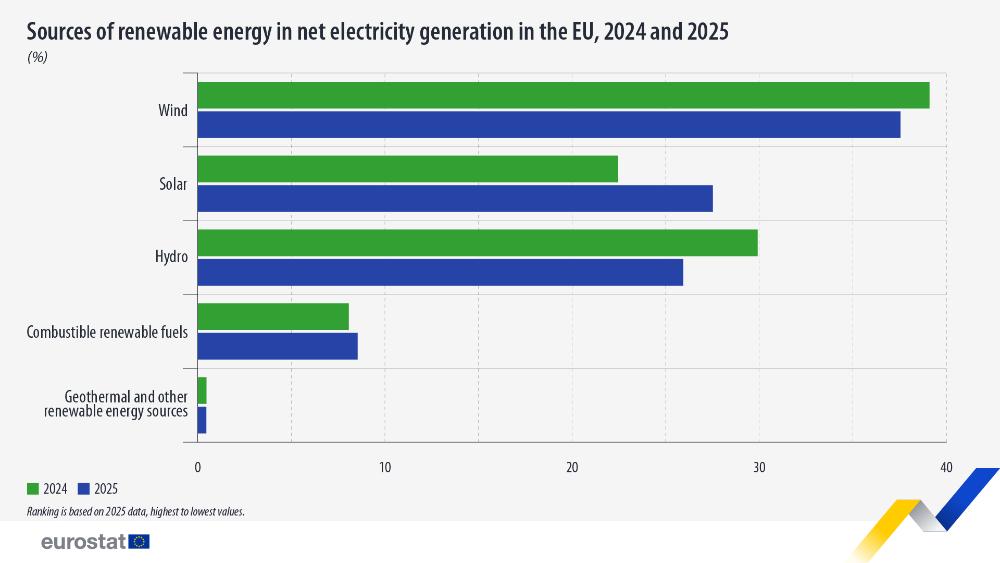
Eurostat reported that 47.3% of electricity generated in the EU last year came from renewables, a marginal increase from 47.2% in 2024. The figures reflect sustained investment in wind and solar capacity, even as hydropower output declined.

Wind energy remained the dominant renewable source, accounting for 37.5% of renewable electricity generation. Solar followed with 27.5%, while hydro contributed 25.9%. The remainder came from combustible renewable fuels at 8.5% and geothermal and other sources at 0.5%.

Solar power recorded the fastest growth, with output rising by 24.6% compared with the previous year, underscoring rapid deployment across southern Europe and increasing rooftop installations. By contrast, hydroelectric generation fell by 11.8%, reflecting lower rainfall levels in parts of the continent.

The data illustrates widening disparities between EU member states. Denmark led the bloc, with 92.4% of its electricity generated from renewable sources, driven largely by wind power. Austria followed with 83.1%, primarily from hydro, while Portugal reached 82.9%, supported by a mix of hydro and wind.

At the other end of the spectrum, Malta recorded the lowest share at 16.2%, followed by Czechia at 16.6% and Slovakia at 17.8%, reflecting continued reliance on fossil fuels and nuclear energy in parts of central and eastern Europe.

The figures come as the EU pushes towards its legally binding target of climate neutrality by 2050 and a higher share of renewables in its energy mix by 2030. Policymakers have accelerated permitting reforms and investment incentives in recent years to support the rollout of clean energy infrastructure.

Despite the gains, the near-flat year-on-year increase suggests the pace of expansion may need to accelerate further if the bloc is to meet its long-term decarbonisation goals, particularly as electricity demand is expected to rise with the electrification of transport and industry.

However, slow growth has led the European Commission (EC) to backtrack some of the rules in its flagship Green Deal reforms. The agricultural lobby in particular is unhappy with strict emissions regulations which it says makes European food uncompetitive with imports from places like South America.

There are also growing concerns among governments and industry that targets agreed in the early 2020s are colliding with economic, geopolitical and competitiveness realities — a dynamic increasingly visible not only in the ongoing deindustrialisation that started in Germany, but is now spreading to the agriculture sector.


Latvia’s LMT and Latvenergo develop AI-driven system to protect birds at wind farms

Latvia’s LMT and Latvenergo develop AI-driven system to protect birds at wind farms
Focus will be placed on large soaring birds, including storks, eagles, cranes and swans, which are particularly vulnerable around wind farms. / Labs of Latvia
By bne IntelliNews March 18, 2026

Latvian telecoms firm LMT and energy utility Latvenergo launched a joint research project to create a system for automatically detecting and identifying birds near wind turbines, the Latvian investment promotion agency, said on March 17.

The initiative aims to reduce bird mortality while supporting the expansion of wind energy in line with environmental standards. It is a notable step for local innovation, with developers describing the technology as unprecedented in Latvia and the wider Baltic region.

The project centres on combining radar with high-resolution cameras – two technologies not previously integrated in this context – to enable real-time monitoring of bird movement. The system is designed to identify species, track flight paths and assess collision risk. If danger is detected, turbines could be temporarily halted to prevent impact.

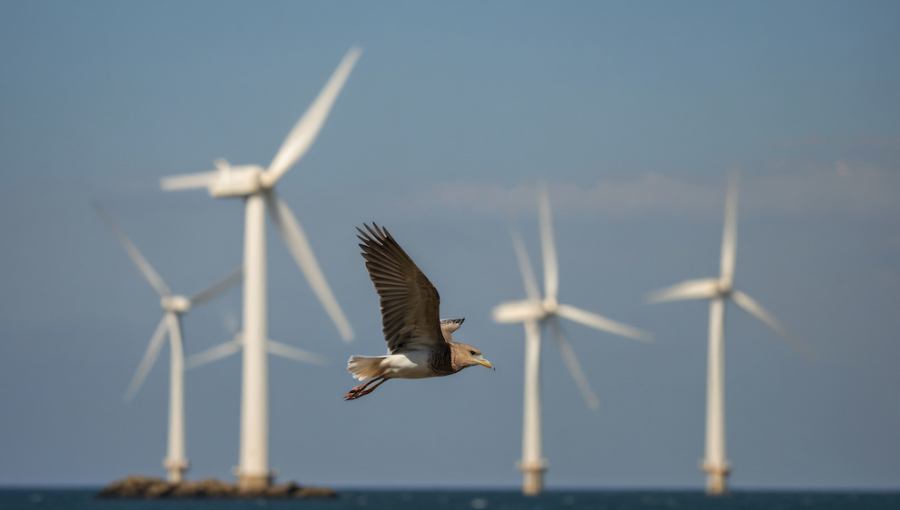
Focus will be placed on large soaring birds, including storks, eagles, cranes and swans, which are particularly vulnerable around wind farms.

“Latvia’s innovation ecosystem is growing stronger, and this project is an excellent example of how technology can help protect nature while promoting sustainable energy production. We are proud that the LMT Group, together with Latvenergo, is creating a solution of significance on both a Latvian and European scale. Similar existing solutions involve only video integration, therefore, this new approach may have significant export potential,” said Juris Binde, president of the LMT Group.

Artificial intelligence will play a central role, analysing combined radar and video data to ensure accurate monitoring even in low visibility or poor weather. The system is expected to reduce reliance on manual observation while helping developers meet EU and national environmental requirements. Species detection will be adaptable, based on expert input.

Martiņs Cakste, chairman of Latvenergo, said balancing energy development with biodiversity remains essential. “…This is an opportunity for Latvian-born innovation to protect birds and ensure the sustainability of wind farms both in our country and on an international scale.”

The project began in October 2025 and is scheduled for completion in the second half of 2027. Its budget exceeds €400,000, with partial funding from the EU Recovery Fund.


FASCIST WRECKER
EU leaders fail to sway Hungary's Orban on €90 billion Ukraine loan


EU leaders on Thursday failed to convince Prime Minister Viktor Orban to lift his blockade on a vital €90 billion loan for Ukraine. The Hungarian leader is blocking the measure over damage to a pipeline running through Ukraine that supplies Hungary and Slovakia with Russian oil, part of an effort to bolster his anti-EU image ahead of national elections next month.


Issued on: 19/03/2026 
By: FRANCE 24

Italian Prime Minister Giorgia Meloni speaks with Hungarian Prime Minister Viktor Orban on the day of a European Union leaders' summit in Brussels, Belgium March 19, 2026. © Yves Herman, Reuters

EU leaders failed to persuade Hungary's Viktor Orban to lift his block on a massive loan to support Ukraine's war effort at summit talks on Thursday, leaving the much-needed funding in limbo.

Moscow's closest partner in the bloc, the nationalist prime minister has long resisted helping Kyiv to repel Russia's invasion, stalling EU aid and repeated rounds of sanctions.

This time around, Orban is holding up a 90-billion-euro ($104 billion) loan as leverage in a feud over damage to a pipeline running through Ukraine – which has choked the flow of Russian oil to Hungary and Slovakia.

"The Hungarian position is very simple. We are ready to support Ukraine when we get our oil, which is blocked by them," Orban said on arrival at the summit, which Ukraine's Volodymyr Zelensky addressed by videolink.


Orban had made it clear he planned to play hardball, as he leans into anti-EU and anti-Ukrainian narratives ahead of close-fought national elections on April 12 – to the exasperation of fellow EU leaders.

And despite concerted pressure from his counterparts in Brussels, he refused to budge.

"No movement from Orban," summed up an EU diplomat after the Ukraine talks concluded. "We all know it's linked to the elections – we are going to have to be creative."

The EU's top diplomat Kaja Kallas warned earlier it was "really, really time" to show support by unlocking funding for Ukraine for this year and the next – which Hungary's leader signed up to in December along with the rest of the bloc.

But only 25 of the bloc's 27 leaders endorsed Thursday summit conclusions reaffirming their intent to begin disbursing the funds next month, with diplomats confirming the holdouts were Budapest and Bratislava.

Leaders agreed to revisit the matter, which requires unanimity, at their next meeting planned in late April.

Election 'weapon'

At the root of the standoff is a weeks-long dispute in which landlocked Hungary and Slovakia accuse Ukraine of stalling on pipeline repairs – while Zelensky has called it "blackmail" to link the issue to support for Kyiv's war effort.

The European Commission moved this week to unblock the situation by sending a team to help restore oil transit, but Orban dismissed the scheme as a "fairy tale".

"We are waiting for the oil," Orban told reporters – calling the matter "existential" for Hungary.

Many of his counterparts see the block as squarely motivated by national politics.

"He's using Ukraine as a weapon in his election campaign, and it's not good. We had a deal," Finland's Prime Minister Petteri Orpo told reporters in Brussels.

Belgium's Bart de Wever likewise said Orban's veto seemed to be "part of his election campaign," calling his U-turn "unacceptable".
Shortfall

It's a well worn routine in Brussels, where Orban has held up countless decisions on Ukraine, and solutions have ultimately been found – in one famous case having him leave the room while the bloc approved the start of membership talks with Kyiv.

But this time around, it remains unclear when he might blink.

"He doesn't sound like he's ready to be convinced," said a second EU diplomat after the talks.

Complicating matters, leaders have been wary of offering Orban – who is trailing main rival Peter Magyar in election polls – a chance to bolster his image as a maverick on the EU stage by publicly ganging up on him.

Facing a budget shortfall four years into the war, Kyiv is estimated to need an influx of funds in early May – implying a decision to unlock the EU loan by mid-April.

The failure to break the deadlock may push the issue back until after the Hungarian vote, whatever its outcome.

Can Ukraine hold out until then? Unclear, say EU diplomats.

(FRANCE 24 with AFP)


ANALYSIS


Why Hungary's Viktor Orban is vilifying Ukraine before crucial elections


Weeks before crucial parliamentary elections, Hungarian Prime Minister Viktor Orban’s campaign has characterised his main rival as a stooge of Kyiv and Brussels. With his party trailing in the polls, the nationalist leader has sought to escalate tensions between Hungary and Ukraine, alleging that Kyiv and its European allies are conspiring to drag Hungary into war with Russia.


Issued on:  19/03/2026 - 
FRANCE24
By: Sonya CIESNIK


An attendee holds an image of Hungarian Prime Minister Viktor Orban at a pro-government rally named a 'Peace March' during Hungary's National Day celebrations in Budapest, Hungary, March 15, 2026. © Marton Monus, Reuters

In 1241, the Mongol army marched into Hungary, creating indescribable chaos. Most of the country’s religious dignitaries were slaughtered. The pillaging, massacres and famine the foreign invaders left in their wake imprinted an undeniable trace on the Hungarian psyche.

Centuries later, as Hungary braces for crucial parliamentary elections in April, Prime Minister Viktor Orban is tapping into the demons of Hungary’s past, claiming the country is once again under threat.

Fidesz, Orban’s far-right party, is focusing on a new foreign menace – the danger it claims is posed by Ukraine. As part of its re-election strategy, the Hungarian government has sought to escalate tensions with Kyiv.

“Orban has repeatedly opposed European funding and military support for Ukraine’s fight,” said Michael Ignatieff, a former Canadian opposition leader and historian, who was rector of the Central European University in Budapest when Orban's government forced it to relocate abroad in 2017.


“What’s new in the campaign is the personal vilification of Ukrainian President Volodymyr Zelensky and the claim that Zelensky will drag Hungary into the war and Hungarian soldiers will die," Ignatieff added.
The threat of imminent war

Richard Demény, a foreign policy analyst at Political Capital, a research institute in Budapest, says Fidesz initially campaigned on "domestic policy narratives focused on the Orban regime’s achievements over the past 16 years."

Yet the messaging has done little to win over digruntled voters who want more from the government in areas like public education and healthcare. "To distract from these shortcomings and to shape the public agenda, Fidesz has employed fear-based narratives to exacerbate anxiety in segments of society susceptible to the threat of an imminent war,” said Demény.

Orban's party has been trailing in the polls since last year, while the centre-right Tisza party, led by Peter Magyar, is picking up speed. Magyar's supporters hope to end Orban's 16-year rule.


Peter Magyar, leader of the opposition Tisza party, attends the Hungary's National Day celebrations, in Budapest, Hungary, March 15, 2026. © Bernadett Szabo, Reuters


In reponse to his rival's lead in the polls, Orban has stepped up his attacks on Ukraine. In one campaign video released by the ruling party in February, a young Hungarian girl asks about her father. The video then cuts to footage of a blindfolded soldier in a Hungarian uniform being shot in the head and falling into the muddy ground. A caption reads: “This is only a nightmare now, but Brussels is preparing to make it a reality. Fidesz is the safe choice!”

Fidesz has framed the 2026 elections as a choice between war and peace, and the video implies that a Tisza victory would force Hungarians to go to war.

“For the first time, Orban is straightforwardly alleging the existence of political coordination and collusion between the Ukrainian administration, EU institutions, and the Hungarian opposition to remove him from power and establish a pro-Ukraine government in Hungary,” said Daniel Hegedüs, deputy director at The Institute for European Politics.

From the cosmopolitan streets of Budapest to small villages in the countryside, large campaign billboards are being used to try to sway “segments of society susceptible to the threat of an imminent war”, said Demény.

“They themselves are the risk,” read a caption of a pro-government billboard featuring a combined photo of European Commission President Ursula von der Leyen, Zelensky and Magyar.

A pedestrian walks past a pro-government billboards featuring a portrait of Ukrainian President Volodymyr Zelensky (L), with the text reading, 'Let's not let Zelensky have the last laugh, and another billboard featuring European Commission President Ursula von der Leyen (R), Ukraine's President Volodymyr Zelensky (C), and Hungarian opposition leader Peter Magyar (L) with a text, 'They themselves are the risk.' in Budapest's 3rd district on March 3, 2026, in prepatation for the upcomping general election set to take place on April 12, 2026. © Attila Kisbenedek, AFP

‘No oil, no money’

At the core of Hungary’s escalating tensions with Ukraine is what Orban called “the Ukrainian oil blockade” in a March 17 video posted on X.

Ukraine and Hungary have been locked in an escalating feud since Russian oil deliveries to Hungary and Slovakia were halted in January due to damage to the pipeline, which crosses Ukrainian territory. Ukrainian officials have blamed the damage on Russian drone attacks.

Orban has accused Zelensky of deliberately holding up oil supplies – claims that Zelensky denies. In retaliation, Orban has vetoed a major €90 billion EU loan to cover Ukraine’s military and economic needs for two years.

“If President Zelensky wants to receive his money from Brussels, then he must reopen the friendship oil pipeline,” said Orban in the video.

Orban has even accused Ukraine of plotting to attack him and his family, releasing a video in March purporting to show him speaking to his daughters over the phone and warning them of the threat.

READ MORE’Ready to govern’ Hungary: Former ally Magyar challenges Orban with Europe gun

“Orban’s basic political method is to create enemies. First Brussels, then George Soros, and now Peter Magyar, all portrayed as malign alien forces conspiring to harm Hungary. Orban then portrays himself as the plucky, heroic defender of the Hungarian nation,” said Ignatieff.

Yet Orban may have met his match in a man like Magyar, added Ignatieff, who is "ex-Fidesz himself, and far too clever a politician to cede the nationalist ground to Orban."

“Magyar tours the countryside, sings patriotic folk songs with his supporters, waves the national flag, quotes Hungary’s great poets and is competing effectively with Orban in the battle for the nationalist vote.”

Orban's strategy could still work. In his book "Hungarians", the historian Paul Ledvai wrote that the most important psychological consequence of the Mongol invasion was the inference that "We Hungarians are alone”.

The mistrust of foreigners, even when they were urgently needed as allies in times of acute danger, “could be effective at keeping Fidesz and undecided voters focused on an existential threat,” said Demény.

(With AP)