Sunday, April 05, 2026

“Back to the Stone Ages”: Donald Trump’s Vicious Fools’ Day SpeechesFacebookTwitterReddi

Image by Ries Bosch.

Paul Street

 April 3, 2026

Two nights ago, during his insane war speech on Iran the demented lunatic atop the US Empire claimed to have created the “highest ever” stock market. But within just minutes of his deranged speech, Newsweek reports, “futures tied to the Dow Jones Industrial Average, S&P 500 and Nasdaq all turned decisively negative, erasing earlier gains from the regular trading session and pushing markets toward fresh short-term lows.”

While stocks plummeted, oil prices surged, fueling further inflation, as I expected (this is why I filled my tank before the speech), adding to the affordability crisis that the orange-brushed madman has called a “hoax.”

The reasons for these rapid economic developments are not mysterious. A senior global investment manager told Reuters that Mein Trumpf provided “no additional certainty or clarity around timeline,” which is “what the market ​was looking for. The fact that we can expect 2-3 more weeks of action, ⁠boots ⁠on the ground were not ⁠ruled out ​and that threats to hit infrastructure were reiterated will put the market back on the ​defensive, particularly as we ⁠come into the long weekend.”

The Washington warmonger offered no well-defined strategy to reopen the Strait of Hormuz, the world’s leading oil and gas supply chokepoint. Telling European nations to send their navies and armies to the Persian Gulf to “just take the oil for yourselves,” the debased maniac said the strait would open “naturally” once the war ended – whenever that might be, after however much death, crippling, and destruction.

“They’re going to want to be able to sell oil, because that’s all they have to try and rebuild. It will resume the flowing and the gas prices will rapidly come back down, stock prices will rapidly go back up,” Jane Doe 4’s Rapist explained. So “we’ll see what happens,” but it’s all good: time to do a YMCA dance and focus more on wiping out what’s left of “democracy,” social justice, sanity, and rule of law in the imperial “homeland.”

The language of portfolio managers and oil traders is technical and anodyne, steering clear of the malevolent fallaciousness and violent psychosis of the Orange Monster’s speech. During his painfully delivered monotone address, the bloated and curiously pinkish war criminal let one lie after another slither off his satanic tongue:

+ “My first preference was always the path of diplomacy.” False.

+ “The regime continued their relentless quest for nuclear weapons and rejected every attempt at an agreement.” False.

+ “They were rapidly building a vast stockpile of conventional ballistic missiles, and would soon have had missiles that could reach the American homeland.” False.

+ “They were right at the doorstep [of developing] a nuclear weapon like nobody’s ever seen before.” False.

+ “Our objectives are very simple and clear.” False: Americans and the world have been consistently mystified and confused by the Epstein President’s shifting justifications and rationales, which have changed again and again from one day to the next. Last night – on April Fools Day! – was the first time the Amerikaner-in-Chief deigned to address the nation on the purported purpose of his arch-criminal unprovoked war, which opened with the slaughter of more than 100 Iranian school girls and has since butchered hundreds more children.

+ “We never said regime change.” False: the war opened with the Malignant One telling the Iranian people to rise up and form a new government!

+ “But regime change has occurred because of all of their original leaders’ death. The new group is less radical and much more reasonable.” False: the old Islamist and nationalist regime has proved resilient, with new and hardened leaders in charge. By “reasonable,” the debased orange-faced child rapist means “ready to make a deal with me like Venezuela’s Delcy Rodriguez.” That’s not where the current regime is in light of America’s existential attack on their nation and their clear capacity to cripple world oil, gas, and fertilizer supplies.

+ Regarding “our allies in the Middle East: Israel, Saudi Arabia, Qatar, the UAE, Kuwait and Bahrain,” the American Crime Boss said, “They’ve been great, and we will not let them get hurt or fail in any way, shape or form.” False: the Trump fascist regime launched their criminal war without properly notifying most of the US Empire’s Gulf allies, who have been predictably and seriously damaged by justifiable Iranian retaliation provoked by America’s illegal and unprovoked war. Many in and atop these Gulf states are naturally angered by Washington’s brazen imperial recklessness and disregard.

+ The tangerine-tinted tyrant said that “the recent rise in gasoline prices here at home” is just a “short-term increase” that “has been entirely the result of the Iranian regime launching deranged terror attacks against commercial oil tankers and neighboring countries that have nothing to do with the conflict.” False: gas prices are going to be significantly escalated in US for a long time and this is the result of America’s supremely criminal and mass murderous war on Iran, which has naturally and predictably responded to this imperialist assault by using its strategic geographic position to close down the world’s leading oil and gas chokepoint.

+ “Iran will use [nuclear weapons] and will use them quickly.” False: there is no reason to believe that Iran is uniquely immune to nuclear deterrence and eager to commit national suicide by initiating a nuclear exchange. The real Iranian potential use of nuclear weapons that Washington and Tel Aviv have always feared is the capacity to deter US and Israeli imperialism, colonialism and terrorism in the Middle East.

· “Every single one of the” survivors of the 13 US military personnel killed in the criminal US war on Iran have come up the diseased fascist president and said “Please, sir, please finish the job…. every one of them.” Not a chance. Nobody should believe that grotesque story. That was a sick joke to put forward on April Fools’ Day.

+ “We are going to finish the job and we’re going to finish it very fast. We’re getting very close.” False: the imperialist regime in Washington has created yet another bloody quagmire based on the recurrent US imperial mistake that Washington can shape events across a giant and complex world through sheer simple military force, without serious political engagement and adult negotiation.

+ “We’ve beaten and completely decimated Iran. Our armed forces have been extraordinary. There’s never been anything like it militarily. Everyone is talking about it.” False: history is full of stories of heavily armed empires rapidly overwhelming the military capabilities of weaker nations and peoples. This reaches far back before the modern era, well into the Bronze Age. But what “everyone is talking about,” so to speak, is less the awesomeness of US military power than the limits of that power in light of the Islamo-nationalist Iranian regime’s remarkable resilience and capacity to inflict retaliatory damage on US regional allies and the oil-and gas-dependent world economy. And this too – the limits of US military imperialism – is anything but a new story (the great radical historian Gabriel Kolko published and warned at length about the false promises of US global militarism as seen in US wars on Korea, Southeast Asia, Afghanistan, and Iraq).

+ “The United States has never been better prepared economically to confront this threat. You all know that. We built the strongest economy in history. We’re going through it right now, the strongest in history. And one year we’ve taken a dead and crippled country. I hate to say that, but we were a dead and crippled country after the last administration and made it the hottest country anywhere in the world by far, with no inflation.” What the holy fuck. Inflation was persistent and rising under Trump47 even before the oil and gas/energy and fertilizer shock created by the Trump fascist regime’s criminal war. Wild asset inflation marked by a classic capitalist explosion of price-earning (PE) ratios was raising serious investor concerns about a coming major downward “market adjustment” potentially sparking a significant recession even more the Mad “King” launched his bloody “excursion.” The US imperial superpower was not “dead and crippled” before Herr Donald returned to power with no small help from the dismal Weimar Democratic party of passive resistance and inauthentic opposition. Saying that there’s been “no inflation” in Trump47s America is on par with saying that 2+2=5, that black is white, that “he who smelt it dealt it,” and that Simon/Big Brother Says!

+ “It all positioned us to get rid of a cancer that has long simmered. It’s known as the nuclear Iran, and they didn’t know what was coming. They’d never imagined it.” False: the repressive Islamo-fascist state of Iran (which should never be confused with forces of revolutionary emancipation) has long imagined the US-Israel attack and planned for it. It has operationalized a decentralized and multi-level response that has seriously damaged world energy markets and inflicted a global price shock through its drone, missile, mine, and speedboat capacities and its related hold over the Strait of Hormuz. Iran is now incentivized even more than before to use its strategically scattered stocks of enriched uranium to threaten radioactive retaliation.

The leading long-simmering cancer facing humanity is not “nuclear Iran” but the eco-cidal system of capitalism-imperialism, whose top superpower the United States is under the command of deranged fascist maniacs. The US and its top rivals are in possession of thousands of nuclear warheads in an increasingly lawless and chaotic planet on the precipice of a potentially irreversible climate catastrophe that the US has long trailblazed with its lethal addiction to the environmentally exterminist mass extraction and burning of fossil fuels. The top threat to use nuclear weapons in the region is of course the US ally Judeo fascist Isreal, which is currently replicating its Gaza genocide in southern Lebanon, and is unofficially equipped with hundreds of thermonuclear weapons capable of turning the Middle East into an atomic ash heap many times over. The Red Hat POTUS’s boasting about the United States’ unmatched oil and gas production last night (“we have so much gas …buy oil from the USA, we have so much”) is akin to a heroin dealer boasting of his leading customers’ remarkable highs: the substance he’s promoting for use and sale is certain to cancel all prospects for a decent future. His call for other nations to join the fight to military bloodily pry oil and gas flows out of the Persian Gulf (and the Red Sea) is an invitation to heightened civilizational collapse and a bid to expand the war to involved nuclear weapons and other nuclear superpowers.

Beneath all the lies, the most remarkable thing about Donald “Poisoning Our Blood” Trump’s sickening Address to the Nation last night was its sheer savagery. “We are going to hit them extremely hard over the next two to three weeks,” Trump said. “We’re going to bring them back to the Stone Ages, where they belong…If there is no deal, we are going to hit each and every one of their electric generating plants very hard and probably simultaneously. We have not hit their oil, even though that’s the easiest target of all, because it would not give them even a small chance of survival or rebuilding. But we could hit it and it would be gone”

Read that again: “back to Stone Ages where they belong.”

Read it one more time.

That is a promise to inflict genocidal civilization collapse. That is a promise of collective punishment, an epic crime against humanity rightly punishable by death. Can you smell the stench of the virulent Western racism rising up from “where they belong”?!

+++

Oh, by the way, Trump’s speech last night was his second menacing and insane address on Fascist Fools Day. NBC reports:

‘President Donald Trump on Wednesday said it’s “not possible” for the federal government to fund Medicare, Medicaid and child care costs, arguing that it should be up to the states to “take care” of those programs while the federal government focuses on military spending. The president’s remarks were delivered to attendees at a private Easter luncheon at the White House, where Trump also accused Democratic-led states of fraud.

He went on to say that he told Office of Management and Budget Director Russell Vought, “don’t send any money for daycare, because the United States can’t take care of daycare. That has to be up to a state. We can’t take care of daycare. We’re a big country. We have 50 states. We have all these other people. We’re fighting wars. We can’t take care of daycare. You got to let a state take care of daycare, and they should pay for it too.”

Later in his remarks, the president added that states would have to raise their taxes to pay for child care costs and that the federal government, “could lower our taxes a little bit to them to make up” for it.

“It’s not possible for us to take care of daycare, Medicaid, Medicare, all these individual things,” Trump said. “They can do it on a state basis. You can’t do it on a federal. We have to take care of one thing: military protection. We have to guard the country.”’

Again, dear readers, I ask you to read that again.

One more time. Let that sink in.

Americans, we are running out of excuses for not taking to the streets and town squares every day and every night, not just once every four and half months, calling (for starters) for the immediate end of the vile exterminist regime sitting atop your superpower nation – and then the system that gave rise to that regime.

Paul Street’s latest book is This Happened Here: Amerikaners, Neoliberals, and the Trumping of America (London: Routledge, 2022).

This is "the worst oil crisis in history", says Goldman Sachs

This is
The Iran war consequences have been upgraded from a "disruption" to the "worst crisis in history" according to Goldman Sachs. / bne IntelliNews
By Ben Aris in Berlin April 5, 2026

US investment bank Goldman Sachs says we are facing the “worst oil crisis in history” as a result of the shut down of Gulf state hydrocarbon exports.

A Goldman Sachs report represents an upgrade in the severity of the crisis the world is now facing. As IntelliNews reported, the conflict quickly metastasised from a disruption to destruction after a week. Goldman Sachs is now calling it a “crisis”, whereas two weeks ago the International Energy Agency (IEA) labelled this the “largest energy supply disruption in history”. 

A  global oil supply crunch is approaching as inventories decline and shipments coming out of the Persian Gulf have dwindled to a trickle. Prices of all commodities in the supply chain have already risen, but the US bank warned that problems will intensify in the coming months.

A briefing note cited by analysts at JPMorgan Chase (JPM) also described the situation as a “ticking time bomb”, warning that “physical scarcity of oil is about to unfold across the globe, spreading sequentially through April from east to west”. The disruption is already being felt in Asia and is expected to reach Europe and the US in the coming weeks as tanker arrivals slow.

Separately, The Guardian reported on a looming food crisis as the lack of fertilisers will reduce crops this autumn, putting millions of people in danger of hunger and even starvation.

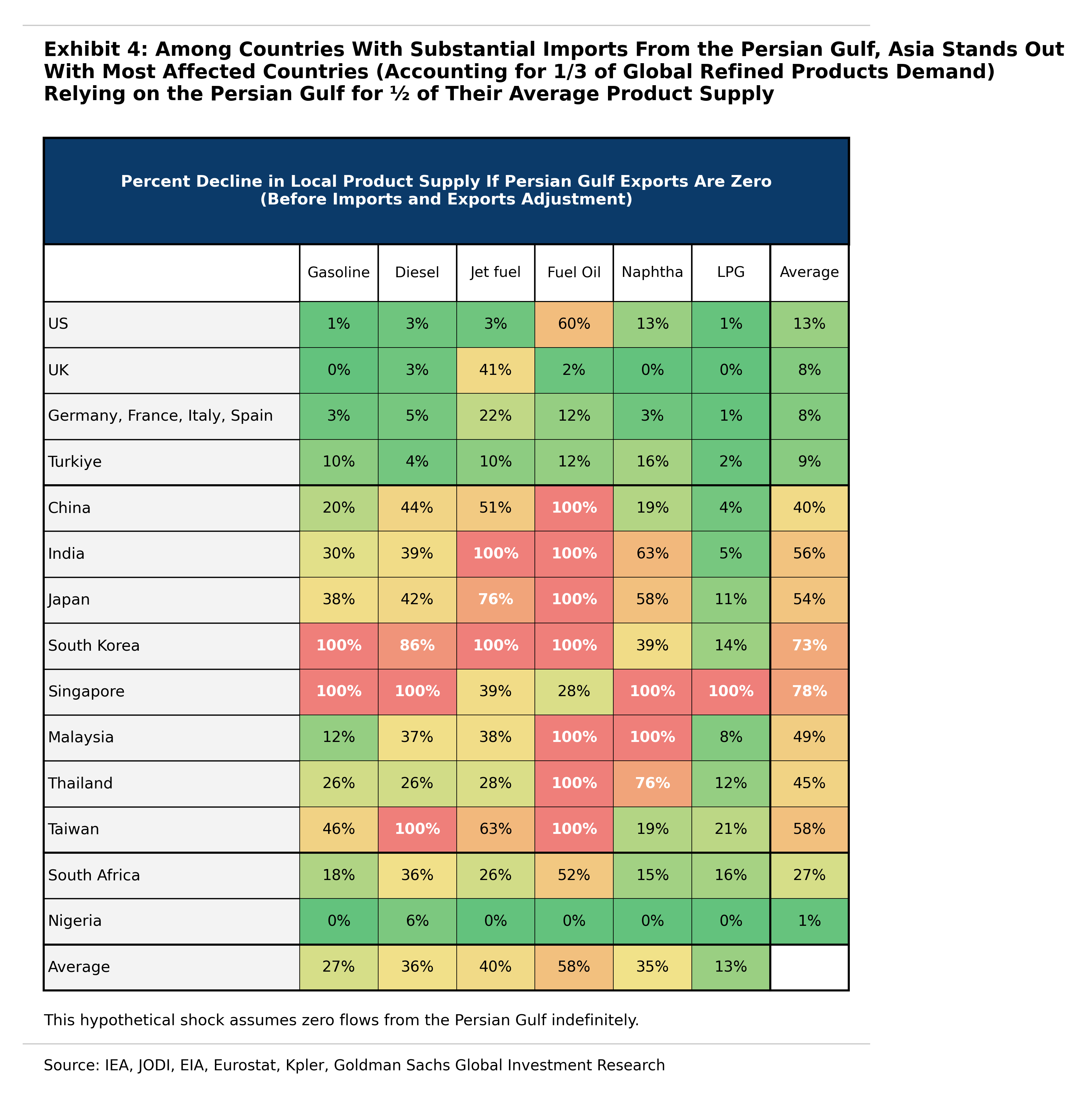
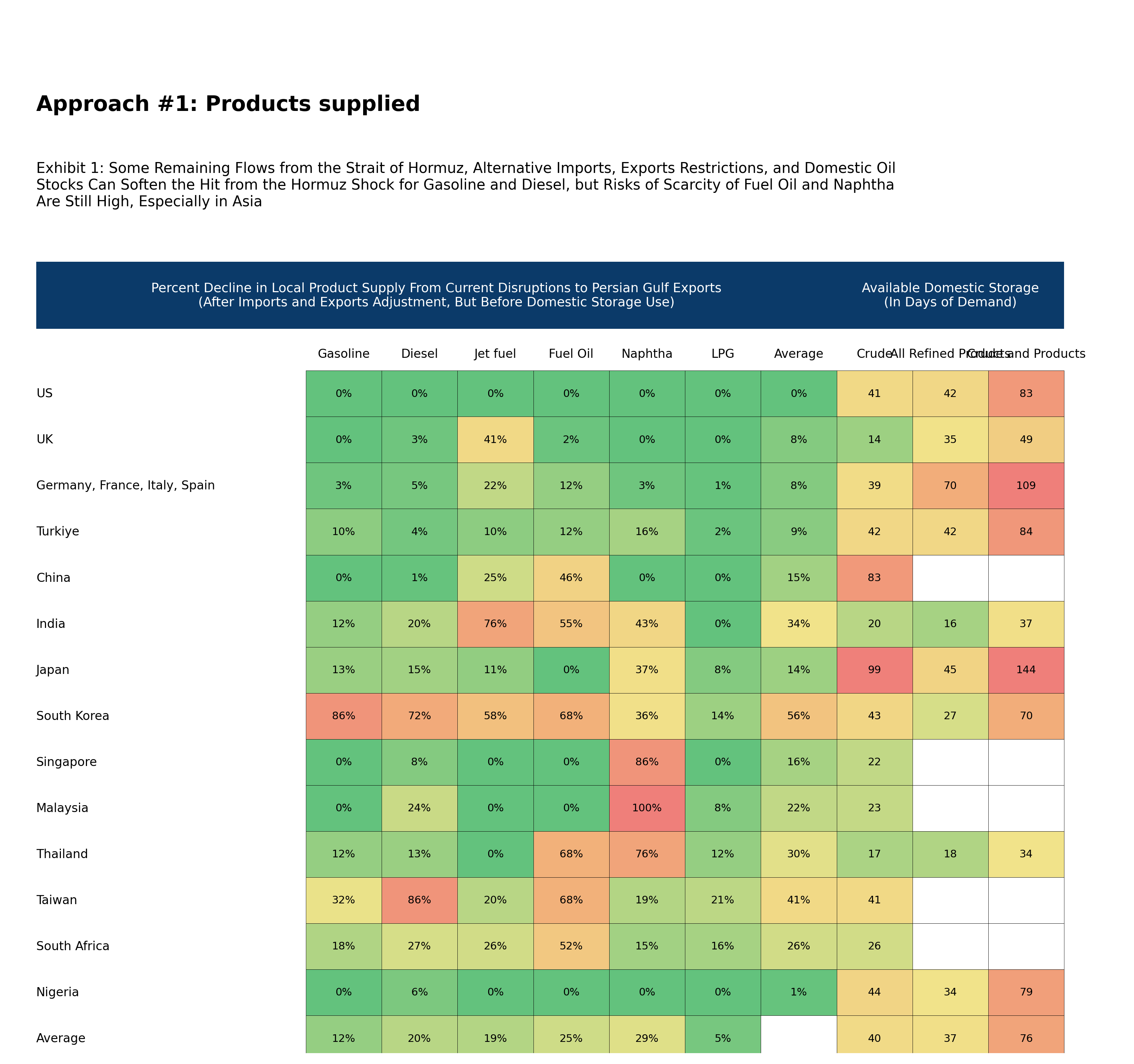
Data from Goldman Sachs indicate that major economies hold an average of about 40 days of crude oil in storage, with significant regional disparities. The UK is described as “uniquely exposed” with only 14 days’ supply, while India holds roughly 20 days. For refined products, inventories average 37 days, with India again among the lowest at 16 days and Japan the highest.

Strategic reserves are being drawn down rapidly. Japan holds the largest crude stockpile in Asia at 99 days, compared with 17 days in Thailand. Countries are increasingly turning to more expensive alternative imports, although analysts note these flows are insufficient to offset the loss of Gulf supplies.

The disruption stems in part from damage to energy infrastructure in Gulf states, alongside a sharp reduction in exports. Analysts warn that these adjustments are finite. “If Persian Gulf flows remain near zero, there is no further offset available and outright supply rationing becomes inevitable,” the JPMorgan note said.

Shipping data indicate that remaining cargoes are already en route, with the last tankers from the region expected to arrive in consuming markets over the coming days. Europe is projected to receive its final shipments shortly, including a last jet fuel delivery scheduled for April 9.

The consequences are expected to be severe. Analysts warn of “demand destruction” through factory shutdowns and flight cancellations, alongside surging prices as Asian buyers pay premiums to divert shipments. In Europe, trucking companies are facing rising costs, with diesel expenses increasing by €1,200 ($1,382) a month. In Germany, up to 100,000 truck driver jobs — about 15% of the sector — are estimated to be at risk.

The disruption will be prolonged thanks to the destruction already wrought. Qatar said that damage to its Ras Laffan LNG plant could take up to five years to repair taking 17% of global supplies off the market.

In the meantime, frustrated with the lack of progress in destroying Iran’s military machine, the US-Israeli coalition are increasingly targeting Iran’s industrial base in the hope of undermining its military. Iran has been responding in kind, putting the industry of the entire region in danger.

Trump set a deadline for Iran to reopen the Strait of Hormuz or face “irreversible damage” to its power grid that expires on April 6. Tehran has vowed to reciprocate and hit the power sectors of all non-friendly countries in the Gulf if the US carries out its threat.

Global recession on the cards

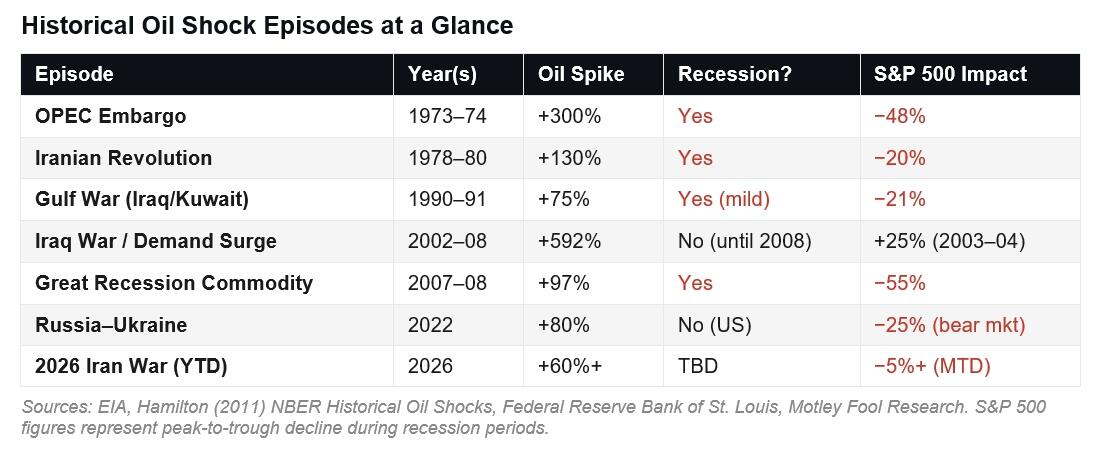
Oil prices would need to average $140 per barrel for two months to trigger a global recession, according to Oxford Economics, as markets brace for prolonged disruption linked to the conflict in the Gulf.

Capital Economics has projected that Brent crude could average $150 per barrel over the next six months if the conflict persists for another three months, pointing to sustained pressure on energy markets already strained by supply constraints.

“The world’s most important price for real-world oil barrels surged above $140, the highest since 2008,” economist Mohamed A. El-Erian said in a post. “Dated Brent, the price of shipments bought and sold in the North Sea, reached $141.37, surpassing levels seen when Russia invaded Ukraine, according to S&P Global, which publishes the data.”

Brent has risen more than 60% since the war began, reflecting escalating risks around the Strait of Hormuz, a critical chokepoint for global oil flows. The International Energy Agency has responded with the largest co-ordinated emergency stock release in its 52-year history, making 400mn barrels available to the market. However, analysts say the intervention has so far failed to stabilise prices.

The disruption carries particular significance for Asia, where approximately 80% of oil imports transit through Hormuz. Several economies in the region face acute vulnerability to supply interruptions. Vietnam, for example, is estimated to hold fewer than 20 days of strategic reserves, leaving it exposed to prolonged price spikes or physical shortages.

In Europe, the economic impact is expected to be uneven but significant. Germany, the UK and Italy are seen as having the highest exposure to recession risks due to their dependence on imported energy and sensitivity to price shocks.

The European Central Bank has already adjusted its policy stance in response to rising inflationary pressures, postponing anticipated rate cuts and revising its inflation forecasts upwards as energy costs feed through to the broader economy.

The combination of constrained supply, limited spare capacity and geopolitical uncertainty has heightened concerns that energy markets could become a central driver of a wider global slowdown.

Behind the Iran War and All the Wars in the Middle East: Oil

April 3, 2026

Photograph by Nathaniel St. Clair

One month into the war in Iran, journalists and politicians, Democrats and Republicans, leftist, rightists, and independents should no longer be asking what this war is all about.

Sasan Fayazmanesh, in his March 13th piece in Counterpunch, made a convincing (and brave) argument that It’s Israel, Stupid. He just didn’t go far enough.

He rightly begins by posing the questions that seemed to have no coherent answer:

Is it because negotiations with Iran over its nuclear program were not progressing? Is it because Iran was close to developing nuclear weapons? Is it because Iranian ballistic missiles were going to reach the US soon? Is it because Israel was going to attack Iran and the US took pre-emptive measures to ensure the safety of Americans? Is it because the Iranian government was violating human rights? Or is it something else?

He posits

The US attacked Iran for one reason and one reason only: Israel. Israel, created by the US and Europeans, has been urging the US for decades to wage a destructive war against Iran.”

Why? To achieve the Zionist goal of achieving a Greater Israel. But she omits Israel’s thirst for getting and controlling oil, harkening back to the presidency of George W. Bush and a revelation made to former NATO commander Wesley Clark immediately after 911. As I documented in my book, Follow the Pipelines: Uncovering the Mystery of a Lost Spy and the Deadly Politics of the Great Game for Oil, Clark in 2007 stated that a Pentagon official revealed to him in 2001 a plan to “attack and destroy the governments in seven countries in five years,” starting with Iraq and moving on to Syria, Lebanon, Libya, Somalia, Sudan [all oil -related conflicts] and Iran. While on a book tour, Clark stated further that the Bush strategy was shaped around gaining control of Middle East oil resources, based on a plan by his neoconservative backers [some with dual US-Israeli citizenship] to “use US troops to secure access to these energy supplies abroad.”

Today Iran is the third largest owner of oil reserves in the world, behind Saudi Arabia and Venezuela. This simple fact has not been adequately addressed by the media, which has focused on the dangers of blockading the Strait of Hormuz and seizing Kharg Island, resulting in the increase in the price of oil, and chronicling how both sides have bombed the others’ oil installations –without explaining the hidden context of competing petro powers seeking to command and control oil to adequately supply their militaries — and most recently, to use natural gas to power AI data centers.

Now, at last, Trump has let the cat out of the bag. Last week, amidst a throng of journalists assembled at a press conference following Trump’s meeting with his cabinet, one reporter raised his hand high and asked the forbidden question: “Do you want to control Iran’s oil?”

“That’s an option,” Trump replied. “But I wouldn’t talk about it.” For the next couple of days, he adhered to the traditional playbook of hiding any oil connection to US war plans, then spilled it out over the weekend, telling the Financial Times he could “take the oil in Iran” and seize the energy export hub of Kharg Island.

The fact is, aside from Israel’s territorial ambitions, oil has always been the cause of all the wars in the Middle East since the state of Israel was created in 1948.

Location, Location

There is even an oil connection to the famous Balfour Declaration of 1917 with the British supporting the creation of a Jewish state in Palestine. It was actually a simple letter by Lord Balfour, Britain’s foreign secretary, to Walter de Rothschild of Europe’s huge oil and banking dynasty. This small but significant detail is often absent from historical accounts on the founding of Israel, whose location, bordering the Eastern Mediterranean, made it a perfect terminal point for a pipeline carrying oil from Iraq. Provided, that is, European Jews could be relied on to protect the pipeline.

Why don’t people know this? Because the oil connection to war has been rigorously suppressed by all the nations that are, or aspire to be, great powers. They learned a big lesson from Germany’s defeat in World War I and World War II: its military ran out of gas.

Oil was, and still is, the fuel of the military, which makes it the most coveted resource on earth. Even if Country A has enough of it (as Trump is now arguing about US reserves) it has to worry about Enemy Country B (Russia, China, Iran, Venezuela, the BRICS alliance) getting other rich, untapped reserves. I call it The Great Game for Oil, and it’s getting more vicious than ever now that huge quantities of natural gas are being sought after to power AI data centers.

President Trump, no student of history, likely knows this fact because he talks to his oil donors frequently, assuring them he will make good on the millions they donated to his campaigns by going to war. He may try to disguise his true ambitions: beyond his moniker Drill Baby Drill, he strives to make billions while serving as Commander in Chief, bent on conquering the oil lands of the world.

At least Senator Ed Marke of Massachusetts revealed on March 27 that the blockade of the Strait of Hormuz had made billions for oil companies, causing their stocks to skyrocket.On March 27, he sent a letter to the CEOs of at five of the largest oil and gas companies — ExxonMobil, Chevron, ConocoPhillips, Shell, and BP — demanding that “big oil and gas companies refrain from awarding executives profits generated from rising oil prices during Trump’s illegal war in Iran.”

But even he missed a central fact. What wife or mother would accept sending her loved ones into harm’s way if an underlying purpose was to enrich oil companies and their government allies? This, and the need to fuel the military, is where pretexts come into play.

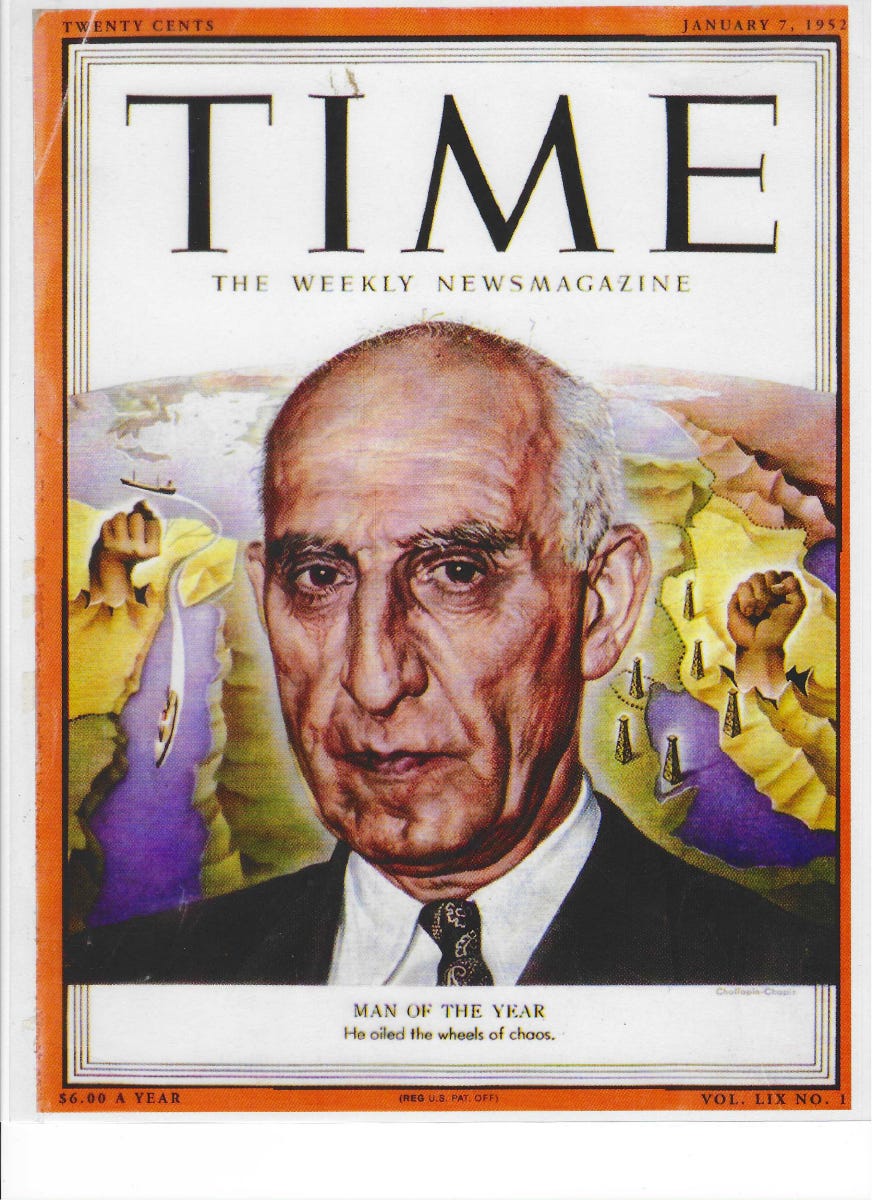
And here’s how Time Magazine, under the ownership of arch-conservative Henry Luce, demonized Iranian President Mohammed Mosadegh in 1952 before the CIA coup that overthrew him in 1953. His “crime” was nationalizing Iran’s oil.

The Iranian people have a long memory of this travesty, which brought the Shah onto the Peacock Throne. Who benefited from the coup? Nelson and David Rockefeller (see my previous substack on Iran)

WWI: When oil first reigned supreme

Winston Churchill, as First Lord of the British Admiralty, made the fateful decision in 1911 to change his navy’s fuel from coal (of which Britain had plenty) to faster, more efficient, and cheaper oil (of which she had none). Britain, Churchill said ruefully, had no choice but to fight “on a sea of troubles” to get the oil Britian needed, but didn’t have.

That’s why seizing the oil of Iraq became Britain’s “first class war aim” during World War I. Once achieved, the next challenge was moving the oil to where it was needed. The victors of World War I knew how to do it: by pipeline.

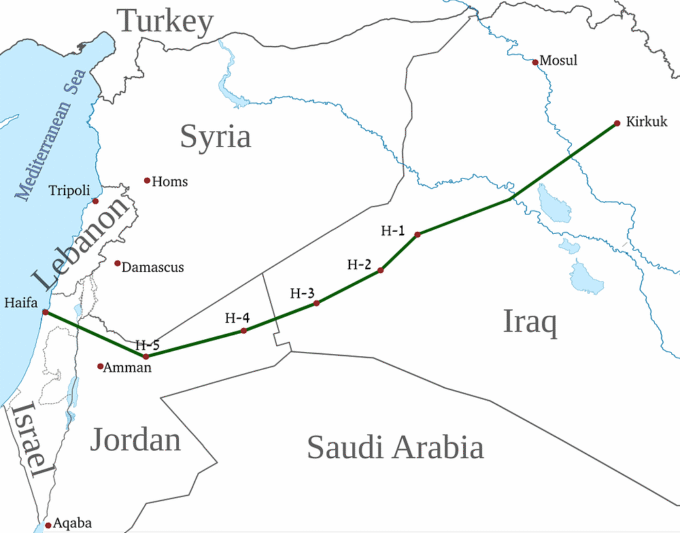
The best route? Piping it to a terminal point on the shores of the Eastern Mediterranean, where warships could fuel up and tankers could transport it to European ports. The perfect location: Haifa, Palestine. Israeli scholar Bernard Aishai, author of The Tragedy of Zionism, has noted that “Haifa was an ideal port — and the natural place for a pipeline terminal bringing oil from the east.” Haifa was inhabited by both Arabs and Jews, but eventually would become primarily Jewish-controlled. What better way to ensure a pipeline’s safety than to colonize Palestine with European Jews who could be trusted to protect it against Muslim infidels?

The Iraq Petroleum Company pipeline. Built in 1934 but conceived after WWI. It was decomissioned in 1948 follow the creation of the state of Israel. Benjamin Netanyabu hoped to reopen it following the 2003 invasion of Iraq, bragging “Soon the oil will flow to Haifa.” But it hasn’t due to ongoing hostilities in the region. Source: Wikipedia

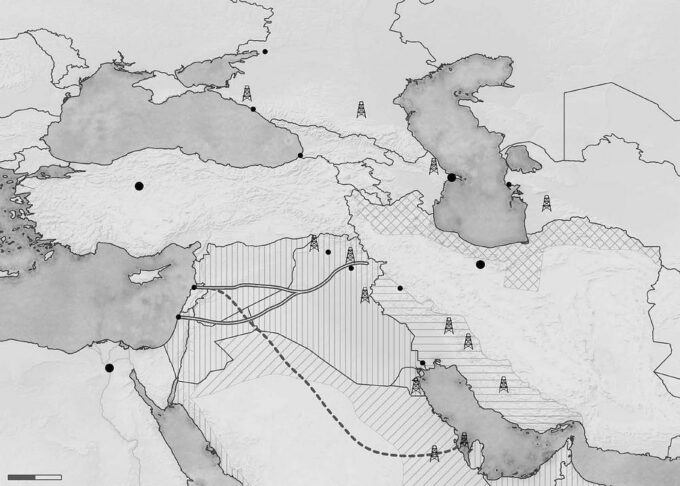
Trust me on this: My father’s mission, as head of U.S. counter-intelligence for the OSS and later CIG (Central Intelligence Group, both precursors of the CIA) )in the Middle East during WWII, wrote in 1943 that his most important mission was “to control the oil at all costs.” That was Saudi Oil, America’s prize possession, that was also going to be piped to the Eastern Mediterranean — either to Israel or Lebanon — by the Trans-Arabian pipeline. As the New York Times wrote on May 2, 1947, two weeks before my father died in a mysterious plane crash, “protection of that investment and its military and economic security that it represents inevitably will become one of the prime objectives of American foreign policy in this area, which has already become a pivot point of world politics and one of the main focal points of rivalry between East and West” –East meaning Russia.

This map, based on the 1947 New York Times article and map, shows the dotted projected route of the Trans-Arabian pipeline. It would end up in southern Lebanon instead of northern Lebanon, as pictured here. The solid pipelines were conceived after WWI, with the French controlling the nothern branch ending up in northern Lebanon and the British controlling the southern branch, terminating in Haifa, Palestine.

This game is still going on: Protection of oil at all costs. And at what cost in human lives and treasure?

Billions of dollars have poured into Israel over nearly eight decades to ensure the secure flow of oil — from Iraq and from Saudi Arabia — to the world. And although Netanyahu is now getting his way for his own expansionist schemes due to his close relationship with Trump, Trump will call the ultimate shots, because Big Oil trumps everything.

A few more nuggets from history

Traditional histories of the immediate post WWI period describe how France and England, the primary victors of their war to seize the oil of Turkey’s defeated Ottoman Empire, divided the rectangle of former Ottoman land stretching from Syria and Palestine through Mesopotamia (Iraq). Their 1920 agreement would come to be known as the San Remo Agreement. In those days, however, State Department documents more accurately termed it the San Remo Agreement on Oil. The reference would subsequently disappear from public discourse, as would 1920 references to U.S. foreign policy as “oleaginous diplomacy.”

Fast Forward to 1944. when Jewish survivors of the Holocaust managed to escape to Palestine. They were the first to hold aloft signs saying “No Blood for Oil,” protesting the Roosevelt Administration’s delay in rescuing Jews so as not to alienate King Ibn Saud of Saudi Arabia, who objected to the creation of a Jewish state in Palestine and threatened the US’s exclusive and very lucrative oil concession.

Five years later, in 1949, the CIA overthrew Syria’s nationalist leader Shukri Quwatly, who opposed the Trans-Arabian pipeline traversing Syrian territory and terminating in Israel, (The pipeline would terminate in southern Lebanon, some 100 miles north of Israel.)

The daughter of a CIA spy, Anne Tazewell, takes us into Egypt and the mid 1950s in her book, A Good Spy Leaves No Trace: Big OIL:CIA Secrets and a Spy Daughter’s Reckoning. She uncovers a document likely by her father, that states “Our policy in the Middle East has been directed toward retaining the area within the free world, developing the oil resources.”

To be fair, the CIA in 2003 put President George W. Bush on notice that Saddam Hussein’s Iraq did not pose an imminent threat requiring an invasion, which Bush (junior oilman that he was) ignored. Same thing happened with Trump: US intelligence warning him that Iran did not pose an imminent threat. Generals also warned Trump about Iran’s control of the Strait of Hormuz.

But now Trump is so locked-in, that he has now ordered over 10,000 American troups to the Middle East.

Yemen and the alternative to the Strait of Hormuz

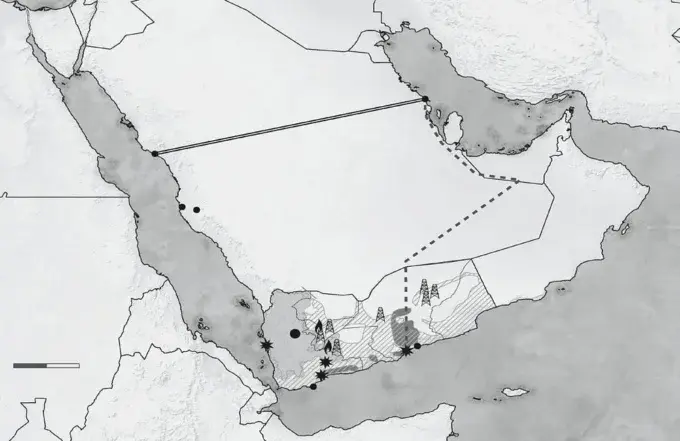
Not addressed by media accounts is Saudi Arabia’s war in Yemen against the Houthis with US backing. The Saudi plan: to build a Trans-Yemen pipeline that would avoid the Strait of Hormuz and carry Saudi oil down through southern Yemen terminating in the Gulf of Aden near the Arabian Sea.

The dotted line represents the projected Trans-Yemen pipeline, still projected, that would avoid the Strait of Hormuz on the east and the Bab al Mandab chokehold in the west. Apologies: for some reason the countries are not identified in this or the Saudi Trans-Arabian pipeline map, but they are in my book, Follow the Pipelines, published by Chelsea Green.

Trump, in 2019, vetoed a Yemen War Powers Act that would have ended US military involvement aimed at subduing the Houthis in this devastating war that caused an acute humanitarian crisis, including mass starvation in Yemen. As of March, 2025, the Saudis have been “insisting that the land the pipeline crosses be considered Saudi territory — a demand that local tribes have rejected.”

At the time of writing, Trump is now threatening to “obliterate” Iranian electric installations and Kharg Island if Iran doesn’t open the Strait of Hormuz. And Israel is expanding its bombing of Southern Lebanon, killing UN peacekeepers and three journalists. More than 1,200 people have been killed, including 120 children, according to the Lebanese Health Ministry and UNICEF, while more than 1.2 million people have been forced out of their homes across the country.

And yes, there is an oil and gas connection to these incursions, as Netanyahu strives to establish an energy corridor along the entire eastern Mediterranean, tapping into $5 billion in oil and natural gas off the coast of Gaza, Israel, Lebanon and Syria. Stay tuned.

This first appeared on Charlotte Dennett’s Substack page, Cui Bono?

Charlotte Dennett is an investigative journalist. Her most recent book, now out in paperback, is Follow the Pipelines: Uncovering the Mystery of a Lost Spy and the Deadly Politics of the Great Game for Oil.