Photograph by Nathaniel St. Clair
[The real problem for the academic humanists] was that they had guilty consciences about their vocations, unwilling or unable to mount a sturdy defense of their calling…. Put bluntly, the stewards of the humanist legacy ceased to believe in their vocations…they ceased to believe in any real stakes when it came to what they taught.”
– David Polansky, The Human Condition or the Conditional Human, Hedgehog Review, Spring 2026
“…the horrific struggle to establish a human self results in a self whose humanity is inseparable from that horrific struggle. That our endless and impossible journey toward home is in fact our home.”
– David Foster Wallace, quoted in (Ibid)
With an unflinching look at what we have made of the world, [British philosopher and author Paul Kingsnorth] sees “a machine made of human parts…”
– Blanton Alspaugh reviewing Against the Machine: On the Unmaking of Humanity, by Paul Kingsnorth, in HR, Spring 2026
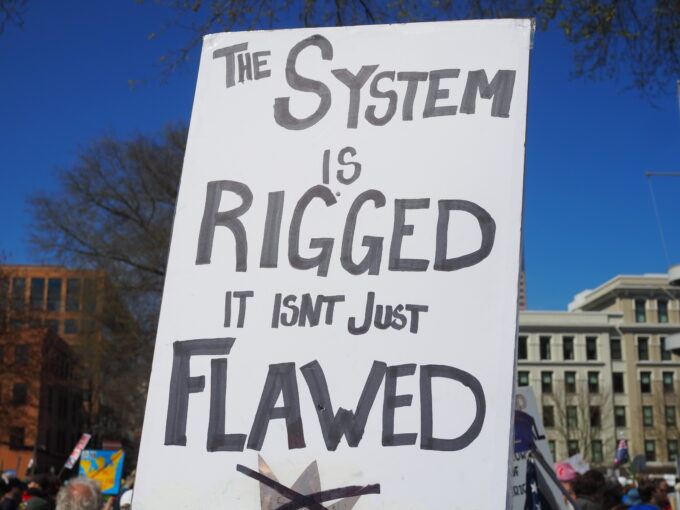
The friend I ran into at an artist talk at our gallery mentioned the No Kings protest that had happened earlier in the day, in consideration of which we had moved the talk to a later time. I had not attended the protest, and not because it was so blasted cold that day! For one thing, I found out about it late. Apparently I’m not on the local lists for Indivisibles or whoever organizes these things nation-wide now; I’m guessing contact is through social media. This mediated kind of organizing influences my sense of personal obligation (though I did attend the previous one.) For some reason – maybe to see what would happen, I blurted out: “I have lived my entire adult life as a no kings protest.” He nodded pleasantly, but moved away from me at that point – apparently not wanting to hear more! I was left to wonder what I would have said had he been interested enough to ask?
As I read reports of the No Kings protests around the country, including in places likely even colder than Utica (i.e., Minneapolis) I asked myself, has the fight gone out of me, just when it is most needed? I fear the Indivisibles just want a nicer “king” to keep capitalism going in the accustomed nice (for some) way. My ideal protest sign would read: “No King But the Sovereign Soul.” I feel there has to be a sovereign, not no sovereign. So what’s the supreme authority to be? Many people don’t get that, but that is the question!
+++
The grandiose-sounding-but-actually-humble purpose I set for my writing nearly 3 decades ago was to defend humanness. A mental crisis in my 40’s had resulted in my being shaken completely out of my customary consciousness, a condition that had begun around age 10, when it seemed the only function of my imagination – apart from the pleasure of reading – was to frighten, intimidate and torment me at night. The crisis opened me to personal discovery of a positive soul, and an alive imagination- a blessing of my human being, instead of the curse I’d known.
The unexpected inward reunion brought with it two connected realizations. After years of failing to find an educational path that fit, always a diffident student, ignorant of the power of my own thinking, I discovered the first intellectual clarity I had ever known: In connecting with the “mythic layer” ( the unconscious) inwardly I was connected subjectively with the very roots of the humanities tradition – I, too, had the power to have ideas and to know things!
Moreover, the fact that healthy imagination brought me my first experience of health as“wholeness” – a word that does not do justice to the experience of feeling whole after a lifetime of partiality – made it clear this is an aspect of being human that deserved and needed defending! I had spent 40 years of my life not using use my creative powers. Instead of exuberance, I had been crippled in a forever hesitation before claiming my own gifts, in a way that William Blake (“Exuberance Is Beauty!”) would surely have frowned upon! More damningly, I realized that the loss of this decisive dimension of my humanity was in some ways, if not intended, a direct result of the secular liberal society I was raised in, the acceptable view being some people are gifted with creative imagination and some not. I had learned in my own case that human becoming is a process, this process completely downplayed in the given context. (Capitalism really does not care if you grow up or not, better not.)
The moral consequence for this at-large dismissal of imaginative knowing is serious. When a few successful creatives are treated as gods, while the rest, the vast ordinary, can only live in denial of the potential for nobility given in their nature, what happens to moral courage? The gift of creativity is not only a private good, but the ultimate social good, personal evidence of cosmic connectedness. Without the imaginative, metaphysical reality, moral vision is severely limited to obedience/disobedience within the given system.
And there is another way in which imagination quickens the moral sense: it allows one to know one’s suffering as suffering (i.e., as “the horrific struggle”) and thus a struggle I have in common with all human beings. Knowing one’s personal suffering (distinct from suffering as a minority) is real is next to impossible in a society based in competition, not compassion, and it is as important to one’s capacity for moral vision as are eyes for sightedness. Clearly, this imaginational deprivation was not – could not be – the way things were intended. Sure, life is unfair, but God, [and this word for me had now gained its referent] is not. To correct this tragic mistake surely something more even than a (shrinking, always embattled) budget line for the arts in secondary school curricula was needed!
On this basis, I knew, even without any kind of working class awareness, the liberal world that had raised me – with its materialist optimism, its worship of technological innovation, its blind faith in its own good ends despite all contrary evidence (i.e., endless wars and barbarous cruelties), above all, in failing to recognize my soul and its suffering, had profoundly failed me. It could not be trusted. Unreasonable on my part? Yes. After all, the distinction between the sovereignty of Caesar and that of the soul is nothing new. But that was it – the distinction was no longer made because metaphysical reality isn’t real.
+++
Out of these new understandings, I (with my husband) came to make life choices as a way of “voting” for the better, not-yet reality. The moral choices we made, in contrast to the career paths and its rewards offered to educated middle class white people like ourselves were admittedly somewhat stern, but in the end, have made the difference in terms of our being able to maintain a way of life that is out-of-sync with kings or capitalism (or racism). They were necessary steps to our establishing an urban, artful coffeeshop (Cafe Domenico) and an accompanying non-profit arts center in an upstate NY county that voted 60% for Trump in the last election. Through these creations, seeds were planted for a creative culture based in the local, de-centralized and face-to-face.
Seen in the “real world’s” more objective light, such “anti-career” choices may be admirable in a way – equally they are screwy, indefensible, maybe forgivable for their attempt to follow the biddings of my soul, but who’s to say? Practicality has its valid perspective! Though our downscale choices no longer have the Cafe to publicly validate them, I can yet assert: to make a stand against relentless dehumanization– the Machine, as author/philosopher Paul Kingsnorth calls it – including abandonment of the traditions of humanism and the humanities, people must have a metaphysics – i.e., a basis for imaginative knowing. Otherwise there’s no counter power to “the fetish for commodities” that feeds a robust Capitalist economy.
All the flailing about I do over my life choices has much to do with the fact that my imagination was long ago “centralized” – bedazzled by television and Big Apple glamor five hours to the South. The local was in a sense despised, the grass always greener where there’s the most green stuff! Where I live is a location that doesn’t have much to say for itself unless its worth is solely in the fact that it is, simply, my place. How does one raised in liberal reality like me come down to earth? Poet Wendell Berry points to it (“no life and no place is destitute; all have possibilities of productivity and pleasure, rest and work, solitude and conviviality…”). But I am not a poet. I love my unifying ideas. Thus I keep writing, obsessively, attempting to keep hold of a vision that so quickly disintegrates when I leave my workspace cloister!
And I look hungrily for signs that there is a crack opening up in secular liberalism’s rejection of metaphysical reality!
+++
Precious few such signs exist. But I have begun to glimpse a groping movement towards religious truth that is new. Last week I went with friends to see the movie The Testament of Ann Lee, about the founder of the radical 18th century communitarian movement, the Shakers, at Utica’s Munson art museum. Impressive to me was the film’s overall respectful attitude not only toward Mother Ann’s condemnation of slavery and her principled non-participation in the Revolutionary war, which got her arrested and jailed. The movie indicated a kind of respect towards beliefs that modern educated, liberal people disdain. In the handout we were given there was an interview with director Mona Fastvold; the last question the interviewer asks her is this: “The film is so focused on Ann’s experience… a very intense subjectivity. You have the euphoric rush of the Shaker rituals, but then the underlying rot of religious dogma…was it a constraint to ground the film in that profoundly devoted perspective?”
The director’s answer is interesting. She’s clear Ann’s belief comes out of the trauma she suffered losing 4 babies one after the other; Ann’s belief – including her rule of celibacy – was her means of survival. Fastvold responds, “I really wanted to take this story, lift it up, elevate it and give it some space and shed light on it. Her (Mother Ann’s) ideas are rooted in religion, but they were really about love, equality, generosity of spirit, kindness…”
In other words, the director offers up a story of a religiously inspired woman as possibly something that could speak to us as long as we can overlook the religion so it can “fit into, philosophically, something that is of interest now, how it(sic) can shape and move with the times we’re in.” I presume the “something of interest now,” has to do with the multiple social and environmental catastrophes Americans – and civilization generally – are faced with, the fact the gospel of love appears to be losing to the “Machine,” brought to a perhaps apocalyptic peak under the Trump administration. Is the desperate need for an adequate repudiation of capitalism’s increasingly blatant Pequod ride to Armageddon causing a crack in liberal consciousness? Is religion’s alternative starting to “re-constitute” itself – however tentatively – in modern imaginations?
Synchronously, less than a month ago a talk was given at The Other Side about the 19th century radical utopian Oneida Community that had flourished a few miles from Utica. The academic who gave the talk did a remarkable job of presenting the perfectionist beliefs of the community’s founder, including its controversial sexual practices which established a kind of “open marriage” among members, and required male continence in order to protect women from unwanted childbirths. The details the speaker included, for instance, of how male continence worked, made for an “X-rated” talk, but it felt respectful in a way it would not have had he been shy about those details.
So is this all coincidence? Can our educated intellectual class now look respectfully at the religious faiths so fanatical that people set up “wacky” alternative communities in repudiation of the given, unacceptable, social/economic/governing model, despite their underlying rot? As appalled as we are at Trump’s MAGA, so far we cannot depart from our own safe mental harbor in rationalist thinking – or from the freedom to have nice stuff made possible by capitalism. We cannot follow a similar flight of imagination into belief, or, that is, into a way of life that repudiates the Machine, rooted in the no- Kings-before-me metaphysics of the heart.
+++
A formidable, perhaps decisive, obstacle to resistance to the Machine is the prevalent attitude of inevitability held toward digital technology makes. Some of us intuit that technology is not “neutral,” as its defenders claim, but we struggle to provide an argument that can have a snowball-in-hell’s chance in secular liberal reality. There is one. As Paul Kingsnorth, echoing William Blake asserts, the sacred and digital worlds are “in metaphysical opposition.” No sacred, no opposition.
I submit – very shakily, for sure! – that true community is among adults; it can be formed only from individuals who know the basis of one’s humanity is in the personal, ineradicable heart’s truth that, in the given (capitalist) reality must be protected from it. The difference between moral virtue coming from a heart that can imagine its being loved fully, and being good in hopes of being loved is all. Virtue lies in coming back to the personal center, to that “endless and impossible journey to establish a human self.” This the suffering which brings one into – as it always has done – the metaphysics of the heart’s imagination, the sovereignty without which there is chaos and looking for a king to save us.
Those unshaky Shakers knew something of how the vulnerable human heart might be protected: “When true simplicity is gained, to bow and to bend we shan’t be ashamed. To turn, turn will be our delight, ’til by turning, turning we come round right.” Apart from communitarian, monastic-type experiment, is another social experiment – one more possible for most of us – calling to our hearts and imaginations in this historical moment? My choices perhaps can seem less like folly when seen as answering the invitation to embark on a humanizing process of coming down to earth, in place, that can be constructively fueled in the fire of creativity joined to constant prophetic critique of what capitalism gives us to be satisfied with instead of love.
