Saturday, April 11, 2026

Warming Intensifies Rainfall In North Atlantic Storms


By Eurasia Review


Rapid ocean warming is likely to make tropical cyclone rainfall more intense and longer lasting, increasing flood risks in parts of the North Atlantic region.

A new study led by Newcastle University using satellite data shows that tropical cyclones and their post-tropical cyclone counterparts are responding quite differently to surface warming. The findings reveal that during the tropical cyclone phase, warmer and more humid conditions are causing storm slowdown and strongly increasing rainfall intensity.

Tropical cyclones are a major driver of very heavy rainfall in warm parts of the world. They can bring huge downpours that not only significantly add to total seasonal rainfall but also increase the risk of flash flooding. In the North Atlantic, these storms are especially important during the peak hurricane season (Aug-Oct), with tropical cyclones producing as much as 30–40% of all rainfall in some regions during that season.

Published in the journal npj Climate and Atmospheric Science, the study shows that storm precipitation is rising rapidly with temperature, with median increases of about 21% per degree increase in local dewpoint temperature, while the area of heavy rainfall expands by roughly 12.5% per degree of warming. At the same time, the overall size of the cyclone tends to shrink slightly with warming, although this process becomes weaker and can even reverse, causing larger tropical cyclones, when sea surface temperatures are very high, particularly in the Caribbean. In these warmer regions, tropical cyclones often move more slowly and last longer, producing more rainfall in one place, especially near to the centre of the storm, causing damaging floods.

In contrast, once storms transition into the post-tropical phase, losing their tropical characteristics as they move across the Atlantic towards Europe, they tend to expand in size but are less strongly affected by temperature changes. Rainfall concentrates to the northeast of the storm centre and over a wider area, often because the storm is moving faster and is driven by different (baroclinic) weather systems.


Study lead author, Dr Haider Ali, Senior Research Associate, at Newcastle University’s School of Engineering said: “The findings show that global warming is increasing both the intensity and area of rainfall from tropical cyclones, especially in warm, low-latitude regions. Because some storms may also move more slowly, this could greatly increase the risk of flooding in parts of the North Atlantic. This trend will likely continue with increased warming.”

Previously, storm size was typically treated as a fixed radius around the storm centre. In contrast, this study adopts a dynamic definition, allowing storm size to vary along the cyclone’s lifetime. Using observational data from satellites, the team examined how storm size, heavy precipitation metrics, and translation speed change with warming for North Atlantic tropical cyclones from 2001 to 2024. This approach provides a consistent framework for analysing storm evolution and assessing how heavy precipitation responds to a warming climate.

Professor Hayley Fowler, Professor of Climate Change Impacts at Newcastle University, and one of the study authors, said: “Tropical cyclones appear to be causing increasing damages from widespread damaging floods from persistent extreme rainfall events, such as in Hurricane Helene. Our study shows that this increase in extreme rainfall is directly linked to our warming climate, caused by our continued societal reliance on fossil fuels. These storms will continue to get wetter, producing more persistent and more intense rainfall and consequent flooding, until we reduce the concentration of greenhouse gases in the atmosphere.”

Looking ahead, the next step is to shift the research focus from storms in the atmosphere to floods on the ground. The goal is to understand whether the most intense rainfall events lead to the most damaging river flooding. This causal link isn’t straightforward, since flood impacts depend on where rain falls, how long it lasts, and how wet catchments are prior to the rainfall event. By combining climate data with hydrological models, we can follow the full pathway from storm structure to rainfall to river flow. This helps identify not just heavy rain events, but the storms that truly translate into real flood risk for people and infrastructure.
Exaggeration Of Real Ocean Climate Risks To Ireland Disrupts Future Planning
Cliffs of Moher in Ireland

April 11, 2026
By Eurasia Review


The real climate risks to Ireland from changes to the Atlantic currents that sustain our mild climate are obscured by exaggerated claims in media headlines and movies.

That’s according to Dr Gerard McCarthy, a Maynooth University (MU) oceanographer at the Irish Climate Analysis and Research UnitS (ICARUS) in the Department of Geography, who has led a new article for Nature Climate Change.

The latest paper is a retrospective on a landmark 2015 study led by Professor Stefan Rahmstorf, which identified long-term Atlantic cooling as a sign that the Atlantic Meridional Circulation (AMOC) was weakening.

“The extreme climate collapse scenarios depicted in the Hollywood film, The Day After Tomorrow, and even in headlines of reputable mainstream media are often not grounded in scientific reality, but the genuine risks for Ireland are still significant and require proper planning,” said Dr McCarthy.

“It has happened that a new paper comes out, you get headlines saying the AMOC is going to collapse in the next few years. What we need to do is bring together a broader scientific voice to properly assess all the existing AMOC research literature, rather than having these seesawing headlines that concern and confuse our policymakers,” said Dr McCarthy.


Dr McCarthy added, “the study led by Stefan Rahmstorf—one of the most influential studies of AMOC—used changes in sea surface temperature records stretching back over a century to build its case. The records show that the stretch of ocean lying between Ireland and Canada is the only region on Earth that has systematically cooled while almost everywhere else warmed.”

This retrospective paper – co-authored by Professor Hans-Otto Pörtner of the Alfred Wegener Institute in Bremerhaven – considered the questions raised by the Rahmstorf paper and highlighted the need for a clearer scientific consensus, setting the stage for a larger international research project called the AMOC in Focus assessment report, which Dr McCarthy is co-leading and is sponsored by JPI Ocean and JPI Climate.

This project is a 60-scientist, 14-country initiative aimed at producing authoritative, usable guidance for policymakers in Europe and around the world.

Regarding what AMOC changes mean for Ireland’s future, Dr McCarthy said it’s likely we will see relative cooling in the Atlantic.

“Cooling is not really what I’m worried about. What concerns me is changes in precipitation patterns and storminess. A weakening AMOC tightens the temperature gradient that fuels Atlantic storms, like a taut elastic band – and then more of those storms get catapulted towards Ireland. Ireland sits right at the end of this system. We are hugely dependent on the heat it transports, so we need a clear consensus voice, grounded in science, to plan properly,” said Dr McCarthy.

Dr McCarthy is an expert on AMOC; the system of ocean currents, sometimes known as the Gulf Stream System, that is critical to Ireland’s temperate climate, despite it being at a similar latitude to southern Alaska.

He also co-chairs the ongoing AMOC in Focus assessment, which brings together leading scientists from across Europe, Canada, and the USA to assess the likelihood and risks of a potential disruption to the Atlantic Ocean’s circulation system and its associated implications for climate, ecosystems, people, and the economy.

Poll: Catholic Support For President Donald Trump Drops Below 50% Amid Iran War

April 11, 2026 
EWTN News
By Tyler Arnold

President Donald Trump was elected in 2024 with support from a majority of Catholic voters, but a poll shows his support from Catholics dipping below 50% amid the U.S. war against Iran.

The poll, conducted March 20–23 jointly by Republican pollster Shaw & Co. Research and Democratic pollster Beacon Research, found that 48% of Catholic voters approve of the job Trump is doing as president and 52% disapprove.

It found that 23% of Catholics strongly approve of the job he is doing, 25% somewhat approve, 12% somewhat disapprove, and 40% strongly disapprove. The pollʼs margin of error is plus or minus 3%.

Pope Leo XIV and Catholic bishops in the United States and globally have encouraged Trump to pursue peace and diplomacy, as opposed to war, in Iran. With peace negotiations underway, the Holy Father echoed his call for more diplomacy in an April 10 post on X.

“God does not bless any conflict,” Leo said. “Anyone who is a disciple of Christ, the Prince of Peace, is never on the side of those who once wielded the sword and today drop bombs. Military action will not create space for freedom or times of peace, which comes only from the patient promotion of coexistence and dialogue among peoples.”

In the 2024 election, Trump won the Catholic vote by a 12-point margin, securing 55% of the voting bloc’s support, compared with former Vice President Kamala Harris’ 43%. In 2020, Trump won 49% of the Catholic vote, compared with former President Joe Biden’s 50%.

This poll comes as Trump’s support is dwindling with the broader American public as well. The poll found that only 41% of all voters approve of the president, and 59% disapprove.
Iran war disapproval

The poll found that most Catholics disapprove of Trump’s actions in Iran and the use of military force against the country but still favor some American influence in the region.

According to the poll, only 40% of Catholics approve of the way Trump has handled the conflict with Iran, and 60% disapprove. It found that 45% of Catholics support military force against Iran and 55% oppose military force. Similarly, 45% of Catholics believe military action against Iran is going well, and 55% believe it is not going well.

The poll found that 39% of Catholics believe attacks on Iran will make the country safer, 38% believe it will make the country less safe, and 23% believe it will not make much of a difference.

Alternatively, 71% of Catholics believe ending Iran’s nuclear program is important, and 29% said it is not important. It found 61% said it is important to bring about changes in Iran’s government, and 39% said it is not important.

The poll also found that 71% of Catholics believe it is important to protect the flow of oil from the region, and 29% believe it is not important. It found that 73% of Catholics believe it is important to reduce Iran’s support for terrorism, and 27% believe it is not important.

According to the poll, 74% of Catholics are concerned about Iran potentially getting a nuclear weapon, and 26% are not concerned.
2024 coalition ‘in tatters’

John White, professor emeritus of politics at The Catholic University of America, told EWTN News that he believes Trump’s 2024 coalition “is now in tatters [and] Catholics are no exception.”

“The Iran War is unpopular with the American public and Catholics reflect that,” he said. “What may carry more resonance with Catholic voters are the strong and blunt statements about the war from Pope Leo. It is not unreasonable to assume that there is a higher level of cognitive dissonance among Catholics who support Trump but are hearing the words of the pope. For some, that may result in their shifting opinions.”

Susan Hanssen, history professor at the University of Dallas — a Catholic institution — had a similar view about why Catholic support has dipped, telling EWTN News “a reversal of positions seems to be underway within the Catholic community.

“During Trump‘s campaign, Trump‘s supporters expressed hopes for a fundamental realignment of America’s foreign policy, particularly withdrawing from ‘forever wars,’ while many of Trump’s Catholic critics expressed concern during his campaign that he would disengage America from its support for Ukraine or [for] Israel,” she said. “Support for Trump’s strong stance on Iran seems to be coming now … from Catholics who were wary of Trump earlier.”

Vice President JD Vance, a Catholic, has departed the U.S. for his trip to Pakistan, where he plans to directly negotiate with Iranian leaders for a long-term peace while both sides hold off on military strikes during a two-week ceasefire.


EWTN News is the rebranding of the Catholic News Agency (CNA), following the decision by EWTN — which was launched as a Catholic television network in 1981 by Mother Angelica, PCPA — that brings CNA and its affiliated ACI international outlets under a single, unified identity. Previous CNA articles may be found by clicking here.
‘Truly Insane’: Pentagon Threatened Pope After He Condemned Trump’s Military Attacks

The US “has the military power to do whatever it wants in the world,” a top official told the Vatican’s US representative. “The Catholic Church had better take its side.”


Pope Leo XIV leads his weekly general audience in St. Peter’s Squarein Vatican City on April 8, 2026.
(Photo by Maria Grazia Picciarella/SOPA Images/LightRocket via Getty Images)


Julia Conley
Apr 09, 2026
COMMON DREAMS


Pope Leo, the first American to be named the head of the worldwide Catholic Church, has spoken out against President Donald Trump’s policies frequently this year as the US has invaded Venezuela and Iran and threatened Cuba’s 10 million people with an oil blockade that has crippled the island’s economy and healthcare system—and according to new reports, his criticism has followed a warning from a Pentagon official who demanded the Vatican take the “side” of the White House in foreign disputes.

The Free Press originally reported this week that after the pope’s “State of the World” address on January 9, US Undersecretary of Defense for Policy Elbridge Colby called Cardinal Christophe Pierre, the Vatican’s US diplomatic representative, to Washington..


In Latest Rebuke of Trump and Hegseth, Pope Says ‘God Does Not Bless Any Conflict’


Colby told Pierre that the US “has the military power to do whatever it wants in the world.”

“The Catholic Church had better take its side,” he said, according to The Free Press.

Another Pentagon official alluded to the Avignon papacy, a period in the 14th century in which the French monarchy ordered an attack on Pope Boniface VIII and forced seven successive popes to relocate from Rome to Avignon in France.

According to Christopher Hale of the Substack blog Letters From Leo, who independently confirmed the meeting had taken place, Vatican officials took the remarks about the Avignon papacy as “a threat to use military force against the Holy See.”

“Bringing up the Avignon papacy as a threat is truly insane,” said progressive organizer Jonathan Cohn.


The pope is unlikely to visit the US during Trump’s presidency as a result of the meeting, Hale reported. Pope Leo rejected an invitation to the White House for the United States’ 250th anniversary celebration on July 4, and is reportedly planning to visit the island of Lampedusa in the Mediterranean that day, where thousands of North African immigrants have arrived as they attempt to reach Europe.

The pope, reported Hale, “is too deliberate a man to have chosen that date by accident.”

The Pentagon meeting took place days after Pope Leo angered the Trump administration, including Defense Secretary Pete Hegseth, by lamenting the fact that “a diplomacy that promotes dialogue and seeks consensus among all parties is being replaced by a diplomacy based on force, by either individuals or groups of allies.”


He made the comments days after the US invaded Venezuela, killing dozens of people and abducting President Nicolás Maduro, and as the US continued its boat bombing campaign that began last year in Latin America.

Since then, the pope has made numerous statements in recent weeks as the US joined Israel in bombing Iran and Trump issued increasingly bellicose threats to attack the country’s population of 93 million people.

He said on Tuesday, hours before a two-week ceasefire was reached between the US, Iran, and Israel, that Trump’s threat to wipe out the “whole civilization” of Iran was “truly unacceptable.”

“There are certainly issues of international law here, but even more, it is a moral question concerning the good of the people as a whole, in its entirety,” said Pope Leo. “Let’s look for solutions in a peaceful way.”

He also appeared to reject a call from Hegseth last month when the defense secretary asked Americans to pray for US troops in Iran “in the name of Jesus Christ.”

“Brothers and sisters, this is our God: Jesus, King of Peace, who rejects war, whom no one can use to justify war,” said the Pope in his homily on Palm Sunday days later. “He does not listen to the prayers of those who wage war, but rejects them, saying: ‘Even though you make many prayers, I will not listen: your hands are full of blood.’”

The New Republic reported that prior to the January meeting Pierre was called to, there were no public records of meetings between the Vatican and Pentagon officials, “let alone an instance in which the world power suggested that it could force the Bishop of Rome into captivity.”

When asked about the meeting on Wednesday, Vice President JD Vance—a Catholic convert—at first claimed not to know who the Vatican’s US representative was, before saying the reported was “uncorroborated.”


The Defense Department also denied The Free Press’ account of the meeting, saying the characterization was “highly exaggerated and distorted.”

Writer Pedro Gonzalez noted that former Trump adviser Steve Bannon discussed strategies to “take down” the late Pope Frances with convicted sex offender Jeffrey Epstein, according to files on Epstein that were released by the Department of Justice.

“It is for this and other reasons that people take seriously the report about the Trump-Vance administration threatening Pope Leo to bend the knee or else,” said Gonzalez. “These people are insane. Their hunger for power is bottomless. Moral resistance will be met with intimidation and threats, whether it’s in America or in Rome.”

Catholic Herald journalist confirms Pentagon delivered 'bitter lecture' to Vatican official


Pope Leo XIV leads the Angelus prayer from a window of the Apostolic Palace, at the Vatican, February 15, 2026. REUTERS/Remo Casilli

Sarah K. Burris
April 09, 2026 
ALTERNET

A journalist with The Catholic Herald has confirmed that the Pentagon attacked Pope Leo XIV and the Catholic Church. What appears to be in dispute, however, is which U.S. Pentagon official made the threat.

Niwa Limbu, an accredited Vatican correspondent, wrote on X that two sources said it was not Elbridge Colby who threatened the Vatican in a closed-door meeting this week. The DOD's undersecretary of defense for policy had been accused by The Free Press of being the source of a "bitter lecture."

"The United States has the military power to do whatever it wants in the world. The Catholic Church had better take its side," he was accused of saying.

But Limbu said that details about Colby are now in dispute.

In a post on X, Limbu said that Cardinal Christophe Pierre suggested over the phone that there was a media blackout over the topic. His Eminence commented, "I would prefer not to speak."

Holy See Press Office aide Matteo Bruni also declined to comment on the Pentagon meeting.

Writer and humorist Emily Zanotti, who is Catholic, argued that it isn't unusual for the Vatican to screw up PR.

She also had a few comments on getting down to the truth on Vatican issues.


"A few things can be true here: 1) It doesn’t quite make sense why the PENTAGON summoned a Vatican ambassador; 2) Bringing up Avignon is straight up insane, if it happened, which seems likely, and that’s aggressive towards Catholics," she wrote.

She also pointed out that she doesn't believe Christopher Hale is a reliable source. She wondered if "the Vatican probably just went 'WTF' and moved on, and until an actually reliable source, like @PillarCatholic confirms any Vatican response, you simply shouldn’t believe any suggestions."

Vice President JD Vance told reporters he wants to get the situation sorted out.

“I would actually like to talk to Cardinal Christophe Pierre and, frankly, to our people, to figure out what actually happened,” he said. “I think it’s always a bad idea to offer an opinion on stories that are unconfirmed and uncorroborated, so I’m not going to do that.”

There is a larger conversation in the Catholic community because Defense Secretary Pete Hegseth's brand of Christian nationalism, and the broader evangelical-focused "MAGA" movement, has made Catholics feel unwelcome. The DOD was criticized last week for having a "Protestant-only" Good Friday service. Typically, there isn't a mass on Good Friday. What was odd to some, however, is that the email sent to all staffers singled out Catholics when it didn't need to.

"There will be a Protestant Service (No Catholic Mass) for Good Friday today at the Pentagon Chapel,” the email read last week.

Anti-Catholicism dates back generations. President John F. Kennedy's candidacy was in question as voters wondered whether he was loyal to the U.S. or the Vatican.

Hegseth's pastor, Doug Wilson, has a history of anti-Catholicism that is well documented. As Right Wing Watch reported in March, Wilson explained in his ideal Christian nation, “public displays of idolatry” would be banned, including Catholic parades. Wilson is one of many in the Trump administration with some anti-Catholic sentiment and antisemitic beliefs, an MS NOW column explained.


Pentagon denies Trump official threatened war against the Pope


Newly elected Pope Leo XIV, Cardinal Robert Prevost of the United States appears on the balcony of St. Peter's Basilica, at the Vatican, May 8, 2025. REUTERS/Yara Nardi
April 09, 2026 
ALTERNET

On Wednesday, reports emerged that the Trump Pentagon threatened to wage war against the Pope. The following day, however, the agency released a statement denying the claims, asserting that the meeting between Administration and Vatican officials was “respectful and reasonable.”

The denial of hostility comes in the wake of a story involving a closed-door meeting between Under Secretary Elbridge Colby and Cardinal Christophe Pierre — Pope Leo XIV’s then-ambassador to the United States — in which the former told the latter, “America has the military power to do whatever it wants in the world. The Catholic Church had better take its side.”

According to Pope Leo XIV chronicler Christopher Hale, as tensions rose, one U.S. official “reached for a fourteenth-century weapon and invoked the Avignon Papacy, the period when the French Crown used military force to bend the bishop of Rome to its will.”


Supposedly, this “bitter lecture” from the Trump Administration came in response to the president’s anger over the Pope’s January state-of-the-world address, particularly his advocacy for “a diplomacy that promotes dialogue and seeks consensus among all parties is being replaced by a diplomacy based on force.”

Trump and the Pentagon took this as a challenge to the president’s so-called “Donroe Doctrine,” a portmanteau of “Donald” with the “Monroe Doctrine,” the latter of which historically asserted American supremacy over the Western Hemisphere.


But now, while a Pentagon statement confirms that the meeting happened, it denies the belligerent tone.

“We can confirm that Cardinal Christophe Pierre had a meeting on January 22, 2026, at the Pentagon where he and several officials had discussed current affairs,” the statement read, but went on to claim that the “characterization of the meeting is highly exaggerated and distorted. The meeting between Pentagon and Vatican officials was a respectful and reasonable discussion. We have nothing but the highest regard and welcome continued dialogue with the Holy See.”

Whatever the content of the meeting, it was an unprecedented event, as there is no previously documented case of a Vatican official being summoned to the Pentagon.

The Local Universe’s Expansion Rate Is Clearer Than Ever, But Still Doesn’t Add Up


Artist’s interpretation of the cosmic distance ladder — a succession of overlapping methods used to measure distances across the Universe, where each rung of the ladder provides information that can be used to determine the distances at the next higher rung. Methods include observations of pulsating Cepheid variable stars, red giant stars that shine with a known brightness, Type Ia supernovae, and certain types of galaxies. In this illustration, the distance ladder begins at the Coma Cluster, which is the nearest extremely rich galaxy cluster to us. The distance to the Coma Cluster can be measured directly using observations of Type Ia supernovae within the cluster. Type Ia supernovae have a predictable luminosity that makes them reliable objects for distance calculations. 
CREDIT: CTIO/NOIRLab/DOE/NSF/AURA/J. Pollard Image Processing: D. de Martin & M. Zamani (NSF NOIRLab)

April 11, 2026
By Eurasia Review


An international collaboration of astronomers has produced one of the most precise measurements yet of how fast the local Universe is expanding. The result deepens one of the most significant challenges in modern cosmology. John Blakeslee, astronomer at NSF NOIRLab, funded by the U.S. National Science Foundation, is a member of the collaboration, and telescopes across two NSF NOIRLab Programs contributed data.

Astronomers have sought to measure the expansion rate of the Universe using two fundamentally different approaches. One method relies on measuring distances to stars and galaxies in the nearby Universe. The other uses measurements of the cosmic microwave background to predict what the expansion rate would be today under the standard model of cosmology.

These two approaches are expected to yield the same result, but they don’t. Measurements based on the nearby Universe consistently indicate a higher expansion rate — around 73 kilometers per second per megaparsec — while predictions derived from the early Universe yield a lower value, closer to 67 or 68. Although the numerical difference is modest, it is far larger than can be explained by statistical uncertainty. This persistent disagreement, known as the Hubble tension, has now been observed across multiple independent studies and techniques.

By bringing together decades of independent observations into a single, unified framework, an international collaboration of astronomers has achieved the most precise direct measurement to date of the expansion rate of the nearby Universe. In a paper published in Astronomy & Astrophysics, the H0 Distance Network (H0DN) Collaboration reports a value of the Hubble constant of 73.50 ± 0.81 kilometers per second per megaparsec, corresponding to a precision of just over 1%.

The study, “The Local Distance Network: a community consensus report on the measurement of the Hubble constant at ∼1% precision,” is the outcome of a broad community effort launched at the International Space Science Institute (ISSI) Breakthrough Workshop, “What’s under the H0od?”, held at ISSI in Bern, Switzerland, in March 2025.

“This isn’t just a new value of the Hubble constant,” the collaboration notes, “it’s a community-built framework that brings decades of independent distance measurements together, transparently and accessibly.”

NSF NOIRLab contributed both expertise and observational data to this effort. John Blakeslee, astronomer and Director of Research and Science Services at NSF NOIRLab, is a member of the collaboration. The study includes data from telescopes at NSF Cerro Tololo Inter-American Observatory (CTIO) in Chile and NSF Kitt Peak National Observatory (KPNO) in Arizona, both Programs of NSF NOIRLab. Those data were incorporated into a broader, collaborative framework spanning both ground and space-based observatories, helping to strengthen the overall result.

Rather than relying on a single method, the team constructed a “distance network” that links many overlapping techniques for measuring distances across the local Universe. These include observations of pulsating Cepheid variable stars, red giant stars that shine with a known brightness, Type Ia supernovae, and certain types of galaxies. This approach enables multiple independent paths to the same final result, and allows for a critical test: is the discrepancy caused by an error within a single method? The results indicate that this is unlikely. Even when individual techniques are removed from the analysis, the overall result changes only minimally. Independent measurements remain consistent with one another, reinforcing the robustness of the locally measured expansion rate.

“This work effectively rules out explanations of the Hubble tension that rely on a single overlooked error in local distance measurements,” the authors conclude. “If the tension is real, as the growing body of evidence suggests, it may point to new physics beyond the standard cosmological model.”

The implications are significant. The lower expansion rate inferred from the early Universe depends on the standard model of cosmology, which describes how the Universe has evolved since the Big Bang. If that model is incomplete — for example, if it does not fully account for the behavior of dark energy, new particles, or modifications to gravity — its predictions for the present-day expansion rate would be affected.

In that case, the Hubble tension may not be the result of measurement error, but rather evidence that the current model of the Universe is missing a key component. The local distance network also establishes a framework for future investigations. By making its methods and data openly available, the collaboration has created a foundation that can be expanded with new observations. With next-generation observatories expected to provide even more precise measurements, astronomers aim to determine whether this discrepancy will ultimately be resolved or continue to point toward new physics.


Bill Nye blasts Trump's NASA plan as ‘illogical’: ‘We cannot allow this’

Erik De La Garza
April 10, 2026 
RAW STORY


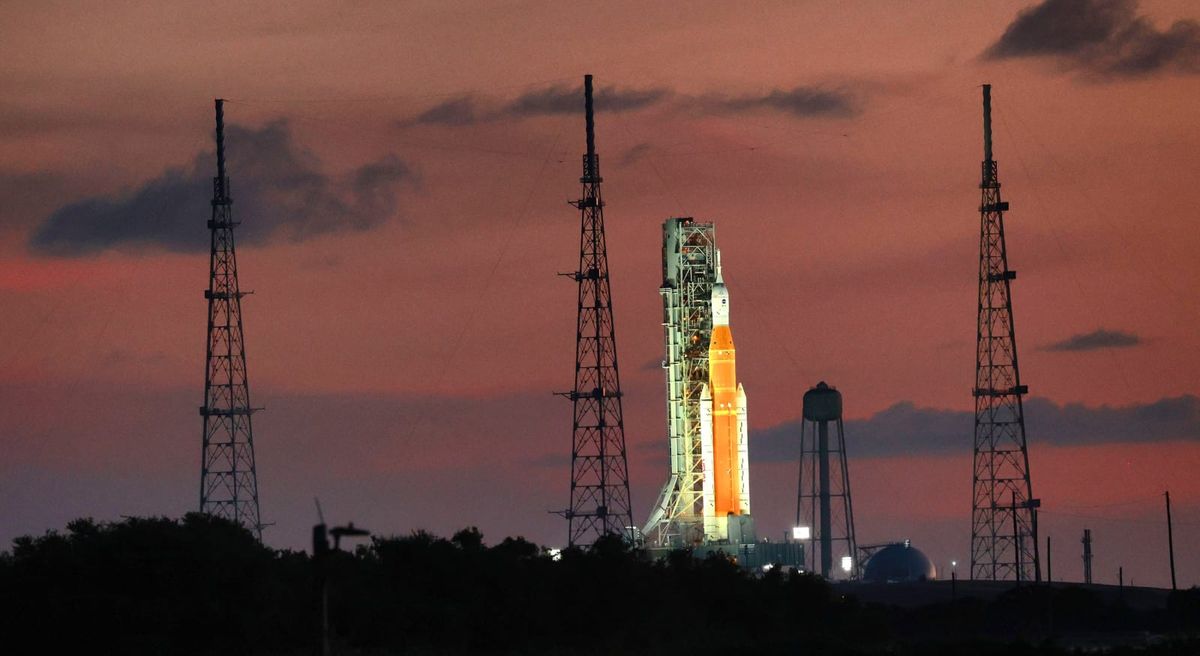
The sun rises behind Artemis I, NASA's heavy-lift lunar rocket system, as it sits temporarily grounded at pad 39- B at Kennedy Space Center, Florida, on Sept. 6, 2022. - Joe Burbank/Orlando Sentinel/TNS

Science educator Bill Nye came out swinging at President Donald Trump on Friday, blasting his administration’s proposed cuts to NASA as “surprising, illogical and very troubling” in a scathing new opinion piece.

Writing for MSNOW in the wake of the historic return of the Artemis II crew – the first mission to the moon since 1972 – Nye argued the moment of celebration is being overshadowed by Trump’s plans to slash funding for space science.

“The proposed cuts would terminate 53 NASA Science missions, throwing away more than $13 billion in taxpayer investment and halting the development of nearly every future NASA Science mission,” according to Nye, best known for hosting the hit educational show “Bill Nye the Science Guy.” He added that such reductions would be “an insult to our astronauts and entire NASA workforce.”

Nye also took aim at proposed cuts to STEM education, calling efforts to eliminate NASA’s outreach programs “quite personal” and warning they would damage the nation’s long-term scientific leadership.

“We cannot allow this,” Nye declared, urging Americans to push back against the MAGA administration’s “draconian cuts.” He pointed to a growing global competition in space, particularly with China, and questioned why the U.S. would “cede the lead” at such a pivotal moment.

“NASA is the best brand our nation has,” Nye told readers Friday. He argued that space exploration reflects America “at its best” – and warned that abandoning scientific investment “would be an unworthy choice.”

“If Artemis II has showed us anything, it’s that the public, across the political spectrum, strongly supports space exploration, scientific discovery and a deeper understanding of the universe and our place within it,” he concluded.

Trump, for his part, on Friday congratulated the Artemis crew in a Truth Social post, praising their trip as "spectacular," and the landing as "perfect."

"I could not be more proud!" Trump wrote.

The president who once said space wasn't important now wants to remake it in his image


Illustration of Donald Trump as an astronaut (Roxanne Cooper/MidJourney)

March 31, 2026
ALTERNET

President Trump is positioning the upcoming Artemis II moon mission as a potential centerpiece of his second-term legacy, according to a New York Times report by Peter Baker. The mission, scheduled to launch this week, will send four astronauts farther from Earth than any humans have traveled since the Apollo program ended more than 50 years ago.

Trump's enthusiasm for space exploration marks a dramatic reversal from his 2015 campaign stance. When asked about space during a New Hampshire campaign stop, Trump dismissed the subject, saying: "Right now, we have bigger problems — you understand that? We've got to fix our potholes." By the time he entered office, however, he had embraced space exploration as integral to American greatness, and no president since Kennedy and Johnson has pushed NASA as aggressively.

Trump's ambitions extend well beyond Artemis II. Shortly after Jared Isaacman became NASA administrator in January, Trump called to ask about Mars missions and nuclear rockets, inquiring: "Are we doing something in the 2028 window for Mars? What do you think about the nuclear rocket?" Isaacman indicated that Trump envisions sustained lunar presence and infrastructure rather than brief visits. Trump emphasized: "We better be doing more than getting rocks this time."

Trump's public attention to the Artemis II launch has been notably limited. Though the four astronauts were seated in the gallery during his February State of the Union address, Trump did not acknowledge them or mention the mission. He has said little about it in recent days despite the launch's imminence.

Trump's space agenda faces fiscal constraints. The Trump administration proposed cutting NASA funding by 24 percent last year, a reduction that would have terminated more than 40 missions. Though Congress protected the Artemis program through budget legislation, nearly 4,000 NASA employees are departing through federal workforce reductions.

Questions remain about Trump's sustained commitment to the long-term program. Retired astronaut Cady Coleman expressed concerns about losing experienced personnel, while Apollo 17 moon walker Harrison H. Schmitt stressed the importance of presidential leadership. Schmitt noted: "You have to have the White House and the president acting as the spokesman for it. There's just no question about that."
In Echoes of Corbyn and Mamdani, Insurgent Candidate Wins Canadian New Democratic Party Leadership


Avi Lewis now leads the New Democratic Party after a campaign reminiscent of left-leaning politicians in the US and UK.

April 8, 2026

At the center is leader of Canada's New Democratic Party Avi Lewis.Canada’s NDP / Le NPD du Canada

Truthout is an indispensable resource for activists, movement leaders and workers everywhere. Please make this work possible with a quick donation.

Canada’s left-leaning New Democratic Party (NDP) has elected a new leader, someone whose campaign drew comparisons to the politics and style of U.S. figures like Bernie Sanders, Alexandria Ocasio-Cortez, and Zohran Mamdani. On March 29, the NDP elected Avi Lewis on the first round of balloting with 55 percent of the vote in his first successful political campaign.

The NDP was decimated in the April 2025 federal election. Former leader Jagmeet Singh lost his own electoral district, and the party only won seven seats, four short of what’s needed to maintain its official party status. It was the worst showing for the NDP in its 64-year history.

Lewis also came in third in that election in his electoral district, his second third-place finish in the two elections that he has run in.

But a commitment to be unapologetically left and a promise to overhaul the party were his key to his victory in the NDP leadership race. Lewis’s allies won key positions within the party, clearing the path for him to implement his campaign promises.

For decades, the NDP has watered down its left-wing policies. But with a Liberal government that has promised to pull tens of billions of dollars from federal departments to fund the military, party members are hungry for a left turn. Are Canadians ready for it?


Advocates Put Palestinian Rights on the Ballot as Canada’s Election Nears
Over 300 Canadian electoral candidates have endorsed a 5-point “Vote Palestine” platform thanks to activist pressure. By Jillian Kestler-D’Amours , TruthoutApril 23, 2025


Who Is Avi Lewis?

Lewis’s campaign was ambitious. He promised to implement national rent controls, build 1 million public housing units, increase taxes on the wealthy, expand the electricity power grid to phase out oil and gas, and fund free public transit. “We can have nice things, but we gotta fight for them together,” he said in one campaign video. The promise to be boldly progressive was music to the ears of many New Democrats who have been frustrated that the NDP has not been able to articulate a compelling reason for the high cost of housing and food, or a solution to the crisis.

Lewis’s campaign capitalized on widespread opposition to U.S. foreign policy, including the thousands of actions that Canadians have taken to show their solidarity with Gaza over the past several years. During his victory speech, he took aim at both U.S. foreign policy and Canada’s willingness to go along with it, saying:

We need a government … that acts with moral clarity when it matters. When missiles are falling on schools and hospitals; when Israel commits a genocide in Gaza, we call it by its name and we do everything in our power to bring it to an end. When the U.S. and Israel start an illegal and reprehensible war against Iran that sets the world on fire, we say Canada should have absolutely no role in it whatsoever.

While other NDP leadership candidates had similar positions on U.S. foreign policy, Lewis was able to rise above his peers by taking cues from social movement organizing, activists, and successful left-wing campaigns south of the border.

Lewis has very little partisan political experience himself, though he comes from a political dynasty. His grandfather, David Lewis, led the federal NDP from 1971 to 1975, and Avi Lewis’s father, Stephen Lewis, led the Ontario wing of the party from 1970 until 1978. His mother is iconic feminist journalist Michele Landsburg. Lewis, 57, has mostly stayed out of public life, until his first election campaign in 2021.

Some Canadians will remember Lewis as a host on the television channel MuchMusic. After that, he worked for CBC on the debate show “CounterSpin” and later, for Al Jazeera. He has produced a handful of documentaries. His wife, Naomi Klein, is a key left-wing voice in American politics. His campaigns have featured non-Canadian celebrity endorsements from Jane Fonda, Billy Bragg, and V (formerly known as Eve Ensler).

The Liberals under Prime Minister Mark Carney managed to eat most of the NDP’s support by framing a vote against Carney as a de facto vote for Conservative leader Pierre Poilievre. The strategy worked during the 2025 election, and many people who would normally vote NDP voted Liberal, hoping that Carney would take on Donald Trump and protect Canada’s sovereignty.

While the NDP is now riddled with campaign debt, Lewis nonetheless out-fundraised all of the other candidates combined by pulling in more than 1 million Canadian dollars. That is equivalent to one-quarter what the entire party raised in the 2025 election.

A Rising Left to Combat a Right-Wing Liberal Party?

From 2022 to 2024, the NDP propped up Justin Trudeau’s deeply unpopular minority Liberal government. Trudeau betrayed his promise on electoral reform, souring many progressive Canadians on his tenure. And he became a symbol of Canadians’ frustrations with how the pandemic was handled, thanks to an aggressive right-wing movement to pin every pandemic-related inconvenience on Trudeau personally. In exchange for minor concessions like a dental care program for some low-income Canadians and coverage for diabetes medication and birth control under the public health insurance program, the NDP voted “yes” on confidence motions to keep Trudeau in power. Over the course of the agreement, the NDP voted 38 times alongside the Liberals out of 55 motions total, including for motions that wouldn’t have triggered an election.

In early 2025, staring down a federal election, the Liberals swapped Trudeau out for former two-time central banker Mark Carney. The NDP didn’t pivot, and Jagmeet Singh, who had attached himself to Trudeau through the confidence motions, came in third in his own electoral district.

Carney’s tenure has been a radical departure from the Trudeau era. He has promised more than $60 billion in cuts from the federal budget — cuts so deep that some journalists have noted similarities between his plan and what Trump’s so-called “Department of Government Efficiency” managed to accomplish.

Carney’s cuts are far-reaching. For example, they will result in fewer food inspectors, close experimental farms where research is done to make improvements to agriculture in Canada, and eliminate prison-based librarians. While there has been some outrage over these cuts, Carney’s popularity has grown slightly since he was elected. He has enticed enough politicians to change their party affiliation to the Liberals, NDP members included, that a majority government is within reach: Of the three by-elections to be held on April 13, two seats are seen as Liberal strongholds, and the Liberals won the third riding by a single vote in 2025. If Carney wins two of these seats, he will have his majority, and, due to Canada’s parliamentary system, will not need to form a coalition government.

Lewis is starting his tenure on difficult political terrain. He was barely noticed outside of the party faithful during the leadership race. The NDP membership only grew to 100,000 people during the race compared to 124,000 during the party’s last leadership race in 2017. When Naheed Nenshi ran to be leader of the Alberta NDP in 2024, 69,000 people in that province alone joined to vote in it. Despite the fact that the race had started on September 1, by mid-March, one poll showed that just 13 percent of Canadians selected Avi Lewis as their first choice (44 percent said they didn’t recognize any of the candidates’ names). While that was higher than the other leadership candidates, it has not turned Lewis into a household name, and many Canadians will first hear about him from a mainstream press, other politicians, and pundits who are antagonistic to left politics.


Backlash

Already, backlash to Lewis has been intense. One of the party’s seven members of parliament (MPs) switched to the Liberal Party during the final days of the leadership campaign (with rumors that Lewis will lose another MP to the provincial left-wing party Québec Solidaire). Then, immediately after Lewis’s victory, the leaders of the Alberta and Saskatchewan wings of the NDP criticized him publicly for being too far left. The leader of the Manitoba wing, Premier Wab Kinew, assured reporters that he supported Lewis even if their views didn’t line up perfectly.

Pundits and journalists were next. The National Post warned people to not “underestimate the appeal of Lewis’ Third Worldism”; the Calgary Herald said that a Lewis NDP “looks more communist than social democratic”; and The Globe and Mail columnist Konrad Yakabuski declared that in the wake of Lewis’s win, the NDP has “an antisemitism problem.” Never mind that Yakabuski is not Jewish, and Lewis — along with his new principal secretary and the new president of the party Niall Ricardo — are.

In anticipation of these attacks, the grassroots organization Independent Jewish Voices reminded Canadians that “the NDP is now Canada’s most Jewish-led party.”

A letter to the editor in The Globe that went viral on social media pointed out that Lewis’s father Stephen, who died shortly after Avi won the leadership race, was being praised by the same news outlets that were denigrating Avi Lewis, despite the two having virtually the same politics.

The Lewis campaign has so far withstood the attacks without giving into criticism, something that his team has no doubt learned from watching how other, similar campaigns in the U.K. and U.S. have unfolded.

Replicating Other Campaigns?

On March 30, Lewis delivered a speech to more than 1,000 delegates gathered in Winnipeg for the NDP convention. His victory was assured when, the day before, a slate critical of the party establishment and supportive of Lewis swept in through a very narrow election. His victory speech felt more like a victory lap than a crossing of the finish line.

He ended the speech with a nod to his cross-border allies: “This is about all of us, coming together to find our place and our power in the thrilling work in building our shared future. A government that works for the many, not for the money.” That slogan harkens to Jeremy Corbyn’s famous slogan for the many, not the few, and has appeared on podium signs behind Alexandria Ocasio-Cortez during some of her public events. Lewis’s campaign demands and rhetoric closely mirror the populist rhetoric that underpinned Ocasio-Cortez and Bernie Sanders’s “Fighting Oligarchy” tour.

This isn’t too surprising, given that Lewis has worked with Ocasio-Cortez before. He co-wrote the script for the short video A Message from the Future with Alexandria Ocasio-Cortez in 2019, working alongside Naomi Klein, who has been involved in campaigns for Sanders, Ocasio-Cortez, and Zohran Mamdani. Lewis’s statement celebrating Mamdani’s victory said that Mamdani’s energy is “the same energy and vision that’s driving our campaign here in Canada.” He promised to create a public grocery service, a nod to one of Mamdani’s central campaign promises.

Lewis isn’t an insurgent member of a party that has enough reach in national politics to win the highest offices of the state, like Ocasio-Cortez is. Nor has he been elected before and practiced in the art of being a politician like Mamdani is. But he has clearly learned from their successes, hoping to borrow their more effective tactics. In a video with Klein the night of Mamadani’s victory, Lewis talked about how progressives need to understand that audacious proposals are key to securing electoral victories, which is what he takes from the Mamdani campaign.

Lewis doesn’t have the internal opposition that Sanders and Ocasio-Cortez have faced within the Democratic Party; the NDP leaders who have criticized him are now marginal in the party. The federal council and party executive support him; the path is clear for Lewis to put his bold words into action.

With no seat in the House of Commons, Lewis has the benefit of being free from the demands of parliamentary life. He won’t be tied down in Ottawa, present in the House of Commons for votes where, as the leader of a party without status, he is given very little time to push forward any motions. However, he will need to win a seat in the next few years to cement his position in the Canadian political landscape.

As social conditions continue to deteriorate, fueled by global crises like the war on Iran, there has scarcely been a better time for a left-wing insurgency. Will Lewis be able to rise to the occasion?


Nora Loreto
Nora Loreto is a writer and activist based in Quebec City. She is also the president of the Canadian Freelance Union.

Ancient Survivor Reveals Its Secret: First-Ever Egg Of A Mammal Ancestor Discovered


Lystrosaurus embryo within its partially preserved shell , reconstruction of the animal 
CREDIT: Professor Julien Benoit Drawing - Sophie Vrard

April 11, 2026
By Eurasia Review


A remarkable new discovery is shedding light on one of the greatest survival stories in Earth’s history, and answering a decades-old scientific mystery. Lystrosaurus, a hardy, plant-eating mammal ancestor, rose to prominence in the wake of the End-Permian Mass Extinction some 252 million years ago, the most devastating extinction event our planet has ever experienced. While countless species vanished, Lystrosaurus not only survived, but thrived in a world marked by extreme environmental instability, intense heat, and prolonged droughts.

Now, groundbreaking research published in PLoS ONE reveals a discovery that transforms our understanding of this iconic survivor. An international team led by Professor Julien Benoit, Professor Jennifer Botha (Evolutionary Studies Institute, University of the Witwatersrand, South Africa), and Dr Vincent Fernandez (ESRF – The European Synchrotron, France) has identified, for the first time, an egg containing an embryo of Lystrosaurus, dating back approximately 250 million years. This extraordinary fossil represents the first-ever egg discovered from a mammal ancestor, finally answering a long-standing question: Did the ancestors of mammals lay eggs?

The answer is yes.

The researchers suggest these eggs were likely soft-shelled, explaining why they have remained elusive for so long. Unlike the hard, mineralized eggs of dinosaurs, which fossilize readily, soft-shelled eggs rarely preserve, making this find exceptionally rare. But the implications go far beyond reproduction.

“This fossil was discovered during a field excursion I led in 2008, nearly 17 years ago. My preparator and exceptional fossil finder, John Nyaphuli, identified a small nodule that at first revealed only tiny flecks of bone. As he carefully prepared the specimen, it became clear that it was a perfectly curled-up Lystrosaurus hatchling. I suspected even then that it had died within the egg, but at the time, we simply didn’t have the technology to confirm it,” says Professor Botha.

With the advent of advanced synchrotron x-ray CT and the bright X-rays of the ESRF, Professor Benoit and Dr Vincent Fernandez were finally able to unlock the last pieces of the puzzle. Dr Fernandez described the experience as particularly thrilling: “Understanding reproduction in mammal ancestors has been a long-lasting enigma and this fossil provides a key piece to this puzzle. It was essential that we scanned the fossil just right to capture the level of detail needed to resolve such tiny, delicate bones.”

The scans revealed a critical clue. “When I saw the incomplete mandibular symphysis, I was genuinely excited,” says Professor Benoit. “The mandible, the lower jaw, is made up of two halves that must fuse before the animal can feed. The fact that this fusion had not yet occurred shows that the individual would have been incapable of feeding itself.”

The study reveals that Lystrosaurus laid relatively large eggs for its body size. In modern animals, larger eggs typically contain more yolk, providing all the nutrients an embryo needs to develop independently, without parental feeding after hatching. This strongly suggests that Lystrosaurus did not produce milk for its young, unlike modern mammals. Large eggs also offer another crucial advantage: they are more resistant to drying out. In the harsh, drought-prone environment following the extinction, this would have been a critical survival trait. The findings further suggest that Lystrosaurus hatchlings were likely precocial, born at an advanced stage of development. These young animals would have been capable of feeding themselves, escaping predators, and reaching reproductive maturity quickly.

In other words, Lystrosaurus succeeded by living fast and reproducing early.

In a world on the brink, this strategy proved unstoppable. This discovery not only provides the first direct evidence of egg-laying in mammal ancestors but also offers a powerful explanation for how Lystrosaurus came to dominate post-extinction ecosystems. As scientists continue to uncover the biology of ancient survivors, one thing is becoming clear: resilience, adaptability, and reproductive strategy were key to enduring Earth’s darkest chapter, and Lystrosaurus mastered them all.
From the Researchers

“This research is important because it provides the first direct evidence that mammal ancestors, such as Lystrosaurus, laid eggs, resolving a long-standing question about the origins of mammalian reproduction. Beyond this fundamental insight, it reveals how reproductive strategies can shape survival in extreme environments: by producing large, yolk-rich eggs and precocial young, Lystrosaurus was able to thrive in the harsh, unpredictable conditions following the end-Permian mass extinction. In a modern context, this work is highly impactful because it offers a deep-time perspective on resilience and adaptability in the face of rapid climate change and ecological crisis. Understanding how past organisms survived global upheaval helps scientists better predict how species today might respond to ongoing environmental stress, making this discovery not just a breakthrough in palaeontology, but also highly relevant to current biodiversity and climate challenges” Julien Benoit explains. “The opportunity to work at the European Synchrotron Radiation Facility alongside beamline scientists was also an unforgettable part of the journey. The cutting-edge data we generated there allowed us to “see” inside the fossil in extraordinary detail, ultimately revealing that the embryo was still at a pre-hatching stage. That moment, when the pieces all came together, was incredibly rewarding”.

“What makes this work especially exciting is that we were able to quite literally follow in John Nyaphuli’s footsteps, returning to a specimen he discovered nearly two decades ago and finally solve the puzzle he uncovered. At the time, all we had was a beautifully curled embryo, but no preserved eggshell to prove it had died within an egg. Using modern imaging techniques, we were able to answer that question definitively” says Jennifer Botha. “It is also thrilling because this discovery breaks entirely new ground. For over 150 years of South African palaeontology, no fossil had ever been conclusively identified as a therapsid egg. This is the first time we can say, with confidence, that mammal ancestors like Lystrosaurus laid eggs, making it a true milestone in the field”.

UPDATE

Argentina eases glacier protection in $40bn mining push despite environmental fears

Argentina eases glacier protection in $40bn mining push despite environmental fears
Argentina hosts nearly 17,000 glaciers covering about 8,484 square kilometres, and these formations play a critical role in regulating freshwater supplies. / CC / Vasiq Eqbal
By bnl editorial staff April 10, 2026

Argentina’s Congress has approved a reform to the country’s glacier protection law, relaxing restrictions on mining in high-altitude regions in a move aimed at attracting billions in investment, while drawing criticism from environmental groups concerned about water security.

Lawmakers on April 9 passed the bill with 137 votes in favour, 111 against and three abstentions, clearing the final legislative hurdle after Senate approval in February.

The measure, backed by President Javier Milei, modifies the 2010 Glacier Law to allow mining activity in certain periglacial zones previously off-limits.

The reform is expected to unlock significant capital flows into Argentina’s mining sector. Industry estimates suggest the new framework could attract more than $30bn in investment over the next decade, largely targeting copper, gold and silver projects, AP reported.

Local industry group CAEM, cited by Clarín, put the potential higher at about $40bn, with Economy Minister Luis Caputo projecting export revenues of up to $165bn by 2035.

Government officials and industry representatives argue the changes reduce regulatory uncertainty that had delayed large-scale projects. CAEM said the update “contributes to clarifying ambiguities that for years generated uncertainty,” while maintaining environmental protections. Mining Secretary Luis Lucero told local media that previous rules imposed “absolute prohibitions without room for exceptions or environmental impact studies,” discouraging investment.

Under the revised framework, only glaciers and landforms with a “specific hydrological function” will receive strict protection, with provincial governments tasked with defining and updating protected areas. 

Argentina is home to nearly 17,000 glaciers covering about 8,484 square kilometres, and these formations play a critical role in regulating freshwater supplies. Environmental groups, including Greenpeace, have vowed to challenge the law in court, warning it could threaten water access and fragile ecosystems.

“If they refuse to listen in Congress, they will be forced to listen in the courts,” a coalition of advocacy groups said in a joint statement, announcing plans for legal action.

Critics, including opposition lawmakers, have described the reform as unconstitutional and argued it weakens national safeguards.

Experts also raised concerns about long-term environmental risks. Enrique Viale, president of the Argentine Association of Environmental Lawyers, warned the changes could affect water resources relied upon by a large portion of the population, while analysts highlighted the technical challenges of mining in periglacial zones.

According to environmental groups cited by The Guardian, glaciers support 7mn Argentines, or 16% of the population. Beyond feeding rivers, they buffer fragile ecosystems already imperiled by climate change. In the north-west, scientists have measured a 17% shrinkage over the past 10 years.

Despite the backlash, government officials maintain the reform strikes a balance between environmental protection and economic development. Milei said the measure would help boost investment, job creation and growth, positioning Argentina to capitalise on rising global demand for critical minerals such as copper and lithium. The country hosts the world's third-largest lithium reserves (4mn tonnes, behind Chile and Australia) and the sixth-largest copper reserves (9.1mn tonnes), according to the US Geological Survey.


Naphtha shortages leading to petrochemical plants force majeures and record prices

Naphtha shortages leading to petrochemical plants force majeures and record prices
Naphtha is a critical feedstock for petrochemical plants, but shortages have led to some plants in Asia reneging on contracts and sent prices to a record highs. / bne IntelliNews
By Ben Aris in Berlin April 10, 2026

Petrochemical producers across Asia have begun shutting down operations after disruptions to shipping through the Strait of Hormuz sharply reduced supplies of naphtha and liquefied petroleum gas (LPG), two critical feedstocks for the region’s chemical industry.

“Naphtha and LPG are the light end of the refining barrel, and boy, oh, boy, how important their roles are in the world that we live in,” Shanaka Anslem Perera, an independent analyst said, describing the immediate effect of constrained flows on Asia’s petrochemical system.

Indonesia's Chandra Asri (TPIA.JK) has declared force majeure on all contracts while two Japanese buyers, Maruzen Petrochemical and Mitsui Chemical, cancelled second-half April naphtha import tenders, Reuters reports. Pre-war Asia sourced roughly 4mn metric tonnes (36mn barrels) of Middle ​East naphtha monthly.

The disruption drove the benchmark naphtha ​refining margin in Asia to four-year high of about $173 per tonne over Brent crude. Naphtha was trading at $918 per tonne as of April 10, up by 88% YTD.

Some Asian buyers are mulling returning to Russian naphtha, another major supplier, in the worst case scenario. As of early 2026, Russia remains a top global exporter of naphtha, shifting its focus from Europe to Asia and the Middle East, with India and Taiwan as significant, though sometimes fluctuating, key buyers.

Last year between February 2022 and mid-2025, Taiwan became Russia’s biggest buyer, importing over $4.9bn in Russian naphtha, with Formosa Petrochemical the major buyer. This year South Korea's LG Chem (051910.KS) has also significantly stepped up imports from Russia, Reuters reports, after the US eased sanctions on buying Russian oil products in March. South Korea relies on imports to satisfy about 45% of its ‌naphtha demand, three quarters of which used to come from the Gulf.

Russian energy company Novatek is set to increase naphtha exports from its Ust-Luga complex in March to about 550,000 metric tons (t), from 360,000 t in February, market sources said and LSEG data showed.

Rising production in Ust-Luga and easing ice conditions in the Baltic Sea will allow Novatek to boost naphtha exports to Asian markets, where supply challenges due to the Gulf conflict have sent prices to record highs.

The Ust-Luga complex has three processing units with a capacity of 3 metric MMtpy each. It refines stable gas condensate into light and heavy naphtha, jet fuel, fuel oil and gasoil.

Novatek processed about 630,000 t of gas condensate at Ust‑Luga in February, when severe frost and heavy ice caused a shortage of ice‑class tankers, curbing loadings, traders said.

In March so far, processing rates at the Ust-Luga complex have averaged nearly 28,000 tonnes a day and could exceed 850,000 tonnes for the month, market sources added.

Despite sanctions, Russia supplies over one-fifth of the global market, with exports totalling roughly 30–35mn tonnes per annum.

Petchem building block

Naphtha, a light petroleum fraction also known in the industry as Tops, FRN, LVN or HVN, is the primary feedstock used in steam crackers. The process produces olefins including propylene, ethylene and butadiene, which form the basis for a wide range of plastics and chemical products.

“Naphtha is the basic building block for petrochemical plants. You feed naphtha into steam crackers to produce olefins like propylene, ethylene and butadiene, which is then used for downstream petchem products. This is the very starting point of where any of our plastics come from,” Perera said.

Asia relies heavily on Middle Eastern supplies of naptha. It is also used to dilute the super-heavy Venezuela crude that is so viscous it can’t be flowed through pipes like normal oil. About 60% of naphtha imports originate from the Gulf.

The supply squeeze has been compounded by lower refinery utilisation across the region, reducing domestic output of feedstocks. Steam crackers, like refineries, cannot operate at very low utilisation. It’s an all or nothing process.

Several Asian producers have already declared force majeure on petrochemical deliveries as feedstock shortages deepen.

LPG, which can also be used as a cracking feedstock, has provided little relief. Refining systems typically yield only about 1–2% LPG, meaning output falls sharply when refinery runs decline.

“The yield of LPG from the refining kit is only a mere 1–2%, yet imagine needing to turn down the intake and get only 0.5–1% yield. That's a drastic 50% reduction of available supply,” Pereras says.

Governments in major consuming markets have intervened to prioritise household supply. India and the Indonesian government then quickly mandated for maximum LPG to be diverted out from the petchem sector into cooking gas, another common use for LPG, as well as car fuel. The disruption could leave petrochemical plants offline for an extended period even if crude flows recover.