Saturday, April 11, 2026

Palestine:

Gaza flotillas - stand together, for as long as it takes


Saturday 11 April 2026, by Nico Dix, William Donaura


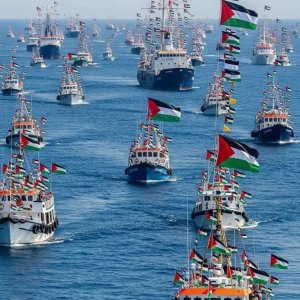
On Saturday, 4 April, in Marseille’s Vieux-Port, at the foot of the Mucem museum, several hundred people crowded the pier to cheer the 19 humanitarian boats of the flotilla setting sail for Gaza.

Speeches, slogans, music and even a batucada in the colours of Palestine: the fervour and hope were palpable. “Bravo, we’re proud of you,” people shout as boats pass by in front of the jetty.

In l’Estaque, a popular organization

Hope also animated the activists of the flotillas in the morning, at the port of l’Estaque. After months of work on an improvised construction site brought to completion, thanks in particular to the mobilization of the inhabitants of this district of Marseille, the flotillas are finally ready for departure.

“We have already won,” says Nemo, skipper of the Ryoko boat, renamed “the Nour” in tribute to the struggle of Palestinian women. “It’s a victory in the sense that we managed to organize ourselves in a non-hierarchical way, in an autonomous way and we managed to take this place, so it’s a popular victory, because nothing was expected.”

The coalition had contacted several ports, but none had responded, and the shipyard was therefore set up in l’Estaque on the proposal of its inhabitants. There, the preparation of the boats and collective life have worked thanks to self-organisation: “We work in the form of a collective, with centres of skills, centres of desire, centres that make sense for people. And people are invested in it,” explains Nemo.

A multifaceted mobilization

This motivation of all is of course rooted in the continuity of the mobilization for Palestine of the last two years, but it is also found in the political commitment of everyone.

“It is the struggle of all oppressed peoples that is symbolized by the struggle of the Palestinian people,” says Tino, an activist on board and member of the navigation centre. For him, the flotilla “is also a way of mobilizing on land around the Palestinian question and anti-imperialist issues.” He thought that the question of war would be central in the coming years and hoped that the flotilla would allow “a broad and common front against the war.”

Beyond the symbols, Claude LĂ©ostic (Association France Palestine SolidaritĂ©) reminds us that the genocide is still underway in Gaza and that “this humanitarian flotilla is first and foremost aimed at the Palestinians, to show them that our solidarity is intact.” But for her, this initiative is also aimed at our leaders whose “behaviour is scandalous and illegal.” She describes the flotilla as a citizen pressure to “move the lines”, a message to end our leaders’ complicity with Israel’s genocidal and colonial policies.

“We are trying to put pressure from our workplaces to put an end to partnerships with Israel,” says Linda Sehili, a member of the international committee of the trade union Solidaires. “This flotilla is the continuation of our militant, political and trade union actions. And this is only the beginning; we will have to remobilize everywhere on the territory with collectives for the right to self-determination of Palestinians.”

In the face of genocide, building solidarity

There is indeed an urgent need to remobilize: the new Israeli law on the death penalty for Palestinians and the Yadan law are at the centre of the discussions. A brutalization of Western colonialism, while, as a report by Urgence Palestine and the Palestine Youth Movement has just revealed, “between October 2023 and March 2026, more than 525 shipments of military equipment were shipped by French manufacturers” to Israel.

Faced with these flows of death, the flotilla embodies a flow of solidarity. It carries medical equipment, seeds and fishing boat repair materials. Obviously, the flotilla is not an end in itself. It is an anchor point for the construction of a huge movement of solidarity. This is the challenge for all the activists and all the organizations of this flotilla.

This is what motivates Tino: “The flotilla is a means of action that allows you to regain control of things. Everyone feels very powerless in the face of the situation there. We have to remain humble, we are not going to change the face of the world, but it is a vector of hope.”

L’Anticapitaliste


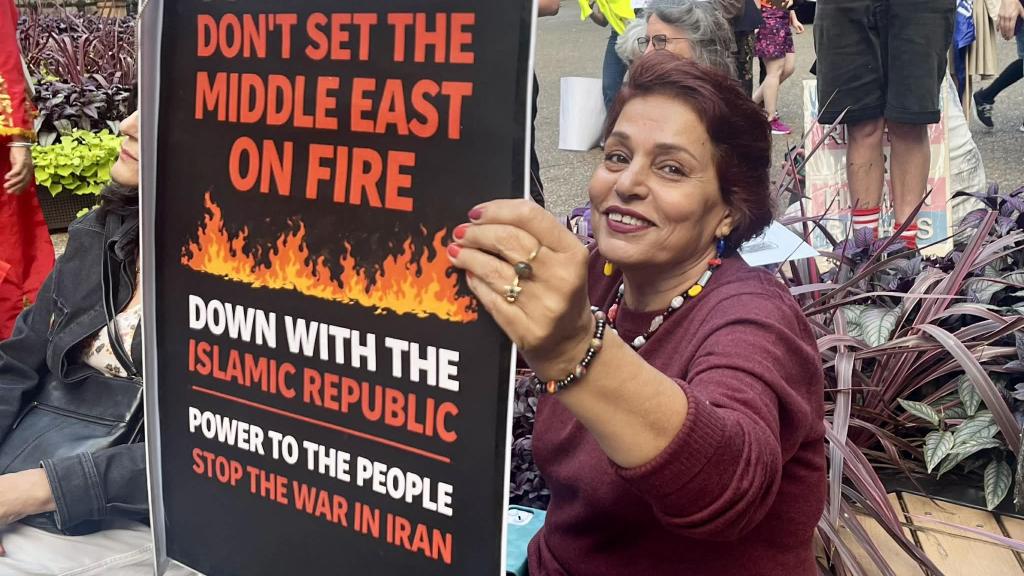
No to war, no to distortion: A critique of ‘limitless unity’ within the anti-Iran war movement


Mitra Mahmoudi

With the shadow of war and devastation continuing to loom over Iranian society, opposing any US or Israeli military intervention is an urgent humanitarian responsibility. There is no justification for bombings, killing civilians or destroying a nation’s infrastructure — this position is a non-negotiable principle.

However, a dangerous distortion is occurring: an attempt to blur political boundaries between the anti-war movement and Islamic Republic supporters in the name of “broad unity”.

Ignoring the reality of symbols

Some have argued that the Islamic Republic’s flag is a neutral symbol and that we should avoid a “flag war” by allowing regime supporters to carry them at anti-war protests. This view turns a blind eye to reality.

For millions of Iranians, this flag is not just a piece of cloth; it is a symbol of a specific socio-political ideology and a reminder of decades of repression, executions, discrimination and structural violence.

One cannot expect victims to stand alongside this symbol and treat it as if it were devoid of meaning. This is not an “emotional” issue — it is about the political and social significance of symbols.

Weakening an independent stance

Without clear political demarcation, the presence of Islamic Republic flags at anti-war protests carries a significant risk: it weakens the independent stance of “No to war, No to dictatorship.”

This intentional ambiguity creates a false impression that Iranians abroad are defending the regime. Such an approach is not just an analytical error but a political retreat.

On the other hand, the solution is not passivity or fragmenting the anti-war movement. A divided movement only serves the interests of pro-war forces.

The third path: Participation with identity

The way forward lies in a “Third Path” based on:

  • Active participation in the anti-war movement;
  • Maintaining a distinct political identity;
  • Echoing a clear and uncompromising message: “No to War, No to the Islamic Republic.”

This approach does not imply unnecessary confrontation or excluding others. Rather, it emphasises maintaining political clarity and refusing to fall into the trap of “false unity”.

Conclusion

A movement’s strength depends not only on its numbers but its ideological clarity and political integrity. A unity built upon erasing truths and denying suffering will be neither sustainable nor liberating.

Today, defending human lives, safeguarding the truth and refusing to ignore the nature of reactionary forces should be three inseparable pillars. Pursuing any one of these without the others will inevitably lead us astray.

Mitra Mahmoudi is an Iranian socialist, political activist and feminist. She is the director of Radio Avaye Zan (Voice of Women) in Sydney, Australia.


Opposing Western intervention and the Iranian regime


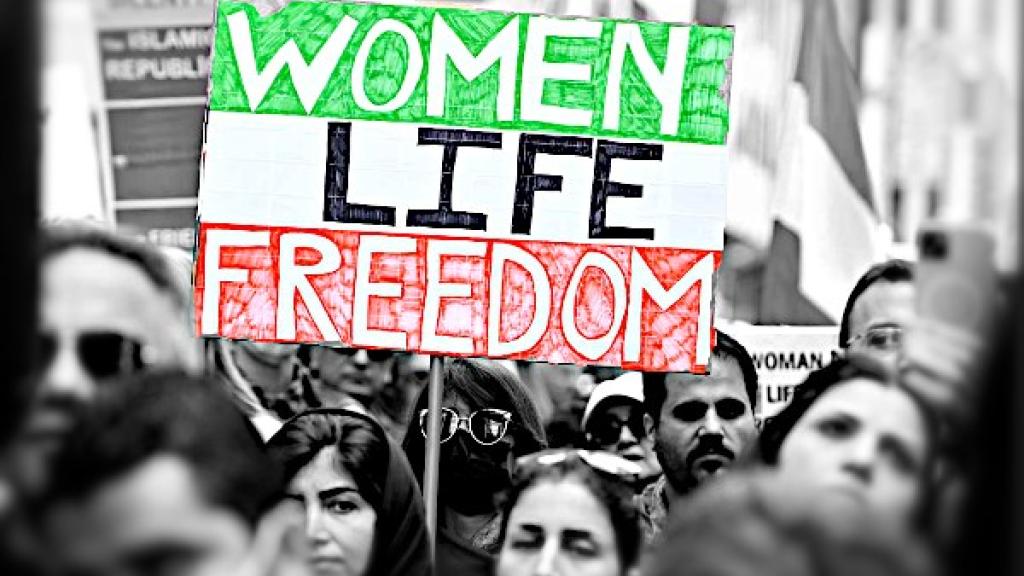
Women Life Freedom placard

First published in Turkish on the BirGĂĽn website. Translations from Socialist Project.

As the United States and Israel escalate their military campaign against Iran, the war is being justified through a familiar vocabulary: security, deterrence, and the elimination of existential threats. Yet beyond official rhetoric, the conflict is also unfolding as a battle over narratives — one shaped by media framing, digital propaganda, and deeply divided political communities.

Among the most striking features of this moment is the fragmentation of the Iranian diaspora. While some voices have openly supported military intervention in the name of “liberation,” others warn that such positions risk legitimizing a destructive external project with long-term consequences for Iranian society. At the same time, attempts to oppose both the Iranian regime and Western intervention are often marginalized, reduced to simplistic binaries that leave little room for nuance.

In this interview, award-winning Iranian-Canadian journalist and producer Samira Mohyeddin offers a critical perspective on the narratives surrounding the war, the role of social media and organized messaging, and the internal contradictions shaping diaspora politics. Drawing on historical context and contemporary developments, she challenges dominant assumptions about Iran, questions the logic of external intervention, and reflects on the political and ethical difficulties of sustaining a principled anti-war position in an increasingly polarized environment.

In his televised address on April 1, Donald Trump defended the war against Iran primarily in terms of security and stability — particularly the need to prevent nuclear escalation and eliminate perceived threats. Similar justifications have appeared across official statements and much of the media coverage. How do you interpret this narrative, and what does it obscure or leave out?

I think the primetime address that Donald Trump gave to the American public was primarily an attempt to sell this war. As you noted, he framed Iran as an imminent threat and emphasized the need to eliminate its nuclear capabilities. But what is consistently missing from media coverage is crucial context.

Back in June, during the 12-day war launched by the United States and Israel against Iran, the US used a weapon it had never deployed before in this context — a 30,000-pound bomb. Following those strikes, Trump himself stated that Iran’s nuclear capabilities had been “obliterated.”

So, the question is: are we really expected to believe that within just a few months, Iran was able to fully recover from that supposed “obliteration” and reconstitute its nuclear program? That claim simply does not hold up.

We know this in part because Rafael Grossi, the head of the International Atomic Energy Agency, stated just days after the latest escalation that Iran posed no imminent threat and was not developing a nuclear weapon. According to the IAEA, Iran was not even close to having that capability. Yet this context is largely absent from mainstream coverage.

Instead, what we are seeing is a process of manufacturing consent. The United States and Israel need to justify this war to their domestic audiences — to convince Americans why they should be paying $4 a gallon for gas. When Trump tells Americans that this war is “a great investment” for them, their children, and their grandchildren, it reveals the extent of that effort. Quite frankly, the statements he was making were laughable.

There is also a broader historical dimension that is often overlooked. Iran fought an eight-year war with Iraq — a conflict in which Iraq was backed by major Western powers, including France and Germany. Despite that, Iran did not concede even a small portion of its territory.

What people don’t understand about Iranians is that they will fight to the end. They don’t care how much infrastructure is ruined or anything. They will not give up this war to America and Israel.

Now, this next question is a little bit personal. You have also been the target of online attacks, including from pro-Israel and Zionist voices. More broadly, how do you assess the role of Zionist and pro-Israel advocacy networks and institutions in shaping media narratives about Iran in Canada and other Western contexts?

I think it would be a mistake — and a dangerous one — to dismiss the role that social media has played, both in this specific conflict and over the past decade.

Let me break your question into two parts, because the impact of propaganda directed at Iranians inside the country is crucial to understanding what is happening.

First, Israel operates a significant number of Persian-language social media accounts that are explicitly targeted at Iranians. What kind of messaging are people hearing? They are hearing messages from Benjamin Netanyahu and other officials claiming, “We are coming to rescue you. We are the only country that cares about you.” At times, Netanyahu has even delivered these messages in Persian, including through AI-assisted translation.

Alongside this, there are satellite television channels such as Iran International and Manoto TV, which for decades have pushed and promulgated a certain ideology into the country. So, there is a long-standing ecosystem of messaging that predates the current war.

And then, on the other hand, we know — from outlets like The Times of Israel and Haaretz, Israeli media outlets — that Israel has spent, this year alone, up to $250-million on social media campaigns, including paying influencers $7,000 per post. Netanyahu met with them in New York — we have the photos. These are not conspiracies; these are facts.

And they have really pushed an agenda to try and get Iranians to agree with the dropping of bombs on their heads.

You mentioned the threats I have received. When I look at many of these accounts, they are not real people. They may have two posts, ten followers — clearly inauthentic profiles. But there are so many of these accounts pushing the same messages that people stop asking basic questions: Is this a real person? Or is this a bot?

Instead, a narrative takes hold — that Iranians support the war, that they welcome these attacks. But the reality is far more complex. These campaigns rely precisely on the assumption that most people will not investigate the sources of what they are seeing.

How do you interpret the fact that parts of the Iranian diaspora, including in Canada, frame external military intervention as “liberation”? What does this reveal about diaspora politics, and what consequences might it have for struggles inside Iran?

These are great questions — really excellent questions — because I think, first of all, we are dealing with a very dangerous diaspora.

And I use the word dangerous on purpose, because they are wholly delusional. And they don’t quite understand the impact, which brings me back to the propaganda we were talking about — the effectiveness of the messaging that Israel has directed at Iranians, both inside and outside the country.

Right now, we are seeing members of the diaspora waving Israeli flags, gathering outside embassies, and thanking Donald Trump for what he is doing. Many people excuse this behavior as desperation. I disagree. I don’t think it is desperation.

I think that within parts of the community, there is a mode of thinking that is deeply authoritarian, even fascistic. And there is also a latent form of racism that is rarely acknowledged. What has emerged, in some cases, is a kind of homo-nationalism that is very fascistic at its core.

There is also a recurring idea among some Iranians that they are the exception. You hear statements like: “We are not Syria. We are not Afghanistan. We are not Iraq. We are much more sophisticated.” But what does that imply? It reflects a hierarchy — it reflects racism.

It suggests that, regardless of what external powers such as the United States or Israel want, Iranians somehow stand apart from the rest of the region. We are much more sophisticated than these people.

You also hear figures like Mark Levin saying that people in Iran are “Persian,” that they are “Western,” and that they are not like the rest of the Middle East. And some Iranians internalize and reproduce this message because it offers a sense of distinction or superiority.

A lot of Iranians get angry at me for pointing this out because there’s this idea of airing our dirty laundry in public. But I think it’s really important to call this stuff out because we’re going down a very dangerous road — very, very dangerous.

In your view, why has it become so difficult in public debate — particularly in Canadian and Western public debate — to sustain a position that both opposes Western military/imperalist intervention and critically engages with the Iranian regime? How should such a position be articulated?

It’s hard to maintain this position because it is, quite simply, a messy one.

In the media and in public discourse, there is a tendency to reduce everything to black and white. We operate in binaries. If you are against the Iranian government, then you are expected to support the war. And if you support the war, then you are aligned with Israel and the United States. There is very little room for people who reject both positions — for people like me, and what I believe is actually a silent majority.

People are afraid to speak out. It is not just about holding a principled position — it is about the consequences of doing so. People are attacked, threatened. I receive death threats and racist abuse on a daily basis. I mean, these aren’t imaginary things, right?

To take a principled stance against the decimation of your country’s infrastructure, while also recognizing that the Iranian government is authoritarian and repressive, is a very difficult balance to maintain right now. But it is one I refuse to abandon.

This is not a new phenomenon. For decades, anyone who has opposed war against Iran has been labelled “pro-regime,” accused of being paid or acting on behalf of the state. I myself have been accused of taking money from the Iranian government. It is absurd — it is almost a parody — but it remains a persistent tactic, especially within parts of the diaspora, to discredit dissenting voices.

Even when someone has consistently criticized the authoritarian nature of the Iranian government — as I have, including in publications like The Globe and Mail — it makes little difference. If you are operating within any space that has nuance or exists in shades of grey, you will be labelled as such. And the people who do this are, I’m sorry to say, very ignorant, and I don’t trust them.

There is a Persian expression — hezb-e baad, the “party of the wind” — which describes those who simply follow whichever direction the wind is blowing.

And the wind has shifted. Just a few months ago, it was strongly pro-war. But in recent days, some of those same voices have reversed their positions, as the consequences of the war become more visible.

A lot of people who were pro-war have now completely done a 180 because they’re starting to realize that with every bridge that gets bombed, with every pharmaceutical company that gets bombed, the United States, and Israel are only concerned with decimating the country of Iran.

Decimating its domestic capabilities and creating a servile client state, like they have in Syria — one that Israel can come and bomb from time to time, and that has no ability or capability to protect itself or its citizens.

You have emphasized that meaningful political change in Iran must come from within. Why do external interventions — despite being framed as supportive — tend to undermine that possibility?

There are historical precedents for this — and it has never worked. If you take a long view of Iran’s socio-political history, going back even to the Constitutional Revolution of 1905–1906, you can see that change has often emerged through internal dynamics and transnational connections within the region. People were learning from each other.

For example, in the early 1900s, Iranian women were in contact with women in India who were organizing boycotts of British cotton. Iranian women learned from that and organized boycotts of British sugar and tea. These kinds of regional exchanges were taking place, but they were never welcomed by external powers such as Britain, Russia, or later the United States.

We have also seen the consequences of external intervention elsewhere. Iraq is a clear example. The country has still not recovered from the US invasion and occupation. Do I think Saddam Hussein was a good person? Of course not. But change should have come from within Iraqi society, not through foreign intervention. It is delusional to think that meaningful change in Iran can come from the outside.

If the United States believes it can engineer transformation, we should already have seen evidence of that. We have repeatedly heard figures like Donald Trump and Benjamin Netanyahu call on Iranians to take to the streets. But how do you expect a civilian population to mobilize when 1000kg bombs are falling on them? It is simply not realistic.

What is often forgotten is that internal change has been happening. During the “Woman, Life, Freedom” movement in 2022–23, significant social transformations were taking place. These social changes — made by women — were incremental — step by step — but they were real.

More broadly, Iran today is not the same country it was in the 1980s. Despite the constraints of the political system, there have been important advances, particularly driven by society itself. Iranian women, for example, have made substantial gains. Iran ranks among the leading countries in terms of women graduating in STEM fields. And figures like Maryam Mirzakhani — the only woman to have won the Fields Medal — reflect these developments.

These changes have often occurred in spite of the state, not because of it. Yet there is a tendency in public discourse to erase them, to present Iran as a static, unchanging society. That is simply not accurate.

Look, we also need to have a long view of what democracy is. Europe had four or five hundred years to get to where it is today. How many revolutions did France go through before developing the system it has now? And we expect Iranians to catch up in 50 years? How is that possible? It’s impossible.

Iran was never left alone to do what it needed to do in order to make these advances — especially in the last few years. And now, we are going to see everything that Iranians were able to build over the past 50 years start to disappear because of this war.

At this moment — given the intensity of the war, the media environment, and the divisions within the diaspora, including in Canada — what do you see as the most dangerous misconception shaping public understanding of Iran today?

I think one of the most dangerous misconceptions is the idea that all Iranians are in favour of this war. One of the most troubling framings — especially in Western media — is the suggestion that Iranians welcome this war, that it is somehow necessary, or that people are simply helpless and waiting for external forces to intervene.

There is also this implication that Iranians themselves wanted this outcome. This is a very dangerous narrative. It’s very dangerous to say that, and it’s because, you know, as I said, we have this diaspora that, unfortunately, is going through this collective psychosis and delusion that somehow Israel and the United States are coming to help it when all they really want to do is destroy the country.

Samira Mohyeddin is an award-winning Iranian-Canadian journalist and producer. She posts on instagram/smohyeddin.

Baris Karaagac teaches international political economy and economic development at Trent University and researches European social democracy, state theory, and Turkish political economy. He is the editor of Accumulations, Crises, Struggles: Capital and Labour in Contemporary Capitalism (2013).
‘America’s not OK’: Surveys show US wellbeing in steep decline under Trump
 Common Dreams
April 10, 2026 


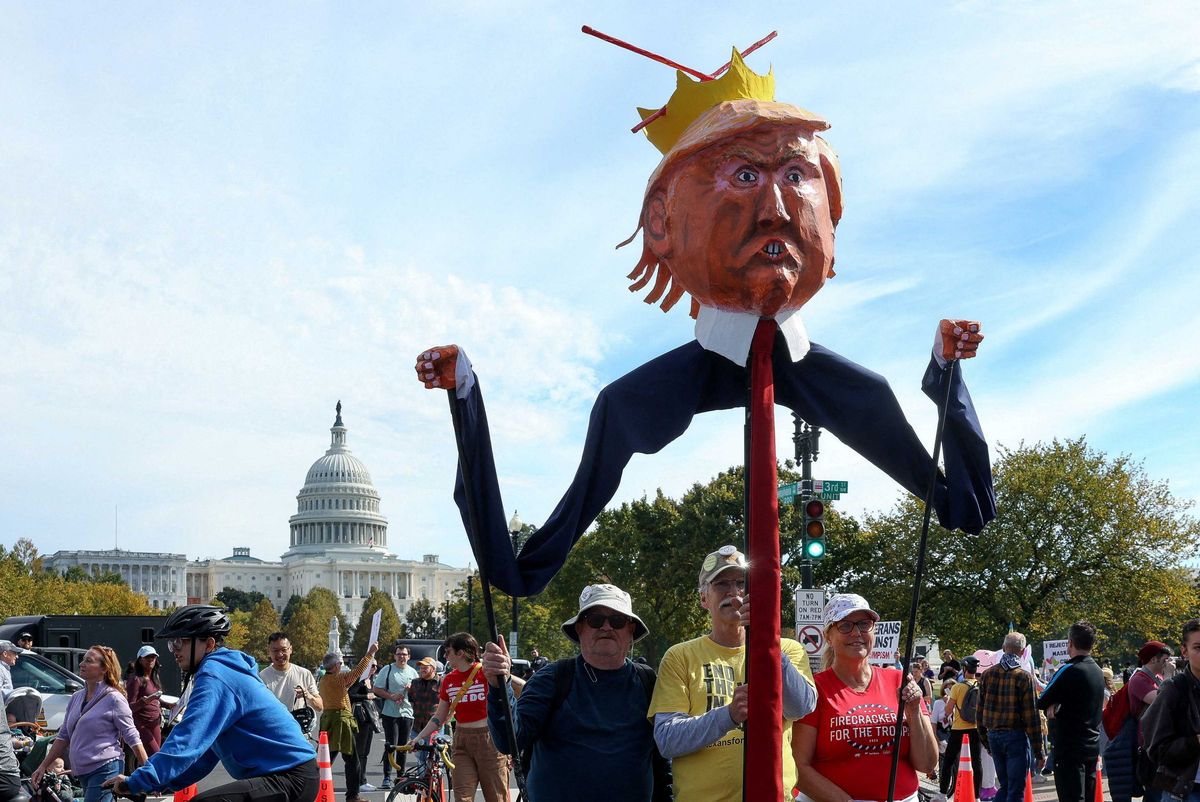
Demonstrators hold an effigy depicting U.S. President Donald Trump during a "No Kings" protest against U.S. President Donald Trump's policies, in Washington, D.C., U.S., October 18, 2025. REUTERS/Kylie Cooper


Two recently released surveys revealed a significant drop in Americans’ self-reported wellbeing as the Trump administration launches illegal and deadly military conflicts and plunges the global economy into chaos.

On Friday, the University of Michigan issued its monthly Survey of Consumers, which showed that consumer sentiment in the US hit an all-time low after dropping by 11% since March, amid President Donald Trump’s war of choice in Iran.

The drop in consumer sentiment was almost universal, the survey found, as “demographic groups across age, income, and political party all posted setbacks in sentiment, as did every component of the index, reflecting the widespread nature of this month’s fall.”

As for the reasons for the decline, the survey found “many consumers blame the Iran conflict for unfavorable changes to the economy,” such as a major spike in gas prices, which the US Bureau of Labor Statistics reported on Friday increased by more than 20% in the month since the war began.

Heather Long, chief economist at Navy Federal Credit Union, noted that the latest consumer sentiment data showed Americans are even more sour on the economy now than they were in the summer of 2022, when the economy was dealing with the highest inflation it had seen in decades.

Kendall Witmer, rapid response director of the Democratic National Committee, seized on the consumer sentiment report and accused Trump of having “tanked the economy for working families.”

“Americans are drowning under rising costs, flat wages, high unemployment, and historic layoffs,” Witmer added. “It’s no wonder they’re concerned about how they’re going to make ends meet and Trump and [Vice President] JD Vance can’t be bothered to make life more affordable for them.”

The record low in consumer sentiment comes just weeks after Gallup released its annual World Happiness Report, which showed that the US had fallen out of its rankings of the 20 happiest countries in the world.

The report says the decrease in US happiness largely came from “lower life evaluations among young adults,” and points the finger at high social media use as a key factor in making young people miserable.

Specifically, the report finds “there is now overwhelming evidence of severe and widespread direct harms (such as sextortion and cyberbullying), and compelling evidence of troubling indirect harms (such as depression and anxiety)” from social media use, adding that “the harms and risks to individual users are so diverse and vast in scope that they justify the view that social media is causing harm at a population level.”

Social media’s impact on mental health has come into focus in recent weeks with juries in multiple states finding Big Tech companies liable for creating products that harm children.

In March, a New Mexico jury found social media giant Meta liable for harming children’s mental health and safety, ordering the company to pay $375 million. A day later, a Los Angeles jury ordered Meta and Google to each pay $3 million in civil damages to a now-20-year-old woman who alleged harm and suffering caused by their products when she was an adolescent.

Journalist Derek Thompson took stock of the Gallup survey and the University of Michigan survey, as well as last year’s General Social Survey that also documented a decline in US happiness, and declared, “America is not OK.”
2.5 Million Poor Americans Have Lost Food Aid Since Trump Signed GOP’s Big Ugly Bill Into Law

“No family should have to worry about putting food on the table, but congressional Republicans have made sure that millions will,” said one critic of the GOP’s budget law.


A bilingual sign on door of frozen food aisle says, “We accept SNAP food stamp cards,” at a Walgreens in Queens, New York.
(Photo by: Lindsey Nicholson/UCG/Universal Images Group via Getty Images)

Brad Reed
Apr 08, 2026
COMMON DREAMS

An analysis published Wednesday by the Center for Budget and Policy Priorities found that millions of low-income Americans have stopped participating in the Supplemental Nutrition Assistance Program ever since President Donald Trump signed the One Big Beautiful Bill Act into law last year.

According to CBPP’s analysis, SNAP participation declined by 6% between July 2025 and December 2025, with 2.5 million fewer Americans receiving benefits.

CBPP estimated that millions more will be dropped from SNAP benefits in the coming months as states adjust their budgets to remain in compliance with the law.

“Starting in 2027, most states will have to pay between 5% and 15% of SNAP benefit costs, totaling hundreds of millions of dollars a year in many states,” explained CBPP. “The magnitude of the cost shift... may incentivize states to take drastic measures to reduce their payment error rates quickly and cut program costs, even if it means delaying or improperly denying benefits to eligible people.”

In total, concluded CBPP, “we estimate that 4 million people in a typical month will lose out” on SNAP benefits “once the changes are fully implemented.”

CBPP published a separate analysis focusing specifically on Arizona, where SNAP participation has already fallen “far more than anticipated,” while warning that other states could soon see similarly steep participation drops as they rush to comply with the law.

The GOP budget law contained roughly $186 billion in cuts to SNAP over the span of a decade, which came from expanding work requirements, shifting some of the cost of the program to the states, and restricting benefit increases. As a result, millions of Americans became vulnerable to losing their benefits.

Leor Tal, campaign director at Unrig Our Economy, pointed to CBPP’s analysis as an example of the GOP waging class warfare on behalf of rich donors.

“SNAP is a lifeline for working Americans nationwide,” Tal said. “Now, that lifeline is being ripped away from millions because Republicans in Congress decided that giving tax breaks to billionaires and waging war are more important than protecting food for families. No family should have to worry about putting food on the table, but congressional Republicans have made sure that millions will.”
‘Shameful’: $4,049 of Average US Taxpayer’s Bill Last Year Went to War and Weaponry

“Our tax dollars are doing more to bomb children in Iran and other countries than to feed and educate children here.”


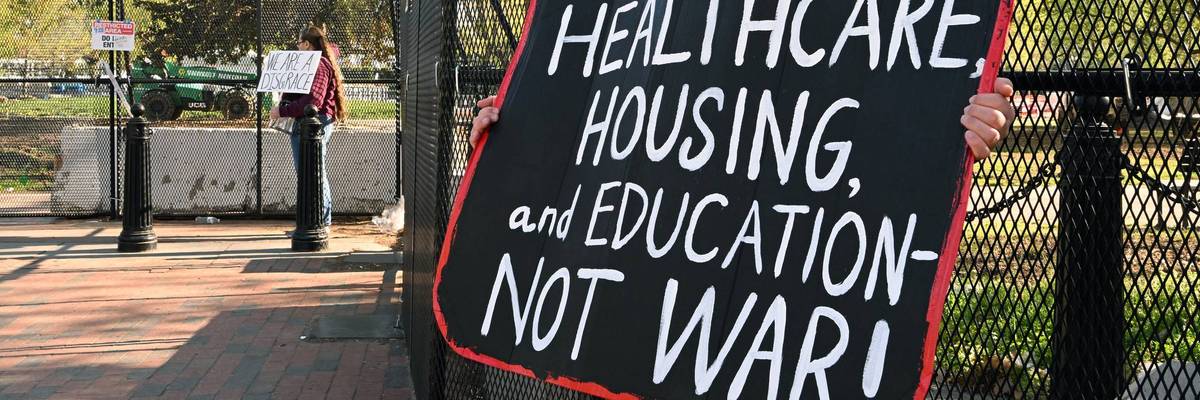
A demonstrator holds a placard in front of the White House in Washington, DC on April 7, 2026.
(Photo by Li Rui/Xinhua via Getty Images)

Jake Johnson
Apr 09, 2026
COMMON DREAMS


A new analysis released Thursday estimates that the average American taxpayer shelled out over $4,000 to the federal government last year “for militarism and its support systems” such as the Pentagon, whose already-massive annual budget is poised to surge to $1.5 trillion if President Donald Trump gets his way.

The National Priorities Project (NPP) at the Institute for Policy Studies found in its latest annual Tax Receipt report that, through their federal taxes, the average US taxpayer contributed $4,049.35 to Pentagon contractors, military personnel, nuclear weapons, aid to foreign militaries, and last year’s bombing of Iran’s nuclear energy facilities. That’s significantly more than the average US taxpayer contributed to healthcare for low-income Americans through Medicaid—$2,492.


NPP’s estimated militarism sum for last year does not include costs related to the current, massively unpopular US-Israeli war on Iran, which began on February 28, 2026 and has already cost Americans billions at the pump.

“But if we place the 2026 Iran war costs in the context of our 2025 tax receipt and put the cost at $35 billion—a line the US is likely on the verge of crossing—the average taxpayer will have paid $130 for the war on Iran, eight times more than the $16 the average taxpayer paid for a full year of home heating and energy assistance in 2025,” NPP said.

The $1,870 that the average US taxpayer paid toward Pentagon contractors in 2025 was “fifteen times as much as the $124 the average taxpayer paid for school lunches and other nutrition programs,” the analysis found.

“It’s shameful that our tax dollars are doing more to bomb children in Iran and other countries than to feed and educate children here,” said Lindsay Koshgarian, NPP’s program director. “Instead of spending even more of our hard-earned dollars on war and mass deportation, we deserve a massive reinvestment in making this country a place where we can all survive and thrive.”

“We’re facing chronic underinvestment in this country, from healthcare to education and more. That money has instead been funding a $1 trillion war machine and a class of Pentagon contractors getting rich off our tax dollars.”

NPP noted that Trump’s recent request for a $1.5 trillion US military budget for the coming fiscal year would, if approved by Congress, further drive up costs for American taxpayers.

“Our tax receipt shows why so many people in this country are struggling,” said Koshgarian. “We’re facing chronic underinvestment in this country, from healthcare to education and more. That money has instead been funding a $1 trillion war machine and a class of Pentagon contractors getting rich off our tax dollars. The good news is that if we reverse our backwards priorities, we can start to make Americans’ lives better.”

MarketWatch reported earlier this week that Americans are “increasingly saying they won’t pay their taxes this year as a political protest,” citing the illegal war on Iran and Trump’s unleashing of federal immigration agents and National Guard troops on US cities.

Activist and attorney Rachel Cohen wrote in Current Affairs magazine last month that she is not paying her federal income taxes this year, noting that “our enormous military budget is going to illegal wars of aggression in multiple hemispheres.”

“When I learned about pacifists who participated in draft refusal during the Vietnam War,” Cohen wrote, “I was confident they were doing the right thing, and that if I were similarly situated, I would have joined them.”


‘People Can’t Afford Rent,’ Critics Say as White House Boasts of Trump’s Plan for Gold-Covered Arch

“While Americans worry about skyrocketing costs and another endless war, President Trump is focused on a taxpayer-funded vanity project,” said Rep. Don Beyer.


A rendering of President Donald Trump’s proposed ‘Arch of Triumph’ in Washington, DC.
(Photo via Harrison Design / X)

Brad Reed
Apr 10, 2026
COMMON DREAMS

On the same day that the US Bureau of Labor Statistics showed that inflation spiked at its fastest monthly rate in four years, the Trump administration unveiled renderings of President Donald Trump’s proposed gold-covered 250-foot-tall arch to be built at Memorial Circle in Washington, DC.

The renderings, which were produced by architecture firm Harrison Design and posted on social media by the White House’s rapid response account, show a gigantic arch that would be flanked on its corners by four gold lions and topped by a 60-foot-tall gold statue of what appears to be an angel.

According to a Friday report in The Washington Post, some preservationists have expressed concerns that the arch, which would be more than twice the height of the Lincoln Monument, would disproportionately tower over the DC skyline, and would block views of Arlington National Cemetery.

Rep. Don Beyer (D-Va.) slammed the president for pushing construction of a gaudy gold-covered arch at a time when Americans are struggling due to the cost-of-living crisis worsened by his war in Iran.

“While Americans worry about skyrocketing costs and another endless war,” he wrote in a social media post, “President Trump is focused on a taxpayer-funded vanity project that would choke traffic, block our skyline, and tower over sacred ground where those who served our nation are buried, including my own parents and sister.”

Beyer added that the arch is “about Donald Trump’s ego,” and vowed, “we’re going to stop it.”


Rep. Katherine Clark (D-Mass.) responded to the renderings by reminding the White House that “Americans can’t afford groceries.”

Progressive activist Nina Turner had a similar reaction to Clark, posting that “people can’t afford rent” in response to the renderings.

Podcaster Brian Taylor Cohen contrasted the renderings of the arch with a statement Trump made earlier this month when he said “it’s not possible” for the federal government “to take care of daycare, Medicaid, Medicare, all these individual things,” because it needs to fund wars instead.

University of Missouri English professor Karen Piper also remarked on the opportunity cost of building the arch, along with other assorted Trump projects.

“This is why they’re going to take away your Social Security, saying we can’t afford it,” she wrote. “Ballrooms, arches, and Don Jr. draining the Treasury.”

California Gov. Gavin Newsom, who has been named as a contender for the Democratic Party’s 2028 presidential nomination, responded to the arch renderings by accusing Trump of “doing everything he can to wreck this country—this time with our nation’s capital.”

Rep. Jared Huffman (D-Calif.) took issue with the decision to inscribe the phrase “one nation under God” at the top of the arch.

“That phrase came from Cold War propaganda, not our Founders,” observed Huffman. “Trump stamping it on his vanity arch tells you everything about what this project is: a Christian nationalist monument, paid for with your tax dollars.”
In Echoes of Corbyn and Mamdani, Insurgent Candidate Wins Canadian New Democratic Party Leadership


Avi Lewis now leads the New Democratic Party after a campaign reminiscent of left-leaning politicians in the US and UK.

April 8, 2026

At the center is leader of Canada's New Democratic Party Avi Lewis.Canada’s NDP / Le NPD du Canada

Truthout is an indispensable resource for activists, movement leaders and workers everywhere. Please make this work possible with a quick donation.

Canada’s left-leaning New Democratic Party (NDP) has elected a new leader, someone whose campaign drew comparisons to the politics and style of U.S. figures like Bernie Sanders, Alexandria Ocasio-Cortez, and Zohran Mamdani. On March 29, the NDP elected Avi Lewis on the first round of balloting with 55 percent of the vote in his first successful political campaign.

The NDP was decimated in the April 2025 federal election. Former leader Jagmeet Singh lost his own electoral district, and the party only won seven seats, four short of what’s needed to maintain its official party status. It was the worst showing for the NDP in its 64-year history.

Lewis also came in third in that election in his electoral district, his second third-place finish in the two elections that he has run in.

But a commitment to be unapologetically left and a promise to overhaul the party were his key to his victory in the NDP leadership race. Lewis’s allies won key positions within the party, clearing the path for him to implement his campaign promises.

For decades, the NDP has watered down its left-wing policies. But with a Liberal government that has promised to pull tens of billions of dollars from federal departments to fund the military, party members are hungry for a left turn. Are Canadians ready for it?


Advocates Put Palestinian Rights on the Ballot as Canada’s Election Nears
Over 300 Canadian electoral candidates have endorsed a 5-point “Vote Palestine” platform thanks to activist pressure. By Jillian Kestler-D’Amours , TruthoutApril 23, 2025


Who Is Avi Lewis?

Lewis’s campaign was ambitious. He promised to implement national rent controls, build 1 million public housing units, increase taxes on the wealthy, expand the electricity power grid to phase out oil and gas, and fund free public transit. “We can have nice things, but we gotta fight for them together,” he said in one campaign video. The promise to be boldly progressive was music to the ears of many New Democrats who have been frustrated that the NDP has not been able to articulate a compelling reason for the high cost of housing and food, or a solution to the crisis.

Lewis’s campaign capitalized on widespread opposition to U.S. foreign policy, including the thousands of actions that Canadians have taken to show their solidarity with Gaza over the past several years. During his victory speech, he took aim at both U.S. foreign policy and Canada’s willingness to go along with it, saying:

We need a government … that acts with moral clarity when it matters. When missiles are falling on schools and hospitals; when Israel commits a genocide in Gaza, we call it by its name and we do everything in our power to bring it to an end. When the U.S. and Israel start an illegal and reprehensible war against Iran that sets the world on fire, we say Canada should have absolutely no role in it whatsoever.

While other NDP leadership candidates had similar positions on U.S. foreign policy, Lewis was able to rise above his peers by taking cues from social movement organizing, activists, and successful left-wing campaigns south of the border.

Lewis has very little partisan political experience himself, though he comes from a political dynasty. His grandfather, David Lewis, led the federal NDP from 1971 to 1975, and Avi Lewis’s father, Stephen Lewis, led the Ontario wing of the party from 1970 until 1978. His mother is iconic feminist journalist Michele Landsburg. Lewis, 57, has mostly stayed out of public life, until his first election campaign in 2021.

Some Canadians will remember Lewis as a host on the television channel MuchMusic. After that, he worked for CBC on the debate show “CounterSpin” and later, for Al Jazeera. He has produced a handful of documentaries. His wife, Naomi Klein, is a key left-wing voice in American politics. His campaigns have featured non-Canadian celebrity endorsements from Jane Fonda, Billy Bragg, and V (formerly known as Eve Ensler).

The Liberals under Prime Minister Mark Carney managed to eat most of the NDP’s support by framing a vote against Carney as a de facto vote for Conservative leader Pierre Poilievre. The strategy worked during the 2025 election, and many people who would normally vote NDP voted Liberal, hoping that Carney would take on Donald Trump and protect Canada’s sovereignty.

While the NDP is now riddled with campaign debt, Lewis nonetheless out-fundraised all of the other candidates combined by pulling in more than 1 million Canadian dollars. That is equivalent to one-quarter what the entire party raised in the 2025 election.

A Rising Left to Combat a Right-Wing Liberal Party?

From 2022 to 2024, the NDP propped up Justin Trudeau’s deeply unpopular minority Liberal government. Trudeau betrayed his promise on electoral reform, souring many progressive Canadians on his tenure. And he became a symbol of Canadians’ frustrations with how the pandemic was handled, thanks to an aggressive right-wing movement to pin every pandemic-related inconvenience on Trudeau personally. In exchange for minor concessions like a dental care program for some low-income Canadians and coverage for diabetes medication and birth control under the public health insurance program, the NDP voted “yes” on confidence motions to keep Trudeau in power. Over the course of the agreement, the NDP voted 38 times alongside the Liberals out of 55 motions total, including for motions that wouldn’t have triggered an election.

In early 2025, staring down a federal election, the Liberals swapped Trudeau out for former two-time central banker Mark Carney. The NDP didn’t pivot, and Jagmeet Singh, who had attached himself to Trudeau through the confidence motions, came in third in his own electoral district.

Carney’s tenure has been a radical departure from the Trudeau era. He has promised more than $60 billion in cuts from the federal budget — cuts so deep that some journalists have noted similarities between his plan and what Trump’s so-called “Department of Government Efficiency” managed to accomplish.

Carney’s cuts are far-reaching. For example, they will result in fewer food inspectors, close experimental farms where research is done to make improvements to agriculture in Canada, and eliminate prison-based librarians. While there has been some outrage over these cuts, Carney’s popularity has grown slightly since he was elected. He has enticed enough politicians to change their party affiliation to the Liberals, NDP members included, that a majority government is within reach: Of the three by-elections to be held on April 13, two seats are seen as Liberal strongholds, and the Liberals won the third riding by a single vote in 2025. If Carney wins two of these seats, he will have his majority, and, due to Canada’s parliamentary system, will not need to form a coalition government.

Lewis is starting his tenure on difficult political terrain. He was barely noticed outside of the party faithful during the leadership race. The NDP membership only grew to 100,000 people during the race compared to 124,000 during the party’s last leadership race in 2017. When Naheed Nenshi ran to be leader of the Alberta NDP in 2024, 69,000 people in that province alone joined to vote in it. Despite the fact that the race had started on September 1, by mid-March, one poll showed that just 13 percent of Canadians selected Avi Lewis as their first choice (44 percent said they didn’t recognize any of the candidates’ names). While that was higher than the other leadership candidates, it has not turned Lewis into a household name, and many Canadians will first hear about him from a mainstream press, other politicians, and pundits who are antagonistic to left politics.


Backlash

Already, backlash to Lewis has been intense. One of the party’s seven members of parliament (MPs) switched to the Liberal Party during the final days of the leadership campaign (with rumors that Lewis will lose another MP to the provincial left-wing party QuĂ©bec Solidaire). Then, immediately after Lewis’s victory, the leaders of the Alberta and Saskatchewan wings of the NDP criticized him publicly for being too far left. The leader of the Manitoba wing, Premier Wab Kinew, assured reporters that he supported Lewis even if their views didn’t line up perfectly.

Pundits and journalists were next. The National Post warned people to not “underestimate the appeal of Lewis’ Third Worldism”; the Calgary Herald said that a Lewis NDP “looks more communist than social democratic”; and The Globe and Mail columnist Konrad Yakabuski declared that in the wake of Lewis’s win, the NDP has “an antisemitism problem.” Never mind that Yakabuski is not Jewish, and Lewis — along with his new principal secretary and the new president of the party Niall Ricardo — are.

In anticipation of these attacks, the grassroots organization Independent Jewish Voices reminded Canadians that “the NDP is now Canada’s most Jewish-led party.”

A letter to the editor in The Globe that went viral on social media pointed out that Lewis’s father Stephen, who died shortly after Avi won the leadership race, was being praised by the same news outlets that were denigrating Avi Lewis, despite the two having virtually the same politics.

The Lewis campaign has so far withstood the attacks without giving into criticism, something that his team has no doubt learned from watching how other, similar campaigns in the U.K. and U.S. have unfolded.

Replicating Other Campaigns?

On March 30, Lewis delivered a speech to more than 1,000 delegates gathered in Winnipeg for the NDP convention. His victory was assured when, the day before, a slate critical of the party establishment and supportive of Lewis swept in through a very narrow election. His victory speech felt more like a victory lap than a crossing of the finish line.

He ended the speech with a nod to his cross-border allies: “This is about all of us, coming together to find our place and our power in the thrilling work in building our shared future. A government that works for the many, not for the money.” That slogan harkens to Jeremy Corbyn’s famous slogan for the many, not the few, and has appeared on podium signs behind Alexandria Ocasio-Cortez during some of her public events. Lewis’s campaign demands and rhetoric closely mirror the populist rhetoric that underpinned Ocasio-Cortez and Bernie Sanders’s “Fighting Oligarchy” tour.

This isn’t too surprising, given that Lewis has worked with Ocasio-Cortez before. He co-wrote the script for the short video A Message from the Future with Alexandria Ocasio-Cortez in 2019, working alongside Naomi Klein, who has been involved in campaigns for Sanders, Ocasio-Cortez, and Zohran Mamdani. Lewis’s statement celebrating Mamdani’s victory said that Mamdani’s energy is “the same energy and vision that’s driving our campaign here in Canada.” He promised to create a public grocery service, a nod to one of Mamdani’s central campaign promises.

Lewis isn’t an insurgent member of a party that has enough reach in national politics to win the highest offices of the state, like Ocasio-Cortez is. Nor has he been elected before and practiced in the art of being a politician like Mamdani is. But he has clearly learned from their successes, hoping to borrow their more effective tactics. In a video with Klein the night of Mamadani’s victory, Lewis talked about how progressives need to understand that audacious proposals are key to securing electoral victories, which is what he takes from the Mamdani campaign.

Lewis doesn’t have the internal opposition that Sanders and Ocasio-Cortez have faced within the Democratic Party; the NDP leaders who have criticized him are now marginal in the party. The federal council and party executive support him; the path is clear for Lewis to put his bold words into action.

With no seat in the House of Commons, Lewis has the benefit of being free from the demands of parliamentary life. He won’t be tied down in Ottawa, present in the House of Commons for votes where, as the leader of a party without status, he is given very little time to push forward any motions. However, he will need to win a seat in the next few years to cement his position in the Canadian political landscape.

As social conditions continue to deteriorate, fueled by global crises like the war on Iran, there has scarcely been a better time for a left-wing insurgency. Will Lewis be able to rise to the occasion?


Nora Loreto
Nora Loreto is a writer and activist based in Quebec City. She is also the president of the Canadian Freelance Union.