Friday, April 17, 2026

ICYMI

‘Decades in the Making’: Antitrust Advocates Celebrate as Jury Rules Against Live Nation-Ticketmaster


Minnesota Attorney General Keith Ellison called the verdict “a win for everyone who thinks concert tickets are too damn expensive.”



The Ticketmaster logo is displayed on a smartphone screen in a photo illustration.
(Photo by Jonathan Raa/NurPhoto via Getty Images)


Brad Reed
Apr 15, 2026
COMMON DREAMS


Antitrust advocates celebrated on Wednesday after a jury found that Live Nation and is subsidiary Ticketmaster were illegal monopolies who for decades systematically overcharged customers for concert tickets.

As reported by The Associated Press, the verdict against Live Nation and Ticketmaster could cost the two entities “hundreds of millions of dollars, just for the $1.72 per ticket that the jury found Ticketmaster had overcharged consumers in 22 states,” and they could be forced to sell off some of the venues they own.
RECOMMENDED...



‘Earthquake for Big Tech’: LA Jury in Social Media Addiction Trial Finds Meta, YouTube Harmed Child



Iran’s Top Diplomat Says Trump Team Sabotaged Talks With Deal ‘Inches Away’

The case against Live Nation, which was brought by 33 states and the District of Columbia, was initially led by the US Department of Justice. However, under President Donald Trump, the DOJ last month reached a last-minute settlement with the company that would not require it to be broken up.

The state attorneys general, however, vowed to see the case through and were rewarded with a big verdict in their favor.

New York Attorney General Letitia James celebrated the verdict, describing it as “a landmark victory to protect New Yorkers from harmful monopolies.”

Minnesota Attorney General Keith Ellison called the verdict “a win for everyone who thinks concert tickets are too damn expensive,” and declared himself “proud to have brought this lawsuit.”

District of Columbia Attorney General Brian Schwalb noted Live Nation “has raked in billions in profits from an illegal monopoly that coerces venues, restricts artists, and exploits fans,” and called the verdict “a massive win in the fight for fairness for local venues, artists, and fans.”

Lina Khan, former chair of the Federal Trade Commission under President Joe Biden, hailed the verdict, but said it was just “a key first step towards ending Live Nation’s monopolistic control and securing real relief for those it harmed.”

Lee Hepner, senior legal counsel at the American Economic Liberties Project, said the verdict was “decades in the making,” and he cited iconic Seattle band Pearl Jam’s fight against Ticketmaster in the 1990s to illustrate just how long it’s taken to hold the company accountable.

“Pour one out for Pearl Jam, who testified before Congress in 1993 about Ticketmaster’s abuse of the live concert industry,” he commented.

The Roosevelt Institute took a shot at the Trump DOJ for bailing on the case, and noted the verdict against Live Nation “only happened because state AGs kept pushing after a federal settlement that let the companies off the hook.”

New Poll Shows Michigan Senate Primary in Dead Heat as Voters Sour on Pro-Israel Lobby

Abdul El-Sayed has been attacked by a centrist think tank for campaigning with anti-Israel commentator Hasan Piker. He faces Haley Stevens and Mallory McMorrow, who both have ties to the pro-Israel lobby.

Abdul El-Sayed greets supporters at the University of Michigan in Ann Arbor, Michigan on April 8, 2026.
(Photo by @AbdulElSayed/X)

Julia Conley
Apr 15, 2026
COMMON DREAMS

Weeks into a controversy egged on by the centrist think tank Third Way regarding Democratic US Senate candidate Dr. Abdul El-Sayed’s decision to campaign with an outspoken anti-Israel commentator, a new poll out Wednesday revealed that despite the best efforts of the explicitly anti-left group and El-Sayed’s opponents, the three candidates are in a dead heat with four months to go until Michigan’s primary.

The Data for Progress poll, conducted on behalf of Zeteo News and Drop Site News, found that US Rep. Haley Stevens (D-Mich.) was in the lead with 23%, but state Sen. Mallory McMorrow (D-8) and El-Sayed were not far behind, with 22% each. A third of voters were undecided, potentially leaving many open to learning more about the three candidates ahead of the August 4 primary.


Under Trump, US Disapproval of Israel, Netanyahu Hits All-Time High in Pew Research Poll


With Israel and Palestine already a central theme in the primary due the uproar over El-Sayed’s decision to campaign with Twitch streamer and commentator Hasan Piker, voters were asked about their views on Piker as well as Stevens’ and McMorrow’s ties to the pro-Israel lobby, and signaled that the latter two candidates may have more to explain than El-Sayed.

“Michigan primary voters appear significantly more concerned about the influence of [the American Israel Public Affairs Committee], America’s top pro-Israel lobby,” wrote Andrew Perez at Zeteo. “Sixty-four percent said they are less likely to support a Senate candidate who receives donations from AIPAC and other pro-Israel groups, while 10% said they are more likely.”

Stevens received $340,000 in direct campaign contributions from AIPAC’s political action committee last year before she launched her Senate campaign, and she taped a promotional video for the powerful group last month.

McMorrow has positioned herself as a middle ground between Stevens and El-Sayed, a vehement supporter of Palestinian rights, and has spoken out against Israel’s US-backed assault on Gaza. The war, which has killed more than 72,000 Palestinians, has been called a genocide by leading human rights groups and Holocaust scholars, but McMorrow has not used that word to describe the attacks and has complained that those who urge politicians to do so are subjecting them to a “purity test.”

McMorrow reportedly drafted a position paper for AIPAC and attended an invite-only event hosted by the group last year, featuring a columnist who publicly questioned whether Israel was imposing a starvation policy in Gaza.

Michigan primary voters’ views on AIPAC mirror those of the larger electorate, according to one poll from last October by Upswing Strategies, which found that nearly half of voters in competitive districts said they “could never support” a candidate funded by AIPAC or the pro-Israel lobby.

The Data for Progress poll also found that 62% of voters agreed with the statement, “If a candidate is not willing to stand up to AIPAC, I am less likely to trust them to stand up for Michiganders on other issues.”

The poll was taken between April 2-8, with 515 people surveyed around the time that El-Sayed was appearing with Piker at rallies at the University of Michigan and Michigan State University.

Stevens and McMorrow both took aim at El-Sayed for associating with Piker, who once said the US “deserved” the September 11 attacks—a remark he later apologized for—and has said the Hamas-led October 7, 2023 attack was a “direct consequence” of US and Israeli actions. Stevens condemned El-Sayed for “choosing to campaign with someone who has a history of antisemitic rhetoric,” while McMorrow compared Piker to far-right, white nationalist streamer Nick Fuentes. Piker and El-Sayed have spoken out against antisemitism and emphasized the difference between opposition to the Israeli government and bias against Jewish people.

Despite the focus on Piker in recent weeks, the poll found that the vast majority of Michigan primary voters didn’t know enough about him to have an opinion about his involvement in El-Sayed’s rallies. Thirteen percent of respondents had a favorable view of him while 7% viewed him negatively.

Data for Progress gave respondents some context about Piker, highlighting his past remarks and noting he’s been accused of antisemitism as well as mentioning El-Sayed’s view that “criticism of Israel should not be confused with antisemitism.” With the background information, 40% of respondents said they approved of El-Sayed campaigning with Piker, 30% said they disapproved, and 30% said they weren’t sure.

Previous polls have found larger gaps between the three candidates; a poll by Upswing Research found in early March that 27% of voters backed Stevens, 25% supported McMorrow, and 23% supported El-Sayed.

While Third Way has cast the primary election as a referendum on a popular livestreamer in recent weeks, Data for Progress executive director Ryan O’Donnell said the poll offered clarity on the other issues that matter to Michigan voters, including expanding Medicare to the entire US population and abolishing US Immigration and Customs Enforcement—both proposals El-Sayed strongly supports.


The Data for Progress poll was released as progressive organization Our Revolution announced its endorsement of El-Sayed.

“He is running on a bold vision beyond universal healthcare, from taking on corporate greed to ending big money in politics to advancing a more just and humane future for all,” said Our Revolution. “This is a people-powered campaign—and a chance to build a government that truly works for working families.”
‘This Is Insane’: Alarm Bells Follow New Report of Looming US Plan to Attack Cuba

“Trump is preparing to take the US into another illegal war against Cuba,” warned one progressive critic of the US president. “We must stop him. It’s not too late.”


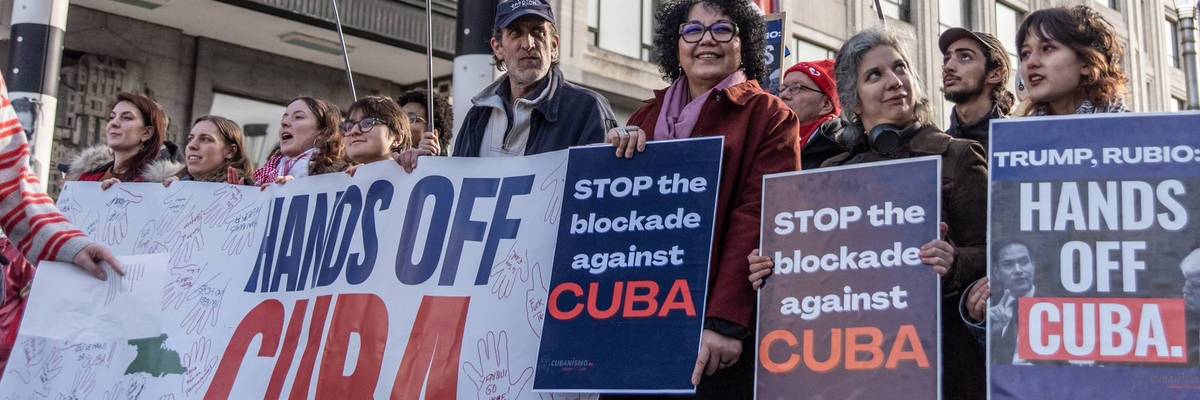
People protest the internationally condemned US blockade of Cuba and the Trump administration’s military threats against the socialist nation, in Brussels on February 7, 2026.

(Photo by Peter Mertens/X)

Brett Wilkins
Apr 15, 2026
COMMON DREAMS

Is Cuba next in line for a US attack?

US President Donald Trump has repeatedly said it could be, and USA Today on Wednesday cited “sources familiar” with the matter who said that the Pentagon is “quietly ramping up” preparations to wage war on the socialist nation if Trump gives the order.


Jayapal-Meeks Bill Would Block Trump From Using Federal Funds for Military Attack on Cuba


‘US Siege Is Warfare’: Cuba Faces Second Nationwide Blackout in Under a Week

On Monday, Trump flippantly declared that “we may stop by Cuba after we’re finished with this,” referring to the illegal US-Israeli war of choice on Iran that’s left thousands of Iranians dead or wounded, including hundreds of children.

Trump has also said that he believes he’ll “be having the honor of taking Cuba,” language echoing the 19th century US imperialists who conquered the island along with Puerto Rico and the Philippines from Spain in another war waged on dubious pretense.

“Whether I free it, take it—I think I can do anything I want,” Trump said of the island and its 11 million inhabitants.

The USA Today report—authored by Kim Hjelmgaard, Rick Jervis, and Francesca Chambers—sparked widespread alarm among advocates for peace.

“This is not a drill. Trump is preparing to take the US into another illegal war against Cuba to appease the Miami mafia,” Progressive International co-general coordinator David Adler said Wednesday on X. “We must stop him. It’s not too late.”

Cubans—who have been subjected to generations of privation and hardship due largely to the internationally condemned US economic embargo of their island—have mostly shrugged off Trump’s threats, with some observers noting that Cuba’s socialist era has outlasted a dozen American presidents.


Responding to a question about a possible US attack on his country, Cuban President Miguel Díaz-Canel said Sunday on NBC News’ “Meet the Press” that “if that happens, there will be fighting, and there will be a struggle, and we will defend ourselves, and if we need to die, we’ll die, because as our national anthem says, ‘Dying for the homeland is to live’.”

Numerous observers expressed shock, but not surprise, that Trump—the self-proclaimed “peace president” who has bombed 10 countries, more than any other US president—is setting his sights on Cuba, which American presidents since Thomas Jefferson have coveted.

Trump has been threatening Cuba since his first administration, when he systematically rolled back the Obama administration’s diplomatic normalization with the island’s socialist government. He also activated a provision of the Helms-Burton Act allowing lawsuits over property confiscated after the Cuban Revolution.

On the last day of his first term, Trump re-designated Cuba a state sponsor of terrorism, a move critics slammed as absurd given that Cuba has never carried out any acts of terrorism—unlike the United States and the militant Cuban exiles it harbors, who have a decadeslong record of terrorist bombings and other attacks, as well as numerous failed or aborted attempts to assassinate former revolutionary leader Fidel Castro.

Since returning to office, Trump has ratcheted up military threats and economic pressure on Cuba, which was already reeling from decades of US sanctions and the inefficiencies of centralized state control. Trump tightened the embargo by severely restricting fuel imports, exacerbating an energy emergency characterized by blackouts and deadly suffering among the most vulnerable Cubans, including sick people and children.

Last month, US Sens. Tim Kaine (D-Va.), Adam Schiff (D-Calif.), and Ruben Gallego (D-Ariz.) introduced a war powers resolution aimed at preventing Trump from attacking Cuba without congressional authorization as required by law. Numerous war powers resolutions related to Iran, Venezuela, and Trump’s extralegal high-seas boat bombings have failed to pass.


‘This Fight Is Nowhere Near Over,’ Privacy Advocates Warn After GOP Again Punts FISA Vote

“We won’t stop fighting for a self-evident truth: The government should not be able to bypass the courts to surveil Americans,” said one privacy campaigner.


US Speaker of the House Mike Johnson (R-La.) arrives for a caucus meeting in the US Capitol in Washington, DC on April 15, 2026.
(Photo by Bill Clark/CQ-Roll Call, Inc. via Getty Images)

Jessica Corbett
Apr 15, 2026
C0MMON DREAMS

A controversial federal spying power is set to expire next week, but Republican leadership in the US House of Representatives again delayed a reauthorization vote on Wednesday amid persistent demands for reforms from across the political spectrum.


President Donald Trump is pushing for a “clean” 18-month extension of Section 702 of the Foreign Intelligence Surveillance Act (FISA), which allows for warrantless spying on the electronic communications of noncitizens located outside the United States.

House Speaker Mike Johnson (R-La.) “canceled a vote scheduled for Wednesday evening... amid a hard-liner rebellion, making it more likely the program could expire in five days—but said the House would try again Thursday,” Politico reported.

As for whether there would be the necessary votes on Thursday to adopt a rule to proceed to consideration of the bill, Johnson said: “I think we will... We’re working through some final details.”

Although GOP leaders are plowing ahead with their reauthorization effort, Demand Progress senior policy adviser Hajar Hammado still welcomed the delay, declaring that “this time, fearmongering was not enough to overcome a bipartisan movement fighting for the privacy rights of all Americans.”

“We rarely ever see the full force of the White House and the intelligence agencies fail to browbeat Congress into giving them what they want,” Hammado noted. “That this happened today is a testament to the tireless work of our movement, which has been successfully bringing Republicans, Democrats, and Independents together for a common cause.”

“Of course, this fight is nowhere near over,” she added. “Speaker Johnson can still force a vote any time with extremely short notice, but our coalition feels the wind at our backs, and we won’t stop fighting for a self-evident truth: The government should not be able to bypass the courts to surveil Americans.”

Hammado’s group has been a leader in the growing coalition calling for reforms—including for lawmakers to close the “data broker loophole” that intelligence and law enforcement agencies use to buy their way around the Fourth Amendment to the US Constitution, which is supposed to protect Americans against unreasonable searches and seizures.

It’s not just congressional Republicans under pressure. Demand Progress Action and Fight for the Future took aim at House Intelligence Committee Ranking Member Jim Himes (D-Conn.)—who has signaled that he will support renewal and vote against adding privacy protections—with a Sunday print advertisement in the Connecticut Post.


On Tuesday, Congressional Asian Pacific American Caucus Chair Grace Meng (D-NY), Congressional Hispanic Caucus Chair Adriano Espaillat (D-NY), and Congressional Progressive Caucus Chair Greg Casar (D-Texas) spearheaded a letter to Democratic and Republican leaders in both chambers arguing that “this authority ought to include meaningful Fourth Amendment protections for Americans in its renewal package.”

“The Trump administration has demonstrated an unparalleled appetite for collecting and exploiting Americans’ personal data,” the caucus leaders and members wrote. “The administration has built profiles on American citizens, demanded that artificial intelligence (AI) companies assist in mass domestic surveillance, and paid hundreds of millions of dollars to build a megadatabase of Americans’ personal data. Without independent guardrails on Section 702, this administration has
repeatedly shown that it cannot be trusted to police its own use of this sweeping surveillance authority.”

Over 30 civil society organizations—including Demand Progress, Fight for the Future, Indivisible, Project On Government Oversight, RootsAction, and more—endorsed the congressional letter. POGO policy counsel Donald Bell commended the leadership of the caucuses “in seeking real guardrails and accountability that protect our constitutional rights,” while Hammado urged “all members of Congress to follow the lead” of the three groups.

Meanwhile, The American Prospect reported Monday that “the Congressional Black Caucus will quietly support an effort to reauthorize surveillance powers that were used to spy on Black Lives Matter activists in 2020,” which “comes after Rep. Gregory Meeks (D-NY), the powerful ranking member of the House Committee on Foreign Affairs, successfully lobbied CBC leadership to stand down on reforming the vast intelligence authority.”

After publication, Meeks told the outlet that “I support FISA reauthorization, but the only vote I’ve been whipping is my war powers resolution to end the war in Iran. Whip operations are traditionally conducted by the ranking member of the committee that has jurisdiction over the legislation being considered. Any claim that I’m whipping the CBC on FISA is false.”

In response to that reporting,Re Access Now, Fight for the Future, and STOP Spying NYC said in a joint statement that “if the heat of the glares aimed at Rep. Meeks right now could melt him, he’d be dripping like a snowman on the pavement in July. No one in Queens wants everybody in the federal government to have total access to the intimate details of their lives with the tap of a mouse.”

Highlighting the danger of continuing the spying power sans privacy protections as Trump’s Immigration and Customs Enforcement officers roam US streets, the groups said that “it is a total betrayal of the Fourth Amendment and the dignity of everyday people in this country to treat us all as if we are guilty until Big Brother Trump proves us innocent by watching our every move. And worse—it’s impossible to predict how these troves of records may be weaponized in the future against racial justice activists, trans and queer families, abortion patients and providers, anti-war activists, or anyone who acts out of step with MAGA.”

“It’s supposed to be the Foreign Intelligence Surveillance Act, not the Forever Indiscriminate Surveillance Act. Rep. Meeks’ colleagues are proposing real safeguards to protect people against this indiscriminate government surveillance,” the trio added. “He is not only failing his constituency, he is disrespecting them and putting them in danger. It’s not too late for Rep. Meeks to get on the right side of history.”

On US Tax Day, Socially Conscious Millionaires Say Make Us Pay More!

“We cannot hand over the keys to our democracy to people who are unwilling to address the economic injustices that exist today,” said Scott Ellis of the Patriotic Millionaires.

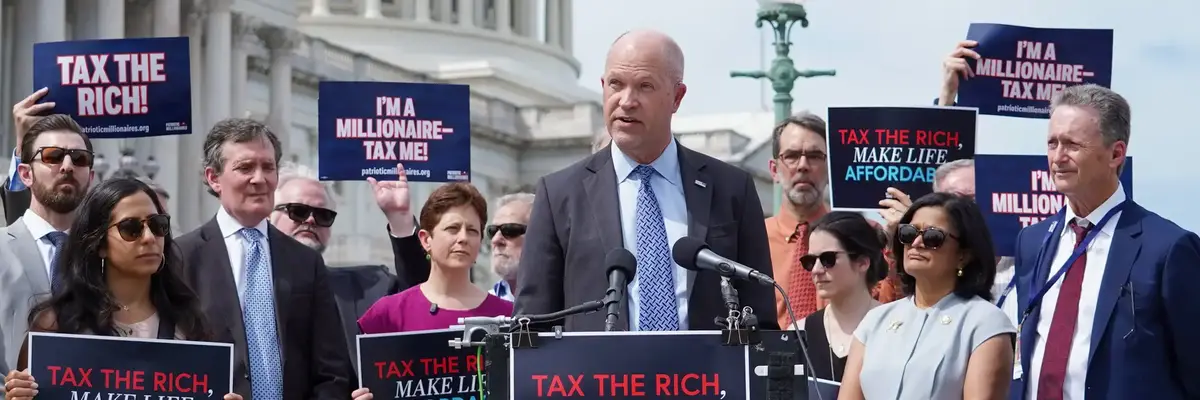
Scott Ellis of the Patriotic Millionaires joined other advocates and lawmakers for a rally calling to tax the rich on April 15, 2026 in Washington, DC.
(Photo by the Patriotic Millionaires/Bluesky)


Jessica Corbett
Apr 15, 2026

“Millionaires like me who want a rich, stable, free country demand an economy that ensures it. That begins with commonsense revenue raisers and tax reforms that stop the accumulation of oligarchic concentrations of wealth.”

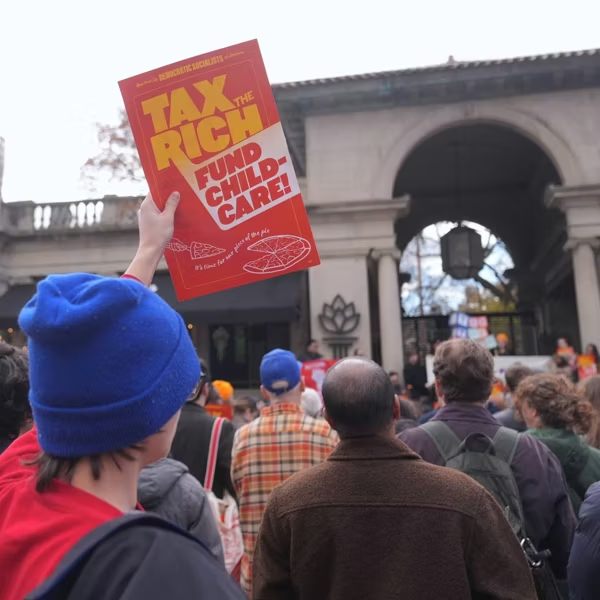
That’s what Scott Ellis of the Patriotic Millionaire said Wednesday—Tax Day in the United States—as he gathered with members of various organizations, plus Sens. Chris Van Hollen (D-Md.) and Ed Markey (D-Mass.), as well as Reps. Don Beyer (D-Va,), Chris Deluzio (D-Pa.), and Pramila Jayapal (D-Wash.), for a “tax the rich” rally on Capitol Hill.


‘The Current Tax Code Is Rigged,’ Plus 6.2 Trillion Other Reasons to Tax America’s Ultrarich

‘Taxing Billionaires Is Not Radical’: Mamdani Joins Top Economists to Denounce ‘Rigged’ US Tax System

“While I’ve seen examples of the good that wealth can do, I have also seen all the ways it can lead to irreparable harm to our personal, political, moral, and societal well-being,” said Ellis. “There is a level of wealth beyond which it threatens the health and even the existence of our democracy and our economy. We cannot hand over the keys to our democracy to people who are unwilling to address the economic injustices that exist today.”


Ellis said that he joined the lawmakers and others gathered “to urge our government leaders to deal with the money problem in our country head-on with solutions like those found in the Patriotic Millionaires’ MONEY Agenda platform. Every time inequality reaches extraordinary levels, we create a vulnerability to authoritarianism where money becomes power. If we want to unrig our economy, we need a bold, surprisingly simple economic vision.”

So far, two bills tied to the MONEY Agenda have been introduced in Congress: the Equal Tax Act, sponsored by Markey and Rep. Delia Ramirez (D-Ill.), and the Working Americans’ Tax Cut Act, spearheaded by Van Hollen and Beyer.

“Teachers, nurses, and millions [of] working people are paying more while getting less because our tax code is rigged to reward wealth over work,” Markey said in a statement. “The Equal Tax Act brings fairness to our tax code by requiring millionaires and billionaires to pay taxes on investment income the same way working people pay taxes. On Tax Day, I’m proud to work with Congresswoman Ramirez to fight for legislation that has the wealthy pay their fair share, and rewards work every bit as much as wealth.”

Van Hollen, meanwhile, said Wednesday that “my Working Americans’ Tax Cut Act creates a fairer system that ensures those who are stretching to make ends meet can keep more of what they earn, while asking the well-off to pitch in more. It’s long past time that we rebalanced our tax code to put working people first—and promote greater opportunity and shared prosperity for all.”


Deluzio used the “Tax the Rich, Make Life Affordable” rally to call out the agenda of elected Republicans—who control the White House and both chambers of Congress—and promote another bill led by Jayapal, Rep. Brendan Boyle (D-Pa.), and Sen. Elizabeth Warren (D-Mass.).

“Our government has a fiscal recklessness problem, and it looks like this: the richest people in the history of Earth facing lower tax rates than Americans who earn a paycheck,” said Deluzio. “Yet that is the Republican plan—jack up the national debt and slash healthcare and more for the American people to pay for these huge tax giveaways to corporations and the ultrarich. We need a vastly different approach, like passing the Ultra-Millionaires Tax to get some sanity back into our tax system.”

To illustrate just how broken the current system is, EJ Juárez, executive director of State Innovation Exchange, noted that “in 2025 alone, billionaire wealth grew 22%—from $6.7 trillion to $8.2 trillion—while working families see the cost of living go up, and wages too low. That is why SiX is working alongside state legislators across the country to lead the way.”

“Across all 50 states, lawmakers are advancing bold solutions to make the ultrawealthy pay what they owe, close corporate loopholes, and build tax systems that actually lower costs and empower working families,” Juárez said, nodding to initiatives in places such as California and Washington state. “Together, states are proving a better future is possible.”

Beyond Washington, DC, New York City Mayor Zohran Mamdani partnered with Nobel laureate in economics Joseph Stiglitz and Paris School of Economics professor Gabriel Zucman for a Tax Day op-ed calling out the “rigged” US tax code.

“The idea that billionaires should pay higher tax rates than working people is not radical,” the trio wrote for The Guardian. “What is radical is allowing a system where extreme wealth exists alongside widespread hardship—and where those billionaires can in effect opt out of contributing to the society that made their success possible.”


Hungary Defeated Authoritarianism and So Can We

For us fighting democratic backsliding, this is exceedingly consequential. Orbán wrote the authoritarian playbook now being used by Donald Trump; the people’s playbook used to oust him is a critical case study to learn from.

A devastated election poster with Hungarian Prime Minister Viktor Orban is seen at a bus stop at the parliamentary election day in Budapest, Hungary on April 12, 2026.
(Photo by Jakub Porzycki/NurPhoto via Getty Images)


Daniel Hunter
Apr 16, 2026
Waging Nonviolence


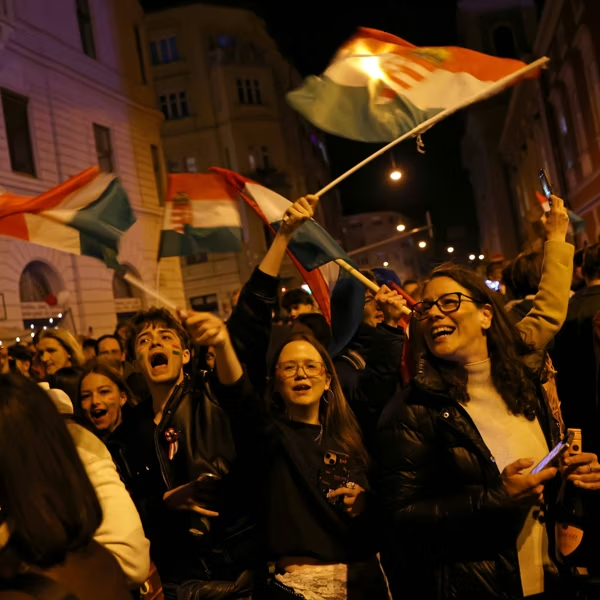
On Sunday night, the streets of Budapest were filled. Tens of thousands of Hungarians poured into the streets along the Danube River, singing folk songs and waving flags celebrating the end of Viktor Orbán’s rule. A young man named Mark Szekeres, his face painted with the colors of the Hungarian flag, told CBC News: “This election was about a clash of civilizations. Either you belong in a Western-type democracy or an Eastern-type dictatorship.”

For 16 years, Orbán controlled the country as the classic strongman. Orbán’s electoral defeat was sound—so much so that he conceded defeat before all the votes were counted. Péter Magyar’s Tisza Party captured more than 53% of the vote and approximately 136 of 199 parliamentary seats, a supermajority decisive enough to undo the constitution and other laws that Orbán rewrote. The turnout alone was a verdict: nearly 80% of all eligible voters.


For us fighting democratic backsliding, this is exceedingly consequential. Orbán wrote the authoritarian playbook now being used by Donald Trump and actively exported his approach, even giving Hungarian tax dollars to fund the Conservative Political Action Conference. The people’s playbook used to oust him is a critical case study to learn from—from how the opposition party organized in Orbán’s strongholds, to how they made repression backfire when he overreached, and more.

Informed by talking with people on the ground, I’m writing an outside take of lessons gleaned knowing we’ll need more analyses to make the most of our learning. Already D-HUB, a network of international anti-authoritarian activists, has vowed a more thorough case study after more study and reflection.

Authoritarians create four times as many economic crises—a threat very much in our sightlines in the US.

Orbán’s loss raises a question we all should learn from: How do you beat someone who has spent 16 years rigging the game?
Understand the Bad

To appreciate what happened Sunday, you have to understand just how thoroughly Orbán had slanted Hungarian political life toward authoritarian rule.

Within months of taking power in 2010, Orbán began systematically dismantling independent journalism. He encouraged his oligarch friends to buy media. He created a new state broadcaster, called MTVA, as a government mouthpiece. And his party created a Media Council—staffed by party loyalists—that issued crushing fines for “unbalanced” news that didn’t toe the party line.

By 2018, more than 470 pro-government outlets had been merged into a single conglomerate called KESMA—the Central European Press and Media Foundation—making the concentration of power official. Orbán’s party and friends eventually controlled roughly 80% of Hungary’s media landscape. “You can’t write anything bad about the government,” one anonymous Hungarian journalist told Al Jazeera.

Then the courts. Orbán passed a new constitution and forced 274 judges and prosecutors into early retirement in the first year alone. The judiciary became almost entirely a political instrument.

Then, most consequentially, he moved to rig elections: The maps were redrawn, and he gained control of independent institutions overseeing elections. Orbán shaped Hungary’s 106 electoral districts with no input from the opposition, concentrating urban voters into large districts while spreading out his rural voters into more districts. The results were staggering: In 2014, Orbán’s ruling party captured 45% of the vote—but 91% of the districts. “Free but not fair,” as the ever insightful John Oliver put it in his review of Orbán’s rule just ahead of the elections. “You are free to vote for anyone you want, whether it’s Orbán or whoever inevitably loses to him.”

Universities are often the birthplace of pro-democracy movements, and grinding them down was essential. The most famous casualty was Central European University, founded by George Soros, which was slandered and pushed out of the country. This was in line with right-wing and antisemitic attacks on anything Soros-related (even though Orbán had once received a Soros-funded scholarship).

And finally, he created imagined enemies of the state. Like every authoritarian, Orbán used divide-and-rule to create people to fear and keep his own growing scandals and corruption off the front page. Like most authoritarians of late, he chose LGBTQ people and immigrants as his primary scapegoats. George Soros, the EU, and Ukrainians were added to the roster of villains.

When President Trump sent Vice President JD Vance to campaign for Orbán, Vance followed Orbán’s escalating attacks on EU bureaucrats, who had voiced concerns about how Orbán’s re-election would affect the future of the EU. With no sense of irony, at his campaign stop Vance called the EU bureaucrats “one of the worst examples of foreign election interference that I have ever seen or ever even read about.”

So with that much control, how did Orbán lose? And so badly?
Tyranny Is Unstable

One reason dictatorships can be appealing, at least to some, is that they appear effective. To his supporters, Trump gets things done. While the democratic process is slow and grinding, the dictatorial one is about action. It breaks through red tape and fixes problems.

There’s truth in this, so far as democracy can be messy and dictatorships simple to understand. But it’s also mythical. Because a dictator doesn’t run a country—they order others to run a country.

Whereas power is traditionally seen as flowing downwards, in fact many pillars are required to hold it upright. These are groups and institutions—like media, religious institutions, the business community, civil servants, and security forces—that prop up the regime. In Thailand, where I first learned about this model of the “pillars of support,” it was drawn as an upside-down triangle.


A dictatorship is no exception. By keeping society functioning, these pillars support the regime, even if they may disagree with it in private.

It’s important to recognize that power is never as stable as it seems. It is not the natural state of humans to be dictated to.

As a parent of a 7-year-old, I can attest: Go to any playground and you will see a bunch of kids experimenting with ordering each other around. Kids don’t like being bossed around. So the wise ones learn how to ask, entice, convince. The bullies learn to just use fear.

The problem with ruling with fear is that it requires constant and ongoing pressure. It creates frustration from those who have been slighted, grudges get nursed and a level of control needs to be constantly applied.

Ahead of the election, many (but not all!) of the pillars propping up Orbán began to crack. The economy, the media stranglehold, and the manufactured fear—all began to crumble.
The Economy Was the Biggest Crack

Most activists I talked with described the Hungarian economy as Orbán’s primary vulnerability. Hungary has suffered the worst inflation of any EU country over the past 25 years. Prices rose 57% over that period—nearly double the EU average of 28%. The healthcare system deteriorated badly, with hospitals crumbling and doctors fleeing for better jobs. Hungary ranked last in the EU on household wealth in 2025.

This is common for authoritarians. We know instinctively that authoritarians do not take orders from polls or the number of people in the streets. As Rebecca Solnit beautifully put it, authoritarians view power as a “conquering army that would terrorize and intimidate the populace into subjugation”—as opposed to that of a flower, where “when you treat others well, when you meet their needs, you can enter into relationships that serve you as well as them.”

The outcome is that authoritarians ignore the pleas of the people. According to research from the Varieties of Democracy Institute, authoritarians create four times as many economic crises—a threat very much in our sightlines in the US. They spend 50% less on social protections like healthcare. Unresponsive to the needs of the people, they spend less on education, with students in school for fewer years, receiving lower quality instruction. All this adds up to life expectancies that are 12 years lower and infant mortality rates that are 62.5% higher. And, of course, corruption becomes the standard way of life.

As Hungarians struggled in all of these ways, Orbán’s friends grew rich. Video footage circulated of an estate owned by Orbán’s father with zebras grazing near it. It turned out that the zebras were from a nearby estate owned by Hungary’s richest man, who is also a close friend of Orbán—so they became a potent symbol of elite excess.

Stefania Kapronczay, a Hungarian human rights strategist, identified the core problem Fidesz faced: It thought it had a sales problem when it really had a problem with the product. “Instead of addressing [voters’] demands they resorted to creating enemies and being louder,” she explained. “The economy stalled in the past 4 years. The explanation that it’s somehow Brussels’ fault and soon there will be never-seen-before success rang empty. They also miscalculated how pro-European Hungarians are.”

Unable to campaign on any positive accomplishments, Orbán defaulted to fearmongering. As an analyst wrote in Foreign Policy, Orbán’s campaign was centered on “fantastical claims about Ukraine planning military actions against Hungary,” substituting conspiracy for governance. “After a while voters, especially moderates, become exhausted by constant messages of fear, hatred, and vituperation.”

But conditions alone do not dictate election outcomes. I’ve been running around the US telling the story of Zimbabwe. In the 2002 elections, President Robert Mugabe abducted activists and controlled elections. By the time the 2005 parliamentary election rolled around, a Zimbabwean colleague told me, “We’re already living in hell; it can’t get any worse.” The inflation rate had exceeded 100%. But Mugabe managed to buy and steal the election for his party again. By 2008 the economy had completely bottomed out with an unbelievable inflation rate: over 200 million percent. The colleague told me the same thing, “This time it can’t get any worse.” Still, Mugabe won—this time by attacking and torturing people so extensively that opposition candidate Morgan Tsvangirai withdrew from the race.

My point here is this: It can get a lot worse and that alone won’t change the electoral outcomes. Organizing, not conditions, is most important.
A Talented Candidate

The opposition party candidate who won the campaign, Péter Magyar, is not a left-wing hero. He was a loyal insider until 2024—an Orbán man through and through. He married a government minister.

His break came after a corruption scandal where—you guessed it—Orbán’s party pardoned a convicted accomplice in child sexual abuse.

Magyar went public on Partizán, an independent YouTube channel, revealing the rot at the center of Orbán’s “Christian nationalist” project. “For a long time I believed in an idea, the national, sovereign, civil Hungary,” he wrote. “Today, I had to realize that all of this is really just a political product, a frosting that serves only two purposes, covering up the operation of the power factory and acquiring enormous amounts of wealth.”

The lesson for Democrats—and for any opposition movement—is painfully direct: Running against the other side’s failures, without a clear and compelling alternative vision, leaves persuadable voters with nothing to vote toward.

His credibility as a defector—someone who had seen it from the inside—gave him a voice that no outside opposition figure could replicate.

He was also a masterful communicator. Unlike traditional politicians who attempt to govern at a distance, he regularly walked the country and held rallies in small towns that the opposition party had “sewn up.” For years, he went directly and repeatedly to Orbán strongholds. In the final weeks before the election, he was visiting up to six towns per day.

As Kapronczay observed: “Tisza won because they went all-in: did not stop campaigning, went around the country to meet people and with an amazing political talent reacted to all the mistakes of Fidesz.”

Magyar did not rely on an anti-Orbánism message. He talked regularly about corruption, healthcare, and everyday affordability—things people actually care about. Political analyst Zsuzsanna Végh of the German Marshall Fund described him as “focusing on policy responses, hitting a moderate tone, and giving back agency to voters to decide about their and their country’s future.” A regular campaign slogan was a call for a “humane Hungary.”

And while a bad dictator versus a strong candidate is a good combo, that alone would not suffice to win. Civil society had to play its role.
Tisza Islands: Organizing That Reached Everywhere

One of the most important tactical decisions of the opposition party, Tisza, was the creation of Tisza Szigetek, or “Tisza Islands.”

Beginning in mid-2024 after Magyar’s strong showing in European Parliament elections, the party began systematically building local chapters across the country—not just in Budapest’s liberal districts, but in the small towns and rural constituencies where Orbán’s party had historically been uncontested. By January 2025, social media analysis suggested there were 208 “islands” with over 20,000 members.

Inside the new chapters were a mix of brand new activists and experienced civic and political activists who had been working to reform Hungary for years. New and old, all were active supporters. They staffed campaign stalls. They distributed a volunteer-delivered newspaper called Tiszta Hang, or Clear Voice, launched in July 2025, specifically designed to reach rural voters who were only exposed to pro-Orbán media.

That last point matters. The Tisza Islands were not top-down campaign field offices. They functioned with genuine local autonomy. The party even held closed primaries for all 106 of its constituency candidates—an internal democratic process designed to give local members real ownership of who represented them.

Crucially, this meant that by election day, Tisza was able to deploy a breath-taking 50,000 activists as election monitors across the country’s polling stations. I’m hoping Hungarians will write more about this polling operation, to relay both how it was set up and its effectiveness in assuring a wary public that elections would hold. This was an historic, organized, and scaled effort of election protection.
Investigative Journalism Did What No Campaign Ad Could

One other piece multiple Hungarian activists have raised with me was the critical role of journalists.

Remember that Orbán controlled 80% of the country’s media. And yet, a handful of outlets—Partizán, Direkt36, Telex, 444, Magyar Hang—managed not only to survive but to land body blows in the final months of the campaign.

Partizán gave Magyar the interview that broke open the sexual abuse pardon scandal. Direkt36 broke the story of attempts by government-connected operatives to infiltrate Tisza’s digital infrastructure. Telex published an interview with a police whistleblower about the government’s attempt to send Hungarian troops to Chad. As Martón Kárpáti, the president of the board of Telex, described it: “This campaign showed the importance of the free media.”

A few people acting courageously opens the doors for more.

A key documentary—A Szavazat Ára, or The Price of the Vote—was released on March 26 by the investigative team at DE! Akcióközösség. Based on a six-month investigation, the film documented Orbán’s party’s systematic operation of vote buying and voter intimidation and coercion in impoverished rural communities. It showed that Orbán’s mayors controlled who got food, housing, and even drugs. Within days, the documentary had been watched 1.3 million times.

This weakened the intimidation network. For the first time, government loyalists felt that they might be exposed. As political scientist Gábor Toka noted, “Intermediaries are [now] far less confident that illegal activities won’t be investigated and punished.”

Ahead of the election, this led Euractic to conclude in a headline: “Hungary’s Independent Media Has Already Won the Election.”
The Public Shakes Off Fear

The June 2025 Budapest Pride parade was a classic backfire moment. Orbán had been escalating his war against LGBTQ folks for sometime. LGBTQ rights activists had been pushing back for years. But last summer his party took an extreme step and all but banned the Budapest Pride parade. His party enacted extremely tight rules on when and where and how the parade could proceed, wild police oversight, further restrictions under the pretense of “child protection,” and encouraged local authorities to deny event approvals entirely. It was an overreach, and the Pride parade swelled to massive numbers, with people clearly having fun and boldly proclaiming they would not let the government scare them off.

“The unsuccessful ban on the Pride parade was a clear sign of Fidesz’s inability to regain the political initiative,” wrote Hungarian journalist Pal Daniel Rényi. Ahead of the elections, the people had signaled that they were not going to be cowed. The massive parades exposed the government as out of ideas and increasingly disconnected from the public mood.

This kind of moment has been described by Turkish-American economist and political scientist Timur Kuran as an “unanticipated revolution”—a moment when an otherwise powerful political leader who seems to have full support suddenly has it evaporate.

Backfire happens when the public shakes off its fear, and the rift between the people and the authoritarian is revealed.
What Activists Should Take From This

Here, then, are eight points about what the defeat of Viktor Orbán offers to people doing the long, unglamorous, essential work of democracy defense.

1. You have to meet people where they actually live. The Tisza Islands model is a direct rebuke to opposition campaigns that organize from the cities outward or from the top downwards. Magyar’s team built physical, relational infrastructure in communities that had been written off—not because they expected to win every seat, but because showing up is the message. The act of going to rural Hungary, of knocking on doors in Fidesz strongholds, communicated something no television ad could: that people in those communities were worth fighting for. Any opposition movement that limits itself to mobilizing its existing base is already half-defeated.

2. Anti is not enough—you need a proposition. Magyar ran on corruption, yes, but he ran for something: affordability, public healthcare, housing, a “humane Hungary.” He hammered relentlessly on what Orbán’s rule had cost ordinary people in their daily lives. The lesson for Democrats—and for any opposition movement—is painfully direct: Running against the other side’s failures, without a clear and compelling alternative vision, leaves persuadable voters with nothing to vote toward.

3. Build for the long game, but deploy at election time. The underground LGBTQ organizing work and the Tisza Islands didn’t spring up in campaign season. They were built over many years, quietly, in communities across the country. Civil society organizations spent that same period building nonpartisan mobilization infrastructure, producing online videos, and recruiting election monitors. The 50,000 activists who showed up as poll watchers on election day didn’t materialize from nowhere—they were organized, trained, and ready. Democracy defense isn’t a sprint. It’s a marathon that occasionally demands a sprint.

4. Investigative journalism is infrastructure. This is perhaps the most striking lesson for movements in countries where independent media has been similarly squeezed. In a media environment where 80% of outlets are government-aligned, a handful of scrappy independent outlets broke stories that changed the trajectory of an election. The lesson isn’t just to support independent journalism (though that matters). It’s that, when coordinated with civil society organizing and election protection, investigative journalism creates a kind of immune system for democracy. When those functions work together, they become more than the sum of their parts.

5. Election protection is a form of power. Hungary’s activists understood something that is increasingly essential in systems where the electoral rules are rigged: You cannot simply outperform the fraud margin and hope for the best. You have to actively contest it. The 50,000 election monitors Tisza deployed were not passive observers—they reduced fear and combated intimidation. The documentary released weeks before the election served a similar function, activating public consciousness about what was happening in those rural constituencies. This combination—exposing the system, then flooding it with watchers—helped neutralize what had historically been a decisive advantage for Fidesz.

6. Plan for backfire. Yes, some moments just arise—in Hungary, wearing zebra costumes; in the US, frog costumes. But other moments are organized, such as the surge of people at the Budapest Pride parade. The folks at HOPE have created a curriculum to learn more about the dynamics of backfire. A key insight: Backfire isn’t automatic. Repression only sparks outrage when it’s seen, understood, and emotionally felt, which means movements have to actively expose injustice, frame it clearly, and help people connect the dots so what power tries to hide becomes impossible to ignore.

7. If you can only do one thing: Act courageously. Much of Orbán’s rule was marked by people publicly kowtowing. Timothy Kuran wrote a book called Private Truths, Public Lies about “preference falsification”—the idea that people fabricate their public preferences to match social pressure. When there’s enough social pressure, people conform—even if privately they disagree. This can generate a collective illusion that the authoritarian has broad support even when he doesn’t—until a sudden tipping point is reached and the whole facade collapses rapidly. Before that tipping point is reached, however, some individuals have to be very brave: acting noncooperatively, voicing dissent, organizing marches and protests, taking public stances, and going into strongholds to convince people they are being cheated. A few people acting courageously opens the doors for more.

8. Don’t let the perfect be the enemy of the winnable. Magyar is not a folk hero. He’s a politician who is, for now, best suited to dismantle Orbán’s authoritarian state. Magyar’s party does promote greater inclusion of women and Romani people in its platform. However, he remains socially conservative, and his history as an Orbán loyalist is more than cause for concern. But after left-wing parties failed to meet the moment, the people saw him as their best chance to defeat Orbán. Movements fighting authoritarianism will always face the tension between holding out for the ideal candidate and unifying behind the one who can actually win.
The Work Continues

As with any electoral win, the work is only started. Orbán still controls Hungary’s media. He packed the Constitutional Court. He built an economy of patronage and dependency that reaches into every village. Magyar’s supermajority gives them the constitutional power to undo much of what was done—but the institutions, the oligarchic networks, the culture of intimidation, will not dissolve the day Magyar is inaugurated.

For organizers, this is the sobering coda: Electoral victory is a door, not a destination. But on a Sunday night in Budapest, they earned a moment to celebrate. And we should take a lot of hope from that, too. As US organizer Ash-Lee Henderson noted in her response to Orbán’s loss: “I’m not trying to tell you that Hungary is America. It’s not. I’m telling you, though, that the math is similar everywhere. There are always more of us than there are of them. The question is never whether the people have the power. The question is whether we build something worth moving for.”


This work is licensed under a Creative Commons Attribution-Share Alike 3.0 License.


Daniel Hunter
Daniel Hunter coaches and trains movements across the globe and is a founder of Choose Democracy. He has trained extensively with ethnic minorities in Burma, pastors in Sierra Leone, and independence activists in northeast India. He has written multiple books, including "What Will You Do If Trump Wins,” "Climate Resistance Handbook," and "Building a Movement to End the New Jim Crow."
Full Bio >
NAKBA2.0

Israeli Journalist With Deep Ties to IDF Admits West Bank Violence ‘Looks Like... Ethnic Cleansing’

West Bank settler attacks on Palestinians are “rather sophisticated, organized, and funded systematic actions,” with the goal of “cleansing” the entire region, said journalist Ron Ben-Yishai.


An Israeli settler from the new outpost of Karmel records movements in the Palestinian village of Um el-Kheir on April 14, 2026.
(Photo by Hazem Bader / AFP via Getty Images)


Brad Reed
Apr 16, 2026
COMMON DREAMS

An Israeli war correspondent who has been described as having deep ties to the Israel Defense Forces said that intensifying settler violence in the occupied West Bank appears to be “ethnic cleansing.”

In an column published by Ynet titled “This looks like blue and white ethnic cleansing,” journalist Ron Ben-Yishai wrote that, during a recent tour of the West Bank, he observed “a disturbing reality” of Israeli teenagers “who go on ‘intimidation tours’” in Palestinian villages, attacking Palestinians while members of the Israeli military frequently either stand by or actively join in the attacks.


Assault on Journalists Shows How Israeli Military Acts ‘In Service of The Settler Movement’: CNN Reporter

“In some cases, these are reservists who also identify ideologically with the rioters, and therefore stand by and do not prevent them from going wild—and sometimes even help them,” explained Ben-Yishai. “Even in the regular IDF units stationed in the territories, there have been quite a few cases in which commanders and fighters have deviated from the norms and the IDF’s code of ethics for religious-nationalist reasons.”

In conversations with Israeli settlers, Ben-Yishai often found that they believed they were entitled by God to take all land where Palestinians reside.

“The confident reliance on God’s command as the answer to all moral and practical questions and concerns,” he wrote, “gave me a disturbing feeling that this was a type of Jewish terrorism motivated by religious and nationalist motives.”

Ben-Yishai also described ways in which Israeli settlers surround Palestinian communities “in order to prevent them from moving freely and strangle them economically.”

Taken as a whole, Ben-Yishai concluded that the Israel settler attacks on Palestinians are a “rather sophisticated, organized, and funded systematic actions—with the long-term strategic goal being to ‘cleanse’ most of” the West Bank and Gaza of Palestinian presence.

In a social media post, geopolitical analyst Shaiel Ben-Ephraim explained how significant it was for someone like Ben-Yishai, whom he said has “the deepest ties to the IDF of any reporter,” to describe West Bank settlers’ actions as ethnic cleansing.

“Observers have been saying for years that what is happening in the West Bank is ethnic cleansing,” he wrote. “But now voices from the heart of the Israeli consensus are admitting it as well.”
Human Rights Groups Demand Ireland Stop Letting Trump Use Airport for ‘Unlawful’ ICE Flights

“If Ireland is facilitating the monstrous ICE project, then we fear the government has lost its way. Rather than cower and capitulate, it must show courage, compassion, and principle,” said the head of Amnesty International Ireland.


A group of detainees board an Eastern Air Express flight at Minneapolis-St Paul International Airport on January 11, 2026 in Minneapolis, Minnesota. At least five of these deportation flights have refueled at the Shannon Airport in Ireland.
(Photo by Stephen Maturen/Getty Images)

Stephen Prager
Apr 16, 2026
COMMON DREAMS

A pair of human rights groups on Thursday called for the Irish government to stop letting the administration of US President Donald Trump use Shannon Airport as a refueling stop for Immigration and Customs Enforcement’s deportation flights.

In a joint letter to Ireland’s transport minister, Darragh O’Brien, and foreign affairs and trade minister, Helen McEntee, Amnesty International Ireland and Human Rights First urged the Irish government to stop cooperating with President Donald Trump’s efforts to deport migrants to third countries.

Using data from its ICE Flight Monitor, Human Rights First determined that Shannon Airport has been used to refuel deportation planes during at least five of these removal operations, which involved what the groups described as “transfers of individuals to countries... they have no ties to and where they have faced arbitrary and prolonged detention and other abuse.”

After one of the flights in May 2025, eight migrants from several countries, including Cuba, Mexico, Myanmar, Laos, Vietnam, and Sudan—some of whom had legally been resettled as refugees—were dropped in the East African nation of Djibouti. There, they were held in a shipping container at a US base for at least six weeks before being sent to war-torn South Sudan, where they were promptly detained by authorities. Six of them remain in detention today, with little ability to communicate with their lawyers.

Another group of five men from Cuba, Yemen, Vietnam, and Laos was taken to the southern African country of Eswatini in July. Four of them remain in state custody more than eight months later, despite the authorities giving no official reason for their ongoing detention.

Another flight stopped in Ireland on its way back from dumping eight Palestinian men, who were shackled for the entire journey, on the side of the road in the occupied West Bank. Some of the men had green cards in the United States, and several had wives and children from whom they had been forcibly separated, despite facing no accusations of having committed a crime. Two such flights have taken place.

In total, the groups found that at least 28 migrants had traveled through the Shannon Airport on their way to third countries.

About 300 migrants have been sent to third countries as part of the Trump administration’s “mass deportation” campaign, according to a February report by Democrats on the Senate Foreign Relations Committee.

The administration has spent more than $40 million, part of which has gone to countries willing to take in deportees, including Equatorial Guinea, Rwanda, El Salvador, Eswatini, and Palau, each of which has received multimillion-dollar lump sums.Most infamously, the administration last year secretly sent more than 280 young men, most without criminal records, to the Terrorism Confinement Center (CECOT), a megaprison in El Salvador, where they were subjected to torture and cut off from communication with their families and lawyers for more than four months before a judge ordered most of them released.

Amnesty and Human Rights First have described this practice as a form of “enforced disappearance” under international law.

“To carry out its mass deportation campaign, the Trump administration is flouting international law and cutting deals with dictators. It is also endangering lives, through its opaque web of third country agreements to send people against their will to countries where they have no connection”, said Uzra Zeya, the CEO of Human Rights First.

“Beyond their cruelty, these agreements reflect a transactional foreign policy driven by xenophobia, and they undermine due process and human rights globally,” she said. “Ireland should play no part in facilitating these unlawful removals, including to third countries notorious for rights abuses.”

Shannon Airport has become a target of protest over its use as a hub for American military planes, which many in Ireland see as an affront to the country’s long history of military neutrality. It has previously come under scrutiny for helping transport detainees renditioned for torture by the CIA during the post-9/11 global War on Terror.

Last week, a man was arrested for allegedly breaking into the facility and damaging a US military plane that was en route to a bilateral military exercise in Poland, according to The New York Times. Though no motive has been made public, the incident evoked other acts of vandalism by anti-war activists opposed to the US military presence.

“People across Ireland and the world look on in horror as the Trump administration continues implementing its vile, racist, and xenophobic executive orders that dehumanize and criminalize people who are, or are perceived to be, migrants and refugees. The administration has brazenly violated the right to due process by unlawfully removing people and subjecting some to enforced disappearance,” said Stephen Bowen, the executive director of Amnesty International Ireland.

Following a request last month for it to stop US deportation flights from using Shannon to refuel, Ireland’s Department of Transport contended that under the 1944 Chicago Convention on International Civil Aviation, US aircraft do not require permission to refuel at Shannon. Transport Minister O’Brien has said the US did not request authorization for the flights to land and that his department had no knowledge of them.

But Bowen says that even though states are not required to obtain permission to land, the convention still requires them to abide by international law, and that the Irish government ultimately has the power to decide how its sovereign airspace is used.

“The Department of Transport’s public responses are just not good enough,” he said. “There are depressing parallels with Ireland’s failure two decades ago to stop CIA-leased civil aircraft using Shannon as a stopover for rendition operations during the US ‘War on Terror’. Despite promises to ‘enforce the prohibition on the use of Irish airspace, airports, and related facilities for purposes not in line with the dictates of international law’, it appears that no concrete actions were ever taken.”

“The government’s timidity in its dealings with President Trump is already a cause for concern,” Bowen added. “If Ireland is facilitating the monstrous ICE project, then we fear the government has lost its way. Rather than cower and capitulate, it must show courage, compassion, and principle.”