Thursday, January 22, 2026

THE GRIFT

Who is joining Donald Trump's 'Board of Peace'?

AUTOCRATS,  ARISTOCRATS & AUTHORITARIANS JOIN THE FASCIST INTERNATIONAL


Issued on: 22/01/2026 - FRANCE24

US President Donald Trump has signed the founding charter of “Board of Peace” at Davos. The Board will be indefinitely chaired by Trump, who will have “exclusive authority to create, modify or dissolve subsidiary entities”. Here's who is participating.

Video by: Elitsa GADEVA


About 30 countries expected to join Trump's 'Board of Peace'
Issued on: 22/01/2026 
US President Donald Trump has unveiled his “Board of Peace,” a $1 billion initiative aimed at resolving international conflicts through permanent membership. Initially designed to oversee Gaza’s reconstruction, a draft of the board’s charter suggests its mandate could extend beyond the Palestinian territory. France24 Senior reporter James André shares his insights.
Video by: James ANDRE

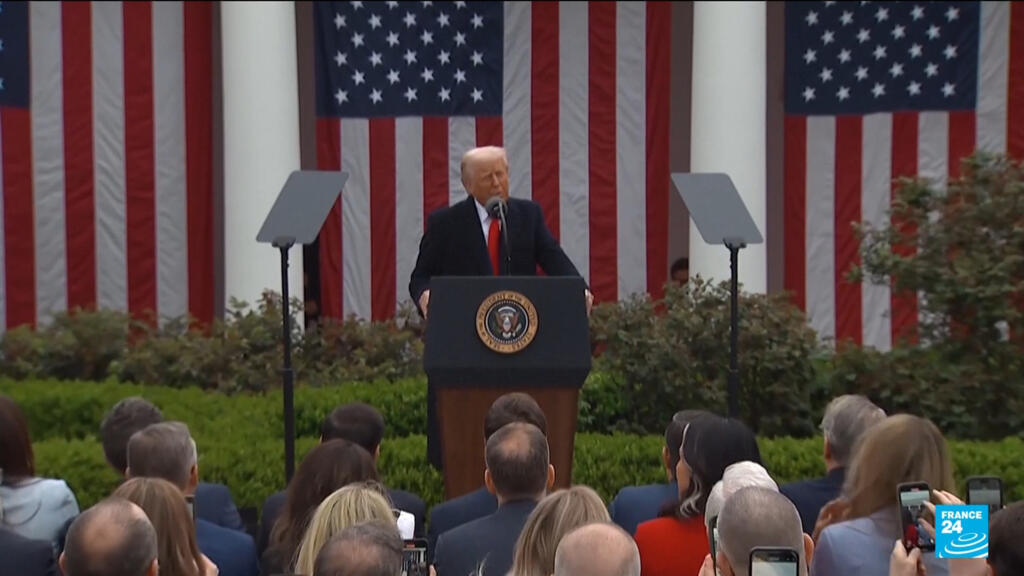
Trump launches 'Board of Peace' at Davos signing ceremony

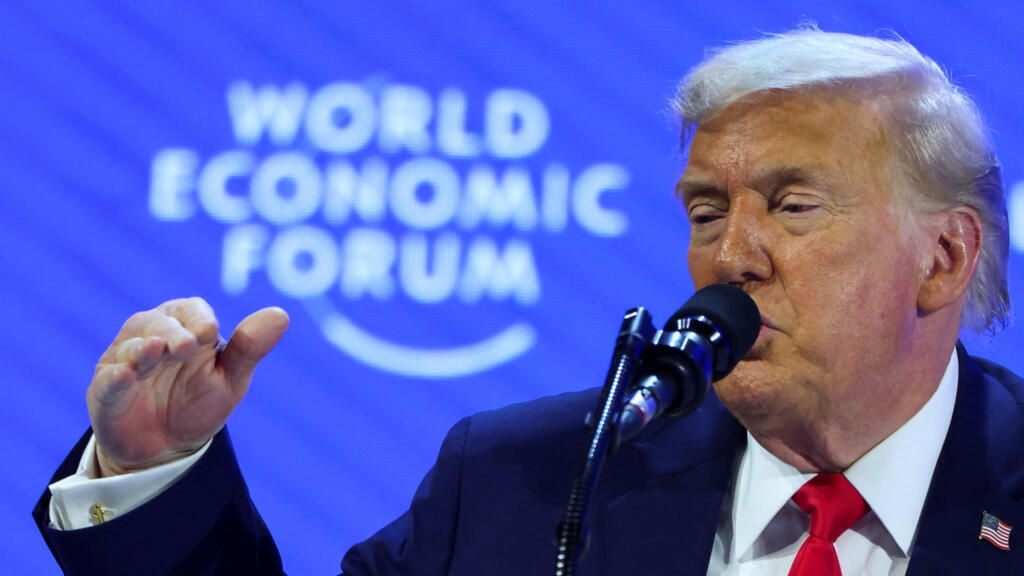
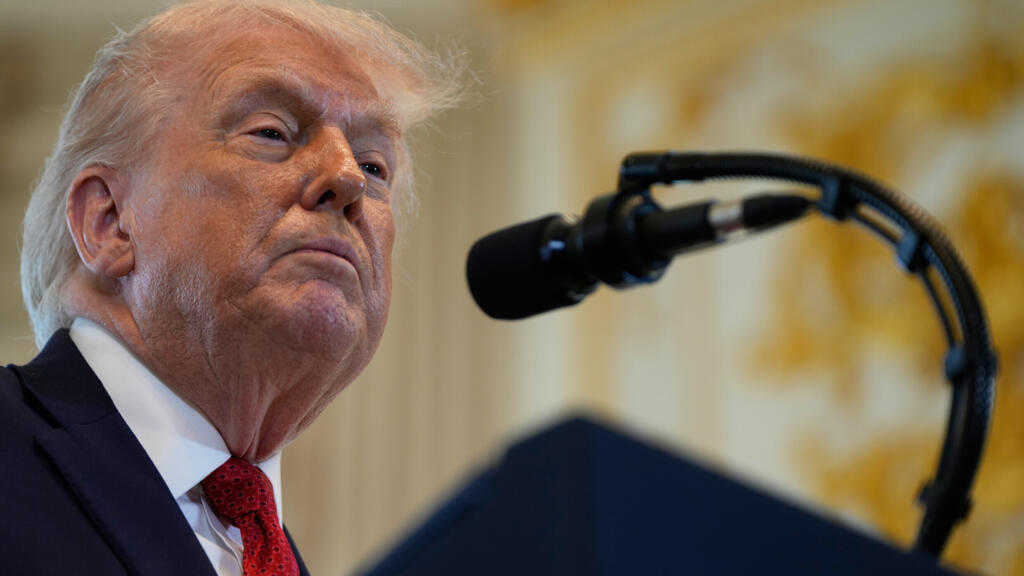
US President Donald Trump speaks at a Board of Peace charter announcement during the Annual Meeting of the World Economic Forum in Davos, 22 January 2026
Copyright Markus Schreiber/Copyright 2026 The AP. All rights reserved


By Aleksandar Brezar
Published on 

The board originated in the US president's 20-point Gaza ceasefire plan endorsed by the UN Security Council, but has expanded far beyond its initial mandate.

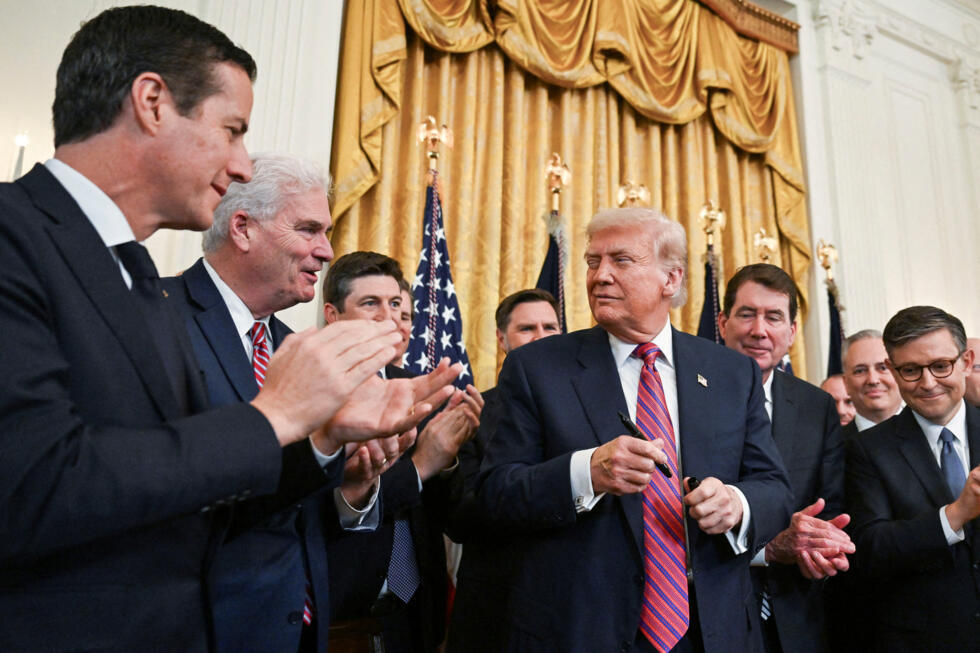
US President Donald Trump signed the charter to formally launch his "Board of Peace" initiative in Davos on Thursday, calling it a "very exciting day, long in the making".

"We're going to have peace in the world," Trump announced. "And we're all stars."

"Just one year ago the world was actually on fire, a lot of people didn't know it," Trump said in his opening speech. Yet "many good things are happening" and the threats around the world "are really calming down," the US president said.

Flanked by leaders of the board's founding member countries — including Argentinian President Javier Milei and Hungarian Premier Viktor Orbán — Trump also praised the work of his administration, "settling eight wars," and added that "a lot of progress" has been made toward ending Russia's all-out war in Ukraine.

He then took a moment to thank the heads of state in attendance. "We are truly honoured by your presence today,” Trump said, stating they were "in most cases very popular leaders, some cases not so popular.”

"In this group I like every single one of them," Trump quipped.

US Secretary of State Marco Rubio was next to praise the Board of Peace as “a group of leaders that is about action” and credited Trump for bringing it together.

“He’s not limited by some of the things that have happened in the past, and he’s willing to talk to or engage with anyone in the interest of peace,” Rubio said.

Rubio stressed the body’s job “first and foremost” is “making sure that this peace deal in Gaza becomes enduring.” Then, Rubio said, it can look elsewhere.

With details of the board’s operations still unclear, Rubio described it as a work in progress.

“Many others who are going to join, you know, others either are not in town today or they have to go through some procedure internally in their own countries, in their own country, because of constitutional limitations, but others will join,” Rubio said.

'Most prestigious board ever'

Trump has previously described the newly-formed body as potentially the "most prestigious board ever formed."

The project originated in his 20-point Gaza ceasefire plan endorsed by the UN Security Council but has expanded far beyond its initial mandate.

Approximately 35 nations had committed to joining while 60 received invitations, according to Trump administration officials. The president suggested the board could eventually assume UN functions or render the world body obsolete.

"We have a lot of great people that want to join," Trump said during a Wednesday meeting with Egyptian President Abdel-Fattah el-Sisi, whose country confirmed membership.

Some leaders required parliamentary approval before committing, while uninvited nations were asking to be included, according to Trump.

Trump also defended inviting Russia's Vladimir Putin — who said he was consulting with "strategic partners" over Moscow's involvement — and strongman figures such as Belarus' Aliaksandr Lukashenka, saying he wanted "everybody" who was powerful and could "get the job done".

Several European allies declined participation. Norway, Sweden and France rejected invitations, with French officials expressing concern that the board might replace the UN as the world's main venue for conflict resolution, while affirming support for the Gaza peace plan itself.

Slovenian Prime Minister Robert Golob said "the time has not yet come to accept the invitation," citing worries the mandate was overly broad and could undermine international order based on the UN Charter, according to STA news agency.

Canada, Ukraine and China had not indicated their positions. Israeli Prime Minister Benjamin Netanyahu agreed to join on Wednesday.

The UK said it would not sign the treaty at Trump's ceremony over concerns regarding the invitation to Putin, British Foreign Secretary Yvette Cooper said.

One billion dollar fee

Countries seeking permanent membership face a $1 billion contribution fee, with Trump designated as permanent chairman even after leaving office, according to a copy of the charter obtained by media outlets. Non-paying members would have a three-year mandate.

Trump's peace initiative follows threats of military action against Iran this month during violent government crackdowns on large street protests that killed thousands. The president signalled no new strikes after receiving assurances that Tehran would not execute detained protesters.

Trump argued his aggressive Iran approach, including June strikes on nuclear facilities, proved essential for achieving the Israel-Hamas ceasefire. Iran served as Hamas' primary backer, providing hundreds of millions in military aid, weapons, training and financial support over the years.

"If we didn't do that, there was no chance of making peace," Trump said.

Meanwhile, Ukrainian President Volodymyr Zelenskyy arrived in Davos on Thursday morning with Trump expressing frustration with both Zelenskyy and Putin over their inability to end the nearly four-year w

"I believe they're at a point now where they can come together and get a deal done," Trump said. "And if they don't, they're stupid — that goes for both of them."


Donald Trump’s ‘board of peace’ looks like a privatised UN with one shareholder: the US president


The US president claims to have ended eight wars. 
Steve Travelguide/Alamy Live News


 January 21, 2026 
THE CONVERSATION 

It is hard to believe that Donald Trump has only been back in the White House for a year. His accomplishments are many – but most of them are of questionable durability or benefit, including for the United States.

Even his UN-endorsed 20-point ceasefire and transition plan for Gaza released on September 29 2025 is now in danger of being subsumed in yet another grandiose fantasy of the American president: the so-called “board of peace” to be chaired by Trump.

This group of international dignitaries was originally intended to oversee the work of a more technical committee, comprising technocrats responsible for the day-to-day recovery and rebuilding of Gaza. But the board of peace’s charter makes no mention of Gaza at all.

Instead, its opening sentence declares that “durable peace requires pragmatic judgment, common-sense solutions, and the courage to depart from approaches and institutions that have too often failed”.

To make this break with such an unseemly past, the board of peace proclaims itself to be “an international organization” to “secure enduring peace in areas affected or threatened by conflict” and commits to conducting its operations “in accordance with international law”.

To which the immediate reaction is that unilateralism is increasingly the hallmark of Trump’s second administration. Settling conflicts is the prerogative of the UN. And, over the past year, the US has shown itself to be unconcerned about international law.

Membership of the board is by invitation from the chairman: Donald Trump – who has broad and flexible discretion on how long he will serve for and who will replace him when he does decide to go. Those invited can join for free for three years and buy themselves a permanent seat at the table for US$1 billion (£740 million) – in cash, payable in the first year.

With Trump retaining significant power over the direction of the board and many of its decisions it is not clear what US$1 billion would exactly buy the permanent members of the board – except perhaps a chance to ingratiate themselves with Trump.

There is no question that established institutions have often failed to achieve durable peace. Among such institutions, the UN has been a favourite target for Trump’s criticism and disdain, as evident in a recent directive to cease participating in and funding 31 UN organisations. Among them were the peace-building commission and the peace-building fund, as well as office of the special representative for children in armed conflict.

Is this the end for the United Nations?

The deeper and more tragic irony in this is threefold. First, there is strong evidence that the UN is effective as peace builder, especially after civil war, and that UN peacekeeping does work to keep the peace.

Second, there is no question that the UN does not always succeed in its efforts to achieve peace. But this is as much, if not more often, the fault of its member states.

There’s a long history of UN member states blocking security council resolutions, providing only weak mandates or cutting short the duration of UN missions. They have also obstructed operations on the ground, as is evident in the protracted crisis in Sudan, where the UN endlessly debates human suffering but lacks most of the funds to alleviate it.

Third, even though he is unlikely to ever admit it publicly, Trump by now has surely found out for himself that making peace is neither easy nor straightforward despite his claim to have solved eight conflicts.

And the more so if the “pragmatic judgement” and “commonsense solutions” that the charter to his board of peace subscribe to end up being, as seems likely, little more than a thin disguise for highly transactional deals designed to prioritise profitable returns for an America-first agenda.
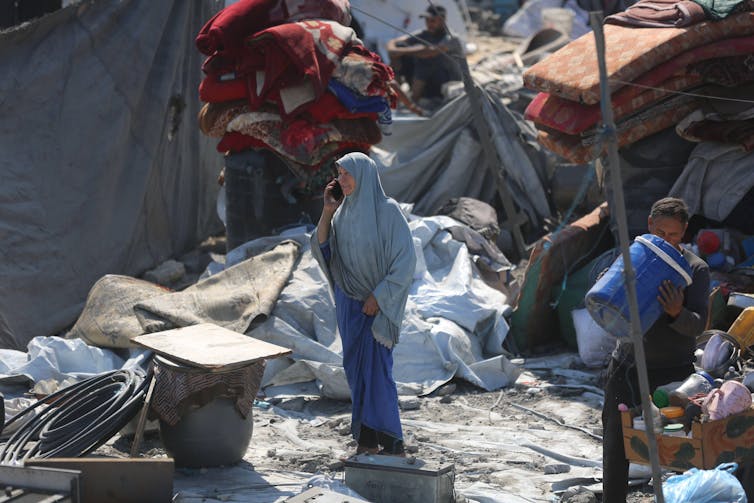
The charter of the board of peace says nothing about Gaza.
\Omar Ashtawy apa

Part of the reason why the UN has success as a peacemaker and peacebuilder is the fact that it is still seen as relatively legitimate. This is something that is unlikely to be immediately associated with Trump or his board of peace if it ever takes off.

Such scepticism appears well founded, particularly considering that among the invitees to join the board is the Russian president, Vladimir Putin, who is not particularly well known for his love of peace. Even Trump, on rare occasions, admittedly, seems to have come to this realisation. But it did not stop him from inviting Putin to join the board of peace.

What’s in it for Trump?

So, what to make of it all? Is it just another of Trump’s controversial initiatives that he hopes might eventually earn him the Nobel peace prize after all? Is it merely a money-making opportunity for Trump personally, or is it designed for his political and corporate allies, who might benefit from projects implemented by his board of peace? Ultimately, it might be any of these.

The real question needs to be about the consequences for the current system. What Trump is effectively proposing is to set up a corporate version of the UN, controlled and run by him. That he is capable of such a proposal should not come as a shock after 12 months of Trump 2.0.

More surprising is the notion that other political leaders will support it. This is one of the few opportunities they have to stop him in his tracks. It would not be a cost-free response, as the French president, Emmanuel Macron, has found when he did not appear sufficiently enthusiastic and Trump threatened the immediate imposition of 200% tariffs on French wine.

But more leaders should consider whether they really want to be Trump’s willing executioners when it comes to the UN and instead imagine, to paraphrase a well-known anti-war slogan, what would happen if Trump “gave a board of peace and no one came?”


Author
Stefan Wolff
Professor of International Security, University of Birmingham
Disclosure statement
Stefan Wolff is a past recipient of grant funding from the Natural Environment Research Council of the UK, the United States Institute of Peace, the Economic and Social Research Council of the UK, the British Academy, the NATO Science for Peace Programme, the EU Framework Programmes 6 and 7 and Horizon 2020, as well as the EU's Jean Monnet Programme. He is a Trustee and Honorary Treasurer of the Political Studies Association of the UK and a Senior Research Fellow at the Foreign Policy Centre in London.


Trump charges $1 billion for permanent seat on Gaza ‘Board of Peace’, invites Russia’s Putin

A permanent seat on US President Donald Trump's "Board of Peace" aimed at resolving conflicts will cost countries $1 billion each, according to its charter. Invited world leaders include Russian President Vladimir Putin, Hungarian premier Viktor Orban and Canadian Prime Minister Mark Carney.


Issued on: 19/01/2026 - 
By: FRANCE 24
President Donald Trump at his Mar-a-Lago Club in Palm Beach, Florida, Friday on January 16, 2026. © Julia Demaree Nikhinson, AP
01:52


US President Donald Trump's government has asked countries to pay $1 billion for a permanent spot on his "Board of Peace" aimed at resolving conflicts, according to its charter, seen Monday by AFP.

The White House has asked various world leaders to sit on the board, chaired by Trump himself, including Russian President Vladimir Putin, Hungarian premier Viktor Orban and Canadian Prime Minister Mark Carney.

Member countries – represented on the board by their head of state – would be allowed to join for three years – or longer if they paid more than $1.0 billion within the first year, the charter says.

"Each Member State shall serve a term of no more than three years from this Charter's entry into force, subject to renewal by the Chairman," the board's draft charter says.
Trump tariff policies © FRANCE 24
01:47


"The three-year membership term shall not apply to Member States that contribute more than USD $1,000,000,000 in cash funds to the Board of Peace within the first year of the Charter's entry into force."

The board was originally conceived to oversee the rebuilding of Gaza, but its charter does not appear to limit its role to the occupied Palestinian territory.

The White House said there would be a main board, a Palestinian committee of technocrats meant to govern devastated Gaza, and a second "executive board" that appears designed to have a more advisory role.

"The Board of Peace is an international organization that seeks to promote stability, restore dependable and lawful governance, and secure enduring peace in areas affected or threatened by conflict," the charter says.

'Failed institutions'

It appears to take a swipe at international institutions such as the United Nations, saying that the board should have "the courage to depart from approaches and institutions that have too often failed."

Trump has regularly criticized the United Nations and announced this month that his country will withdraw from 66 global organizations and treaties – roughly half affiliated with the UN.

Membership of the board would be "limited to States invited to participate by the Chairman," according to the draft charter.

Trump would have the power to remove member states from the board, subject to a veto by two-third of members, and choose his replacement should he leave his role as chairman.

The "Board of Peace" began to take shape on Saturday when the leaders of Egypt, Turkey, Argentina and Canada were asked to join.

Trump also named as members Secretary of State Marco Rubio, former British prime minister Tony Blair, senior negotiator Steve Witkoff and his son-in-law Jared Kushner.

Israel has objected to the line-up of a "Gaza executive board" to operate under the body, which includes Turkish Foreign Minister Hakan Fidan and Qatari diplomat Ali Al-Thawadi.

(FRANCE 24 with AFP)


Will Trump's 'board of peace' in Gaza really rival the UN?


Issued on: 20/01/2026 
FRANCE24

Play (05:22 min)


PRESS REVIEW – Tuesday, January 20: Donald Trump's "board of peace" in Gaza aims to oversee the peace process between Israel and Hamas, but critics say he intends to create a rival body to the UN. Also, the Italian dailies pay tribute to the "ultimate emperor" of Italian fashion, Valentino, who has died aged 93. The Beckham family's disputes are the focus of the British tabloids. Finally, an Austrian cow proves that the animals are extremely intelligent.

We begin with Donald Trump's so-called board of peace in Gaza. Officially, the board aims to oversee the ceasefire between Israel and Hamas in Gaza, as The New York Times reports. Trump sent out letters of invitations last week to "historically close" US allies like Canada and France, but also Russia and Belarus. The charter of the board indicated a desire to get involved in all types of global conflicts, beyond just Gaza. As the Times notes, this is why critics fear the board is set up to rival the UN. So far, only a handful of Trump-allied countries have RSVPd positively.

There is a catch, of course. Countries that agree to join the board can serve for three years, but that can be permanent if they agree to pay $1 billion in cash to the board. The Wall Street Journal calls it Trump’s "One-billion-dollar diplomacy club." The charter doesn't say how these funds will be used and by whom. But of course, Trump would have overriding powers to veto and revoke membership. Despite overseeing Gaza, the board does not have any Palestinian members yet. French President Emmanuel Macron says France doesn't plan to join. This prompted Trump to threaten a 200 percent tax on French champagne and wine. The Guardian's Owen Jones is outraged about the council, which he calls an "appalling neocolonial project". The fact that not a single seat is reserved for a Palestinian, he says, shows that Trump aims to play the role of "Gaza’s emperor."

We move on to a man the Italian dailies are calling an emperor: fashion designer Valentino Garavani, who has passed away in Rome at 93. Valentino was known mononymously and dressed royals, Hollywood stars and first ladies. The tributes are pouring in for a man who defined Italian fashion. La Repubblica calls him the "ultimate emperor." Il Giornale calls him "Saint Valentino" and bids adieu to a "man who defined style." "Red Paradise," La Stampa says, alluding to the colour that defined Valentino and his designs, even becoming known for the Valentino Rosso shade. Il Messagero says "Roma in the world". Valentino set up his fashion house in the Italian capital in 1960.

Next, there's trouble in paradise for the Beckham family, whose family spats are playing out in the British tabloids. Brooklyn Beckham, the eldest son of David and Victoria Beckham, broke his silence on social media about a growing rift within his family. He laid it on thick and fast and has disowned his parents, the Daily Star reports. He accused his parents of being obsessed with the family name and publicity, accused his mother of being too controlling, of disrespecting his wife, of humiliating him during his wedding and of trying to bribe him to sign away the rights to his family name. The tirade is as extraordinary as it is rare these days. "Brooklyn goes nuclear," the Daily Mail says on its front page

Finally, scientists are astounded by a discovery about the intelligence of cows and they can thank Veronika, a beautiful brown cow living peacefully in the Austrian Alps. She recently demonstrated an "impressive and until now undocumented" knack for tool use, the Guardian reports. Veronika was observed using a stick to scratch her back – this tool use was previously only seen in humans and chimpanzees. Researchers discovered that she could also pick up a broom and wield it according to the job at hand. It's proof that cows are much more intelligent than we give them credit for!
AMERIKA'S MAD KING DJTRUMP
Trump covets Greenland, insults allies and talks up US economy at Davos


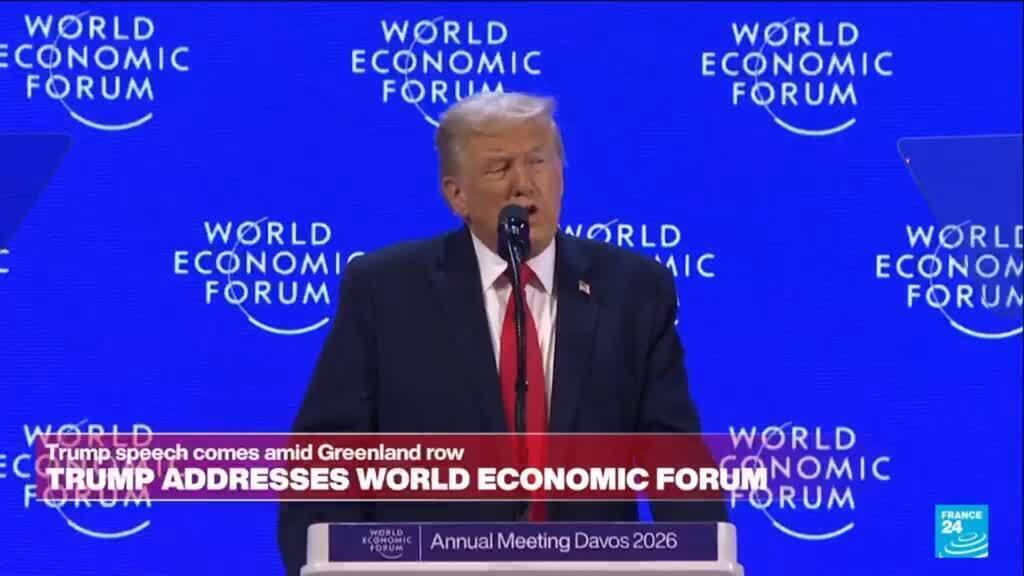
US President Donald Trump arrived at the Economic World Forum in Davos on Wednesday, where he used his keynote speech to hector world leaders in the audience, boast about his domestic policies and reiterate claims that Washington should own Greenland.


Issued on: 21/01/2026 
By: FRANCE 24


US President Donald Trump speaks at the 56th annual World Economic Forum (WEF) meeting in Davos, Switzerland, on January 21, 2026. © Denis Balibouse, Reuters


President Donald Trump arrived at the international forum at Davos amid soaring tensions as he threatened steep US import taxes on Denmark and seven other allies unless they negotiate a transfer of the semi-autonomous territory of Greenland – a concession the European leaders indicated they are not willing to make.

Trump said the tariffs would start at 10 percent in February and climb to 25 percent in June, rates that would be high enough to increase costs and slow growth, potentially hurting Trump’s efforts to tamp down the high cost of living in the US.

The president in a text message that circulated among European officials this week linked his aggressive stance on Greenland to last year’s decision not to award him the Nobel Peace Prize. In the message, he told Norway’s Prime Minister Jonas Gahr Store that he no longer felt “an obligation to think purely of Peace”.

Replay: US President Donald Trump gives speech at Davos forum
© France 24
1:11:00!!!


Onlookers, including some skiers, lined the route as Trump’s motorcade arrived in the Swiss mountain town. Some made obscene gestures, and one held up a paper cursing the president.

Billionaires and business leaders nonetheless sought seats inside the forum’s Congress Hall, which had a capacity of around 1,000, to hear Trump. By the time he began, it was standing room only.

Trump addresses World Economic Forum in Davos, making many "false statements"

© France 24
04:15


​​​​​Trump is expected to have around five bilateral meetings with foreign leaders while at the forum, where more than 60 other heads of state are in attendance, though further details weren't provided.

Here are the highlights of Trump's speech:


The US 'will not take Greenland by force'


Trump insisted he wants to “get Greenland, including right, title and ownership”, but he said he wouldn’t employ force to achieve that.

“What I’m asking for is a piece of ice, cold and poorly located,” Trump said, declaring of NATO: “It’s a very small ask compared to what we have given them for many, many decades.”

He urged NATO to allow the US to take Greenland from Denmark and added an extraordinary warning, saying alliance members can say yes “and we’ll be very appreciative. Or you can say, ‘No,’ and we will remember.”

“This enormous unsecured island is actually part of North America,” Trump said. “That’s our territory.”

On several occasions during a speech which lasted ‌more than an hour, Trump mistakenly referred to Greenland as Iceland.

Trump "does not appear to give regard to US softpower" as he addresses economic leaders
Trump has no regard for US soft power © France 24
05:55


Europe is 'not heading in the right direction'

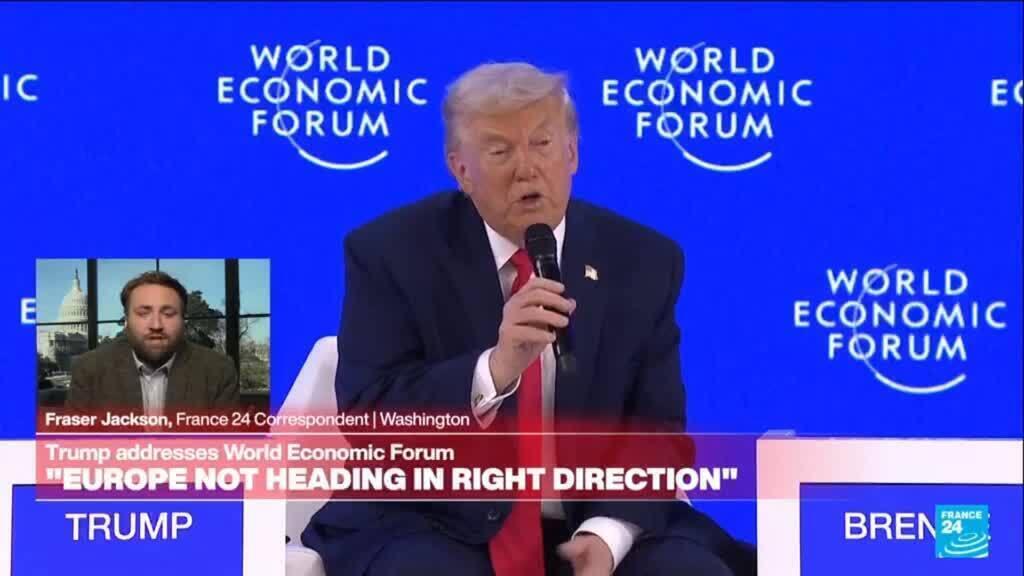
Trump said that the US is booming but Europe is “not heading in the right direction" which he blamed on European leaders' policy missteps in areas ranging from wind power and the environment to immigration and geopolitics.

“I love Europe and I want to see Europe go good, but it’s not heading in the right direction,” Trump said. He added, “We want strong allies, not seriously weakened ones."

Trump also proclaimed that, “When America booms the whole world booms,” and, “You all follow us down and you follow us up.”

Macron 'acting tough', Carney 'should be grateful'

Trump took a hectoring ​tone, chastising the United States' European allies for their insolence and disloyalty to the US.

He singled out French President Emmanuel Macron, taking aim at sunglasses his French counterpart wore a day earlier for health issues and accusing him of playing tough over pharmaceutical price negotiations.

"I watched him yesterday with those beautiful sunglasses – what the hell happened? But I watched him sort of be tough" over his hesitation to raise drug prices to be more in line with US rates, Trump said in an address to the economic forum.

"I said, 'Emmanuel you've been taking advantage of the United States for 30 years with prescription drugs. You really should do it, and you will do it,'" Trump said.

Trump also targeted Canadian Prime Minister Mark Carney saying he "should be grateful" to Washington, a day after Carney warned of a rupture to the US-led global system.

"Canada lives because of the United States. Remember that, Mark, the next time you make your statements," Trump added.

No concessions for affordable housing


Trump planned to use his Davos appearance to talk about making housing more attainable and other affordability issues that are top priorities for Americans, but his appearance at the gathering of global elites focused more on his gripes with other countries.

When he finally did mention housing, meanwhile, Trump suggested he didn't support a measure to encourage affordability. He said bringing down rising home prices hurts property values and makes homeowners who once felt wealthy because of the equity in their houses feel poorer.

White House officials had promoted the speech as a moment for Trump to try to rekindle populist support back in the US, where many voters who backed him in 2024 view affordability as a major problem.

About six in 10 US adults now say that Trump has hurt the cost of living, according to the latest survey by The Associated Press-NORC Center for Public Affairs Research.

US home sales are at a 30-year low with rising prices and elevated mortgage rates keeping many prospective buyers out of the market. So far, Trump has announced plans to buy $200 billion in mortgage securities to help lower interest rates on home loans, and has called for a ban on large financial companies buying houses.

(FRANCE 24 with AP and Reuters)
One year of Trump: the 'far-right revolution’ testing America and the world

Twelve months into Donald Trump’s second term, a presidency driven by impulse rather than restraint is hollowing out US institutions at home while sending shockwaves through NATO, the UN and the wider international order.


Issued on: 20/01/2026 - RFI

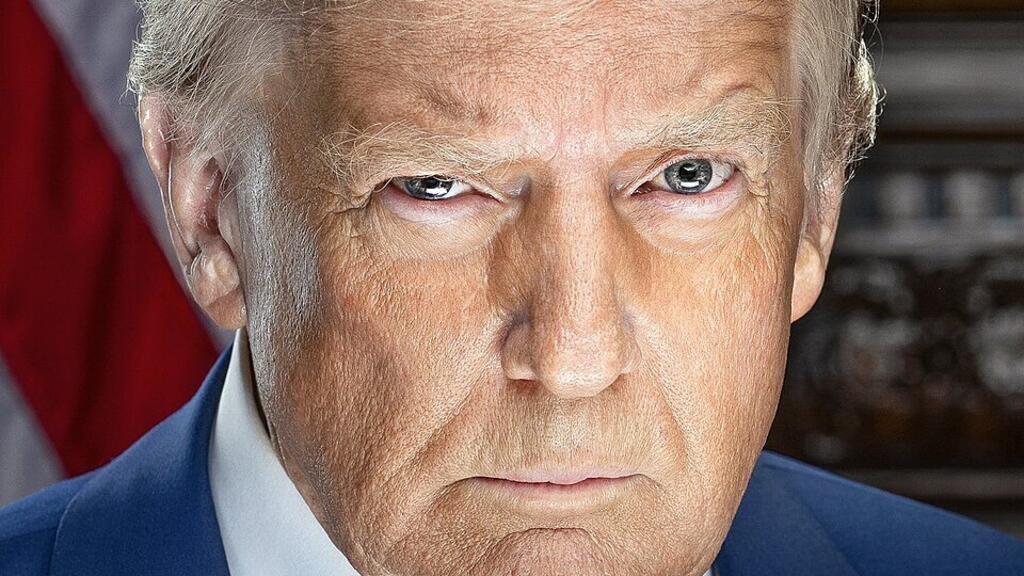
The official portrait of US President Donald Trump, 2025 © wikimedia commons

By:David Coffey

A year after Donald Trump's return to office, the shock persists – but the consequences grow starker. Power is wielded impulsively, institutions appear weakened, and policy often follows presidential whim over process. Critics call it monarchical governance. What does this mean for American democracy and the global order?

Speaking to RFI, former US diplomat William Jordan says what we are witnessing is not simply an unconventional administration, but something far more radical.

“What’s happening in Washington is basically a revolution – a far-right or reactionary revolution – that is playing out every day,” he says. “It’s driven by agitation and then propaganda to support it.”

Jordan points to what he describes as a deliberately performative strategy, popularised by Trump allies like Steve Bannon, designed to overwhelm opponents and institutions alike.

“There’s a certain theatricality to it – flooding the zone, making it impossible for anybody to focus on anything else,” he says. “And the institutions that should be protecting the American system are proving they’re not up to the task.”

Checks, balances and a broken Congress

The United States’ constitutional architecture – its checks and balances,its bicameral Congress – is often held up as a model of democratic resilience. But Jordan is blunt about how well it is functioning today.

“Is it working? I would say no,” he says. “Congress has not been insisting on any sort of real accountability from the executive – at least not anything the executive would have a hard time ignoring.”

While courts are clogged with legal challenges to Trump administration actions, Jordan notes that even there, resolution is slow and often indulgent.

“The court system is choked with pending cases, and we have no clear resolution,” he says. “So the real stakes now are how much has already changed – and how much of that we won’t be able to change back easily, or at all.”

Recent, tentative pushback from Republican senators – particularly over Venezuela and Trump’s threats towards Greenland – may hint at limits, but Jordan cautions against optimism.

“Congress, as an institution, is simply not functioning in the way it’s supposed to,” he says. “The House is basically deadlocked, and the Senate has only shown resistance in very limited areas.”

Trump has openly suggested that a Democratic victory in the midterm elections could lead to impeachment – and has even hinted at blocking or cancelling the vote altogether. Constitutionally, Jordan says, that line is difficult to cross.

“I’m not aware of any provision that+ allows a president to suspend elections,” he says. “Even during the Civil War, the United States continued to hold federal elections. Abraham Lincoln was re-elected in the middle of it.”

The real battleground, he argues, lies elsewhere – in voting rules, redistricting and restrictions on mail-in ballots.

“If the Democrats do take control of the House, it would at least allow hearings and some level of accountability,” Jordan says. “It could also open the door to articles of impeachment – and frankly, they’d likely have even more material to work with than before.”

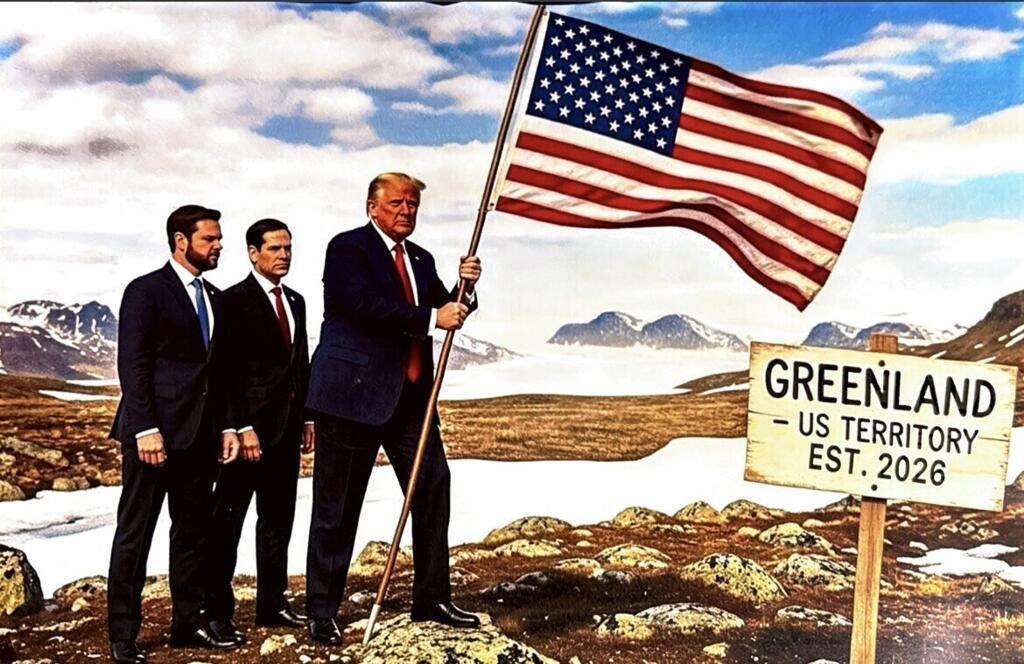
A montage of US President Donald Trump, Vice President JD Vance and Secretary of State Marco Rubio posted on Trump's Truth Social account, 19 January 2026 © Truth Social

American expansionism

Abroad, Trump’s expansionist rhetoric is being digested very differently depending on the capital.

“The Russians are much more publicly in a celebratory mode,” Jordan says. “The Chinese are more inscrutable – and I think more apprehensive.”

Far from welcoming chaos, he argues that Beijing sees itself as a status quo power.

“What the United States is doing is undermining the status quo,” he says. “And I don’t think that’s in China’s interest.”

European allies hit back at US threat to start trade war over Greenland

Few issues encapsulate the current unease more clearly than Trump’s repeated threats to take control of Greenland – a move that would strike at the heart of NATO.

“If the United States were to move on Greenland, that would effectively spell the end of the transatlantic alliance as we know it,” Jordan says.

Could NATO survive without Washington?

“I think something would emerge from the ashes,” he says, though he acknowledges it would be an “extremely heavy lift” for Europe. “Europe remains heavily dependent on American equipment and capabilities. That’s a vulnerability that will last for decades.”

Still, he believes the political will is growing – and that Canada, in particular, could play a key role in keeping NATO genuinely transatlantic.

“I can’t help but think Canada will continue to see value in a very close relationship with European partners,” he says

Pulling back the curtain

Commentators argue that Trump is merely exposing behaviour the US has long practised behind closed doors, and Jordan agrees – up to a point.

“What we’re seeing now is the culmination of decades of the US undermining the rules-based international order it helped create,” he says, pointing to Iraq, the war on terror, and long-standing double standards over issues like Palestine.

But he warns that what comes next could be even more destabilising.

“I think the next target is the United Nations,” Jordan says. “I’ve been waiting for the guns to come out and start blasting at what remains of the UN system.”

He sees recent talk of an alternative "board of peace" as the opening shots in a broader campaign.

“This is being carried out in stages,” he says. “What we’re seeing now is likely the first salvo in a much larger battle to undermine the international order.”


Crypto investments and conflicts of interest: Trump's very profitable year in office


EXPLAINER

Twelve months into Donald Trump’s second presidency, his personal fortune has shot up by at least $3 billion, according to estimates by US media. This is largely due to his family’s crypto ventures, which have attracted wealthy investors and sparked conflict of interest accusations from critics.


Issued on: 20/01/2026 
FRANCE24
By: Joanna YORK


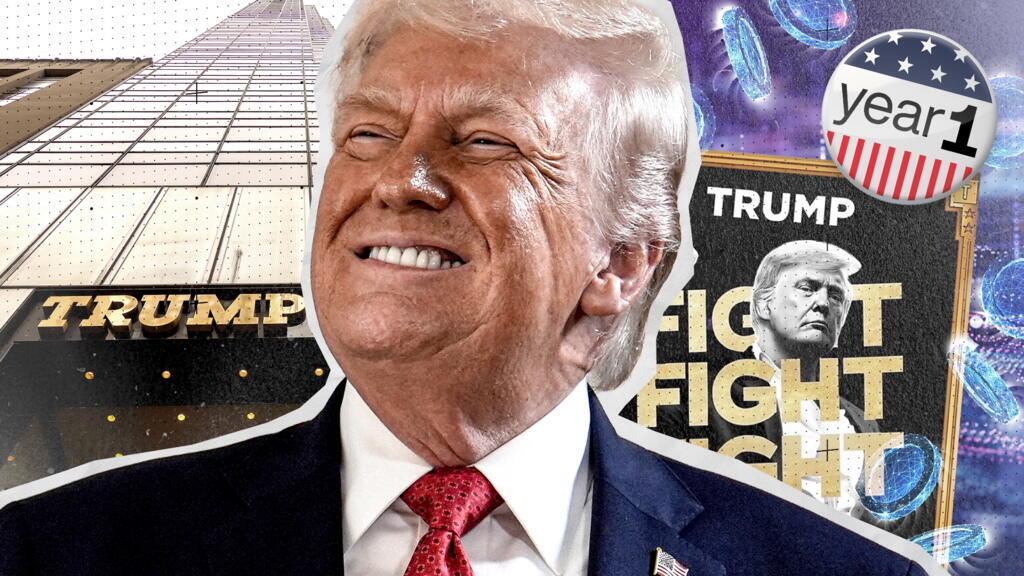
President Donald Trump's is thought to have made billions of dollars from crypto ventures doing his second term. © Studio graphique FMM

In his second inaugural address, US President Donald Trump promised a “golden age of America” was about to begin.

One year later, many Americans still find themselves in the grip of price hikes, but Trump’s personal fortune has flourished, according to estimates from US media and monitors.

The US president has increased his wealth by $3 billion in the past 12 months – up to a total of $7.3 billion, according to Forbes. The New Yorker meanwhile estimates his fortune shot up $3.4 billion in the first six months of his second term alone, largely from “pocketing off the presidency”.

Almost $2 billion-worth of cash and gifts have boosted the Trump family fortune according to the Trump's Take tracker, run by the Center for American Progress (CAP) policy institute.

No one knows exactly how much Donald Trump is worth. Since he first took office in 2017, he has refused to comply with the decades-old tradition of US presidents releasing their tax returns. He has also been accused by a US court of lying about his net worth to make himself look richer.

Historically Trump’s fortune came from the Trump Organisation family conglomerate focused on real estate and tourism, but much of his new wealth is thought to come from crypto ventures that have boosted his fortunes by billions of dollars in just a few months.

The sums are unprecedented for a president in office. “There is no historical parallel for this. Nothing comes close,” said Will Ragland, vice president of research at CAP.

While former presidents have gone to great lengths to avoid conflicts of interest, such as Jimmy Carter putting his peanut farm into a blind trust, Trump seems to embrace the grey area.

Trump is “a president who appears to actively use his businesses as a vehicle for blatant conflict of interest for personal gain,” said Ragland.

A crypto windfall


During Trump’s first term, the infamous dealmaker lost money. According to Forbes, Trump was worth $3.5 billion when he was first inaugurated. By 2021, the figure had slumped to $2.4 billion.

The loss was largely due to the impact of the Covid pandemic on his commercial real-estate interests, including hotels, resorts and office blocks, as well as devaluations in his fleet of planes and golf courses.

By the time Trump was poised to run for a second presidential term in 2024, his portfolio of investments had diversified.

The vast majority of his new wealth has come from crypto investment projects run by the Trump family including World Liberty Financial, stablecoin USD1, meme coin tokens and NFTs (non-fungible tokens).

Although many of these are run by Trump’s sons, Forbes estimates that Trump himself has made $2.4 billion from cryptocurrencies since 2024 while Trump’s Take estimates the total value of the Trump family’s crypto assets has grown by $7.4 billion since his returned to the White House.

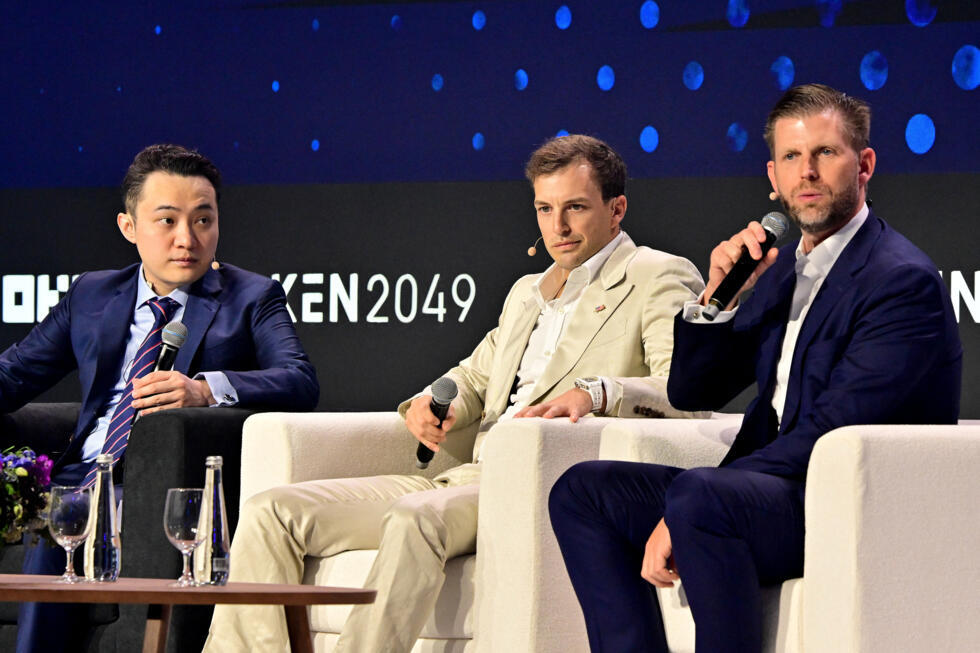
Crypto billionaire Justin Sun, World Liberty Financial co-founder Zach Witkoff and Eric Trump participate in a session at the Token 2049 crypto conference in Dubai on May 1, 2025. © Giuseppe Cacace, AFP


This, despite Trump's claim back in 2019 that he was “not a fan” of cryptocurrencies as their value was “highly volatile and based on thin air” and that they could also facilitate “illegal activity”.

Six years later, the mercurial nature of crypto has played to his advantage.

Meme coins, for example, are cryptocurrencies that generally emerge from internet jokes and are often bought as a novel way to engage with online trends, rather than as a serious investment.

When Trump launched his $TRUMP meme coin days before his second inauguration, buying in was a way for his supporters to ride a wave of excitement – but it was also a money spinner. By March, Trump had made $350 million off the coin, according to the Financial Times.

Next to launch was the $MELANIA meme coin, named after the first lady, which quickly earned $65 million in sales and trading fees – with particular benefits for a few early investors.

In the minutes before it’s official launch, 24 unidentified wallets bought up $2.6 million of the $MELANIA coin and within days flipped them for $100 million, the Financial Times reported.

Paying for access


Trump’s other crypto ventures have benefitted from similar boosts since he became president.

Since 2025, World Liberty Financial – a platform for borrowing, lending and trading cryptocurrencies – has sold more than $1 billion of its own tokens, Trump NFT’s have netted him around $13 million and the USD1 stablecoin is now worth an estimated $235 million.


US President Donald Trump signed the "Genius Act" to develop regulatory framework for stablecoin cryptocurrencies and expand oversight of the industry at the White House on July 18, 2025. © Annabelle Gordon, Reuters

The advantage of an association with the White House is especially clear for Trump's stablecoin.

Stablecoins are cryptocurrencies that aim to maintain a stable value through links to specific assets – in USD1’s case it comes with a presidential guarantee that it is backed by short-term US government treasuries and dollar deposits.

The safeguard has encouraged foreign investment. In May 2025, the UAE’s ruling family bought up $2 billion of USD1.

Weeks later the White House gave the UAE access to thousands of the world’s most advanced and scarce computer chips.

Although the two incidents are not explicitly linked, there are indications – some more blatant than others – that those who invest in Trump’s crypto ventures are being given preferential treatment.

In April 2025, it was announced that the top 25 $TRUMP coin holders would be invited to a reception and VIP tour of the White House, a clear opportunity to pay for access to the President.

Among those on the guest list was China-born crypto billionaire Justin Sun, who is thought to own hundreds of millions of Trump’s meme coins, and is also the second-largest known investor in World Liberty Financial.

He was also the subject of a 2023 investigation by the US Securities and Exchange Commission (SEC), which charged him with finding illicit ways of trading in the US including enlisting celebrities to endorse his cryptocurrency.

The Trump administration has since ended nearly all regulation against crypto traders and, in 2026, the SEC put its charges against Sun on hold.

'A systemic failure'

Such deals are not necessarily illegal, but they “certainly transgress the ways in which things have been done in the past,” said Emma Long, associate professor in American history and politics, at the University of East Anglia.

It is not unusual for US presidents to use their profile for lucrative ends: most do this after they leave office, via book deals and speaking fees worth tens of millions of dollars.

But while in office, “presidents usually divest themselves of any financial arrangements that might be a conflict of interest or that might be seen as trading on their official position”, Long added.

While crypto ventures are the main source of Trump’s rapidly increasing fortune, there are other ventures that operate in this grey area.

On the 2024 campaign trail, Trump became the only presidential candidate to run an online merchandise store redirecting funds – that supporters may have believed were going to his campaign – into his own pocket.

Since his re-election, there have been claims that Trump’s hotels and resorts have benefitted from their association with the White House and from Trump holding official events there. Membership fees for Trump’s most famous resort, Mar-a-Lago in Florida, have now risen to $1million.

Then there are a host of other eyebrow-raising deals, such as a $40 million agreement signed with Amazon giving the corporation access to film a documentary with Melania Trump.

There's also the $400 million luxury jet that Trump accepted from Qatari government, which he has been allowed to keep even though it “appears to violate the spirit if not the letter of the Constitution, which essentially prohibits accepting profits or gifts from foreign countries without congressional approval”, said Ragland.

US Congress has so far failed to take action against the exceptionally expensive gift, making it part of a wider cash grab that indicates the country's “ethical guardrails are no longer functional,” said Ragland.

“We aren't just looking at one man’s fortune; we’re looking at a systemic failure that leaves the American public completely vulnerable to industrial-scale corruption,” he added.


One year of Trump's war on American culture

Issued on: 20/01/2026 
07:24 min
From the show


One year after Donald Trump's return to power, FRANCE 24's Eve Jackson revisits the paradoxical and conflictual relationship between the US president and culture and the arts. From controversial appointments in Hollywood, to attacks on diversity policies, to the symbolic takeover of the Kennedy Center, the US president intends to regain control of the American cultural narrative. Faced with this pressure, artists and institutions are getting organised, taking a stand and mobilising for freedom of speech.

BY: 
VIDEO BY:  Eve JACKSON


One year of Trump 2.0: How he's weaponised AI as political propaganda


Issued on: 20/01/2026 - 
05:31 min


As Donald Trump marks one year back in the White House, FRANCE 24's Vedika Bahl takes a closer look at how he has weaponised artificial intelligence into a political tool, used to glorify himself, attack his opponents and amplify his political agenda. Whilst it has become a defining feature of his digital presence, it's brought with it a new frontier for misinformation and fake news.


Mercosur trade deal in limbo after EU parliament asks top court to weigh in

The European Union's parliament voted on Wednesday to refer a freshly signed trade deal with the South American Mercosur trade bloc to the EU's top court, casting the hard-fought accord into legal limbo.


Issued on: 21/01/2026 - RFI

Farmers react as the EU parliament's vote result is announced during a protest against the free trade agreement between the European Union and the Mercosur countries, on the day of a vote on a referral to the courts, in Strasbourg on 21 January, 2026
© AFP - ROMEO BOETZLE

Signed on Saturday with Brazil, Argentina, Uruguay and Paraguay, the pact to create one of the world's largest free trade areas has been fiercely opposed by farmers' groups backed by France and others.

Lawmakers in Strasbourg voted 334 to 324 in favour of asking the Court of Justice of the European Union (CJEU) to determine whether the deal is compatible with the bloc's rules.

Hundreds of farmers had gathered with tractors outside the parliament building ahead of Wednesday's vote – and erupted in celebration as the result came in.

"We've been on this for months and months, for years," a euphoric Quentin Le Guillous, head of a French young farmers group, told French news agency AFP outside the EU parliament.

Tractors surround EU Parliament as MEPs vote on Mercosur review

"Tonight, I'm going home, I'm going to kiss everyone, and I'm going to tell my kids, 'I got it, we got it, we can be proud.'"

The court will now have to assess the legal challenge, a process that could delay and even derail a deal seen as a cornerstone of a Brussels push to open up new markets.

The vote deals a blow to the European Commission, whose president Ursula von der Leyen had given a speech to parliament just hours earlier touting the "historic deal".
Devastating sign

More than 25 years in the making, the EU-Mercosur deal was given fresh impetus amid the sweeping use of tariffs and trade threats by US President Donald Trump's administration, which has sent countries scrambling for new partnerships.

The commission, which championed and negotiated the pact that eliminates tariffs on more than 90 percent of bilateral trade, said it "regrets" the lawmakers' decision.

"According to our analysis, the questions raised in the motion by the parliament are not justified because the commission has already addressed those questions and issues in a very detailed way," European Commission trade spokesman Olof Gill told reporters in Brussels.

EU countries green-light Mercosur trade deal despite France's opposition

The court challenge centres on whether the deal can be partially applied before full ratification from member states, as envisaged by the commission, and if it unlawfully restricts Brussels' powers on some environmental and food safety matters.

The head of German auto industry group VDA decried the EU parliament's decision, saying it sent a "devastating sign" and risked irking Mercosur countries.

"Europe is weakening itself with the EU Parliament's decision at a time when geopolitical stability and reliable international partnerships are more urgent than ever," Hildegard Mueller said.

Parliament will now wait for the court's opinion before holding a vote on whether to approve the Mercosur deal – a necessary step for it to fully come into force.

But the commission could push ahead and apply it provisionally, also pending judgement, a potentially politically explosive move.
A small battle in a larger war

Key power Germany, as well as Spain and the Nordic countries, strongly support the pact, eager to boost exports as Europe grapples with Chinese competition and a tariff-happy administration in the White House.

"We are convinced of the legality of the agreement. No more delays. The agreement must now be provisionally applied," German Chancellor Friedrich Merz said after the vote.

But France, Poland, Austria Ireland and Hungary oppose it over concerns for their agricultural sectors.

"The fight continues to protect our agriculture and guarantee our food sovereignty," said French foreign minister Jean-Noël Barrot.

EU backs tough legislation to slash food waste and rein in 'fast fashion'

The deal favours European exports of cars, wine and cheese, while making it easier for South American beef, poultry, sugar, rice, honey and soybeans to enter Europe.

This has angered many European farmers, who have rolled tractors into Paris, Brussels and Warsaw to protest a feared influx of cheaper goods produced with lower standards and banned pesticides.

"It feels good, finally a victory," French farmer Alice Avisse, 52, said of the vote, cautioning however that it was "only a small battle in a larger war".

Together, the EU and Mercosur account for 30 percent of global GDP and more than 700 million consumers.

(with AFP)
WAR ON WOMEN

France urged to act as rising masculinism flagged as security threat

France must adopt a national strategy to combat masculinism – an organised ideology that promotes male supremacy and hostility to women – as it spreads online and poses a growing public security risk, the country’s gender equality watchdog has warned.

Masculinist ideas are spreading online, with a French report finding many men view feminism as a threat rather than a movement for equality. 


Issued on: 22/01/2026 - RFI

In its annual report on sexism, the High Council for Gender Equality, an advisory body attached to the office of the prime minister, on Wednesday said France was falling worryingly behind in identifying and tackling masculinism.

The council said the phenomenon should be recognised as a public security issue, warning that hatred of women can lead to violence and even terrorism. It noted that countries such as Canada and the United Kingdom have already included the issue in their strategies against violent extremism.

Masculinism emerged in the 1980s as a reaction to feminism. The ideology promotes male supremacy and blames women for what its supporters see as a decline in men’s living conditions.

Senior French civil servant accused of mass drinks spiking to humiliate women

From ideology to violence

“This is a real threat. From the moment you develop a hatred of women, there can be violence and terrorist acts,” Bérangère Couillard, president of the council, told French news agency AFP.

The report cited several cases linked to misogynist violence, going back to 1989 when a self-declared anti-feminist shot dead 14 women at Montreal’s École Polytechnique in Canada.

In France, an 18-year-old was arrested last summer in Saint-Étienne on suspicion of planning knife attacks against women. He was charged by the national anti-terrorism prosecutor, marking the first case involving someone claiming allegiance solely to the masculinist “incel” movement.

The council described that judicial decision as “a major step forward”, and said it now supports integrating what it calls “misogynist terrorism” into security doctrines.

This would involve training intelligence agents to recognise the language, recruitment methods and narratives used within the so-called manosphere.

Growing 'masculinist' culture in France slows down fight against sexism

Online influence

“If masculinist language is not understood, it gets missed,” Couillard said. She cited the British series Adolescence as an example of why familiarity with these terms matters.

The Netflix series, released in March 2025, depicts the murder of a schoolgirl by a classmate and the influence of masculinist ideas on boys. In January, French Education Minister Elisabeth Borne announced that it will be shown in French schools.

The gender equality watchdog said such masculinist ideologies were spreading more widely in France and elsewhere, especially among young people through social media.

It called for stronger regulation and more resources for Pharos, the state platform for reporting illegal online content, and Arcom, the media regulator.

A 2024 study by Dublin City University found that young men are exposed to masculinist content within 23 minutes of browsing TikTok and YouTube, on average, regardless of whether they looked for this material.

France to show 'Adolescence' mini-series as part of school curriculum

Hostile vs. paternalistic sexism

The council's report is based on an online survey by polling company Toluna Harris Interactive of 3,061 people aged 15 and over, representative of the French population.

It found that 60 percent of men believe feminists are seeking to give women more power than men.

A quarter of men said it was normal for a woman to agree to sex to please a partner or out of duty. The same proportion said they had already doubted a partner’s consent.

From these findings, the council estimated that 17 percent of the French population adheres to “hostile” sexism, which devalues women and justifies discrimination and violence.

“The risk is that these people join and become members of masculinist networks,” said Couillard.

In addition, some 23 percent of those surveyed supported a more “paternalistic” form of sexism which promotes traditional gender roles, the council said. Often seen as benevolent by its proponents, it nonetheless contributes to inequality by confining women to stereotypical roles based on fragility or dependence.


French investigators expose failings in Dominique Pelicot mass rape case


France's General Inspectorate of Justice has exposed failings in an investigation into Dominique Pelicot, accusing authorities of not acting on DNA evidence against him for a dozen years. Pelicot's DNA was taken by police after he was first apprehended in 2010 in a suburban Paris shopping centre while filming up women's skirts .


Issued on: 19/01/2026 
By: FRANCE 24
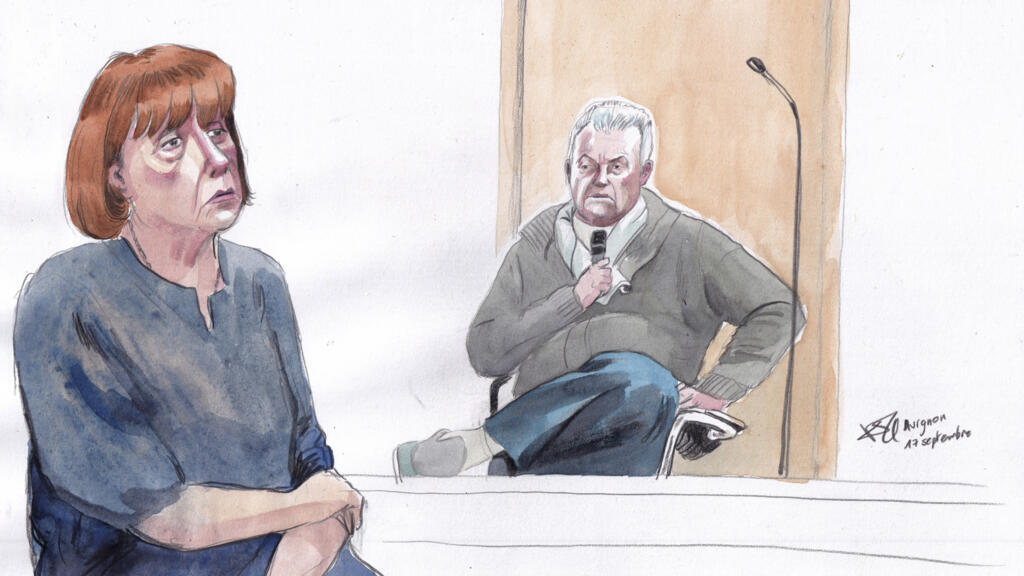
Courtroom sketch by Valentin Pasquier shows Gisele Pelicot, and her ex-husband Dominique Pelicot during his trial in Avignon, southern France, on September 17, 2024. © Valentin Pasquier, AP

France's General Inspectorate of Justice (IGJ) has exposed failings in an investigation into Dominique Pelicot, convicted in a high-profile rape case, for not acting on DNA evidence against him for a dozen years, in a report seen by AFP.

Pelicot was sentenced to 20 years in prison in December 2024 in a case that shocked the country, after admitting to repeatedly drugging his then-wife Gisele Pelicot and inviting dozens of men to rape her while she was unconscious between 2011 and 2020.

During the trial, it emerged that he had been first apprehended in 2010 in a suburban Paris shopping centre while filming up women's skirts, and had his DNA taken by police.

A few months later, he was connected with an attempted rape in the Seine-et-Marne area east of the capital on May 11, 1999.

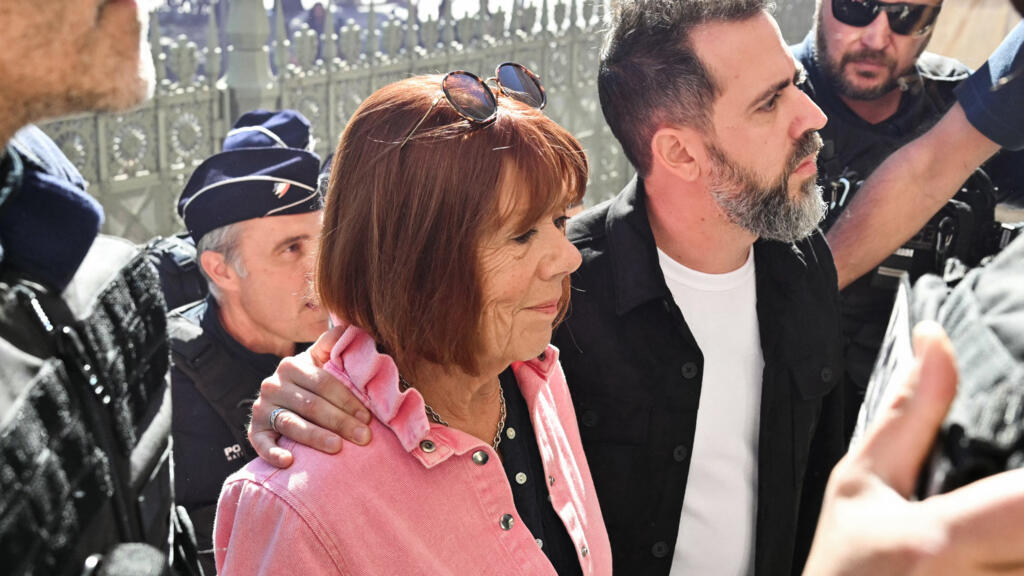
French rape victim Gisele Pelicot arrives at court for appeal trial 
AFP - CHRISTOPHE SIMON
01:51


Yet the DNA match was not acted upon by the justice system for more than 12 years.

In October 2022, he was finally placed under formal investigation by a cold case unit in Nanterre, west of Paris, for the 1999 incident as well as a 1991 rape and murder of a woman in Paris.

Last year, Justice Minister Gérald Darmanin called on the IGJ to look into why the investigation did not happen sooner.

The IGJ report seen by AFP this week found that the court investigating the 1999 rape had no receipt of receiving the evidence, which was sent by regular mail.

Furthermore, the court at the time was undergoing a structural re-organisation and "loss of documents was sometimes observed", the report said.

READ MORE  France enshrines consent in sexual violence law in wake of Pelicot case

The IGJ report highlighted "vulnerabilities" and general malfunction in the handling of genetic profiles, prompting a list of recommendations to secure the receipt of reports issued by France's National Automated DNA Database (FNAEG).

Contacted by AFP, Dominique Pelicot's lawyer, Beatrice Zavarro, said "the work of justice had been undermined".

She also acknowledged that the rape case involving his ex-wife "could have been avoided" had police intervened earlier.

"If we take it at face value, yes, this case could obviously have been avoided," she said.

Pelicot has admitted to his involvement in the 1999 case after he was identified by his DNA, but has denied involvement in the 1991 rape and murder case.

Last week, the Nanterre cold case unit launched a broader investigation into Pelicot's "criminal trajectories" to identify other possible crimes and victims.

(FRANCE 24 with AFP)