'The future is extreme heat': Group worries province isn't prepared for what's coming
Seniors federation seeks answers on plans to protect residents from increasing heat waves

The New Brunswick Senior Citizens Federation is calling for governments to be better prepared for heat waves that are becoming more common with climate change.
Alphonse Dionne, the president of the federation, said he's particularly worried about how things will play out for elderly people living in rural and remote areas of the province.
"The future is extreme heat," he said. "In the cities, people can go to the mall to cool off, but in the rural areas, it's different."
Dionne said the federation has yet to hear from the province or municipal governments this summer about steps being taken to protect seniors from intense heat waves.
During the recent "heat dome" in British Columbia, when temperatures soared above 40 C, 719 people died in one week, triple the number that would typically die during a week in that province. The majority were seniors found alone, said Lisa Lapointe, the chief coroner of British Columbia.
"I think a lot of people are still not taking this as seriously as they should," Dionne said. "The planet is changing and it's changing fast."
Nearly 22 per cent of New Brunswick's population is over 65, according to 2020 estimates from Statistics Canada. The province projects that number will grow to 31 per cent by 2038.
Forty-seven per cent of seniors live in rural parts of the province, where governments have fewer resources to dedicate to emergency planning, said Ian Mauro, executive director with the Prairie Climate Centre based at the University of Winnipeg.
The centre has been mapping out environmental changes in rural and urban parts of the country that are expected over the coming decades.
New Brunswick vulnerable
"There's a very significant and differentiated impact on rural and remote communities that needs to be taken into account," Mauro said.
"With the heat wave that went across Western Canada, the coroner's report out of British Columbia clearly indicated that a hugely disproportionate number of the fatalities in the heat wave ... was actually seniors — isolated seniors living in overheated homes," he said.
"New Brunswick is a more vulnerable area."

Paramedics in B.C. also struggled to keep up with the demand, with response times to lower priority calls taking between four and 16 hours.
In rural and remote communities of New Brunswick, ambulances often still fail to respond to 90 per cent of calls within their target of 22 minutes.
In 2020, an auditor general's report found ambulances failed to reach that target in 19 of 67 communities.
"We need to catch up. We need to have health and climate change considered simultaneously," Mauro said. "How do you ensure that people in those rural and remote areas are taken care of?"
A recent report released by the Canadian Institute for Climate Choices estimates that heat-related deaths and hospitalizations are expected to rise by mid-century.
What constitutes a heat wave
In Fredericton, the number of heat waves, defined as three or more consecutive days over 30 C, is predicted to triple.
Between 1976 and 2005, the region typically averaged one per year. It is believed that between 2021 and 2050, the area could average three heat waves per year, and up to five per year after 2050 if emissions are not controlled, according to the climate centre's modeling.
The number of days exceeding 25 and 30 C are also expected to increase.
"That's a significant change and could in fact be a very costly change in terms of the impact on the environment, the impact on species, the impact on human health," Mauro said.
"We really do need to be thinking strategically about how this will impact all New Brunswickers, but specifically vulnerable people, like seniors."
Deaths can be avoided if the province and federal governments provide the resources needed to set up services like cooling sites, Mauro said.
Governments should also be planting more trees to create shaded areas, and opening more splash pads and public pools, he said.
Public Health currently operates a heat alert system with three levels. At the second-highest level, residents are encouraged to check in on their neighbours.
At the third and highest level, the province recommends the cancellation of sporting and outdoor events. It also said people living alone without air conditioning are at extreme risk.
The province could not be reached to discuss what measures come into effect in the instance of extreme heat to protect vulnerable populations, or what emergency planning there has been for more intense heat waves in the future.
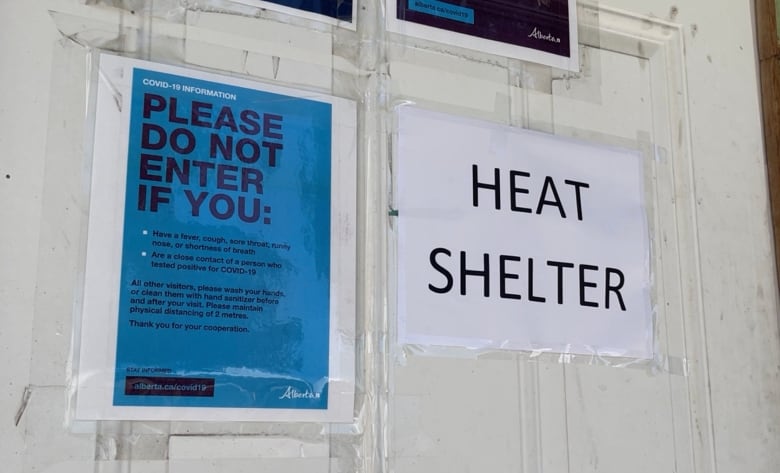
Some cities, like Moncton, already have a system of cooling centres that can be opened if temperatures get dangerous.
Fire Chief Conrad Landry, who is also the city's director of emergency measures, said the heat hasn't become extreme enough for them to open yet.
"We have many cooling centres that we can open up and that's not just to cool down, (people) could stay there," Landry said.
Moncton doing more planning
The city currently has two public misting tents that open whenever the province issues a heat alert. It has also started emergency planning for more intense heat waves in the future.
"We do have a plan on how to provide water to all our citizens for up to six months actually," Landry said.
"It's the same in case there's something that goes wrong with our water treatment plan."
The cities of Fredericton and Saint John were not able to provide anyone to speak about heat emergency planning in those communities.
No comments:
Post a Comment