by Amy Goodman and Denis Moynihan
April 27, 2023
As the legendary singer, actor and activist is laid to rest, his message still sings out.
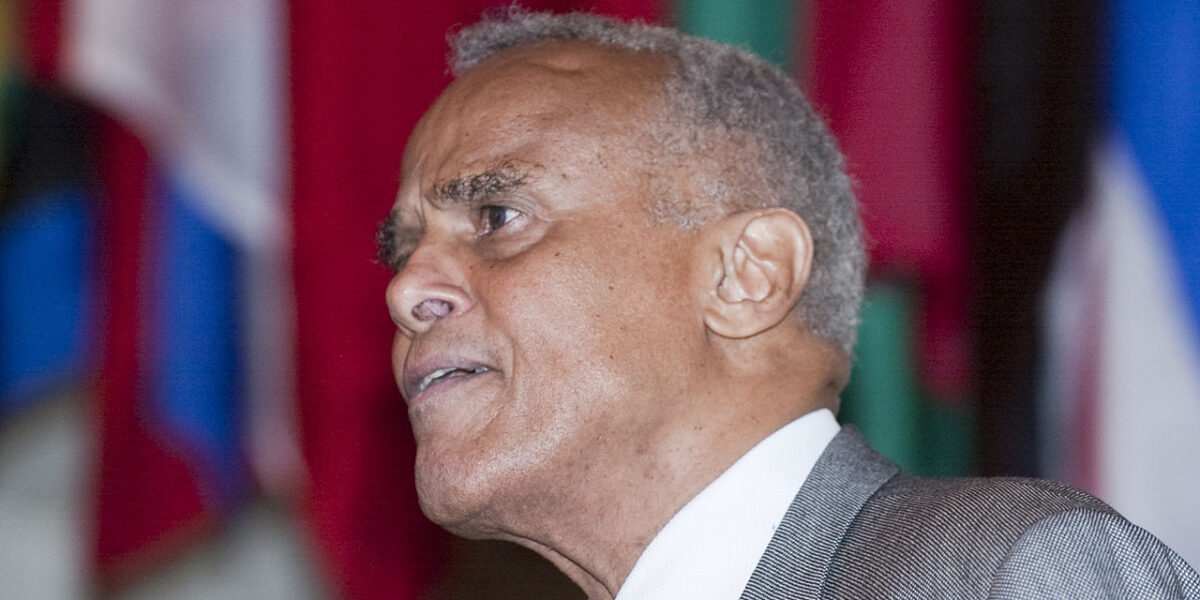
As the legendary singer, actor and activist is laid to rest, his message still sings out.
Harry Belafonte at the 2003 Letelier Moffit Human Rights Awards.
Credit: Institute for Policy Studies / Wikimedia Commons
On a freezing cold day, February 15, 2003, Harry Belafonte, the legendary singer, actor and activist strode onto a stage outside the United Nations in New York City. Rallies against the imminent U.S. invasion of Iraq were taking place around the globe that day, in what is believed to be the largest mass protest in human history. Belafonte then did what he had been doing for over half a century – he spoke truth to power:
“We stand for peace. We stand for the truth of what is at the heart of the American people.”
Harry Belafonte died this week at the age of 96. Throughout his life, he fought for justice, using his celebrity to support causes from civil rights to anti-colonialist and anti-war movements and Black Lives Matter.
Belafonte continued in that 2003 speech, delivered to several hundred thousand anti-war marchers in New York:
“We were misled by those who created the falseness of the Bay of Tonkin, which falsely led us into a war with Vietnam, a war that we could not and did not win. We lied to the American people about Grenada…about Nicaragua, El Salvador, Cuba and many places in the world. We stand here today to let those people know that America is a vast and diverse country, and we are part of the greater truth of what makes our nation. Dr. King once said that if mankind does not put an end to war, war will put an end to mankind.”
Harry Belafonte was one of Martin Luther King, Jr.’s closest advisers and confidants. He first met King in 1956, during the Montgomery bus boycott. Their initial meeting, slated for 20 minutes, lasted four hours.
“At the end of that meeting, I knew that I would be in his service and focus on the cause of the desegregation movement, the right to vote, and all that he stood for,” Belafonte said at the Sundance Film Festival in 2011, on the Democracy Now! news hour. “Although we understood how perilous the journey would be, we were not quite prepared for all that we had to confront. I think that it was the most important time in my life.”
Thus began a historic friendship that shaped the struggle for desegregation and racial equality. Belafonte knew King like few others. He was loyal to him until the end, when many had abandoned King as his agenda broadened to include fierce opposition to the Vietnam War.
In his memoir, My Song, Belafonte recounts a conversation with King one week before his assassination in Memphis on April 4, 1968. King was organizing The Poor People’s Campaign, to link and overcome the three evils he saw in our society: racism, militarism, and materialism. As King described the campaign’s strategy, he was challenged by Andrew Young, an adviser who would later become the mayor of Atlanta and the U.S. ambassador to the United Nations. Belafonte recounted King’s reply:
“‘The trouble,’ Martin went on, ‘is that we live in a failed system. Capitalism does not permit an even flow of economic resources. With this system, a small privileged few are rich beyond conscience and almost all others are doomed to be poor at some level…That’s the way the system works. And since we know that the system will not change the rules, we’re going to have to change the system.’”
Dr. King frequently spoke out against capitalism, but this private moment shared by Belafonte shows the depth of his critique. “At heart, Martin was a socialist and a revolutionary thinker,” Belafonte wrote. One week later, King was dead, shot while standing on the balcony of the Lorraine Motel.
Harry Belafonte never relented. He intensified his fight against South African apartheid and the ravages of U.S. imperialism abroad. He challenged those in power regardless of political party, from George W. Bush to Barack Obama, from Donald Trump to Joe Biden.
In 2006, as President George W. Bush’s disastrous war in Iraq was still raging, Belafonte travelled to Venezuela and spoke at a mass rally, standing alongside President Hugo Chavez:
“No matter what the greatest tyrant in the world, the greatest terrorist in the world, George W. Bush, says, we’re here to tell you: Not hundreds, not thousands, but millions of the American people — millions — support your revolution, support your ideas, and, yes, expressing our solidarity with you.”
Not long after, Belafonte was disinvited from speaking at the funeral of his dear friend, Coretta Scott King, as President Bush was going to attend.
Belafonte often told the story of his mentor, the singer and activist Paul Robeson, who told him, “Get them to sing your song and they will want to know you.” As the venerable entertainer and activist is laid to rest, his message still sings out: we cannot rest.
This column originally appeared in Democracy Now!

On a freezing cold day, February 15, 2003, Harry Belafonte, the legendary singer, actor and activist strode onto a stage outside the United Nations in New York City. Rallies against the imminent U.S. invasion of Iraq were taking place around the globe that day, in what is believed to be the largest mass protest in human history. Belafonte then did what he had been doing for over half a century – he spoke truth to power:
“We stand for peace. We stand for the truth of what is at the heart of the American people.”
Harry Belafonte died this week at the age of 96. Throughout his life, he fought for justice, using his celebrity to support causes from civil rights to anti-colonialist and anti-war movements and Black Lives Matter.
Belafonte continued in that 2003 speech, delivered to several hundred thousand anti-war marchers in New York:
“We were misled by those who created the falseness of the Bay of Tonkin, which falsely led us into a war with Vietnam, a war that we could not and did not win. We lied to the American people about Grenada…about Nicaragua, El Salvador, Cuba and many places in the world. We stand here today to let those people know that America is a vast and diverse country, and we are part of the greater truth of what makes our nation. Dr. King once said that if mankind does not put an end to war, war will put an end to mankind.”
Harry Belafonte was one of Martin Luther King, Jr.’s closest advisers and confidants. He first met King in 1956, during the Montgomery bus boycott. Their initial meeting, slated for 20 minutes, lasted four hours.
“At the end of that meeting, I knew that I would be in his service and focus on the cause of the desegregation movement, the right to vote, and all that he stood for,” Belafonte said at the Sundance Film Festival in 2011, on the Democracy Now! news hour. “Although we understood how perilous the journey would be, we were not quite prepared for all that we had to confront. I think that it was the most important time in my life.”
Thus began a historic friendship that shaped the struggle for desegregation and racial equality. Belafonte knew King like few others. He was loyal to him until the end, when many had abandoned King as his agenda broadened to include fierce opposition to the Vietnam War.
In his memoir, My Song, Belafonte recounts a conversation with King one week before his assassination in Memphis on April 4, 1968. King was organizing The Poor People’s Campaign, to link and overcome the three evils he saw in our society: racism, militarism, and materialism. As King described the campaign’s strategy, he was challenged by Andrew Young, an adviser who would later become the mayor of Atlanta and the U.S. ambassador to the United Nations. Belafonte recounted King’s reply:
“‘The trouble,’ Martin went on, ‘is that we live in a failed system. Capitalism does not permit an even flow of economic resources. With this system, a small privileged few are rich beyond conscience and almost all others are doomed to be poor at some level…That’s the way the system works. And since we know that the system will not change the rules, we’re going to have to change the system.’”
Dr. King frequently spoke out against capitalism, but this private moment shared by Belafonte shows the depth of his critique. “At heart, Martin was a socialist and a revolutionary thinker,” Belafonte wrote. One week later, King was dead, shot while standing on the balcony of the Lorraine Motel.
Harry Belafonte never relented. He intensified his fight against South African apartheid and the ravages of U.S. imperialism abroad. He challenged those in power regardless of political party, from George W. Bush to Barack Obama, from Donald Trump to Joe Biden.
In 2006, as President George W. Bush’s disastrous war in Iraq was still raging, Belafonte travelled to Venezuela and spoke at a mass rally, standing alongside President Hugo Chavez:
“No matter what the greatest tyrant in the world, the greatest terrorist in the world, George W. Bush, says, we’re here to tell you: Not hundreds, not thousands, but millions of the American people — millions — support your revolution, support your ideas, and, yes, expressing our solidarity with you.”
Not long after, Belafonte was disinvited from speaking at the funeral of his dear friend, Coretta Scott King, as President Bush was going to attend.
Belafonte often told the story of his mentor, the singer and activist Paul Robeson, who told him, “Get them to sing your song and they will want to know you.” As the venerable entertainer and activist is laid to rest, his message still sings out: we cannot rest.
This column originally appeared in Democracy Now!
The Radical Harry Belafonte
By Trish Meehan
By Trish Meehan
April 28, 2023
Source: Jacobin

From the struggle for civil rights to opposing apartheid in South Africa and the war against Cuba, Harry Belafonte was a fighter for justice both at home and abroad.
Harry Belafonte, the pioneering singer, songwriter, and actor who began his career singing calypso before turning to political activism, has died at the age of ninety-six.
Beyond his groundbreaking contribution to the arts, Belafonte was a committed activist in the fight against imperialism, worker oppression, and racial discrimination, using the platform his artistic talents afforded to him to oppose injustice in all forms. “I have to be part of the rebellion that tries to change all this,” he told the New York Times in 2001. “Anger is a necessary fuel. Rebellion is healthy.”
Born in Manhattan, New York, Belafonte spent his early childhood in his parent’s native Jamaica. After returning to America, he volunteered with the US Navy to fight fascism in World War II. His artistic ambition was sparked after working as a cleaner in a New York theater in the late 1940s, eventually training under the iconic German communist director Erwin Piscator.
Belafonte began singing as a club singer to fund acting classes, but it was his musical talent that first propelled him to celebrity. Credited with popularizing Caribbean music with international audiences, he was dubbed the “King of Calypso.” At a time when segregation was in practice in much of the United States, he would become the first black person to perform in many clubs and made racial breakthroughs in cinema.
In the 1957 Robert Rossen movie An Island in the Sun, Belafonte played a black union leader from a fictional Caribbean country who has a love affair with a young middle-class woman played by Joan Fontaine, prompting threats to burn down cinemas in the American South. The roles Belafonte played over the course of his on-screen career regularly challenged and skewered the racism and injustice prevalent in American society.
A prominent member of the civil rights movement, Belafonte would become a personal friend of Martin Luther King Jr. A significant figure in the struggle against racism and discrimination in his own right, he used his wealth and fame to champion and fund anti-racist activism, bailing out activists, funding voter registration drives, and bankrolling organizations opposing racism and promoting black liberation.
As an actor, singer, and songwriter, Belafonte’s artistic expression was too great to be confined to only one medium, and his opposition to injustice too principled to be limited to just one struggle. Like King, Belafonte recognized the linked oppression of racism, imperialism, and capitalism, resulting in his being blacklisted during the McCarthy era.
In the 1980s, he campaigned against apartheid in South Africa and later coordinated Nelson Mandela’s first visit to the United States. Belafonte’s opposition to apartheid was part of a broader stance against imperialism and oppression across the globe.
An outspoken opponent of the American invasion of Grenada, a supporter of Hugo Chávez and hostile to Cold War antagonism, Belafonte’s internationalism frequently pitted him against US foreign policy. A fierce opponent of the 2003 invasion of Iraq, he would receive considerable press backlash in 2006 when he declared George W. Bush “the greatest terrorist in the world.”
Belafonte traveled the world as a United Nation’s Children Fund (UNICEF) goodwill ambassador in 1987 and later set up an AIDS foundation — part of his wider campaigning efforts to promote education and economic development in Africa, for which he would receive an Oscar in 2014 in honor of his humanitarian work.
Belafonte said in an interview in 2011, “I was an activist long before I became an artist.” Even in his late eighties, Belafonte was still speaking out about racial and economic inequality, urging President Barack Obama to do more to help the poor, and later endorsing Bernie Sanders in the Democratic primaries. Belafonte called for the “unleashing of radical thought” to make progress on racial equality, and supported the Black Lives Matter movement, which he recognized as confronting the racial injustices that remained from the civil rights era.
When an anthology of his music was published in 2017, Belafonte told Rolling Stone magazine that singing was for him a way to express the injustices of the world. “It gave me the opportunity to make social statements, to talk about things that I found unpleasant,” he said, “and things that I found inspiring.”
In many ways, Belafonte’s politics demonstrate that the struggle for civil rights in the United States was intimately connected with socialism — with Martin Luther King frequently criticizing capitalism and leaders such as Bayard Rustin and Ella Baker having roots in the socialist movement. Harry Belafonte was very much part of this tradition and received the Medal of Friendship from the Cuban state in recognition of his solidarity with Cuba over the years. He had cultivated a close relationship with Fidel Castro since the start of the revolution.
In his memoirs, published in 2011, Belafonte talked about racism in prerevolutionary Cuba:
When I became an artist and started to have some fame, I went to Cuba quite regularly before ’59. I went there with Sammy Davis Jr. to listen to Nat King Cole and to hang out with Frank Sinatra; the place where we met the most was the Hotel Nacional. Everyone was performing there except me. When they came to me — and I had a work contract — I was in an interracial marriage as it was called in those days, and suddenly I became persona non grata, in Cuba, everywhere.
In September 2003, Belafonte gave a speech in New York condemning the US blockade against Cuba. When asked why he supported the Cuban people, he replied, “I don’t see it as a supreme effort,” he said, “It’s a way of life: if you believe in freedom, if you believe in justice, if you believe in democracy, if you believe in people’s rights, if you believe in the harmony of all humanity.”
As much as Belafonte’s achievements in cinema and music are a testament to his artistic greatness, his legacy of devotion to the liberation of people from all forms of injustice is evidence of one of the most remarkable moral and political figures of his era.
Source: Jacobin

From the struggle for civil rights to opposing apartheid in South Africa and the war against Cuba, Harry Belafonte was a fighter for justice both at home and abroad.
Harry Belafonte, the pioneering singer, songwriter, and actor who began his career singing calypso before turning to political activism, has died at the age of ninety-six.
Beyond his groundbreaking contribution to the arts, Belafonte was a committed activist in the fight against imperialism, worker oppression, and racial discrimination, using the platform his artistic talents afforded to him to oppose injustice in all forms. “I have to be part of the rebellion that tries to change all this,” he told the New York Times in 2001. “Anger is a necessary fuel. Rebellion is healthy.”
Born in Manhattan, New York, Belafonte spent his early childhood in his parent’s native Jamaica. After returning to America, he volunteered with the US Navy to fight fascism in World War II. His artistic ambition was sparked after working as a cleaner in a New York theater in the late 1940s, eventually training under the iconic German communist director Erwin Piscator.
Belafonte began singing as a club singer to fund acting classes, but it was his musical talent that first propelled him to celebrity. Credited with popularizing Caribbean music with international audiences, he was dubbed the “King of Calypso.” At a time when segregation was in practice in much of the United States, he would become the first black person to perform in many clubs and made racial breakthroughs in cinema.
In the 1957 Robert Rossen movie An Island in the Sun, Belafonte played a black union leader from a fictional Caribbean country who has a love affair with a young middle-class woman played by Joan Fontaine, prompting threats to burn down cinemas in the American South. The roles Belafonte played over the course of his on-screen career regularly challenged and skewered the racism and injustice prevalent in American society.
A prominent member of the civil rights movement, Belafonte would become a personal friend of Martin Luther King Jr. A significant figure in the struggle against racism and discrimination in his own right, he used his wealth and fame to champion and fund anti-racist activism, bailing out activists, funding voter registration drives, and bankrolling organizations opposing racism and promoting black liberation.
As an actor, singer, and songwriter, Belafonte’s artistic expression was too great to be confined to only one medium, and his opposition to injustice too principled to be limited to just one struggle. Like King, Belafonte recognized the linked oppression of racism, imperialism, and capitalism, resulting in his being blacklisted during the McCarthy era.
In the 1980s, he campaigned against apartheid in South Africa and later coordinated Nelson Mandela’s first visit to the United States. Belafonte’s opposition to apartheid was part of a broader stance against imperialism and oppression across the globe.
An outspoken opponent of the American invasion of Grenada, a supporter of Hugo Chávez and hostile to Cold War antagonism, Belafonte’s internationalism frequently pitted him against US foreign policy. A fierce opponent of the 2003 invasion of Iraq, he would receive considerable press backlash in 2006 when he declared George W. Bush “the greatest terrorist in the world.”
Belafonte traveled the world as a United Nation’s Children Fund (UNICEF) goodwill ambassador in 1987 and later set up an AIDS foundation — part of his wider campaigning efforts to promote education and economic development in Africa, for which he would receive an Oscar in 2014 in honor of his humanitarian work.
Belafonte said in an interview in 2011, “I was an activist long before I became an artist.” Even in his late eighties, Belafonte was still speaking out about racial and economic inequality, urging President Barack Obama to do more to help the poor, and later endorsing Bernie Sanders in the Democratic primaries. Belafonte called for the “unleashing of radical thought” to make progress on racial equality, and supported the Black Lives Matter movement, which he recognized as confronting the racial injustices that remained from the civil rights era.
When an anthology of his music was published in 2017, Belafonte told Rolling Stone magazine that singing was for him a way to express the injustices of the world. “It gave me the opportunity to make social statements, to talk about things that I found unpleasant,” he said, “and things that I found inspiring.”
In many ways, Belafonte’s politics demonstrate that the struggle for civil rights in the United States was intimately connected with socialism — with Martin Luther King frequently criticizing capitalism and leaders such as Bayard Rustin and Ella Baker having roots in the socialist movement. Harry Belafonte was very much part of this tradition and received the Medal of Friendship from the Cuban state in recognition of his solidarity with Cuba over the years. He had cultivated a close relationship with Fidel Castro since the start of the revolution.
In his memoirs, published in 2011, Belafonte talked about racism in prerevolutionary Cuba:
When I became an artist and started to have some fame, I went to Cuba quite regularly before ’59. I went there with Sammy Davis Jr. to listen to Nat King Cole and to hang out with Frank Sinatra; the place where we met the most was the Hotel Nacional. Everyone was performing there except me. When they came to me — and I had a work contract — I was in an interracial marriage as it was called in those days, and suddenly I became persona non grata, in Cuba, everywhere.
In September 2003, Belafonte gave a speech in New York condemning the US blockade against Cuba. When asked why he supported the Cuban people, he replied, “I don’t see it as a supreme effort,” he said, “It’s a way of life: if you believe in freedom, if you believe in justice, if you believe in democracy, if you believe in people’s rights, if you believe in the harmony of all humanity.”
As much as Belafonte’s achievements in cinema and music are a testament to his artistic greatness, his legacy of devotion to the liberation of people from all forms of injustice is evidence of one of the most remarkable moral and political figures of his era.
No comments:
Post a Comment