As Billionaires Consolidate Power, We Need to Recommit to MLK’s Radical Vision
MLK was assassinated on the cusp of a strike wave in a time of counterrevolution. We need his “revolution in values.”
By Austin C. McCoy ,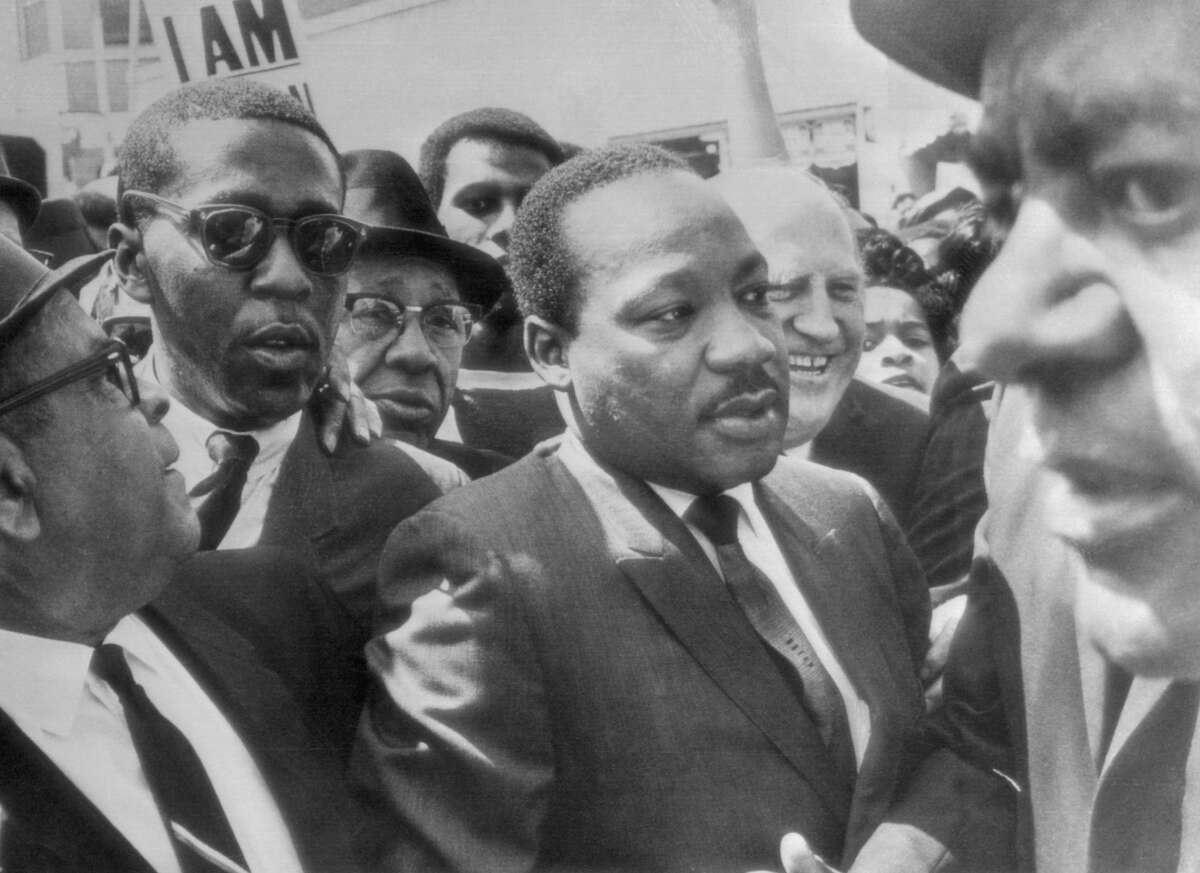
Despite these major setbacks, one progressive political force is poised to lead us through this winter season — workers and labor unions. Of course, union density is at its lowest since the 1970s. Nor has organized labor organized a strike wave on the level of the 1970s. But labor unions have experienced a sort of upsurge in the last ten years. Fast food, restaurant, hotel and coffeehouse workers launched the “Fight for 15” movement with the demand of a $15/hour wage and union recognition. The Fight for 15 movement represents one of the contemporary labor movement’s most notable successes, as it has won wage increases in hundreds of U.S. cities and changed public discourse.
Thousands of educators have engaged in labor actions as well. More than 100,000 teachers participated in the “Red for Ed” strike wave in 2018-2019. These actions took root in mostly “red” states like Oklahoma, Arizona and West Virginia. Facing increased precarity, stagnant wages and benefits, and losing control over shared governance, tens of thousands of college and university faculty, graduate assistants and staff have responded by unionizing and striking. According to a report in Inside Higher Ed, nearly 36,000 graduate students won union representation in 2022 and 2023. Three faculty unions at Rutgers University struck for the first time over salaries, graduate student funding and job security for adjuncts and won. Members of University of Michigan’s Graduate Employees Organization responded to the 2020 uprisings for Black lives with an “abolitionist strike” to transform the way the university approached public safety. Members have also struck for improved trans health care.
We can start with King’s declaration that “all labor has dignity” and then move toward his argument for a “revolution in values” that centers human rights and the environment.
Flight attendants, led by AFA-CWA international president Sara Nelson, have positioned themselves at the fore of fighting for improved working conditions for themselves and all workers, especially amid the COVID-19 pandemic. American Airlines flight attendants won pay increases after threatening to strike last year. Hundreds of Starbucks and Amazon workers have recently engaged in inspirational unionization drives. The Writers Guild of America and the Screen Actors Guild-American Federation of Television and Radio Artists (SAG-AFTRA) went on strike to protect their labor from AI and win revenues from streaming. The Teamsters union, representing UPS workers, won wage gains for all of the company’s workers in 2023. The United Auto Workers (UAW) won an extraordinary contract that included increases in wages, retirement benefits and other benefits for all of its workers, in its strike against the Big Three automakers in 2023. Rather than all workers going on strike simultaneously, the UAW utilized a different tactic, a “stand up strike,” where the union would decide which plants to idle, hoping employers could not recalibrate production to blunt the stoppages. Last year, the labor movement scored a major victory. The UAW successfully unionized Ultium Cell workers and a Volkswagen plant in Tennessee, establishing a potential organizing beachhead in the South. This effort took place in a year where tens of thousands of workers at Boeing, Starbucks, Amazon and U.S. ports engaged in labor actions.
Organized labor has also advocated against another one of King’s “giant triplets” — militarism. The UAW used its power to weigh in on the genocide that Israel is inflicting on Gaza when Shawn Fain called for a ceasefire. Rank-and-file members of the UAW also demanded that Fain and the leadership divest from Israel. Members from several unions including the Association of Flight Attendants, Service Employees International Union and the United Electrical Workers also called for the end of the genocide and the defunding of U.S. military aid to Israel. It would be powerful if workers in shipping and the defense industry joined to support Palestinian liberation in the wake of the recently announced ceasefire agreement.
Lastly, more Americans recognize the importance of labor unions in fighting for their rights as workers. According to a September 2024 Gallup poll, labor unions are polling their highest approval rating since 1965. And as winter in America comes and more Americans grow skeptical of political institutions, tech companies, health insurance firms, and other corporations, organized labor is the best force to lead this struggle.
Workers and organized labor can provide a more expansive vision of democracy that does not just emphasize voting. What would it mean for workers to provide a real countervailing force against authoritarians and capitalists? And what would it mean for them to determine their fates in their workplaces at a time when costs and expenses remain high, when employers continue to steal wages, and at a time when generative AI threatens to degrade human labor?
But, to confront billionaire authoritarians, economic inequality and fascism, we need to build power. King articulated a similar point in his March 18, 1968, speech, saying:
We can all get more together than we can apart; we can get more organized together than we can apart. And this is the way we gain power. Power is the ability to achieve purpose, power is the ability to affect change, and we need power. What is power? Walter Reuther said once that ‘power is the ability of a labor union like UAW to make the most powerful corporation in the world—General Motors—say yes when it wants to say no.’ That’s power.
Racial justice protesters, educators, workers for Starbucks and Amazon, port workers, and other laborers have demonstrated the necessity of utilizing the disruptive power of collective action. The UAW’s use of stand up strikes is another example of using disruption strategically.
Unions and worker organizations are needed the most at this moment as economic inequality is increasing and as billionaire authoritarians continue their quest to consolidate power over the private and public sectors. We need a radical independent labor movement to bring in those disaffected with capitalism, the legal system and electoral politics. Of course, not all labor unions fit within this category, but workers and unions in the U.S. boast a tradition of advocating for various issues important to a broad swath of workers including workplace democracy, socialized health care, racial justice, immigrant rights and disinvestment from militarism. This tradition of solidarity is a good place to deepen contemporary workers’ political consciousness. Unions and workers’ organizations can be the institutions that welcome all of us into radical politics without fear of making mistakes. We can start with King’s declaration that “all labor has dignity” and then move toward his argument for a “revolution in values” that centers human rights and the environment..
This article is licensed under Creative Commons (CC BY-NC-ND 4.0), and you are free to share and republish under the terms of the license.
Austin C. McCoy is a scholar of African American history, labor and social movements. Follow him on Bluesky.
'There is still hope for a brighter tomorrow': Read MLK Jr.'s Nobel Prize acceptance speech

(Creative Commons)
Dr. Martin Luther King Jr. at the University of Minnesota on April 27, 1967
MLK was assassinated on the cusp of a strike wave in a time of counterrevolution. We need his “revolution in values.”
By Austin C. McCoy ,
January 20, 2025
Dr. Martin Luther King is surrounded by leaders of the sanitation strike in Memphis, Tennessee, as he arrives to lead a march in support of the striking workers on March 28, 1968.
Bettmann via Getty Images
Less than a month before his assassination, Martin Luther King Jr. addressed a crowd of 10,000 striking sanitation workers and their supporters in Memphis, Tennessee. “One day our society will come to respect the sanitation worker if it is to survive,” he said, “for the person who picks up our garbage … is as significant as the physician, for if he doesn’t do his job, diseases are rampant. All labor has dignity.”
King delivered this message at Mason Temple on March 18, 1968, as Black sanitation workers in the city were waging a historic strike for safer working conditions. His speech also focused on one of the central themes that consumed his political work in the last two years of his life: the moral and political need for the United States to divest itself from fighting wars and reinvest in ending poverty, or the U.S. would surely, he declared, go “to hell.”
When King delivered this speech advocating for workers to overturn segregation and build power to pursue economic justice, the U.S. was on the cusp of a strike wave. In less than a month, King would be struck down by an assassin’s bullet while standing on the balcony of the Lorraine Motel. According to the Bureau of Labor Statistics, there were more than 26,000 strikes involving more than 10 million workers between 1969 and 1973. These strikes gave birth to new radical labor organizations like the Dodge Revolutionary Union Movement, League of Revolutionary Black Workers and the Black Workers Congress that articulated transformative visions aimed at disrupting what King called the “giant triplets” — racism, militarism and materialism, or capitalism.
However, this new wave of strikes and labor actions took place at a time of growing counterrevolution. Richard Nixon won the 1968 election on an anti-civil rights “law and order” campaign. Law enforcement throughout the U.S. engaged in violent repression of the Black liberation movement and the New Left. These efforts featured COINTELPRO’s attempts to extinguish the Black Panther Party, which arrived in the form of raids, shootouts, jailings and assassinations of activists like Fred Hampton. By the end of the 1970s, state repression; economic turbulence, in the form of stagflation, energy shocks, recession and deindustrialization; and organized labor’s failure to win labor law reform had frozen workers’ aspirations to achieve power. As Gil Scott Heron said, “It was winter in America.”
We are living in a similar moment. Five years after the largest racial justice uprising in the U.S., we live in a counterrevolutionary moment. Most Democrats and Republicans are in agreement about lavishly funding the police; celebrations of “essential” workers during the pandemic did not translate into material gains; white nationalists have launched ideological and political attacks on critical race theory, diversity, equity and inclusion programs, and on the teaching of Black history; and politicians are targeting trans people and immigrants in their bid to secure and maintain power. Colleges and universities have led the crackdown effort on Palestinians, Arabs, Muslims, and anyone else protesting apartheid and genocide in Gaza. Billionaire authoritarians and media organizations appease the incoming Trump administration in advance. Corporations seek to foist generative AI onto everyone, which threatens to displace workers. The Trump administration seeks to enact policies such as broad tariffs and cutting welfare benefits like SNAP that will disproportionately hurt working-class people. Lastly, the new administration’s promises to enact mass deportations of Global South migrants are reminiscent of the anti-immigrant programs of the 1930s and the 1950s.
Less than a month before his assassination, Martin Luther King Jr. addressed a crowd of 10,000 striking sanitation workers and their supporters in Memphis, Tennessee. “One day our society will come to respect the sanitation worker if it is to survive,” he said, “for the person who picks up our garbage … is as significant as the physician, for if he doesn’t do his job, diseases are rampant. All labor has dignity.”
King delivered this message at Mason Temple on March 18, 1968, as Black sanitation workers in the city were waging a historic strike for safer working conditions. His speech also focused on one of the central themes that consumed his political work in the last two years of his life: the moral and political need for the United States to divest itself from fighting wars and reinvest in ending poverty, or the U.S. would surely, he declared, go “to hell.”
When King delivered this speech advocating for workers to overturn segregation and build power to pursue economic justice, the U.S. was on the cusp of a strike wave. In less than a month, King would be struck down by an assassin’s bullet while standing on the balcony of the Lorraine Motel. According to the Bureau of Labor Statistics, there were more than 26,000 strikes involving more than 10 million workers between 1969 and 1973. These strikes gave birth to new radical labor organizations like the Dodge Revolutionary Union Movement, League of Revolutionary Black Workers and the Black Workers Congress that articulated transformative visions aimed at disrupting what King called the “giant triplets” — racism, militarism and materialism, or capitalism.
However, this new wave of strikes and labor actions took place at a time of growing counterrevolution. Richard Nixon won the 1968 election on an anti-civil rights “law and order” campaign. Law enforcement throughout the U.S. engaged in violent repression of the Black liberation movement and the New Left. These efforts featured COINTELPRO’s attempts to extinguish the Black Panther Party, which arrived in the form of raids, shootouts, jailings and assassinations of activists like Fred Hampton. By the end of the 1970s, state repression; economic turbulence, in the form of stagflation, energy shocks, recession and deindustrialization; and organized labor’s failure to win labor law reform had frozen workers’ aspirations to achieve power. As Gil Scott Heron said, “It was winter in America.”
We are living in a similar moment. Five years after the largest racial justice uprising in the U.S., we live in a counterrevolutionary moment. Most Democrats and Republicans are in agreement about lavishly funding the police; celebrations of “essential” workers during the pandemic did not translate into material gains; white nationalists have launched ideological and political attacks on critical race theory, diversity, equity and inclusion programs, and on the teaching of Black history; and politicians are targeting trans people and immigrants in their bid to secure and maintain power. Colleges and universities have led the crackdown effort on Palestinians, Arabs, Muslims, and anyone else protesting apartheid and genocide in Gaza. Billionaire authoritarians and media organizations appease the incoming Trump administration in advance. Corporations seek to foist generative AI onto everyone, which threatens to displace workers. The Trump administration seeks to enact policies such as broad tariffs and cutting welfare benefits like SNAP that will disproportionately hurt working-class people. Lastly, the new administration’s promises to enact mass deportations of Global South migrants are reminiscent of the anti-immigrant programs of the 1930s and the 1950s.
Despite these major setbacks, one progressive political force is poised to lead us through this winter season — workers and labor unions. Of course, union density is at its lowest since the 1970s. Nor has organized labor organized a strike wave on the level of the 1970s. But labor unions have experienced a sort of upsurge in the last ten years. Fast food, restaurant, hotel and coffeehouse workers launched the “Fight for 15” movement with the demand of a $15/hour wage and union recognition. The Fight for 15 movement represents one of the contemporary labor movement’s most notable successes, as it has won wage increases in hundreds of U.S. cities and changed public discourse.
Thousands of educators have engaged in labor actions as well. More than 100,000 teachers participated in the “Red for Ed” strike wave in 2018-2019. These actions took root in mostly “red” states like Oklahoma, Arizona and West Virginia. Facing increased precarity, stagnant wages and benefits, and losing control over shared governance, tens of thousands of college and university faculty, graduate assistants and staff have responded by unionizing and striking. According to a report in Inside Higher Ed, nearly 36,000 graduate students won union representation in 2022 and 2023. Three faculty unions at Rutgers University struck for the first time over salaries, graduate student funding and job security for adjuncts and won. Members of University of Michigan’s Graduate Employees Organization responded to the 2020 uprisings for Black lives with an “abolitionist strike” to transform the way the university approached public safety. Members have also struck for improved trans health care.
We can start with King’s declaration that “all labor has dignity” and then move toward his argument for a “revolution in values” that centers human rights and the environment.
Flight attendants, led by AFA-CWA international president Sara Nelson, have positioned themselves at the fore of fighting for improved working conditions for themselves and all workers, especially amid the COVID-19 pandemic. American Airlines flight attendants won pay increases after threatening to strike last year. Hundreds of Starbucks and Amazon workers have recently engaged in inspirational unionization drives. The Writers Guild of America and the Screen Actors Guild-American Federation of Television and Radio Artists (SAG-AFTRA) went on strike to protect their labor from AI and win revenues from streaming. The Teamsters union, representing UPS workers, won wage gains for all of the company’s workers in 2023. The United Auto Workers (UAW) won an extraordinary contract that included increases in wages, retirement benefits and other benefits for all of its workers, in its strike against the Big Three automakers in 2023. Rather than all workers going on strike simultaneously, the UAW utilized a different tactic, a “stand up strike,” where the union would decide which plants to idle, hoping employers could not recalibrate production to blunt the stoppages. Last year, the labor movement scored a major victory. The UAW successfully unionized Ultium Cell workers and a Volkswagen plant in Tennessee, establishing a potential organizing beachhead in the South. This effort took place in a year where tens of thousands of workers at Boeing, Starbucks, Amazon and U.S. ports engaged in labor actions.
Organized labor has also advocated against another one of King’s “giant triplets” — militarism. The UAW used its power to weigh in on the genocide that Israel is inflicting on Gaza when Shawn Fain called for a ceasefire. Rank-and-file members of the UAW also demanded that Fain and the leadership divest from Israel. Members from several unions including the Association of Flight Attendants, Service Employees International Union and the United Electrical Workers also called for the end of the genocide and the defunding of U.S. military aid to Israel. It would be powerful if workers in shipping and the defense industry joined to support Palestinian liberation in the wake of the recently announced ceasefire agreement.
Lastly, more Americans recognize the importance of labor unions in fighting for their rights as workers. According to a September 2024 Gallup poll, labor unions are polling their highest approval rating since 1965. And as winter in America comes and more Americans grow skeptical of political institutions, tech companies, health insurance firms, and other corporations, organized labor is the best force to lead this struggle.
Workers and organized labor can provide a more expansive vision of democracy that does not just emphasize voting. What would it mean for workers to provide a real countervailing force against authoritarians and capitalists? And what would it mean for them to determine their fates in their workplaces at a time when costs and expenses remain high, when employers continue to steal wages, and at a time when generative AI threatens to degrade human labor?
But, to confront billionaire authoritarians, economic inequality and fascism, we need to build power. King articulated a similar point in his March 18, 1968, speech, saying:
We can all get more together than we can apart; we can get more organized together than we can apart. And this is the way we gain power. Power is the ability to achieve purpose, power is the ability to affect change, and we need power. What is power? Walter Reuther said once that ‘power is the ability of a labor union like UAW to make the most powerful corporation in the world—General Motors—say yes when it wants to say no.’ That’s power.
Racial justice protesters, educators, workers for Starbucks and Amazon, port workers, and other laborers have demonstrated the necessity of utilizing the disruptive power of collective action. The UAW’s use of stand up strikes is another example of using disruption strategically.
Unions and worker organizations are needed the most at this moment as economic inequality is increasing and as billionaire authoritarians continue their quest to consolidate power over the private and public sectors. We need a radical independent labor movement to bring in those disaffected with capitalism, the legal system and electoral politics. Of course, not all labor unions fit within this category, but workers and unions in the U.S. boast a tradition of advocating for various issues important to a broad swath of workers including workplace democracy, socialized health care, racial justice, immigrant rights and disinvestment from militarism. This tradition of solidarity is a good place to deepen contemporary workers’ political consciousness. Unions and workers’ organizations can be the institutions that welcome all of us into radical politics without fear of making mistakes. We can start with King’s declaration that “all labor has dignity” and then move toward his argument for a “revolution in values” that centers human rights and the environment..
This article is licensed under Creative Commons (CC BY-NC-ND 4.0), and you are free to share and republish under the terms of the license.
Austin C. McCoy is a scholar of African American history, labor and social movements. Follow him on Bluesky.
MLK’s Legacy Is One of Class Struggle. To Fight Trump, We Must Carry His Torch.
Project 2025 aims to recreate the state-sanctioned discrimination and inequality that our ancestors fought to end.
Martin Luther King Jr. Warned That the Poor Pay for War With Their Lives
King warned us that the real enemy is war itself.
By Nicholas Powers , Truthout January 20, 2020
Dismantling the Trap
On Inauguration Day, Trump will place his hand on the Bible and be sworn into office. The ceremony will take place on the West Front of the U.S. Capitol as jubilant Republicans plan to cut, cut, cut the federal budget. They want to cut poor people from social services, the sick from health care and undocumented workers from the country with Immigration and Customs Enforcement (ICE) raids. They come armed with a plan: Project 2025, a 900-plus page tome of conservative policy crafted by the Heritage Foundation. When you look at it closely, you see more than budget cuts, it is a plan to institutionalize conservatism. It is state-sponsored, widespread suffering.
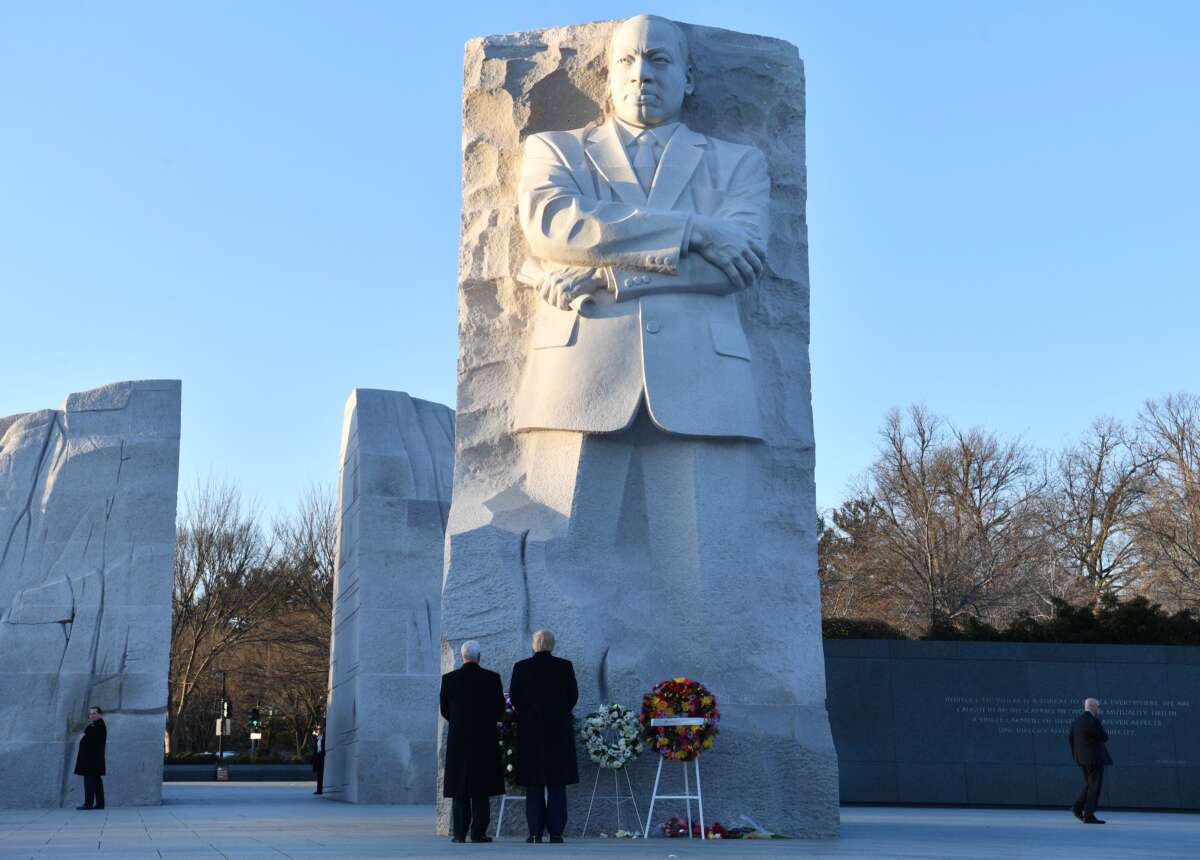
In contrast to Trump’s swearing in to office, just two miles away at the Lincoln Memorial, King gave the “I Have a Dream” speech in the 1963 March on Washington. Nearby is the Reflecting Pool, where after King’s murder in 1968, the Poor People’s Campaign built Resurrection City, a protest camp to make visible the multiracial poor. In downtown D.C. sits a massive statue of King called The Stone of Hope, engraved with his speeches. D.C. is filled with the King’s history; the man’s life was dedicated to expanding the circle of citizenship.
Trump’s inauguration on MLK Jr. Day highlights the clash of two opposing visions. MAGA wants to rebuild walls of racism, patriarchy and classism — even ending birthright citizenship. The left has fought to enlarge the circle of citizenship and include people of color, women, workers and LGBTQ folks. But the right has the White House, Senate, House and Supreme Court.
“I like one big beautiful bill,” Trump recently bragged at a news conference. His reconciliation bill, scheduled for April, can pass the Senate with a simple majority. It is the first step to Project 2025. And it’s a whopper. First up is the renewal of Trump’s Tax Cuts and Jobs Act: basically tax cuts for the rich to the tune of $4 trillion. Think about it. The government will have $4 trillion less to fund services. Next are additional funds for ICE to brutally deport undocumented workers. What is obscene is that Republicans plan to plug the hole left by those tax cuts with $5 trillion in budget cuts.
Working in concert, Trump, the Republican-led House and Senate, and the right-wing Supreme Court threaten to dismantle King’s legacy.
And the cuts are sure to keep coming. Trump’s blueprint is Project 2025, which aims to take a chainsaw to programs that help the poor. Medicaid will be cut and the spending left to states. Project 2025 calls the U.S. Department of Agriculture a “welfare agency” and plans to cut SNAP (food stamps) and school meal programs. Project 2025 aims to dismantle the Department of Education and end federal aid to low-income schools. On housing, it calls for an end to the Housing Trust Fund, a federal grant to states to alleviate chronic homelessness. Project 2025’s plan for the Department of Justice is to shift its focus to prosecuting officials, colleges and private businesses that promote social justice. To cap it off, Project 2025 plans to remove any federal workers that get in the way of Trump’s agenda by using executive order Schedule F, which makes tens of thousands of them replaceable with Trump loyalists.
Project 2025 is an attack on workers, on the racially marginalized, on LGBTQ people and the poor. It will cause mass suffering and death. How? The U.S. has 304 million citizens. The Poor People’s Campaign calculates 140 million are poor and working poor, and 47 million go hungry, including 14 million children. At the bottom of this cruel class oppression are 771,800 unhoused people. All of this kills. The Journal of the American Medical Association cited poverty as the fourth-leading cause of death in the U.S. each year as 183,000 people die from poverty-related causes. And nearly 45,000 die because they have no health insurance.
Project 2025 is an assault on vulnerable people. Trump and the Republicans are threatening to push the hungry deeper into hunger. They will make the sick sicker — and many, if you follow the math, inevitably will die. Project 2025 is racist because poverty in the United States is racialized; 21 percent of Indigenous people are poor, along with 17 percent of Black people and 16 percent of Latinos.
Project 2025 is also a trap. Republican budget cuts and extremist policies will compell people to protest them. Marches will roll like waves and hit the wall of police and draconian laws that Trump builds around his government. Anger will spike in the streets. When a window is broken or a police car is torched, the trap is sprung. Trump says he is eager to send in riot police or the military. He has already given a wink to far right groups like the Proud Boys that like to break bones.
This is why we have to turn to King again. His radical legacy is a blueprint to avoid the trap and defeat Project 2025.
A Tale of Two Kings
In April 1963, an incarcerated King wrote the “Letter from Birmingham Jail” to push back against white moderates who feared conflict. He wrote, “I am not afraid of the word ‘tension.’ I have earnestly opposed violent tension, but there is a type of constructive, nonviolent tension which is necessary for growth … we must create the kind of tension in society that will help men rise from the dark depths of racism to the majestic heights of understanding and brotherhood.”
In May 1963, his ideas came to life. King created tension not only from nonviolent direct action, but also from contrasting widely accepted values against less accepted ones: in this case, the universal value of children’s innocence versus white supremacy. Firefighters in Birmingham, Alabama, shot high-powered fire hoses at children. Police let dogs loose to tear at their clothes and skin. White supremacist and Commissioner of Public Safety Bull Connor ordered the assault on the 1963 Children’s Crusade in Birmingham, in which thousands of Black children walked downtown to protest segregation. They were arrested and thrown in jail where they sang freedom songs. Reporters filmed it. The world saw the news and was shocked. A moribund civil rights movement was reenergized.
We can learn from King how to maneuver from a position of weakness. The civil rights movement faced hostile officials that used violence to suppress protests. We face similar threats under Trump and the Republican trifecta. King faced a hostile public raised on anti-Black racism. We likewise now face a public turned against “wokeness.” King faced interlocking laws from legal segregation, redlining and a racist criminal legal system. We face Project 2025, which seeks to recreate, to a degree, the state-sanctioned discrimination that our ancestors fought to end.
Project 2025 is a plan to institutionalize conservatism. It is state-sponsored, widespread suffering.
Project 2025 and the second Trump administration will surely set the stage for more protests. Again, images of families torn apart by government officials may soon spark rage. News of increased poverty and hunger will likely direct disgust at Trump and the GOP. Protests and lawsuits might hamper the Trump administration temporarily, but it is not enough. We must go beyond political trench warfare and build a progressive supermajority.
Here is where we shift from the “I Have a Dream” King to the later, more radical King. He realized the integration of Black people was just the first step; next was to integrate the poor and working class as well. Which is why, in 1966, he told his staff that the U.S. must “move toward a democratic socialism.”
Integration did not mean marginalized people transform themselves to fit into the U.S. mainstream. No, for King it meant that everyone has a place at the table. Capitalism must be replaced with democratic socialism, in which people are integrated by a government that answers their needs for food, housing and jobs with dignity. That’s why in 1968, King marched in Memphis with striking sanitation workers and told them in a sermon, “Whenever you are engaged in work that is at the service of humanity it has dignity and work. You are reminding the nation that it is a crime for people to live in this rich nation and receive starvation wages.”
Mine Eyes Have Seen the Glory
We must now pick up the baton from the radical King of 1968. His legacy pulls the rug from under even the most powerful and violent regimes. King’s political adherents used his tactic of contrasting widely accepted values (in sociology known as “consensus values”) to less accepted ones. The goal is to make clear that most Americans already were progressive.
Rev. Jesse Jackson thundered in his climatic 1988 Democratic Convention speech, “What’s the moral challenge of our day? We have public accommodations. We have the right to vote. We have open housing. What’s the fundamental challenge of our day? It is to end economic violence.” He evoked a powerful image: “Most poor people are not lazy. They are not Black. They are not Brown. They are mostly white and female and young. But whether white, Black or Brown, a hungry baby’s belly turned inside out is the same color — color it pain; color it hurt; color it agony.”
In 2016, Anderson Cooper asked Sen. Bernie Sanders about his spirituality. Sanders said, “I believe as a human being that the pain one person feels, if we have children who are hungry, if we have elderly people who can’t afford their prescription drugs, that impacts you and that impacts me. My spirituality is that we are all in this together.”
Jackson and Sanders use King’s strategy of turning class warfare into a spiritual struggle between good and evil. Since class cuts across race and gender, it becomes a powerful leverage to topple a corrupt Trump administration the way that King toppled a corrupt Southern white supremacy — and to go further and build a supermajority. The Democratic Party’s liberal politics will fail unless there is a call for economic justice.
We are in a two-front struggle. The Congressional Black Caucus, the NAACP and the ACLU are preparing to fight Trump in the courts and at the ballot box. Yet the neoliberal Democratic Party is exhausted. Now the left has a historic chance to follow King’s footsteps and mobilize the poor and workers. To say clearly that integration means recognizing the working class — the janitors, mass transit drivers, nurses and undocumented day laborers — who make life possible.
For King, the Memphis strike wasn’t just a class conflict; it was a spiritual struggle to redeem humanity. We are not fully realized until we accept responsibility for the relationships we are in with others. That’s why King marched with the sanitation workers.
All around you is the world our forebears in the civil rights movement created for us. Harriet Tubman and Frederick Douglass are here. Ella Baker and Fannie Lou Hamer. And Martin Luther King Jr. They’re still here, marching in spirit. They’re still leading us
This article is licensed under Creative Commons (CC BY-NC-ND 4.0), and you are free to share and republish under the terms of the license.
Nicholas Powers is the author of Thirst, a political vampire novel; The Ground Below Zero: 9/11 to Burning Man, New Orleans to Darfur, Haiti to Occupy Wall Street; and most recently, Black Psychedelic Revolution. He has been writing for Truthout since 2011. His article, “Killing the Future: The Theft of Black Life” in the Truthout anthology Who Do You Serve, Who Do You Protect? coalesces his years of reporting on police brutality.
Project 2025 aims to recreate the state-sanctioned discrimination and inequality that our ancestors fought to end.
January 19, 2025
President Donald Trump and Vice President Mike Pence look on at the Martin Luther King Jr. memorial on MLK day in Washington, D.C., on January 20, 2025.
NICHOLAS KAMM /AFP via Getty Images
This Martin Luther King Jr. Day, Donald Trump will be sworn into office. Working in concert, Trump, the Republican-led House and Senate, and the right-wing Supreme Court threaten to dismantle King’s legacy. If they do, the most vulnerable people in the United States, Black folks in particular, will be attacked. The blueprint for this assault is Project 2025.
The symbolism of Trump being inaugurated on MLK Jr. Day is chilling. Is King’s legacy dead? How can we be observing MLK Day by handing power to a politician who ran a blatantly racist campaign to beat the first Black woman to have run as a major party’s presidential nominee? Has the goal of transforming the United States from a white ethno-state into a multiracial democracy been vanquished? If so, does that leave us plunging headlong into a permanent Republican oligarchy?
King’s life and martyrdom have been split in two. The dominant one is the “I Have a Dream” King. He appears on Apple ads. He is the apostle for nonviolent direct action to end racial segregation
The lesser known King, the one repressed from official celebration, is the 1968 radical, who was an anti-poverty and antiwar democratic socialist.
We need that legacy of King to build a working class, progressive supermajority that can fight the cruel agenda of Project 2025.
Related Story
This Martin Luther King Jr. Day, Donald Trump will be sworn into office. Working in concert, Trump, the Republican-led House and Senate, and the right-wing Supreme Court threaten to dismantle King’s legacy. If they do, the most vulnerable people in the United States, Black folks in particular, will be attacked. The blueprint for this assault is Project 2025.
The symbolism of Trump being inaugurated on MLK Jr. Day is chilling. Is King’s legacy dead? How can we be observing MLK Day by handing power to a politician who ran a blatantly racist campaign to beat the first Black woman to have run as a major party’s presidential nominee? Has the goal of transforming the United States from a white ethno-state into a multiracial democracy been vanquished? If so, does that leave us plunging headlong into a permanent Republican oligarchy?
King’s life and martyrdom have been split in two. The dominant one is the “I Have a Dream” King. He appears on Apple ads. He is the apostle for nonviolent direct action to end racial segregation
The lesser known King, the one repressed from official celebration, is the 1968 radical, who was an anti-poverty and antiwar democratic socialist.
We need that legacy of King to build a working class, progressive supermajority that can fight the cruel agenda of Project 2025.
Related Story
Martin Luther King Jr. Warned That the Poor Pay for War With Their Lives
King warned us that the real enemy is war itself.
By Nicholas Powers , Truthout January 20, 2020
Dismantling the Trap
On Inauguration Day, Trump will place his hand on the Bible and be sworn into office. The ceremony will take place on the West Front of the U.S. Capitol as jubilant Republicans plan to cut, cut, cut the federal budget. They want to cut poor people from social services, the sick from health care and undocumented workers from the country with Immigration and Customs Enforcement (ICE) raids. They come armed with a plan: Project 2025, a 900-plus page tome of conservative policy crafted by the Heritage Foundation. When you look at it closely, you see more than budget cuts, it is a plan to institutionalize conservatism. It is state-sponsored, widespread suffering.
In contrast to Trump’s swearing in to office, just two miles away at the Lincoln Memorial, King gave the “I Have a Dream” speech in the 1963 March on Washington. Nearby is the Reflecting Pool, where after King’s murder in 1968, the Poor People’s Campaign built Resurrection City, a protest camp to make visible the multiracial poor. In downtown D.C. sits a massive statue of King called The Stone of Hope, engraved with his speeches. D.C. is filled with the King’s history; the man’s life was dedicated to expanding the circle of citizenship.
Trump’s inauguration on MLK Jr. Day highlights the clash of two opposing visions. MAGA wants to rebuild walls of racism, patriarchy and classism — even ending birthright citizenship. The left has fought to enlarge the circle of citizenship and include people of color, women, workers and LGBTQ folks. But the right has the White House, Senate, House and Supreme Court.
“I like one big beautiful bill,” Trump recently bragged at a news conference. His reconciliation bill, scheduled for April, can pass the Senate with a simple majority. It is the first step to Project 2025. And it’s a whopper. First up is the renewal of Trump’s Tax Cuts and Jobs Act: basically tax cuts for the rich to the tune of $4 trillion. Think about it. The government will have $4 trillion less to fund services. Next are additional funds for ICE to brutally deport undocumented workers. What is obscene is that Republicans plan to plug the hole left by those tax cuts with $5 trillion in budget cuts.
Working in concert, Trump, the Republican-led House and Senate, and the right-wing Supreme Court threaten to dismantle King’s legacy.
And the cuts are sure to keep coming. Trump’s blueprint is Project 2025, which aims to take a chainsaw to programs that help the poor. Medicaid will be cut and the spending left to states. Project 2025 calls the U.S. Department of Agriculture a “welfare agency” and plans to cut SNAP (food stamps) and school meal programs. Project 2025 aims to dismantle the Department of Education and end federal aid to low-income schools. On housing, it calls for an end to the Housing Trust Fund, a federal grant to states to alleviate chronic homelessness. Project 2025’s plan for the Department of Justice is to shift its focus to prosecuting officials, colleges and private businesses that promote social justice. To cap it off, Project 2025 plans to remove any federal workers that get in the way of Trump’s agenda by using executive order Schedule F, which makes tens of thousands of them replaceable with Trump loyalists.
Project 2025 is an attack on workers, on the racially marginalized, on LGBTQ people and the poor. It will cause mass suffering and death. How? The U.S. has 304 million citizens. The Poor People’s Campaign calculates 140 million are poor and working poor, and 47 million go hungry, including 14 million children. At the bottom of this cruel class oppression are 771,800 unhoused people. All of this kills. The Journal of the American Medical Association cited poverty as the fourth-leading cause of death in the U.S. each year as 183,000 people die from poverty-related causes. And nearly 45,000 die because they have no health insurance.
Project 2025 is an assault on vulnerable people. Trump and the Republicans are threatening to push the hungry deeper into hunger. They will make the sick sicker — and many, if you follow the math, inevitably will die. Project 2025 is racist because poverty in the United States is racialized; 21 percent of Indigenous people are poor, along with 17 percent of Black people and 16 percent of Latinos.
Project 2025 is also a trap. Republican budget cuts and extremist policies will compell people to protest them. Marches will roll like waves and hit the wall of police and draconian laws that Trump builds around his government. Anger will spike in the streets. When a window is broken or a police car is torched, the trap is sprung. Trump says he is eager to send in riot police or the military. He has already given a wink to far right groups like the Proud Boys that like to break bones.
This is why we have to turn to King again. His radical legacy is a blueprint to avoid the trap and defeat Project 2025.
A Tale of Two Kings
In April 1963, an incarcerated King wrote the “Letter from Birmingham Jail” to push back against white moderates who feared conflict. He wrote, “I am not afraid of the word ‘tension.’ I have earnestly opposed violent tension, but there is a type of constructive, nonviolent tension which is necessary for growth … we must create the kind of tension in society that will help men rise from the dark depths of racism to the majestic heights of understanding and brotherhood.”
In May 1963, his ideas came to life. King created tension not only from nonviolent direct action, but also from contrasting widely accepted values against less accepted ones: in this case, the universal value of children’s innocence versus white supremacy. Firefighters in Birmingham, Alabama, shot high-powered fire hoses at children. Police let dogs loose to tear at their clothes and skin. White supremacist and Commissioner of Public Safety Bull Connor ordered the assault on the 1963 Children’s Crusade in Birmingham, in which thousands of Black children walked downtown to protest segregation. They were arrested and thrown in jail where they sang freedom songs. Reporters filmed it. The world saw the news and was shocked. A moribund civil rights movement was reenergized.
We can learn from King how to maneuver from a position of weakness. The civil rights movement faced hostile officials that used violence to suppress protests. We face similar threats under Trump and the Republican trifecta. King faced a hostile public raised on anti-Black racism. We likewise now face a public turned against “wokeness.” King faced interlocking laws from legal segregation, redlining and a racist criminal legal system. We face Project 2025, which seeks to recreate, to a degree, the state-sanctioned discrimination that our ancestors fought to end.
Project 2025 is a plan to institutionalize conservatism. It is state-sponsored, widespread suffering.
Project 2025 and the second Trump administration will surely set the stage for more protests. Again, images of families torn apart by government officials may soon spark rage. News of increased poverty and hunger will likely direct disgust at Trump and the GOP. Protests and lawsuits might hamper the Trump administration temporarily, but it is not enough. We must go beyond political trench warfare and build a progressive supermajority.
Here is where we shift from the “I Have a Dream” King to the later, more radical King. He realized the integration of Black people was just the first step; next was to integrate the poor and working class as well. Which is why, in 1966, he told his staff that the U.S. must “move toward a democratic socialism.”
Integration did not mean marginalized people transform themselves to fit into the U.S. mainstream. No, for King it meant that everyone has a place at the table. Capitalism must be replaced with democratic socialism, in which people are integrated by a government that answers their needs for food, housing and jobs with dignity. That’s why in 1968, King marched in Memphis with striking sanitation workers and told them in a sermon, “Whenever you are engaged in work that is at the service of humanity it has dignity and work. You are reminding the nation that it is a crime for people to live in this rich nation and receive starvation wages.”
Mine Eyes Have Seen the Glory
We must now pick up the baton from the radical King of 1968. His legacy pulls the rug from under even the most powerful and violent regimes. King’s political adherents used his tactic of contrasting widely accepted values (in sociology known as “consensus values”) to less accepted ones. The goal is to make clear that most Americans already were progressive.
Rev. Jesse Jackson thundered in his climatic 1988 Democratic Convention speech, “What’s the moral challenge of our day? We have public accommodations. We have the right to vote. We have open housing. What’s the fundamental challenge of our day? It is to end economic violence.” He evoked a powerful image: “Most poor people are not lazy. They are not Black. They are not Brown. They are mostly white and female and young. But whether white, Black or Brown, a hungry baby’s belly turned inside out is the same color — color it pain; color it hurt; color it agony.”
In 2016, Anderson Cooper asked Sen. Bernie Sanders about his spirituality. Sanders said, “I believe as a human being that the pain one person feels, if we have children who are hungry, if we have elderly people who can’t afford their prescription drugs, that impacts you and that impacts me. My spirituality is that we are all in this together.”
Jackson and Sanders use King’s strategy of turning class warfare into a spiritual struggle between good and evil. Since class cuts across race and gender, it becomes a powerful leverage to topple a corrupt Trump administration the way that King toppled a corrupt Southern white supremacy — and to go further and build a supermajority. The Democratic Party’s liberal politics will fail unless there is a call for economic justice.
We are in a two-front struggle. The Congressional Black Caucus, the NAACP and the ACLU are preparing to fight Trump in the courts and at the ballot box. Yet the neoliberal Democratic Party is exhausted. Now the left has a historic chance to follow King’s footsteps and mobilize the poor and workers. To say clearly that integration means recognizing the working class — the janitors, mass transit drivers, nurses and undocumented day laborers — who make life possible.
For King, the Memphis strike wasn’t just a class conflict; it was a spiritual struggle to redeem humanity. We are not fully realized until we accept responsibility for the relationships we are in with others. That’s why King marched with the sanitation workers.
All around you is the world our forebears in the civil rights movement created for us. Harriet Tubman and Frederick Douglass are here. Ella Baker and Fannie Lou Hamer. And Martin Luther King Jr. They’re still here, marching in spirit. They’re still leading us
This article is licensed under Creative Commons (CC BY-NC-ND 4.0), and you are free to share and republish under the terms of the license.
Nicholas Powers is the author of Thirst, a political vampire novel; The Ground Below Zero: 9/11 to Burning Man, New Orleans to Darfur, Haiti to Occupy Wall Street; and most recently, Black Psychedelic Revolution. He has been writing for Truthout since 2011. His article, “Killing the Future: The Theft of Black Life” in the Truthout anthology Who Do You Serve, Who Do You Protect? coalesces his years of reporting on police brutality.
(Creative Commons)
Dr. Martin Luther King Jr. at the University of Minnesota on April 27, 1967
.January 20, 2025
Your Majesty, Your Royal Highness, Mr. President, Excellencies, Ladies and Gentlemen:
I accept the Nobel Prize for Peace at a moment when 22 million Negroes of the United States of America are engaged in a creative battle to end the long night of racial injustice. I accept this award on behalf of a Civil Rights Movement which is moving with determination and a majestic scorn for risk and danger to establish a reign of freedom and a rule of justice. I am mindful that only yesterday in Birmingham, Alabama, our children, crying out for brotherhood, were answered with fire hoses, snarling dogs and even death. I am mindful that only yesterday in Philadelphia, Mississippi, young people seeking to secure the right to vote were brutalized and murdered. And only yesterday more than 40 houses of worship in the state of Mississippi alone were bombed or burned because they offered a sanctuary to those who would not accept segregation. I am mindful that debilitating and grinding poverty afflicts my people and chains them to the lowest rung of the economic ladder.
Therefore, I must ask why this prize is awarded to a movement which is beleaguered and committed to unrelenting struggle; to a movement which has not won the very peace and brotherhood which is the essence of the Nobel Prize.
After contemplation, I conclude that this award which I receive on behalf of that movement is a profound recognition that nonviolence is the answer to the crucial political and moral question of our time — the need for man to overcome oppression and violence without resorting to violence and oppression. Civilization and violence are antithetical concepts. Negroes of the United States, following the people of India, have demonstrated that nonviolence is not sterile passivity, but a powerful moral force which makes for social transformation. Sooner or later all the people of the world will have to discover a way to live together in peace, and thereby transform this pending cosmic elegy into a creative psalm of brotherhood. If this is to be achieved, man must evolve for all human conflict a method which rejects revenge, aggression and retaliation. The foundation of such a method is love.
The tortuous road which has led from Montgomery, Alabama to Oslo bears witness to this truth. This is a road over which millions of Negroes are travelling to find a new sense of dignity. This same road has opened for all Americans a new era of progress and hope. It has led to a new Civil Rights Bill, and it will, I am convinced, be widened and lengthened into a super highway of justice as Negro and white men in increasing numbers create alliances to overcome their common problems.
I accept this award today with an abiding faith in America and an audacious faith in the future of mankind. I refuse to accept despair as the final response to the ambiguities of history. I refuse to accept the idea that the “isness” of man’s present nature makes him morally incapable of reaching up for the eternal “oughtness” that forever confronts him. I refuse to accept the idea that man is mere flotsam and jetsam in the river of life, unable to influence the unfolding events which surround him. I refuse to accept the view that mankind is so tragically bound to the starless midnight of racism and war that the bright daybreak of peace and brotherhood can never become a reality.
I refuse to accept the cynical notion that nation after nation must spiral down a militaristic stairway into the hell of thermonuclear destruction. I believe that unarmed truth and unconditional love will have the final word in reality. This is why right temporarily defeated is stronger than evil triumphant. I believe that even amid today’s mortar bursts and whining bullets, there is still hope for a brighter tomorrow. I believe that wounded justice, lying prostrate on the blood-flowing streets of our nations, can be lifted from this dust of shame to reign supreme among the children of men. I have the audacity to believe that peoples everywhere can have three meals a day for their bodies, education and culture for their minds, and dignity, equality and freedom for their spirits. I believe that what self-centered men have torn down men other-centered can build up. I still believe that one day mankind will bow before the altars of God and be crowned triumphant over war and bloodshed, and nonviolent redemptive good will proclaim the rule of the land. “And the lion and the lamb shall lie down together and every man shall sit under his own vine and fig tree and none shall be afraid.” I still believe that we shall overcome!
This faith can give us courage to face the uncertainties of the future. It will give our tired feet new strength as we continue our forward stride toward the city of freedom. When our days become dreary with low-hovering clouds and our nights become darker than a thousand midnights, we will know that we are living in the creative turmoil of a genuine civilization struggling to be born.
Today I come to Oslo as a trustee, inspired and with renewed dedication to humanity. I accept this prize on behalf of all men who love peace and brotherhood. I say I come as a trustee, for in the depths of my heart I am aware that this prize is much more than an honor to me personally.
Every time I take a flight, I am always mindful of the many people who make a successful journey possible — the known pilots and the unknown ground crew.
So you honor the dedicated pilots of our struggle who have sat at the controls as the freedom movement soared into orbit. You honor, once again, Chief Lutuli of South Africa, whose struggles with and for his people, are still met with the most brutal expression of man’s inhumanity to man. You honor the ground crew without whose labor and sacrifices the jet flights to freedom could never have left the earth. Most of these people will never make the headline and their names will not appear in Who’s Who. Yet when years have rolled past and when the blazing light of truth is focused on this marvellous age in which we live – men and women will know and children will be taught that we have a finer land, a better people, a more noble civilization – because these humble children of God were willing to suffer for righteousness’ sake.
I think Alfred Nobel would know what I mean when I say that I accept this award in the spirit of a curator of some precious heirloom which he holds in trust for its true owners – all those to whom beauty is truth and truth beauty – and in whose eyes the beauty of genuine brotherhood and peace is more precious than diamonds or silver or gold.
Your Majesty, Your Royal Highness, Mr. President, Excellencies, Ladies and Gentlemen:
I accept the Nobel Prize for Peace at a moment when 22 million Negroes of the United States of America are engaged in a creative battle to end the long night of racial injustice. I accept this award on behalf of a Civil Rights Movement which is moving with determination and a majestic scorn for risk and danger to establish a reign of freedom and a rule of justice. I am mindful that only yesterday in Birmingham, Alabama, our children, crying out for brotherhood, were answered with fire hoses, snarling dogs and even death. I am mindful that only yesterday in Philadelphia, Mississippi, young people seeking to secure the right to vote were brutalized and murdered. And only yesterday more than 40 houses of worship in the state of Mississippi alone were bombed or burned because they offered a sanctuary to those who would not accept segregation. I am mindful that debilitating and grinding poverty afflicts my people and chains them to the lowest rung of the economic ladder.
Therefore, I must ask why this prize is awarded to a movement which is beleaguered and committed to unrelenting struggle; to a movement which has not won the very peace and brotherhood which is the essence of the Nobel Prize.
After contemplation, I conclude that this award which I receive on behalf of that movement is a profound recognition that nonviolence is the answer to the crucial political and moral question of our time — the need for man to overcome oppression and violence without resorting to violence and oppression. Civilization and violence are antithetical concepts. Negroes of the United States, following the people of India, have demonstrated that nonviolence is not sterile passivity, but a powerful moral force which makes for social transformation. Sooner or later all the people of the world will have to discover a way to live together in peace, and thereby transform this pending cosmic elegy into a creative psalm of brotherhood. If this is to be achieved, man must evolve for all human conflict a method which rejects revenge, aggression and retaliation. The foundation of such a method is love.
The tortuous road which has led from Montgomery, Alabama to Oslo bears witness to this truth. This is a road over which millions of Negroes are travelling to find a new sense of dignity. This same road has opened for all Americans a new era of progress and hope. It has led to a new Civil Rights Bill, and it will, I am convinced, be widened and lengthened into a super highway of justice as Negro and white men in increasing numbers create alliances to overcome their common problems.
I accept this award today with an abiding faith in America and an audacious faith in the future of mankind. I refuse to accept despair as the final response to the ambiguities of history. I refuse to accept the idea that the “isness” of man’s present nature makes him morally incapable of reaching up for the eternal “oughtness” that forever confronts him. I refuse to accept the idea that man is mere flotsam and jetsam in the river of life, unable to influence the unfolding events which surround him. I refuse to accept the view that mankind is so tragically bound to the starless midnight of racism and war that the bright daybreak of peace and brotherhood can never become a reality.
I refuse to accept the cynical notion that nation after nation must spiral down a militaristic stairway into the hell of thermonuclear destruction. I believe that unarmed truth and unconditional love will have the final word in reality. This is why right temporarily defeated is stronger than evil triumphant. I believe that even amid today’s mortar bursts and whining bullets, there is still hope for a brighter tomorrow. I believe that wounded justice, lying prostrate on the blood-flowing streets of our nations, can be lifted from this dust of shame to reign supreme among the children of men. I have the audacity to believe that peoples everywhere can have three meals a day for their bodies, education and culture for their minds, and dignity, equality and freedom for their spirits. I believe that what self-centered men have torn down men other-centered can build up. I still believe that one day mankind will bow before the altars of God and be crowned triumphant over war and bloodshed, and nonviolent redemptive good will proclaim the rule of the land. “And the lion and the lamb shall lie down together and every man shall sit under his own vine and fig tree and none shall be afraid.” I still believe that we shall overcome!
This faith can give us courage to face the uncertainties of the future. It will give our tired feet new strength as we continue our forward stride toward the city of freedom. When our days become dreary with low-hovering clouds and our nights become darker than a thousand midnights, we will know that we are living in the creative turmoil of a genuine civilization struggling to be born.
Today I come to Oslo as a trustee, inspired and with renewed dedication to humanity. I accept this prize on behalf of all men who love peace and brotherhood. I say I come as a trustee, for in the depths of my heart I am aware that this prize is much more than an honor to me personally.
Every time I take a flight, I am always mindful of the many people who make a successful journey possible — the known pilots and the unknown ground crew.
So you honor the dedicated pilots of our struggle who have sat at the controls as the freedom movement soared into orbit. You honor, once again, Chief Lutuli of South Africa, whose struggles with and for his people, are still met with the most brutal expression of man’s inhumanity to man. You honor the ground crew without whose labor and sacrifices the jet flights to freedom could never have left the earth. Most of these people will never make the headline and their names will not appear in Who’s Who. Yet when years have rolled past and when the blazing light of truth is focused on this marvellous age in which we live – men and women will know and children will be taught that we have a finer land, a better people, a more noble civilization – because these humble children of God were willing to suffer for righteousness’ sake.
I think Alfred Nobel would know what I mean when I say that I accept this award in the spirit of a curator of some precious heirloom which he holds in trust for its true owners – all those to whom beauty is truth and truth beauty – and in whose eyes the beauty of genuine brotherhood and peace is more precious than diamonds or silver or gold.
No comments:
Post a Comment