Siemens Energy boss warns of skills shortage
BBC
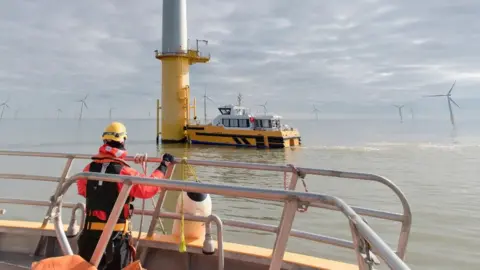
Darren Davidson said the green skills gap was one of the biggest challenges facing the sector
The boss of one of the UK's largest manufacturers of wind turbines has said up to 500,000 more workers were needed in order to meet net zero targets in the coming years.
Darren Davidson, the UK and Ireland boss of Siemens Energy, said the green skills gap was one of the biggest challenges facing the sector as it goes through a period of "unprecedented growth".
He also suggested that focusing too much on wind and solar at the expense of other technologies could undermine plans.
The government said it would work with partners to support British workers and provide the skills necessary for the clean energy jobs of the future.
Siemens Energy owns the country's biggest factory for wind turbine blades, in Hull, which opened in 2016 and now has 1,300 workers.
Mr Davidson said the company was set to play a key role in Labour's plans to decarbonise the power system and quadruple the amount of energy generated by offshore wind farms by the end of the decade.
"There's never been a better time to be in the energy sector. There are so many different technologies and types of jobs.
"We've created an environment in Hull where we've gone from zero to 1,300 jobs. We found the market in Hull and have been able to recruit locally because people there want to be part of those types of jobs."
However, he said it was "getting tough", adding that creating a workforce with the right skills "is probably one of the challenges [Britain] needs to get right as we move forward".
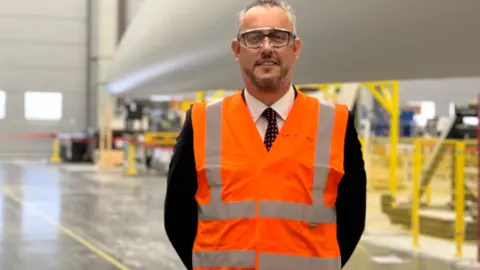
Mr Davidson said thousands of additional skilled workers were needed in order to meet net zero targets
The UK has pledged to reduce its greenhouse gas emissions to net zero by 2050, which means a country takes as much planet-warming gases out of the atmosphere as it puts in.
There are also plans to decarbonise the power grid by 2030.
Mr Davidson said in order to achieve this, more action was also needed on other technologies like hydrogen and long-duration energy storage.
Siemens Energy also has a gas turbine factory in Lincoln that employs about 1,500 people. Mr Davidson said he wanted to adapt the plant so it can operate on hydrogen gas.
"If the conditions are correct, that is something that we would look to invest in, but we need to have confidence in the market before we decide to," he added.
In response, a Department for Energy Security and Net Zero spokesperson said: "Our transition to clean, homegrown power will create a new generation of good jobs across the country.
"The Office for Clean Energy Jobs is at the heart of the government's plans to reach clean power by 2030 and will highlight the job opportunities from this transition.
"It will work closely with Skills England, trade unions, experts and industry to support British workers and provide the skills necessary for the clean energy jobs of the future," they added.
BBC
Monty Rakusen/Getty Images
Darren Davidson said the green skills gap was one of the biggest challenges facing the sector
The boss of one of the UK's largest manufacturers of wind turbines has said up to 500,000 more workers were needed in order to meet net zero targets in the coming years.
Darren Davidson, the UK and Ireland boss of Siemens Energy, said the green skills gap was one of the biggest challenges facing the sector as it goes through a period of "unprecedented growth".
He also suggested that focusing too much on wind and solar at the expense of other technologies could undermine plans.
The government said it would work with partners to support British workers and provide the skills necessary for the clean energy jobs of the future.
Siemens Energy owns the country's biggest factory for wind turbine blades, in Hull, which opened in 2016 and now has 1,300 workers.
Mr Davidson said the company was set to play a key role in Labour's plans to decarbonise the power system and quadruple the amount of energy generated by offshore wind farms by the end of the decade.
"There's never been a better time to be in the energy sector. There are so many different technologies and types of jobs.
"We've created an environment in Hull where we've gone from zero to 1,300 jobs. We found the market in Hull and have been able to recruit locally because people there want to be part of those types of jobs."
However, he said it was "getting tough", adding that creating a workforce with the right skills "is probably one of the challenges [Britain] needs to get right as we move forward".
Sarah Sanderson/BBC
Mr Davidson said thousands of additional skilled workers were needed in order to meet net zero targets
The UK has pledged to reduce its greenhouse gas emissions to net zero by 2050, which means a country takes as much planet-warming gases out of the atmosphere as it puts in.
There are also plans to decarbonise the power grid by 2030.
Mr Davidson said in order to achieve this, more action was also needed on other technologies like hydrogen and long-duration energy storage.
Siemens Energy also has a gas turbine factory in Lincoln that employs about 1,500 people. Mr Davidson said he wanted to adapt the plant so it can operate on hydrogen gas.
"If the conditions are correct, that is something that we would look to invest in, but we need to have confidence in the market before we decide to," he added.
In response, a Department for Energy Security and Net Zero spokesperson said: "Our transition to clean, homegrown power will create a new generation of good jobs across the country.
"The Office for Clean Energy Jobs is at the heart of the government's plans to reach clean power by 2030 and will highlight the job opportunities from this transition.
"It will work closely with Skills England, trade unions, experts and industry to support British workers and provide the skills necessary for the clean energy jobs of the future," they added.
20 Jan 2025
NATION CMYRU
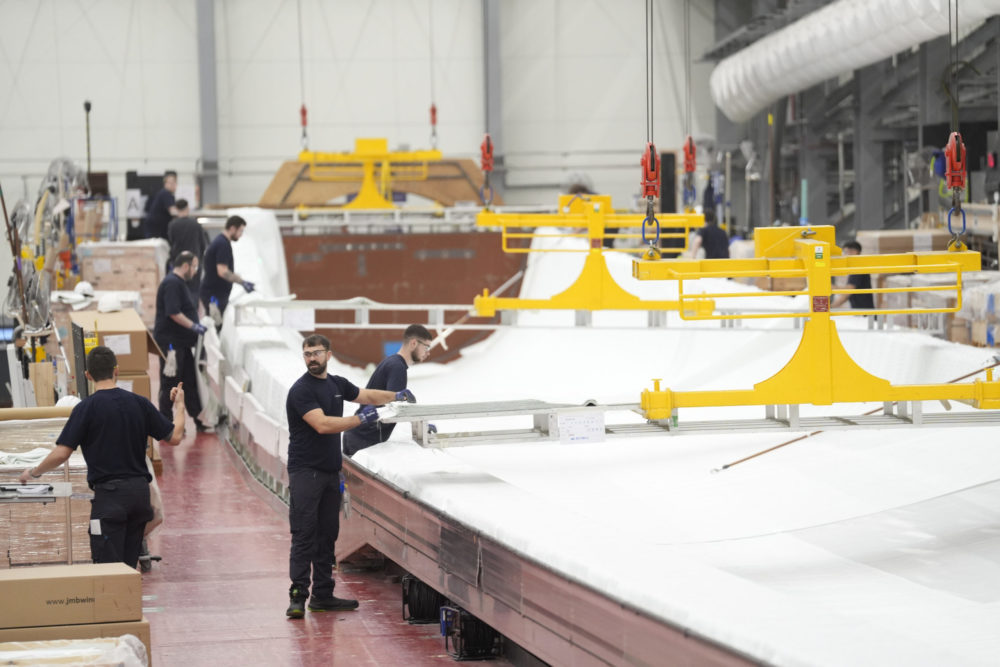
Worker in the Siemens Energy turbine factory in Hull – Photo Danny Lawson/PA Wire
The UK could face a shortage of skilled clean energy workers, according to the UK’s biggest wind turbine blade manufacturer.
Darren Davidson, the UK and Ireland boss of Siemens Energy, said the green skills gap is one of the biggest challenges facing the sector as it goes through a period of “unprecedented growth” as Labour ramps up spending in the sector.
He estimated about 500,000 more workers will be needed for energy jobs over the coming years as the Government tries to decarbonise the power grid by 2030 and reach net zero carbon emissions across the whole country by 2050.
Key part
Siemens Energy owns the country’s biggest factory for wind turbine blades, in Hull, which opened in 2016 and now has 1,300 workers turning out the machinery used in the UK’s offshore wind farms.
The company is set to play a key part in Labour’s plans to decarbonise the power system, which have centred in large part around quadrupling the amount of energy generated by offshore wind farms by the end of the decade.
Mr Davidson told the PA news agency: “There’s never been a better time to be in the energy sector. There are so many different technologies and types of jobs.
“We’ve created an environment in Hull where we’ve gone from zero to 1,300 jobs. We found the market in Hull and have been able to recruit locally because people there want to be part of those types of jobs.
But he added it is “getting tough”, adding that creating a workforce with the right skills “is probably one of the challenges (Britain) needs to get right as we move forward”.
The Government and power companies need to “do more to make sure that people choose a career in energy with apprenticeships and graduate programs,” he added.
Asked if Labour’s push for Clean Power 2030 is achievable, Mr Davidson suggested focusing too much on wind and solar farms at the expense of other technology, like hydrogen gas and batteries, could undermine the plans.
He said: “Certain aspects of that mission are on track and there’s certain parts of that mission which need some focus.”
“I would say it’s a difficult target, but for us to have any chance of achieving it we need to move on not just offshore wind, but other technologies like hydrogen and long-duration energy storage.”
Hydrogen
Siemens Energy has a gas turbine factory in Lincoln that employs about 1,500 people. Mr Davidson said he wants to adapt the plant so that it can operate on hydrogen gas.
“If the conditions are correct, that is something that we would look to invest in, but we need to have confidence in the market before we decide to,” he said.
Experts think green hydrogen will be a critical part of decarbonising heavy industries, although the National Infrastructure Commission advised in 2023 that it was not suitable for heating homes en masse.
Labour has said it plans to double the nation’s green hydrogen production target by 2030.
Long-duration energy storage, meanwhile, is an industry term for various forms of batteries that can store energy for longer than 10 hours.
The Government gave the green light to plans that make it less risky to develop and invest in pumped storage hydropower, a way of storing energy using reservoirs, last year.
Mr Davidson said: “It’s right that they’ve focused on resurrecting offshore wind, it’s right that they’ve invested in in power grids and networks. That was probably a right decision.”
But he added: “It’s not just about offshore wind. It’s about a balance, a mix of energy. I think all technologies have their part to play.”
“To have a chance (of reaching clean power by 2030) we need to move quickly on those other technologies in 2025,” he said.
The UK could face a shortage of skilled clean energy workers, according to the UK’s biggest wind turbine blade manufacturer.
Darren Davidson, the UK and Ireland boss of Siemens Energy, said the green skills gap is one of the biggest challenges facing the sector as it goes through a period of “unprecedented growth” as Labour ramps up spending in the sector.
He estimated about 500,000 more workers will be needed for energy jobs over the coming years as the Government tries to decarbonise the power grid by 2030 and reach net zero carbon emissions across the whole country by 2050.
Key part
Siemens Energy owns the country’s biggest factory for wind turbine blades, in Hull, which opened in 2016 and now has 1,300 workers turning out the machinery used in the UK’s offshore wind farms.
The company is set to play a key part in Labour’s plans to decarbonise the power system, which have centred in large part around quadrupling the amount of energy generated by offshore wind farms by the end of the decade.
Mr Davidson told the PA news agency: “There’s never been a better time to be in the energy sector. There are so many different technologies and types of jobs.
“We’ve created an environment in Hull where we’ve gone from zero to 1,300 jobs. We found the market in Hull and have been able to recruit locally because people there want to be part of those types of jobs.
But he added it is “getting tough”, adding that creating a workforce with the right skills “is probably one of the challenges (Britain) needs to get right as we move forward”.
The Government and power companies need to “do more to make sure that people choose a career in energy with apprenticeships and graduate programs,” he added.
Asked if Labour’s push for Clean Power 2030 is achievable, Mr Davidson suggested focusing too much on wind and solar farms at the expense of other technology, like hydrogen gas and batteries, could undermine the plans.
He said: “Certain aspects of that mission are on track and there’s certain parts of that mission which need some focus.”
“I would say it’s a difficult target, but for us to have any chance of achieving it we need to move on not just offshore wind, but other technologies like hydrogen and long-duration energy storage.”
Hydrogen
Siemens Energy has a gas turbine factory in Lincoln that employs about 1,500 people. Mr Davidson said he wants to adapt the plant so that it can operate on hydrogen gas.
“If the conditions are correct, that is something that we would look to invest in, but we need to have confidence in the market before we decide to,” he said.
Experts think green hydrogen will be a critical part of decarbonising heavy industries, although the National Infrastructure Commission advised in 2023 that it was not suitable for heating homes en masse.
Labour has said it plans to double the nation’s green hydrogen production target by 2030.
Long-duration energy storage, meanwhile, is an industry term for various forms of batteries that can store energy for longer than 10 hours.
The Government gave the green light to plans that make it less risky to develop and invest in pumped storage hydropower, a way of storing energy using reservoirs, last year.
Mr Davidson said: “It’s right that they’ve focused on resurrecting offshore wind, it’s right that they’ve invested in in power grids and networks. That was probably a right decision.”
But he added: “It’s not just about offshore wind. It’s about a balance, a mix of energy. I think all technologies have their part to play.”
“To have a chance (of reaching clean power by 2030) we need to move quickly on those other technologies in 2025,” he said.
No comments:
Post a Comment